Caleb Mercer’s voice was small beneath the wide Wyoming sky, almost too weak to rise above the dry wind. He was only eight years old, but the last two weeks had carved a tiredness into his face that did not belong to a child. His little hand held Evelyn’s so tightly that his fingers had gone pale, as if he feared the prairie itself might pull them apart. Beside him, six-year-old Lily stumbled in the dust, gripping the side of her mother’s worn brown dress with both hands.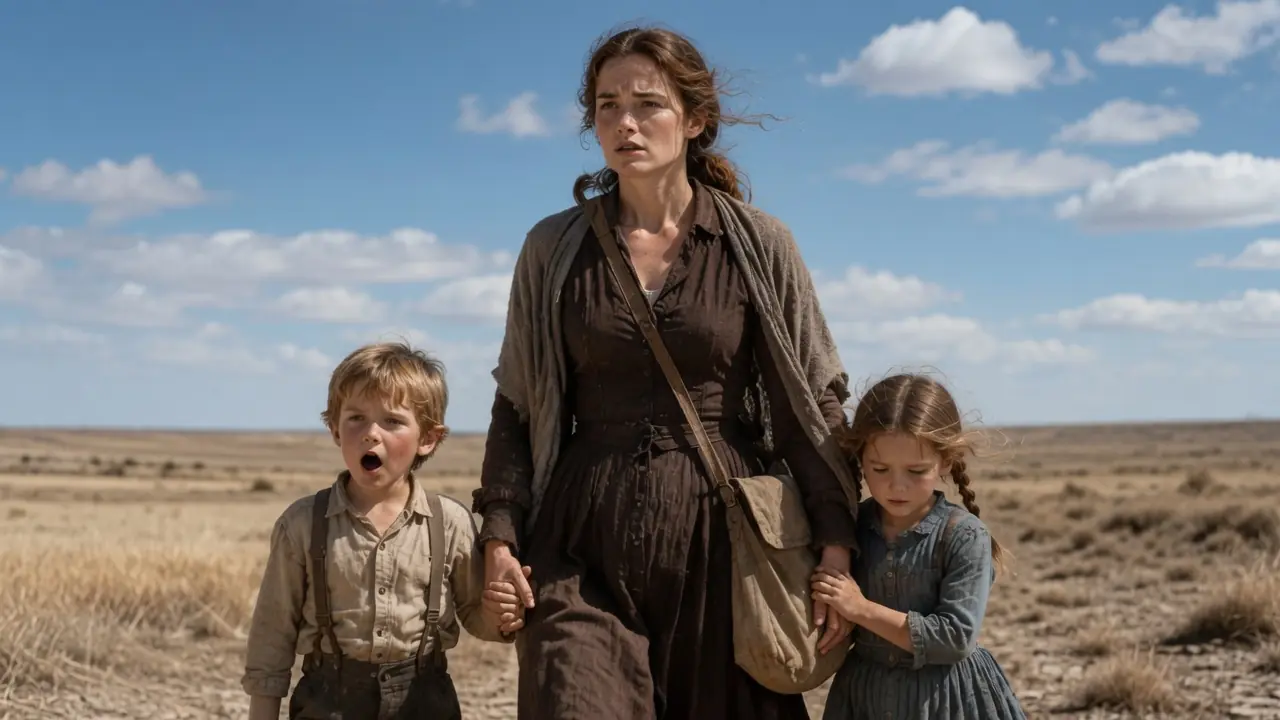
Evelyn Mercer looked ahead toward the distant line where the trail disappeared into heat. Somewhere beyond that trembling horizon was Brackenridge, a frontier town with a church, a general store, a sheriff’s office, and people who might still remember mercy. She had not wanted to go there with nothing but two hungry children and a grief too fresh to name. But the cabin behind them held no flour, no water, no money, and no husband to split wood, mend fences, or tell her that morning would be kinder than night.
“Yes, Caleb,” she said, forcing steadiness into her voice. “We’re going into town.”
The boy looked up at her. “Do you think they’ll have bread?”
Evelyn’s throat tightened so sharply that she had to turn her face into the wind. Bread had once been ordinary, something she wrapped in cloth and placed beside stew without thinking. Now the word felt like a prayer too dangerous to speak. “I hope they will,” she whispered.
Her husband, Daniel Mercer, had been buried fourteen days earlier beneath a dying cottonwood near their cabin. There had been no preacher, no neighbors, no hymns, and no proper marker except a rough wooden cross Caleb helped hold upright while Evelyn packed stones around the base. Daniel had grown weaker through the winter, hiding pain behind smiles until there was no strength left to hide anything. By spring, the prairie had taken him quietly, the way it took grass, water, hope, and sometimes whole families.
Evelyn had dug the grave herself. Her hands had blistered, then split, then gone numb around the borrowed shovel. Caleb had stood nearby holding Lily, both children too frightened to cry loudly, as if death might hear them and turn its head. When the grave was covered, Evelyn knelt beside it until sunset, one hand on the dirt, trying to understand how a life could end while the sky remained so wide and blue.
For three days after that, she stayed in the cabin waiting for some answer to arrive. No one came. The flour sack gave her dust, the water barrel gave her echoes, and the garden gave her nothing but dry stems. On the fourth morning, Evelyn tied what little she could carry into a cloth bundle, took Daniel’s pocketknife, kissed the doorframe of the cabin, and began walking with her children.
By midday, the heat had become cruel. The creek bed ahead had no water, only cracked earth that looked like broken plates spread across the land. Evelyn lowered herself to one knee and pulled Caleb and Lily close, feeling how hot their foreheads had become beneath the sun. She took the last swallow from their canteen, wet Lily’s lips first, then Caleb’s, and pretended she was not thirsty.
“If someone offers you food,” Evelyn said carefully, “you thank them. No matter who they are.”
Caleb nodded, but his eyes were worried. “Why are you saying that?”
“If someone offers you a place to stay, you stay together,” she continued. “You never leave your sister. Not for any reason.”
Lily began to cry silently, wrapping her arms around Evelyn’s waist. “Mama, don’t talk like that.”
Evelyn closed her eyes. She did not know whether she was teaching her children how to survive or preparing them to live without her. That thought nearly broke her, but she swallowed it down because the prairie had no use for a mother who collapsed before her children did. She kissed Lily’s hair, then Caleb’s dusty forehead, and whispered, “I love both of you more than my own heartbeat.”
Then the hoofbeats came.
At first, Evelyn thought the sound belonged to the wind, a loose rhythm scattered across the dry creek bed. But the sound grew heavier, steadier, and closer. Caleb heard it too and stepped behind her, pulling Lily with him. Evelyn rose slowly, placing herself between the children and the ridge ahead.
A lone rider appeared through a veil of golden dust. His horse was lean, dark, and tired, stepping carefully down the slope as if the animal knew the land could punish one careless move. The man in the saddle wore a long dusty coat, leather gloves, and a hat pulled low against the sun. He did not ride fast, and that made Evelyn more afraid, not less.
Danger often rushed. But men with patience could be worse.
The rider stopped several yards away and lifted one hand from the reins, palm open. “Ma’am,” he called, his voice calm, “are you heading into town?”
Evelyn’s fingers closed around Daniel’s pocketknife inside her bag. “I was.”
The man’s gaze moved from her face to Caleb, then to Lily. He did not look at them the way some men looked at weakness. He looked at them the way a man might look at a roof beam about to break. “Looking for work?”
“I’ll take any honest work,” Evelyn said.
The rider removed his hat, revealing dark hair dusted with gray at the temples. His face was weathered, not old, but marked by years under hard sun and harder days. “Name’s Silas Ward,” he said. “I run the stage station east of Brackenridge. Got a kitchen, a barn, three spare bunks, and more repairs than one man can manage.”
Evelyn said nothing.
Silas reached slowly into his saddlebag. Evelyn tensed, but he pulled out only a cloth-wrapped bundle and a canteen. He dismounted without stepping toward her, set the bundle on a flat stone halfway between them, and backed away. “Bread, cheese, dried apples. Water too.”
Lily stared at the bundle like it was treasure from a storybook. Caleb’s lips parted, but he did not move until Evelyn told him to. She watched Silas carefully, searching his face for greed, impatience, or triumph. He only stood beside his horse, hat in hand, waiting.
“What do you want?” Evelyn asked.
Silas looked from the sun to the children. “I want you to let me take them ahead before this sun takes them from you.”
Caleb grabbed Evelyn’s dress. Lily made a small frightened sound. Evelyn stepped back at once, pulling both children behind her. “No stranger asks for a widow’s children and calls it kindness.”
“I reckon he doesn’t,” Silas said quietly.
“Then get on your horse and ride away.”
Silas did not move. “Ma’am, Brackenridge is still ten hard miles from here. My station is four. I’ve got water, shade, and stew on the fire if my cook remembered not to burn it.” His eyes settled on Caleb’s trembling knees. “That boy’s near done walking.”
Evelyn’s heart pounded. She knew he was right, and that made her hate him for saying it. Caleb was trying to stand tall, but he swayed with every breath. Lily’s face had turned pale under the dust, her small fingers limp against Evelyn’s skirt. A mother could lie to herself, but the body of a child told the truth.
“I can carry them,” Evelyn said.
Silas looked at her cracked lips, her sunken cheeks, and the way one of her hands shook. “No, ma’am. You can’t.”
The words were not cruel, only honest. That almost made them worse. Evelyn bent and picked up the food bundle, then handed the bread first to Caleb and Lily. The children ate too quickly, and she had to slow them with trembling hands.
Silas turned his face away while they ate, as if giving them privacy from their own hunger. That small act unsettled Evelyn more than any kindness so far. Men who wanted power usually watched gratitude closely. Silas seemed to have no interest in seeing anyone humbled.
“What happened to your husband?” he asked after a while.
Evelyn’s hand tightened around the canteen. “He died.”
“I’m sorry.”
“You didn’t know him.”
“No,” Silas said. “But I know what it does to a person when the one who helped hold up the world is suddenly under it.”
Evelyn looked at him then. Something in his voice carried its own grave. “You lost someone?”
“My wife,” he said. “Fever, seven years back. Our boy too, that same winter.”
The prairie wind passed between them. Evelyn did not know what to say. Grief recognized grief, even when it came riding out of dust wearing a stranger’s face.
Silas replaced his hat slowly. “I don’t ask for your trust because I earned none. But I can put Caleb up on the horse in front of me and Lily behind the saddle. You walk beside us if you’ve got strength. If you haven’t, you ride too, and I walk.”
Evelyn almost laughed from the pain of it. “You would walk your own horse four miles for people you don’t know?”
Silas looked toward the horizon. “I once prayed someone would come down a road in time for my family. No one did.” He looked back at her. “I don’t pass children in the heat.”
Evelyn stared at him for a long moment. The decision before her felt impossible. If she refused, she might keep her children beside her until they collapsed. If she agreed, she might hand them to danger wearing a gentle voice. Either choice could haunt her for the rest of her life.
Caleb tugged her sleeve. “Mom,” he whispered, “I can still walk.”
But his voice betrayed him.
Lily looked up at Evelyn with dry eyes, too tired even for tears. “Mama, I’m thirsty.”
That broke the last thread of Evelyn’s resistance. She turned away, pressing her knuckles to her mouth so the children would not see her face twist. Then she faced Silas again. “If you lie to me, I will crawl across this whole territory to find them.”
Silas met her eyes. “Then by sundown, every soul in Brackenridge will know I brought them there alive.”
He helped Caleb onto the horse first, keeping every movement slow and visible. Then Lily, who clung to Evelyn until Silas quietly offered her the dried apple from his own pocket. Evelyn walked beside the horse at first, one hand on Lily’s ankle, the other on Caleb’s leg. She would not let go until her own knees began to buckle.
Silas noticed before she fell. Without a word, he stopped the horse and stepped away. “You ride,” he said.
“I won’t take your saddle.”
“You won’t make it otherwise.”
“I said no.”
Silas looked at Caleb. The boy was watching her with fear too adult for his face. Evelyn saw it and hated that pride had become another weight her children had to carry. She let Silas help her onto the horse behind Lily, then he took the reins and began walking.
The journey to the station felt longer than four miles. The sun lowered, turning the prairie gold and red, and Evelyn drifted in and out of awareness. Sometimes she heard Silas speaking softly to the horse. Sometimes she heard Caleb asking whether there would be more water. Once, she woke with her head against Lily’s hair and realized Silas had removed his own coat and draped it over the children to shield them from the worst of the dust.
Near sundown, a low wooden building appeared ahead beside the stage road. A barn leaned behind it, a water pump stood in the yard, and smoke rose from a crooked chimney. Evelyn blinked hard, afraid the sight might disappear if she trusted it too quickly. But then Caleb whispered, “Mom, is that real?”
Silas looked back over his shoulder. “That’s the station.”
A woman came out onto the porch before they reached the yard. She was broad-shouldered, with sleeves rolled to her elbows and a dish towel in one hand. Her dark hair was streaked with silver, and her face sharpened when she saw the children on the horse. “Silas Ward,” she called, “what did you drag out of the prairie this time?”
“Mercers,” he answered. “Widow and two children. Need water, food, and a bed.”
The woman’s expression changed immediately. “Bring them in.”
Her name was Nora Pike, the station cook, though cook was too small a word for what she did. She lifted Lily from the horse, clucked over Caleb’s sunburned face, and put a cup of water in Evelyn’s hands before asking a single question. Evelyn tried to thank her, but the cup shook so badly that Nora wrapped both hands around hers.
“Slow,” Nora said. “Too much too fast will turn your stomach.”
Inside, the station smelled of beans, coffee, smoke, and bread warming near the stove. It was the most beautiful smell Evelyn had ever known. Caleb and Lily sat at a rough wooden table while Nora placed small portions before them, watching to make sure they did not eat too quickly. Silas stood near the door, dust-covered and quiet, as if unsure whether he belonged inside the kindness he had carried them to.
Evelyn sat across from her children and watched them eat. Caleb’s hands trembled around the spoon. Lily leaned into Nora when the woman wiped dust from her cheek with a damp cloth. The sight filled Evelyn with gratitude so fierce it hurt, but beneath it still lived fear.
“What happens now?” she asked.
Silas removed his hat. “Now you sleep.”
“And tomorrow?”
“Tomorrow, we talk honest.”
That night, Evelyn lay on a narrow bunk with Lily tucked against her and Caleb sleeping on a pallet beside them. She did not expect to sleep, but exhaustion pulled her under before the lantern was fully dimmed. Her last waking thought was of Daniel’s grave under the cottonwood, and the terrible guilt of having walked away from it. In her dream, Daniel stood by the cabin door and nodded toward the road, as if telling her she had done right.
Morning brought voices.
Evelyn woke to men in the yard, horses, wheels, and the creak of a stagecoach. For one frightened second, she thought someone had come to take the children. She sat up quickly, waking Lily, and reached for Daniel’s pocketknife. Then Nora pushed the door open and said, “Easy. It’s just the Brackenridge stage.”
Caleb was already outside with a biscuit in his hand, standing beside Silas near the water pump. Evelyn rushed out, relief and anger mixing in her chest. “Caleb Mercer, you don’t go anywhere without telling me.”
The boy lowered his head. “Sorry, Mom. Mr. Ward said I could help pump water.”
Silas turned. “My fault. Should’ve asked you first.”
That apology mattered. Evelyn was not used to men apologizing for small things. Daniel had, but Daniel was gone. Most others simply expected women to adjust around them.
Before she could answer, a stage passenger climbed down from the coach and stared at her. He was a thin man in a fine vest, with a narrow mustache and eyes that moved too quickly. “Evelyn Mercer?” he said.
Evelyn stiffened. “Do I know you?”
“No, ma’am. But I knew your husband owed money.”
Silas stepped closer. “State your business.”
The man smiled without warmth. “Harold Voss. I represent Mr. Crane in Brackenridge. Daniel Mercer signed a lien against his land and livestock before his death. Since Mrs. Mercer appears to have abandoned the property, Mr. Crane is prepared to claim it.”
The world seemed to tilt beneath Evelyn. “That cabin is all my children have left.”
Voss shrugged. “Then your husband should have paid his debts.”
Silas’s face darkened. Nora muttered something unkind from the doorway. Evelyn felt Caleb press against her side. Lily hid behind her skirt.
“I didn’t abandon anything,” Evelyn said. “I came for help.”
“With no proof,” Voss replied. “And no witness except a station man with a known habit of collecting strays.”
The insult landed in the yard like a thrown stone. Silas did not move, but Evelyn saw his jaw tighten. Voss smiled as if he had found the sore place he wanted.
“I’ll be returning to Brackenridge by sundown,” Voss continued. “If you have a claim to make, make it there. Otherwise, Mr. Crane will take possession.”
After the stage departed, Evelyn stood trembling in the dust. She had thought hunger was the worst thing waiting for her in town. Now she understood that men with papers could be as dangerous as drought. Daniel had mentioned debts, but never a lien. He had believed he could work through them before summer.
Silas looked toward the road. “Crane’s been circling small claims for years.”
“You know him?”
“Everybody knows him. That’s the problem.”
Evelyn turned to him. “Why didn’t you tell me men like that were in Brackenridge?”
His eyes softened. “Because yesterday your children needed water before you needed warnings.”
That silenced her. He was right, but right did not make the fear smaller. Nora came down the porch steps wiping her hands on her apron.
“If Voss says sundown, Crane’s already spreading word,” she said. “By tonight, half the territory will think those children are abandoned and that land is free for taking.”
Silas looked at Evelyn. “Then we make sure the whole territory knows different.”
“What does that mean?” she asked.
“It means we ride into Brackenridge before Voss does,” he said. “With you, your children, and witnesses who saw you alive, seeking work, and not abandoning anything.”
Nora folded her arms. “And with food in their bellies so no one can say hunger made her unfit.”
Evelyn looked from one to the other. “Why would you do this?”
Silas’s answer was quiet. “Because yesterday you asked what I wanted.” He looked toward Caleb and Lily. “I want a town that doesn’t let men take from widows just because they can.”
By late afternoon, the station yard had changed into something Evelyn could hardly understand. Nora packed biscuits and beans into a cloth sack. A blacksmith passing through agreed to ride with them, saying he had seen the children at the station and would speak if needed. Two stage passengers, a schoolteacher and a traveling seamstress, also agreed to testify that Evelyn had not abandoned her children or her claim.
Silas saddled two horses and hitched a small wagon for Evelyn and the children. He placed a clean shawl around Evelyn’s shoulders, not as charity, but as armor. “Hold your head high when we get there,” he said.
“I have nothing.”
“You have two children watching how their mother stands when men try to take what’s left.”
Evelyn looked at Caleb and Lily. Caleb sat straighter when he heard that. Lily reached for her mother’s hand.
They reached Brackenridge at sundown.
The town had gathered in front of the land office, exactly as Voss intended. Word traveled fast when a widow’s weakness could become public entertainment. Men stood outside the general store. Women watched from porches. The sheriff leaned near a post, not yet involved but not gone either.
Harold Voss stood beside a heavier man in a dark coat. Crane. He had the polished calm of someone who had won too often. When he saw Evelyn arrive with Silas Ward, his expression cooled.
“Well,” Crane said, “the widow returns.”
Evelyn stepped down from the wagon. Her legs trembled, but she did not let go of Lily’s hand. Caleb stood on her other side, chin lifted. Silas remained slightly behind them, close enough to support, not close enough to speak over her.
“I did not abandon my land,” Evelyn said. “I left to keep my children alive.”
Crane smiled. “A moving story. Unfortunately, debt is not moved by tears.”
Silas spoke then. “Nor by forged pressure.”
Voss’s eyes narrowed. “Careful, Ward.”
The sheriff straightened. “What’s this about?”
Silas handed him a folded paper. “Daniel Mercer bought grain through Crane last winter. Debt was thirty-two dollars. Crane’s lien claims one hundred eighty-seven, plus livestock Daniel didn’t own.”
Crane laughed. “You have proof?”
Evelyn reached into her bag with shaking hands and withdrew Daniel’s small ledger. She had taken it from the cabin without knowing whether it mattered. Daniel had written everything in that ledger: seed costs, grain debts, payments made, promises due. On the last page was Crane’s amount, marked disputed, with Daniel’s note beside it.
Crane added charges I never agreed to. Must speak to sheriff when I’m strong enough.
The sheriff read it. His face changed.
Voss stepped forward. “A dead man’s private scribble is not law.”
Nora Pike pushed through the crowd, surprising everyone. “Maybe not. But living witnesses are.” She pointed to two men near the general store. “You hauled grain to Mercer’s place in January. You heard Daniel argue the amount.”
One man looked away. The other swallowed. The sheriff turned to them. “Is that true?”
The first man muttered, “Crane added fees after delivery.”
Crane’s face hardened. “You’d best mind your own trade.”
That was when Silas stepped fully into the street. “No. By sundown, everybody was going to know you found a widow weak enough to rob.” His voice carried across the gathered town. “Instead, they’re going to know she walked half-dead across prairie to save her children, and you tried to steal the roof waiting for them.”
The crowd shifted. Shame moved through people slowly, but once it started, it had weight. Women whispered. Men stopped meeting Crane’s eyes. The sheriff folded the paper and tucked it into his vest.
“This claim is suspended,” the sheriff said. “Until the debt is reviewed proper.”
Crane’s smile vanished. “You have no authority.”
“I have enough to keep you from taking property on a disputed lien tonight,” the sheriff replied. “And if I find fraud in the filing, we’ll have a longer conversation.”
Voss stepped back first. Crane followed, furious but careful. Evelyn stood in the middle of the street, still holding both children, unable to believe the town had not swallowed her whole. Caleb looked up at her as if she had become taller than the buildings.
Lily whispered, “Mama, do we still have our house?”
Evelyn knelt and pulled both children close. “For tonight,” she said, crying at last. “For tonight, we do.”
Silas stood nearby, watching the horizon darken beyond town. Evelyn rose and faced him, overwhelmed by everything she could not say. “You asked for my children,” she said softly.
He shook his head. “No, ma’am. I asked to keep them breathing long enough for you to fight.”
“And now?”
“Now you decide what comes next.”
What came next was not easy. The cabin needed repairs, the land needed water, and the debts did not disappear simply because Crane’s fraud was questioned. But Brackenridge could no longer pretend Evelyn Mercer was invisible. Nora found her work at the stage station kitchen three mornings a week. The schoolteacher arranged lessons for Caleb and Lily. The blacksmith repaired Daniel’s old stove door for no charge and claimed it was because he hated seeing bad hinges.
Silas helped quietly. He drove Evelyn and the children back to the cabin with supplies, patched the roof before the next rain, and fixed the water barrel. He never stepped inside without asking. He never spoke to the children as if they owed him affection. That, more than anything, allowed trust to grow.
Weeks later, Evelyn visited Daniel’s grave with fresh wildflowers Lily had gathered near the creek. Caleb stood beside the wooden cross, telling his father that they had bread now and that Mr. Ward’s horse was named Moses because Silas said the animal was stubborn enough to argue with heaven. Lily placed one flower at the base of the cross and whispered, “Mama fought the bad man.”
Evelyn closed her eyes. “No,” she said softly. “Mama had help.”
Behind them, Silas waited near the wagon, hat in hand. He did not intrude on grief. He understood that some places in a heart remained married to the dead, even when life continued calling from the road.
By autumn, the territory knew the story. People told it at the general store, at the church steps, beside stagecoach wheels and supper tables. Some said Silas Ward had saved two children from the prairie. Some said Evelyn Mercer had faced down Crane at sundown with nothing but a ledger and a mother’s fury. Some said Brackenridge changed that day because shame finally found the right doorstep.
Evelyn knew the truth was larger and simpler.
A stranger had offered bread without stepping closer. A widow had chosen trust because fear could not feed her children. A town had been forced to decide whether it would watch another family disappear into dust.
Years later, when Caleb was tall enough to ride his own horse and Lily helped Nora run the station kitchen, Evelyn would still remember the dry creek bed. She would remember the sun, the silence, the food on the stone, and Silas saying the children would not make town under that heat. She would remember how close she came to refusing the only kindness that could save them.
And whenever someone asked why she trusted Silas Ward, Evelyn would look toward the prairie and answer the same way every time.
“I didn’t trust him first,” she would say. “I trusted the way he stepped back.”
Because on the frontier, mercy did not always arrive with promises.
Sometimes it arrived with bread, water, and enough distance for a frightened mother to choose.