On the cracked, drought-burned ground of Ash Hollow Farm, thirty-eight-year-old Marin Holloway knelt in the dirt with a dying piglet trembling against her chest. Fifty-nine others crowded weakly behind a broken wooden fence, their ribs visible beneath thin skin and their frightened cries barely louder than the dry wind scraping across the Nebraska fields. Marin’s faded brown jacket was stained with mud, her black jeans were torn at one knee, and her exhausted green eyes had not known a full night’s sleep since her husband died eight months earlier. She was trying to coax the piglet to breathe when Silus Crowe walked through the gap in her fence without permission.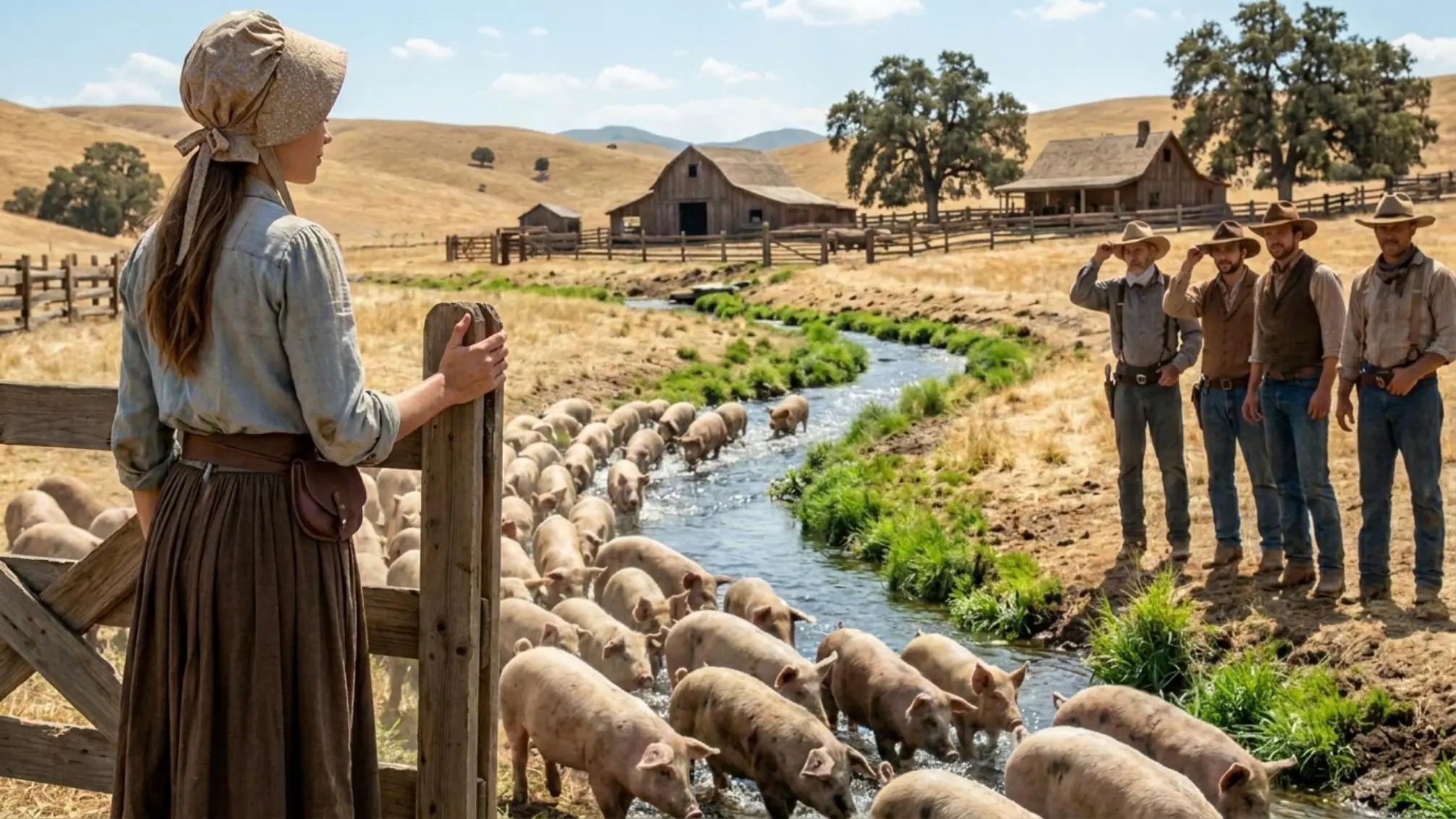
Silus smiled as if her resistance amused him.
At sixty-one, he had spent decades acquiring land from farmers who ran out of money one payment before hope returned. His silver hair was perfectly combed, his charcoal coat showed no dust, and his polished boots looked obscene against ground cracked like broken pottery. He held the foreclosure papers loosely, certain that time would finish the argument for him.
“Thirty days,” he repeated. “After that, sentiment won’t matter.”
Marin rose carefully, still protecting the piglet against her chest.
“My husband is buried on this land.”
“And debt survives grief.”
“So do I.”
Silus’s smile thinned.
He looked past her toward the weathered farmhouse, the leaning barn, and the barren eastern field that had produced almost nothing for eleven years. To him, Ash Hollow was exhausted property waiting to be transferred into more capable hands. He did not see the repaired fence posts Dale had set before his illness, the apple tree beneath which Marin had scattered part of his ashes, or the coffee mug still sitting beside the kitchen sink because moving it felt too much like admitting he would never return.
Silus folded the papers and placed them against the fence.
“You’ll sign eventually.”
Marin stared at him until he turned away.
The piglet in her arms gave a faint, shuddering breath.
“That’s right,” she whispered after Silus disappeared beyond the gate. “Neither of us is done yet.”
Three weeks earlier, Marin had possessed exactly eighteen dollars.
She knew because she counted the money before leaving home: one ten-dollar bill, one five, three ones, and coins scattered at the bottom of an old wallet. She intended to buy secondhand irrigation pipe advertised in the next county, though eighteen dollars would barely cover fuel.
She never reached the seller.
At a livestock auction along the county road, Marin heard a thin collective squeal from behind the main pens. The healthy animals stood beneath shade canopies where serious buyers inspected muscle, weight, and breeding potential. The sound came from a temporary enclosure made of wire panels and damaged pallets.
Inside were sixty piglets.
Several lay on their sides. Others stood only because neighboring bodies held them upright. Their skin hung loosely across narrow frames, and their eyes carried the dull resignation of animals that had stopped expecting kindness.
A yard worker leaned against the fence eating from a paper bag.
“What happened to them?” Marin asked.
“Seller left them three days ago. Didn’t disclose how bad they were.”
“What happens if no one buys them?”
“We clear the pen Friday.”
Marin understood what that meant.
“How much?”
The worker gave her a skeptical look. “Eighteen dollars for all sixty.”
“Eighteen?”
“The owner wants them gone.”
She looked into the pen.
Dale used to say she moved before her mind finished measuring the distance. She had once stopped traffic to rescue an injured dog, accepted a teaching position she had not applied for, and married him six months after their first date because waiting seemed dishonest when she already knew.
He had admired that impulsiveness when life was good.
During the final months of his illness, he occasionally feared it.
“Marin,” he told her from the hospital bed, “after I’m gone, don’t try to rescue everything because you couldn’t rescue me.”
She had promised.
Then she stood beside sixty starving piglets with her last eighteen dollars in her hand.
“I’ll take them.”
The yard worker stopped chewing.
“Ma’am, do you have feed?”
“I have land.”
“That wasn’t my question.”
Marin handed him the money. “It’s the answer I have.”
She borrowed a livestock trailer from her neighbor, Roy Parkins, who asked enough questions to make her regret seeking help. By late afternoon, the piglets stumbled onto Ash Hollow’s gray grass and gathered against the fence, shaking in the heat.
Marin filled two rusted troughs with well water and found half a sack of cracked corn in the barn. She scattered the feed thinly, watching the strongest piglets push forward while the weakest remained behind.
Two died by the third morning.
She buried them near the dead apple tree and returned to the barn without speaking. There was no useful prayer for an animal that had suffered because people considered its life worth less than the effort required to save it.
Her neighbor Celia Marsh visited that afternoon.
“Marin, you spent your last money on these animals.”
“I know.”
“You’re four months behind on the land note.”
“I know.”
“You can barely feed yourself.”
“I know.”
Celia’s expression softened. “Then tell me how this ends.”
Marin looked toward the piglets.
“I haven’t reached that part yet.”
The following dawn, an elderly farmer named Gregor Volik appeared at her gate.
Gregor was nearly eighty, broad through the shoulders, with hands shaped by fifty years of hard work. He had emigrated from Eastern Europe with almost nothing and built one of the valley’s most stable farms without borrowing more than he could repay.
He studied the animals quietly.
“You feed them too much at once, more will die.”
Marin stiffened. “I’m doing everything I can.”
“I did not say you were careless. I said starving bodies cannot accept everything they need.”
He entered the pen and separated the weakest animals.
Gregor showed her how to divide the feed into small portions, how to watch for refeeding sickness, and how to identify piglets whose weakness came from hunger rather than infection. He returned each morning for eleven days, never asking for payment and refusing whenever Marin offered.
“Why are you helping me?” she finally asked.
Gregor adjusted a trough before answering.
“Because someone taught me before I knew enough to survive.”
By the twelfth day, fifty-seven piglets remained.
Every one could stand.
Their recovery gave Marin hope, but hope did not fill feed sacks. The co-op refused additional credit, suppliers demanded cash, and the drought had turned even good pasture brittle. Marin stretched kitchen scraps, soaked hay, and spent grain donated by neighbors until her hand finally struck the bottom of the last bag.
The piglets watched her from behind the gate.
They were stronger now, which meant they were hungrier.
“I know,” Marin said. “I’m trying.”
That afternoon, they began pressing against the gate leading to the lower field.
It was strange behavior. The field held no crop and almost no grass. A dry depression crossed its center, marked on old county maps as Vanic Creek, although no living resident remembered water flowing there.
The pigs pushed together.
Some rooted beneath the bottom rail while others struck the gate with their shoulders. They were not frightened or restless. They seemed determined to reach something.
Marin opened the latch.
The herd moved across the field in a direct line.
They passed the dead apple tree, crossed the slope, and descended into the dry creek bed. There, they spread along the cracked clay and began digging with extraordinary focus.
Marin followed.
The piglets returned repeatedly to several locations, driving their snouts into ground packed harder than the barn floor. She knelt beside them and pressed her palm against the clay.
It felt cold.
Not shaded.
Not merely cooler than the surface.
Cold in the deep, steady way of underground water.
Marin fetched an iron digging bar and worked for three hours. Her palms blistered, sweat soaked through her shirt, and the afternoon sun pressed against her back. Just before she decided exhaustion had turned desperation into imagination, the bar struck dark mud beneath the pale clay.
She drove it down again.
When she withdrew it, a tiny amount of water collected inside the hole.
Marin sat back on her heels.
The piglets continued digging around her.
That evening, she drove to Gregor’s farm and described what happened. He listened without interruption, then asked about the color and temperature of the soil.
“My grandfather told me Vanic Creek never disappeared,” he said. “He believed it went underground after a collapse sealed the surface channel.”
“Could there be enough water to feed the animals?”
Gregor looked toward Ash Hollow.
“If the old stories are true, there may be enough to save far more than pigs.”
He warned her to tell no one until they understood what they had found.
For nine days, Marin followed the animals along the creek bed. Each morning, she opened the lower gate, and the pigs chose where to root. Each afternoon, she deepened the locations they marked.
On the ninth day, the clay released.
Cold water rose around her shovel blade and steadily filled the opening. It was not rainwater or drainage from her well. It came from beneath the valley floor, clear and persistent.
The piglets drank first.
Marin placed both hands in the water and began to cry.
Eight months of grief broke through her composure at once. She cried for Dale, for the animals she could not save, for the bills hidden beneath her kitchen table, and for the absurdity of discovering life beneath land everyone had declared dead.
The underground flow widened as the pigs continued working. Grass near the creek bed changed from gray to green. Roots strengthened, insects returned, and the remaining animals gained weight rapidly.
By August, they no longer resembled the dying creatures from the auction yard.
Marin kept careful records of the digging sites and noticed the buried waterway curved beyond her eastern boundary. It appeared to run beneath Roy Parkins’s property, then north toward the Kesler farm and several other drought-stricken operations.
She wanted to tell them.
But she also knew Silus Crowe had surveyors.
His letters arrived more frequently as the foreclosure deadline approached. Each one repeated that Ash Hollow had little productive value and suggested she accept his offer before taxes, penalties, and legal costs erased whatever equity remained.
Then Marin found a boot print near the eastern fence.
Beside it was the round impression of a tripod leg positioned on a rise overlooking the reopened creek.
Someone had been watching.
That evening, Silus called.
“I hear Ash Hollow has changed.”
“People talk.”
“They do when supposedly dead land becomes interesting.”
“What do you want?”
“To remind you that my offer remains available.”
Marin looked through the kitchen window toward the strip of green cutting across the lower field.
“You priced this place as worthless dry land.”
“I priced it according to the information available.”
“And now you want it before the information becomes public.”
Silus paused.
“The deadline is still the deadline, Mrs. Holloway.”
After he hung up, Marin opened every letter he had sent and arranged them across the table. The timing formed a pattern. His interest increased shortly after the pigs uncovered the first visible water.
He had not been waiting for her to fail.
He had been waiting for her discovery to become valuable enough to steal.
Marin contacted Dale’s cousin Janet, a property attorney in another county. Janet examined the tax assessment, the historical maps, and a 1941 survey describing a subsurface waterway beneath Ash Hollow.
“The eastern acreage is incorrectly classified,” Janet explained. “The county still assesses it as unproductive dry land.”
“Wouldn’t recognizing the water raise its value?”
“Yes, but it also corrects several calculations tied to the delinquent amount. Under this county’s agricultural rules, the revised figure may reduce what you must pay immediately.”
Marin sold forty pigs at market weight.
She kept seventeen for breeding stock—the strongest animals and those that had led the herd toward the buried creek. The sale hurt, but it produced nearly enough money to cover Janet’s estimated reassessment amount.
The remaining problem was Silus.
Once Marin filed, he would have seventy-two hours to contest the correction and delay it beyond the foreclosure deadline.
She needed his attention somewhere else.
Marin called his office and requested a meeting, claiming she had discovered something that could benefit both of them. Silus agreed immediately.
At eight thirty-one Monday morning, she filed the reassessment request.
At two that afternoon, she entered Silus Crowe’s marble office.
He rose behind a desk large enough to remind visitors who held the power.
“You said you had a proposal.”
“I found water.”
Silus remained composed, though the satisfaction in his eyes confirmed he already suspected it.
“How much?”
“Enough to change the land’s value.”
“Then perhaps you finally understand why selling is sensible.”
“I’m not selling.”
His expression sharpened.
Marin placed the assessor’s receipt on his desk.
Silus read the timestamp.
“You filed this morning.”
“Before coming here.”
“The property’s value will rise.”
“So will the public attention if you foreclose on a widow immediately after spying on a water discovery during the worst drought in thirty years.”
“That sounds like a threat.”
“It’s a description.”
Silus leaned back.
He had seventy-two hours to contest the filing, but doing so would require revealing his surveillance, defending his undervalued offer, and turning a private acquisition into a public dispute. Marin had placed him exactly where he placed struggling farmers for years: between an expensive fight and an unwanted retreat.
“You’ve become unexpectedly difficult,” he said.
“I had good teachers.”
Silus stared at the receipt.
Then he pushed it back across the desk.
“I won’t contest the reassessment.”
Marin picked it up.
“What do you want in return?” she asked.
“The extent of the water.”
“It runs beneath the valley.”
His eyes narrowed.
“Not only your land?”
“Water doesn’t recognize your contracts.”
Marin stood.
Silus no longer smiled.
The corrected assessment arrived eleven days before the deadline. After paying the revised amount in person, Marin had two hundred twelve dollars remaining.
Ash Hollow was hers.
She did not celebrate alone.
Marin invited the neighboring farmers to the reopened creek and explained what the pigs found. Roy Parkins knelt beside the water, placed his hand beneath the surface, and stayed silent for a long time.
He had sold forty cattle during the drought.
The Keslers were hauling water twelve miles each day. Francis Alderman’s well had nearly failed, and a young farmer named Deak Sutherland feared losing his first lease before completing his second season.
“The underground channel continues beneath your farms,” Marin told them. “I can’t guarantee how much water we’ll reach. But I know where it begins.”
“What do you want from us?” Roy asked.
“Labor. Permission. And an agreement that nobody controls what everyone needs.”
They began digging the following Saturday.
Marin brought the pigs.
The animals crossed onto Roy’s land and immediately followed the buried channel. Men and women worked behind them with shovels, iron bars, and borrowed equipment.
Seven days later, cold water rose through the clay on Roy’s property.
He walked to his truck and cried alone for five minutes.
Nobody followed him. Farmers understood that some emotions needed privacy even when everyone knew they were happening.
The channel beneath the Kesler farm required two weeks. The ground collapsed twice, and the crew had to start again. Old Mr. Kesler guided them using stories his grandfather told him in Polish when he was a child.
When water finally appeared, the old man knelt and placed both hands into it.
The underground creek eventually reached six properties directly and three others through connecting channels. It did not make anyone wealthy, but it kept livestock alive, restored pasture, and reduced dependence on county water deliveries.
Rain returned in October.
By then, the valley no longer depended entirely on the sky.
Silus Crowe left the county before winter.
Once Marin’s reassessment became public, investigators discovered he had surveyed other drought-stricken farms and approached outside buyers about “water-adjacent opportunities” before owners knew underground resources crossed their land. Complaints multiplied, lenders distanced themselves, and his carefully controlled reputation collapsed.
Marin did not pursue revenge.
She was too busy rebuilding.
The seventeen pigs she kept produced healthy litters. Within a year, the herd exceeded sixty again. Farmers who once laughed at her auction purchase now asked to buy breeding stock.
Marin named the reddish-brown sow that first led the herd toward the creek First.
It was not a poetic name.
It was accurate.
Gregor visited less often as Marin became more confident. One winter morning, he stood beside the water with her and watched ice form along the edges.
“You saved the valley,” he said.
“The pigs found the creek.”
“You followed them.”
“That doesn’t make me a hero.”
Gregor nodded approvingly. “Good. Heroes stop listening when they begin believing the story is about them.”
A sixteen-year-old foster boy named Elias later came to live at Ash Hollow after helping Gregor with the animals. Marin taught him the lesson she had learned during the hardest summer of her life.
“Watch before you decide,” she told him. “Sometimes the thing everyone calls worthless knows something nobody else does.”
One year after discovering the creek, Marin walked the entire reopened waterway alone.
It ran for hundreds of feet across land once dismissed as barren. Grass grew thick along its banks, pigs rooted beneath the willows, and irrigation channels carried water toward neighboring fields.
At the original digging point, Marin knelt and placed her hand beneath the surface.
The water remained cold.
Steady.
Certain.
She thought about the morning she spent her last eighteen dollars. There had been no guarantee the piglets would live, no guarantee she would keep the farm, and no reason to believe starving animals would lead her toward a buried creek.
She had not purchased a miracle.
She purchased sixty lives everyone else had abandoned.
Three died.
Fifty-seven survived.
And because Marin refused to stop watching them, they uncovered something that had been beneath the dying surface all along.
Silus Crowe believed Ash Hollow was worthless because he measured only what he could see.
Marin learned that value sometimes remains buried beneath grief, debt, drought, and the judgment of people who arrive too early and declare the story finished.
The pigs did not understand foreclosure.
They did not know about taxes, creditors, or land assessments.
They only knew water was beneath the clay.
And when every human plan failed, Marin was desperate enough—and wise enough—to follow.