“Get a job and stop living off everyone—you’re an embarrassment to this family.”
Bianca Maddox’s voice cut across the Sunday dinner table so sharply that even the crystal glasses seemed to tremble. Sixty-six-year-old Pat Maddox sat beneath the chandelier with her hands folded beside a chipped plate, a cracked drinking glass, and a bent spoon that had clearly been selected for her alone. Across the table, Pat’s only son, Wesley, stared down at his untouched food and said nothing.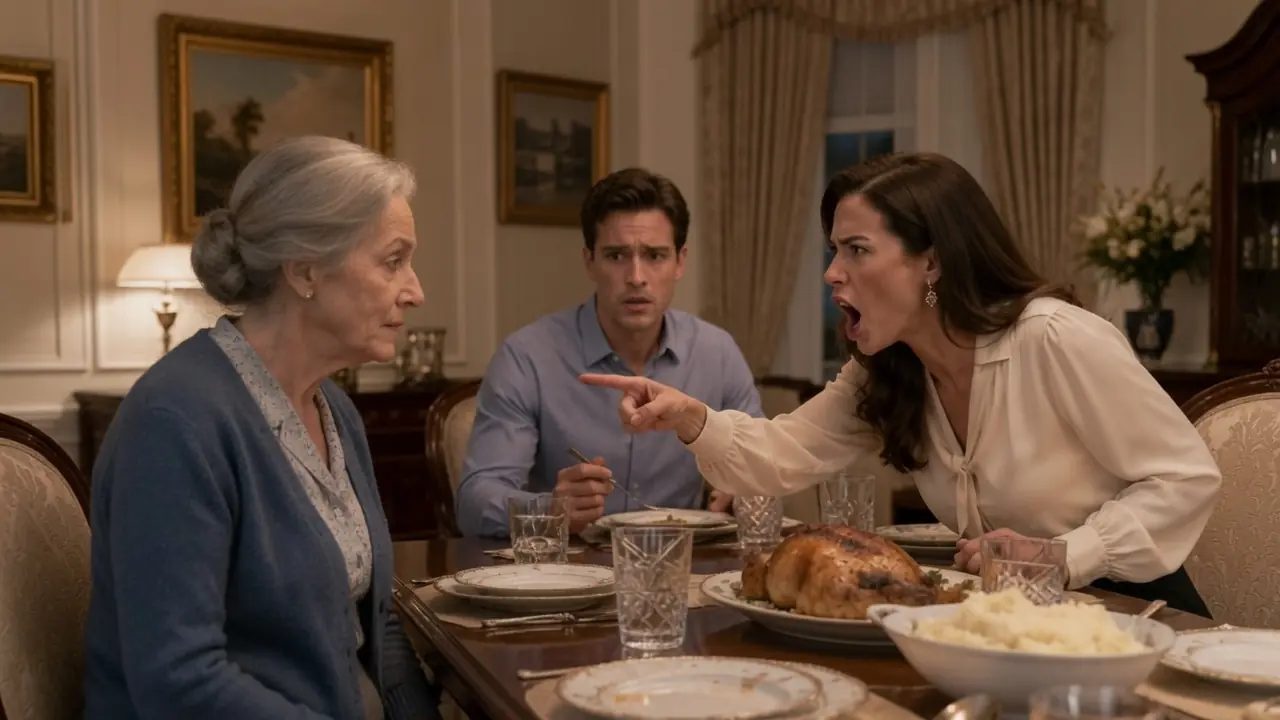
Pat looked smaller than usual in her faded blue cardigan and modest patterned blouse. Her silver hair was gathered into a low bun, still damp from the cold mist she had walked through after taking two buses across Hastings, Nebraska. Bianca wore a cream silk blouse, diamond earrings, and the expression of a woman who believed wealth had given her the right to measure another person’s worth. Between them sat roasted chicken, mashed potatoes, vegetables, and enough food to feed twice the number of people present.
Pat lowered her eyes toward the chipped plate.
“I took two buses in the cold just to see my only son,” she said, her voice trembling. “I never came here asking for money.”
Bianca leaned back and crossed her arms. “Then stop coming here at all. We’re tired of pretending your lonely little life is our responsibility.”
Pat’s face tightened as though the words had struck her physically. She looked toward Wesley again, giving him one final opportunity to protect the mother who had raised him, paid for his education, and sat beside his hospital bed through childhood illnesses. Wesley shifted uncomfortably but still could not meet her eyes.
“Bianca can be blunt,” he muttered.
“Blunt?” Pat repeated softly.
“She’s worried about you, Mom.”
Bianca gave a humorless laugh. “Someone has to be. You’re sixty-six, not ninety. The grocery store is always hiring baggers, and the diner downtown needs dishwashers. A job might give you purpose, independence, and a little self-respect.”
Self-respect.
Pat had negotiated bank loans, managed hundreds of employees, and kept five restaurants alive during a regional recession. She had signed paychecks for families who depended on her judgment and personally guaranteed the loan that saved a trucking company where Wesley later became a senior manager. Yet here she sat while her daughter-in-law lectured her about purpose beneath a roof Pat had secretly purchased.
“There is dignity in every honest job,” Pat said. “But I’m curious why you believe I need one.”
Bianca stared at her as though the answer were obvious. “Because Wesley cannot spend the rest of his life wondering whether you paid your rent or bought groceries.”
“I have never asked Wesley for money.”
“That isn’t the point.”
“Then what is?”
Bianca’s cheeks flushed. For months, she had waited for an opportunity to say these things without witnesses outside the family. Pat’s quietness had always irritated her because it made cruelty feel louder.
“The point is that you act helpless,” Bianca said. “You wear those old clothes, take buses, and live in that miserable cottage as if suffering makes you noble. Then you come here expecting us to feel guilty because our life turned out better than yours.”
Pat glanced around the room.
The walnut dining table had been imported from Italy. The chandelier cost more than some families earned in a year, and the house contained five bedrooms, a landscaped garden, and a heated three-car garage. Bianca believed she and Wesley had received the property from an anonymous family trust as a wedding gift nine years earlier.
That was technically true.
What they did not know was that Pat controlled the trust.
Pat’s late husband, Hal Maddox, had been a cook when they married at twenty-three. He could turn simple ingredients into meals that made exhausted farmers and factory workers feel cared for. Pat understood numbers, suppliers, leases, and people, so together they opened a twenty-seat breakfast restaurant with secondhand chairs and an oven purchased from a closed school cafeteria.
They called it Hal and Pat’s Kitchen.
For two years, they worked from four in the morning until nearly midnight. Hal cooked while Pat handled the accounts, served customers, cleaned tables, and slept in an office chair when there was no time to go home. Wesley grew up in that restaurant, completing homework in a corner booth while waitresses slipped him pancakes shaped like animals.
The first restaurant became profitable.
Then came a second location, followed by three more. Pat began purchasing the buildings instead of paying rent, and when a local bakery failed, she bought the equipment and hired back most of the employees. Later, she invested in storage facilities, a regional trucking company, and several commercial properties across Adams County.
By the time Hal died, their combined assets were worth slightly more than ten million dollars.
They had never lived extravagantly. Hal still drove the same pickup truck for fifteen years, and Pat preferred comfortable cardigans to designer clothing. They gave quietly, funding scholarships, hospital equipment, and emergency loans without attaching their names to plaques.
Hal believed generosity became less pure when it required applause.
His death changed Pat’s life more profoundly than anyone understood. After forty-two years of marriage, she no longer knew what to do with mornings when his coffee cup remained empty. Their large family home felt unbearable, so she sold it and moved into a modest cottage outside town.
The cottage was not rented.
Pat owned it outright.
She also kept control of the businesses through holding companies and trusts established years earlier. Her attorney, Margaret Sloan, handled most public documents, allowing Pat to step away from daily operations while retaining final authority over major decisions. Pat could have purchased almost anything she wanted, but grief had made luxury feel unnecessary.
She stopped wearing jewelry because every valuable piece reminded her of an occasion shared with Hal.
She walked whenever weather allowed because movement made the silence easier to bear. She used buses because she enjoyed speaking with ordinary people who never treated her like the owner of half the block. Her shoes were scuffed because they were comfortable, not because she could not replace them.
Bianca interpreted every choice as evidence of failure.
At first, Pat found the misunderstanding harmless. She assumed her son would eventually explain that his mother was financially secure. But Wesley knew only part of the truth; Pat had never told him the full value of the estate because she wanted him to build his own life without waiting for an inheritance.
She told him merely that she had enough.
Wesley heard modest savings.
Bianca heard poverty.
The change in their behavior happened gradually. Invitations to restaurants stopped because Bianca said Pat’s clothing did not fit the atmosphere. At Christmas, Pat was asked to wash dishes while the rest of the family opened expensive gifts because Bianca claimed she could not contribute equally.
Pat accepted each small humiliation in silence.
She was not testing whether they respected wealth.
She was discovering whether they respected a person without it.
The results became painful but undeniable.
That Sunday dinner was the final answer.
Bianca pointed toward Pat’s cardigan. “Look at yourself. You dress like someone expecting charity and then act offended when people worry about supporting you.”
Pat touched the worn cuff. Hal had bought the cardigan during their final winter together. One pocket still carried a nearly invisible repair he had stitched badly after catching it on a door handle.
“I like this sweater,” Pat said.
“Of course you do. You cling to everything old because moving forward would require effort.”
Wesley finally looked up. “Bianca, maybe that’s enough.”
Bianca turned on him. “No, it isn’t. You complain every time your mother calls because you think she needs something, and then you expect me to smile while she sits here judging our life.”
“I have never judged your life,” Pat said.
“You don’t have to say it. You sit there with that wounded expression and make Wesley feel guilty for being successful.”
Pat’s eyes filled, but she refused to let the tears fall.
“I was proud of him before he earned his first paycheck.”
“Then prove it by becoming independent.”
“I already am.”
Bianca slapped her palm against the table. “Stop lying! You need to get a job and stop living off everyone.”
The room fell silent.
Wesley’s fork remained suspended halfway to his plate. The wall clock ticked above the sideboard while Pat carefully placed the bent spoon beside her chipped plate.
Then she smiled.
It was not a happy smile.
It was the expression of someone who had finally reached the end of a long and disappointing investigation.
“What is funny?” Bianca demanded.
Pat looked at her calmly. “Honey, you might want to start packing your bags tonight.”
Bianca’s mouth opened. “Are you threatening me?”
“No.”
“Then what does that mean?”
Pat reached into her old leather handbag and removed a folded document prepared by Margaret Sloan. Wesley recognized the attorney’s letterhead and immediately straightened.
“Mom, what is that?”
Pat unfolded the page and smoothed it against the table.
The document listed the property address, the trust designation, the beneficial owner, the occupancy provisions, and the conditions under which residency could be terminated. Bianca stared at the page without touching it.
Pat rested one finger beside the ownership line.
“Let us begin,” she said quietly, “with who actually owns the chair you are sitting in.”
Wesley rose halfway from his seat. “You own this house?”
“The Maddox Family Property Trust owns it.”
“And who controls the trust?” Bianca asked, though fear had already entered her voice.
“I do.”
Bianca laughed too quickly. “That’s impossible. The house was a wedding gift from an anonymous trust.”
“Yes. My trust.”
Wesley sank back into his chair.
Pat explained that she had purchased the property nine years earlier after learning they could not qualify for financing on a home Bianca wanted. She created the arrangement to protect them from debt and placed occupancy rights in the trust so they could live there without mortgage payments.
“You told me the trust came from Dad’s side of the family,” Wesley said.
“I said it was created from family assets. Your father and I built those assets together.”
Bianca grabbed the document and scanned it. “Even if this is true, you gave us the house.”
“No. I gave you the right to live here under specific conditions.”
“What conditions?”
Pat pointed toward the relevant section. “The occupants must maintain the property, pay taxes and utilities, and refrain from using the residence for illegal or abusive purposes. The trustee retains the right to terminate occupancy with proper notice.”
Bianca’s face went pale.
“You cannot evict your own son because of one argument.”
“This was not one argument.”
Pat opened her handbag again and removed a small notebook. Inside were dates, remarks, invitations withdrawn, and moments when Bianca had deliberately humiliated her. Pat had recorded them not out of revenge, but because Hal taught her never to make serious decisions from emotion alone.
Christmas Eve: instructed to eat in the kitchen because her dress was inappropriate.
March 14: asked to leave a restaurant before Bianca’s friends arrived.
May 7: Wesley canceled a visit after Bianca claimed Pat might ask for money.
September 22: Bianca told neighbors Pat suffered from financial problems and poor judgment.
The incidents continued for four years.
Wesley read several entries and covered his mouth with one hand.
“Mom, why didn’t you say anything?”
“I did.”
“When?”
“Every time I told you I was hurt and you replied that Bianca was blunt.”
His face crumpled.
Pat continued, “Every time I asked why you stopped visiting and you said work was busy. Every time I reminded you that I had never asked for financial help and you changed the subject.”
Bianca pushed the notebook away. “This is insane. You pretended to be poor to trap us.”
“I never pretended.”
“You let us believe it.”
“I told you repeatedly that I had what I needed.”
“That is what broke people say when they are ashamed!”
“No,” Pat replied. “That is what secure people say when they do not feel required to display their accounts.”
Bianca stood so abruptly that her chair scraped against the floor.
“So this entire time, you were rich?”
Pat’s expression changed.
Not once had Bianca asked whether Pat was lonely, healthy, or safe. Her first response to discovering the truth concerned money.
“I am comfortable,” Pat said.
“How comfortable?”
“That is none of your business.”
Bianca turned toward Wesley. “Did you know?”
“No.”
“You expect me to believe your mother has millions and never told you?”
Pat watched suspicion replace fear in Bianca’s eyes. Wealth had changed her understanding of Pat within seconds, but it had not produced love or regret. It merely changed the type of opportunity she saw.
Wesley looked at his mother. “Are there really millions?”
“A little over ten.”
The number silenced them.
Bianca slowly sat down again. Her voice softened immediately, becoming the pleasant tone she used with donors and influential guests.
“Pat, there has clearly been a terrible misunderstanding.”
Pat almost admired the speed of the transformation.
“Five minutes ago, my lonely little life was not your responsibility.”
“I was frustrated.”
“You gave me a broken plate.”
“That was an accident.”
“And the cracked glass?”
“We have several old glasses.”
“Every other place setting matches.”
Bianca looked toward Wesley for help.
He said nothing.
Pat gathered the documents. “You will receive formal notice tomorrow. You have sixty days to leave.”
Wesley’s eyes widened. “Mom, please.”
“You may stay temporarily if you choose,” Pat said. “But Bianca cannot.”
Bianca stared at her husband.
There it was—the second test.
Pat was not forcing Wesley to abandon his wife. She was forcing him to decide whether he would continue excusing cruelty when consequences finally reached his own comfort.
Wesley looked between them. “I need time.”
Pat nodded. “You have sixty days.”
She placed the papers inside her handbag and stood.
Bianca’s anger returned. “You cannot walk in here, reveal some secret fortune, and destroy our marriage.”
“I did not create the contempt sitting at this table.”
“You manipulated us!”
“I removed the one thing you respected—visible wealth—and watched how you treated the person underneath.”
Pat picked up her coat.
At the doorway, Wesley called after her.
“Mom, how are you getting home?”
“The same way I arrived.”
“I’ll drive you.”
Pat looked at him for a long moment. “You watched your wife tell me never to come back. Do not offer me a ride now because you discovered I am wealthy.”
The words broke something in Wesley’s face.
Pat left alone.
Cold air met her outside, and for the first time that evening, her tears fell. Revealing the truth had not felt victorious. She had hoped until the last moment that her son would stand up, defend her, or simply place a matching plate in front of her.
He had done none of those things.
Money could expose character.
It could not repair what character destroyed.
Margaret Sloan waited in a parked car at the end of the street. Pat had asked her friend to remain nearby in case the conversation became unsafe. The attorney opened the passenger door when she saw Pat approaching.
“How did it go?”
“Exactly as we expected.”
“And how did you hope it would go?”
Pat looked back at the illuminated house.
“Differently.”
Formal notice arrived the next morning.
Bianca called twelve times, leaving messages that shifted from anger to apology and finally to threats. She claimed Pat was mentally unstable, accused her of manipulating the trust, and promised to challenge the ownership in court.
The documents were airtight.
Bianca had no legal claim.
Wesley visited Pat’s cottage three days later. He arrived without warning and stood on the porch holding the chipped plate and bent spoon inside a cardboard box.
“I found them in the trash,” he said.
Pat let him inside but did not offer comfort.
He placed the box on her kitchen table. “I’m sorry.”
“For which part?”
His eyes filled. “All of it.”
Wesley admitted that Bianca often mocked Pat after visits. At first, he defended his mother, but arguments exhausted him, so he began remaining silent. Over time, silence became agreement because Bianca grew crueler whenever no one objected.
“I told myself keeping peace in my marriage mattered,” he said.
“You kept peace for yourself by handing the pain to me.”
“I know.”
“No, Wesley. You know now because there are consequences.”
He lowered his head.
Pat asked whether he would have visited if she did not own the house or control millions. The question wounded him because he could not answer immediately.
That hesitation was the answer.
“I want to fix this,” he whispered.
“You cannot fix four years in one conversation.”
“What can I do?”
“Become a man who speaks when cruelty costs him something.”
Wesley moved into a small apartment before the sixty-day period ended. He and Bianca entered counseling, but their marriage did not survive. Once the free house and anticipated inheritance disappeared, Bianca’s contempt turned toward him.
She blamed him for failing to obtain Pat’s fortune.
Wesley finally understood that Bianca had not valued success itself. She valued proximity to anything she could use.
Their divorce became final the following year.
Pat did not celebrate.
She sold the large house and used part of the proceeds to create a housing fund for widows over sixty who faced eviction or financial abuse from relatives. The program offered temporary cottages, legal assistance, and employment support for women who wanted work without treating age as shameful.
She named it Hal’s Door.
The remaining proceeds funded scholarships for local hospitality workers and their children. Pat returned to several of her businesses, not because she needed purpose, but because she remembered how much she enjoyed mentoring people who had never been given opportunity.
Wesley began rebuilding their relationship slowly.
He visited every Sunday, but Pat made no promises about inheritance. Sometimes they ate soup at her cottage. Other weeks, they walked through town or visited Hal’s grave.
Trust returned in inches rather than miles.
Two years after the dinner, Wesley accompanied Pat to the opening of the tenth Hal’s Door cottage. An elderly woman named Ruth received the keys after her grandson emptied her savings and tried to remove her from her home.
Ruth held Pat’s hands and cried.
“You made me feel like I still matter.”
Pat looked toward Wesley.
He understood.
Value had never lived inside the ten-million-dollar fortune, the family trust, or the property documents. Those things merely revealed who believed dignity needed proof.
Pat had worn an old cardigan and arrived by bus because she expected love to recognize her without decoration.
Bianca saw a burden.
Wesley saw an inconvenience and remained silent.
The truth changed their behavior, but it did not change what had already been revealed.
Years later, Pat kept the chipped plate in a glass cabinet at Hal’s Door headquarters. Beneath it sat a small card carrying one sentence:
Never confuse what someone owns with what someone is worth.
Visitors often assumed the plate represented poverty.
Pat would gently correct them.
“It represents the moment I discovered I had been wealthy in every way that mattered long before anyone saw my bank account.”
And whenever a frightened widow entered through the door believing age, loneliness, or financial hardship had made her disposable, Pat sat beside her in the same faded blue cardigan.
She never asked what the woman owned.
She asked what had happened.
Then she listened in the way she once wished her own son had listened.
Because wealth could purchase houses, businesses, and comfortable lives.
But only character could make any of them feel like home.