Proof did not arrive like thunder.
It arrived like an open tab.
One click later, my marriage split cleanly into before and after.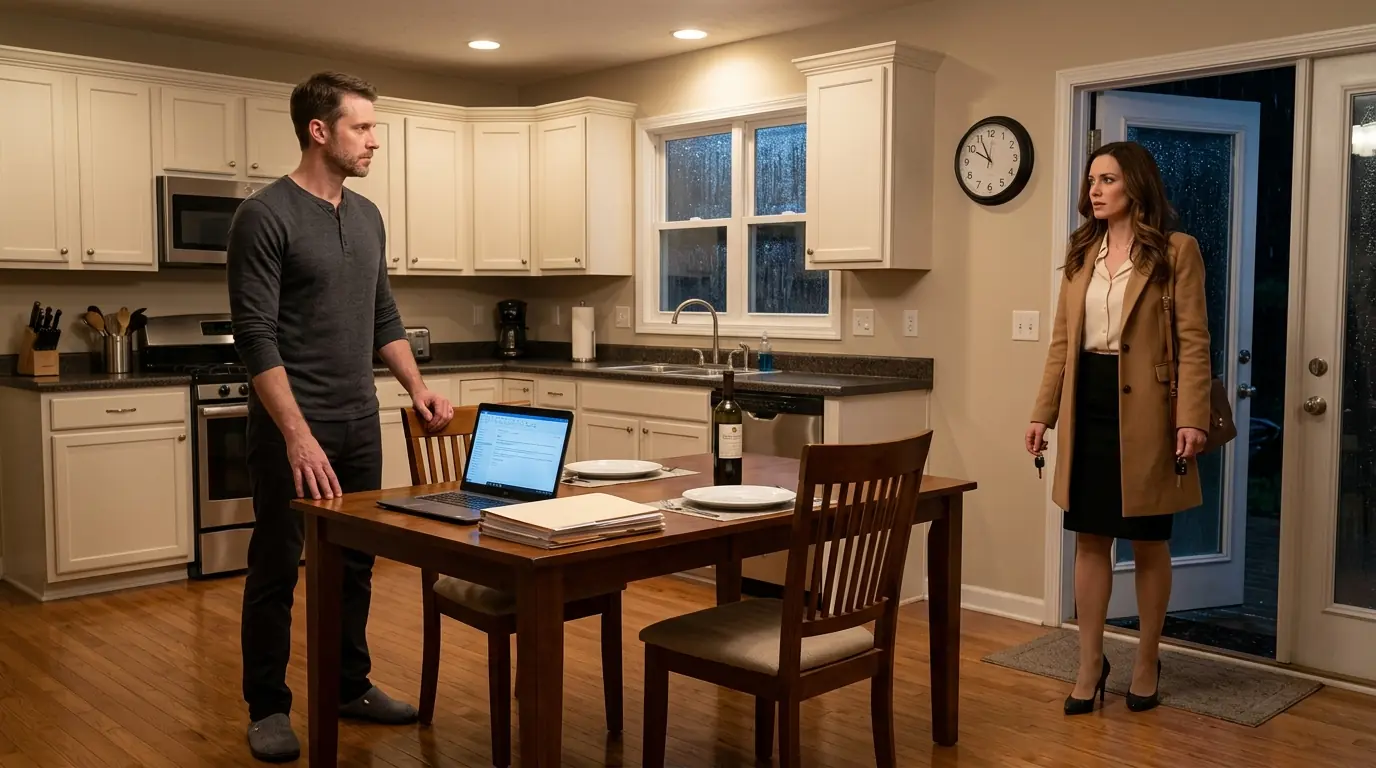
My laptop died on a Tuesday in October, the kind of death that happens mid-boot with no warning and no dignity. A flicker, a click, and then nothing.
I stared at the black screen for a second too long, like staring could change the outcome.
Work does not care about bad timing. Clients still need answers. Deadlines still breathe down your neck.
So I went to the shared household laptop, the family one, the one we bought because Rachel liked the idea of a clean counter and fewer wires. It lived in the kitchen most days, tucked beside the fruit bowl like a harmless appliance.
I carried it into my home office, set it down, and opened it like I had done a hundred times.
It woke up fast.
Too fast.
Her email was still up.
Rachel’s inbox, open, logged in, bright and innocent on the screen like it belonged there, like I was the guest.
My first instinct was to close it. Muscle memory. Decency. The fifteen-year habit of not looking.
I reached for the mouse.
That was when the preview flashed.
From Logan.
Subject: Last night didn’t feel like just stress relief.
My hand stopped midair.
I read it again, slower this time, like the words might rearrange into something normal if I gave them enough time.
They did not.
A decent husband closes the tab and pretends he never saw it.
A decent husband trusts his wife’s privacy.
But I was not thinking about decency anymore.
I was thinking about physics, about how one sentence can change the weight of a room.
The house was quiet. The steady hum of the fridge. The faint tick of the wall clock.
Rachel was still out, running errands.
That was what she had said.
A simple line tossed over her shoulder with car keys in hand.
Running errands.
I told myself there was an explanation. Wrong recipient. Bad joke. A coworker with no boundaries. Anything that did not require my heart to accept a new reality.
My cursor hovered over the message.
I could still back out.
I could still be the man who did not snoop.
Then I realized something sharp and cold.
I was not snooping.
This was not a lock I picked.
This was a door she left open.
I clicked.
The email loaded.
The thread was longer than it had any right to be.
And in that first second of scrolling, I felt the floor shift.
Quietly.
Completely.
Like the house was still standing, but the foundation had cracked.
I did not say her name out loud. I did not make a sound.
I just read.
The first thing I noticed was not the flirting.
It was the confidence.
People hiding something talk like they are scared of the truth.
This thread did not.
It read like two people building a routine, like they had already rehearsed the lies and gotten bored of pretending to feel guilty.
I scrolled once, slowly, like the movement might wake me up.
Logan: You were different last night.
Rachel: Because you don’t expect anything from me except what I want to give.
My throat tightened.
Not from emotion.
More like my body trying to reject what my eyes were feeding it.
I kept going.
There were dates, times, casual check-ins. The kind of everyday intimacy that does not happen in a one-time mistake.
They talked about the weather, traffic, a show they were both watching.
Next time.
Next time.
Rachel replied with a smiley face I recognized because I had watched her use it on me for years when she wanted something small to feel light.
Only this was not light.
This was a second life typed out in neat little bubbles.
I looked at the top of the thread again, hoping I had misunderstood the name. Maybe Logan was a nickname for a friend I did not know. Maybe I was overreacting and my brain had grabbed the worst possible meaning because humans are wired to fear loss.
Then I saw her line buried in the middle like it belonged there.
Rachel: I hate going home after being with you. Feels like putting on a costume.
I sat back in my chair.
The room did not change, but it felt like it did.
Same desk.
Same framed photo of us at the lake, sunburned, smiling, pretending the future was guaranteed.
Same work notebook with today’s to-do list, neat and pathetic.
I scrolled again.
There were pictures.
Not explicit.
Worse than that.
Normal.
Familiar.
Proof of place.
A selfie of her in a hotel mirror, hair slightly damp, wearing the cardigan I bought her last winter. In the background was a lamp I recognized because we had sat under one just like it two years earlier on our anniversary trip.
Same chain.
Same style.
Same bland, expensive comfort.
Except the timestamp did not belong to our trip.
It landed on a week I remembered clearly because she had told me she was staying late for quarter-end chaos.
I had heated leftovers for one and sent her a text.
Drive safe.
She replied, Love you.
I stared at the date like it was a math problem that would not be solved.
Then I found another.
A receipt screenshot.
A reservation confirmation.
Her name.
Two guests.
Not me.
I did not slam the laptop shut. I did not punch a wall. I did not collapse into a movie-scene breakdown.
I just sat there and listened to the house, its ordinary hum, its calm, its routine, while my mind did the ugly arithmetic.
It was not just that she cheated.
It was that she had room for it.
Room to build it.
Room to maintain it.
Room to look me in the eyes every morning and smile like nothing was wrong.
I scrolled to the bottom, and my finger trembled once on the trackpad.
Not fear.
Something closer to instinct.
The part of me that knew without being told that once you see enough, you do not get to go back to before.
And I had already seen enough.
I did not confront her.
Confrontation is for men who want relief.
Relief is expensive.
It buys you a moment and sells you the outcome.
I wanted certainty.
I shut the laptop halfway.
Not all the way.
Just enough that it looked idle.
Then I sat there and breathed through my nose until my pulse stopped trying to climb out of my throat.
Fifteen years with a person teaches you their patterns.
Rachel’s were clean.
The phone was always face down when she worked. Passwords saved because she liked convenience. Cloud syncing turned on because she hated losing photos. Shared calendars because we were organized adults.
That night, I played my role.
I asked about her day. I nodded at the right spots. I laughed when she made a small joke about a coworker.
I poured her a glass of wine like I had not just watched her write that coming home felt like wearing a costume.
She took a shower and hummed, soft and careless, like a woman whose conscience had already negotiated peace with itself.
I waited until the water ran steady.
Then I moved.
I did not rummage like a desperate husband.
I worked like an IT consultant looking at a breach.
Quiet.
Methodical.
No panic clicks.
I opened the settings and checked saved accounts.
The laptop was linked to her phone.
Her phone was linked to her cloud.
The cloud was linked to everything.
Photos.
Messages.
Location history.
App logins.
A life leaves fingerprints when it thinks it is safe.
I did not grab everything at once. That is how people get caught. That is how they tip off the other side and watch the evidence evaporate.
I took notes.
I made a timeline in my head.
I marked what existed and where it lived.
When she got out of the shower, she walked past my office door in a towel, hair wrapped, and called, “You still working?”
“Just finishing a few things,” I said.
My voice came out normal.
That was the first win of the new version of me.
Normal.
Later, she climbed into bed beside me.
The mattress shifted.
The familiar weight of her shoulder near mine.
Close enough to be intimate, far enough to feel like a stranger.
She checked her phone one last time, the screen glow lighting her cheek.
I stared at the ceiling and regulated my breathing like I was lying next to someone I had just met.
Because I had decided something simple and final.
I was going to know everything before I said a single word.
The next day, I wore the same clothes as every other day.
Coffee.
Shower.
Work emails.
Rachel moving through the kitchen in socks, talking about schedules like our life was still a shared document.
I answered on autopilot.
The right sounds at the right time.
A husband-shaped presence.
Inside, everything had narrowed.
On my second monitor, I kept a plain text file open. Nothing dramatic. Just dates, times, and short notes.
A case file built out of ordinary lies.
By lunch, I had mapped enough of the synced accounts to stop guessing. The cloud held message previews. The calendar held patterns. Location history filled in the spaces where her stories went vague.
Then the new message hit.
Logan: Usual spot. 7:30. Don’t be late this time.
A minute later, Rachel’s text came in on my phone.
Client dinner tonight. Might be late. Don’t wait up.
The timing was almost insulting.
Same hour.
Same calm.
I did not respond right away.
I let the message sit there because I wanted to remember what it felt like when she chose to lie to my face without even slowing down.
I opened the thread again and scrolled until I found the part they treated like routine.
Rachel: Same place?
Logan: The apartment hotel off Kingsley. Yeah. The front desk knows you now.
There it was.
A location that was not poetic or mysterious.
Just practical.
A place designed for people who did not want neighbors.
I pulled up the address and cross-checked it with her location history.
A neat little cluster of pings always within the same block, always in the same two-hour window.
Dates stacked like bricks.
I started taking screenshots.
Clean captures with timestamps visible.
Not just the messages, but the context.
Her lie to me.
His confirmation to her.
The address in black and white.
Then I backed them up twice.
Local folder.
Encrypted drive.
Because now the betrayal was not a feeling.
It was not even a secret.
It was measurable.
At 3:12 p.m., she told me, Client dinner.
At 3:13 p.m., she confirmed, Usual spot.
At 7:30 p.m., she would drive across town and step into the life she thought I would never see.
I wrote it down anyway.
Not because I would forget.
Because details are weapons when someone lies calmly.
For three days, I lived like I was acting in my own life.
Daytime Ethan made toast, asked about her meetings, and remembered to take the trash out.
Nighttime Ethan sat in a dark office with the laptop glow on his hands, pulling threads until the whole thing stopped looking like an affair and started looking like a habit.
The first night, I told myself I only needed proof.
The second night, I realized proof was the easy part.
The third night was when it got ugly.
I found the messages where they did not perform, where they did not write like two people in love.
They wrote like two people amused by the same joke.
And the joke was me.
Logan: He really buys it?
Rachel: Ethan? He’s predictable. If I smile and ask about his day, he melts.
Logan: That’s sad.
Rachel: It’s convenient.
I read that line twice.
Not because I did not understand it.
Because my brain refused to file it under my wife.
There was more.
She described my routines like weaknesses. My steadiness like stupidity. The things I thought were strengths, reliability, patience, showing up, reduced to a punchline.
Rachel: He thinks stability is a personality.
Logan: Maybe he just needs a hobby.
Rachel: He has one. Paying bills and thinking that makes him a man.
I sat there with my hands flat on the desk.
I did not move.
I did not blink for a few seconds.
It felt like my body was trying to keep still so something inside me did not crack and spill out.
People talk about heartbreak like it is just sadness.
This was not sadness.
This was contempt.
Cold.
Specific.
Personal.
An affair is betrayal.
Contempt is a kind of violence that does not leave bruises, but it changes how you see the person holding the knife.
I kept reading because once you know what someone really thinks, you either face it or you lie to yourself.
Rachel: If he ever finds out, he’ll probably cry.
Logan: What, like a movie?
Rachel: Like Ethan. He’s soft when it counts.
Soft.
It was the word that landed the hardest because it was simple and final, like she had already decided who I was and filed me away as something safe to step over.
I scrolled further and found something that made my stomach go tight.
A voice memo.
Short.
Casual.
Her voice recorded for him, laughing, talking about timing and money and how she would play nice until it was convenient.
Not a woman trapped.
Not a woman confused.
A woman planning.
I stopped the playback before it finished.
Not because I could not handle it, but because I did not need to hear more to understand the shape of her.
I leaned back and looked around my office.
The wedding photo on the shelf.
The little bowl where she dropped spare change.
The framed certificate from a job promotion she had celebrated with me like I was her teammate.
All of it suddenly felt like set dressing.
That was when the shock drained out and something colder took its place.
Not rage.
Rage is loud and clumsy.
This was weight.
A calm heaviness settling into my bones.
And in that quiet, I accepted the real truth.
There was not going to be a romantic misunderstanding.
No tearful confession that fixed it.
No “we can work through this” conversation that made it whole again.
There was only an exit.
And I was going to plan it like a man who refused to be laughed at in his own house.
Once you have seen enough, the work changes.
I stopped collecting like a wounded husband and started organizing like a professional.
Feelings are messy.
Files are not.
I made a folder structure the way I would for a client audit.
Simple.
Clean.
Impossible to argue with.
01 Timeline.
02 Messages.
03 Photos.
04 Receipts.
05 Audio.
06 Backups.
Every screenshot got a name with a date and time. Every email thread got exported. I grabbed metadata where I could. Headers, timestamps, anything that turned “he said, she said” into “here is the record.”
Receipts were everywhere once I looked with the right eyes.
Small charges at places she never mentioned. Rideshare trips that did not match her story. A hotel payment sitting in plain sight like it did not know it was a confession.
The audio clip went into its own folder.
I listened to it once all the way through without blinking.
Her voice was light, almost bored, talking about divorce like it was a logistics problem. Talking about money like it was the real relationship she cared about preserving.
When it ended, I did not replay it.
I did not need to.
I had already memorized the tone.
Then I backed everything up.
Multiple places.
Encrypted drive.
A cloud account she did not know existed.
The way you back up something you cannot afford to lose, because once the other person senses the floor moving, they start sweeping.
That afternoon, I called a divorce attorney a friend in finance had used.
The kind of man who did not sell hope.
He sold outcomes.
His receptionist tried to schedule me for the following week.
I told her it was urgent, and my voice did not shake when I said it.
Ten minutes later, I had an appointment.
His office was clean and quiet. Expensive without trying to impress.
I sat across from him in a chair that felt designed to keep you upright.
He did not ask for my feelings first.
He asked for facts.
I slid the folder across his desk.
He opened it and flipped through the pages. He looked at the timestamps. He studied the receipts with the same calm I had seen in surgeons.
No raised eyebrows.
No pity.
Just attention.
When he got to the audio transcript, his mouth tightened slightly, like he had just found the motive written in the suspect’s own handwriting.
He closed the folder and looked at me.
“This is strong,” he said. “Not just proof. Pattern. Planning. That matters.”
I nodded once because nodding was safer than speaking.
He laid out the procedure like a road map.
What to do.
What not to do.
What to document.
How to protect assets without doing anything that could be framed as vindictive.
He was not emotional about it.
That was the point.
When he finished, he said, “If you want to move forward, we can file when you are ready.”
Ready.
I had been ready since the moment I read her call me convenient.
I just had not admitted it yet.
I stood, shook his hand, and felt something shift again.
Not like the floor cracking this time.
Like it locking into place.
Heartbreak was personal.
Protection was procedural.
And now, this was not just a wound.
It was a legal process with stakes I refused to lose.
Friday night, I set the table like we were still us.
Her favorite meal.
Candles.
The bottle of red we had been saving for someday.
Like someday was a real place and not just a lie we used to avoid looking at the present.
I moved through the kitchen with steady hands.
Not because I felt steady.
Because I had decided the end of this would be clean.
Rachel walked in around 7:00, heels clicking, hair done, face arranged.
“Wow,” she said, smiling like I had just handed her a reason to believe she was still safe here. “What’s the occasion?”
“Just felt like doing something nice,” I said.
She kissed my cheek.
A quick press.
Routine intimacy.
Then she sat down and started talking about work.
Names.
Deadlines.
Harmless complaints.
Like her voice could wallpaper over the cracks.
I poured wine.
I ate.
I listened.
I answered when it was my turn, like a man reading from a script he had memorized years ago.
For a while, it almost worked.
That was the scary part.
Habit is powerful. If you do not fight it, it will keep you in a burning house because the furniture is familiar.
Halfway through dinner, she laughed at something she had said, and I watched her mouth shape the sound.
I realized I did not recognize her anymore.
I put my fork down.
She noticed.
“You okay?”
I looked at her and let the silence stretch just long enough to change the air in the room.
“Who’s Logan?” I asked.
It was not loud.
It was not dramatic.
It was the only question that mattered.
The color did not just drain from her face.
It emptied, like someone had pulled the plug on whatever performance she had been running.
Her eyes flicked down, then back up.
A quick recalculation.
“How did you…”
She started, and that was all I needed.
Not “What are you talking about?”
Not “Who?”
Not even “Ethan, please.”
Just logistics.
Just damage control.
I stood, walked to the counter, and picked up the folder I had placed there earlier like an ingredient.
When I came back, I did not throw it.
I slid it onto the table between us, slow and deliberate, like a verdict being served.
She stared at it the way people stare at something they know will end them.
“I know,” I said. “All of it.”
And for the first time in weeks, the room was honest.
She reached for the folder like it was hot.
“Ethan, please,” she said.
Her voice finally found a tremble, like emotion was something she could still deploy when the stakes were real.
I did not speak.
I just watched her open it.
Her eyes moved fast.
Screenshots.
Timestamps.
Receipts.
She kept flipping like speed could change what she was seeing.
Her mouth opened once, then closed.
Then she tried the first move.
Denial with confidence.
“This… this isn’t what it looks like.”
I leaned back slightly.
“It looks like you were meeting him at an apartment hotel off Kingsley at 7:30 while you texted me about a client dinner.”
Her head snapped up.
Her face tightened.
The second move came next.
Tears.
They arrived quickly, like she had practiced them.
“I was lonely. You were always working. I didn’t mean for it to…”
I cut it off without raising my voice.
“Don’t.”
The third move was bargaining.
“We can go to therapy,” she said, her voice rushing now. “I’ll block him. I’ll do anything. Please, Ethan. We’ve built a life.”
I let her talk until she ran out of breath, because watching someone scramble is its own kind of truth.
When she stopped, I said, “You messaged him today.”
Her eyes widened.
“No.”
I tapped the page.
A screenshot with the timestamp.
Her words.
The plan for the weekend.
She stared at it, and the tears changed.
Less performance.
More fear.
Then I showed her the part she did not know existed.
I turned my laptop toward her and opened a simple folder.
Screenshots of dating profiles.
Logan’s face.
Same grin.
Same angles.
Different bios.
Different apps.
Different women.
Recycled lines.
Same “looking for something real” nonsense, copied and pasted like his personality came from a template.
Rachel’s eyes scanned the screen, and confusion hit first.
Then realization.
Slow and sick.
Her lips parted.
She swallowed like she might throw up.
“No,” she whispered, like saying it could undo it. “He… he told me…”
“He told you what worked,” I said. “That’s what men like him do.”
She turned her head toward me, looking for something.
Sympathy, maybe.
Rescue.
The old Ethan who would absorb her mess because stability was my religion.
She did not find him.
“I’m not here to gloat,” I said. “I’m here to end this.”
Her voice rose.
“You’re really doing this? After fifteen years?”
“I’m filing Monday,” I said. “My lawyer already has everything.”
That landed harder than the evidence.
The folder was pain.
The lawyer was consequence.
Rachel stood, chair scraping back.
“You can’t just…”
“I can,” I said.
My tone stayed flat because anger would only give her something to hold on to.
“And I am.”
She made a sound, half sob, half gasp, and reached for my hand like it was instinct.
I pulled back before she could touch me.
Then I stood, gathered the folder, and walked out of the dining room.
Not fast.
Not storming.
Just leaving.
I went to the guest room, closed the door, and locked it.
On the other side, the house absorbed the sound of her collapse.
Shaky breaths.
A muffled cry.
A cabinet door opening and shutting like she did not know what to do with her hands.
I sat on the edge of the bed and stared at the wall.
I did not feel victorious.
I felt clean.
And for the first time since October, I slept without pretending.
The months after Friday were not cinematic.
They were procedural, like demolition work done by people who do not talk much.
Emails with subject lines that looked harmless until you realized each one was another brick removed from a life you built together.
Rachel cycled through emotions like she was trying on outfits in a mirror.
One week she was remorseful and soft, texting paragraphs about history, about vows, about who we really were.
The next week she was furious, calling me cold, calling me cruel, acting like my refusal to be manipulated was the real betrayal.
I stayed consistent.
That was the only way to win without losing myself.
My attorney filed on Monday, exactly like I said.
The first formal letter went out, and the tone of everything changed.
Rachel stopped speaking to me like a spouse and started speaking to me like an opponent.
The house got quieter.
We moved through it in separate lanes.
I documented everything.
Expenses.
Conversations.
Dates.
Not because I enjoyed it.
Because ambiguity is where people rewrite history.
When the financials started coming in, the story on paper looked worse than the story in my head.
Money spent on hotels. Meals that were not client dinners. Rideshare trips across town on nights she told me she was exhausted and going to bed early.
Still, I did not lash out.
I did not scream.
I did not smash anything.
Rage would have been easy.
Rage would have been a gift to her.
Proof that I was unstable.
Proof that I was the problem.
What I did instead was report what was real.
Rachel’s affair had overlapped with work, time, resources, and at least one trip logged as business.
My lawyer did not push me toward it, and he did not stop me.
He just said, “If you’re going to do it, do it clean.”
So I made a formal report to HR.
Facts only.
Dates.
Screenshots.
Receipts.
A short statement that avoided drama.
No moral language.
No “I’m hurt.”
Just misuse, conflict, and evidence.
An internal investigation is not a thunderstorm.
It is a slow leak that turns into a flood once someone checks the pipes.
Rachel lost her job.
She showed up at the house like she had been shot with it.
Eyes wild.
Voice shaking.
“You did this,” she said. “You ruined me.”
I did not raise my voice.
“The rules did that,” I told her. “You broke them. I documented it.”
She stared at me like she was waiting for me to soften, waiting for the old Ethan to apologize for her consequences.
I did not.
The divorce itself was a grind.
Asset division.
Valuations.
Negotiation.
We did not have kids, which made it cleaner, but not easier.
Every shared thing became a line item.
Every memory got assigned a number.
In the end, I kept the house after paying her court-ordered share. She got the car and part of the investments.
It was not a victory lap.
It was an ending.
On the day everything was finalized, I came home and stood in the entryway for a minute, listening to nothing.
No keys dropping in the bowl.
No footsteps in the hallway.
No voice calling from the kitchen.
Just air.
It felt strange.
Then it felt light.
Winter turned into spring.
The world did what it always does.
It kept moving, indifferent to personal tragedy.
I rebuilt my routines without her inside them.
Work.
Gym.
Meals that were mine.
Friends I had neglected because I had been busy maintaining a marriage that was not mutual.
Then, in April, on a rainy afternoon, I ran into her.
It was outside a cafe near downtown.
Gray sky.
Wet pavement.
She looked thinner.
Not elegant thinner.
Worn thinner.
Her hair was pulled back like she did not have energy for the old performance.
We stood there for a second, both of us measuring the distance between who we were and who we had become.
“Ethan,” she said quietly.
“Rachel.”
She tried a small smile and failed.
“You look okay.”
“I am,” I said.
Her eyes searched my face for something.
Anger.
Regret.
Any sign that she still mattered in the way she wanted to matter.
“I didn’t think it would end like this,” she said.
I nodded once.
“Neither did I.”
She opened her mouth like she wanted to say more.
An apology, maybe.
Or a defense.
Or a request.
I did not give her room for it.
“I hope you figure your life out,” I said.
And I meant it in the cleanest way possible.
Not as forgiveness.
Not as revenge.
Just closure.
Her shoulders sagged.
“I’m sorry,” she whispered.
The words were late enough to be useless.
I held her gaze for a beat.
“I know.”
Then I stepped around her and walked away.
No backward glance.
No final speech.
Closure is not winning.
It is choosing not to live in the past anymore.