The rain had been falling over Portland, Maine, since late afternoon, and by the time Rachel Moore stepped out of Harbor Light Diner, the streets looked like rivers of black glass.
Water rushed along the curbs, carrying yellow leaves, cigarette wrappers, and the trembling reflection of streetlights.
The wind cut between the buildings and pushed the rain sideways, hard enough to sting Rachel’s cheeks when she pulled her jacket tighter around her body.
Rachel was thirty years old, a waitress who had worked the late shift for nearly six years.
Her feet ached from standing all day, her shoulders were stiff from carrying trays, and her dark blue uniform still smelled faintly of coffee, fried potatoes, dish soap, and the sweet syrup customers spilled on the counter.
She had dark brown skin, long black braids tucked under a faded baseball cap, and tired eyes that always seemed softer than the world around her deserved.
In her coat pocket were her tips for the night.
Twenty-seven dollars and forty cents.
She had counted them twice in the diner bathroom before leaving, folding the bills carefully and tucking the coins into a small side pocket so they would not fall out. It was not much, but it was enough to buy a few groceries, maybe pay part of the electric bill, and keep her small apartment warm for another week.
The sensible thing would have been to wait for the bus.
But the next bus would not arrive for almost twenty minutes, and Rachel’s apartment was only six blocks away. She had walked home in rain before.
She had walked home in snow, in summer heat, and once during a power outage when the streetlights were dead and the whole neighborhood felt like it was holding its breath.
So she lowered her head and began walking.
The diner sign buzzed behind her in red neon, blinking against the wet street. Somewhere nearby, a car alarm chirped once and went silent. A delivery truck rumbled past, spraying water across the curb.
Rachel crossed her arms over her chest and walked faster.
She was thinking about the soup in her fridge, the laundry she still had not folded, and whether her landlord would give her until Monday for the rent balance.
Then she saw him.
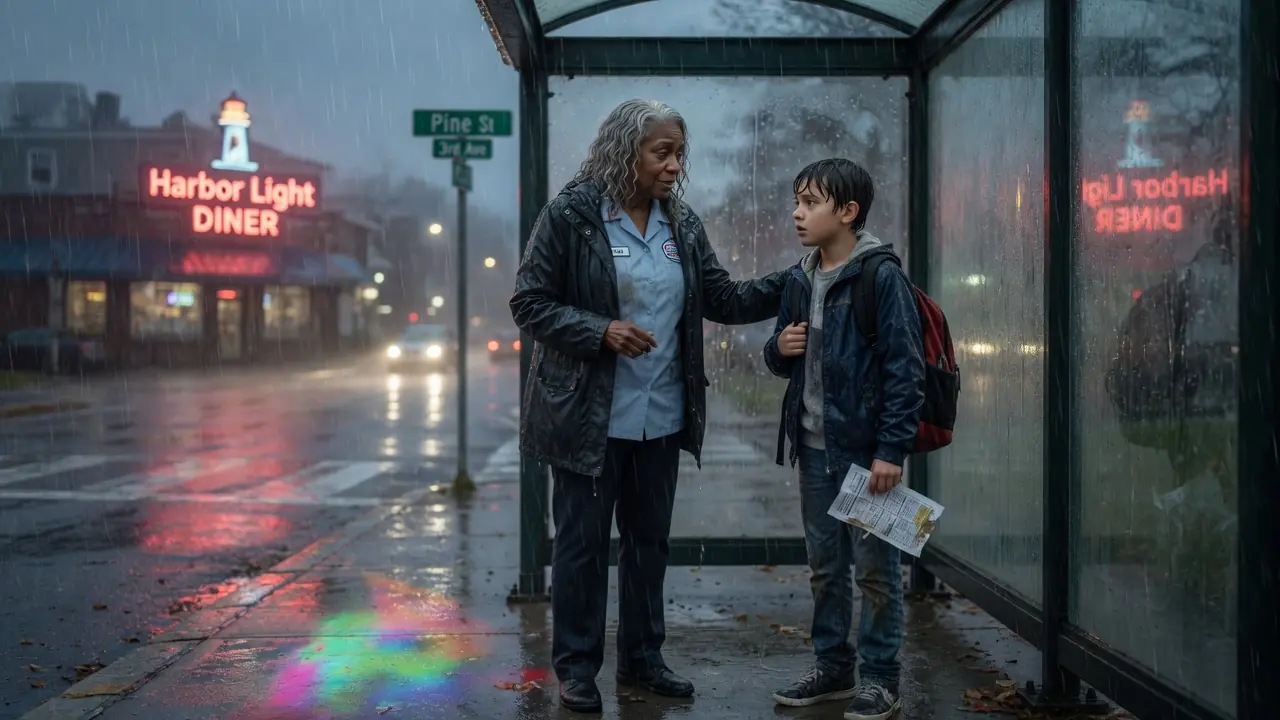
At first, the boy looked like a dark bundle beneath the bus stop shelter at the corner of Pine and Third.
Rachel almost walked past.
Then the bundle moved.
A small face lifted toward the street, then lowered again. A pair of thin arms tightened around a backpack. Wet sneakers swung slightly above the puddled sidewalk because the child’s feet barely reached the ground from the metal bench.
Rachel slowed.
The bus stop shelter had a thin roof and glass panels on three sides, but the wind was blowing rain through the open front. Water dripped steadily from one broken corner, falling beside the boy’s shoes. The bench beneath him was wet, and his jacket had soaked through.
He looked about ten years old.
His hair was dark and plastered to his forehead. His face was pale from cold. His navy jacket clung to his shoulders, and beneath it he wore a gray sweater that looked much too thin for the weather. His jeans were wet to the knees, and his backpack was held tightly against his chest as if it contained everything important in the world.
In one hand, he clutched a crumpled sheet of paper.
Every few seconds, he looked down the street.
Then at the paper.
Then back down the street again.
That was what stopped Rachel completely.
It was not only the rain.
It was the way he was waiting.
Children waiting normally had boredom in their faces. They kicked their feet, complained, played with phones, watched cars, or looked annoyed with adults who were late.
This boy was not bored.
He was afraid.
Rachel stepped under the shelter, leaving enough space between them so he would not feel trapped.
“Hey there,” she said gently. “Are you okay?”
The boy’s head jerked up.
His eyes were wide, dark, and startled. He hugged his backpack tighter.
“I’m fine,” he said quickly.
Rachel looked at the rain dripping from his sleeves.
“I hear you,” she said softly. “But you don’t look fine.”
He looked away. “I’m just waiting.”
“For someone?”
He nodded.
“My mom.”
Rachel glanced up and down the street. No one was running toward them. No car slowed near the curb. No adult stood across the road searching through the rain.
“What’s your name?” she asked.
The boy hesitated.
“Alex.”
“Alex what?”
“Alex Rivera.”
Rachel nodded. “I’m Rachel Moore.”
He looked suspicious now.
“I’m not supposed to talk to strangers.”
Rachel nodded again. “That is a very good rule.”
His eyebrows pulled together. “Then why are you talking to me?”
“Because sometimes a safe adult helps you find the adult you already know.”
Alex stared at her for a moment, unsure what to do with that answer.
A hard gust of wind blew rain under the shelter. He shivered so sharply that his teeth clicked together.
Rachel noticed his hands.
They were red from cold.
“How long have you been waiting here, Alex?”
He looked down at the crumpled paper.
“I don’t know.”
“Was it still light outside when you got here?”
He nodded.
Rachel felt her stomach tighten.
It had been fully dark for over an hour.
“Did your mom tell you to wait at this bus stop?”
His face crumpled slightly, but he fought to keep it steady.
“She told me to take the bus after school and get off at the stop near our new apartment. She wrote it down. But I think I got off wrong.”
He held out the paper.
Rachel took it carefully.
The paper was wet and soft, almost tearing under her fingers. The ink had blurred badly, but she could still make out pieces of the writing: Maple Street, Unit 3B, Route 12, and a phone number with the last two digits smeared into blue-gray streaks.
“Do you know your address?” she asked.
He swallowed.
“Not all of it. We just moved.”
“Do you have a phone?”
He shook his head.
“My mom’s phone is cracked. Sometimes it works, sometimes it doesn’t. She said she’d fix it when she got paid.”
Rachel held the paper carefully under her coat so it would not get wetter.
“What school do you go to?”
“East Harbor Elementary.”
“What grade?”
“Fourth.”
“And your mom’s name?”
“Maria Rivera.”
Rachel listened carefully, storing every detail.
The boy was not just lost.
He was lost in the middle of a transition, in a city that had suddenly become unfamiliar, with a paper that had failed him in the rain.
Alex looked past her again.
“My mom will come,” he said.
“I believe she is looking for you,” Rachel replied. “But she may not know you are at this stop.”
His eyes filled fast.
“She told me not to get lost.”
Rachel crouched slightly, not too close, just enough to meet his eyes.
“Getting lost is an accident. It does not mean you did something wrong.”
His mouth trembled.
“I missed the stop,” he whispered. “The bus turned, and I thought maybe I had gone too far, so I got off. Then I tried to walk back, but the streets looked different.”
Rachel’s chest ached.
She thought of being a little girl herself, standing outside a grocery store years ago, waiting for a mother whose car had broken down. She remembered people walking past her, adults with bags and umbrellas and somewhere to go, none of them asking why a child was alone.
That memory had stayed with her in a place deeper than words.
She looked at Alex.
“You can’t stay here all night,” she said gently.
He stiffened.
“I can wait.”
“Not in wet clothes. Not in this cold.”
“I’m not supposed to go anywhere with strangers.”
“You are right.”
He looked confused again.
Rachel spoke slowly.
“My apartment is a few blocks away. You do not have to trust me all at once. You can stand in the hallway while I call the police non-emergency number and try to reach your mom. I’ll give them my full name, address, and where I found you. Everything will be proper.”
Alex looked toward the street.
Rachel added, “Or we can go to the diner behind us. It is closed, but I know the owner. It may take longer to reach someone. My apartment has dry towels and a phone.”
He kept looking at the road.
Rain ran down the glass behind him.
“Just to call?” he asked.
“Just to call first,” Rachel said. “And to get you dry enough that you stop shaking.”
“I’m not shaking.”
His body betrayed him again.
Rachel gave him a small smile, but not a teasing one.
“Okay. Then we’ll get you dry before you start shaking.”
For a second, he almost smiled.
Then he stood.
Rachel walked slowly, keeping half a step ahead of him and not touching him. He followed with his backpack hugged to his chest, his wet sneakers squeaking on the sidewalk.
They crossed Pine Street carefully.
The rain blurred everything: the street signs, the traffic lights, the closed shops, the gray buildings with dark windows above them. Alex walked close but not too close. Rachel could feel him watching her, measuring every movement, ready to run if something seemed wrong.
She did not blame him.
A careful child was often a child who had already learned the world could be unsafe.
Her apartment building was above a closed laundromat on the corner of Mason and Fifth. The downstairs windows were dark, but the stairwell light still worked. It flickered once when Rachel opened the door.
Alex stopped at the bottom of the stairs.
“This is where you live?”
“Second floor.”
“Are there other people?”
“Yes. Mrs. Donnelly lives across the hall from me. She is nosy in a useful way.”
“What does that mean?”
“It means if anything strange happens, she will know before I do.”
Alex seemed to consider this.
That made him feel safer.
Rachel led him upstairs and unlocked her apartment door. She left it open while she switched on the light.
The apartment was small but clean.
A faded green couch sat against one wall with a knitted blanket folded over the arm. A small kitchen table stood near the window. There were two mugs in the sink, a stack of library books on the counter, a calendar with bills marked in blue pen, and a pot of chicken soup on the stove.
Alex stood in the doorway, dripping rain onto the floor.
“I’m getting it wet.”
“Floors dry.”
“My shoes are muddy.”
“I own a mop.”
He looked down, still ashamed.
Rachel pointed to the entry rug. “Stand there for a second. I’ll get towels.”
She went to the linen closet and pulled out two towels, thick socks, and an old gray sweatshirt her younger brother had left behind years ago. It was too big for Alex, but dry.
She placed them on a chair near the bathroom.
“You can change in there,” she said. “Keep the door unlocked if that feels safer. I’ll stay in the kitchen.”
He looked at the clothes.
“I don’t have money.”
Rachel paused.
“For the sweatshirt?”
“For anything.”
Her face softened.
“I didn’t ask for money.”
“I can pay you back when my mom comes.”
“You can get warm first.”
Alex looked like he wanted to argue, but he was too cold.
He went into the bathroom and closed the door halfway.
Rachel stood in the kitchen, listening to the rain hit the window. She took a deep breath, then called the police non-emergency line from her cell phone.
She gave her name, address, the bus stop location, Alex’s full name, his mother’s name, his school, the blurred address, and the situation exactly as it happened.
The dispatcher asked whether the child was safe.
“Yes,” Rachel said. “He is wet and cold, but safe.”
The dispatcher told her no confirmed missing child report had matched yet but said they would check and call back. Rachel asked whether an officer should come immediately. The dispatcher said they might, depending on what they found, but for now Rachel had done the right thing by reporting the location and keeping him safe.
Alex came out of the bathroom wearing the oversized sweatshirt and dry socks. His wet hair curled against his forehead. He carried his soaked clothes carefully in both hands.
“I don’t know where to put these.”
Rachel took them and placed them near the radiator.
“Right here.”
“I’m sorry.”
“You don’t need to apologize for rain.”
He stood awkwardly.
Rachel held up her phone. “I called the non-emergency line. They know you’re here. They know my name and address.”
“Am I in trouble?”
“No.”
“Is my mom?”
Rachel looked at him.
“No one has said that. We are trying to find her.”
His shoulders lowered a little.
Rachel warmed the soup and placed a bowl on the kitchen table with two slices of bread.
Alex sat but did not touch it.
“I’m not hungry.”
His stomach growled loudly.
Rachel looked toward the stove as if it had spoken.
“Interesting. The kitchen disagrees.”
His cheeks turned red.
She set a spoon beside the bowl.
“You don’t have to eat fast. It’s not going anywhere.”
He picked up the spoon and took one careful bite.
Then another.
Then the hunger caught up with him.
Rachel turned away and washed the two mugs in the sink so he would not feel watched. She knew the strange shame of eating when someone had just given you food. She had felt it as a child. She had seen it in customers who counted coins before ordering the cheapest thing on the menu.
When Alex finished the bowl, he stared down at it.
Rachel asked, “Would you like more?”
He hesitated.
“There’s enough?”
“There is enough.”
He nodded.
She gave him a second bowl.
After he ate, Rachel spread the wet paper on the counter and tried to read the phone number again. She called every possible combination of the last two digits. Three were wrong numbers. One went to a disconnected line. One rang until voicemail, but the voice did not match.
Alex sat on the couch, wrapped in the blanket, watching her with anxious eyes.
“Maybe she’s still working,” he said.
“Where does she work?”
“The hospital cafeteria. But sometimes she cleans offices after.”
“Which hospital?”
“Mercy General.”
Rachel called Mercy General.
The main desk transferred her to food services. Food services transferred her to another office. Someone put her on hold for nearly six minutes. Rachel listened to soft instrumental music while Alex stared at the floor.
Finally, a woman answered and confirmed that Maria Rivera worked in the cafeteria but had left earlier that evening.
“She said she needed to pick up her son,” the woman said.
Rachel closed her eyes.
“Do you have a working number for her?”
“We can’t give that out.”
“I understand. Can you take my number and call her emergency contact? Her son is safe, but she needs to know where he is.”
The woman’s voice changed.
“She’s been calling here. She said he didn’t get home.”
Rachel gripped the phone tighter.
“Please give her this number immediately.”
After she hung up, Alex stood.
“She called?”
“Yes.”
“She’s looking?”
“Yes.”
His eyes filled again, but this time with relief so strong it frightened him.
“She didn’t forget.”
Rachel turned to him immediately.
“No, sweetheart. She did not forget.”
He sat down hard on the couch.
Rachel sat in the chair across from him.
For a while, they listened to the rain.
Then Alex whispered, “She works too much.”
Rachel nodded.
“That can happen when bills are too heavy.”
“She says we’re starting over.”
“Did you move here recently?”
“Two weeks ago.”
“From where?”
“Lewiston. We lived with my aunt for a while, but her boyfriend didn’t like us there.”
Rachel heard the whole story inside the small sentence.
Not all of it, but enough.
“Do you like your new school?”
Alex shrugged.
“I don’t know yet.”
“That’s fair.”
“I don’t know the bus route.”
“You know more of it now than you did this morning.”
He looked at her.
“That’s not much.”
“It’s still something.”
He pulled the blanket closer around his shoulders.
“My mom said I was brave.”
“She was right.”
“I cried at the bus stop.”
“Brave people cry too.”
He looked skeptical.
Rachel smiled faintly.
“I cry when my landlord sends letters with too many numbers.”
That surprised a small laugh out of him.
A little after ten, Rachel’s phone rang.
She answered so fast she nearly dropped it.
“Hello?”
A woman’s voice came through, shaking and breathless.
“Is my son there? Is Alex there?”
“Yes,” Rachel said. “He’s safe. He is right here.”
The woman sobbed.
“Oh God. Oh God, thank you. I’ve been looking everywhere.”
Rachel held the phone out.
“Alex. It’s your mom.”
He took it with both hands.
“Mom?”
His face collapsed.
“I’m sorry. I got off wrong. I tried to find it. The paper got wet. I’m sorry.”
Rachel turned away and went to the kitchen, pretending to check the soup so they could have privacy.
But she heard Maria crying through the phone.
“No, baby. No. You’re safe. That’s all I care about. I’m coming. I’m coming right now.”
Alex listened, nodding even though his mother could not see him.
After a few minutes, he gave the phone back.
Rachel spoke to Maria, gave her the address, and explained that she had already contacted the non-emergency line. Maria was across town, had no car, and the buses were running slow because of the weather.
“I’m coming,” Maria said. “It may take a while, but I’m coming.”
Rachel looked at Alex, who was fighting to stay awake.
“It’s late, and the weather is still bad,” Rachel said. “He can sleep here until you arrive. Or if it becomes too difficult, he can stay until morning. I will update the non-emergency line with whatever we decide.”
“No,” Maria said quickly. “I mean, thank you, but I don’t want to impose.”
“You are not imposing.”
“I don’t know you.”
“I know.”
“I’m not a bad mother.”
Rachel closed her eyes for a second.
That sentence.
Again and again, women seemed forced to say it at the exact moment they most needed help.
“I didn’t think you were,” Rachel said.
Maria was quiet.
Then she cried harder.
“I wrote the route down. I thought he’d be okay. I had to stay late. We need the hours. I thought…”
“I know,” Rachel said. “He told me. He did his best. So did you.”
Maria whispered, “Thank you.”
In the end, Maria tried to come that night, but the storm worsened.
A section of road near the hospital flooded. Buses were delayed. Maria called twice from borrowed phones, each time more exhausted, more frantic, more ashamed.
Rachel finally said firmly, “Maria, he is asleep. He is warm. I have given my information to the dispatcher. Come in the morning when the buses are running safely.”
“I should be with him.”
“You will be. But he needs you safe too.”
There was a long silence.
Then Maria whispered, “Can you tell him I’m coming?”
“He knows.”
“Tell him again.”
“I will.”
Alex had fallen asleep on the couch, one hand gripping the strap of his backpack.
Rachel covered him with another blanket.
She turned off the kitchen light, left the hallway light on, and sat in the chair near the window for a long time, listening to rain.
She thought about Maria crossing the city in panic.
She thought about Alex at the bus stop.
She thought about how easily one wrong stop, one wet paper, one late shift, one broken phone could become a nightmare for a family already stretched thin.
She slept lightly in her own room with the door open.
Twice during the night, Alex woke.
The first time, he sat up suddenly and whispered, “Mom?”
Rachel came to the doorway.
“She called. She is coming in the morning. The buses were unsafe tonight.”
He looked scared.
“She didn’t leave me?”
“No. She is trying to get to you safely.”
He lay back down slowly.
The second time, near dawn, he was just sitting awake, looking toward the window.
Rachel made tea.
He sat at the kitchen table with the blanket around his shoulders.
“I dreamed I missed the bus again,” he said.
“Dreams like to repeat things we are afraid of.”
“How do you make them stop?”
Rachel thought for a moment.
“Sometimes you make a plan for what happens next time.”
Alex looked at her.
“What plan?”
“You keep your address in a plastic bag so rain can’t ruin it. You learn one safe place near each stop. You memorize two numbers. And you remember that if you get lost, you ask a safe adult in a public place for help.”
He nodded seriously.
“Like a diner?”
“Yes. Like a diner. A library. A school. A store. A bus driver.”
“Or you?”
Rachel smiled.
“Or me.”
Morning came gray and wet.
The rain had softened into mist, but the streets were still slick. Rachel made oatmeal, scrambled eggs, and toast. Alex ate more comfortably now, though he still asked if there was enough.
Rachel said, “There is enough.”
At 8:17, there was a knock at the door.
Alex froze.
Rachel looked through the peephole first.
Maria Rivera stood in the hallway, soaked, breathless, and trembling.
Rachel opened the door.
Alex ran.
Maria dropped to her knees and caught him, holding him so tightly they nearly fell against the wall.
“Mom,” he cried.
“I’m here. I’m here.”
“I’m sorry.”
“No. No, baby. You don’t apologize. I found you. You’re safe.”
“I got scared.”
“I know. I was scared too.”
Rachel stood back, tears pressing behind her eyes.
Maria was smaller than Rachel expected, maybe in her early thirties, with light brown skin, dark hair tied in a loose bun, and a hospital cafeteria uniform under her thin black coat. Her eyes were swollen from crying, and exhaustion sat on her shoulders like weight.
She looked at Rachel over Alex’s head.
“Thank you.”
Rachel nodded.
“Come inside. Sit down.”
Maria tried to refuse.
Rachel simply pointed to the kitchen chair.
Maria sat.
Her hands shook around the mug of tea Rachel placed in front of her.
“I looked everywhere,” Maria said. “I went to the stop near our apartment first. Then the school. Then the old apartment because I thought maybe he tried to go back there. Then the hospital told me you had called. I tried to get here, but the buses…”
Her voice broke.
Alex leaned against her side, still holding on.
Rachel said softly, “You don’t have to explain everything right now.”
“Yes, I do,” Maria whispered. “People always think the worst.”
Rachel sat across from her.
“I don’t.”
Maria looked up.
“I work,” she said, as if defending herself against an invisible courtroom. “I work every shift they give me. We just moved because rent went up. My sister helped for a little while, but it got complicated. I thought if I wrote the directions clearly, he could make it one time. Just one time.”
Rachel nodded.
“You were trying to keep a roof over his head.”
Maria covered her mouth.
“I should have been there.”
“You were trying to be,” Rachel said.
Those words broke her.
Maria cried into one hand while the other stayed on Alex’s shoulder.
Rachel let the silence hold.
After a while, they made a plan.
Rachel wrote Alex’s address and Maria’s work number clearly on several index cards. She placed each card in a plastic sandwich bag. One went into Alex’s backpack. One into his jacket pocket. One into Maria’s purse. One Rachel kept on her fridge.
Then Rachel drew a simple map from East Harbor Elementary to the correct bus stop. She marked landmarks Alex could remember: the pharmacy with the blue sign, the bakery with the yellow awning, the red mailbox near the corner, the mural of a whale on the brick wall.
Alex studied it carefully.
Maria watched with tears in her eyes.
“I should have done that,” she whispered.
Rachel shook her head.
“You were surviving. Sometimes surviving takes all the room.”
Before leaving, Maria tried to give Rachel money.
It was five dollars, folded small.
Rachel refused.
Maria insisted.
Rachel closed Maria’s fingers around the bill.
“Use it for bus fare.”
“I don’t want charity.”
“This is not charity,” Rachel said. “This is one mother getting back to work and one boy getting home.”
Maria looked at her.
“You’re not a mother.”
Rachel smiled faintly.
“No. But I was a child once.”
That answer stayed with Maria.
For the next few weeks, Rachel checked in.
At first, she told herself it was only to make sure Alex was okay. Then it became something more natural, something that did not need explanation.
Maria called when the bus schedule changed.
Rachel helped Alex practice the route twice on a Saturday morning.
They rode the bus together, got off at the correct stop, walked to the apartment building, then rode again from school to home until Alex could point out every landmark.
“You see the whale mural?” Rachel asked.
“Get ready.”
“The yellow bakery?”
“Next stop.”
“The blue pharmacy?”
“Pull the cord.”
By the third practice run, Alex smiled.
“I know it now.”
Rachel smiled back.
“I know you do.”
Then came the first Tuesday Maria had to work late again.
She called Rachel with shame in her voice.
“I hate asking.”
“So don’t hate it,” Rachel said. “Just ask.”
“Could Alex sit at the diner for an hour after school?”
“Yes.”
That was how Alex became part of Harbor Light Diner.
He arrived with his backpack and sat in the back booth near the kitchen, where Rachel could see him while working. He did homework between the salt shakers and napkin dispenser. Mr. Kaplan, the diner owner, pretended to be annoyed.
“This is not a school,” he grumbled.
“No,” Rachel said. “Schools have better coffee.”
He glared at her.
By the end of the week, Mr. Kaplan was saving extra muffins for Alex.
“Inventory mistake,” he said.
Rachel looked at the perfectly wrapped muffin.
“Of course.”
Soon, the other waitresses knew Alex by name.
Tina called him Professor because he always had a book open.
Lena helped him with spelling words when Rachel was busy.
Cook Manny made him grilled cheese when the kitchen had extra bread.
Maria came after work, tired but grateful, sometimes sitting for ten minutes with a cup of coffee before taking Alex home.
The diner became a safe place.
Not official.
Not planned.
Just real.
Winter came.
Then spring.
Alex grew more confident on the bus. He still carried the plastic-wrapped address card, though after a while he no longer needed to look at it. Maria found a more stable shift at the hospital cafeteria. Rachel picked up extra hours and slowly paid down her electric bill.
Their lives remained hard, but less lonely.
That mattered.
One evening months later, Maria sat in the diner after closing while Rachel wiped down tables.
“You could have walked past him,” Maria said quietly.
Rachel paused.
“Maybe.”
“Most people would have.”
Rachel looked toward the front window, where rain streaked the glass again.
“When I was eight, my mom was late picking me up outside a grocery store,” she said. “Her car had broken down. I waited almost two hours. People kept walking past me. I remember thinking I must have looked invisible.”
Maria’s eyes softened.
Rachel continued wiping the table.
“I promised myself if I ever saw a child waiting like that, I would stop.”
Maria whispered, “I’m glad you did.”
“So am I.”
Years passed.
Alex grew taller. His voice deepened. His fear from the bus stop did not vanish, but it changed shape. It became awareness. Then curiosity. Then purpose.
He became fascinated with maps.
At first, it was bus maps.
Then city maps.
Then maps of neighborhoods, school routes, public shelters, hospitals, diners, libraries, police stations, grocery stores, and places where someone could ask for help.
He noticed things adults often ignored.
Some bus stops had no lights.
Some had no shelter.
Some route maps were faded or confusing.
Some stops near schools had no safe businesses nearby.
Some children waited alone every day because their parents worked late, and everyone pretended not to see it because pretending made the problem easier to ignore.
When Alex was fourteen, he created a school project called Safe Stops.
The project mapped every bus stop within a mile of East Harbor Elementary and marked which ones had shelter, lighting, readable signs, nearby public phones, and safe businesses.
His teacher expected a simple poster.
Alex delivered a full report.
He stood in front of the class, nervous but determined.
“A bus stop is not just a place where people wait,” he said. “It can be a safe place or a dangerous place depending on whether someone can understand where they are and ask for help.”
Rachel sat in the back row beside Maria.
Maria cried quietly.
Rachel had to pretend she was not crying too.
Alex won first place at the school fair.
At sixteen, he joined a youth city council program and argued for better lighting near bus stops. At seventeen, he helped create a student guide called What To Do If You Get Lost On The Bus.
He dedicated it to Rachel.
She told him that was too much.
He told her it was not enough.
When Alex graduated high school, Maria and Rachel sat side by side in the front row. Mr. Kaplan closed the diner for two hours to attend, claiming it was because the oven needed maintenance.
Everyone knew he was lying.
Alex received a scholarship to study urban planning and public policy.
After the ceremony, he handed Rachel a small framed drawing.
It showed the bus stop at Pine and Third in the rain. A boy sat under the shelter with a backpack in his arms. A woman stood nearby, holding out a phone and an umbrella.
At the bottom, Alex had written:
For Rachel, who stopped walking.
Rachel held the frame and could not speak.
Alex hugged her.
“You made me feel like I wasn’t invisible,” he whispered.
Rachel cried then.
Not quietly.
Not politely.
She cried like someone who had been carrying a memory for twenty years and had just watched it become something good.
College took Alex out of Portland for a while.
He studied transportation, community design, child safety, and public systems. He called Maria every Sunday and Rachel almost as often. He sent pictures of bus shelters, train stations, city maps, and sidewalks.
Rachel sent back practical comments.
“That bench looks uncomfortable.”
“Where would a kid charge a phone?”
“Can people read that sign in rain?”
“Needs better lighting.”
Alex saved every message.
By twenty-eight, Alex returned to Portland as part of a nonprofit that helped cities redesign public transit spaces for vulnerable people, especially children, elderly riders, working parents, and people without reliable phones.
His first major local project was not downtown.
It was Pine and Third.
The old bus stop still stood there.
The roof still leaked in one corner.
The bench was still metal and cold.
The route sign was faded.
The glass was scratched.
Rachel stood beside Alex one rainy afternoon while city workers measured the sidewalk.
“You’re really starting here?” she asked.
Alex nodded.
“This is where I started.”
Maria stood on his other side, older now, steadier now, wearing a blue coat and holding an umbrella.
“What will it have?” she asked.
Alex opened his folder.
“A wider roof. Better lighting. A clear route map that won’t smear in rain. A protected emergency contact board. A call button connected to transit support. A list of nearby safe waiting places. And a dry bench.”
Rachel looked at the drawing.
The shelter was simple but warm in feeling. Not fancy. Not wasteful. Just thoughtful.
Then she noticed the words etched into one side panel.
Someone Safe May Be Closer Than You Think.
Rachel’s throat tightened.
“Alex.”
He smiled softly.
“You told me that without saying it.”
The new shelter opened in May.
The city held a small dedication, though Rachel begged them not to make it a big thing. Alex ignored her. Maria helped him ignore her. Mr. Kaplan brought muffins from the diner and said loudly that he had not come for emotional reasons, only civic duty.
No one believed him.
Neighbors gathered near the corner. Teachers came from East Harbor Elementary. Several bus drivers came in uniform. The waitresses from Harbor Light Diner stood together under umbrellas, whispering and wiping their eyes before the ceremony even began.
Alex stood in front of the new bus shelter.
“When I was ten years old,” he said, “I got off at the wrong bus stop during a storm. My address had blurred on a wet piece of paper. My mother was searching for me, but I did not know how to get home.”
Rachel looked down.
“I sat right here, cold and scared, trying not to cry. Rachel Moore had just finished a long shift at the diner. She was tired. She had every reason to keep walking. Instead, she stopped.”
Maria reached for Rachel’s hand.
Alex continued.
“She gave me food, warmth, a safe place to sleep, and the help I needed to find my mother the next day. That one night changed how I understood safety. It taught me that good systems matter, but good people matter too.”
He turned toward Rachel.
“This stop is dedicated to every child who has ever waited alone, every parent working too hard to arrive on time, and every person who chooses to notice.”
Then he unveiled the plaque.
RACHEL MOORE SAFE STOP
In honor of the kindness that brought a lost child home.
Rachel cried openly.
She tried to cover her face, but Maria pulled her hand down and hugged her.
“You deserve to be seen too,” Maria whispered.
The Safe Stop became more than a bus shelter.
It became the first of many.
Alex’s program expanded to other neighborhoods. Bus stops near schools received clearer signs, better lighting, emergency contact boards, and partnerships with diners, libraries, pharmacies, and grocery stores where children could wait safely if they were lost, delayed, or frightened.
Harbor Light Diner became an official safe waiting place.
Mr. Kaplan put up a sign near the register.
If You Are Lost Or Waiting For Family, Tell Us. Quietly Is Fine.
Rachel laughed when she saw it.
“You stole that from somewhere?”
Mr. Kaplan shrugged.
“Good words are reusable.”
Years passed.
Rachel grew older.
Silver began to show in her braids. Her feet hurt more after long shifts. She eventually became manager of Harbor Light Diner, then part owner after Mr. Kaplan retired and claimed he was leaving because “the chairs were too emotional.”
Maria became a cafeteria supervisor at Mercy General and later helped train new workers. She still kept Rachel’s phone number in her contacts under Safe Rachel, even though Rachel told her that was embarrassing.
Alex became known for his Safe Stops program, but he never let people turn the story into something grand and distant.
When reporters asked why he cared so much about bus shelters, he always told the truth.
“Because once, I was a child in the rain, and one person stopped.”
One rainy evening many years later, Rachel closed the diner after a long shift.
She stepped outside and looked toward Pine and Third.
The Safe Stop glowed under soft white lights. The bench was dry. The route map was clear behind protective glass. The emergency button reflected a small red light.
A little girl sat beneath the shelter with a backpack in her lap, staring at a phone with a dead screen.
Rachel stopped.
The rain tapped gently against the shelter roof.
For a moment, time folded.
Rachel saw Alex at ten years old.
She saw herself at eight outside the grocery store.
She saw every child who had ever tried to look brave while waiting for someone who had not arrived yet.
She walked over.
“Hey there,” Rachel said gently. “Are you okay?”
The girl looked up, nervous.
“I’m waiting for my aunt.”
“Do you need help calling her?”
The girl hesitated.
“I’m not supposed to talk to strangers.”
Rachel smiled softly.
“That is a very good rule. So we’ll do this carefully.”
Across the street, Alex was stepping out of the diner after visiting for the Safe Stop anniversary. He stopped when he saw Rachel beneath the shelter.
He did not interrupt.
He simply watched.
Rachel pointed toward the diner.
“That place behind me is part of the Safe Stop program. My name is Rachel. We can call your aunt from inside, or we can use the emergency button here. You choose.”
The girl looked at the diner sign.
Then at Rachel.
Then at the rain.
“The diner,” she whispered.
Rachel nodded.
“Good choice. They have muffins.”
Alex laughed quietly from across the street, tears in his eyes.
The girl’s aunt arrived fifteen minutes later, frantic and apologetic. The phone had died. The bus was late. The plan had fallen apart.
Rachel listened, nodded, and said the words she wished every tired adult could hear when life went wrong.
“I didn’t think you forgot her.”
The aunt cried.
The little girl ate half a muffin and held her aunt’s hand.
Alex stood in the doorway, watching the circle complete itself again.
Later that night, he walked Rachel home with an umbrella.
“You’re still stopping,” he said.
Rachel smiled.
“You’re still building places for people to stop.”
He looked down at the wet sidewalk.
“I used to think that night was the worst thing that happened to me.”
Rachel looked at him.
“And now?”
“Now I think it was the night I learned what I was supposed to do.”
Rachel’s eyes softened.
“Funny how life works.”
“Not always funny.”
“No,” she said. “But sometimes kind.”
They passed the Safe Stop, glowing quietly in the rain.
The plaque shone beneath the light.
RACHEL MOORE SAFE STOP
Rachel still thought it was too much.
Alex still thought it was not enough.
Long ago, she had walked home from work with sore feet, little money, and every reason to keep moving.
But she stopped.
She noticed a boy who was wet, scared, and trying not to cry.
She gave him soup, warmth, a couch, and one safe night.
The next morning, she helped him find his mother.
At the time, it seemed like one small act of kindness.
But kindness, when given at the right moment, does not stay small.
It becomes a memory.
Then a mission.
Then a shelter with light in the rain.
Then a diner booth where children can wait safely.
Then a city that remembers people are not only passengers, workers, parents, or strangers.
They are human beings trying to get home.
And every time rain fell over Pine and Third, the Safe Stop lights glowed against the wet street, reminding anyone who passed that sometimes the road home begins with one person asking, “Are you okay?”