“She laughed the moment she saw him.”
Ryan Mitchell was walking through Bellmont Galleria on a quiet Saturday afternoon, wearing the same dark jacket Claire Bennett remembered from years ago. It was simple, plain, and almost too ordinary for a mall filled with glass storefronts, designer handbags, bright signs, and people dressed like they had come to be noticed. He carried no shopping bags, wore no expensive watch, and moved through the polished walkway with the same calm silence she used to mistake for weakness. To Claire, he looked exactly like the man she had left behind.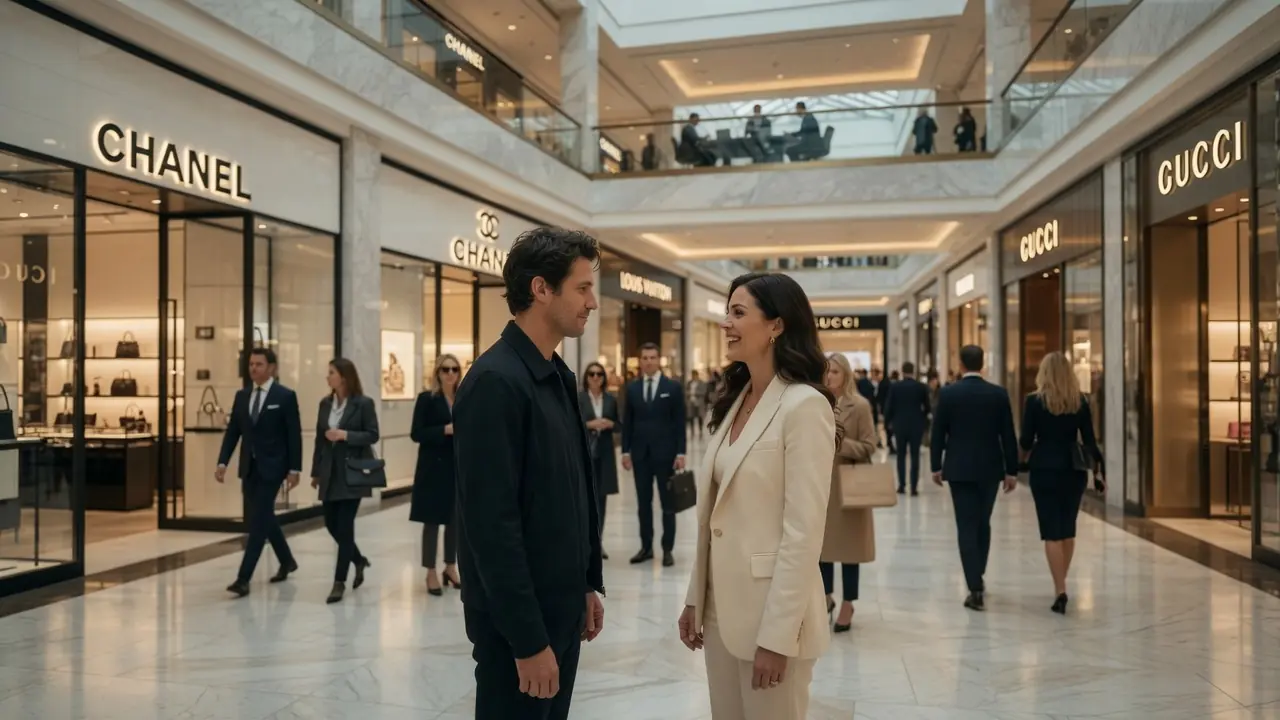
She was standing outside the Chanel storefront with her friend Marissa, both holding iced coffees and laughing about a boutique manager who had tried too hard to impress them. Claire wore a cream blazer, tailored pants, gold earrings, and a smile that had been practiced in mirrors for years. She had built her new life around looking successful, being seen in the right places, and making sure no one could confuse her with the girl who once lived in a small apartment with a man who worked too quietly and dreamed too slowly. Then Ryan stepped into view, and something cruel and familiar woke up inside her.
“Ryan?” she called, loud enough for people nearby to hear.
He stopped.
For a moment, neither of them moved. Ryan turned toward her with calm eyes and a face that revealed almost nothing. Claire smiled wider because his silence gave her the same old confidence she once had over him. She looked him up and down, letting the pause become public before she spoke again.
“Still dressing like nothing changed?” she said, turning slightly toward Marissa. “I guess some men really never move up.”
Marissa laughed because that was what friends like Marissa did when cruelty came dressed as charm. A couple walking past slowed down. A man near the jewelry store glanced over. Two teenagers by the escalator lifted their phones, not recording yet, just ready in case the moment became entertaining. Claire felt the attention and enjoyed it.
Ryan did not argue.
He did not remind her of the nights he worked two jobs while she went back to school. He did not mention the rent he paid alone after she quit her job to “find herself.” He did not talk about the small investment firm he had started from a folding table in his cousin’s garage after she told him he had no ambition. He only looked at her with a calmness that made her want to sharpen the insult.
“Appearances can be misleading,” Ryan said.
Claire tilted her head and laughed softly. “Please. You looked ordinary when I left you, and somehow you look even smaller now.”
Ryan’s expression did not change, but something in his eyes cooled. He had expected many things when he returned to Bellmont Galleria that day, but he had not expected Claire to be the first person to greet him. The mall had been part of his past in more ways than she knew. Years ago, before luxury storefronts and polished marble, before boardrooms and acquisition papers, Ryan had worked in the loading dock beneath this very building, unloading boxes before sunrise while Claire slept late and complained that he smelled like cardboard when he came home.
He had loved her then with the stubborn faith of a young man who believed effort would eventually be understood. Claire wanted movement, attention, brightness, and proof that life was rising. Ryan wanted stability first, then growth. He saved money in small amounts, invested carefully, studied lease agreements at night, and learned how commercial property worked while other men his age were trying to look rich before they ever became secure.
Claire never saw that as discipline.
She saw it as lack.
When she left him, she did not do it gently. She told him she was tired of waiting for a man who moved like life had no deadline. She said she needed someone with vision, someone who could walk into a room and make people notice. Ryan remembered standing in the doorway of their apartment while she packed, holding a cheap lamp in one hand because she could not decide whether to take it. Her final sentence stayed with him longer than the breakup itself.
“You’re a good man, Ryan,” she said. “But good doesn’t build a life worth showing off.”
That sentence had followed him for years.
At first, it hurt like a wound. Then it became fuel. Ryan did not become loud after Claire left. He did not buy expensive clothes to prove her wrong or post pictures of fake success online. He stayed quiet, worked harder, and made decisions that looked boring until they started changing everything.
He studied distressed commercial properties during the recession that followed. He found small retail centers no one wanted, helped restructure leases, repaired neglected buildings, and treated tenants with enough fairness that failing plazas became stable again. His company, Mitchell Urban Holdings, started with one strip mall on the edge of Aurora and grew into a private investment group that specialized in saving troubled retail spaces from foreclosure. By thirty-six, Ryan had more influence in commercial property than Claire would ever have imagined.
Bellmont Galleria was his newest project.
The mall had been declining behind its beautiful walls. Luxury brands still occupied the main level, but upstairs vacancies were rising, small vendors were being crushed by unfair lease renewals, and the old ownership group had nearly defaulted twice. Ryan’s company had quietly purchased the controlling debt, negotiated with lenders, and secured the right to lead a full redevelopment plan. That afternoon, the board was waiting upstairs to meet the man who would decide the mall’s future.
Claire knew none of that.
To her, he was still the man in the simple jacket.
She stepped closer, lowering her voice just enough to make the cruelty feel personal but still audible. “Are you here to window-shop, Ryan? Or did you come to remember what success looks like from the outside?”
Marissa covered her mouth, laughing again.
Ryan looked past Claire for a moment at the upper level, where a glass railing ran along the second floor. Behind it, near the private elevator, two men in suits stood waiting and watching anxiously. He recognized one of them as Paul Whitaker, the mall director. Paul had been texting him for ten minutes, worried because the board meeting was already delayed.
Ryan looked back at Claire. “You still think success is something people wear.”
Claire’s smile tightened. “And you still think silence makes you deep.”
“No,” Ryan said. “Silence just keeps me from wasting words on people who only respect noise.”
That line landed harder than Claire expected. For half a second, her face flickered. Then she recovered, letting her voice turn sharper. “Don’t act above this. You were never above anything. You were the man who counted coupons, drove an old car, and called it responsibility.”
“I remember,” Ryan said.
“I left because I wanted a real life.”
“I remember that too.”
A small crowd had formed now. Not large, but enough to make the air around them feel staged. Claire noticed and straightened her shoulders. She had always performed best with an audience. Her friend Marissa stood beside her, smiling like she was watching the final scene of a story where the ex-boyfriend was supposed to shrink.
Then Paul Whitaker came rushing through the walkway.
He was a polished man in his fifties, silver-haired, wearing a navy suit and a Mall Director badge clipped discreetly to his lapel. He moved quickly, but not casually. He looked nervous, almost embarrassed, as if he had been forced to interrupt something he wished had never happened. Claire saw him approaching and assumed he was coming to ask what the disturbance was about.
Instead, Paul stopped beside Ryan and lowered his voice with deep respect.
“Mr. Mitchell, the board is waiting for you upstairs.”
The entire space changed.
Claire’s smile faded slowly, not all at once. First her eyes narrowed, confused by the formality. Then her mouth parted slightly. Marissa stopped laughing. The couple near the jewelry store turned fully toward them, and one of the teenagers whispered, “Wait, that’s him?”
Ryan did not look surprised. He only nodded. “Thank you, Paul. I’ll be up in a minute.”
Paul glanced at Claire, then back at Ryan. He had heard enough to understand that something unpleasant had happened. “Would you like security to clear the area?”
“No,” Ryan said calmly. “There’s nothing to clear.”
Claire forced a laugh, but it came out thin. “Mr. Mitchell?”
Paul looked at her, confused. “Yes. Ryan Mitchell, managing partner of Mitchell Urban Holdings.”
Claire’s face went pale.
Paul continued, unaware of how each word was cutting through her confidence. “His firm is leading the Bellmont redevelopment. The board has been waiting for his approval on the new ownership transition.”
Marissa looked at Claire quickly. The audience around them grew quieter. The Chanel sign behind Claire glowed brightly, suddenly making her look less powerful and more exposed.
Claire swallowed. “Ryan… you own this mall?”
Ryan looked at her for a long moment. “Not in the way people like you brag about owning things.”
Paul answered anyway. “Mitchell Urban Holdings controls the redevelopment authority and majority financial interest.”
Claire blinked as if the words were too large to fit the version of Ryan she had kept in her memory. The man she had mocked as ordinary was not standing outside success. He had walked into the building as the person everyone upstairs had been waiting for. The simple jacket, the quiet face, the lack of performance — none of it meant failure.
It meant he no longer needed strangers to recognize him.
Ryan stepped slightly past her, but Claire reached for words before he could leave. “I didn’t know.”
He stopped.
That sentence irritated him more than the insults. Not because it was false, but because it revealed the entire problem. She was not sorry for how she had spoken when she thought he was nobody. She was shaken because she had discovered he was somebody.
Ryan turned back. “That’s always been your weakness, Claire. You only regret cruelty after status corrects you.”
Her face flushed. “That’s not fair.”
“Neither was what you said.”
Marissa looked down at her coffee. People nearby were still silent, the kind of silence that made every sentence feel permanent. Claire tried to gather herself, smoothing the front of her blazer as if appearance could restore control.
“I was joking,” she said.
Ryan almost smiled. “No. You were comfortable.”
That left her with nothing easy to say.
Paul cleared his throat gently. “Mr. Mitchell, they’re waiting.”
“I know.”
Claire stepped closer, lowering her voice. “Ryan, can we talk?”
“We just did.”
“No, I mean privately.”
He looked around the mall walkway, then back at her. “You made it public.”
She flinched because she had. She had wanted people to hear when she mocked him. She had wanted her friend to laugh, wanted strangers to see that she had moved beyond him, wanted the old story to remain intact with her standing above him. Now that the story had turned against her, privacy suddenly looked appealing.
Ryan’s phone buzzed. A message from the board chair appeared on the screen. He did not read it fully. He looked at Claire one last time.
“You once told me good didn’t build a life worth showing off,” he said. “You were wrong. Good built quietly. Good paid attention. Good kept going after you stopped watching.”
Claire’s eyes filled unexpectedly.
Ryan did not soften too quickly. He had learned that tears could be real and still not erase harm. “I hope one day you learn the difference between being seen and being valuable.”
Then he walked toward the private elevator with Paul.
The crowd parted without being asked.
Claire stood frozen in the middle of the walkway. The mall lights seemed brighter than before, almost unforgiving. Marissa touched her arm lightly, but Claire pulled away. For the first time in years, she did not want someone beside her laughing.
Upstairs, the boardroom overlooked the mall through a wall of glass. Ryan entered to find twelve people waiting around a long table: investors, tenant representatives, legal counsel, and two members of the old ownership group. They all stood when he came in. That still made Ryan uncomfortable, though he had learned not to show it.
“Sorry for the delay,” he said.
The board chair, Helen Graves, studied his face. “Everything all right?”
Ryan set his folder on the table. “Just ran into someone from an old life.”
Helen nodded like she understood more than he said. “Old lives have a way of asking whether we’ve changed.”
Ryan glanced down through the glass at the mall floor below. Claire was still there, smaller from this height, standing near the store where she had tried to make him feel small. “Sometimes they ask whether they have.”
The meeting began.
For two hours, Ryan reviewed the redevelopment plan. He did not speak like a man trying to impress anyone. He spoke clearly, carefully, and with the same quiet discipline Claire had once dismissed. He explained how the mall could survive only if the redevelopment served more than luxury brands.
He wanted part of the upper level converted into local retail spaces with lower introductory rents. He wanted underused corridors transformed into medical offices, after-school learning centers, and small business incubators. He wanted to keep anchor brands but stop treating them as the only reason the building existed. He wanted Bellmont Galleria to become a place people used, not just a place people photographed.
One old ownership member resisted. “Luxury image is what made this mall.”
Ryan looked at him. “Luxury image is what made it fragile.”
The room went quiet.
He continued, “A mall cannot survive on people who come to pose and leave. It survives on tenants who can pay sustainably, customers who return, and a community that feels welcome inside it. We are not redeveloping a museum for expensive bags. We are rebuilding a living property.”
By the end of the meeting, the board approved his plan.
When Ryan left the boardroom, Paul walked beside him toward the elevator. “I apologize for what happened downstairs.”
Ryan shook his head. “You didn’t do it.”
“No, but the mall is mine to manage.”
Ryan appreciated that answer. Accountability mattered to him. Not the loud kind that appeared only after public embarrassment, but the quiet kind that made people examine what had happened under their roof.
“Make sure security doesn’t bother her,” Ryan said.
Paul looked surprised. “Ms. Bennett?”
“Yes. She doesn’t need punishment from the mall.”
Paul nodded. “Understood.”
When Ryan reached the main level again, Claire was sitting alone on a bench near the fountain. Marissa was gone. The iced coffee sat untouched beside her, the ice melted into pale liquid. She looked up when she saw him, and for once, there was no performance in her face.
“I waited,” she said.
“I see that.”
“I didn’t know whether you’d come back down this way.”
“You could have left.”
“I know.”
Ryan stood a few feet away. He did not sit. Sitting would have made the moment feel kinder than it was.
Claire folded her hands in her lap. “I’m sorry.”
He waited.
She took a breath. “Not because of the board. Not because of the mall. I mean, that shocked me, obviously, but…” She stopped and looked down. “I’m sorry because I heard myself. When you walked away, I kept hearing what I said, and I realized I sounded exactly like the people I used to hate.”
Ryan’s expression stayed guarded, but he listened.
Claire continued, “When we were together, I was scared of being ordinary. I thought if I stayed with you, my life would become small. Then I spent years chasing rooms where people looked successful, and most of them were emptier than our old apartment ever was.”
“That doesn’t explain why you mocked me.”
“No,” she said. “It doesn’t. I mocked you because I needed the story to stay true.”
“What story?”
“That I left because you were going nowhere.” Her eyes filled. “If you became someone without becoming flashy, then maybe I left because I didn’t know how to recognize value.”
Ryan looked toward the fountain. Water moved over white stone, smooth and controlled, unlike anything he felt in his chest. He had imagined conversations like this years ago. In those fantasies, he was sharper, colder, more victorious. Real life made victory feel quieter and less satisfying.
“You hurt me when you left,” he said. “But what bothered me most was not that you wanted more. It was that you needed me to be less so you could justify leaving.”
Claire nodded, tears falling now. “I know.”
“No,” Ryan said. “You know now.”
She accepted the correction.
A mother and child walked past them toward the escalator. Somewhere nearby, a store employee laughed. The mall continued around them as if their old pain were just another private conversation under public lights.
Claire wiped her face. “Are you happy?”
The question surprised him.
Ryan thought about it seriously. He thought about his company, the board meeting, the redevelopment plan, the money he had made, the lonely hotel rooms, the years of work, and the quiet apartment he returned to most nights. “Some days,” he said.
She gave a small, sad smile. “Still honest.”
“I try.”
“I hope you become happier than I thought you could be.”
Ryan looked at her then. That was the closest she had come to blessing the life she once dismissed. It did not fix the past, but it loosened something.
“I hope you become kinder than you needed to be today,” he said.
Claire nodded, crying harder now but quietly.
Ryan walked away after that. Not cruelly. Not dramatically. He simply left because some conversations are not meant to end with reunion. Some are meant to return dignity to the person who lost it and truth to the person who avoided it.
Months passed.
Bellmont Galleria changed slowly at first. Temporary walls went up on the second floor. Empty storefronts became small business spaces. A pediatric clinic opened where a luxury luggage store had failed. A local bookstore moved into a corner unit that had sat dark for eight months. Foot traffic rose, not because the mall became flashier, but because it became useful again.
Ryan visited often, usually in the same simple jacket. Tenants learned his name. Maintenance workers spoke to him without fear. Store owners stopped seeing him as a distant investor and started seeing him as the man who asked whether the loading dock lights worked and whether rent terms were clear enough to plan around.
One afternoon, he passed the same Chanel storefront where Claire had mocked him. A young employee was helping an elderly woman compare handbags, speaking with real patience. Ryan paused, watched for a moment, and smiled faintly. Places remember behavior, he thought. But they can learn new behavior too.
Claire did not contact him again for six months.
When she finally did, it was not a dramatic message. It was a short email.
“I opened a consulting studio for small nonprofits. Not glamorous. Real. I thought you should know I’m trying to build something that doesn’t depend on looking impressive. Thank you for what you said.”
Ryan read it twice.
He did not reply immediately. When he did, he wrote only four words.
“Build it well, Claire.”
A year after the mall incident, Bellmont held a public reopening event. There were no red carpets, no champagne towers, no empty luxury spectacle. There were local vendors, musicians, families, business owners, and a ribbon-cutting ceremony for the new community floor. Ryan stood near the back, trying to avoid the front of the cameras.
Helen Graves found him there. “You know they want you up front.”
“I know.”
“And?”
“I prefer the back.”
She laughed. “You own half the reason this worked, Ryan.”
He looked around at the crowded walkways, the open stores, the people who actually seemed to belong there. “No,” he said. “I helped make room. They made it work.”
Just before the ceremony began, Ryan saw Claire across the atrium. She stood near the second-floor railing, wearing a simple navy dress, no dramatic jewelry, no performance. She did not wave at first. She only looked at him with a quiet expression he had never seen from her before.
Respect.
Then she gave him a small nod.
Ryan nodded back.
That was all.
And somehow, it was enough.
Because the day she mocked him in the mall, Claire believed she was looking at the same man she had left behind. Same simple jacket. Same quiet face. Same lack of show. But she had mistaken consistency for failure, humility for lack, and silence for emptiness.
Ryan Mitchell had changed, but not in the way she understood.
He had not become louder. He had not become cruel. He had not become the kind of man who needed an expensive suit to prove he mattered. He had simply built a life so solid that it did not need to announce itself in the walkway of a mall.
Claire had laughed because he looked unchanged.
Then the director came running, the board waited upstairs, and the truth stepped into the light.
Appearances had been misleading.
But not his.
Hers.