In 2024, three SUVs rolled into a small Georgia town, the kind of vehicles nobody in Hadley Springs had ever seen before.
They were the kind that cost more than most houses there, polished and powerful against the dusty roads and aging storefronts.
Eight hundred people gathered in the town square while CNN cameras pointed toward a wooden stage. 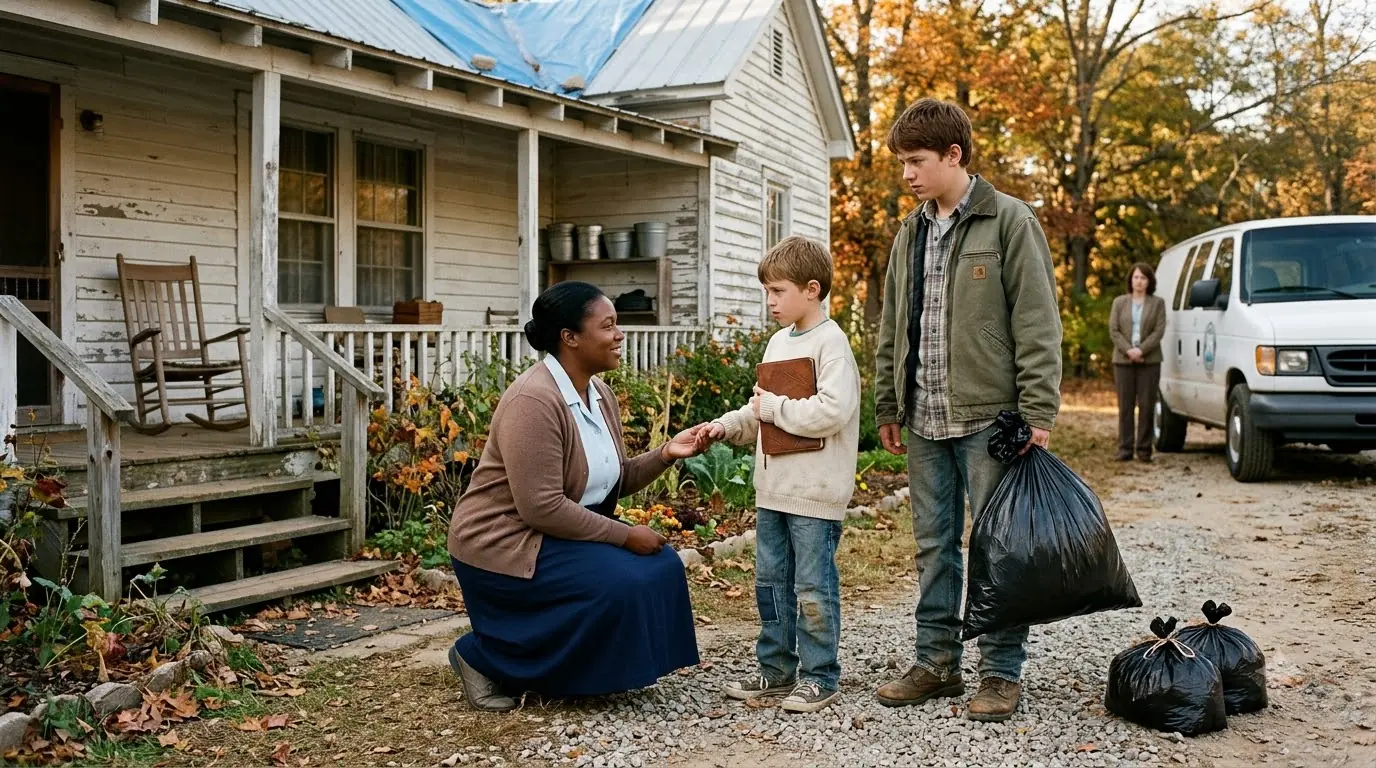
Standing on that stage was a sixty-five-year-old woman with tears streaming down her face and both hands trembling at her sides.
Twenty years earlier, she had welcomed three white boys nobody else wanted. They were three brothers the entire town had rejected, and she raised them with little more than love, discipline, and prayers whispered in the darkness.
Then they were ripped away from her.
She never saw them again until that day.
What she did not know was that those three boys had grown into some of the most powerful men in the Southeast. What they did next would make the entire town confront what it had done.
To understand that moment, the story must return to 2004, to a woman who had no idea her life was about to change forever.
Hadley Springs, Georgia, had a population of approximately twenty-eight hundred people. It had one gas station, one church, and one grocery store that closed every evening at six.
It was the kind of town where everybody knew everybody else. It was also the kind of town where everybody had an opinion about everybody else.
Beatrice Owens lived in a three-bedroom house her grandmother had built in 1955. The wooden floors creaked beneath every step, and a rocking chair rested on the wraparound porch.
Behind the house was a vegetable garden Beatrice tended every morning before sunrise. She was forty-five years old, unmarried, and without children, though not because she had never wanted them.
Beatrice had dreamed of becoming a mother for as long as she could remember. After two miscarriages in her thirties, however, she had stopped trying.
Eventually, she stopped hoping too.
She poured the love she had intended for children into the young people in her Sunday-school class, stray cats that appeared near her porch, and rows of tomato plants in the garden.
Beatrice worked two jobs. During weekday mornings, she served food inside the elementary-school cafeteria, and on weekends she cleaned the county courthouse.
Her monthly income was approximately one thousand two hundred eighty dollars. The mortgage required six hundred twenty dollars, leaving very little for utilities, food, transportation, and repairs.
The roof had been leaking since February. A blue tarp covered one corner of the living room, and three buckets caught the water whenever it rained.
The repair estimate was three thousand four hundred dollars. Beatrice had seven hundred eighty dollars in savings.
She applied for a home-repair grant through the county and waited four months. Each time she called, the woman at the office told her she remained in the queue.
Beatrice did not complain.
That was not her way.
Every Sunday, she sat in the third pew at Greater Hope Baptist Church. Pastor Raymond Coleman knew she brought potato salad to every community dinner, volunteered before anyone else, and remained behind to clean after everyone had gone home.
He watched the way Beatrice interacted with the children after services. She knelt to their level, listened without interrupting, and treated every small problem as though it deserved her complete attention.
Pastor Coleman noticed something the rest of the town often overlooked.
Beatrice Owens had a gift for broken things.
Her neighbor Denise Harper visited most Tuesdays. They sat on the porch drinking sweet tea while Denise’s children played in the yard.
“B, have you ever considered leaving this place?” Denise asked one afternoon. “Your cousin in Atlanta has room.”
Beatrice smiled, tired but warm.
“And who would take care of Grandma’s tomatoes?” she asked. “Who would make sure Pastor Coleman does not put too much sugar in the lemonade?”
She laughed, but Denise could see the loneliness behind her eyes.
It sat there like a permanent guest that never left.
Every night, Beatrice prayed the same prayer she had been repeating for fifteen years.
“Lord, if I am meant to be a mother, send me someone to love. If I am not, help me make peace with this empty house.”
She had made peace with it, mostly.
Above the fireplace hung a small wooden plaque carved by her grandmother decades earlier. Its edges had been worn smooth through years of careful dusting.
The words read:
A HOUSE BECOMES A HOME WHEN IT HOLDS SOMEONE ELSE’S PAIN.
Beatrice had read those words thousands of times. She was about to discover what they truly meant.
Hadley Springs was not openly hostile. There were no public displays of hatred and no shouted insults in the street.
The prejudice existed in quieter forms.
When Beatrice entered the grocery store, conversations sometimes paused for a second before resuming. When she applied to become a substitute teacher, despite having thirty college credits and being only fifteen credits short of a degree, the school board thanked her for applying and never contacted her again.
She told herself it did not bother her.
She told herself she was satisfied working in the cafeteria and cleaning courthouse floors.
On certain nights, however, while lying inside the silent house, she wondered what it might feel like to be chosen for something.
What would it feel like to be someone’s first choice instead of the last available option?
She did not yet know that she was about to find out.
The telephone rang on a Tuesday night.
Carolyn Mitchell, a county social worker, was on the other end. Beatrice had known her since high school, back when she was Carolyn Baker.
“B,” Carolyn said, her voice strained. “I know this is last minute, and I know it is a great deal to ask.”
Beatrice sat straighter.
“I have three boys,” Carolyn continued. “They are brothers, and nobody will take them. I mean nobody.”
Beatrice’s heart began beating faster.
“They have been through four foster homes in eighteen months,” Carolyn said. “At the last home, there was an incident.”
“What kind of incident?”
Carolyn remained silent for several seconds.
“The kind that makes people stop asking questions and begin closing doors.”
Beatrice looked toward her grandmother’s plaque above the fireplace.
A house becomes a home when it holds someone else’s pain.
“Carolyn,” she said slowly, “tell me about the boys.”
What Carolyn told her next changed everything.
What Carolyn did not explain, because she did not fully understand it herself, was why those three boys appeared to have been erased from every important record.
No relatives had come forward.
Years earlier, a family sharing their last name had been mentioned in Atlanta newspapers and connected to significant wealth.
Carolyn did not know the complete story.
Neither did Beatrice.
“Three boys?” Beatrice repeated, tightening her grip on the telephone cord. “They are all brothers?”
“Yes,” Carolyn answered. “James is fourteen. Daniel is eleven, and Thomas is eight.”
“Why will nobody take them?”
Carolyn hesitated.
“There is history connected to the family, B. There are things I cannot discuss, but I promise you these boys are not dangerous.”
She drew a breath.
“They are hurt.”
The youngest, Thomas, had not spoken for six weeks. Not one word.
Daniel had been suspended from school three times for fighting. Every fight began because he believed someone was threatening one of his brothers.
“And James?” Beatrice asked.
“James is fourteen years old,” Carolyn said. “But he speaks like a boy who does not expect to live until eighteen.”
Beatrice closed her eyes.
“What happened to their parents?”
“A car accident eight months ago. Both died immediately.”
“And no family came for them?”
Carolyn was silent again.
“There may be family somewhere, but nobody has claimed them. At this point, the state has mostly stopped searching.”
Beatrice’s jaw tightened.
Three children had lost their parents, their home, and every adult they thought they could trust. They had been moved through four foster placements, and the system was preparing to separate them.
“If I cannot find a placement by Friday, they will be divided,” Carolyn said. “Three group homes in three different counties.”
Beatrice’s chest tightened.
“They have already lost everything,” Carolyn whispered. “Each other is all they have left.”
Beatrice looked around her small house.
She saw the leaking roof, the plastic buckets, the flapping tarp, and the empty bedrooms she had stopped entering years earlier.
She thought about the seven hundred eighty dollars in her savings account.
Then she imagined an eight-year-old child who had decided the world was no longer worth speaking to.
“Carolyn.”
“Yes?”
“Bring them here.”
Friday arrived gray and cold. October wind scattered leaves across Beatrice’s porch as the county van stopped in front of the house.
It was a van rather than a sedan because it needed enough room for three boys and everything they owned.
Everything they possessed fit inside three garbage bags.
Carolyn accompanied them along the path.
The oldest boy walked first.
James was fourteen but carried himself like an adult. His jaw was set, his hands clenched, and his eyes constantly searched for threats.
He had effectively been the parent for four years, since he was ten and the adults in his life began falling apart.
Daniel followed.
At eleven, he was lean, tense, and constantly alert. A fading yellow bruise surrounded his left eye, and his gaze moved across the property as though identifying possible escape routes.
Thomas remained behind both brothers.
He was eight years old and small for his age. He held a battered leather notebook against his chest like a shield.
Beatrice first noticed the holes in both toes of his shoes.
Then she noticed the notebook.
Its leather was old, the edges worn, and a pair of gold initials had nearly disappeared from one corner.
H.W.
Beatrice did not think much about the initials at the time.
She should have.
Beatrice did something none of the boys’ previous foster parents had done.
She stepped off the porch, walked down the path, and knelt until she was at Thomas’s eye level.
“I am Miss B,” she said softly. “This is my house, and for as long as you are here, it is your house too.”
James stared at her.
He had heard similar speeches before. Every foster family began with promises and comforting words.
“I have three rules,” Beatrice continued. “We eat together. We do not lie to each other, and nobody in this house goes to bed without knowing they are loved.”
Daniel gave a small, skeptical laugh.
“That is four rules.”
Beatrice did not hesitate.
“The fourth one is not a rule,” she said. “It is a promise.”
Something briefly changed inside James’s eyes.
Across the street, seventy-year-old Edna Cartwright watched from behind her curtains. She was president of the garden club, and her lips tightened as she studied the scene.
Three houses away, Sheriff Earl Dawson slowed his patrol car. He looked toward Beatrice and the boys, made a silent note of what he had seen, and continued driving.
Beatrice felt people watching.
She had felt eyes like theirs her entire life.
That day, for the first time, she did not care.
She reached toward Thomas and gently took his hand.
“Come inside,” she said. “I made dinner.”
That first night, they sat around her kitchen table eating baked chicken, rice, and green beans from the garden.
James and Daniel ate as though they expected the food to disappear. They moved quickly, glancing around between bites.
Thomas only pushed the food around his plate.
He did not eat or speak.
“Thomas, honey,” Beatrice said gently, “you do not have to talk, but you need to eat something.”
“Only a little.”
He looked up at her.
It was the first time in weeks that he had made direct eye contact with an adult.
Slowly, Thomas lifted his fork and took one bite.
Beatrice’s eyes filled with tears.
She blinked before anyone noticed.
What none of them knew was that someone powerful was already searching for those boys.
When he eventually found them, everything would begin falling apart.
The first six months were the most difficult.
James tested Beatrice constantly. He returned home late without explaining where he had been, argued with her, slammed doors, and waited for her to abandon him like everyone else.
She never did.
One Tuesday night, James arrived at eleven.
Beatrice was waiting on the porch with a plate of food resting on her lap.
The meal was still warm.
“I do not know where you were,” she said calmly. “Eventually, you are going to tell me because honesty is one of our rules.”
James prepared himself for shouting or punishment.
“But right now, you are going to eat,” Beatrice continued. “Because feeding you is one of my promises.”
James stared at her in confusion.
There was no lecture and no threat.
There was only a plate of chicken and a woman who refused to give up.
He sat down and ate.
The following Tuesday, James returned home before nine.
Daniel’s pain came through his fists.
The principal contacted Beatrice three times in two months. Daniel fought in the hallway, on the playground, and whenever he believed someone had looked at his brothers the wrong way.
Beatrice attended every meeting.
She sat beside him and held his hand beneath the table where nobody could see.
“Mrs. Owens,” the principal said sternly, “this behavior is unacceptable.”
“It is Miss Owens,” Beatrice corrected. “And I agree.”
Then she leaned forward.
“But I am curious. Has anyone asked this boy why he is fighting, or do all of you skip directly to the punishment?”
The principal had no answer.
That weekend, Beatrice drove Daniel to the community center and enrolled him in a youth boxing program.
“You want to throw punches?” she told him. “Fine, but you will do it correctly, with gloves, rules, discipline, and respect.”
Daniel found something inside the boxing ring.
He found control.
He found discipline and a way to release the anger that had been consuming him.
He began returning home exhausted instead of furious.
Thomas remained silent.
He did not speak for eight weeks.
Beatrice never pressured him.
Every night, she sat beside his bed and read aloud.
She read Charlotte’s Web, The Chronicles of Narnia, and Where the Red Fern Grows.
Thomas listened.
His eyes followed every word.
During the ninth week, Beatrice tucked the blanket around him.
“Miss B?”
Her heart stopped.
His voice was barely a whisper, rough from disuse.
“Yes, baby?”
“Will you still be here in the morning?”
Beatrice’s eyes burned.
She blinked hard.
“I will be here in the morning,” she said. “I will be here the morning after that and every morning you need me.”
That night, Thomas slept without nightmares for the first time since his parents died.
Then January arrived.
Everything nearly fell apart.
A sudden ice storm struck Georgia, the worst the region had experienced in twenty years. Electrical lines failed across the county, and the temperature fell to eighteen degrees.
Beatrice’s house lost power at two in the morning.
She wrapped the boys in every blanket she owned and gathered them together inside the living room.
The temperature continued dropping.
The tarp across the leaking roof froze solid. Ice began forming along the interior edges of the windows.
Then Thomas started coughing.
At first, it was occasional.
Then the coughing became constant, his body began shaking violently, and his lips turned blue.
Beatrice touched his forehead.
He felt dangerously hot and cold at the same time.
Her old sedan had stopped running two months earlier.
The telephone lines were down, and the nearest neighbor lived a quarter mile away across roads covered with ice.
Thomas’s breathing became shallow.
Beatrice made a decision.
“James, Daniel, stay here,” she said. “Keep your brother warm. Lie beside him if you have to.”
“Where are you going?” James asked, his voice cracking.
“To find help.”
Beatrice put on her grandmother’s old coat and wrapped a scarf around her face.
Then she walked into the storm.
The world outside was white chaos.
Ice covered every surface. Trees bent beneath the weight, and the wind screamed so loudly that Beatrice could barely hear her own thoughts.
She walked one step at a time.
Denise Harper’s house was a quarter mile away.
Beatrice fell twice.
Both times, she stood and continued.
Her hands became numb first.
Then she lost feeling in her feet and face.
Still, she kept walking.
When Beatrice finally reached Denise’s house, she struck the door with both fists. She did not stop until Denise opened it.
“B?”
Denise’s eyes widened.
“What in God’s name happened?”
“Thomas,” Beatrice managed to say. “He cannot breathe.”
She struggled for air.
“I need your truck now.”
They reached the hospital, barely.
The emergency-room physician diagnosed Thomas with early hypothermia and a serious respiratory infection.
Another hour inside the freezing house could have resulted in pneumonia or something worse.
Beatrice remained in the waiting room until sunrise.
James and Daniel pressed against her sides.
All three were exhausted and terrified, but they were alive.
At approximately four in the morning, James finally spoke.
“Why are you doing this?”
Beatrice looked at him.
“Doing what, baby?”
“This.”
He gestured toward the hospital.
“All of this.”
His voice broke.
“We are not even yours.”
Beatrice remained quiet for a long moment.
Then she placed one arm around him.
“My grandmother once told me something,” she said. “She said family is not about blood.”
“Family is about who shows up when the ice comes.”
She pulled him closer.
“I am showing up. That is all I know how to do.”
James did not move away.
For the first time since his parents died, he allowed himself to lean against someone.
After that night, something changed.
James began calling her Mama B instead of Miss B.
Daniel stopped studying every building for possible escape routes.
Thomas drew her a picture.
It showed a house with a yellow roof and four stick figures holding hands.
At the top, he had written MY FAMILY.
The spelling was imperfect.
The picture was perfect.
Beatrice placed it on the refrigerator.
Not everyone in Hadley Springs viewed the family the same way.
One afternoon, Edna Cartwright stopped Beatrice outside the grocery store.
“Beatrice, I have known you since you were a child,” Edna said, her voice cold. “People are talking.”
She lowered her voice.
“Three white boys living in your house does not look right.”
Beatrice met her gaze.
Her voice remained calm, but there was steel beneath it.
“Mrs. Cartwright, I appreciate your concern, but those boys needed a home, and I had one.”
She adjusted the grocery bag in her arms.
“Now, if you will excuse me, I have dinner to prepare.”
Beatrice walked away without looking back.
Her hands were shaking, but she did not let anyone see.
News of the hospital journey spread through town.
Many people admired what she had done.
Others did not.
Whispers followed Beatrice through the grocery store, the church, and even the courthouse where she cleaned floors.
She heard them.
She continued holding her head high.
She continued showing up for the boys and being their mother in every way that mattered.
That was who Beatrice Owens was.
Neither gossip, judgment, nor an ice storm would change it.
What she did not know was that someone else was watching from far away.
Someone powerful had been searching for those boys for a long time.
He was about to arrive at her door.
Eighteen months passed.
There were eighteen months of homework at the kitchen table, Sunday dinners filled with too much laughter and not enough chairs, bedtime stories, boxing practice, and ripe tomatoes from the garden.
The boys grew taller and stronger.
More importantly, they became whole.
James smiled now.
His smiles were genuine and reached his eyes.
He had begun discussing college and the possibility of becoming a social worker so he could help children like himself.
Daniel won the county youth boxing championship.
He brought home a gold medal and hung it on the refrigerator beside Thomas’s drawing.
Thomas was reading two grade levels above his age.
He remained quiet, but it was a healthy quiet now.
It meant he was thinking rather than hiding.
Beatrice submitted the documents for formal adoption.
Carolyn guided her through each step.
The process moved slowly through mountains of forms, background investigations, and home inspections.
Still, it was moving forward.
One Sunday evening, all four of them sat on the porch after dinner.
The setting sun painted the garden gold and pink.
Thomas read aloud from his leather notebook.
He had begun filling it with his own stories about brave knights, dragons, and enchanted kingdoms.
Beatrice listened to every word.
Daniel lay back and tossed a tennis ball into the air, catching it repeatedly.
James sat beside Beatrice and helped shell peas.
His hands moved automatically because they had completed the same task many times.
“Mama B?”
Beatrice’s heart still skipped whenever he used the name.
“Yes, baby?”
“I wanted to say something.”
James looked down at the peas.
“Thank you for not giving up on us.”
Beatrice placed the bowl aside and took his hand.
“Baby, I could never give up on you.”
“Not ever.”
The moment felt perfect and complete.
None of them noticed the car parked at the end of the road.
It had been there for three days.
Watching.
Beatrice noticed it the following afternoon.
The vehicle was parked beyond the old oak tree with the engine off.
Its windows were tinted too deeply for her to see inside.
It was not a car from Hadley Springs.
It was too new, too expensive, and too out of place.
Beatrice mentioned it to Sheriff Dawson after church.
“It is probably someone who got lost,” he said. “City people following bad directions from their navigation systems.”
The car returned on Tuesday.
Then Wednesday.
Then Thursday.
It always occupied the same position.
It was always watching.
Friday afternoon, Beatrice was hanging laundry behind the house when she heard an engine.
This one sounded different.
Deeper.
She walked toward the front.
A limousine sat in her driveway.
It was long, polished, and completely wrong for the dusty road.
The rear door opened.
A man approximately seventy years old stepped out.
He had silver hair and wore a suit worth more than Beatrice’s mortgage.
His face was hard and controlled, like someone who had spent his life giving orders without hearing the word no.
A younger man followed him, carrying a leather briefcase.
The older man looked at the peeling paint, the tarp covering part of the roof, and the aging porch.
One corner of his mouth lifted with visible contempt.
Then he looked toward Beatrice.
“Miss Owens?”
“That is me.”
“My name is Harold Whitfield.”
He did not offer his hand.
“I am here for my grandchildren.”
Beatrice felt the ground shift beneath her feet.
“Your grandchildren?”
“James, Daniel, and Thomas.”
Harold spoke their names as though reading items from a list.
“They are my daughter’s children.”
“My blood.”
He straightened his suit.
“I have come to take them home.”
The screen door creaked behind Beatrice.
She turned.
James stood there with a pale face and his eyes fixed on the old man.
“You,” James whispered.
The word came out broken and jagged.
“You are the one she wrote letters to.”
“You are the one who never answered.”
Harold’s expression did not change.
“That is a conversation for another time.”
He glanced toward the man carrying the briefcase.
“For now, we need to discuss the legal situation. My attorneys will explain.”
Beatrice barely heard him.
She was watching James.
His hands had tightened into fists.
Eighteen months of healing appeared to crack apart in a single moment.
Beatrice knew everything was about to change.
The following three weeks were a nightmare.
Harold Whitfield was not merely wealthy.
He possessed the kind of power that bent laws and damaged people without visible effort.
His lawyers arrived with stacks of documents.
Birth certificates.
Genetic tests.
Custody petitions.
Their message was simple.
Harold Whitfield was the boys’ only living blood relative.
He had legal standing.
Beatrice had none.
She was a foster parent.
Temporary.
Disposable.
Beatrice hired a lawyer anyway.
He was the only attorney she could afford, charging eighty dollars an hour and only recently graduated from law school.
He faced an Atlanta legal team that charged more in one minute than Beatrice earned in a day.
Beatrice brought witnesses.
Pastor Coleman testified.
Denise Harper testified.
The physician who treated Thomas after the ice storm appeared.
Teachers described how the boys had changed.
None of it overcame Harold’s argument.
Blood.
In that Georgia courtroom, blood appeared to matter more than anything Beatrice had built.
The judge ruled in Harold’s favor.
Custody transferred immediately.
The morning the boys left, Beatrice stood on the porch where she had knelt eighteen months earlier and promised three frightened children they had found a home.
Now she watched that home being taken from them.
James approached first.
He was sixteen now, tall and physically strong.
His eyes had returned to those of a lost ten-year-old child.
“Mama B?”
His voice cracked.
“We do not want to leave.”
“Please tell them.”
“I know, baby.”
Tears streamed down Beatrice’s face.
“I know.”
She held his hands.
“I did everything I could, but the law does not understand what we are.”
Daniel embraced her so tightly she struggled to breathe.
His shoulders shook.
The boy who rarely cried sobbed against her.
“Do not let the anger win,” Beatrice whispered. “Remember what I taught you.”
“Control it.”
“Do not allow it to control you.”
Then Thomas stood before her.
He was small and silent.
The leather notebook rested in his hands.
Slowly, he held it out.
“Keep it for me, Mama B.”
His voice was steady, stronger than an eight-year-old’s voice should have needed to be.
“I will come back for it.”
Beatrice accepted the notebook and pressed it against her heart.
“I will keep it safe, baby.”
“I promise.”
James looked back one final time.
His eyes remained fixed on hers.
“We will come back, Mama B.”
“I swear.”
“No matter how long it takes.”
Harold’s driver opened the limousine door.
One by one, the boys climbed inside.
The door closed.
The engine started, and the car moved down the dirt road before turning the corner and disappearing.
Beatrice remained on the porch until the sun went down.
She stood alone, holding a leather notebook marked with the initials H.W.
She did not know she would not see the boys again for twenty years.
Twenty years is a long time.
It is enough time for a town to forget and for hope to weaken.
It is enough time for a woman to wonder whether the happiest period of her life had been a dream.
Beatrice never forgot.
She never stopped trying.
During the first year, she wrote one letter every week.
She mailed each one to Harold’s Atlanta address, the same location his lawyers listed in the court records.
Every letter was returned.
RETURN TO SENDER.
She attempted to call.
The number had been disconnected.
Whenever she located another number, it was disconnected too.
Beatrice hired a private investigator with two hundred dollars she did not have.
He discovered that the boys had been sent to an expensive boarding school in New England.
Visitors were not allowed without authorization.
Beatrice drove eight hours to the school.
She stood outside the iron gates and begged to see them.
The security officer remained polite but firm.
“Ma’am, Mr. Whitfield’s instructions are clear.”
“You are on the restricted list.”
“I am sorry.”
Beatrice drove eight hours home alone.
After that, the trail disappeared.
There was no forwarding address, no working telephone number, and no way to reach them.
Harold Whitfield erased Beatrice from his grandchildren’s lives as thoroughly as though she had never existed.
Meanwhile, Hadley Springs turned against her.
Rumors spread quickly.
They were the kind of stories that almost sounded reasonable to people who did not know the truth.
“Someone said the grandfather discovered she was mistreating them.”
“Why else would a wealthy man travel all that way?”
“She probably only wanted the foster-care payments.”
Nobody said those words directly to Beatrice.
She heard the whispers anyway.
She saw the sideways glances and felt conversations stop when she entered rooms.
In 2010, the school board eliminated her cafeteria position.
They called it a budget reduction.
Beatrice suspected another reason.
Edna Cartwright sat on that board.
Beatrice found work cleaning private homes, offices, and any other place willing to pay her.
Then 2015 arrived.
She found a lump in her breast.
At first, Beatrice tried to ignore it.
Eventually, she could not.
The diagnosis was early-stage breast cancer.
It was treatable, but treatment required money.
Beatrice had no health insurance, savings, or financial support.
She sold her only car for three thousand two hundred dollars.
She obtained a second mortgage against her grandmother’s house.
She sold the jewelry her grandmother had left her, the final pieces of her inheritance.
Beatrice underwent six months of chemotherapy alone.
Denise drove her to every appointment.
She held Beatrice’s hand while she became ill and brought soup when she could not eat.
Beatrice survived.
The cancer did not.
The debt remained.
Twenty-eight thousand dollars was added to her mortgage.
Then the year 2020 arrived.
The pandemic closed the courthouse and eliminated nearly all of Beatrice’s cleaning jobs.
She was sixty-one years old with no income, no savings, and a mortgage she could not pay.
Beatrice accepted every small job she could find.
She babysat for five dollars an hour, sold cornbread for three dollars each, and pulled weeds for neighbors who had once spread rumors about her.
Every night, she continued praying.
Not for herself.
For them.
“Lord, keep my boys safe.”
“Keep them healthy and happy.”
“If it is Your will, let them know I never stopped loving them.”
Harold Whitfield died in 2020.
Beatrice discovered it through a short obituary in the Atlanta Journal.
It described him as a billionaire philanthropist and founder of Whitfield Capital Partners.
The obituary said he was survived by three grandchildren.
Her boys.
Beatrice began searching again.
She used computers at the public library and asked Carolyn Mitchell to check old records.
There was nothing.
James, Daniel, and Thomas had disappeared completely into Harold’s world.
What Beatrice did not know was that the three young men were searching for her too.
After Harold died, everything changed.
His will was opened.
James, Daniel, and Thomas each inherited approximately six hundred million dollars.
The first thing James did was hire the best investigator money could purchase.
“Find Beatrice Owens,” he ordered. “Whatever it takes.”
Beatrice had almost no digital presence.
She had no social-media profile, cellular telephone, or email account.
She continued living in the same house and using the same landline number.
The investigator’s letters were lost, mistaken for unwanted mail, or returned because of formatting errors in the address.
The search lasted four years.
There were dead ends, incorrect leads, and near discoveries.
In early 2024, the investigator finally confirmed the truth.
Beatrice Owens was alive.
She remained in Hadley Springs, still living inside her grandmother’s house.
She was barely holding on.
In 2023, the bank had mailed a notice.
Beatrice was three months behind on mortgage payments.
She owed two thousand four hundred dollars and had thirty days to pay before foreclosure proceedings began.
That night, Beatrice sat inside the same kitchen where she had fed three hungry boys twenty years earlier.
She held Thomas’s leather notebook.
It remained unopened.
It was still waiting for him.
Outside, the roof continued leaking.
The buckets still caught water.
Beatrice had one hundred forty-seven dollars inside her account.
“Lord,” she whispered, “I do not know what to do anymore.”
“I have nothing left.”
She looked at the notebook and traced the gold initials with one finger.
H.W.
“If I cannot see them again, at least let them know.”
“Let them know I kept my promise.”
“I kept it safe.”
“I loved them every single day.”
Beatrice did not know that three men were already traveling toward her.
They drove through the night for six hundred miles, racing against time.
They had finally found her.
They would not lose her again.
Their return would change everything, not only for Beatrice but for the town that had abandoned her.
On a Saturday morning in the spring of 2024, Beatrice sat on the porch holding Thomas’s notebook and watching the empty road.
Seven days remained before the bank took her house.
She had mostly made peace with it.
The house was only walls and wood.
What mattered was what had happened inside it.
The memories and love could not be taken through foreclosure.
Still, the thought of leaving hurt.
Beatrice decided to work in the garden one final time.
If she had to surrender the property, she wanted her grandmother’s tomatoes to look their best.
She was watering the plants when she heard engines.
They did not sound like the pickup trucks normally traveling along the road.
The sound was deeper and smoother.
Beatrice looked up.
Three SUVs moved slowly along the dirt road like a procession.
They were the kind of vehicles that did not belong in Hadley Springs, the kind that cost more than local houses.
Neighbors stepped onto their porches.
Edna Cartwright pressed her face against the window.
The SUVs stopped outside Beatrice’s home.
The doors opened.
The first man stepped out.
He was tall, with broad shoulders, a gray suit, and a confident posture.
Something about his eyes made Beatrice place one hand against her chest.
It could not be.
The second man emerged.
He was muscular, carried himself with military discipline, and had a scar across one forearm.
Then the third appeared.
He was slender and wore glasses.
His expression was gentle, and his blue-green eyes were identical to those of a frightened eight-year-old who once refused to speak.
The watering can slipped from Beatrice’s fingers.
“Thomas?”
The man wearing glasses smiled.
It was the same shy smile she remembered from twenty years earlier.
“Hey, Mama B.”
His voice cracked.
“I came back for my notebook.”
Beatrice could not move or breathe.
James stepped forward.
He was the boy who had tested her every day, returned home late, and eaten her food in silence before finally learning to call her Mama.
“We promised we would return,” he said.
“We keep our promises.”
Daniel was already crying.
The angry boy who once communicated through his fists now allowed tears to move freely down his face.
“Mama B.”
That was all Beatrice needed to hear.
At sixty-five, with painful knees and a body that had not run in years, she ran.
James caught her first.
He wrapped both arms around her and held on as though he would never release her.
Daniel joined them.
Then Thomas.
Four people stood together inside the vegetable garden and cried.
Twenty years of separation.
Twenty years of searching.
Twenty years of prayers whispered in darkness.
It was finally over.
They went inside the house.
The boys, now grown men, looked around at the creaking floors, old furniture, rocking chair, and wooden plaque above the fireplace.
On the refrigerator, faded and yellowed but still present, was Thomas’s drawing.
The house with the yellow roof.
Four stick figures holding hands.
MY FAMILY.
“You kept it,” Daniel whispered.
“I kept everything,” Beatrice answered.
She reached above the mantel and removed the leather notebook.
Then she offered it to Thomas.
“I never opened it.”
“Not once.”
“It belongs to you.”
Thomas accepted it with trembling hands.
He opened the notebook for the first time in twenty years.
Inside were the stories he had written as a child about knights, dragons, and enchanted kingdoms.
On the final page was something none of them expected.
A letter.
It was written in his mother’s handwriting before her death.
Thomas had never known it was there.
“She placed it inside for you,” Beatrice said softly. “I believed you would find it when you were ready.”
Thomas broke down completely.
James took Beatrice’s hands and looked into her eyes.
“Mama B, we know about the bank.”
“We know about the foreclosure.”
Her expression tightened.
“How?”
“We have been searching for you for four years,” James said. “When we finally found you, we discovered everything.”
Daniel stepped forward.
“We paid the mortgage.”
“The entire balance.”
“This house belongs to you now, free and clear, forever.”
Beatrice’s legs weakened.
James caught her and helped her into the rocking chair.
“That is not all,” Thomas said.
He had regained his composure and now spoke with the controlled precision of an attorney.
“We are establishing the Beatrice Owens Foundation.”
“Fifty million dollars to assist foster families throughout Georgia.”
“Emergency housing, legal assistance, and scholarships.”
Beatrice stared at him.
“Fifty million?”
“We want you to lead it,” James added. “If you are willing.”
Beatrice could not understand the scale of what they were saying.
The numbers were too large and impossible.
“I do not understand,” she whispered. “Why would you do this?”
Daniel knelt beside her chair and took her weathered hand.
“Mama B, you walked through an ice storm for us.”
“You fought a billionaire in court for us.”
“You waited twenty years for us.”
His voice broke.
“There is nothing we could ever do that would be enough.”
“But we are going to spend the rest of our lives trying.”
Beatrice looked at them.
Her boys were now successful and powerful men.
They were still hers.
She began laughing.
Then she cried.
Soon, she was doing both at once.
“I prayed for this,” she said. “Every night.”
“I asked the Lord to keep you safe and let you know I still loved you.”
She touched each of their faces.
“James.”
“Daniel.”
“Thomas.”
“And here you are.”
James gave her the real smile she remembered.
“Here we are, Mama.”
“We are not going anywhere.”
The reunion was not finished.
The brothers had not returned only to find their mother.
They intended to confront the town that had abandoned her.
By afternoon, word spread across Hadley Springs.
Three wealthy men were at Beatrice Owens’s house.
There were expensive vehicles and television cameras.
Something important was happening.
People gathered in the town square.
At first, there were several dozen.
Then one hundred.
Eventually, nearly eight hundred people stood waiting.
Almost the entire town had arrived.
A small stage had been built with microphones, speakers, and cameras from Atlanta television stations.
Nobody knew what was about to happen.
James approached the microphone first.
The crowd became silent.
“Thank you for coming,” he said.
His voice was calm and commanding.
“I know many of you are wondering who we are.”
He allowed the silence to grow.
“Twenty years ago, we stood on this same street.”
“We were three children whose parents had just died.”
“We had no family and nowhere to go.”
Murmurs moved through the crowd.
“We had already been rejected by four foster homes.”
“We were called troubled.”
“We were called broken.”
James looked across the faces below.
“When the social worker asked whether anyone in this town would take three orphaned brothers, there was silence.”
People shifted uncomfortably.
“Not one person volunteered.”
The murmurs stopped.
“Except one.”
James pointed toward the side of the stage.
Beatrice stood beside Daniel and Thomas.
“A woman living alone, working two jobs, with a leaking roof and barely enough money to feed herself.”
James’s voice grew stronger.
“She did not have much.”
“But she had a home.”
“And she opened it to us.”
Daniel helped Beatrice climb the steps.
The crowd watched silently.
“This woman walked through an ice storm to save my brother’s life,” James continued.
“She fought a billionaire in court to keep us together.”
“She never stopped loving us.”
“Not for one day.”
His voice cracked.
“Her name is Beatrice Owens.”
“She is our mother.”
Applause erupted.
People gasped.
Some began crying.
James raised his hand.
He was not finished.
“Now I will tell you what happened after we were taken away.”
The applause faded.
“This town turned against her.”
“There were rumors, whispers, and lies.”
“People said she mistreated us.”
“People said she only wanted foster-care payments.”
James searched the crowd, looking directly at certain faces.
“She lost her job.”
“She fought cancer almost alone.”
“She nearly lost her home.”
His jaw tightened.
“Where was this town?”
“Where were all of you?”
Nobody answered.
Daniel stepped toward the microphone.
“We returned to make things right.”
“Not only for Mama B.”
“For this entire community.”
He allowed the statement to settle.
“We have paid her mortgage.”
“Her home belongs to her forever.”
Applause began again.
Daniel raised one hand.
“But that is not all.”
“We are establishing the Beatrice Owens Foundation with fifty million dollars.”
The crowd became completely silent.
“This foundation will construct a family-resource center here in Hadley Springs.”
“It will provide college scholarships for every foster child in this county who wants an education.”
“It will repair or rebuild fifty homes belonging to families in need.”
Daniel paused.
“That includes the homes of families who said terrible things about our mother.”
Gasps and whispers moved across the square.
Thomas approached the microphone last.
He was the quiet one, the boy who had stopped speaking after losing everything.
“Mama B taught us something,” he said softly.
“She taught us that kindness does not keep score.”
“It does not hold grudges.”
“It continues giving.”
Thomas looked toward Beatrice.
She was crying openly.
“That is what we are going to do.”
“We will give to everyone.”
“Even those who may not deserve it.”
A figure began moving through the crowd.
Edna Cartwright was eighty-eight years old now, frail and trembling.
She slowly climbed the stage steps and approached Beatrice.
Then Edna lowered herself to her knees.
“Beatrice.”
Her voice shook.
“I was wrong.”
“Everything I said and everything I did was wrong.”
Tears traveled down her wrinkled face.
“Can you ever forgive me?”
Beatrice looked down at the woman who had made her life difficult for two decades.
Edna had spread rumors, influenced the loss of her job, and turned neighbors against her.
Beatrice reached down and took Edna’s hands.
She helped the elderly woman stand.
“I forgave you a long time ago, Edna.”
Her voice was gentle.
“Holding anger only injures the person carrying it.”
Then Beatrice embraced her.
The crowd erupted.
People applauded, cheered, cried openly, and embraced one another.
Something broke open inside Hadley Springs that day.
Twenty years of whispers, judgment, and silence were confronted by one woman’s grace and three sons who never forgot where they came from.
One year later, Hadley Springs was almost unrecognizable.
The Owens Family Resource Center stood in the center of town.
It was three stories tall, modern, bright, and the most impressive building within fifty miles.
Outside was a bronze statue of a woman kneeling and holding a child’s hand.
Beneath it were words carved into stone.
A HOUSE BECOMES A HOME WHEN IT HOLDS SOMEONE ELSE’S PAIN.
The results spoke clearly.
Twenty-eight families registered to become foster parents.
Before the foundation, there had been none.
Forty-five young people received full college scholarships.
Many had aged out of the foster-care system after being told they would never accomplish anything.
Thirty-two homes were repaired or rebuilt.
There were new roofs, working plumbing, and fresh paint on walls that had not received care in decades.
National newspapers began calling Hadley Springs the town of second chances.
The brothers remained close.
James purchased the house beside Beatrice’s.
“Mama will never have to be alone again,” he said.
He managed the foundation full-time.
James reviewed every grant and application, ensuring that no child disappeared through cracks in the system.
Daniel built the Owens Athletic Center beside the old community building.
It offered free boxing lessons, basketball courts, after-school programs, and a safe place for children carrying too much anger with nowhere to release it.
Thomas opened a legal clinic inside the resource center.
It provided free advice for foster families and representation for parents fighting to keep siblings and children together.
He also helped develop legislation called the Owens Family Preservation Act.
The proposed law was designed to prevent siblings from being separated inside the foster-care system.
Every Sunday, the family gathered at Beatrice’s house.
James came with his wife.
Daniel brought his girlfriend.
Thomas arrived with his two-year-old daughter.
Her name was B, honoring the woman who was her grandmother in every way that mattered.
The dinner table was crowded and loud.
There was laughter, disagreement, spilled juice, and never enough room.
Beatrice sat at the head of the table and watched her family.
It was the family she had prayed for many years earlier.
One Tuesday afternoon, the telephone rang.
Carolyn Mitchell had retired, but she still made certain calls.
“B, I know you are busy these days,” Carolyn said. “But there is a seven-year-old girl.”
“Nobody will take her.”
Beatrice looked through the window.
James was pushing baby B on the porch swing.
Daniel was preparing the grill.
Thomas sat on the steps reading.
Her house was full.
Her heart was fuller.
“Bring her here, Carolyn.”
An hour later, a car stopped outside.
A little girl stepped out with frightened eyes and a torn backpack held tightly against her body.
Beatrice walked down the porch steps.
She knelt in the grass until she was at the child’s eye level.
“Hello, sweetheart.”
“I am Miss B.”
Beatrice extended her hand.
“This is your home now.”
The little girl placed her small hand inside Beatrice’s.
Some things never change.
Some things should not.
Beatrice Owens had said yes when everyone else said no.
She walked through an ice storm, fought a billionaire, survived cancer, endured judgment, and waited twenty years without abandoning the children she loved.
The court took the boys from her.
The town turned against her.
Time took her health, employment, savings, and nearly her home.
None of it could destroy what she planted inside those three children.
Twenty years later, three men who had each inherited six hundred million dollars did not return merely to build mansions or purchase luxuries.
They returned to build a foundation in her name.
That was not money speaking.
It was love coming home.
Kindness does not always return according to the timetable of the person who offered it.
Sometimes, it takes twenty years.
Love does not require a bloodline.
It only requires someone willing to stay.