For three years, Ava Sinclair survived Liberty Cross Trauma Institute by becoming forgettable. She spoke softly, wore loose teal scrubs, and lowered her eyes whenever an attending physician interrupted her. Patients remembered her kindness, but most doctors barely remembered her name after leaving the room. Nobody suspected that the strikingly beautiful nurse with dark-brown hair, piercing green eyes, and a thin scar above her eyebrow had once answered to a call sign whispered only inside classified military units.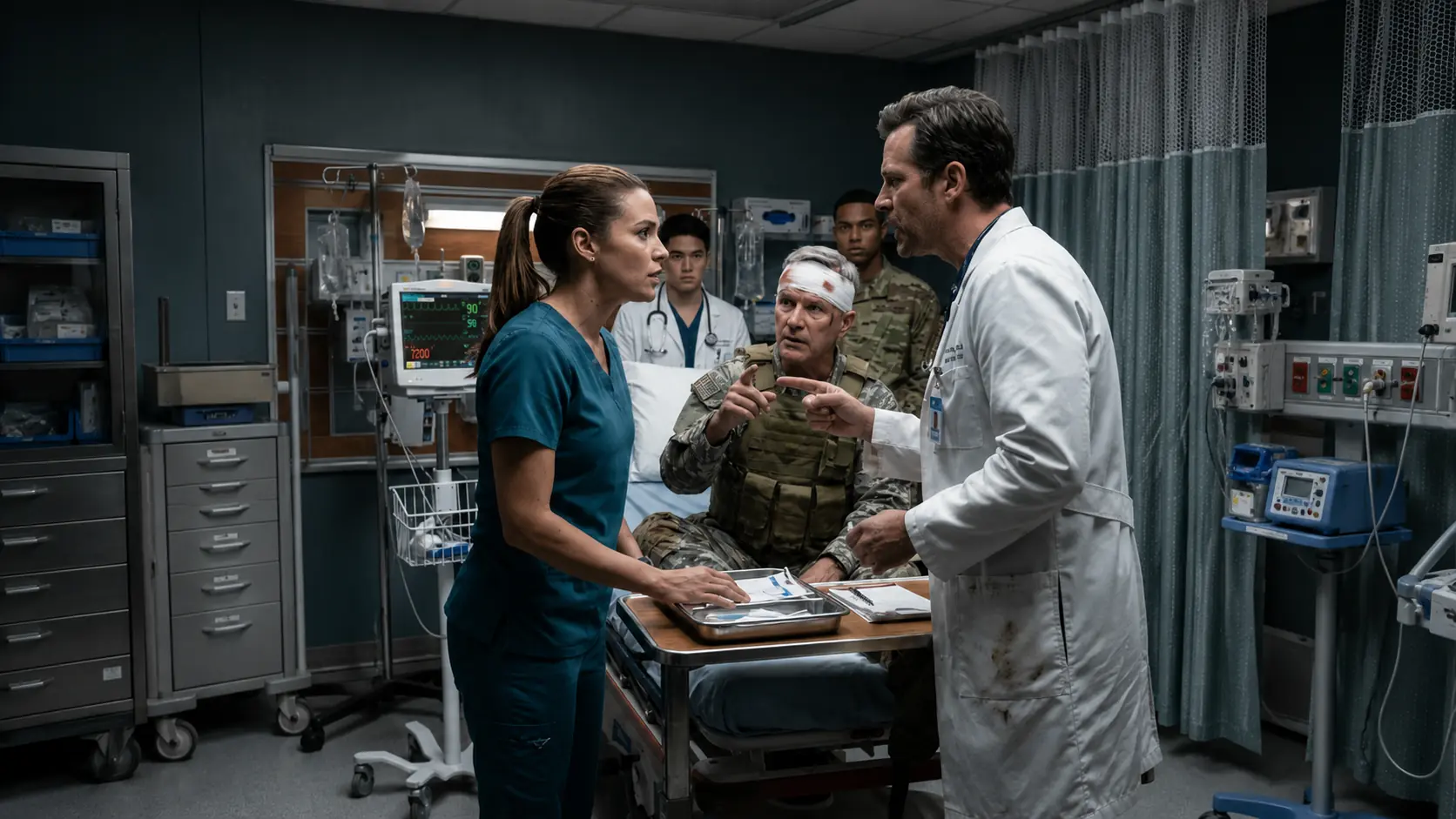
Dr. Marcus Reed considered Ava an easy target. He was charming around hospital executives, confident before frightened families, and cruel whenever junior staff could not challenge him safely. If supplies went missing, he blamed Ava. If a resident misunderstood an instruction, Reed raised his voice at the nurse standing closest to him.
That morning, he accused her of applying a dressing incorrectly in front of the entire nurses’ station. Ava knew the dressing had been placed exactly as ordered, but correcting him would invite attention she had spent years avoiding. She apologized, replaced it, and walked toward the supply room while several residents watched in uncomfortable silence. Reed smiled as though he had restored order.
Inside the supply room, Ava closed her eyes for thirty seconds. The fluorescent lights hummed above her, reminding her of generator-powered field hospitals where distant gunfire sometimes vibrated through metal walls. She breathed slowly until the memories withdrew. When she returned to the corridor, her face once again carried the harmless calm everyone expected.
The hospital knew her as a competent trauma nurse with an ordinary employment history. Her credentials contained no record of covert medical deployments, emergency extractions, or the soldiers she had carried through fire. The name Ava Sinclair had been chosen because it sounded common enough to disappear inside paperwork. Even her oversized scrubs were part of the camouflage, hiding the disciplined strength and movement of a woman whose body still remembered combat.
At 11:42 that night, the emergency radio exploded with a priority transport warning. A male patient in his sixties was arriving with a gunshot wound, blunt-force injuries, and severe respiratory distress. The dispatcher identified him only as a high-value government casualty under armed escort. Reed immediately claimed the head position in the trauma bay.
“Everyone follows my orders,” he announced.
Ava took her place near the equipment tray.
Rain struck the ambulance-bay windows while red lights flickered across the wet pavement outside. The ambulance doors opened before the vehicle had fully settled, and paramedics rushed a blood-covered man through the entrance. Two armed operators moved beside the gurney, scanning every doorway and reflective surface before allowing the medical team to approach.
The patient was Vice Admiral Charles Holloway.
His silver hair was soaked with blood beneath a temporary head dressing. A military jacket had been cut open across his chest, exposing bandages around his shoulder and ribs. His oxygen mask fogged with every ragged breath, while the monitor screamed warnings Reed appeared determined to silence through volume alone.
“Move him over,” Reed ordered. “Get another line and prepare imaging.”
Ava looked at Holloway’s chest.
Something was already wrong beyond the visible injuries.
The admiral’s eyes opened. Despite blood loss and pain, they moved through the trauma bay with the practiced awareness of someone who had survived decades of danger. He studied the exits, the medical team, the armed escorts, and finally the nurse standing near his right shoulder.
His expression changed.
Holloway forced one hand away from the blanket and pointed directly at Ava.
“Phantom.”
The word cut through every alarm.
Reed stopped speaking.
The two armed operators turned toward Ava simultaneously. One of them, a tall man with a scar crossing his eyebrow, stared at her as if a dead soldier had stepped out of history. The second moved one hand instinctively toward his concealed weapon before the first operator signaled him to remain still.
Holloway pulled the oxygen mask aside.
“I only accept Phantom.”
Ava felt three years of invisibility collapse around her. She knew the admiral’s voice, though time and pain had roughened it. Years earlier, he had commanded an operation where an eighteen-year-old soldier began bleeding to death while more senior men argued about evacuation routes.
Ava had ignored the argument.
She compressed the wound, stabilized the soldier, and refused to surrender him to panic. Holloway watched her hands throughout the procedure. Afterward, he told her they were the steadiest hands he had ever seen under fire.
That mission gave her the call sign Phantom.
Now the admiral had spoken it inside a civilian hospital.
Reed stepped between Ava and the bed. “I don’t know what game this is, but she is a nurse. I am the attending physician.”
Holloway pointed at Ava again. “Her.”
Reed looked toward the operators. “Your patient is confused.”
The scarred operator moved closer. “The admiral knows exactly who he requested.”
Ava remained still until Holloway’s monitor changed.
His oxygen level began falling rapidly. His breathing became shallower, and the right side of his chest moved differently from the left. The veins in his neck stood out while his skin turned pale beneath the blood.
Reed placed a stethoscope against him and ordered someone to page the surgeon. A resident began opening defibrillator pads even though Holloway’s heart was still beating. Another nurse reached for additional oxygen, but Ava knew increased oxygen would not remove the pressure building inside his chest.
His injured lung was collapsing.
Every breath trapped more air where it did not belong, placing increasing pressure on the heart and major blood vessels. Holloway could enter cardiac arrest within moments if nobody relieved it. The treatment required immediate, precise intervention followed by definitive trauma care.
Ava stepped around Reed.
“Tension pneumothorax on the right side. He needs decompression now.”
Reed blocked her with one arm. “Back off—you’re a floor nurse, not a combat surgeon.”
“His heart is being compressed.”
“I will decide the diagnosis.”
“You’re running out of time.”
Reed reached for the equipment in her hand. Ava did not release it. For the first time since arriving at Liberty Cross, she looked directly into his eyes without apology.
“Move now—or your ego stops his heart.”
The scarred operator stepped behind Reed.
“You heard the admiral,” he said. “Let her work, or I move you.”
Reed looked from the armed man to Holloway’s collapsing vital signs. His authority had always depended on everyone else accepting it. Now a patient was dying, his own team looked uncertain, and the two men guarding the admiral had chosen a quiet nurse over him.
He moved aside.
Ava’s hands changed immediately.
The slight nervousness she displayed around hospital administrators disappeared. Her movements became fast, economical, and exact. She identified the emergency, prepared the necessary equipment, and carried out the lifesaving intervention with the focused control of someone who had performed similar procedures under far worse conditions.
A sharp release of trapped pressure followed.
Holloway’s oxygen level stopped falling.
Then it began climbing.
Color slowly returned to his face, and his breathing became less desperate. The alarms softened one by one until the room heard the steady rhythm of a heart no longer being crushed.
Nobody spoke for several seconds.
Reed stared at the monitor.
The scarred operator studied Ava’s hands. “Those aren’t ordinary nursing hands.”
Ava continued stabilizing the admiral.
“That is battlefield training,” he said.
Holloway’s eyes opened again. Sedation and exhaustion had weakened him, but his gaze remained fixed on Ava.
“I told them,” he whispered. “Only Phantom touches me.”
The second operator looked toward the corridor, then back at Ava. Recognition traveled between the two men without explanation. Whatever they had heard about Phantom before that night, they now understood the stories had been true.
Reed took one step backward.
“Who are you?”
Ava adjusted the oxygen flow without answering.
The rest of the trauma team finally caught up with the emergency. A respiratory therapist prepared for definitive chest management, residents checked the gunshot injuries, and the surgical team arrived to evaluate Holloway. Ava gave them a concise report, speaking with a command presence nobody at Liberty Cross had ever heard from her.
Reed did not interrupt once.
When Holloway was stable enough for imaging, Chief of Trauma Dr. Benjamin Whitfield appeared with a hospital attorney. Whitfield was more concerned with institutional liability than the admiral’s survival. He found Ava outside the imaging suite and immediately demanded an explanation for the unauthorized procedure.
“You acted without a physician’s order,” he said. “Your personnel file contains no certification supporting what witnesses claim you performed.”
“He would be dead if I had waited.”
“That was not your decision.”
“It was the only decision anyone made.”
Whitfield’s jaw tightened. He glanced toward the attorney, expecting support, but the man avoided his eyes. The intervention had succeeded, and a decorated military commander was alive because Ava acted while Reed hesitated.
The scarred operator entered the hallway.
His name was Graves, though hospital staff did not yet know it.
“With respect,” he told Whitfield, “that woman saved the life of someone whose survival matters far more than your concern about embarrassment.”
“This is a medical facility,” Whitfield replied. “Your authority does not replace ours.”
“No. But armed men attacked the admiral’s transport tonight, and one of them may already know he was brought here. Your hospital is not prepared for what may be coming.”
Whitfield looked toward the federal escorts stationed outside the imaging room. For the first time, the situation expanded beyond a dispute over credentials.
Graves turned toward Ava.
“You disappeared three years ago.”
She said nothing.
“People asked about Phantom. Some thought you were dead.”
“I needed them to.”
He studied the quiet corridor. “You could have allowed us to believe that tonight.”
“I couldn’t let him die.”
Graves nodded slowly.
The sliding doors near registration opened at the far end of the hall. A man in a plain gray jacket approached the intake desk and asked whether a government transport patient had been admitted. His voice sounded casual, but his eyes moved repeatedly toward the secured wing.
The second operator, Dutch, noticed immediately.
He stepped between the stranger and the corridor while politely asking for identification. The man offered an excuse, turned, and disappeared through the doors before hospital security understood anything had happened.
Dutch returned to Graves.
“He was checking the location.”
Ava looked toward Holloway’s room.
The attack was not finished.
By morning, rumors had spread throughout Liberty Cross. Some employees said Ava had served as a combat medic. Others claimed she had belonged to a classified rescue unit. Nobody possessed the full story, but everyone knew the nurse Reed humiliated had recognized a lethal condition before the physicians surrounding her.
Whitfield summoned Ava into his office at six.
He placed a suspension document before her.
“Pending review, you are removed from clinical duties.”
Ava read the first line.
Before she could respond, Graves entered without knocking.
“We have confirmed at least two people connected to the attack are near this hospital,” he said. “One attempted to obtain patient information last night. Federal backup remains forty minutes away.”
Whitfield stared at him. “What are you asking?”
“I’m telling you the person most qualified to keep the admiral alive and defend his location is the nurse you just suspended.”
The hospital attorney closed the folder in front of him.
Whitfield looked toward Ava. “The suspension is temporarily reversed.”
Ava left the paper on his desk.
The hospital began a quiet lockdown. Staff redirected visitors, restricted elevators, and sealed part of the third floor under the explanation of a security exercise. Graves asked Ava where Holloway could be moved safely.
She had spent three years walking every corridor unnoticed.
“The old records room behind radiology,” she said. “Reinforced walls, one entrance, no exterior windows, and direct access to the service corridor.”
Graves glanced at Dutch.
“Lead the way.”
For the first time since joining Liberty Cross, doctors, armed operators, and administrators followed Ava instead of ordering her behind them. She moved through the hospital with her shoulders straight, pointing out stairwells, blind corners, loading entrances, and routes invisible on modern floor plans.
The old records room became a temporary treatment bay. Medical monitors and oxygen equipment were rolled inside while Dutch guarded the service corridor. Graves positioned himself at the main entrance.
Holloway’s oxygen level suddenly dropped again during the transfer.
The nurse assigned to him panicked, but Ava identified a mechanical obstruction in the chest-tube system rather than a new collapse. She corrected it quickly, and the monitor stabilized.
Graves appeared in the doorway.
“He’s stable,” Ava said. “Return to the corridor.”
He obeyed without question.
That trust affected her more than praise ever had.
Minutes later, the parking cameras showed three men moving toward the loading dock. They wore ordinary jackets, but their spacing and coordinated movements revealed training. One carried a bag large enough to conceal weapons.
Dutch’s voice came through the radio. “Three approaching.”
Ava studied the corridor layout.
“They’ll split at the radiology junction.”
“How do you know?” Graves asked.
“Because the public hallway looks watched. The service route appears empty.”
“What do you need?”
“Control of the lighting panel and the fire doors.”
Graves hesitated. “You are not engaging them directly.”
“I’m buying time.”
She shut down half the service-corridor lights and triggered an alarm near a secondary stairwell. Hospital security responded to the false disturbance, unintentionally placing uniforms between the intruders and Holloway’s room.
The first man entered the dark corridor and followed the sudden motion near the stairwell. Ava remained hidden behind a supply cart, watching him pass without realizing his target lay in the opposite direction.
Dutch intercepted the second man near the junction.
The struggle lasted only seconds. Dutch forced him down, removed a concealed weapon, and secured his hands before hospital guards arrived.
The third intruder moved more carefully.
He was the man from the registration desk.
He avoided the false alarm and followed the service corridor toward radiology, stopping several times to listen. Ava used automatic doors, lights, and hospital equipment to redirect him deeper into the wrong wing.
By the time he recognized the deception, Graves stood behind him.
“Stop.”
The intruder reached beneath his jacket.
Graves closed the distance before the weapon cleared. He drove the man against the wall, disarmed him, and restrained him on the floor.
Federal agents arrived soon afterward.
They found all three attackers alive, the admiral stable, and the hospital functioning without public panic. Agent Elena Reyes assumed command of the investigation and questioned Ava inside a small conference room.
“How did a civilian nurse organize a defensive response faster than hospital security?”
Ava held her gaze.
“I’m not entirely civilian.”
Reyes closed her notebook.
“Phantom?”
Ava’s expression answered before her voice did.
“I stopped using that name.”
“It seems the name never stopped belonging to you.”
Federal records remained classified, and Reyes promised nothing from Ava’s past would enter civilian hospital files. Graves confirmed that the attack came from a compromised communication channel connected to Holloway’s transport.
The admiral had been brought to Liberty Cross because attackers expected an ordinary civilian hospital.
They had not expected Phantom.
Holloway regained consciousness later that morning. He requested Ava before speaking with investigators.
She entered his room and stood beside the bed.
“You saved me twice,” he said.
“Once.”
“Years ago counts.”
“You were not the patient then.”
“You saved the operation. That saved me too.”
Ava looked toward the monitor.
Holloway reached for her hand. His grip was weak but deliberate.
“You never disappeared because you were weak.”
“I disappeared because I couldn’t carry it anymore.”
“And now?”
She considered the question.
“Now I know hiding and healing were not the same thing.”
He nodded. “Then stop hiding.”
The hospital review board still convened the following week. Whitfield expected questions about liability, but federal representatives submitted statements explaining that Ava’s clinical decision prevented Holloway’s death and her later actions helped stop an armed intrusion.
An older trauma physician read the reports twice.
“I have reviewed thousands of cases,” he said. “I have never seen several federal agencies recommend that a hospital thank a nurse and get out of her way.”
The board cleared Ava unanimously.
Reed faced a separate review. Investigators asked him to explain why he failed to identify Holloway’s deterioration and why he blocked the person who had recognized it. Without confidence to hide behind, his answers revealed hesitation, arrogance, and dependence on hierarchy.
He was not dismissed.
His reputation changed anyway.
Residents began checking his orders. Nurses stopped lowering their eyes when he raised his voice. Reed gradually spoke less and listened more, understanding that charm could no longer protect him from the memory of the night a nurse saved his patient while he argued about rank.
Whitfield personally reversed every disciplinary note connected to the incident. He later apologized to Ava inside his office.
“I saw liability before I saw the life you saved.”
“You saw hierarchy.”
He accepted the correction.
Graves returned several days later with an offer. A joint program was training civilian trauma teams alongside experienced military medical personnel. The position required no deployment and no return to combat.
“They need someone who understands both worlds,” he said.
Ava looked through the hospital windows toward Charleston Harbor.
“I’m not returning to the field.”
“I didn’t ask you to.”
She agreed to review the proposal.
In the weeks that followed, Ava remained at Liberty Cross. Her scrubs were still teal, her voice still calm, and her work still centered on ordinary patients who would never know her past.
But she stopped making herself small.
A nervous resident named Priya asked for help recognizing severe chest trauma. Ava spent twenty minutes explaining the warning signs and the need to act decisively while properly trained help was available.
Priya returned the next week.
Soon, several residents joined them.
The informal sessions became regular training. Ava taught without humiliation, remembering the officers and instructors who once trusted her before she trusted herself.
Holloway left the hospital three weeks later. Federal officers escorted him through the main corridor while nurses and residents gathered near the station.
He stopped in front of Ava.
“You were never hiding weakness,” he said. “You were hiding command.”
Then he saluted her.
Ava did not salute back. She was no longer wearing the uniform that required it.
Instead, she shook his hand.
The doors closed behind him, and the ordinary hospital noises returned—phones ringing, monitors beeping, shoes moving across polished floors. Yet nothing felt ordinary to the people who had watched the admiral trust Ava with his life.
For three years, Liberty Cross had mistaken her silence for uncertainty.
Reed thought she lacked confidence.
Whitfield thought she lacked authority.
The hospital believed her hands belonged only to a quiet floor nurse.
Then a dying admiral pointed across the trauma bay and called her Phantom.
After that, nobody ever told Ava Sinclair to make herself small again.