“You and your boy need a home,” Clara whispered.
Silas Thorne stopped at the foot of her porch as though the words had struck him in the chest.
Six years had passed since Clara last saw her first love. 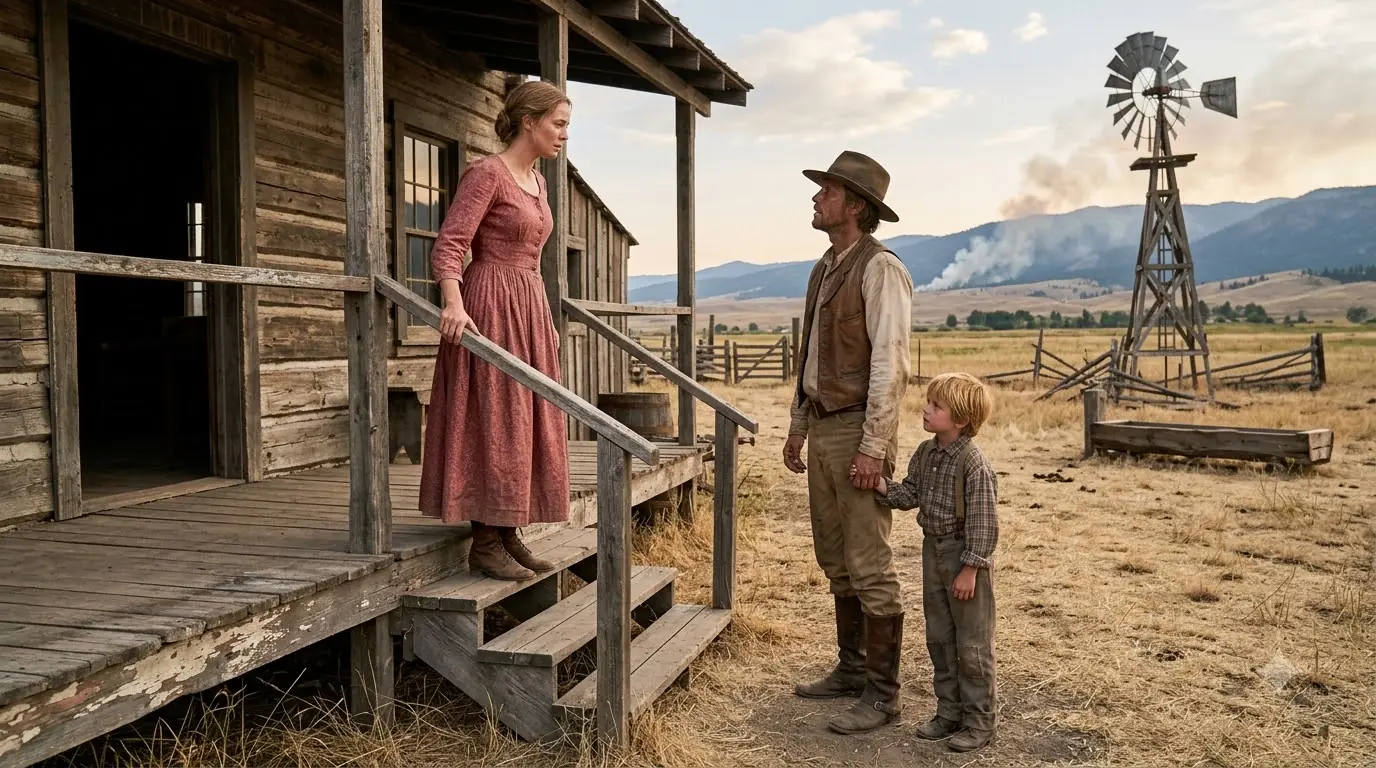
Back then, Silas had been a hopeful young ranch hand with strong shoulders, an easy smile, and a promise to return before winter.
He never had.
Now he stood before her beneath the fading Montana sun, dressed in a dust-covered shirt and a worn leather vest. Secured against his back inside a handmade leather carrier was a little boy not yet two years old. The child had golden hair, tired blue eyes, and one small hand curled tightly around his father’s shoulder strap.
Silas was thinner than Clara remembered. The years had hardened his face, but his eyes were exactly the same. They still held the quiet warmth that had once convinced a nineteen-year-old girl she could follow him anywhere.
Clara tightened her fingers around the fabric of her faded red calico dress. She had worn that same dress on the day Silas left the Bitterroot Valley. It had been bright crimson then, a bold splash of color against the gray hills. The Montana sun had since softened it to the color of a faded rose.
“His name is Toby,” Silas said.
His voice was rough from dust and exhaustion. It sounded like the voice of a man who had spent too many nights without proper sleep.
Clara looked at the boy. Toby rested his cheek against his father’s back and studied her with the solemn uncertainty of a child who had learned not to expect kindness from strangers.
“Where is his mother?” Clara asked softly.
Silas lowered his eyes. His shadow stretched long across the dry dirt.
“She died last winter.”
The words settled between them like heavy stones. No music came from the cabin. No wind moved through the dry golden grass. Even the old windmill seemed to hold its breath.
Clara understood what it meant to bury the person with whom you had planned your entire future. Her husband, Arthur Montgomery, had died from fever three years earlier. He left her the ranch, a failing well, and enough debt to keep the bank circling like a hungry hawk.
Silas looked toward the distant road shimmering beneath the heat.
“I should not have come here,” he muttered.
“Then why did you?” Clara asked, her voice trembling despite her effort to control it.
“My horse is nearly spent,” Silas replied. His jaw tightened with shame. “Toby has not eaten since morning. The rail camp turned me away, and the boarding house in Stevensville would not take a man who could not pay in advance.”
He swallowed and looked toward the ground.
“I remembered your cabin.”
Clara felt the old wound inside her tear open.
“You remembered my cabin,” she said. “But you did not remember the girl who waited twelve years for an explanation.”
Silas finally met her eyes. The pain inside them was unmistakable.
“I remembered her every day.”
Toby stirred on his back and released a weak, sleepy whimper. Silas immediately reached behind him and touched the child’s small leg, reassuring him without even turning around.
That single tender movement changed something inside Clara.
Whatever anger she still carried belonged to another lifetime. The child standing at her gate had done nothing wrong.
Clara stepped down from the porch. Her boots pressed into the dry silt.
“You and your boy need a home,” she said firmly.
Silas stared at her.
“Clara, I am not asking for charity.”
“Good,” she replied. “Because I am not offering charity.”
She pointed toward the damaged windmill and the dry cattle trough beside it.
“My well is failing. The north fence is down, and the bank expects payment before the first snowfall. You need shelter for your son, and I need someone who knows how to keep a ranch alive.”
Silas looked at the cabin and then back at her.
“And when the work is finished?”
Clara’s voice softened.
“Then we will decide whether you came here because you had nowhere else to go or because some part of you was finally ready to come home.”
For the first time, Toby lifted his head. He looked at Clara and then at the open cabin door.
It was only one word, spoken in a tiny and fragile voice, but it nearly broke Clara’s heart.
She turned away before Silas could see the tears gathering in her eyes.
“Bring him inside,” she said. “The evening air is turning cold.”
Silas remained still for one more second.
Then he followed his first love into the home he had once dreamed of building with her.
Outside, the late summer sun hung low over the Bitterroot Mountains. The valley glowed with copper light and dry golden grass. It was August of 1889, and Montana Territory stood on the edge of statehood.
Far from the speeches and celebrations in Helena, survival remained the only law that mattered. The drought had emptied the creeks weeks earlier. Cattle moved slowly through the fields, their ribs beginning to show beneath their hides.
The earth had cracked under weeks of punishing heat. Somewhere beyond the northern ridge, a thin line of smoke was already rising into the sky.
That first evening, Clara warmed a little milk on the stove and softened a piece of bread in it for Toby. The boy sat at her kitchen table wrapped inside a heavy wool blanket. He watched her with cautious, wide blue eyes.
Silas remained near the door as though he expected Clara to ask him to leave at any moment.
“He eats slowly when he is frightened,” Silas said quietly.
Clara placed the warm bowl in front of Toby.
“Then no one will hurry him here.”
Toby looked toward his father before touching the silver spoon.
Silas nodded.
Only then did the child begin to eat.
Clara pretended to occupy herself near the wood stove, but she noticed every heartbreaking detail. Toby’s sleeves were much too short for his growing arms. One of his small boots had been repaired with rough twine, and his left sock had a large hole near the heel.
Silas had clearly given the boy everything he could offer. Love alone had not been enough to keep hardship away.
When Toby began falling asleep at the table, Silas lifted him with practiced care. The child curled against his father’s chest without fully waking.
“You are good with him,” Clara said.
“He is all I have.”
Silas spoke quietly, but Clara heard the fear beneath the words.
She opened the door to the small spare room.
“You may put him here.”
Silas looked at the clean sheets and the folded quilt. A small oil lamp glowed beside the window.
“I can sleep in the barn,” he offered.
“I offered both of you a home.”
“I do not want the town talking about you, Clara.”
“The town has been talking about me since Arthur died.”
She met his eyes without blinking.
“I survived their gossip before. I will survive it again.”
Silas carried Toby into the room. As he lowered the child onto the bed, Toby’s fingers caught around one of the polished silver buttons on Clara’s dress.
Clara gently opened his tiny hand.
“My father gave me that button before he passed,” she explained. “It came from his old Union Army coat.”
Toby stared at the silver resting in his palm.
“Pretty,” he whispered.
Clara smiled despite the heaviness inside her chest.
“You may hold it until you fall asleep.”
Silas watched her pull the quilt around his son.
For one fragile moment, they did not resemble two people separated by twelve years of silence. They looked like the family they might once have become.
Long after Silas fell asleep on the floor beside the bed, Clara remained near Toby.
The little boy had wrapped one hand around the silver button. After he drifted into deeper sleep, Clara gently eased it from his fingers.
His breathing was soft and uneven, as though even in sleep he expected the world to take something else from him.
Clara brushed a strand of golden hair from his forehead.
For years, she convinced herself that the silence inside the cabin did not trouble her. She told herself she was fortunate to have land, work, and enough strength to survive.
Sitting beside Toby, she finally admitted how empty the rooms had become.
There had been no small footsteps crossing the floor. No sleepy voice calling through the darkness. No tiny stockings hanging near the stove during winter.
Toby stirred and opened his eyes.
“Clara,” he whispered.
“I am here.”
“Papa go?”
“No,” she answered gently. “Your papa is right beside you.”
The boy looked toward Silas sleeping on the floor. Only then did his small body relax.
Clara pulled the quilt higher over his shoulders.
“Papa comes back,” Toby murmured.
The words struck Clara harder than she expected.
Silas had once failed to return for her. To this child, however, he was the man who always came back.
Clara looked down at the sleeping father and son.
Perhaps a person could be both the source of an old wound and the answer to a new prayer.
She remained beside Toby until his breathing became steady. Before leaving, Clara placed the silver button beneath his pillow.
For the first time in three years, she did not feel alone inside her own home.
The following morning, after Toby awakened, Clara returned the silver button to her sewing basket for safekeeping.
Silas began working before the sun climbed high. He repaired the broken northern fence, cleared silt from the well housing, and climbed the windmill tower to inspect the failing gears.
Clara watched from the kitchen garden.
She saw the muscles across Silas’s shoulders tighten beneath his faded shirt. Time had changed his face, but not the way he worked. He still treated every task like a sacred promise.
By noon, the heat had become a physical weight. Sweat darkened his collar and stained the brim of his hat.
Clara carried a jar of cool water toward him.
“You do not have to rebuild the entire ranch in one day.”
“I have twelve years of silence to repay,” Silas answered.
She stopped beside him, her shadow falling across his work.
“Work can repair a fence, Silas. It cannot explain why you disappeared.”
His hands became still.
“I wrote to you, Clara.”
She stared at him.
“I never received a single letter.”
“I sent six.”
His voice cracked.
Clara stopped breathing.
Silas looked toward the distant mountains, their edges softened by heat.
“My father was dying. He made me promise to take the family north, somewhere safer. By the time I returned to the valley, I was told you had married Arthur Montgomery.”
“I waited two years for you.”
“I came back three months too late,” Silas whispered.
Neither spoke for a long time.
Only dry grass moving beneath the hot wind broke the silence.
From the porch, Toby laughed at a grasshopper jumping through the dust. The sound was small and bright, and it loosened something trapped between Clara and Silas for twelve years.
Clara handed him the water.
“Then perhaps we both spent twelve years grieving a lie.”
Silas accepted the jar. His fingers brushed hers.
Neither pulled away immediately.
The old connection remained, quiet but unmistakable.
Clara turned first because she did not trust herself to remain that close.
For twelve years, she built her life around the belief that Silas chose not to return. That belief carried her through lonely winters, Arthur’s illness, and the long nights after her husband’s death.
Now six missing letters had shaken the foundation of everything she remembered.
“Who told you I had married?” she asked.
Silas hesitated.
“Your uncle Charles.”
The color drained from Clara’s face.
Charles had never approved of Silas. He called him a penniless dreamer and repeatedly warned Clara that love could not fill an empty pantry.
After Clara’s mother died, Charles handled the family’s accounts and mail.
A cold understanding moved through her.
“He knew I was waiting for you.”
Silas stared at her.
“Are you saying he kept my letters?”
“I do not know.”
The answer was already visible in her expression.
Silas lowered the water jar.
“I spent years believing you chose Arthur.”
“And I spent years believing you had forgotten me.”
There was no way to recover the stolen years.
Arthur had been a decent husband. Silas had loved Toby’s mother. Their lives had continued even while a part of each remained trapped inside the past.
Clara looked toward Toby.
“We cannot pretend those years never happened.”
“I would never ask you to.”
“But we can stop allowing a lie to decide what happens next.”
Silas nodded slowly.
It was not forgiveness.
Not yet.
It was the first honest step toward it.
They might never know for certain what Charles had done with the letters, but neither would allow his silence to steal another day.
Later that afternoon, a rider approached the ranch.
Clara tightened her hand around the wooden handle of her lantern as the sun began descending. Living alone had taught her to treat every unexpected sound with caution.
She stepped closer to the porch where Toby was playing.
A tall and thin man emerged through the dust.
Clara lowered the lantern when she recognized him.
It was Jedediah, their neighbor from three miles beyond the ridge.
“I saw Silas repairing your northern fence,” Jedediah said. “I did not know he had returned to the valley.”
“He arrived yesterday with his little boy,” Clara replied. “They had nowhere else to stay.”
Jedediah studied her face.
He did not ask the question already forming inside his tired eyes. Everyone in the valley remembered what Silas Thorne once meant to Clara.
“The well went dry at my place this afternoon,” Jedediah said.
He looked at the ground, defeated.
“Sarah is distraught. She is crying beside the kitchen garden as we speak. I came to ask whether I could borrow a few buckets of life.”
Clara felt a wave of sympathy.
In that territory, a dry well was a slow death sentence.
“Take whatever you need. The pump is working again, thanks to Silas.”
Jedediah cupped one hand beneath the pump and drank deeply.
When he lifted his face, his eyes were red with exhaustion.
“A man does not understand how rich he is until his children ask for water he cannot give them.”
He filled his heavy wooden pails in the growing darkness.
Clara watched him leave, a lonely figure moving through the vast open land.
His visit reminded her how fragile every life in the valley had become.
That night, Clara lay awake inside her narrow bed.
She listened to the unfamiliar sound of another adult moving through the cabin.
Silas slept on the floor beside Toby’s bed. Twice during the night, Clara heard him rise to check the child’s breathing.
He was a man haunted by everything he had already lost.
By dawn, Silas was outside again, wrestling with the heavy gears of the windmill.
For the next two days, Clara and Silas worked beside each other beneath the punishing heat. Silas restored the pump well enough to draw a steady stream of water.
Clara cooked, tended the scorched garden, and kept the cabin running. During the evenings, she quietly repaired the hole in Toby’s small wool sock.
The boy began following her from room to room like a shadow.
At first, Toby communicated only through shy glances and small gestures. Then, one morning, he surprised them both by saying her name.
“Clara.”
Every time the boy spoke it, Silas looked away.
The sound awakened something he did not trust.
He was afraid to want a life that felt safe again.
On the third afternoon, Toby fell asleep in Clara’s lap.
They sat on the porch beneath the small awning. Silas found them there when he returned from the lower pasture.
For several seconds, he simply stood and watched.
“You always wanted children,” he said softly.
Clara lowered her eyes to the sleeping boy.
“Some wishes arrive late.”
Silas removed his hat and wiped his brow.
“And some men arrive later than they should.”
Before Clara could answer, the wind changed.
The warm breeze became a hot and dry blast.
The sharp smell of smoke moved across the valley.
Silas turned toward the northern ridge.
The thin smoke they had noticed earlier was no longer distant. It had grown into a massive black column climbing above the hills.
“Clara,” he said sharply. “Take Toby inside.”
The afternoon sun became a white, unblinking eye overhead.
Smoke crossed the ridge and turned the sky a bruised yellow.
Silas ran toward the barn while Clara lifted Toby.
“The fire crossed the creek!” Silas shouted over the rising wind. “We may have less than an hour.”
He opened the livestock pens and drove the animals toward the southern fields.
Clara carried Toby into the cabin and wrapped a damp cloth loosely around his shoulders, keeping his face uncovered.
The boy began to cry.
“Papa!”
“I am here!” Silas called from the doorway. “I am not leaving you, son.”
Clara heard more than a father comforting his child.
Twelve years earlier, Silas had left her behind.
This time, with fire advancing toward them, he promised to stay.
Silas soaked burlap sacks in the trough and began clearing dry grass away from the cabin walls.
Clara carried Toby to the wagon near the southern edge of the yard. She remained close enough to keep one hand on him while bringing water to Silas whenever the smoke allowed.
Silas climbed onto the roof and smothered the first sparks landing on the shingles.
More embers fell faster than he could remove them.
The roar of the approaching flames grew louder each minute. It sounded like a hundred freight trains rushing through the forest.
Ash drifted across the ranch like heavy gray snow.
“We cannot hold it!” Silas shouted from the roof.
Clara looked at the cabin Arthur had left her.
She saw the porch she repaired with her own hands. She saw the garden she fought to keep alive and the small room where Toby had slept safely for three nights.
“This is all I have left, Silas!”
He jumped from the roof and came directly toward her.
“No, Clara.”
Silas placed both hands on her shoulders.
“It is not.”
He looked toward Toby waiting inside the wagon.
“A house is wood and stone. Home is whoever still reaches for you when the walls are gone.”
A burning branch fell from the sky and struck the fence.
Silas took Clara’s hand.
“We leave now.”
Jedediah suddenly appeared through the smoke, leading an empty wagon. His horse was wild with fear.
Sarah sat beside him with a damp cloth over her mouth and nose.
“The families are gathering at the river!” Jedediah shouted.
Silas lifted Toby into the neighbor’s wagon.
Then he turned toward Clara’s cabin.
“What are you doing?” she cried.
Silas did not answer.
He ran back onto the porch and disappeared inside.
Seconds later, he emerged through the smoke, coughing heavily.
He carried Clara’s father’s Bible in one arm. In the other was the small sewing basket from beside her chair.
The silver button Toby had held was still inside it.
Silas pressed the basket into Clara’s hands.
“I could not save your past twelve years ago,” he said. “I will not leave it behind again.”
Clara could no longer contain her tears.
They climbed into the wagon as sparks struck the roof.
A flying ember caught the lower edge of Clara’s red dress and scorched the fabric. Silas smothered it with his gloved hand.
He wrapped one strong arm around Toby and the other around Clara’s shaking shoulders.
For the first time in twelve years, she leaned against him and allowed his strength to keep her upright.
They rode toward the Bitterroot River while the fire rose behind them.
The horizon became a wall of orange light.
Dozens of exhausted families stood together inside the shallow water with frightened horses and whatever belongings they had managed to save.
Children cried in the darkness.
Women prayed in low and steady voices.
Clara stood near the riverbank with the hem of her dress soaked. She watched the sky glow with a hungry and terrifying light.
The fire burned beyond the river throughout the long night.
Silas sat beneath a broad cottonwood near the bank. Toby slept against his father’s chest.
Clara placed the dry half of her shawl over the child.
“You saved my father’s Bible.”
Silas looked toward the orange glow across the water.
“I should have come back for you twelve years ago.”
“Yes,” Clara answered honestly. “You should have.”
Silas accepted the truth without trying to defend himself.
“I was ashamed,” he admitted. “By the time I learned you had married, I felt lost. I believed I no longer had the right to explain.”
Clara sat beside him on the damp earth.
“You did lose that right.”
Silas lowered his eyes. His shoulders sank.
Clara reached toward him.
“But perhaps you have earned the right to begin again.”
Toby moved between them and reached for Clara.
She took his warm little hand.
Silas covered both of their hands with his own.
The fire burned beyond the river, and the cold current moved beside them. Together, however, they felt a warmth that had nothing to do with flames.
For a while, the three remained silent.
Around them, families whispered prayers and counted the names of everyone who reached the river.
The orange light slowly faded beneath the smoke.
Toby shifted in Silas’s arms and moved closer to Clara. She rested one hand against the child’s back.
Silas watched her with an expression she could not fully understand.
“What is it?” she asked.
“I was thinking about his mother.”
Clara did not remove her hand.
Silas looked down at his son.
“Before she died, she made me promise that Toby would never grow up believing he was a burden.”
“He is not a burden.”
“I know.”
Silas swallowed.
“But there were nights when I had no food, no work, and nowhere safe for him to sleep. I was afraid love would not be enough.”
Clara looked toward the families gathered beside the river.
“Love alone cannot keep a roof standing.”
Silas lifted his eyes.
“It also means food, shelter, work, patience, and people willing to stay.”
A tired smile touched Clara’s face.
“That sounds less like romance and more like ranching.”
“Perhaps they are not so different.”
Despite the smoke and fear, Clara laughed softly.
It was the first time Silas heard that sound since returning.
His face changed.
For one brief moment, the years fell away. He looked like the young man who once waited outside her father’s gate with wildflowers hidden behind his back.
“I missed that laugh.”
Clara’s expression softened.
“You had no right to miss it.”
“No,” he agreed. “But I did.”
Toby stirred and placed one hand against Clara’s chest.
She covered it with her own.
Silas looked at their joined hands.
“I do not know what will remain when morning comes.”
Clara leaned closer beneath the cottonwood.
“Then morning will tell us what must be rebuilt.”
“And if nothing remains?”
She looked at Toby and then at Silas.
“Then we begin with the three people sitting here.”
Silas closed his eyes.
When he opened them again, some of the fear had left his face.
The fire continued burning beyond the river, but for the first time since entering the valley, Silas no longer looked like a man with nowhere to go.
By the following morning, a gentle rain began to fall.
At first, only scattered drops struck the ash.
Then the sky opened with mercy.
The surviving families waited until the road became safe.
Silas drove Clara and Toby back toward the ranch.
The valley had become a blackened and unfamiliar world.
Smoking fence posts stood like grave markers. Trees had been reduced to skeletal shapes against the gray sky.
Clara prepared herself to find nothing except an empty foundation.
When the wagon crossed the final hill, she gasped.
The cabin remained standing.
The porch roof had burned away completely. One wall was badly scorched and blackened.
The main logs, the heart of the house, had held.
Clara climbed down before the wagon stopped.
She crossed the ruined yard and fell to her knees inside the ash.
Silas set Toby down several feet away and held the boy’s hands while he took small and uncertain steps.
Clara covered her face.
“I thought I had lost everything.”
Toby looked at her soot-streaked face.
His lower lip trembled as though a sudden realization had reached him.
“Mama,” he whispered.
For one heartbeat, even the rain seemed silent.
Clara froze.
Her breath caught inside her chest.
Toby had never called her that before.
He pulled away from Silas and stumbled into her arms.
Clara made a broken sound and held him tightly. She pressed her face into his golden hair.
Silas knelt beside them in the wet black ash.
“You do not have to call her that, Toby,” he whispered.
Clara looked at Silas through her tears.
“He may call me whatever makes him feel safe.”
Silas lowered his head.
He could no longer contain his grief.
His shoulders shook as the tears finally came.
Clara reached for him and pulled him into the embrace.
The three of them remained together among the ruins while rain fell across the surviving walls of their home.
“The cabin is still standing,” Clara whispered.
Silas looked at her and his son.
“So are we.”
During the following weeks, help arrived from across the region.
Families in Stevensville sent flour and wool blankets. People from Missoula sent seed and tools for the coming spring.
Montana had not yet become a state, but its communities were already learning how to stand together.
On November 8, 1889, word reached the Bitterroot Valley that Montana had officially entered the Union as the forty-first state.
Jedediah rang his old dinner bell until the sound echoed across the hills.
Sarah baked a small cake using the last of her sugar.
Clara cared little about political speeches.
She cared that Toby was warm and fed.
She cared that the well worked again.
She cared that Silas sat beside her hearth every night.
By the time the first heavy snow arrived, the ranch was prepared.
Silas rebuilt the porch and repaired the windmill gears. He fashioned a small wooden bed for Toby and placed it near the warm stone hearth.
One evening, Silas held the silver button inside his palm.
“You gave me a home when I had nothing, Clara.”
She closed her fingers over his hand.
“I gave Toby a room. You rebuilt the home.”
Silas slowly shook his head.
“No. You rebuilt it the moment you opened the door.”
He knelt beside her rocking chair.
“I cannot return the twelve years we lost to the wind.”
Clara waited.
“But if you allow me, I will spend the rest of my life choosing you.”
She touched his weathered cheek.
“Then do not leave again, Silas Thorne.”
“Never.”
Clara rested her forehead against his.
Outside, the windmill turned in the cold night breeze.
Its steady clanking no longer sounded lonely.
It sounded like the heartbeat of a family that had refused to die.
Years passed, measured by harvests and long winters.
Toby grew tall and strong beneath the Montana sky.
He did not remember the boarding house that turned him and his father away.
He always remembered the woman wearing the faded red dress.
He remembered the woman who opened her door to a man everyone else had forgotten.
Clara kept one charred piece of that red dress inside her sewing basket.
When Toby married many years later, she prepared a surprise.
She stitched the faded piece of fabric into one corner of his wedding quilt.
“This survived the fire,” she told him on his wedding day.
Toby touched the darkened piece of calico.
“So did we, Mama.”
Clara looked across the room at Silas.
His hair had turned silver, matching the winter frost, but his eyes remained those of the young man she once loved.
He reached across the table and took her hand.
Their story had never been about a perfect or easy life.
They lost years, security, and people they loved.
Still, they found enough courage to open one more door.
True love did not always arrive on a white horse.
Sometimes it arrived exhausted and covered in trail dust.
Sometimes it carried a sleeping child on its back.
Sometimes all it needed was one voice willing to say, “You and your boy need a home.”