Wyatt Calder stood on the platform at Larkspur Station on a bright April morning in 1879, holding a fistful of larkspur flowers that were already going soft in his hand.
He was about to meet a woman who was not the woman he believed he was waiting for.
He had picked the flowers himself at first light because the town was named after them, and he thought a bride from Boston might appreciate the joke. 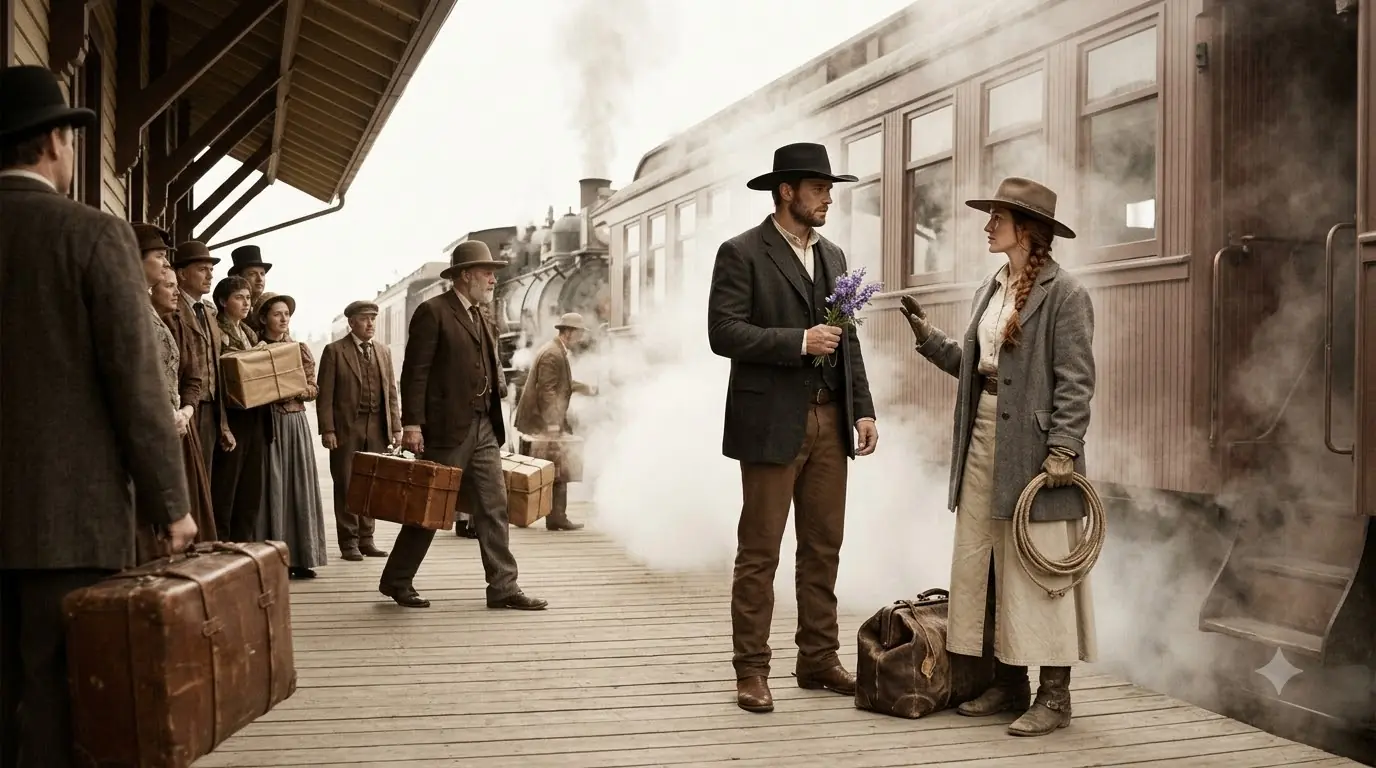
He wore his one good coat and had practiced her name beneath his breath during the entire ride into town.
“Constance. Constance Whitfield.”
He repeated it until the name stopped sounding like it belonged to a stranger and began sounding like something that might belong to him.
The train arrived loudly and slowly, hissing steam across the platform. Wyatt watched every window like a man studying the sky for weather.
A woman stepped down from the second car.
She was not dressed for a wedding.
She wore a split canvas riding skirt faded at the knees, a man’s wool coat two sizes too large, and gloves worn through at the first knuckle. A coiled lariat hung from the strap of her travel bag the way another woman might carry a parasol.
She looked like someone who had spent more of her life riding than walking.
Wyatt stepped forward anyway, flowers first and hope doing most of the thinking for him.
“Miss Whitfield?”
The woman raised one hand before he could come any closer, using the same gesture she might have used to stop a runaway calf.
“You bought the wrong bride,” she said.
Three words strong enough to fold flowers.
Wyatt Calder stood on the platform of his own town, in front of half the people he had grown up with, holding a fistful of larkspur for a woman who apparently no longer existed in the way he had expected.
Then he did something nobody in Larkspur anticipated, least of all the woman standing before him.
He smiled.
Wyatt lowered the flowers and offered his hand instead.
“Then I am glad to meet whoever you are,” he said. “You rode a long way to tell a stranger bad news in person, and that is not a small thing.”
Most men, after being told at a train station that their promised bride was gone, might have reddened with humiliation, become angry, or turned away without another word.
Wyatt Calder held out his hand.
To understand why, one must know what he already understood while standing on that platform and what he had not yet learned about the woman before him.
Both mattered.
Her name was Josie Farrow, and she had not come to marry anyone.
Three days earlier, Josie had been minding her own business entirely, which meant cattle rather than correspondence.
She was twenty-six years old, born in Texas, and had spent the previous six years moving livestock north along the rail lines for her father’s outfit. It was work that suited her considerably better than any parlor ever had.
That week, Josie was escorting forty head of cattle to a buyer outside Larkspur. She had boarded the same eastbound train after making a connection in Omaha, concerned only with her cattle, her ledger, and the rising cost of keeping the animals inside railway stock pens.
Constance Whitfield, meanwhile, was occupied with a great deal of romance, all of it going badly.
Constance had answered Wyatt Calder’s matrimonial advertisement from a Boston parlor six months earlier. She had been charmed by his descriptions of open skies and good grazing land, which she had mistakenly imagined as something resembling a very large park.
They corresponded pleasantly throughout the winter.
Constance packed a trunk filled with dresses unsuitable for every task a working ranch might demand. Somewhere near Omaha, however, she watched the trees thin, the landscape flatten, and the country stretch endlessly in every direction without one familiar landmark.
In that moment, she understood completely that she had made a catastrophic mistake.
Constance refused to leave the train.
By her own tearful explanation afterward, she was not brave enough to face the man with whom she had exchanged a hundred letters and tell him directly that she had changed her mind.
She was brave enough to grab the sleeve of the nearest capable-looking woman in the railway car.
That woman happened to be Josie Farrow, who had just returned from inspecting her cattle in the stock car.
Constance begged Josie to carry a folded letter to whoever was waiting outside. She could not bear to see Wyatt’s face when he heard the truth.
Josie had no reason in the world to agree.
She had cattle to sell, another train to catch, and no connection whatsoever to a disappointed rancher in Larkspur, Nebraska.
She agreed anyway.
Later, Josie could never fully explain why, beyond the plain fact that somebody had to do it, and she happened to be the person standing closest to the railway door.
She intended to hand Wyatt the letter and walk away within two minutes.
That was not how those two minutes ended.
“There is a letter,” Josie said after Wyatt lowered the hand he had offered and neither of them had quite moved beyond the moment.
She extended the folded paper.
“She asked me to give you this instead of telling you herself.”
Josie studied his expression.
“I read enough of it on the way out to spare you some of the dressed-up language, if you would rather hear the truth plainly.”
“Plainly, then,” Wyatt said.
“She is not coming.”
Josie did not soften it unnecessarily.
“She looked at Nebraska through a train window and decided Nebraska was considerably more Nebraska than she had imagined.”
Wyatt said nothing.
“She is sorry,” Josie continued. “I believe she means it. She is not a bad woman.”
“She is simply the wrong woman for this particular piece of ground, and she discovered that about four hundred miles too late to say it kindly in a letter.”
Josie glanced toward the train.
“So she said it kindly through me instead.”
Wyatt looked down at the unopened letter for a long time.
Something moved across his face that was not entirely grief and not entirely relief. It settled somewhere honest between the two.
“I am obliged to you,” he finally said. “Riding herd over your own cattle and another person’s heartbreak during the same week seems like a poor bargain.”
“It was not much of a bargain,” Josie agreed.
She adjusted the strap of her travel bag.
“But I was not going to allow a man to stand on a platform holding flowers and learn the truth the hard way.”
“Some things ought to be heard from a person, even when it is the wrong person doing the telling.”
She turned to leave.
Josie had a buyer waiting, and forty head of cattle were consuming feed money for every hour they remained inside the railway pens. Her act of kindness was complete.
Then Wyatt said something that kept her on the platform longer than either of them had planned.
“Miss Farrow, before you go, do you know any rancher nearby who might need an additional hand for thirty days?”
Josie stopped.
“I find myself in considerably greater trouble than a missing bride,” Wyatt continued. “It happens to be the sort of trouble in which someone who rides better than she talks might prove useful.”
Josie turned and looked at him properly for the first time.
She saw beyond the flowers, the good coat, and the disappointment settling into his shoulders. Something about the shape of his question caught her interest in the way an unfamiliar brand caught the attention of an experienced cattlewoman.
“Thirty days for what?”
“For keeping a ranch that will not remain mine unless I am married by my thirtieth birthday.”
Wyatt’s mouth tightened.
“That is the twenty-third of May, twenty-nine days from this morning.”
The real problem, once Wyatt explained it over coffee at the Larkspur Hotel, had nothing to do with romance.
It involved legal documents, and paper was often the more dangerous enemy.
Wyatt’s father, Thaddeus Calder, had built the Anchor Ranch from eleven thousand acres of good grazing land and twenty years of stubbornness. He died the previous autumn, leaving behind a will that every attorney described as the work of a proud man determined to continue controlling his son from the grave.
The Anchor Ranch would pass entirely and without debt to Wyatt, provided he was a married man maintaining a household by his thirtieth birthday.
If Wyatt failed to satisfy that condition, the ranch would be divided.
One half would belong to Wyatt.
The other half would pass to his cousin, Cyrus Calder.
Cyrus had never delivered a calf, repaired a fence, or worked through a winter beside a starving herd. During the previous six months, however, he had maintained frequent and private correspondence with a land agent representing the Union Pacific Railroad.
“My father believed a wife would settle me,” Wyatt said.
He stared into his coffee.
“Mostly, I think he was afraid of exactly what is happening now.”
“Cyrus intends to sell his half the moment the deadline passes. He will sell to the railroad, a cattle syndicate, or whoever pays first.”
Wyatt looked toward the hotel window.
“Once outside money owns half the Anchor, the entire ranch will be gone within two years, including my portion.”
“I have watched it happen to three ranches in this county. I do not intend to watch it happen to a fourth.”
“So you advertised for a wife,” Josie said. “Like buying seed corn from a catalog.”
“I am not proud of the method.”
Wyatt did not defend himself.
“I am twenty-nine days from losing the only thing my father ever built.”
He lifted his cup.
“Pride is a luxury I find myself unable to afford this spring.”
Josie allowed her coffee to cool while she studied the situation.
She considered it the way she would examine a horse before purchasing it, checking the legs, teeth, and temperament together.
“You are asking a stranger you met forty minutes ago to marry you.”
She leaned back.
“That is a larger request than asking for a ranch hand for thirty days.”
“I am asking a stranger I met forty minutes ago to help me preserve a ranch.”
Wyatt spoke carefully.
“How that help might be arranged, legally or otherwise, is a discussion for later and only if you are willing to have it.”
“I have been engaged to a woman I never met for six months, and it produced nothing.”
He looked directly at her.
“I am not foolish enough to believe a wedding solves anything that is not also true beneath it.”
“But I have twenty-nine days, a lawyer who is a decent man performing an indecent duty on my cousin’s behalf, and a ranch I mean to protect.”
Wyatt placed both hands on the table.
“I would rather spend those days working beside someone honest than waiting for a woman who has already told me through a stranger and a folded letter that she does not want this life.”
It was possibly the strangest proposal Josie had ever heard delivered over lukewarm hotel coffee.
It was also, uncomfortably, one of the more honest conversations she had ever had with a man.
“I have a buyer waiting for forty head,” she said. “I can give you two days while I complete that business.”
“After that, I must answer to my father’s outfit.”
Josie raised one eyebrow.
“They are not expecting me to marry a Nebraska rancher while returning home from a cattle sale.”
“Two days is a beginning,” Wyatt said. “I have learned to work quickly this spring.”
Whatever Josie expected from the Anchor Ranch, the reality surprised her.
She had imagined something threadbare and desperate, suitable for a man reduced to finding a wife through the mail.
Instead, the house was sound, the fences were tight, and the cattle were fat from good spring grass.
Four older ranch hands worked the property.
Each had ridden for Thaddeus Calder for at least a decade, and they observed Josie’s arrival with the wary courtesy of men waiting to see whether a newcomer could truly work before deciding whether to respect her.
Josie answered that question before sundown.
A heifer became trapped inside a bog and injured one leg while struggling to escape.
Josie roped the animal on her second attempt, brought it onto firm ground, and set the leg herself more effectively than the ranch foreman believed he could have managed.
By supper, the four men had stopped calling her ma’am with careful suspicion.
They began calling her ma’am the way one addressed a person who had earned the word.
Wyatt watched all of it with an expression Josie noticed twice but could not name.
It was not exactly surprise.
It was something closer to recognition, like hearing a familiar melody without remembering where one first heard it.
The original two days extended without ceremony into four days.
Then four became a week.
There was genuine work to complete, and Josie found herself completing it.
She culled cattle, branded calves, maintained the records, and rode fences with a competence that made the thirty-day arrangement feel less like charity and more like a partnership neither of them had named.
During the evenings, they sat together on the porch.
The attorney’s letters and the exact wording of Thaddeus Calder’s will lay between them as they planned like two people solving a difficult puzzle rather than two people falling toward anything personal.
Josie privately considered that the safest way for it to happen, if anything was happening at all.
Cyrus Calder rode to the Anchor on the ninth day.
He wanted to see for himself what his cousin was doing and made no effort to hide his displeasure when he discovered a competent stranger managing cattle instead of a heartbroken bachelor watching the deadline approach.
“People in town say your bride never arrived,” Cyrus said without dismounting.
He examined Josie the way a man might examine a horse he intended to disqualify from a race on a technicality.
“They also say this woman is some drover’s daughter you collected from a railway platform for the occasion.”
Cyrus looked toward Wyatt.
“A judge will want proof that any marriage is genuine, cousin, rather than a legal arrangement designed to defeat a deadline.”
“I will make certain he asks.”
“Let him ask,” Josie said before Wyatt could answer.
Her voice had once settled forty frightened cattle into a railway car without rising even once.
“I have branded more of this ranch’s calves in nine days than you have branded in your entire life, Mr. Calder.”
Cyrus’s expression hardened.
“You may tell your judge that a woman capable of roping cattle, treating injuries, maintaining accounts, and managing a ranch is not a genuine wife because she arrived on a stock train instead of a passenger coach.”
Josie folded her arms.
“I expect he will have opinions about which one of you understands what marriage on a ranch actually requires.”
Cyrus had no immediate response.
He rode away considerably less certain about his expected railroad money than when he arrived.
Wyatt watched Josie for several moments after the dust settled.
“You did not need to fight that battle,” he said. “It belongs to me.”
“It belongs to us,” Josie answered.
She heard her own words and did not take them back.
“If I remain beyond the thirty days, which I find myself beginning to consider.”
It was the first time either of them had said the word us aloud.
Neither drew attention to it.
Both noticed.
A letter reached Josie on the twelfth day.
It had been forwarded from the cattle buyer’s office in Larkspur, and it did not make the decision to remain any simpler.
The letter came from her father.
He was pleased that the cattle had sold at a good price.
In the same unhurried handwriting he used for branding schedules and bad news, he mentioned that Everett Whitlock had visited the house twice that month asking about her.
Everett owned a respectable ranch two counties away.
Josie’s father observed that a man who asked about a woman twice in one month while she was four hundred miles away deserved a serious answer, one way or another.
Her father did not order her to return.
He never told her what decisions to make.
He simply arranged the facts before her, much as he laid out a saddle before a long journey, and allowed her to decide what she was riding toward.
Josie read the letter twice on the porch steps.
Then she read it a third time.
Wyatt came outside to inspect the evening herd.
He saw her face and possessed enough good sense not to ask what the letter contained.
Josie wrote a response that night by lamplight.
She destroyed two drafts before allowing the third to remain.
She told her father the truth because lying to him had never worked once during her twenty-six years, and she saw no reason to begin then.
Josie described the missing bride, the thirty days, and the rancher who offered honest work rather than a sweet promise.
She wrote about the Anchor Ranch, which felt, with every passing day, more like something worth fighting to protect.
She told him Everett Whitlock was a good man.
She was in no position to promise Everett anything because she did not yet understand what she was promising herself.
Josie did not mention the coat inside Wyatt’s trunk.
She did not yet know about it.
That recognition remained nine days away, waiting inside a torn saddle blanket and a line of red thread.
Near the bottom of the page, she wrote:
You always said a person ought to choose the harder true thing over the easier maybe. I do not know whether this is the true thing yet. I know it is not the easy one, and for once in my life, that is not frightening me away from it.
Her father’s response arrived three weeks later.
As always, it was brief.
He had informed Everett Whitlock, kindly, that his daughter’s heart appeared to be occupied elsewhere.
Everett, being a decent man, wished her well.
Within the year, he married a schoolteacher who was a friend of one of his cousins, and everyone eventually agreed they were better suited.
That answer came later.
For the moment, Josie folded her letter and lived with uncertainty, which was its own kind of labor and in some ways more difficult than delivering any calf.
She had built her entire life on reading signs accurately.
Josie could distinguish a lame horse from a lazy one and a serious cattle buyer from a time-waster at fifty paces.
She had never been required to examine her own heart with the same precision.
It proved considerably more difficult than any trail she had ridden.
Josie remained at the Anchor.
She did not stay only because of the deadline, although the deadline still mattered.
She did not stay solely because the ranch needed her, although that was plainly true.
She stayed because certain mornings, while watching Wyatt ride the fence line at first light with the same patient thoroughness he brought to every responsibility, she caught herself wishing the remaining days would pass more slowly.
Watching him from the porch with her father’s letter inside her coat pocket, Josie understood that the thought was probably an answer in itself, whether she was prepared to read it or not.
Cyrus did not return to the ranch.
Instead, he traveled to the county seat, which was worse.
He filed a petition in the court of Judge Alden Pruitt, a circuit judge from Kearney who had been brought in specially.
The petition requested that any marriage completed during the final days before Wyatt’s deadline be examined for what Cyrus described in careful legal language as a want of genuine intent.
Cyrus had witnesses.
The stationmaster would testify that the bride Wyatt expected had never left the train.
The hotel clerk would confirm that a completely different woman had taken a room that same afternoon.
The petition was not unreasonable when dressed in reasonable words.
That was precisely what made it dangerous.
“He is not wrong about the facts,” Wyatt said.
He read the filing at the kitchen table with a grimness Josie had never seen in him.
“He is only wrong about what the facts mean.”
Wyatt placed the document down.
“A judge who knows neither of us will read this and see precisely what Cyrus wants him to see.”
“A rancher frightened by a deadline and a woman paid to step off a passing train.”
“Nobody is paying me anything,” Josie said.
“I know that.”
Wyatt rubbed his eyes.
“You know it.”
“A stranger reading a petition behind a desk in Kearney does not.”
The hearing was scheduled for May twenty-first, two days before the deadline.
“If Judge Pruitt decides that any marriage was arranged in bad faith, the entire condition fails whether we are married by the twenty-third or not.”
Wyatt looked toward the darkened window.
“Cyrus receives his half without restriction.”
“Then we need to give the judge something more real to examine than a filing filled with facts arranged sideways,” Josie said.
She looked down at the petition.
“Facts arranged honestly usually defeat facts arranged cleverly.”
“I have watched it happen at cattle auctions more times than I can count.”
She did not say that the facts had ceased feeling arranged around the ninth day.
They had begun feeling simply true.
To understand what happened next, one must return three winters to a blizzard neither Wyatt nor Josie knew they had shared until that week.
During the winter of 1876, Wyatt rode with his father’s outfit on a late drive along the Ogallala Trail.
They were moving eight hundred cattle north against sound advice and weather that changed faster than it had any right to change.
The storm came down across the plains with almost no warning.
A wall of white swallowed the sun within twenty minutes.
Wyatt was chasing a break in the herd when he became separated from the other riders.
His horse stepped into a drift neither of them saw and fell.
Wyatt was thrown.
He remained in the snow long enough to stop feeling his hands.
Every experienced trail rider understood that losing sensation in the hands was one of the final stops before losing sensation everywhere else.
A stranger saved him.
A young cowgirl riding drag for another outfit approximately a mile east saw a riderless horse circling through the storm.
Relying only on instinct and stubbornness, she went searching for its rider.
She found Wyatt half buried beneath the snow.
With hands nearly as cold as his, the woman built a fire from buffalo chips and sagebrush.
She wrapped him in her coat and blanket.
Throughout the worst part of the night, she forced him to remain awake and talking so he would not slip into unconsciousness.
By the gray hour before dawn, the wind began weakening.
The woman lifted Wyatt onto her horse and walked beside him for three miles until they reached a line shack.
She built another fire inside.
Then she left before full daylight without giving him her name.
Eight hundred cattle belonging to someone else were scattered across the blizzard, and she still had a job to complete.
Wyatt spent three years attempting to describe that night to people who had not experienced it.
He always failed.
He remembered the coat most clearly.
It was an old canvas garment, too large for the young woman, repaired along one shoulder with a distinct row of red stitches shaped like small running birds.
Wyatt also remembered her voice.
She never allowed fear to enter it, even after fear entered his.
He could not remember her face clearly.
The cold took faces first and returned them last.
For a year, Wyatt asked about her at every ranch within two hundred miles.
Nobody claimed to know the woman.
Eventually, he stopped asking.
He folded the memory away like a coat too painful to wear and too important to discard.
Wyatt continued with the work of living.
Then, three years later, a woman stepped from a train in Larkspur and declared herself the wrong bride.
The recognition, when it arrived, began with almost nothing.
Real recognitions often do.
Nine days before the hearing, Josie sat on the porch beneath lamplight, repairing a torn saddle blanket.
Without thinking, she ran a needle through the canvas in a small, quick pattern she had sewn a thousand times.
The stitches formed a line resembling tiny running birds.
Wyatt sat across from her with the legal papers forgotten in his lap.
He became completely still.
“Where did you learn that stitch?”
His voice had changed.
“My mother used it,” Josie answered without looking up.
“She sewed that pattern into everything.”
“Saddle blankets, coats, and my brothers’ shirts whenever they tore.”
Josie pulled the thread tight.
“She said a plain patch was an insult to good canvas.”
Then she looked up and saw Wyatt’s face.
Her hands stopped.
“Wyatt, what is wrong?”
“Nothing is wrong.”
He spoke slowly.
“I think something may finally be right, and I do not trust it yet.”
Wyatt leaned forward.
“The winter of 1876.”
“The Ogallala Trail, north of the forks.”
“The worst storm anyone on that drive had seen.”
He watched her closely.
“Does any of that mean something to you?”
Josie’s hands remained frozen around the needle.
“There was a rider,” she said quietly.
The entire shape of her attention changed.
“He had been thrown.”
“He was half frozen and alone.”
Josie stared past Wyatt, returning to the memory.
“I never learned his name.”
“There was no time to ask, and I did not expect to see him again.”
She placed the blanket down.
“I gave him my old canvas coat and walked him to a line shack.”
“I left before daylight because cattle were scattered nearly from Nebraska to Ohio.”
Josie finally examined Wyatt as though adding three years backward onto his face.
“That coat had my mother’s stitching along one shoulder.”
“I still have it,” Wyatt said.
His voice was almost a whisper.
“I could never give it away.”
“It is folded inside a trunk in the house at this very moment.”
Wyatt had once read that truth was stranger than fiction because fiction was obligated to remain within the limits of possibility, while truth carried no such responsibility.
At the time, he had considered it clever.
Sitting on his porch nine days before a hearing that might cost him everything, looking at the woman who had kept him alive during a blizzard and disappeared before dawn without a name, he understood it as something closer to scripture.
“You saved my life and never told me your name,” Wyatt said.
“Three years later, I met you on a railway platform, and the first thing you told me was that I had purchased the wrong bride.”
A laugh nearly escaped him, but the sound became something more emotional.
“Josie Farrow, I do not believe you have ever been the wrong anything.”
The hearing on May twenty-first lasted eleven minutes.
That was eleven minutes longer than necessary because Judge Pruitt, described by everyone who knew him as plain and unsentimental, found himself moved despite his intentions.
Cyrus Calder’s attorney presented the timeline exactly as written.
A missing bride.
A stranger stepping from a stock train.
A convenient marriage arranged inside a legal deadline.
It was a tidy story.
It fell apart the moment Wyatt Calder stood without being invited and told the judge about a blizzard in 1876.
He described the coat with his rescuer’s mother’s stitching, which had remained folded inside his trunk for three years.
Wyatt asked the court one simple question.
Did a marriage built upon a debt three winters old and a rescue that requested nothing in return sound like fraud?
Or did it sound like the most genuine thing either person involved had ever known?
Judge Pruitt asked Josie Farrow only one question.
“Do you love this man separately from the ranch, the deadline, and his cousin’s ambitions?”
“I loved the shape of him before I ever learned his name,” Josie said.
“The ranch is only where I finally caught up with it.”
The petition was dismissed.
Cyrus Calder left the courthouse with considerably fewer prospects than when he entered.
Two years later, he sold his greatly reduced settlement interest to a cattle syndicate for far less than the railroad had once offered.
Wyatt and Josie married on the morning of May twenty-third, Wyatt’s thirtieth birthday.
The ceremony took place in the yard at the Anchor Ranch.
The four ranch hands stood as witnesses.
A circuit preacher performed the ceremony and asked no questions for which he did not already know satisfactory answers.
Josie wore her own canvas riding skirt.
One knee had been repaired with a small row of running birds.
A woman did not stop being the person who saved her groom in a blizzard merely because the wedding had finally caught up with the rescue.
The old canvas coat still hangs inside the hallway at the Anchor Ranch, its repaired shoulder and red stitching clearly visible.
Neither Wyatt nor Josie has ever found a reason to put it away.