The town of Hollow Glen woke slowly every morning, like an old man easing himself out of bed.
The sun never seemed to rush there. It rose gently over the maple-lined streets, touched the rooftops one by one, and spilled across the white fences, red-brick storefronts, and narrow sidewalks with the patience of something that had seen the same view for a hundred years.
Hollow Glen was small enough that everyone knew which porch belonged to whom, which mailbox leaned after every storm, and which families had been feuding since before anyone could remember why.
The church bell rang every Sunday at the same hour.
The hardware store closed early on Wednesdays.
The barbershop kept a jar of striped candies by the register. And Marriott & Daughters Bakery opened at exactly five o’clock every morning.
That bakery had stood on Maple Street for nearly fifty years.
Its front windows were wide and clean, decorated with hand-painted lettering and small seasonal displays. In spring, there were lemon tarts and sugar cookies shaped like flowers. In summer, peach pies cooled on the back racks, filling the air with sweetness. In autumn, pumpkin scones and cinnamon bread made customers line up before sunrise. In winter, the bakery smelled of ginger, molasses, hot coffee, and the kind of warmth people wanted to carry home in paper bags.
The bakery had been started by Margaret Marriott, then passed to her daughter, Elaine, and now mostly run by Elaine’s daughter, Meline Marriott.
Meline was twenty-eight years old, fair-skinned, light-haired, and soft-spoken in a way that made people assume she was easier to influence than she actually was. She had her grandmother’s steady hands, her mother’s discipline, and a quiet kind of courage that did not announce itself until it was tested.
Most people in Hollow Glen considered her a good girl from a good family.
She was polite.
She worked hard.
She attended church most Sundays.
She brought extra rolls to neighbors when they were ill.
She sent thank-you cards by hand.
She was engaged to Brian Whitaker, whose family owned the town’s accounting office and whose mother had already started telling people the wedding would be “simple, tasteful, and proper.”
Meline did not argue with that.
She rarely argued at all.
But in the months before her wedding, the people of Hollow Glen began whispering about her.
Not because of the wedding dress.
Not because of Brian.
Not because of the bakery.
Because of the old man behind the shop.
Every morning, long before the first customer stepped inside, before Cara arrived to work the register, before Mason started rinsing trays, before the ovens reached full heat, Meline prepared a second package.
It was never listed on the order sheet.
Never entered into inventory.
Never discussed during staff meetings.
She made it quietly and carefully.
A sandwich wrapped in wax paper.
A piece of fruit, usually an apple or banana, depending on what was ripe.
A bottle of water.
Sometimes a muffin from the day before.
Sometimes a small container of soup if there had been leftovers.
And always, tucked on top, a folded brown napkin with a handwritten note.
You are not forgotten.
Someone sees you.
May today be gentle.
You matter.
The words were simple, but Meline wrote each one as carefully as if she were icing a wedding cake. She never repeated them exactly. She never made them overly sweet. She understood that kindness could feel humiliating if it was wrapped in too much pity.
Once the bag was packed, she slipped it over her wrist and stepped out the back door.
The alley behind Marriott & Daughters was cleaner than most alleys in Hollow Glen, partly because Meline swept it herself every Saturday morning. The dumpsters stood in a neat row, lids closed tight. A narrow strip of grass grew beside the back fence. Near the brick wall, across from the loading door, sat an old wooden bench that had once belonged inside the town library before renovations.
And on that bench, almost every morning, sat Hubert Evans.
He was an older Black man, somewhere in his late sixties or early seventies. His skin was dark and weathered by years of weather, hardship, and sun. His beard was mostly gray, trimmed unevenly but never wild. His shoulders were broad beneath his worn jacket, and though age had taken some strength from him, it had not taken his posture. He sat upright, hands folded or resting on his knees, as if waiting for orders no one else could hear.
His clothes were old but clean.
Layered with care.
A faded green military-style jacket.
A heavy shirt buttoned high in cold weather.
Dark trousers mended at one knee.
Boots polished when they could be polished, scuffed when they could not.
At his feet sat a canvas duffel bag with frayed straps and a zipper that never quite closed. Meline had never looked inside it. She would not have dreamed of it. A person could lose a home and still deserve privacy.
Hubert never asked for food.
Never begged.
Never knocked on the bakery door.
Never troubled customers.
He simply appeared before sunrise, sat on the bench, and stayed until sometime after the morning rush. Then he disappeared again into whatever part of town no one cared to notice.
The first time Meline had brought him food, it had been winter.
A hard, bitter morning with ice along the gutters and wind sharp enough to make her eyes water. She had seen him through the narrow back window while taking out a tray of old rolls. He sat on the bench in silence, his hands tucked beneath his arms, snow collecting lightly on his shoulders.
She had paused.
Then gone back inside.
Not because she did not care.
Because she was afraid of making him feel ashamed.
Five minutes later, she packed a turkey sandwich, a pear, hot tea in a paper cup, and a note that said, No one should start a cold day hungry.
She carried it outside and placed it at the far end of the bench, far enough to give him space.
He looked at her.
His eyes were steady.
Not pleading.
Not grateful in the easy way people expected.
Just aware.
Meline nodded once and went back inside.
The next morning, he returned.
So did she.
That was how it began.
A sandwich.
A fruit.
A note.
A nod.
No speeches.
No questions.
No rescue story.
Just a routine that slowly became a promise.
For nearly a year, Meline fed him every morning.
And for nearly a year, the town pretended not to notice.
At first, the staff joked lightly.
Cara, who worked the register and wore her blonde curls pinned perfectly behind her ears, asked one morning, “Is that man your uncle or something?”
Meline did not answer.
Mason, the dishwasher, laughed from the sink.
“Maybe he’s her secret admirer. Silent, mysterious, very romantic.”
No one else laughed very loudly.
Meline kept kneading dough.
The comments stopped for a while, then returned sharper.
“Still feeding your ghost out back?”
“Careful, Miss Meline. People get ideas.”
“You know customers can see him from the side lot, right?”
“He makes the alley look bad.”
That last one came from Amanda, the youngest employee, who often repeated things she had heard from customers and pretended she had not meant them cruelly.
Meline looked up from the tray of croissants.
“The alley looks better when people are fed,” she said.
Amanda blinked, unsure if that was a joke.
It was not.
By late September, the whispers had spread beyond the bakery staff.
Mrs. Delaney from the consignment shop leaned toward the counter one morning while Cara rang up her order.
“Is that man still sitting behind the bakery?”
Cara glanced toward the kitchen.
“Most mornings.”
Mrs. Delaney lowered her voice, though not enough.
“I don’t know. It makes people uneasy. You never know with people like that.”
Meline was placing pumpkin scones into the display case.
Her hand froze for half a second.
People like that.
The phrase sat in the room like smoke.
Meline placed the tray down and looked at Mrs. Delaney.
“Would you like anything else today?”
Mrs. Delaney flushed.
“No, dear. That’ll be all.”
People in Hollow Glen were rarely openly cruel. That was not the town’s style.
They brought casseroles when someone died.
They waved from porches.
They said “bless your heart” when they meant something else entirely.
They understood how to make a person feel unwelcome without raising a voice.
And Hubert Evans had become something they did not know how to place inside the town’s tidy picture of itself.
He did not shout.
He did not cause trouble.
He did not ask for anything.
That made him harder to dismiss.
If he had been loud, they could call him dangerous. If he had been rude, they could call him ungrateful. If he had begged, they could call him a nuisance. But his silence left them with only their discomfort.
So they blamed Meline instead.
Her mother was the first person in her family to confront her directly.
Elaine Marriott came into the bakery one evening after closing, wearing her navy coat and the look she used when she intended to sound calm but was already angry.
Meline was wiping down the prep table.
Elaine stood near the doorway.
“We need to talk.”
Meline did not stop wiping.
“About what?”
“You know what.”
The kitchen hummed quietly around them. The ovens were cooling. The smell of bread still lingered in the walls.
Elaine folded her arms.
“People are talking.”
“They usually are.”
“This is not funny, Meline.”
“I didn’t say it was.”
Elaine stepped closer.
“That man behind the bakery. This has gone on long enough.”
Meline placed the cloth in the sink.
“He has a name.”
Elaine looked thrown off.
“What?”
“His name is Hubert.”
“You don’t know anything about him.”
“I know his name.”
“That is not the same as knowing him.”
Meline turned fully toward her mother.
“No. But neither is gossip.”
Elaine’s mouth tightened.
“You are engaged. You are about to be married. You are helping run a family business. You cannot keep acting like choices have no consequences.”
“Feeding someone has consequences?”
“In a town like this? Yes.”
Meline let out a quiet breath.
“That says more about the town than about me.”
Elaine looked pained then, and for a moment, Meline saw the fear beneath the disapproval.
“I am trying to protect you.”
“From what?”
“From people taking advantage of you. From looking foolish. From inviting trouble.”
“Hubert has never asked me for anything.”
“That doesn’t mean he won’t.”
“Mother.”
“Meline, you have always been soft.”
The words struck harder than Elaine intended.
Meline stood very still.
Soft.
She had heard that word all her life.
Soft when she cried over stray animals.
Soft when she gave away pastries to children whose lunch accounts ran low.
Soft when she visited old customers in the hospital.
Soft when she forgave too quickly.
Soft when she noticed pain that others found easier to ignore.
But the way people said it, they did not mean gentle.
They meant weak.
Meline looked at her mother.
“If being soft means I can still see someone everyone else wants to erase, then I hope I never become hard.”
Elaine closed her eyes briefly.
“This will affect your marriage.”
“Then my marriage needs to know who I am.”
That conversation was not resolved.
It merely ended.
Brian was next.
He came by the bakery the following evening with a folder full of wedding invoices and a tired expression. He was a good man in many ways. Responsible. Thoughtful. Careful. He loved Meline, or at least the version of her he understood.
They sat at a small table near the front window after closing.
Rain tapped lightly against the glass.
Brian rubbed his forehead.
“My mother heard something today.”
Meline gave a humorless little smile.
“Hollow Glen has been busy.”
“She said you’re still bringing food to the man behind the bakery.”
“I am.”
“She also said you invited him to the wedding.”
Meline looked down at her hands.
Not in shame.
In preparation.
“Yes.”
Brian stared.
“You invited him?”
“Yes.”
“To our wedding?”
“Yes.”
He leaned back, stunned.
“Meline.”
“He matters to me.”
“He’s a stranger.”
“He is not.”
“What do you know about him?”
“I know he has sat behind my bakery for nearly two years without harming anyone. I know he never asks for more than I offer. I know he writes thank you on napkins because speaking must cost him something. I know he is more respectful than half the people judging him.”
Brian’s jaw flexed.
“That’s not what I mean.”
“Then say what you mean.”
He looked toward the window.
“I mean people will talk.”
“They already do.”
“At the wedding.”
“Yes.”
“My family will be there. Your mother. People from town.”
“I know.”
“And you want to bring a homeless man into the front row?”
Meline’s eyes sharpened.
“I did not say front row.”
“That’s not the point.”
“No,” she said quietly. “The point is that you think where he sits matters more than whether he is welcome.”
Brian looked hurt.
“That’s unfair.”
“Is it?”
He stood and paced once toward the counter.
“I love you, Meline. I do. But marriage is about making decisions together. You can’t just invite someone like that without talking to me.”
“Someone like what?”
He stopped.
He knew he had made the same mistake as everyone else.
Meline waited.
Brian looked back at her, troubled.
“I don’t know how to say this without sounding cruel.”
“Then maybe examine why.”
The rain tapped harder against the glass.
Brian sank back into the chair.
“I’m afraid,” he admitted.
That honesty softened her slightly.
“Of Hubert?”
“No. Of what people will do to you because of him. Of what they’ll say. Of how they’ll look at you. I know you think you can withstand it, but weddings are public. Families remember everything.”
Meline looked at him for a long moment.
“Brian, I cannot begin a marriage by pretending my kindness is something to hide.”
He looked down.
“And if I’m not ready for that?”
The question hung between them.
Meline’s heart hurt.
“Then we need to know that before Saturday.”
He closed his eyes.
Neither of them spoke for a while.
The invitation had been simple.
Meline wrote it late at night in her small apartment above the bakery, when the town had gone quiet and the wedding dress hung near the closet like a pale ghost.
Dear Hubert,
I would be honored if you came to my wedding.
You do not have to bring anything.
You do not have to explain anything.
You are welcome because you matter to me.
Meline.
She folded the note into an envelope and tucked it into the next morning’s paper bag with an egg sandwich, a banana, and a thermos of coffee.
When she placed it on the bench, Hubert looked at the envelope but did not touch it immediately.
Meline said nothing.
She only nodded and went inside.
That was three days before the wedding.
Hubert did not appear the next morning.
Or the next.
Meline told herself not to worry. He owed her nothing. Perhaps the invitation had been too much. Perhaps he had left town. Perhaps he had decided that being seen so publicly was a burden he did not want.
But the empty bench unsettled her.
On the morning of her wedding, the sky threatened rain but held itself back.
Clouds hung low over Hollow Glen, turning the world silver. The ceremony was set behind the old community hall, where rows of white chairs faced a wooden trellis decorated with eucalyptus, cream roses, and small strings of lights. The reception tent stood nearby, filled with round tables, simple flowers, and trays of pastries from Marriott & Daughters.
Meline stood in the preparation room, wearing her wedding dress.
The lace sleeves fit perfectly. The bodice was simple. The skirt moved like soft water when she turned. Her hair was pinned with delicate gold leaves, and her veil had tiny embroidered wheat stalks in honor of the bakery’s history.
Her mother cried when she saw her.
Then immediately adjusted a curl near her ear.
“You look beautiful,” Elaine said, voice trembling.
“Thank you.”
For a moment, mother and daughter looked at each other in the mirror, both wanting to say things pride had made difficult.
Elaine touched Meline’s shoulder.
“About the man…”
Meline went still.
Elaine exhaled.
“I still don’t understand.”
“I know.”
“But I know you.”
Meline looked at her mother’s reflection.
Elaine’s eyes were wet.
“And if you have insisted this long, there must be something there I failed to see.”
Meline swallowed.
“That means more than you know.”
Elaine nodded once.
“I am still your mother. I may worry incorrectly, but I worry because I love you.”
Meline reached up and covered her mother’s hand.
“I know.”
Outside, guests arrived in clusters.
Brian’s relatives from out of town.
Church members.
Bakery customers.
Neighbors.
Old school friends.
People who had never cared about the bakery but cared very much about being seen at a Marriott wedding.
Cara and Amanda helped direct seating, whispering with the same nervous energy they brought to busy mornings. Mason carried a tray of water bottles to the back. Mark, the operations manager, stood near the tent looking uncomfortable in a suit.
Brian waited near the trellis in a gray suit, handsome and pale, his hands clasped tightly in front of him.
He had not mentioned Hubert again.
Meline did not know whether that was acceptance or avoidance.
The music shifted.
The coordinator opened the preparation room door.
“Five minutes.”
Meline took a breath.
Then it happened.
A hush moved across the lawn.
Not silence exactly.
A ripple.
Like wind moving through grass before anyone feels the storm.
Cara was the first to see him.
Her clipboard lowered.
Amanda stopped mid-sentence.
A few guests turned.
Then more.
At the entrance to the lawn stood Hubert Evans.
He wore a navy suit that looked old but carefully pressed. The cuffs were slightly frayed, and the jacket was a little loose at the shoulders, but he had made it dignified. Beneath it was a white shirt buttoned neatly to the collar. Around his neck was a soft gray scarf Meline had once given him in December, tucked into his food bag on a morning so cold that frost had formed on the bakery window.
He had shaved.
His beard was trimmed.
His boots were polished.
He stood upright, hands at his sides, his canvas duffel bag nowhere in sight.
For the first time since anyone in Hollow Glen had noticed him, Hubert Evans had entered their world from the front.
And the town did not know what to do with him.
Whispers rose.
“Is that him?”
“From the alley?”
“Why is he here?”
“Did she invite him?”
“Oh my Lord.”
A woman clutched her purse closer.
Brian’s uncle leaned toward his wife and muttered, not softly enough, “That’s the homeless man behind the bakery.”
No one greeted Hubert.
No one offered him a seat.
No one blocked him either.
They simply stared.
From the preparation room window, Meline saw everything.
The whispers.
The disdain.
The way Hubert stood alone at the edge of her wedding like a man prepared to leave if kindness failed him at the door.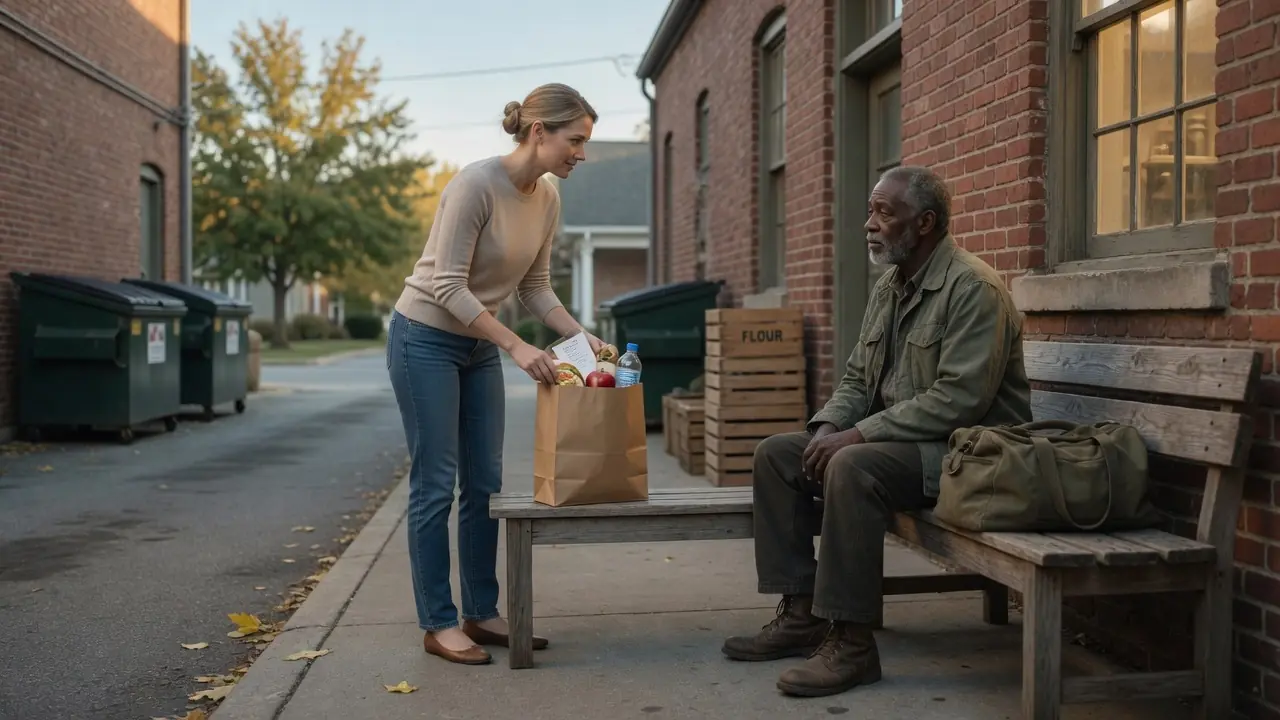
Meline turned from the mirror.
The coordinator stepped in front of her.
“Wait, not yet. We’re not ready for the aisle.”
Meline moved past her.
Outside, the guests turned as the bride appeared before the ceremony had begun.
Her dress brushed the grass. Her veil lifted slightly in the breeze. Her mother stood behind her, startled. Brian took one step forward from the trellis.
Meline did not look at them.
She walked straight to Hubert.
Every eye followed.
When she reached him, she stopped.
For a moment, neither spoke.
Then Meline extended her hand.
The entire lawn seemed to hold its breath.
Hubert looked at her hand.
Then at her face.
Slowly, he took it.
His palm was large, weathered, and careful around hers.
Meline turned toward the aisle.
Together, they walked.
Not quickly.
Not dramatically.
With quiet dignity.
The guests remained silent as the young bride and the old homeless man walked down the aisle together. Some looked embarrassed. Some offended. Some confused. Some could not look away.
Brian stood at the front, face unreadable.
When Meline reached him, Hubert released her hand and stepped aside.
The first row had no empty chair.
Meline turned and looked directly at the guests.
Cara, red-faced, quickly stood and moved one seat over, creating space.
Hubert sat down.
Alone, but no longer outside.
Meline faced Brian.
He leaned closer.
“Are you okay?”
She looked at him, steady and clear.
“Now I am.”
The ceremony began.
The officiant’s voice trembled at first, then settled.
Beloved friends and family.
Marriage.
Commitment.
Grace.
Promises.
But everyone heard the words differently because a man they had ignored for nearly two years sat in the front row, and the bride had made them all see him.
Meline said her vows with calm strength.
Brian said his with emotion that surprised even him.
When he promised to honor what she loved, his eyes moved briefly toward Hubert, then back to her.
Meline noticed.
She wanted to believe it.
The ceremony ended with a kiss and polite applause, but the sound faded quickly.
Something still hung in the air.
The reception had not yet begun when the first engine sounded.
Deep.
Steady.
Purposeful.
Heads turned toward the gravel drive beside the community hall.
A black SUV with government plates pulled up slowly.
Behind it came a second vehicle.
Doors opened.
Several uniformed members of the National Guard stepped out.
The crowd stiffened.
Two officers in formal dress uniforms walked toward the ceremony lawn. One was older, silver-haired, with precise posture and a solemn expression. The other carried a small velvet case.
Whispers erupted.
“What is going on?”
“Is something wrong?”
“Are they here for him?”
Meline’s heart began to pound.
Hubert did not move.
He sat with his hands folded, eyes lowered, as if he had known this moment might come and dreaded it anyway.
The older officer stopped near the front and removed his cap.
“I apologize for interrupting this celebration,” he said.
His voice carried across the lawn with practiced clarity.
“My name is Colonel David Hargrove. We are here today to correct an omission long overdue.”
The guests fell silent.
Colonel Hargrove turned slightly toward Hubert.
“Mr. Hubert Evans is not merely a guest at this wedding. He is a former Army officer, a decorated serviceman, and a man whose acts of courage saved lives during some of the most difficult missions of his generation.”
A collective gasp moved through the crowd.
Meline looked at Hubert.
His expression did not change, but his hands tightened slightly.
The officer continued.
“Hubert Evans served more than twenty years. He was known among his unit not only for bravery under pressure, but for refusing to leave anyone behind. During a rescue operation overseas, he led a convoy through hostile conditions to retrieve stranded personnel after communications failed. He was wounded during that mission. He refused evacuation until every person under his command was accounted for.”
The younger officer opened the velvet case.
Inside lay a medal, polished and gleaming beneath the gray sky.
“For reasons known only to him and those who loved him, Mr. Evans declined public recognition after returning home. Following the tragic loss of his wife and son, he withdrew from military life and later from the community that should have supported him better.”
The words struck the lawn like thunder.
Tragic loss.
Wife and son.
Meline’s eyes filled instantly.
She looked at Hubert and understood, finally, the depth of the silence he carried.
Colonel Hargrove’s voice remained steady, though something in it softened.
“His former unit never forgot him. We searched for him for many years. Recently, a local outreach volunteer recognized him from an old service photograph and contacted us. Today, we came to offer formal recognition for a man who has lived too long without honor from the country he served.”
No one moved.
No one whispered now.
The people who had mocked Hubert’s clothes, feared his presence, and questioned his worth sat frozen before the truth.
Colonel Hargrove stepped toward Hubert.
“Colonel Evans, on behalf of a grateful nation and the soldiers whose lives were shaped by your courage, we present this medal in recognition of your service, your sacrifice, and your humanity.”
Hubert slowly stood.
The lawn seemed to shrink around him.
He was no longer the man from the alley.
Or perhaps he had always been more than they had allowed themselves to see.
The younger officer handed the medal to Colonel Hargrove, who held it out with both hands.
Hubert looked at it.
Then at the officer.
Then at Meline.
For the first time, his voice carried clearly across the lawn.
“I don’t deserve ceremony.”
Colonel Hargrove’s eyes softened.
“With respect, sir, that is not your decision alone.”
A faint, painful smile touched Hubert’s mouth.
The guests remained breathless.
Hubert accepted the medal, but instead of pinning it to himself, he turned toward Meline.
She froze.
He stepped closer.
“This young woman fed me when people looked past me,” he said. “She gave me dignity when I had forgotten how to ask for it. If there is honor here today, she kept it alive before you came.”
Meline shook her head, tears spilling.
“Hubert…”
He held the medal carefully and pinned it to the lace at her shoulder, just beneath her collarbone.
The gesture was simple.
Quiet.
But it carried more weight than any speech.
When he finished, he looked at her.
“Thank you for seeing me.”
The words broke something open in her.
They were the same words from the napkin she had kept in her wallet for months.
Meline took his hand.
“You were always worth seeing.”
Colonel Hargrove saluted.
The younger officer saluted as well.
For a moment, only the uniformed men stood at attention.
Then Brian stood.
Slowly.
His face was pale, his eyes wet.
He looked at Hubert, then at Meline, then placed one hand over his heart.
Elaine stood next.
Then Cara.
Then Mason.
Then Mrs. Delaney, trembling with shame.
One by one, the wedding guests rose.
Not all with understanding.
Not all with clean hearts.
But they stood.
And sometimes, standing is the first honest thing people do after sitting too long in judgment.
The reception changed after that.
The laughter was softer.
The conversations more careful.
Some guests avoided Hubert, still too ashamed to approach. Others came awkwardly, offering stiff apologies that did not fully name what they were sorry for.
Hubert accepted none dramatically.
He nodded when he wished to.
Stayed silent when words were unnecessary.
Mrs. Delaney came to him near the lemonade table, twisting her gloves.
“Mr. Evans, I… I don’t suppose you remember me.”
Hubert looked at her.
“I remember most people.”
Her face reddened.
“I said things I shouldn’t have.”
“Yes.”
She swallowed.
“I’m sorry.”
Hubert was quiet for a long moment.
Then he said, “Be kinder sooner next time.”
Mrs. Delaney lowered her eyes.
“I will try.”
“That is all most of us can do.”
Brian approached Hubert later, when the music had begun and the sky finally cleared.
He stood beside him near the edge of the lawn.
“I misjudged you,” Brian said.
Hubert looked toward the guests.
“You misjudged her first.”
Brian absorbed that like a blow.
Then nodded.
“Yes. I did.”
Hubert turned to him.
“Do not marry a woman with a brave heart and spend your life asking her to make it smaller.”
Brian’s eyes shone.
“I won’t.”
Hubert studied him.
“For her sake, be sure.”
“I am.”
Hubert nodded once.
“Then stand beside her when it costs you something.”
Brian looked toward Meline, who was speaking with Colonel Hargrove, one hand resting near the medal pinned to her dress.
“I will.”
Hubert said nothing more.
He did not need to.
After the wedding, Hollow Glen tried to rewrite itself quickly.
That was what towns often did when shame became public. People who had whispered suddenly claimed they had always wondered about Hubert’s story. Customers who had complained about him now spoke of him with reverence. Someone suggested placing a plaque near the bakery alley.
Meline refused.
“He is not a town decoration,” she said.
The following week, Hubert disappeared again.
Not entirely.
But he no longer sat on the bench every morning.
The National Guard connected him with veteran support services he had avoided for years. Colonel Hargrove returned twice, not with cameras, but with paperwork, a counselor, and someone from housing assistance. Hubert resisted most of it at first. Then, slowly, he accepted enough help to move into a small apartment above the pharmacy.
Meline still brought him food some mornings, though now he sometimes came into the bakery through the front door.
The first time he did, the entire room quieted.
He stood at the counter and looked at Meline.
“Coffee,” he said.
She smiled.
“One sugar?”
“No sugar.”
“You hate sugar?”
“I respect it from a distance.”
She laughed.
The sound warmed the bakery more than the ovens.
Hollow Glen changed, but not all at once.
No town becomes kind overnight because one man receives a medal.
But small things shifted.
The bench behind the bakery was no longer treated like a stain.
Meline placed a small wooden box near the back door with sealed food bags for anyone who needed them. At first, people pretended not to notice. Then someone added apples. Someone else added hand warmers. Mrs. Delaney left a stack of clean scarves one cold morning with no note.
Cara began volunteering at the church pantry.
Mason stopped making jokes about people he did not know.
Amanda, after months of awkward silence, quietly asked Meline if she could help write the napkin notes.
Meline handed her a pen.
“Write what you would need to hear on your worst day.”
Amanda stared at the blank napkin for a long time.
Then wrote:
You are still welcome here.
Meline read it and nodded.
“That’s a good one.”
The bakery continued, but Meline felt a pull toward something larger than pastries and wedding cakes.
The idea came slowly.
Then all at once.
The bench.
The food bags.
Hubert’s note.
The shame of hiding kindness.
The power of making someone visible.
Six months after the wedding, Meline and Brian bought the empty storefront next to the bakery and opened a small community room called The Gathering Porch.
There was no grand launch.
No ribbon-cutting ceremony.
No press release.
Just a hand-painted sign in the window:
Come in. Sit down. Eat something.
Inside were mismatched tables, a coffee station, shelves of donated coats, a community bulletin board, and a long oak table where anyone could sit without being asked to buy something.
The bakery supplied soup and bread each afternoon.
Volunteers helped serve.
A nurse from a nearby clinic came every Thursday to check blood pressure and connect people with services.
Colonel Hargrove arranged for veteran outreach workers to visit monthly.
Hubert came often.
Sometimes he sat by the window with coffee.
Sometimes he swept the floor before opening.
Sometimes he spoke to veterans who entered with the same guarded silence he had once carried.
He never gave speeches.
But one sentence from Hubert often did more than a sermon.
“You can sit here,” he would say.
For some people, that was enough to make them cry.
Meline hung one thing on the wall above the long table.
The napkin.
The original one.
Yellowed slightly at the edges, folded and unfolded many times.
Thank you for seeing me.
Beneath it, Meline wrote:
Everyone who sits at this table has a story worth knowing.
People stopped in front of it often.
Some asked about it.
Some did not.
Some simply read it and sat down.
Years passed.
The Gathering Porch never became famous in the way large charities become famous. It did not have glossy brochures or celebrity donors. But it became known in the surrounding towns as a place where people could eat without shame, rest without being questioned, and be seen without having to prove they deserved it.
Meline and Brian’s marriage grew around that work.
It was not always easy. Brian had to learn that supporting a brave heart meant more than admiring it when others applauded. Sometimes it meant standing beside Meline when donors withdrew, when customers complained, when town officials asked for permits that had never mattered before.
To his credit, he learned.
Slowly.
Honestly.
Hubert remained in their lives.
He never became sentimental.
He never allowed anyone to turn him into a symbol while forgetting he was a man who liked black coffee, disliked overly soft bread, and preferred quiet mornings.
But each year on Meline’s wedding anniversary, he arrived at the bakery with a folded napkin.
Always one sentence.
Always in the same careful hand.
Year one:
Still here.
Year two:
Still seen.
Year three:
Still grateful.
On the fifth anniversary, Hubert arrived wearing the same navy suit from the wedding, now better tailored after Meline insisted and he pretended to be annoyed.
He sat at the long oak table in The Gathering Porch while rain tapped against the windows.
Meline brought coffee.
“No sugar,” she said.
“You finally learned.”
“I learned the first time. I just like annoying you.”
“Good. Keeps me sharp.”
She sat across from him.
For a while, neither spoke.
Then Hubert reached into his jacket and placed a folded napkin on the table.
Meline opened it.
This one read:
You did not save me. You reminded me I was still worth saving.
Her eyes filled.
“Hubert.”
He looked toward the window.
“I lost my wife and son on a road outside Fort Bragg,” he said quietly.
Meline went still.
He almost never spoke of them.
“My boy was nineteen. Thought he knew everything. My wife knew everything and let him think he did.”
A faint smile moved across his face.
“After they were gone, people tried to honor me. Medals. Ceremonies. Speeches. They wanted the uniform, the stories, the brave parts. Nobody knew what to do with the empty chair at my kitchen table.”
Meline listened.
“So I walked away. From the Army. From friends. From everything. Years passed. I became easier to ignore than to help.”
His eyes met hers.
“Then you left me a sandwich with a note that said someone sees you.”
Meline wiped her cheek.
“I didn’t know what else to do.”
“That was enough.”
They sat in silence together.
Not empty silence.
Full silence.
The kind that holds what words cannot carry.
Much later, after Hubert had gone home, Meline stood before the framed napkin on the wall. The room was empty. Chairs tucked in. Coffee pot cleaned. Lights low.
Brian came to stand beside her.
“You okay?”
She nodded.
“I keep thinking how close we came to missing him.”
Brian looked at the napkin.
“We did miss him. For a long time.”
Meline leaned her head against his shoulder.
“Not forever.”
“No,” he said softly. “Not forever.”
Outside, Hollow Glen settled into evening.
The bakery windows glowed.
The Gathering Porch waited for morning.
And on the wall, a small napkin held a truth the town had learned slowly, painfully, and finally.
People are not made worthy by what the world discovers about them later.
Not by medals.
Not by uniforms.
Not by titles.
Not by applause.
Hubert Evans had been worthy when he sat alone behind the bakery.
He had been worthy when people whispered.
He had been worthy before anyone knew his name.
Meline had understood that before the town did.
That was why the story mattered.
Not because a homeless man turned out to be a hero.
But because he had always been one.
And one young woman had chosen to feed him before the world remembered how to honor him.