Some stories begin with a hero, but this one begins with a man who no longer believed he was one. At thirty-eight, Ethan Ward tried to live quietly, far from the shadows of the Marine he used to be.
Yet the scars he carried were the kind that never stayed silent, and only his German Shepherd seemed to understand how loudly they spoke.
Danger did not always roar. Sometimes it waited, breathing softly in the dark.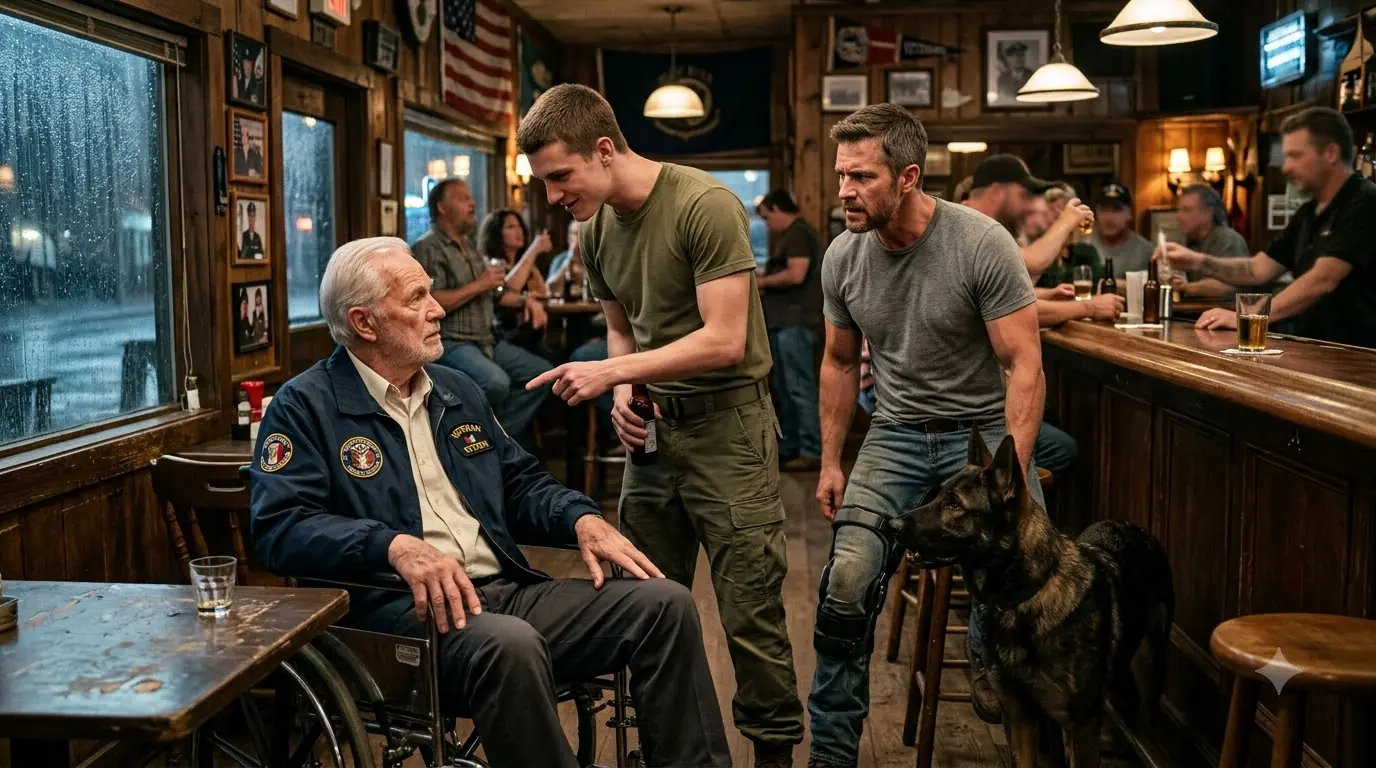
On a rainy night in a forgotten corner of town, Rowan sensed it before any human could. A trail appeared, tied to betrayal, buried missions, and a father’s secret no one was ever meant to uncover.
By the time Ethan understood that the past had come hunting for him again, it was already too late to run.
The wind off the Atlantic crept into Silver Pines the way old regrets crept into a man’s chest: quiet, insistent, and impossible to shut out completely. It slid between the warped boards of Pier Three, rattled a rusted sign that read FISHERMAN’S REST, and pressed its cold face against the windows until the glass fogged with breath and memory.
Inside the bar, the light was warm and low, amber bulbs casting soft halos over scarred tables and framed photographs of men in uniform. The place smelled of fried fish, beer, lemon cleaner, salt, and something older: gun oil and the ghosts of nights when laughter had to fight for space.
Ethan sat near the far end of the bar, where he could see both the door and the long mirror behind the counter. He had the build of a man the Marine Corps had once spent serious time molding: tall, broad-shouldered, and still strong beneath a plain gray T-shirt.
Short dark-brown hair carried tired streaks of silver at the temples, and his storm-gray-blue eyes held the weight of things he had never said aloud. A brace beneath his worn denim supported his left leg and forced him into a slow, deliberate walk. He no longer drifted through rooms. He moved along their edges, always touching something solid.
At his feet lay Rowan, a four-year-old German Shepherd with a sable coat of deep black and storm gray, broken by a crooked, arrow-shaped patch of pale fur on his chest. His amber eyes swept the room in disciplined arcs.
One ear tracked the jukebox, the other monitored the door, and his nose moved constantly, tasting the air as if it whispered secrets only he could hear. To the regulars, Rowan was part of the bar. To Ethan, he was the rope a drowning man held when he was too tired to keep swimming.
The bar was busier than Ethan liked that night. A cluster of young Marines had claimed three tables, their laughter rising and crashing like waves over deployment rumors, training stories, and borrowed swagger.
Private First Class Jace Holloway sat at the center, twenty years old and tall in the unfinished way youth often was. His jawline was sharp but not fully carved, his hazel eyes restless, and his high-and-tight haircut gave him more confidence than experience.
Beside Holloway sat Corporal Mason Caldwell, shorter and compact, with pale skin dotted by freckles and brown hair cropped close. Caldwell watched more than he spoke, his eyes steady as if he had already seen something he wished he had not.
On Holloway’s other side sat Lance Corporal Danny Ruiz, broad-shouldered and friendly-eyed, the kind of Marine who cracked jokes to avoid thinking too hard about anything heavy.
Behind the counter stood Marty Delgado, the bartender. He was in his early fifties, with olive skin weathered like driftwood and silver hair pulled into a short ponytail. A faded Navy anchor curled around his forearm. He polished glasses without rushing, a man who had learned long ago that letting silence breathe prevented more fights than shouting ever did.
Ethan noticed Marty glancing toward the door again and again. Trouble had its own smell.
Then the door opened. A gust of fog swept inside with an old man in a wheelchair. The chair was metal and worn from decades of use, but the man seated in it wore a brown field jacket stretched across shoulders that remained broad and straight. His skin was sun-spotted and weathered, his white hair cropped close, and his clean jaw still carried the discipline of another era. His pale-blue eyes were sharp enough to cut through a lie.
He rolled in with the quiet confidence of someone who had entered more dangerous rooms than this one and survived them all. Marty moved before Ethan even breathed.
"Evening, Sergeant Major," Marty said with reverence.
The old man nodded once. "Evening, sailor."
He took a small table by the window. Marty brought him whiskey without asking, and Rowan watched every second. The dog lifted his head, nostrils flaring. His tail did not rise or stiffen. He simply stared with the focus of a creature sensing something beneath the skin of the world.
Ethan felt tension ripple through Rowan’s muscles. The dog stood suddenly and took three slow steps forward, not toward the door or the young Marines, but toward the old man. Then Rowan released a single soft whine, a sound Ethan had not heard in years. It was the sound the dog made only in places soaked in old blood and unfinished stories.
It was the sound he had made the night they stumbled into a valley overseas, when no radio worked and Ethan learned that ghosts were not always metaphors. A chill crawled up Ethan’s spine. Rowan was not merely looking at the old man. He was looking between Ethan and the old man, as if seeing a thread neither man had touched yet.
The moment passed, but Ethan knew better than to ignore it. Rowan never reacted without a reason.
It did not take long for the young Marines to notice the wheelchair. Holloway spotted it first and smirked.
"Well, would you look at that? VIP rolling in."
Ruiz lowered his voice. "Leave it, man."
Caldwell rose halfway from his chair. "Jace, don’t."
But Holloway lived for the kind of attention that pushed him into bad decisions. He swaggered toward the old man. Marty froze with a half-cleaned glass in his hand. Rowan tensed. Ethan set his drink down and watched.
"Evening, sir," Holloway drawled. "You lose your bingo group, or did you just roll in for the veteran discount?"
A few Marines laughed. The old man did not. He swirled his whiskey, then raised his eyes, cold, patient, and unafraid.
"Son," he said softly, "I stopped playing games a long time ago."
Holloway snorted. "Yeah? Then where did you serve? The parking lot?"
Caldwell stood fully. Ruiz winced. Rowan rose to his full height, steady, silent, and ready.
Holloway leaned closer. "Come on, Grandpa. You got a jacket. What’s your story, or is it just decoration?"
The old man’s jaw twitched. He turned fully until he was eye to eye with Holloway.
"You want a story? Answer me something first."
Holloway blinked. "What?"
"What’s your MOS?"
"0311. Rifleman," Holloway said, straightening automatically.
"Good," the old man murmured. "Then maybe you’ll understand this. There was a valley once, far from here. Thirty-two Marines went in. Twenty-nine came back."
He set the glass down gently. "You are standing in front of the man they followed out."
Silence rippled across the room. Holloway’s mouth opened, but nothing came out.
Ethan stood, and Rowan stopped beside him like a sentinel made of muscle and instinct.
"That’s Sergeant Major Leonard Briggs," Ethan said calmly. "Third Battalion, Fifth Marines. Korengal and Helmand."
Holloway paled. Ethan’s voice remained steady as stone.
"He didn’t just bring twenty-nine men back. He stayed on the ridge when the rest withdrew. He called fire onto his own position so his Marines could live. They made his name a rumor because the truth frightened people."
The young Marine stared at the old man, seeing him for the first time. Holloway swallowed hard.
"No," Briggs said. "You didn’t. Ignorance is forgivable. Disrespect isn’t."
Then Rowan moved. He stepped forward and gently raised one paw, placing it on the footplate of Briggs’s wheelchair. The entire bar froze. Briggs’s pale-blue eyes softened, and his weathered hand lowered to rest on Rowan’s head.
"You pick your friends well, son," he murmured.
It did not matter whether he meant Ethan or Rowan. The moment struck the room like scripture.
Holloway removed his cap and pressed it to his chest. "Sergeant Major, I’m sorry, sir."
Caldwell came to attention, eyes forward. "Sergeant Major, honored to meet you."
Ruiz straightened, his usual grin gone. "Yes, sir."
One by one, the young Marines stood and saluted, not with perfect form, but with perfect sincerity. Marty placed a hand over his heart. Ethan felt something deep inside him shift awake, a sense of duty he had tried to bury breathing again.
Outside, the Atlantic wind rattled the windows, but now it sounded almost like applause. Rowan remained beside Briggs and exhaled softly, as if confirming that this meeting was not an accident, but the spark of something much larger still waiting in the dark.
The bar emptied slowly after that, like a tide withdrawing from shore. The young Marines finished their beers more quietly than they had begun them. Their laughter, when it returned, carried a different shape, with fewer sharp edges and more weight. One by one, they approached Briggs to shake his hand, murmur another apology, or simply whisper, "Thank you," their voices suddenly too small for everything they wanted to say.
Briggs received each gesture with steady calm, as if he had forgiven them before they even understood they needed forgiveness. Ethan stayed back, allowing the moment to belong to them. Rowan remained beside Briggs’s wheelchair, alert and planted like a guardian that had chosen its post. He kept one paw on the footplate until Briggs finally brushed it away with a rough, affectionate pat.
Caldwell and Ruiz left with quiet nods. Holloway lingered longest near the door, cap still in hand and head bowed, before stepping out into the fog without another word. Marty moved in slow circles, wiping tables but never straying too far.
Outside, the wind grew harsher. It rattled the door and tapped the windows like impatient fingers.
"You planning to camp here all night?" Marty finally asked. Though he spoke to Ethan, his eyes moved toward Briggs.
Ethan exhaled. "Wouldn’t be the worst idea."
"My electric bill thinks otherwise," Marty grunted, then softened. "And the dog won’t sleep until he knows where that man ends up."
Rowan proved him right by walking to the back door and waiting there, tail still and head slightly tilted as if marking attendance.
Ethan sighed. "That’s one vote."
Briggs chuckled dryly. "Guess I’ll accept the escort."
They stepped into the cold. Fog swirled along the pier, swallowing streetlamps and stretching shadows into long, uncertain lines. Ethan’s battered blue pickup waited in the alley behind the bar, rust creeping along the wheel wells and a faded Marine Corps sticker clinging to the bumper like a memory refusing to wash away.
He lowered the tailgate with a rusty clank. "Chair can go back here. Seat’s not first class, but it doesn’t bite."
Briggs maneuvered closer. "Haven’t flown first class since Nixon was president."
Together, with careful leverage and practiced efficiency, Ethan helped Briggs from the wheelchair into the passenger seat. The old man’s body felt both lighter and heavier than expected: light in weight, heavy with years. When Briggs settled in, he released a long breath that fogged the windshield.
Ethan folded the chair and slid it into the truck bed. Rowan jumped in behind it before moving into the cab, taking his usual post behind Ethan’s shoulder.
"You always drive wounded strays home?" Briggs asked.
"Only the ones my dog approves of," Ethan replied, turning the key.
Silver Pines felt smaller at night, compressed by fog and narrow streets. Houses leaned closer together, whispering old secrets beneath dim streetlights, while a foghorn moaned somewhere in the distance. They drove in silence at first. Briggs watched the passing lights, Ethan watched the road, and Rowan watched both men, amber eyes moving back and forth as though monitoring an unseen conversation.
"You didn’t have to stand up for me back there," Briggs said eventually.
"You didn’t have to carry thirty-two men into that valley," Ethan answered.
Briggs almost smiled. "Fair enough."
The truck rumbled on.
"But you looked at me," Briggs added quietly, "like you knew something you shouldn’t know yet."
Ethan tightened his grip on the steering wheel. "Let’s just say I’ve heard enough stories to know the difference between a myth and the men behind it."
"From whom?"
"Men who made it back," Ethan said, his voice tightening. "And men who didn’t."
He glanced in the rearview mirror. Rowan was still watching Briggs, head slightly tilted.
"And a dog," Ethan added softly, "who doesn’t forget a shadow on the road."
They were nearing the outskirts of town when Briggs stiffened. His gaze shot toward the side mirror, and his fingers dug into his knee.
"You’ve got a tail," he murmured.
Ethan checked the mirror. At first, he saw nothing but fog and distant halos of streetlight. Then a pair of headlights appeared, far enough back to pretend coincidence, but too steady to be one. They turned when Ethan turned and slowed when he slowed.
"Maybe they live out here," Ethan offered without conviction.
Rowan disagreed. His muscles stiffened, and he turned fully toward the rear window, ears pricked and teeth barely visible. A controlled growl vibrated in his chest.
"I’m not a fan of paranoia," Ethan muttered, "but he doesn’t growl unless something is wrong."
"You’re not imagining it," Briggs said. "I’ve had shadows like that for months. Different cars, same distance, same behavior."
"You tell anyone?"
"I told a VA doctor once. She wrote hypervigilance in my chart."
Ethan bit back a curse.
The car behind them flashed its headlights: two long, one short, a pause, then the same pattern again. Ethan frowned.
"Maybe he hit the switch."
Briggs slammed a trembling hand against the dashboard. "No. That’s an old convoy signal from routes where radio chatter got men killed." He swallowed hard. "They aren’t just following us. They’re talking to us."
Ethan’s pulse struck once, hard. "To whom?"
"To me," Briggs said. "And to anyone else who lived through Iron Meridian."
The name landed like cold metal between them. Even Rowan reacted, ears snapping forward as his growl deepened.
"Iron Meridian," Ethan repeated. "That mission was sealed."
"Exactly," Briggs whispered. "Sealed and buried."
Ethan tested the tail by taking two side streets, making sharp turns, and varying his speed. The headlights followed, neither gaining nor falling back. When they reached Briggs’s apartment complex, a squat, tired building with peeling paint and a lonely buzzing lamp, the car drifted past the entrance like a shark cruising the edge of a pier. It did not attack or flee. It merely observed.
Rowan tracked it with his whole body until it vanished. Ethan cut the engine, and silence slammed into the cab.
"They won’t come tonight," Briggs said softly. "Watching is safer than acting. And now they know who brought me home."
Ethan clenched his jaw. "Why not knock? Why not confront you?"
"Because they don’t want answers. They want silence that looks like old age and bad memory." Briggs shifted toward the door. "Come inside. If you’re going to have a target on your back for driving me home, you might as well know why."
Ethan hesitated. Every instinct told him to turn around and walk away. Then Rowan leaned forward from the back seat and rested his head on Ethan’s shoulder, quiet, steady, and heavy with meaning.
Another vote.
Ethan opened his eyes. "All right. Let’s get you in."
He helped Briggs down, steadying his own injured leg, and together they crossed the dim parking lot. As they moved toward the stairwell, Ethan felt the old, familiar prickle at the back of his neck.
The past had not followed him home. It had been waiting for him.
Briggs’s apartment was smaller than Ethan expected, but it carried the quiet order of a man who had lived a long time with chaos and decided it was no longer welcome beneath his roof. The living room was a narrow rectangle with beige walls and a sagging couch pushed against one side. A single bookshelf stood opposite, crammed with dog-eared paperbacks, war memoirs, history texts, and battered crime novels. Above it hung one framed photograph of a young Marine platoon beneath a washed-out desert sky.
Briggs rolled inside without turning on more than the single lamp near the couch. Its yellow glow threw long shadows across the floor. Ethan followed, his limp sharper after the cold, while Rowan slipped in behind him and began mapping the room with precise, quiet breaths.
The German Shepherd moved carefully, his nails ticking against the laminate. He sniffed table legs, the couch edge, and the lower shelves, then paused beneath the framed photograph. His ears twitched before he looked back at Ethan with a quiet huff, as if he had recognized something he could not explain.
"Not much to look at," Briggs said, maneuvering his chair to face the room. "Landlord calls it cozy. I call it cheap."
There was humor in his voice, but beneath it lay an old weight he had learned to carry without letting it bend his spine. Ethan lowered himself onto the couch with a slow exhale, his damaged leg throbbing.
He glanced around. There were no medals, plaques, or flags behind glass, only one sun-faded family photograph on a side table, its edges softened by years of handling.
"I’ve seen men turn their living rooms into shrines," Ethan said. "You don’t seem the type."
"Shrines are for the dead," Briggs replied. "I still wake up breathing. Most days, that’s enough."
He studied Ethan briefly. "You don’t like being here."
"I don’t like being anywhere unless I understand the exits," Ethan said. "And I really don’t like being followed."
Briggs nodded. "Then let’s give you something real to hate."
He gestured down the narrow hallway. "Help me."
Ethan pushed himself up and moved behind the wheelchair, steering Briggs toward the bedroom. Rowan followed like a silent shadow. The room was small and neat, with a worn dresser, a carefully made bed, and a desk beneath a window overlooking the dim parking lot. A closet door with a brass knob stood on the far wall.
"Open that," Briggs said.
Ethan did. Inside was not clothing, but an improvised storage nook packed with plastic crates and an old olive-drab footlocker scarred at the corners. A green plastic box sat on top with duct tape across the lid.
"That one."
Ethan placed it on the bed. Briggs released the latches with practiced fingers. Inside were bundled folders, a small black notebook, and a scratched metal case about the size of a paperback. Rowan moved forward, sniffed once at the edge of the box, then backed away with his ears slightly lowered. Something weary flickered through his posture.
"He doesn’t usually do that," Ethan muttered.
"Smart dog," Briggs said. "Maybe he can smell lies. Maybe secrets."
He tapped the folders. "This is Iron Meridian. What remains of it."
Ethan froze. He had heard the name in whispers, but never spoken plainly.
"Orders, communications logs, mission updates," Briggs continued. "Enough to prove Iron Meridian wasn’t a sacrifice. It was an abandonment."
Ethan swallowed. "Tell me from the beginning."
Briggs looked toward the window for a long moment before he began.
"Iraq, 2003. Not the version anyone printed."
He described a ghost unit with no insignia and no patch, a handpicked team built to leave no trace. Their mission was to extract two high-value hostages from a faction never named in public channels, but feared in private ones.
"We were sold heroics," Briggs said. "They needed us to board the helicopters smiling."
The insertion had dissolved into chaos. Darkness masked everything, sand stripped skin raw, and the desert was colder than expected. The first contact broke the plan apart. Intelligence had predicted twenty hostile fighters. Instead, more than a hundred shapes moved through the darkness.
"We were pinned in a courtyard," Briggs said, his eyes drifting somewhere far beyond the apartment. "Radio calls went out. For the first ten minutes, reinforcements were coming. During the next ten, the language changed.
"Complications. Rerouted. After that, nothing."
"The silence of men already written off," Ethan said.
Briggs reached into the box and removed a set of dog tags. He held them out.
"Read the name."
Ethan angled them beneath the lamp.
CPL JAMES ORTIZ, USMC.
The room seemed to tilt.
"No," Ethan whispered. "Ortiz was..."
A memory struck him with the force of a door kicked open. Another battle, another valley, Ortiz bleeding in his arms while a radio screamed for retreat. Dust had been thick enough to taste. Ortiz had refused to close his eyes, a young Marine who gave Ethan the last minutes he barely survived.
"You were there," Briggs said softly. "Different flank. Same buried truth."
Rowan pressed against Ethan’s knee, sensing the tremor and watching his handler with instinctive concern.
"Ortiz stayed with us after the outer cordon broke," Briggs continued. "He bought us time. Command called it a contained loss. I kept his tags because he deserved more than a line in a report."
Ethan closed his fist around the metal until its edges pressed into his skin.
Briggs then spoke of the aftermath. A ceremony had been held for men presumed dead, complete with folded flags and speeches, while Briggs was still alive and crawling out of the desert with the hostages after the mission had already been declared closed.
"Easier to hide one survivor than admit the mission," Briggs said.
"You could have exposed them."
"And then what? My wife would lose her husband to a black cell. My daughter would grow up with a ghost instead of a father. Silence kept them alive."
Briggs looked toward the frayed family photograph on the side table. "They’re gone now. The equation changed."
Rowan suddenly lifted his head. His ears stood straight, and his nose pointed toward the front door. A low rumble vibrated in his chest.
Ethan straightened. "Rowan."
The shepherd moved closer to the door, muscles tightening, tail rigid but low. From outside came the faint sound of engines, then a car door closing and footsteps on gravel.
Briggs’s face remained still, but his voice changed. "You said they followed me for months. Tonight, that car didn’t feel like it was only for me."
Ethan started toward the hallway, but Rowan stepped in front of him, blocking the path with gentle, immovable resolve.
"Move," Ethan whispered.
Rowan did not. His eyes moved toward the door, and he released one short, controlled bark.
Briggs looked toward the hall. "You feel that?"
Ethan nodded slowly.
Whatever truth they had opened in that small room had reached the outside world. Something in the darkness had decided its waiting period was over.
Rowan’s bark still echoed when Ethan moved toward the front door. The dog planted himself between Ethan and the hallway, body rigid, tail lowered, and ears slicing the air toward the sound outside. It was not aggression. It was the kind of tension that came when danger had shape and direction.
Briggs wheeled closer, shoulders squared despite his age. Lamplight sharpened the lines of his weathered face, the sunken cheeks, and the jaw time had not softened.
"Kid," he said quietly, "your dog knows something we don’t. If he’s reacting like that, we shouldn’t be standing near the door."
Ethan breathed slowly. Old memories returned with the metallic taste of adrenaline and the sensation of someone unseen measuring every breath. He stepped back, fingers unconsciously tracing scar tissue beneath his pant leg.
Rowan shifted with him, still angled toward the threat. Outside, the hallway fell silent. That silence was worse than footsteps. It meant precision. It meant training. It meant they were not there to talk.
"Bedroom," Briggs said. "Lights off. Move slowly. They want us in the open."
Rowan’s head jerked toward the window. A growl rolled through his throat.
Ethan crossed to the blinds and tilted them just enough to look into the fog-thick parking lot. Three silhouettes stood below in dark jackets without reflective patches or identifying marks. Cars idled behind them with their headlights off. One man held a small metal device in his left hand.
"Signal equipment," Ethan murmured. "They may be tracing the call or suppressing the building’s communications."
Briggs exhaled. "Thought I switched that phone off."
"You did. Turning it off doesn’t erase every breadcrumb."
Rowan pressed close to the window frame, his nose tracing the edges of the glass. Ethan watched the figures below and felt a cold certainty settle over him.
"They know exactly which apartment they need."
A knock came, soft, polite, and deliberate.
"Mr. Briggs," a calm male voice called through the door. "We need a word."
Briggs’s jaw locked. "They want me alive."
"Only long enough to learn what you know," Ethan said. "After that, the details won’t matter to them."
Rowan stepped forward, every hair along his back stiffening. His movement remained precise, a trained animal preparing rather than panicking. Ethan recognized the shift. It was the same stance Rowan took before finding a missing child beneath winter snow, and before sensing an ambush on a wooded trail.
The knock came again. A woman’s voice followed, clipped and professional.
"Open the door, Mr. Briggs. We’re here under federal directive."
"Federal, my ass," Briggs muttered.
Ethan scanned the room for options. Briggs watched him and managed a thin smile.
"You planning to fight them with a toaster?"
"I’m planning to survive."
The bottom edge of the apartment door flexed inward. Someone outside was testing the frame near the lock. They were not waiting for permission.
Rowan moved halfway down the hallway and became unnaturally still. Ethan had seen that look once overseas when a bomb-detection dog froze before a collapsed doorway. Rowan was not merely sensing danger. He was sensing someone familiar.
Briggs noticed it too. "He’s reacting as if he knows a scent."
"Rowan has never met them."
"Not here," Briggs said. "Maybe somewhere you haven’t told me about. A battlefield. A place dead men walk."
Someone shifted outside. Rowan growled, and Ethan understood that one of the men carried Iron Meridian in his clothes, his equipment, or his past. The lock clicked. A pin slipped, then a hinge loosened.
They were professionals, quiet and efficient.
Ethan grabbed the wheelchair. "Back room. Now."
"I’m done running," Briggs said.
"Well, I’m not," Ethan snapped. "And neither is Rowan."
The dog backed beside Ethan, keeping himself between the door and both men. Ethan took the metal case containing the Iron Meridian files and pushed it beneath his coat.
Briggs saw the movement. "You’re taking it?"
"They can’t leave with it."
A tool slid quietly outside the door. Rowan’s growl deepened.
"Bedroom window," Ethan whispered. "Fire escape."
Briggs hesitated, then nodded. "Go."
Ethan pulled the wheelchair toward the back hall just as the front door eased open without a sound. Hallway light spilled across the floor in a thin, predatory line.
A tall, broad-shouldered man stepped inside wearing a dark tactical coat. He was clean-shaven, with an angular face, a severe jaw, and cold gray eyes that no longer belonged to someone who believed in orders, only outcomes. Behind him entered a shorter, wiry man with a shaved head and a faint scar across one eyebrow. Neither wore a badge. Neither announced any lawful authority.
The taller one spoke softly. "Mr. Briggs, we only want to talk."
Ethan tightened his hands around the wheelchair grips.
Briggs’s voice drifted back, low and bitter. "Funny. That’s exactly what they said before they declared me dead."
The tall man moved farther inside, scanning the room with clinical precision. His gaze landed on Rowan. The dog snarled, a deep sound rooted not in fear, but recognition.
The man’s eyes flicked downward. He knew something about the dog, or the dog knew him. Ethan could not tell which.
Ethan pushed Briggs faster down the hall. The fire escape was only twenty feet away, but with two professionals behind them, the distance felt endless.
The shaved-headed operative moved first. "There’s nowhere to go."
Rowan shot forward several steps and released a bark so explosive it stopped the man cold. It was not an attack, but a warning and a line drawn in instinctive stone.
The taller man lifted a hand. "Stand down. All of you."
Ethan did not. He pushed open the bedroom window, and fog rushed inside, cold and sharp. The fire escape clung to the outside wall like a metal skeleton.
"Briggs, move."
He hauled the old man toward the opening while Rowan backed toward them, guarding the retreat. Before they could climb through, the taller man spoke again.
"Ethan Ward."
Ethan froze.
Briggs twisted in the chair. "They know your name."
The man’s voice remained eerily calm. "We’ve been watching you since Fallujah."
Ethan’s heart slammed once, hard enough to hurt. They had not come only for Briggs. They had come for both of them.
Rowan pressed against Ethan’s thigh, trembling with focus and waiting for one command. Outside, an engine revved. Below the fire escape, another figure stepped into view carrying a portable jammer.
They were cutting off every exit.
"Ethan," Briggs whispered, "you’d better have an idea."
The men in the doorway advanced. Rowan growled, and Ethan understood that they were not leaving through the window quietly.
The room seemed smaller with his name hanging in the air like a verdict. Ethan’s fingers tightened on the back of Briggs’s chair. The old man’s hand gripped the armrest, knuckles pale. Rowan stood between them and the hallway, body angled toward the intruders, muscles coiled but movement still measured.
"Step away from the window and sit down," the shaved-headed operative called. "No one needs to get hurt tonight."
"Men who say that sentence already made a list of whom they’re willing to hurt," Briggs muttered.
Ethan slowed his breathing, an old discipline returning. Window blocked. Door controlled. Two men inside, at least one outside, and communications suppressed. Rowan’s ears moved backward as if tracking Ethan’s thoughts.
"You still remember how to fall?" Ethan asked Briggs quietly.
The old man gave him a sideways glance. "Son, I’ve been falling for twenty years. What are you thinking?"
Ethan looked toward the far corner of the ceiling. The plaster sagged around a faint square outline.
"Old building. Maintenance access."
Briggs followed his gaze. "You are not dragging me into a crawlspace."
"You want to stay and let them bag you? They know my name. That means they know yours. We’re past polite conversations."
Rowan stepped toward the doorway, then backed toward the far wall, as if herding both men toward the access panel. His gaze never left the dark hall.
The tall operative’s voice traveled down the corridor. "Mr. Ward, if you come out now, we can still fix this. You were never the primary concern. You’re a variable. Don’t make yourself a liability."
Ethan closed his eyes for one controlled breath. They had his service record, his injuries, and his past. They expected him to be worn down and predictable, but they did not understand Rowan.
"Briggs," Ethan whispered. "Do you still trust me?"
"You’re the only man here who isn’t trying to file me away. So yes. For tonight."
"Then we’re going up."
Ethan grabbed a chair, stepped onto it, and pushed at the sagging plaster. It cracked with a gritty tear, dust raining down in a choking curtain. Above, a dark opening smelled of insulation and old wood. The building groaned as if objecting.
"Ward," the shaved-headed operative snapped, footsteps approaching. "Don’t."
Ethan jumped down, ignoring the pain in his leg. Rowan was already poised beneath the opening.
"Up."
The shepherd jumped in one smooth movement, claws scraping before catching the wood. He pulled himself into the darkness. A soft thump told Ethan he had landed.
The operative reached the bedroom threshold and saw the hole. "Seriously? We’re doing this?"
"Turn your lights off," the taller one ordered. "He’s ex-Marine. He’ll use every angle we hate."
Ethan climbed, pain cutting through his damaged leg. He used Rowan’s steady presence above to anchor himself and dragged his body into the narrow space, rolling onto dusty boards that creaked like old bones.
Below, Briggs looked up.
"They’re going to force the door."
"Not before they decide which kind of ghost they want to be," Ethan whispered. "Lawful or feral."
He reached down. "Your turn, Sergeant Major."
Briggs stared at the opening and laughed softly. "They told us we’d be above it all one day. Didn’t think they meant this literally."
Ethan hooked his arms beneath Briggs’s shoulders. The old Marine pushed with what strength remained, boots scraping the wall. For a moment, his weight nearly pulled free, but Ethan held on.
"Hang on."
"You drop me," Briggs rasped, "and I haunt you."
Together, with Rowan backing away to make room, they pulled Briggs onto the boards. The old man lay breathing hard in the thick dust.
"Next time," he wheezed, "we take the elevator."
Below, the bedroom doorframe splintered. A harsh beam swept across the room, then locked on the opening above.
"He’s using old ghost routes," the scarred operative muttered.
"He’s not a ghost," the taller man replied. "He’s loose."
In the crawlspace, Rowan stopped. Every muscle froze as he stared into the darkness ahead. He sniffed once, slowly, then released a soft, eerie whine Ethan had heard only once before, at the burned edge of an abandoned forward operating base where something terrible had happened years earlier.
Rowan nudged a wooden beam with one paw. Ethan reached out and felt something smooth and cold taped underneath it. He peeled away a tiny black transmitter, dust packed around its edges.
Briggs narrowed his eyes. "Is that what I think it is?"
"Old listening device. Dead indicator." Ethan turned it over in his hand. "This has been here for years."
"They’ve been listening that long," Briggs said. "Not only tonight."
Rowan sneezed sharply as if rejecting the scent.
Ethan pocketed the device. "Then this didn’t begin with the men downstairs. It began with whoever signed your death certificate."
They crawled forward until the ceiling dipped toward another access panel. Ethan pressed his ear against it and heard washing machines humming below.
"Laundry room."
Rowan slipped through first, landing on a folding table. Ethan lowered Briggs next, then dropped down after him. The room was empty.
"There’s a side exit," Briggs said. "Used for deliveries."
They moved toward it, Rowan helping guide the chair with a secondary harness line while Ethan listened for every sound. Cold fog washed inside when Ethan cracked the door. The back lot was dim and empty.
"Rowan," Ethan murmured. "Steady."
The dog leaned into the harness with controlled strength. The chair rolled quietly across the concrete. They hugged the wall, crossed the lot, and slipped into an alley.
Fog drifted like pale curtains around them. Ethan looked toward the street. Cars moved beneath amber lamps. Everything appeared almost normal.
"We cut across the block," he whispered. "I know a place."
Briggs nodded.
At the sidewalk, Rowan paused to scent the air. Every hair along his spine lifted. Ethan felt the change before he saw its cause.
A black sedan waited at the end of the block. Its headlights flashed once, then went dark.
Rowan pressed against Ethan’s leg, growling low.
"They’re patient," Ethan said. "That’s worse."
They disappeared into the fog, three fugitives pursued not only by the men from the apartment, but by something older, deeper, and far more deliberate.
Fog clung to the street as if it were trying to keep secrets. Ethan felt it bead against his face while Rowan remained a warm line of tension at his side. Behind them, Briggs’s wheelchair rolled softly over cracked pavement, the old Marine’s hands braced tight on the armrests.
The black sedan stayed at the end of the block without moving. No siren, no engine rev, only presence. Ethan guided them into a narrow alley between an old warehouse and a shuttered convenience store. The passage smelled of oil, wet cardboard, and stale smoke, while a single security light flickered above a rear door and turned the fog into a restless halo.
"You sure about this?" Briggs asked.
"The alley is better than the main road," Ethan said. "Fewer civilians and fewer directions for them to approach. If they want us, they have to show themselves."
"You always talk like that when you walk into a funnel?"
"Only when I plan to walk out."
Rowan moved several steps ahead, checking every shadow and trash bin before circling back. Halfway down the alley, an engine growled from the far end. Headlights swept across the opening, and a dark pickup rolled forward until it blocked the exit.
Two men stepped out. The first drew attention without trying. He was tall, broad, and in his mid-forties, with the body of someone shaped by real war rather than a gym. Dark-blond hair was cut close, a thick beard was streaked with gray, and a white scar ran from his lower lip to his chin. His pale-blue eyes were cold enough to seem brighter than the fog.
The second man was wiry and narrow-faced, with a buzz cut and a hooded sweatshirt beneath a leather jacket. His movements were quick, controlled, and practiced. They were not police, and they were not amateurs.
"Well," Briggs murmured. "That’s new."
Rowan stepped forward, hackles rising.
The taller man spoke in a low, unhurried voice. "Evening, Sergeant Ward."
Ethan froze. No one had used that rank in years.
"You’re not with the people from the apartment," Ethan said.
"No. They ask questions. I clean up when questions don’t work."
"You have a name?"
"Dean Calder. Most people who know it don’t say it twice."
Recognition moved through Ethan. After-action rumors, contractor lists, and whispers about a Marine who had gone private and never refused a contract written in blood.
Calder saw it in his face and gave a small, humorless smile. "We’ve been circling each other for years, Ward. Different continents. Same ghosts."
Rowan raised his nose into the fog, sniffed twice, then stiffened. Something in Calder’s scent unsettled him. It was not only danger. It was memory.
"You’re not here for a reunion," Ethan said. "Say what you want."
Calder nodded toward Briggs. "I came for him, and for whatever he’s carrying that everyone pretends never existed."
Briggs’s jaw tightened. "You work for the people who buried Iron Meridian."
"I work for whoever pays. Tonight, the check comes from people who preferred your file when it ended with KIA."
Rowan’s growl deepened.
Then Calder said something he had no right to know. "I read the report from Kunar. The one about your dog choosing you over the extraction route. Command called it asset bias. I call it loyalty. Shame we may have to watch that loyalty tear him apart."
Ethan’s heart seemed to stop. The report was sealed. Only people deep inside the chain had access to it. Rowan looked up at him, amber eyes wide and confused, as if he also sensed that someone had broken into a private part of their past.
For the first time, Ethan wondered how long they had been watched and how much had been read.
Calder’s face changed. "My brother died in that courtyard your unit was supposed to clear. Wrong briefing, wrong location, same bloodbath. They handed me a folded flag and a clean lie."
"That wasn’t Iron Meridian’s fault," Briggs said.
"No," Calder answered. "But it was your ghost unit they removed from the story. Someone decided my brother’s death needed a cleanup instead of justice."
His anger was not only professional. It had lived with him for years.
"Here’s the offer," Calder said. "Hand over Briggs and the files. You and the dog walk away breathing."
Ethan gave a dark laugh. "You don’t believe that any more than I do."
"Belief doesn’t matter. Deliverables do."
Rowan planted himself in front of the wheelchair, chest expanding as he stared at Calder.
"You really think," Ethan said quietly, "that after what they did to him, I’m going to hand him over?"
"I think you’ve seen bad endings. Sometimes the least ugly option is the only one left."
Calder stepped closer. His partner’s hand moved toward his waistband, and the tension snapped tight.
"Rowan," Ethan whispered. "On me."
The dog’s eyes cut toward a dented metal trash can leaning against the wall. Ethan did not look at it directly. Rowan waited.
Calder took another step.
Rowan burst into motion, not toward either man, but toward the trash can. His shoulder struck the metal, and the can collapsed with a violent clatter. Bottles exploded across the pavement, turning the alley into a chamber of echoes.
Calder’s partner flinched and began drawing a weapon. Calder seized his wrist.
"Not here, idiot."
Ethan shoved Briggs’s wheelchair toward the warped delivery door. The wheels struck the frame and stuck.
"Push!" Briggs grunted.
Ethan drove forward. Metal screamed, and the chair lurched through. Rowan spun and barked, holding the opening long enough for Ethan to pull the door shut behind them.
A shot struck the outer metal with a sharp clang. Calder’s voice followed through the alley.
"Cover every exit. Call it in. If we don’t bring them out breathing, someone else will bring them out empty."
Inside was a narrow concrete loading corridor lit by red emergency lamps. Rowan panted, but his eyes remained focused. Briggs released an uneven breath.
"I hate to tell you this, but men like Calder don’t waste thirty seconds. They turn them into weapons."
"Then we move."
Rowan led them toward a faint glow around the next door. Behind them, a vehicle engine roared. Calder was not giving up.
The corridor stretched like a forgotten artery beneath the city. Its old hospital-green walls were chipped and stained, and emergency lights threw long shadows across the concrete. Ethan pushed Briggs steadily, one hand on the chair and the other occasionally touching Rowan’s back as the dog stayed close.
Briggs rolled his shoulders, his breathing heavy but controlled.
"Feels like a place where secrets come to rot," Ethan murmured.
Rowan stopped suddenly. His nose rose, his body stiffened, and his tail lowered without tucking.
Ethan froze. "What is it, boy?"
The dog took a cautious step, tested the air, then looked back with a sharp, insistent stare.
"We keep going," Ethan said. "Carefully."
They advanced until the passage turned and widened into an underground service junction lined with old crates, pallets, and a rusted cart. A bulletin board hung crooked on one wall, its papers yellow and curled.
"This place is older than both of us," Briggs said.
"You complaining or observing?"
"Both."
A faint scrape moved through the darkness ahead. Rowan’s head snapped toward it. Ethan reached for the flashlight inside his jacket.
"Don’t point that at me, Sergeant," a soft voice called from the far corner. "I’ll take it the wrong way."
A man stepped into the weak light. He looked to be in his early fifties, or younger if life had not weathered him so severely. He had a narrow face, stubble along a sharp jaw, and dark hair fading to gray around the edges. Pale-hazel eyes held the tired awareness of someone who expected danger from every direction.
He wore a faded Army-surplus jacket over a gray Henley, cargo pants stained with dirt, and boots worn at the toes. No weapon was visible, but his posture suggested he did not need one to be dangerous. He raised both hands slowly, not in surrender, but as someone familiar with frightened dogs and armed men.
"Name’s Cole Mercer," he said. "Used to patch up people like you before command decided all of us were expendable."
Briggs narrowed his eyes. "Mercer? Lieutenant Mercer from the recon medical unit?"
One corner of the man’s mouth lifted in a sad smile. "Yeah. That Mercer."
Rowan stopped growling, though he did not relax. He sniffed the air and tilted his head as if the man’s scent belonged to a buried memory.
"You’re far from the recon zone, Lieutenant," Ethan said.
"So are you," Mercer replied.
Briggs stared at him. "You shouldn’t be alive. Command listed you KIA."
"The blast didn’t finish the job," Mercer said softly. "Some days I wish it had."
Ethan felt a cold line travel down his spine. "How long have you been down here?"
"Long enough to know they’ve been hunting you since you walked into that bar. Long enough to know Calder isn’t the worst thing coming."
Rowan’s ears shifted at the name.
"What do you know?" Briggs demanded.
"The people chasing you aren’t interested only in you," Mercer said. "They want everything you remember, everything they removed from the record, and everything Iron Meridian left behind."
His attention moved to Rowan. He regarded the shepherd as if seeing something sacred and dangerous at once.
"And they’re afraid of what happens if you start talking."
Ethan heard certainty in the man’s voice. Mercer was not speculating. He knew.
"Why help us?" Ethan asked. "A man with your experience doesn’t hide in tunnels unless someone erased him too."
"They didn’t erase me," Mercer said with a humorless laugh. "They left me alive. That’s worse."
Rowan suddenly stepped forward, sniffed Mercer’s boots, and jerked his head toward the far-left corridor. His growl became sharper.
"Another scent?" Briggs asked.
A mechanical hum began in the distance.
Mercer’s face hardened. "They found another entrance."
"How many entrances are there?"
"More than the building code knows about. Old Prohibition tunnels, maintenance shafts, smuggling routes. Take your pick."
Ethan braced himself behind the wheelchair. "Which way out?"
Mercer pointed toward a narrow passage sloping steeply downward. "That leads to the storm-drain system. If you’re lucky, it isn’t flooded."
"And if we aren’t?"
"Then you’ll wish you stayed with Calder."
They moved quickly. Ethan pushed Briggs while Rowan trotted ahead, checking the ground with every step. Mercer kept pace beside them, his stride still sure despite the years he had spent away from open battlefields.
"What happened after Iron Meridian?" Briggs asked him.
Mercer kept his eyes forward. "The same thing that happens to ghosts. We drift. We wait. Eventually, someone returns to finish the story we weren’t allowed to tell."
The passage narrowed until it barely fit the wheelchair. Pipes ran along the walls, sweating moisture. The air grew heavy with damp earth and a faint chemical scent.
Rowan stopped. A low whine escaped him.
"What is it?" Ethan asked.
"Gas," Mercer answered. "Low concentration. Likely meant to disorient and contain, not kill immediately."
"They’re driving us," Ethan said.
"They always do," Mercer replied. "But they forget one thing."
"What?"
"Ghosts don’t stay where you put them."
The hum grew louder. Rowan barked once, short and urgent. Mercer ran ahead through shallow water and pointed toward a metal grate covering a storm-drain opening.
"We’re going through?" Ethan asked.
"Unless you want to meet the team behind that gas."
Ethan reached for the rusted fastenings, but Rowan pressed his shoulder against the weakened grate and pushed. Metal groaned and shifted until the old frame gave way. The grate fell open with a splash.
"Good boy," Ethan whispered.
Rowan looked back, eyes bright with trust and instinct, as if remembering some other tunnel and some other escape.
Ethan lowered Briggs over the concrete edge and guided the wheelchair into the cold water below. Rowan jumped down lightly. Mercer followed and pulled the grate back toward its frame.
Before it closed, footsteps thundered into the corridor they had abandoned. Voices shouted, and flashlight beams cut through the chemical haze.
Too late.
The grate slammed shut, and darkness swallowed them. Only Rowan’s breathing and the distant sound of pursuit remained.
Every step carried them farther into the world Iron Meridian had tried to bury, and closer to the people determined to keep its ghosts silent.
The storm drain wound downward like a fractured spine. Water rushed beside them through a concrete trough, the ceiling dropped lower, and grit thickened the air. Rowan’s paws splashed softly as he led. Ethan pushed Briggs with steady force while Mercer followed close behind.
Faint echoes of radio static and running feet drifted through access points above. Ethan did not know how many teams had entered the tunnels. He knew only that they were moving quickly.
"Rowan acts like he knows the way," Briggs said.
"He usually does."
The shepherd stopped at a fork. The left tunnel was completely dark. A faint orange glow shone from the right. Rowan looked back, sharp-eyed and certain.
"Right," Ethan said. "Move."
They followed the glow. The walls widened enough to ease the chair through, and old pipes crossed overhead like ribs. The floor sloped steeply, forcing Ethan to brace his boots to control the descent.
"You holding up?" he asked Mercer.
"Good stopped applying to me a long time ago."
Briggs managed a dry laugh. "Welcome to the club."
The orange light grew brighter until they reached a circular chamber carved into old stone. Water dripped from above. An aging pump system stood in the center with amber indicators flickering weakly. On the far wall, a rusted ladder climbed toward a metal hatch.
"Surface exit?" Briggs asked.
"Maybe," Mercer said. "Depends how accurately the city has updated its maps since Nixon."
"It’s our best chance."
Rowan approached the ladder and sniffed its base. His ears twitched. Before Ethan could react, the dog turned toward the tunnel entrance and growled.
Voices and footsteps drew closer.
Dean Calder stepped into the chamber, water running from his jacket. Two figures followed him: his wiry partner from the alley and a heavy, bald man with a square face and the expression of someone who enjoyed obedience more than conversation.
Calder planted his boots. "This ends here."
Ethan pulled Briggs behind him. Rowan moved forward, teeth visible but posture controlled. Calder raised one hand toward his men.
"No weapons yet."
"They’re cornered," the wiry man said.
"I said no."
The men stopped. Mercer stepped beside Ethan, his jaw tight.
Calder’s gaze moved over him. "Well. Look who crawled out of the grave. Cole Mercer, the ghost medic."
"Not a ghost," Mercer said. "A mistake you forgot to clean up."
"Wasn’t my contract."
"But you signed this one."
Calder’s jaw shifted. Regret appeared for an instant, then vanished.
"You know the terms, Ward," he said. "Hand over Briggs and the files. Maybe your dog lives long enough to die in a backyard."
Briggs laughed bitterly. "You think a backyard is where this dog belongs?"
Rowan stepped farther in front of Ethan.
"You’re pushing me, Sergeant," Calder warned.
"No," Ethan said quietly. "I’m done being pushed."
A radio on Calder’s vest came alive.
"Team G reporting. Gas deployed. Target trace moving toward containment."
Calder stiffened. He tore the radio from his vest and threw it into the water.
Ethan stared. Calder had just rejected a direct order.
Rowan sensed the change immediately. His growl broke into a confused chuff, and he tilted his head toward Calder. For the first time, the contractor did not look like an executioner. He looked like a man who had realized he was standing in the wrong war.
The moment ended when the bald enforcer stepped forward.
"Orders are orders," he said. "I’ll finish it."
He reached for his weapon.
Ethan moved to shield Briggs, but Mercer stepped ahead of him.
"Don’t."
His voice filled the chamber.
"You want someone?" Mercer asked. "Take me."
The bald man frowned. "What?"
"You want your contract fulfilled? You want a body? Take mine."
"Mercer, stop," Ethan said.
Mercer did not turn. "You still have a life. Briggs has truth left to tell. Rowan has years ahead of him.
"Me? I’ve been borrowing time since Iron Meridian." He laughed softly. "Maybe I can finally make it mean something."
Calder stared at him. Pain flickered behind his cold eyes.
"You don’t have to do this," Calder said.
"I do. Someone was supposed to die that day, and I survived by accident."
The bald enforcer raised his weapon. Ethan reached toward Mercer. Rowan barked, and Briggs shouted.
Mercer moved first. He struck the enforcer with his shoulder and drove him backward into a pipe junction. A shot thundered through the chamber. Mercer staggered, but remained upright and forced the man harder against the wall.
"Go!" Mercer roared.
Ethan hesitated for only a second, then seized Briggs’s chair. Rowan darted toward Mercer, barking in urgent warning as the enforcer struggled.
"Mercer, move!" Calder shouted.
Mercer pushed again. Old pipes groaned, stone cracked, and a heavy steel support above them shifted after decades of corrosion.
Calder saw it first. "Merc, get clear!"
Mercer looked up and smiled once, small and tired.
"Not this time."
The support collapsed. Dust and broken stone filled the chamber while water surged across the floor. Ethan shielded Briggs, and Rowan pressed close, trembling as the lights went out.
For several long seconds, the world became darkness, noise, and falling debris. Then everything stopped.
When the dust thinned, Calder stood near the edge of the collapse, bruised and covered in debris, but alive. His two men were buried beneath the wreckage. Mercer was gone.
Calder turned toward Ethan. His eyes were red, and not only from dust.
"He gave himself for you," Calder said. "For all of you."
Ethan swallowed. "He chose his ending."
Calder nodded once, the brief nod of one soldier to another. Then he stepped aside.
"I didn’t see you leave," he said. "Neither will they."
Ethan stared at him. "Why?"
Calder’s voice cracked. "My brother never got a choice. Mercer just gave me one."
Rowan approached Calder carefully, sniffed one glove, then turned away. Calder closed his eyes.
Ethan took hold of Briggs’s chair and moved toward the ladder beneath the rusted hatch. Rowan followed with his tail low but steady.
As Ethan began climbing, he whispered a promise to the ghost left in the chamber.
"Your death won’t become another secret."
Calder’s voice followed faintly through the dust. "Go before they send someone worse than me."
Ethan climbed. Rowan climbed. Briggs followed with Ethan’s help. The metal hatch opened into cold night air and a world still waiting for the truth Iron Meridian had tried to bury.
They emerged not as ghosts, but as men who had refused to remain dead in someone else’s report. Beneath the open sky, Rowan stood beside them, breathing steadily, while Ethan held the metal case close and understood that Mercer’s sacrifice had changed the mission. They were no longer running only to survive. They were carrying a story that had finally found its way back into the light.