Tom Gideon drove the shovel into the cracked Missouri ground until the handle shook in his palms. Dust rose around him in a pale cloud, sticking to his sweaty face, his soaked shirt, and the dark stubble along his jaw. Above the shallow pit, beyond the rough fence line, Gerald Pitts leaned on the gate with three other farmers behind him, all of them watching like they had come to see a fool bury himself. Behind them, the faded “HOUSE SOLD” banner slapped weakly in the hot wind, reminding Tom what he had given up to stand on this dead-looking land with a shovel in his hands.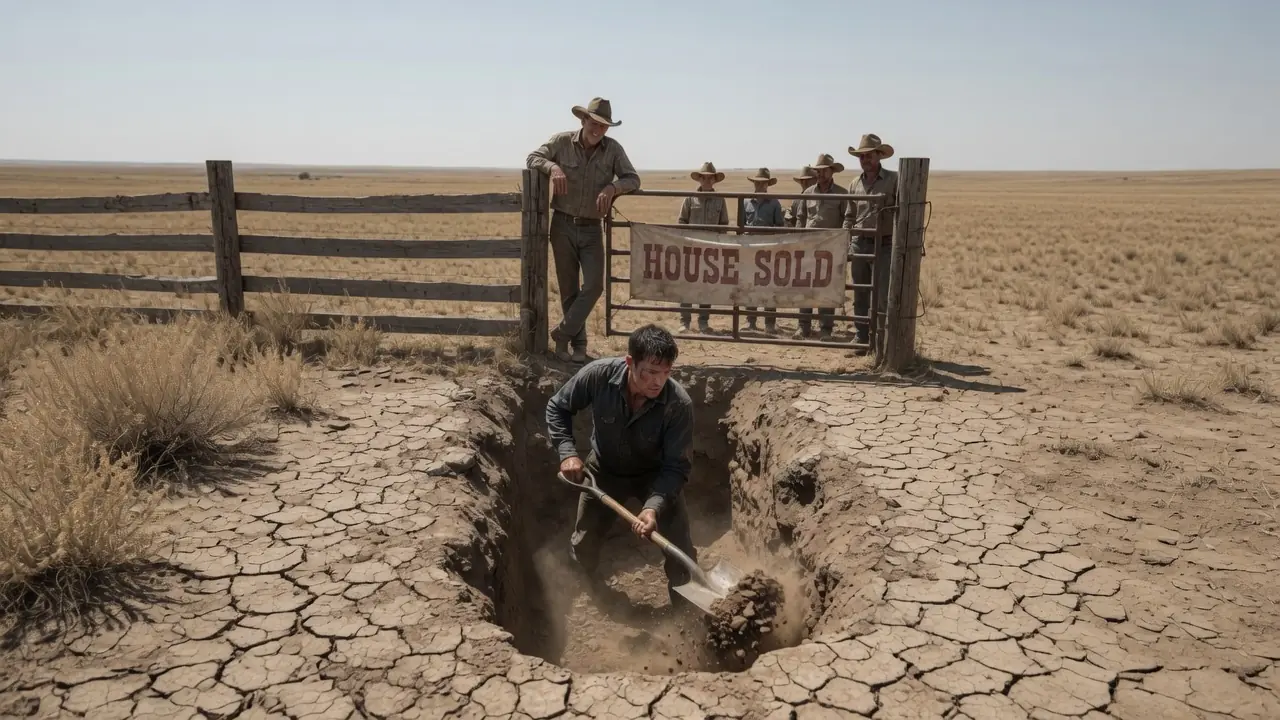
Gerald spat into the dirt and laughed. “You sold your house for this hole, Tom — how much deeper you planning to bury yourself?” The other men chuckled, not loudly at first, but enough for Tom to hear it clearly from the pit. Tom did not stop digging. He only tightened his grip and drove the blade down again.
“Keep laughing, Gerald,” Tom said, breathing hard. “The ground talks more honest than men like you ever do.” The shovel struck a harder layer, scraped sideways, and sent a sharp jolt through his arms. His shoulders ached, and his knees were already caked with gray dust. But his eyes stayed fixed on the bottom of the hole because the soil had changed color just enough to keep him going.
Gerald leaned farther over the fence, his weathered face twisted with amusement. “There’s nothing under that dirt but your last mistake.” Tom finally looked up at him, sweat running down his neck. For one second, every man at that fence saw the exhaustion in his face, but they also saw something they did not expect: certainty. “Then stand there and watch me hit the truth,” Tom said.
The land had been called dead for nineteen years before Tom bought it. In Barton County, people talked about that 160-acre parcel the way they talked about old family curses, failed marriages, and rusted machinery left behind a barn. It was the place nobody could make work, the place where weeds returned stronger than seed, where cattle wandered away from thin grass, where the low ground held water at the wrong time and the high ground turned hard when it should have been growing. Men older, richer, and better equipped than Tom had tried and walked away.
Tom had heard all of that before he ever raised his hand at the county tax sale. He heard it at the grain elevator, at the diner in Liberal, at the gas station, and outside the feed store where men liked to give advice they would never risk their own money on. They said the place was too acidic, too neglected, too compacted, too cursed. They said whoever bought it would spend everything and grow nothing.
But Tom had not listened to the gossip first. He had listened to the soil map. Months before the tax sale, he had gone to the extension office and pulled the Barton County survey, spreading it across a metal table under buzzing fluorescent lights. Most men saw colored patches and technical names, but Tom saw a story. Parsons silt loam across the upland, claypan underneath, stubborn but not useless; and along the north edge, a narrow strip of Verdigris silt loam that should not have been there unless water had moved through that land for generations.
That strip changed everything. Verdigris soil meant old water movement, organic matter, and bottomland behavior hiding inside a parcel everyone had written off as dead. Tom drove out the next Saturday and walked the place alone for three hours. He found the swale, the willow scrub, the sedge grass, and the rusted metal headwall half buried at the county road. Then he found the shallow depression sixty feet upslope, greener than the surrounding claypan, and when he drove a steel bar into it, wet soil clung to the tip.
He had written three words in his notebook that day: Property not dead. Then beneath it, with his pencil pressing hard enough to tear the page, he added one more word. Mismanaged. That word stayed with him through the tax sale, through the laughter, through the county clerk’s blank face when she handed him the deed, and through every night he sat at the kitchen table doing math he could barely afford.
He bought the 160 acres for back taxes, and almost everyone called him desperate. Gerald Pitts, whose land bordered the north fence, was the loudest. Gerald had farmed in that county since the early sixties and believed experience gave him the right to turn every opinion into a verdict. When Tom first walked the land as its new owner, Gerald came to the fence and told him plainly, “That place eats money and gives nothing back.”
Tom asked him what had grown there before the place went bad. Gerald scoffed and listed weeds like he was reading a sentence: horseweed, dock, ironweed, cedar, blackberry, useless stuff. But Tom heard signs instead of insults. Ironweed meant compaction and poor drainage, yes, but it also meant the ground had once held enough strength to support deeper-rooted growth. Weeds were not proof of death; they were proof of neglect.
The first year, Tom did not plant like a dreamer. He worked like a mechanic repairing a machine everyone else had thrown away. He cleared brush in winter with a borrowed tractor, burned cedar piles in February, opened the clogged headwall in March, and patched collapsed tile sections with cheap plastic pipe he paid for out of the little money left after the tax bill. He pulled soil cores in April and sent them to the lab, then waited like a man waiting on a doctor’s answer.
The report came back ugly but useful. The upland soil was acidic, far below what grass needed to establish properly. That would have scared off a man looking for quick success, but Tom was not looking for quick. Acid soil could be corrected with lime, and lime was cheaper than buying good ground. He could not afford the full recommended application, so he convinced Dale Fortner, the local lime supplier, to split the treatment over two seasons.
That was the beginning of the whole county laughing harder. A young man with almost no money had bought dead land, patched old tile, spread partial lime, and seeded grass into soil that had humiliated better farmers. By late summer, the stand looked thin and uneven. Gerald came to the fence, studied the patchy field, and smiled like the land had personally proven him right. “Told you,” he said.
Tom did not answer that day. He walked the ground instead, flagging the places where the grass held better and the places where it failed. He noticed the stronger stand followed the old tile line like a secret written in green. He took more soil samples, marked more notes, and refused to let one ugly season judge a farm that had been abused for nineteen years.
The Verdigris strip gave him his first real proof. While the upland struggled, the swale came alive with orchard grass, timothy, and red clover. He borrowed hay equipment, traded labor for its use, and cut enough hay to sell part and keep part for a single cow-calf pair he bought from the sale barn. It was not much money, but it was something alive from a place everyone called dead.
The cow taught him more than the men at the fence. She grazed the improving areas, avoided the compacted patches, and showed him exactly where the soil still needed help. Tom watched her every evening, notebook in hand, studying her choices like she was an expensive consultant who worked for grass instead of a paycheck. When she kept returning to the green places near the swale, he knew the water story under the farm was not finished.
Then came the dry summer. Surrounding pastures faded to brown by July, and even good farms looked tired under the hot sky. Gerald’s cattle stood in short grass, kicking dust at the fence. Tom walked his north swale and found the Verdigris strip still green enough to make his heart beat faster. It was drought-stressed, yes, but alive.
That same day, he went back to the depression upslope of the swale. The ring of grass around it was greener than anything around it, and the soil beneath the crust gave way too easily. He drove his bar down. At sixteen inches, the ground was damp; at twenty-two, it pulled up mud. Tom knelt there for a long time, staring at the wet soil in his hand while the wind moved dry grass around him.
That was the place he was digging now, with Gerald laughing from the fence. Tom had called the extension office, listened to the agronomist explain perched water above claypan, and learned that water could be moving sideways under the ground from higher land. She told him a shallow interceptor tile might catch it and send it to a stock tank. But Tom wanted to see it with his own eyes before he spent money he did not have.
So he dug by hand. He dug because he could not afford to be wrong, but he also could not afford to ignore what the soil was telling him. Every foot mattered. Every inch of color change mattered. Every bit of dampness clinging beneath the dry crust felt like a voice from the ground saying, lower.
The shovel hit the bottom again, and this time the sound changed. It was not the dry scrape of clay. It was a heavier sound, soft and thick, and the blade came up carrying darker soil. Tom froze. Gerald was still talking, still laughing, but his voice seemed to move far away.
Tom dropped to one knee and dug with his hands. The dirt beneath the surface was cool. He pressed his fingers into it, and moisture shined briefly across his knuckles. It was not a gushing miracle. It was not a fountain bursting into the sky for the county to cheer. It was something quieter, better, and more believable: wet earth where everyone had sworn there was nothing.
Gerald’s laugh faded. “What are you doing down there?” Tom did not answer. He scraped another handful away, and the bottom of the pit darkened. A thin seep of water gathered slowly in the lowest crease, trembling in the sunlight like a secret that had waited too long.
One of the men behind Gerald stepped closer to the fence. “Is that wet?” he asked. Gerald’s face hardened, but he said nothing. Tom sat back on his heels, chest heaving, hands muddy now instead of dusty. For the first time all afternoon, the men at the fence were not laughing.
Tom looked up at Gerald. “You see it?”
Gerald squinted, jaw tight. “Could be leftover moisture.”
“In July?” Tom asked. “On claypan ground everyone says is dead?”
Gerald had no quick answer. The other farmers exchanged glances, and that silence gave Tom more satisfaction than shouting ever could. He picked up a clod of wet soil, held it in his palm, and let them see the dark mud smear across his fingers. “This land wasn’t dead,” he said. “You just quit listening.”
That moment did not make Tom rich. It did not fix the soil overnight, pay for lime, build fences, buy cattle, or erase years of neglect. But it changed something important. It gave him proof he could hold in his hand. From that day forward, when men mocked him, Tom no longer had to defend a theory; he could point to the ground.
He hired a tile contractor later that summer, spending more than he wanted and sleeping poorly the night after he signed the check. The contractor cut a shallow interceptor line upslope of the depression and ran a pipe downhill toward a stock tank site near the center of the pasture. Gerald watched from his side of the fence for most of the work, pretending not to be interested. Tom said nothing to him.
By September, water flowed into the stock tank without a pump, without electricity, and without a well. Not a flood, not a spectacle, but steady enough to matter. Eight hundred gallons a day in dry weather was not magic; it was management. Tom stood beside the tank the first morning it filled and listened to the trickle as if it were applause.
The next spring, he stocked the pasture with eighteen cow-calf pairs. Men who had laughed at the pit now drove slower past the property, watching cattle graze where they had expected weeds. The grass thickened under hoof traffic, the improved drainage helped the roots, and the lime slowly did its quiet work beneath the surface. The Verdigris strip produced hay again, better than before.
Gerald came to the fence in September with his hat low over his eyes. Tom was checking the stock tank when the older man called out. “How much water that thing putting out?” Tom looked at him for a moment, remembering every insult. He could have thrown the words back. Instead, he answered plainly, “About eight hundred gallons a day.”
Gerald looked across the pasture, then down toward his own west field. “I got a soft depression on my side,” he said. “Always drove around it.” Tom heard the pride cracking underneath the question Gerald did not want to ask. “You should probe it,” Tom said. Gerald nodded once and walked away.
That fall, Tom went to the lender with records, photographs, soil tests, hay numbers, lime receipts, and documentation on the water system. He did not bring dreams. He brought proof. The loan officer had expected tax-sale scrubland worth almost nothing. Instead, the appraisal came back far above the county’s old valuation because the land was no longer just a neglected parcel; it was a working pasture with documented improvements and gravity-fed water.
Tom did not borrow against every dollar of new value. That was another thing men did not understand about him. He had not bought the land to pretend he was suddenly rich. He had bought it because he saw capacity where others saw failure. Pulling out too much debt would have made him exactly the kind of fool they thought he was.
Over the next few years, the land kept improving. The grass deepened. The cattle gained well. The hay strip became reliable enough that buyers started calling before cutting. Tom still worked part-time when he needed extra money, still repaired fences himself, still kept a notebook in his truck, and still walked the swales after every heavy rain.
But the way people spoke about the land changed. First, they stopped calling it dead. Then they called it lucky. Later, they said Tom had found water by chance, as if the soil map, the walking, the probing, the testing, the tile repairs, and the ugly hard work had nothing to do with it. That bothered him more than the laughter had.
One evening, Gerald stood beside him at the fence, older now, quieter than before. The pasture was green under late light, and cattle moved slowly toward the stock tank. Gerald watched them drink for a long time. “I was wrong about this place,” he said.
Tom leaned on the fence beside him. “Yes, you were.”
Gerald winced slightly, but he accepted it. “I thought dead was dead.”
Tom looked across the land. “Dead ground doesn’t grow willow in a swale. Dead ground doesn’t hold Verdigris soil on a north edge. Dead ground doesn’t give you mud at twenty inches in July.” He paused. “Dead is what men call land when they’re done thinking.”
Gerald nodded slowly. “I laughed pretty hard that day.”
“You did.”
“I suppose you enjoyed proving me wrong.”
Tom thought about the pit, the dust, the wet soil in his hand, and the silence that came over the fence. “For about ten seconds,” he said. “Then I still had to build the water line.”
Gerald laughed softly, but not in mockery this time. It was the tired laugh of a man who knew the truth had caught up with him and had decided not to run. “You’re a stubborn man, Tom.” Tom smiled faintly. “No. I just don’t trust crowds when they all agree too fast.”
Years later, when young farmers asked Tom how he found value in land nobody wanted, he never started with the water. He started with the courthouse steps, the tax bill, the soil map, and the laughter. He told them how easy it was to mistake public opinion for evidence. He told them a cheap price did not make land good, but a bad reputation did not make land useless.
Then he would take them to the old pit site. The edges had long since softened with grass, and the stock tank nearby still filled from the interceptor line. He would push a steel probe into the ground, pull it out, and show them the darker moisture below. “The land was talking the whole time,” he would say. “Most people were just too loud to hear it.”
Tom never became the biggest operator in Barton County. He did not need to. He built a place that carried cattle, produced hay, and held its value because he worked with what the land actually was instead of punishing it for what it was not. The farm that had been dead for nineteen years became proof that restoration did not begin with hope alone; it began with observation.
And every now and then, when the summer turned dry and neighboring fields faded under the heat, Tom would walk to the swale at sunset. The grass there always held on a little longer. The stock tank would keep filling, drop by drop, from water that had been moving beneath the surface long before men argued about the land’s worth. He would stand there quietly, remembering Gerald at the fence and the dust in his lungs.
He would remember the shovel hitting damp earth.
He would remember the laughter stopping.
Most of all, he would remember the first dark handful of mud in his palm, the moment the dead farm answered back. That was the moment Tom Gideon understood something he never forgot: some land is not dead, some people are not foolish, and sometimes the whole county can be wrong because nobody bothered to dig deep enough.