Earl Halverson laughed loudly enough for three workers in the neighboring field to hear him. He stood between two rows of corn on Mercer Farm, holding an open burlap sack labeled RED CLOVER SEED as though it were evidence of a crime. Across from him, twenty-six-year-old Hannah Mercer balanced a heavy woven basket against her hip and refused to lower her eyes. Beneath their boots, thick green clover covered the soil that every other farmer in Madison County had left bare.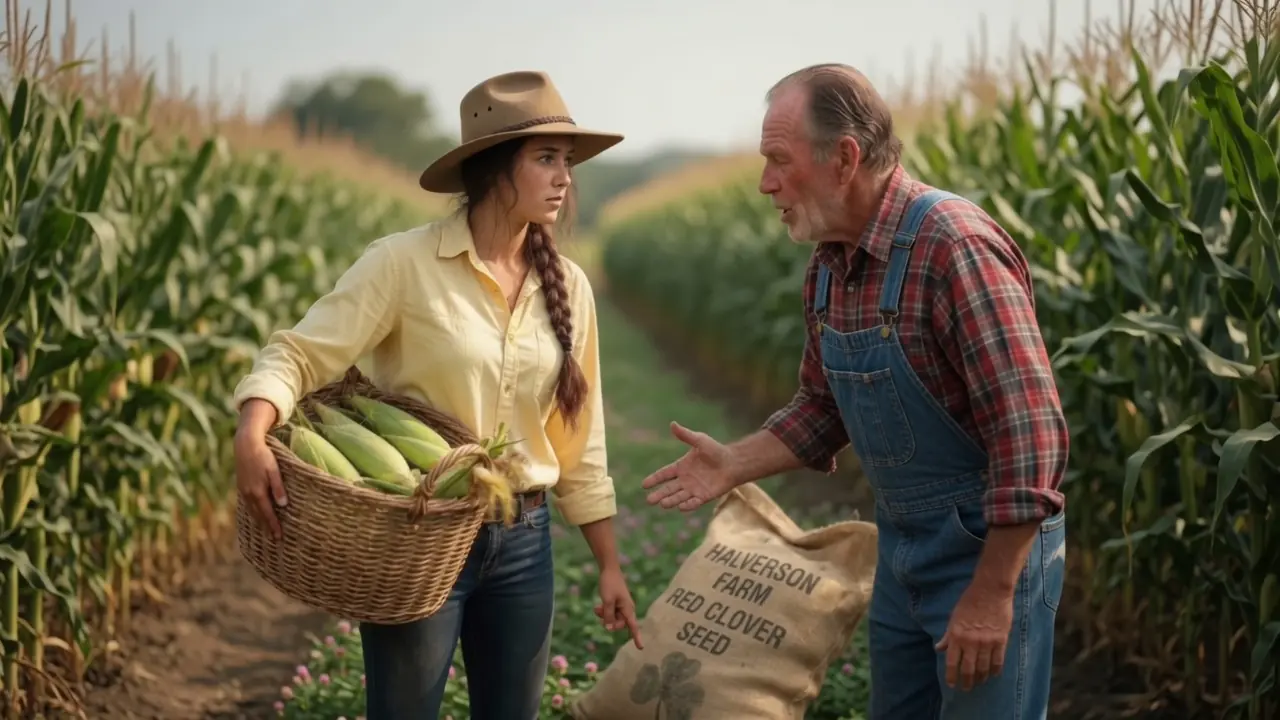
Hannah’s father had died eleven months earlier, leaving her one hundred and sixty acres of corn, an aging farmhouse, two unreliable tractors, and a debt large enough to frighten every banker in town. Most neighbors expected her to sell before spring planting. Earl expected to buy the land himself. He owned nearly two thousand acres surrounding Mercer Farm and had spent years waiting for the narrow property beside Willow Creek to become available.
Instead of listing it, Hannah moved home from Des Moines and began repairing what her father had left behind. She replaced broken fence posts, rebuilt the planter drive with secondhand parts, and spent nights studying notebooks filled with her father’s observations about rainfall, soil structure, and crop rotation. The final notebook contained one sentence circled three times.
Bare soil is a leaking bank account.
Her father had spent five years experimenting with small clover strips behind the equipment shed. He discovered that the covered soil stayed cooler, absorbed heavy rain more slowly, and remained damp longer during dry weeks. He had wanted to expand the system across the entire cornfield, but debt and illness prevented him from taking the risk.
Hannah decided to finish what he started.
She planted corn in wide, carefully measured rows and seeded red clover between them after the young stalks were established. The clover would remain low beneath the corn canopy, protecting the surface from direct heat while sending fine roots through the upper soil. It would suppress erosion, support beneficial insects, and eventually return organic material to land that had been losing structure for decades.
To Earl, it looked like foolishness.
He had farmed the conventional way for forty years. Every spring, he worked the ground until it appeared smooth and black. He planted tightly, sprayed anything that grew between the rows, and measured success only through the number of bushels harvested that year. His reputation rested on clean fields with no visible plant except the crop he intended to sell.
Hannah’s field offended him because it suggested that his way was not the only way.
“You’re wasting moisture on clover,” Earl said after the workers stopped laughing. “Every one of those plants is drinking water your corn needs.”
Hannah set the basket down. “The moisture probe says otherwise.”
“You trust a plastic sensor over experience?”
“I trust numbers over insults.”
Earl stepped closer, lowering his voice. “Your father owed the cooperative three hundred and twelve thousand dollars. One weak harvest and the bank takes everything. When that happens, remember I offered you a clean way out.”
“You offered sixty percent of the land’s assessed value.”
“I offered what a failing farm is worth.”
Hannah picked up the basket again. “Then you should stop worrying about what I plant.”
Earl left with the seed sack still in his hand. Before climbing into his pickup, he threw it beside the gravel road and drove over one corner. Hannah waited until his truck disappeared, then retrieved the torn bag and carried it back to the barn.
The humiliation spread through town faster than any agricultural news. At the diner, farmers joked that Hannah was raising rabbit food beneath her corn. At the hardware store, one man asked whether she planned to harvest flowers instead of grain. Someone placed a hand-painted sign beside her mailbox that read MERCER WEED PRESERVE.
Hannah removed the sign without reacting.
Her only regular supporter was Dr. Leah Grant, an agronomist from the state extension office. Leah had reviewed the notebooks, inspected the field, and helped Hannah install moisture probes at depths of six, twelve, and twenty-four inches. They also placed identical sensors in an unused strip of bare soil near the southern boundary.
The comparison became impossible to ignore.
By early June, the surface temperature between Hannah’s covered rows was often twelve degrees lower than the exposed strip. After rainfall, water entered the clover-covered soil rather than racing toward the drainage ditch. Earthworm counts increased, and soil aggregates held together instead of collapsing into powder.
The corn grew evenly.
Earl continued insisting the system would fail once summer heat arrived.
He had another reason to want it to fail. For six years, he had served as chairman of the Madison Grain Cooperative, which purchased most of the county’s harvest and controlled access to the only large storage silos within forty miles. Farmers who challenged Earl’s decisions often found their deliveries delayed, moisture tests questioned, or contracts reduced.
Hannah’s father had challenged him repeatedly.
The two men disagreed over fertilizer contracts, equipment fees, and the cooperative’s practice of purchasing distressed farms through companies connected to board members. Shortly before becoming ill, Thomas Mercer accused Earl of using cooperative information to identify families approaching financial collapse.
No investigation followed.
After Thomas died, Earl visited Hannah three times with purchase agreements already prepared.
Each offer became lower.
Hannah began to suspect he was not merely predicting her failure. He was planning around it.
Rain stopped during the second week of June.
At first, no one was alarmed. Iowa summers often included dry stretches, and the spring had provided enough moisture to establish the crop. Farmers continued spraying, repairing machinery, and discussing expected yields as though weather could be negotiated through confidence.
By the end of June, the county had received less than one-third of its normal rainfall.
The cracks appeared first in Earl’s southern fields. Fine lines opened between the corn rows, widened beneath the sun, and joined until the surface resembled broken pottery. The upper leaves of his corn began rolling inward during the afternoon to conserve moisture.
Hannah’s field remained green.
The clover wilted slightly on the hottest days, but its leaves shaded the ground. Beneath it, the soil stayed dark several inches below the surface. The corn roots followed old channels created by clover roots and earthworms, reaching deeper moisture than plants in compacted neighboring fields.
Hannah did not celebrate.
She knew the farm was surviving, not winning. Every week without rain reduced yield potential, and the bank still expected payment after harvest. She checked the sensors before sunrise, inspected the stalks at noon, and recorded everything at night.
In July, the county entered severe drought.
The creek narrowed between exposed stones. Farm ponds dropped low enough to reveal old fence posts. Earl’s workers began hauling water to livestock, while several farmers cut immature corn for feed rather than wait for grain that might never form.
The jokes about Hannah stopped.
Vehicles began slowing along the county road outside Mercer Farm. Farmers stared through the fence at corn that stood taller and straighter than anything surrounding it. From a distance, the clover looked like a green carpet beneath the rows.
Earl returned on a morning when the temperature reached ninety-eight degrees before noon.
This time, he did not laugh.
“You’ve been irrigating at night,” he said.
Hannah continued checking a moisture probe. “I don’t own irrigation equipment.”
“You’re drawing illegally from Willow Creek.”
“The creek is too low to pump.”
“Then someone is supplying you.”
Hannah held up the sensor display. “The water is already in the soil.”
Earl looked down at the clover. “That stuff cannot create rain.”
“No. It keeps the rain from escaping when it comes.”
He walked several rows in silence, digging his boot into the ground. The soil beneath the clover compressed slightly but did not crumble into dust. Hannah watched his expression change as he understood that her father’s idea was working.
Then his face hardened.
“The cooperative has concerns about contamination.”
“What contamination?”
“Clover seed mixed with harvested corn. Weed matter. Excess moisture. We may not be able to accept your grain.”
“The clover is under the canopy. It won’t enter the combine.”
“That will be for our inspectors to decide.”
Hannah understood the threat. Even if she produced a crop, Earl could prevent her from selling it locally. Transporting grain to another facility would cost thousands she did not have.
“You’re using the cooperative to force me to sell.”
“I’m protecting quality standards.”
“You haven’t inspected anything.”
“I’m telling you what could happen.”
Hannah stepped toward him. “Then put it in writing.”
Earl’s mouth tightened. “Be careful how you speak to people you depend on.”
“That is exactly why I want it in writing.”
He left without providing a notice.
That afternoon, Hannah called the cooperative office and requested its written crop-acceptance standards. The receptionist promised to email them. Nothing arrived.
She called again the next day.
Still nothing.
Leah advised her to document every conversation. Together, they collected soil samples, photographed the field, and downloaded the moisture data from every probe. Leah arranged for an independent laboratory to test the corn and clover separately.
The results showed no contamination risk.
More importantly, the data proved that Hannah’s field held nearly twice as much plant-available moisture in the upper two feet of soil as Earl’s adjacent field. Root samples showed deeper penetration, while temperature sensors confirmed the clover reduced heat stress during the most damaging afternoon hours.
Leah wanted to publish the findings.
Hannah asked her to wait until harvest.
“If Earl knows how much evidence we have, he’ll find another way to stop me.”
He already had.
Two weeks later, Hannah received a letter from First County Bank informing her that the cooperative had downgraded the projected value of her crop. Because the harvest served as collateral for part of her operating loan, the reduced estimate placed the farm in technical default.
The bank gave her thirty days to provide additional security.
Attached to the letter was an assessment signed by Earl Halverson.
He estimated Hannah would produce fewer than forty bushels per acre because of “aggressive inter-row competition from uncontrolled clover growth.” He valued the expected harvest at less than one-third of what Hannah needed to service the debt.
No one from the cooperative had entered her field.
Earl had created the report from his office.
Hannah drove directly to the bank and requested a meeting with loan officer Martin Pierce. She placed the moisture records, laboratory tests, plant measurements, and photographs across his desk.
Martin barely looked at them.
“The cooperative has decades of experience estimating local yields,” he said.
“The chairman wants my land.”
“That is an accusation.”
“He wrote a report without inspecting the crop.”
“He is not required to enter every field.”
“Then send an independent assessor.”
Martin folded his hands. “The cost would be your responsibility.”
“How much?”
“Five thousand dollars.”
Hannah had less than three thousand remaining in the farm account.
She left the bank without signing anything.
That evening, she entered her father’s office and opened every drawer. Thomas had saved receipts, maps, cooperative notices, and handwritten records going back fifteen years. Hannah searched for anything connecting Earl’s decisions to previous farm sales.
Near midnight, she found a folder labeled DISTRESSED ACQUISITIONS.
Inside were copies of letters from six local farms that had received sudden crop-value reductions before losing access to operating credit. Within months, companies connected to Earl or other cooperative directors purchased portions of each property.
Thomas had mapped the sequence.
First, the cooperative reduced a crop estimate.
Then the bank demanded additional collateral.
Next, suppliers shortened payment terms.
Finally, Earl offered to buy the land before foreclosure.
Hannah’s father had written one final note beneath the list:
They are not predicting failure. They are arranging it.
Hannah photographed the entire folder.
The following morning, she contacted the state cooperative-regulation office and requested a confidential meeting. Investigator Nathan Cole arrived two days later in an unmarked sedan. He reviewed Thomas’s records, Hannah’s bank letter, and Earl’s unsigned contamination threat.
“This proves a pattern worth examining,” Nathan said. “It does not yet prove the cooperative intentionally falsified values.”
“What would?”
“Internal messages, financial connections, or evidence that the chairman knew your crop estimate was false.”
Hannah looked toward the field.
“Then let him inspect it.”
She sent Earl a certified invitation to conduct a formal yield assessment with the bank, county extension office, and state regulator present. Refusing would weaken his report. Accepting would place him inside a field that contradicted everything he claimed.
Earl accepted.
He arrived the next Monday with two cooperative board members and an employee carrying sample bags. Martin Pierce represented the bank. Leah brought calibrated equipment, while Nathan observed without identifying himself as an investigator.
The group entered Hannah’s field at nine in the morning.
The difference became visible within twenty steps.
Earl’s adjacent corn stood pale and curled beyond the fence. Several stalks had failed to form full ears. Hannah’s corn carried well-developed ears with kernels filling evenly from base to tip.
Leah selected random plots according to standard sampling procedures. She counted plants, measured ears, tested moisture, and calculated a conservative projected yield of one hundred and forty-eight bushels per acre.
Earl’s written estimate had been thirty-eight.
Martin stared at the numbers. “That cannot be right.”
Leah handed him the raw measurements. “Calculate it yourself.”
The cooperative employee opened an ear and inspected the kernels. “There’s no clover contamination.”
Earl glared at him.
Hannah watched Nathan photograph the exchange.
Then Earl made his mistake.
“This field was supposed to burn with the rest of them,” he snapped.
No one spoke.
Hannah looked directly at him. “Supposed to?”
Earl recovered too slowly. “I mean under these drought conditions.”
Nathan stepped forward and identified himself. He asked Earl to explain why the cooperative had issued a crop valuation without inspection and why that valuation contradicted both field conditions and independent measurements.
Earl refused to answer without counsel.
The investigation expanded immediately.
Regulators seized cooperative emails and financial records under an administrative order. They discovered messages between Earl and Martin discussing Hannah’s loan weeks before the downgrade.
One message from Earl read:
If Mercer’s projection falls below forty, Pierce can call the note. I’ll have the acreage before winter.
Martin replied:
Use the clover as justification. No one at the bank understands cover crops anyway.
The records connected five previous farm acquisitions to similar manipulated estimates. Earl’s private company purchased land shortly after cooperative reports reduced its expected value. Martin then refinanced the properties after Earl took control.
The drought had not created their scheme.
It had exposed it.
First County Bank suspended Martin and restored Hannah’s loan status. The cooperative removed Earl as chairman pending a full audit. A judge temporarily blocked the sale or transfer of every property connected to the distressed-acquisition pattern.
Harvest began under a pale September sky.
Across much of Madison County, combines moved through short, damaged corn. Some fields produced less than fifty bushels per acre. Others were abandoned entirely.
Hannah harvested one hundred and forty-three.
It was below a normal season but nearly three times the county average.
Her field stood alone not because she received more rain, better soil, or secret irrigation. It stood because clover protected the water that everyone else allowed heat and wind to take.
The local cooperative could no longer refuse her grain. State regulators placed an independent manager in control, and the first trucks from Mercer Farm crossed the scales under outside supervision.
Every load passed inspection.
The harvest paid the operating loan, covered the mortgage, and left enough money to repair the older tractor. Hannah also sold clover seed collected from her trial plots to farmers who had spent months mocking her.
The first person to request a meeting was Earl.
He arrived without his cooperative jacket or confident smile. Investigators had frozen several of his business accounts, and farmers were preparing civil claims over the manipulated valuations.
He stood beside the field where Hannah was spreading chopped residue over the clover.
“I need seed for eight hundred acres,” he said.
Hannah shut down the tractor.
“I thought it was useless.”
“I was wrong.”
“You tried to take my farm.”
“That was business.”
“No. Business measures value. You manufactured desperation.”
Earl looked across the green cover beneath the harvested rows. “Name your price.”
Hannah considered refusing him.
Instead, she gave him the same price she charged everyone else, with one condition. He had to attend the county soil workshop and publicly explain why his crop estimate for Mercer Farm had been false.
Earl’s face darkened. “You want to humiliate me.”
“I want every farmer you pressured to hear the truth from you.”
He walked away without accepting.
Two days later, his manager returned and purchased the seed.
Earl attended the workshop.
More than two hundred farmers filled the county fair building. Leah presented the soil data, rainfall records, root measurements, and harvest results. Hannah explained what had worked, what had nearly failed, and what she would change the following year.
Then Earl stood before the room.
He admitted that he had never inspected Hannah’s crop before downgrading it. He admitted the clover had protected her soil and that his own bare fields lost moisture faster. Under legal advice, he avoided discussing the broader fraud investigation, but everyone understood why his voice shook.
Hannah did not smile.
The moment was not revenge. It was correction.
The state later charged Earl and Martin with fraud, conspiracy, falsifying agricultural valuations, and using confidential cooperative information for personal gain. Several farmers recovered land or received financial settlements. Cooperative rules changed so no chairman could issue individual crop assessments or participate in purchasing distressed property within the county.
All yield reductions required independent field inspections.
Banks had to disclose conflicts between loan officers and prospective land buyers.
Hannah used part of her harvest income to establish a soil-testing fund for small farmers who could not afford independent assessments. Leah turned Mercer Farm into a demonstration site where farmers could compare covered and uncovered soil under identical weather conditions.
Within three years, clover, rye, and other cover crops appeared across thousands of county acres.
Not every field used Hannah’s exact system. Some farmers changed row spacing, seed timing, or species. The point was not to copy her perfectly.
The point was to stop treating bare ground as proof of good farming.
One autumn afternoon, Hannah stood where Earl had first thrown down the seed sack. Corn filled the basket against her hip, and clover covered the soil beneath her boots. A group of young farmers waited nearby while she explained how to read a moisture probe.
One of them asked whether she had known the system would work.
“No,” Hannah said. “I knew the soil was telling us something, and I decided to listen.”
She kept the torn red-clover sack framed in the farm office beside her father’s final notebook. Beneath it, she placed a photograph taken from the road during the worst week of the drought.
Every surrounding field appeared pale and exhausted.
Mercer Farm remained green.
Earl had laughed because Hannah planted what he considered worthless between the rows that produced money. He never understood that the most valuable crop on her farm was the one protecting everything he could see.
The drought did not make her right.
It simply stripped away every excuse people had used to ignore her.