“You spent every dollar burying kitchen pottery because a pretty girl like you has no business pretending she understands drought.”
Caleb Harlan stood at the edge of May Sutler’s freshly plowed field with the county crop report folded beneath one thick hand. At forty-six, he owned more cattle than anyone else in the northern valley and had spent twenty-five years treating every successful harvest as proof that he understood the land better than those around him. His narrow gray eyes moved from the unglazed clay pot beside May’s boots to the hundreds of identical vessels stacked inside her borrowed wagon.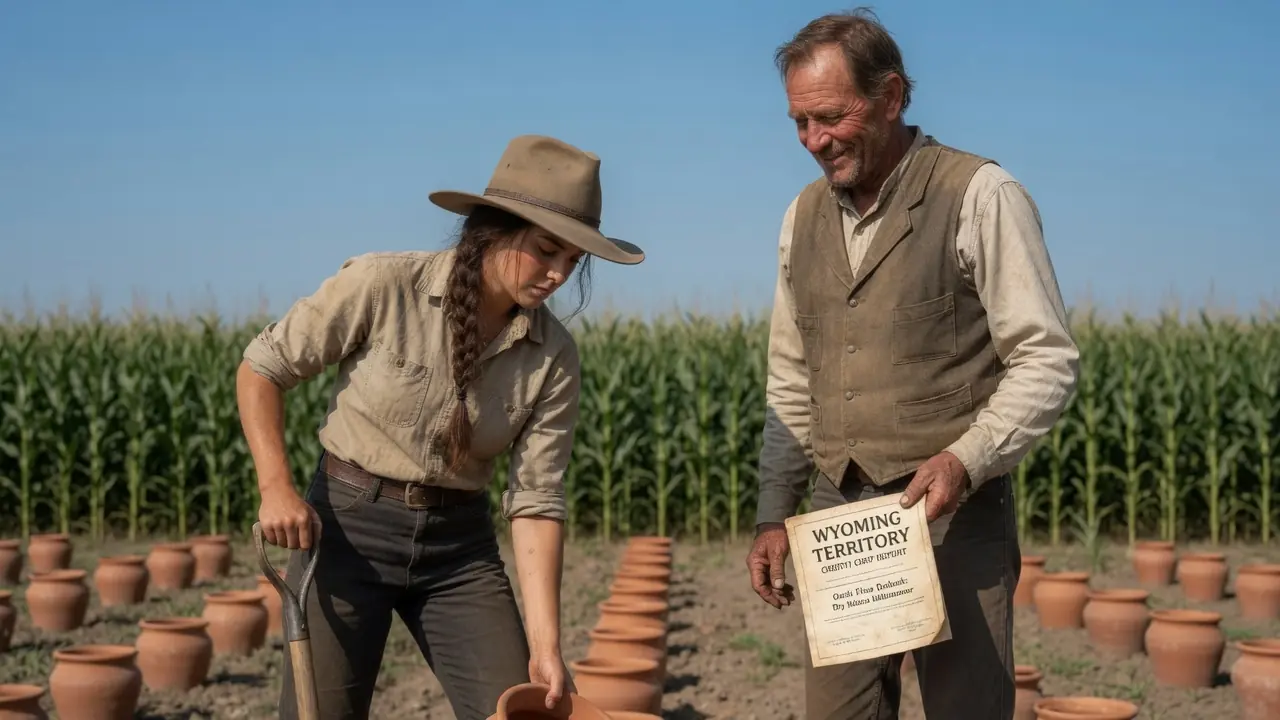
May pressed another shovelful of soil around the buried pot. “You measure farming by what men before you already tried.”
Caleb waved the crop report toward the hard blue Wyoming sky. “When the creek dries, your field will die first—and I’ll buy this claim after you crawl away hungry.”
May straightened slowly, one hand resting on the shovel handle. Her long dark-brown braid hung over the shoulder of her beige work shirt, and dust covered the brown boots she had worn since leaving Ohio two years earlier. “Then remember where you stood, Caleb—because when your corn turns brown, mine will still be feeding the valley.”
Several neighbors watching from the road laughed.
May did not.
She had learned during her first winter alone that frontier laughter was usually strongest when people encountered something they did not understand. It followed unusual clothing, unfamiliar tools, and any woman who attempted work traditionally controlled by men. May had stopped wasting energy trying to silence it.
Her homestead covered one hundred sixty acres of Wyoming bottomland bordered by low hills and a shallow creek. The soil was rich enough to grow corn, beans, squash, and almost anything else—provided the creek continued running. In good years, snowmelt carried water from the mountains through June, giving settlers enough time to establish crops before summer heat arrived.
This was not going to be a good year.
The mountain snowpack had remained thin throughout winter. By late April, the creek already moved with the weak, apologetic current May usually expected in mid-June. She estimated that it might disappear within sixty days.
Her hand-dug well reached deeper water, but carrying enough buckets to irrigate four acres had nearly destroyed her shoulders the previous summer. Despite hauling water from before sunrise until darkness, half her bean crop shriveled in August. She survived winter by selling preserves, repairing clothing, and eating fewer meals than she admitted to her neighbors.
May refused to repeat that failure.
The idea of burying clay pots came from an elderly traveler she met along the wagon road during her first autumn in Wyoming. He had farmed in dry country farther south and described an old irrigation method using unglazed vessels placed beneath the soil. Water inside the porous clay escaped slowly, feeding plant roots without being wasted through surface evaporation.
“Let the clay remember where the water belongs,” he told her.
May initially assumed he was speaking poetically. Months later, she found a short agricultural pamphlet confirming the method. The article explained that crops planted around buried vessels could survive on far less water than fields irrigated from above.
She read the paragraph until the paper softened along the folds.
Throughout winter, May planned the system by lantern light. She measured her field, calculated the distance roots could travel, and designed staggered rows allowing each pot to serve several plants. Three hundred vessels would be enough for four acres if she placed them carefully.
The problem was finding three hundred unglazed pots.
Then a traveling potter arrived at the trading post with a wagon filled with exactly that number. He had made them from river clay and expected to sell them gradually across several settlements. Each was narrow-necked, thick-walled, and fired without glaze.
He asked forty-one dollars for the entire load.
That was every coin May possessed.
The money was supposed to purchase seed, lamp oil, salt, and replacement harness leather. Spending it meant she would have no emergency savings, no money for another mule, and nothing to repair the well if its wooden pump broke. She stood beside the wagon for nearly ten minutes before making her decision.
“I’ll take all three hundred.”
The potter raised one eyebrow but did not laugh. He gave her three days to arrange transportation and helped pack the vessels with straw to prevent cracking. By the time May returned with a borrowed flatbed wagon, news of her purchase had traveled across the valley.
People gathered beside the trading post to watch her load them.
Some asked whether she intended to open a pottery business. Others joked that she planned to serve soup to every resident in the territory. One man suggested she had spent too many winters alone and finally lost her judgment.
Caleb Harlan laughed loudest.
He had wanted May’s claim since the day she arrived. Her land controlled access to the creek bend where his cattle naturally gathered during summer. He offered to purchase the property twice, describing both offers as favors to a young woman incapable of managing a frontier farm.
May refused him each time.
After learning she had spent her savings on clay pots, Caleb assumed desperation would soon force her to reconsider. He began telling neighbors that he would own her land before the first snowfall. Some believed him.
May unloaded every vessel herself.
That night, she arranged the pots inside her barn and drew planting rows in the dirt floor with her boot heel. She calculated four feet between vessels, alternating their positions so moisture zones overlapped. She checked the numbers twice before sleeping.
Before dawn the next morning, she began digging.
Each hole had to be deep enough to bury the pot to its shoulder while leaving only the narrow opening above ground. If she buried it too deeply, filling would become difficult. If she left too much exposed, sunlight would heat the water and increase evaporation.
The first ten holes took nearly an hour.
By the second day, May developed a rhythm: drive the shovel, lift the soil, shape the hole, lower the vessel, and pack the earth firmly around its neck. Her shoulders burned, her palms blistered, and the constant bending sent pain through her back. Still, she moved from one marked position to the next.
Neighbors occasionally stopped along the road.
Most watched for a few minutes before continuing. Caleb visited on the fourth morning and told her she would be too exhausted to plant after burying all the pots. May did not answer.
She finished the final hole on the ninth evening.
Three hundred clay mouths remained visible across the dark soil. They looked unremarkable—small circles scattered in an otherwise empty field. Anyone passing on the road might have mistaken them for stones.
May planted corn first.
She placed each seed at a measured distance from the vessels, then added beans that would climb the cornstalks and enrich the soil. Squash went between the rows, where broad leaves would cover the ground and slow moisture loss. It was an old companion-planting system sometimes called the Three Sisters.
After planting, May filled each buried pot from her well.
The work required ten heavy barrel trips across the field. She covered every opening with a flat creek stone to keep out dirt, insects, and sunlight. The pots released no visible stream; they simply darkened slightly as moisture passed through the clay beneath the soil.
For the first week, May worried constantly that the method had failed.
Then green shoots appeared.
Corn rose in orderly lines, beans unfolded beside it, and squash leaves spread close to the ground. The plants nearest each pot grew first, but roots gradually extended into the spaces between them. By early June, all four acres had become green.
Caleb passed on horseback one afternoon.
“You could have achieved that with ordinary watering,” he called.
May continued removing weeds. “Then ordinary watering should save your field too.”
“My creek ditch is three times larger than yours.”
“So is your field.”
His smile disappeared.
The rain did not come.
June skies remained pale and empty. The creek narrowed until gravel appeared along both banks, and settlers began cutting irrigation turns shorter to preserve what remained. Arguments broke out over water rights that families had shared peacefully for years.
May changed her routine before the crisis became obvious.
She rose while stars remained overhead, drew cold water from the deep well, and filled a wooden barrel mounted on a handcart. Each load reached approximately thirty pots. She made ten trips before sunrise, lifting every stone cover and pouring carefully until the hollow sound inside the vessel became dull and full.
The system was laborious, but nothing compared with surface irrigation.
Water poured above ground disappeared into cracks or evaporated beneath the afternoon heat. Water stored inside the pots moved directly toward thirsty roots. The surface around May’s crops often appeared dry, while the soil several inches below remained dark and cool.
By the first week of July, the creek stopped moving.
Three days later, it disappeared completely.
The empty channel lay white beneath the sun, its mud broken into curled plates. Children walked along the dry bed collecting stones from places that had been underwater their entire lives. Older settlers stared at it without speaking.
Caleb’s confidence began fading with the water.
His corn covered twenty acres along the eastern valley floor. He had planted densely, expecting the creek to support irrigation through summer. When the channel dried, he attempted hauling water from two shallow wells, but neither produced enough.
The lower leaves of his corn turned yellow.
Soon the edges curled.
May saw the damage each morning while pulling her water cart. She felt no satisfaction. Caleb had mocked her and threatened to take her land, but his failure meant reduced food, lost wages, and hungry families among the workers depending on him.
Still, she could not save his field.
The buried-pot system had been installed before planting. Digging vessels into mature crops would destroy root systems and waste precious time. Even if settlers found another potter, the season had already advanced too far.
Ingrid Halverson became the first neighbor to ask for help.
She approached May at the trading post with her eldest son standing behind her, hat held nervously in both hands. Their beans were curling, and their corn had begun dying near the edges. Ingrid asked whether May knew any method that might preserve what remained.
May explained everything openly.
She described the spacing, the buried depth, the unglazed clay, and the amount of water each pot required. She even drew the system in the dust outside the trading post. Ingrid listened carefully, but disappointment settled across her face when she realized it was too late.
“I should have asked before planting,” she said.
“You didn’t know.”
“I laughed when your wagon passed our gate.”
May looked at her. “Laughter didn’t dry your field.”
“No, but it kept me from asking what you knew.”
May gave her several squash seedlings and advised her to plant them near the household wash-water trench. It would not save the corn, but it might provide something for winter. Ingrid thanked her and left quietly.
By August, the valley had turned the color of straw.
Cornstalks stood pale and hollow across neighboring claims. Beans stopped producing, and families pulled livestock into smaller pastures because grass no longer recovered after grazing. Several settlers discussed abandoning their homesteads before winter.
May’s four acres remained green.
Her corn rose taller than her shoulders. Beans twisted around the stalks, and heavy squash leaves spread across the shaded soil. Beneath the surface, every root reached toward the slow moisture seeping from buried clay.
Word traveled.
People began stopping along May’s fence to stare. They did not laugh or make jokes. Some stood silently for several minutes, comparing her field with the dead land surrounding it.
A little girl arrived one evening and wrapped both hands around the top fence rail.
May was working at the far end of the corn when she noticed her. The child’s dress was faded, and her loose sunbonnet hung against her back. She looked not at May but at the plants.
“Is it real?” the girl finally asked.
May walked closer. “What?”
“My father says nothing green can live without the creek.”
May picked a bean pod and handed it through the fence. “Your father is looking at something green.”
The girl held the pod carefully. “Can I show him?”
“Yes.”
The following afternoon, her entire family came.
Then others followed.
By September, May had become uncomfortable with the attention. People who once dismissed her now watched every movement, asking how often she filled the pots and whether the clay cracked beneath the ground. May answered patiently because knowledge hidden out of pride would not feed anyone.
Caleb did not visit.
His twenty-acre cornfield failed almost completely. He sold part of his cattle herd at a low price because he lacked feed for winter. The county crop report estimated that he had lost more than any other farmer in the valley.
One evening, May found him standing outside her fence.
His hat was tucked beneath one arm, and the arrogance had disappeared from his face. He looked older than he had in spring.
“Your field is still alive,” he said.
“You can see that.”
“I thought the pots were foolish.”
“I remember.”
Caleb looked toward the rows. “How much water are you using?”
“Less than one-third of what I hauled last summer.”
He stared at the ground. “I offered to buy this land.”
“You threatened to take it after I starved.”
“I was angry.”
“You were certain.”
Caleb accepted the correction. “Will you show me how it works?”
May could have refused.
Part of her wanted to remind him of every insult, every joke, and the way he had spoken about a woman crawling away hungry. Yet she remembered Ingrid’s words: laughter had prevented people from asking what she knew.
May opened the gate.
She lifted one stone cover and invited Caleb to place his hand inside the pot’s narrow mouth. The upper clay felt cool despite the heat. Then she dug carefully several inches from the vessel and showed him the damp soil surrounding the roots.
“The water moves only when the ground needs it,” she explained. “Dry soil pulls more through the clay. Wet soil pulls less.”
Caleb examined the roots. “Who taught you this?”
“An old traveler and half a paragraph in a damaged pamphlet.”
“I have spent twenty-five years farming.”
“And still had something left to learn.”
He nodded slowly. “I suppose I did.”
Harvest began in mid-September.
May moved through the rows with a notebook, recording every basket of beans, every ear of corn, and every squash placed inside the root cellar. The crop was not merely alive; it was abundant. Her four acres produced more food than she and several families could consume before spring.
The valley had almost nothing.
May sent a handwritten invitation through the settlement:
Come if you need food. Come if you want seed. Come if you want to learn.
The first wagon arrived before noon.
Eighteen families came that day. Some had children with hollow cheeks, while others carried empty sacks and the uncomfortable posture of people unused to accepting help. May opened the root cellar and distributed corn, beans, and squash without asking anyone to explain their need.
She kept only enough for winter, spring planting, and emergencies.
Caleb arrived last.
He brought two sacks of flour from supplies he had preserved for his own household and placed them beside May’s door. “For families who need something besides vegetables.”
May accepted them.
Inside the field, she removed one clay vessel and showed the group how it had rested beneath the soil. Fine roots clung to the earth surrounding its curved walls. The pot remained damp even though the surface ground had been dry for months.
“This is not magic,” May said. “It is storage, patience, and putting water where roots can reach it.”
One man asked how much the system cost.
“Forty-one dollars and nine days of digging.”
Several people exchanged embarrassed looks.
May continued, “You don’t need to purchase every pot. We can make them.”
The traveling potter had shown her enough about clay preparation and firing to understand the basics. River deposits existed three days south, and local soil contained enough clay for smaller vessels. Before frost, the valley organized its first communal firing.
Families dug clay, shaped pots, gathered wood, and built two outdoor kilns.
Caleb worked beside men he once commanded. Ingrid taught children to smooth vessel walls. May inspected every pot for glazing, cracks, or openings too wide to conserve water.
By winter, the settlement had produced more than eight hundred irrigation vessels.
The laughter from spring became a story people repeated with embarrassment and humor. May never encouraged them to feel ashamed for long. She preferred they remember the lesson rather than the humiliation.
“Looking foolish is sometimes the price of discovering something useful,” she told them.
Three days before the first frost, May traveled twelve miles to the land office.
Her coat carried the farming logs she had maintained throughout the year, survey documents, witness statements, and proof that she had improved the required acreage. Under homestead law, successful cultivation brought her closer to receiving permanent ownership of all one hundred sixty acres.
The clerk reviewed her records carefully.
Her entries documented planting dates, water usage, harvest amounts, and every improvement completed since she arrived. He stamped the final certificate and slid it across the counter.
“The Sutler claim is legally yours.”
May held the paper without speaking.
For two years, Caleb and others had treated her land as something temporary—a place she would eventually fail and abandon. Now no drought, buyer, or powerful neighbor could remove it from her without her consent.
She tucked the certificate inside her coat.
When she returned that evening, Caleb waited beside the cedar corner post. May showed him the document. He removed his hat.
“Congratulations.”
“You once said you would buy this place for almost nothing.”
“I remember.”
“It is no longer for sale at any price.”
Caleb looked toward the harvested field. “I don’t think I could afford what it became.”
The following spring, the valley looked different.
Rows of small clay openings appeared across twelve farms. Families planted fewer acres but used water more carefully. Caleb buried five hundred vessels across the best portion of his land and left the driest acres in native grass.
The snowpack remained poor again.
This time, no one panicked.
May helped neighbors build covered filling barrels and calculate which crops needed the closest pot spacing. She improved her own system, moving several vessels where root growth had been weaker and creating shared channels that reduced the number of cart trips.
The creek dried in July.
The valley remained green.
Not every crop survived perfectly, and the work stayed difficult, but families harvested enough food to remain on their claims. No household abandoned the settlement that winter.
Years later, travelers passing through the valley noticed hundreds of small stones scattered across the fields. Beneath every stone waited a vessel holding water in the darkness, giving it slowly to roots.
They called the method Sutler irrigation.
May objected to the name because she had not invented it. The knowledge came from older lands, distant farmers, one traveler, and a neglected agricultural pamphlet. Still, the community insisted that she had taught them what mattered most.
She had believed the method before anyone respected it.
Caleb eventually became one of its strongest advocates. At county meetings, he told farmers about the season he mocked a young woman for burying pottery. He never softened his own cruelty in the story.
“I thought experience meant I had already seen every sensible idea,” he admitted. “May Sutler taught me experience is worthless when pride keeps you from looking.”
May remained on her homestead for the rest of her life.
Her original three hundred pots served for many seasons. Some cracked and were replaced, but she preserved the first one inside her barn, beside the faded crop report Caleb had waved at her that spring morning.
The report predicted the creek would fail.
It had been correct.
What the report could not predict was the beautiful young farmer who refused to let the creek decide whether her field lived or died.