Mara Bennett let the dark soil crumble slowly through her fingers while County Inspector Roy Harlan stared at it. Beneath the pale blanket of peanut hulls, the earth was cool, damp, and alive with thin white fungal threads that had not existed six months earlier. Only a few feet away, the unprotected ground remained hard enough to crack beneath a boot. Roy saw the difference, but pride kept his finger aimed at her face.
“This proves nothing,” he snapped.
“It proves you never dug beneath the surface.”
“I don’t need a shovel to recognize a violation.”
“You might need one to recognize soil.”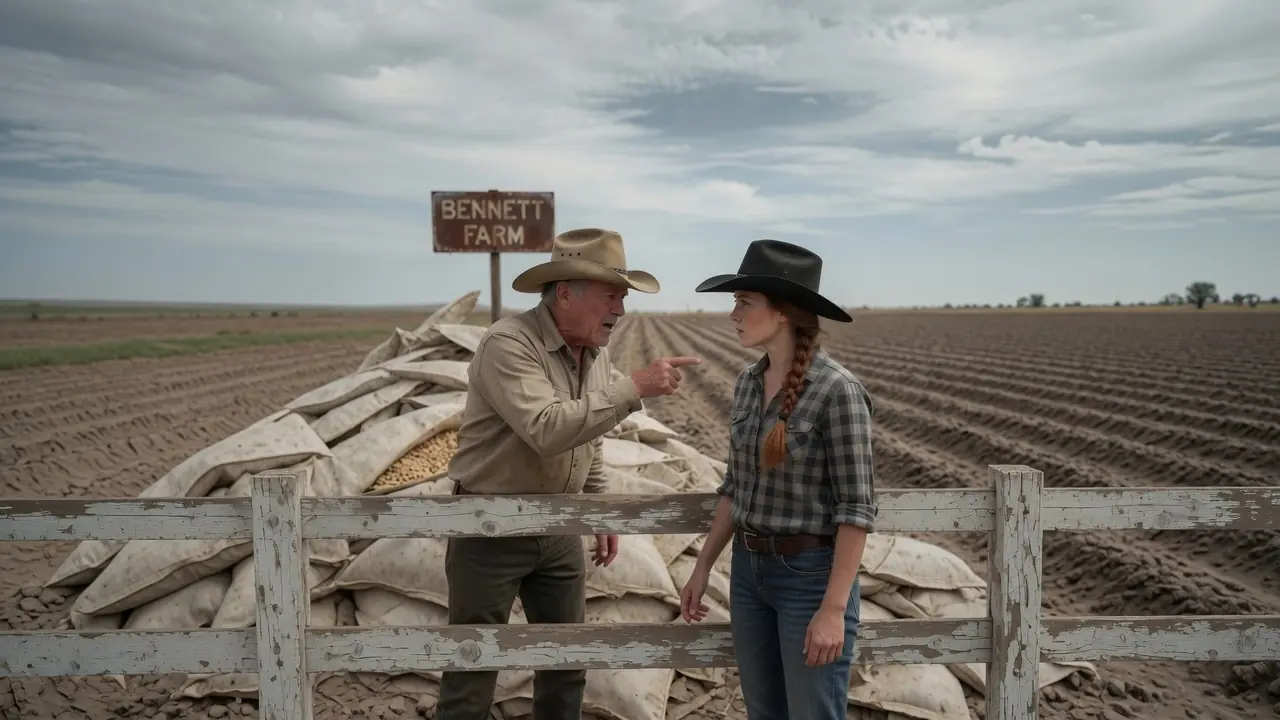
The pile of peanut hulls stretched along the weathered fence behind Mara, glowing pale beneath the afternoon sun. From the road, it looked exactly as Roy described it: waste spread across a farm too poor to afford anything better. The county had received three complaints claiming Bennett Farm had become an illegal dumping ground, and each complaint carried the signature of a neighboring landowner who wanted Mara gone.
She was twenty-six years old and had inherited six hundred acres of exhausted Texas farmland from her grandfather. The land had once produced cotton, sorghum, and winter wheat, but decades of aggressive tilling and chemical treatments had stripped it until rain ran across the surface instead of soaking in. By the time Mara returned from agricultural college, several fields had become almost sterile. Her father had already sold most of the machinery trying to save them.
The farm’s remaining tractor leaked hydraulic fluid. The irrigation pump coughed every time it started, and the barn roof surrendered another sheet of metal whenever the wind rose. Mara had twenty-three thousand dollars in debt, a stack of unpaid seed invoices, and exactly one season left before the bank could force a sale. Every practical voice in the county told her to stop pretending heritage could pay bills.
Roy Harlan had been the loudest.
He inspected nearly every farm in the county and treated his authority like a private inheritance. For thirty years, growers had accepted his advice because disagreeing could delay permits, block water access, or invite repeated inspections at the worst possible time. Roy favored deep tilling, heavy fertilizer, and the same chemical programs promoted by companies that sponsored county agricultural dinners.
Mara had questioned those programs during her first month home.
She showed Roy soil tests revealing dangerously low organic matter and microbial activity. He dismissed the results as academic nonsense and told her the land needed stronger fertilizer, not “college theories.” When she refused to purchase the recommended chemical package, her permit applications suddenly began taking twice as long.
Then the drought arrived.
By June, the sun had burned pasture grasses into brittle straw. Wells dropped, ponds shrank, and wind lifted loose topsoil from fields in brown curtains that crossed the highway. Farmers who had once laughed at Bennett Farm began watching their own rows die.
Mara’s fields looked terrible too, but she noticed something others overlooked. Along the back fence, where an old peanut processor had once dumped shells decades earlier, weeds remained green. The soil beneath that forgotten layer was darker and softer than the surrounding ground.
She began studying peanut hull decomposition, carbon balance, moisture retention, and fungal networks. Raw shells could temporarily tie up nitrogen if spread carelessly, so Mara did not simply dump them onto her fields. She mixed the hulls with composted manure, aged cottonseed residue, mineral-rich clay, and a microbial inoculant she cultivated from healthy woodland soil.
She built test rows behind the barn.
One plot received the county’s standard fertilizer plan. A second received compost alone. The third was covered with Mara’s prepared peanut-hull mixture and left mostly undisturbed.
For weeks, nothing happened.
Roy drove past one morning, slowed his truck, and laughed through the open window. “Growing peanuts without peanuts now, Bennett?”
Mara kept working.
By the second month, the treated plot retained moisture nearly twice as long after watering. Earthworms appeared beneath the mulch, and roots pushed deeper instead of spreading weakly along the surface. The county-recommended plot produced fast green growth, then wilted as soon as the temperature climbed.
Mara expanded the experiment to twenty acres.
That was when the ridicule became public.
Photographs of the pale hulls appeared on a local farming page with the caption, Bennett Farm Finally Becomes the Trash Heap Everyone Expected. Neighbors joked that Mara was insulating the dirt because she could not afford seed. Someone placed a handmade sign beside the road reading, FREE GARBAGE TOUR.
Mara removed the sign and kept spreading hulls.
She could not afford enough material to cover everything, so she negotiated with a peanut-processing plant two counties away. The company paid disposal fees to haul its waste to a landfill, and Mara offered to accept properly inspected hulls at no charge. In return, the plant delivered them directly to Bennett Farm.
That arrangement made Roy furious.
He claimed she was operating an unlicensed commercial waste site. Mara showed him laboratory reports proving the hulls contained no prohibited chemicals or contaminants. He then argued that the material attracted pests, although his own inspection found none.
Each time Mara disproved one accusation, another arrived.
The pressure was not accidental.
Across the highway, developer Calvin Stroud had been purchasing failed farms for a proposed solar-industrial complex. He already controlled four neighboring properties and needed Bennett Farm to connect the project to a major transmission corridor. Mara had rejected three offers, including one large enough to clear her debts.
Calvin’s fourth offer arrived the same week the complaints began.
He visited the farmhouse wearing polished boots that had never touched mud. “You can walk away with dignity now,” he told her. “Or you can lose the place after everyone watches you fail.”
Mara set the unsigned contract on the porch rail. “My grandfather survived dust storms on this land.”
“Your grandfather didn’t owe the bank what you owe.”
“He also didn’t sell to men who created the problem they offered to solve.”
Calvin’s smile disappeared.
Two days later, Roy issued a preliminary violation notice concerning the peanut hulls. The language closely matched the complaint submitted by one of Calvin’s companies. Mara appealed, but the county scheduled her hearing after the bank’s foreclosure deadline.
She understood the plan.
If Roy condemned part of the property, the land’s value would collapse. The bank would refuse to extend her loan, and Calvin could purchase Bennett Farm cheaply after foreclosure. The peanut hulls were not the real threat.
Her refusal to sell was.
Mara began recording every inspection.
She installed cameras near the gate and kept copies of every soil report, water test, and conversation. She also sent samples from the treated and untreated fields to an independent agricultural laboratory outside the county.
The results arrived one morning before sunrise.
Organic matter in the treated field had nearly doubled. Water infiltration had increased dramatically, and microbial diversity was recovering. The soil was not yet healthy, but it was moving in the right direction faster than the laboratory expected.
Mara printed the report and placed it inside a sealed folder.
She did not tell Roy.
By August, the county’s crops began failing openly. Corn leaves curled before noon, cotton bolls remained small, and shallow roots could no longer reach moisture. Several farmers increased irrigation until their wells began producing sand.
Bennett Farm still looked strange from the road.
Pale shells covered the earth between planting rows, and weeds grew along strips Mara intentionally left untouched. Yet beneath that untidy surface, moisture remained after neighboring fields had turned powder-dry. Her test crop of drought-resistant sorghum stood shorter than usual but green.
People stopped laughing as loudly.
Roy arrived at Bennett Farm on a blazing Thursday morning with two county vehicles and a photographer from the local newspaper. He handed Mara a final order requiring removal of the peanut hulls by sunset. If she refused, the county would declare the fields contaminated and place a lien on the property.
That was the confrontation beside the fence.
Mara heard the newspaper photographer’s shutter click as Roy pointed at her. She saw Calvin Stroud watching from his white truck across the road. Several neighboring farmers had gathered near the gate, expecting to witness the moment Bennett Farm finally broke.
Instead, Mara lifted the restored soil.
“Bring the county board,” she told Roy. “By sunset, they’ll be begging me to teach them.”
The gathered farmers murmured.
Roy smiled as though she had made the mistake he wanted. “Fine. We’ll test your little miracle in public.”
“I was hoping you’d say that.”
Mara opened the gate.
She led the group first to an untreated section beside the road. Roy pushed a metal soil probe against the surface, but it penetrated less than two inches before stopping. When Mara poured a measured gallon of water onto the ground, most of it spread sideways and ran into a crack.
Then she took them to the peanut-hull plot.
The probe sank nearly a foot with little pressure. Water disappeared into the soil instead of pooling, and when Mara dug beneath the mulch, the ground remained damp despite five days without irrigation. Fine roots threaded through dark crumbs of soil.
The laughter vanished completely.
A neighboring farmer named Earl Dawson crouched and touched the earth. His own cotton field had lost nearly half its plants during the previous week. “How much water did this section get?”
“Forty percent less than the county recommendation,” Mara answered.
Roy stepped forward. “She could have watered it last night.”
Mara pointed toward a monitoring station mounted on a post. “Moisture levels, pump activity, rainfall, and irrigation are recorded automatically.”
“Records can be altered.”
“Not the duplicate logs stored by the state university.”
The newspaper photographer lowered his camera and looked at Roy.
Mara had invited a soil scientist from the university to supervise her experiment months earlier. Dr. Lena Ortiz had not endorsed the treatment before seeing results, but she had agreed to monitor the fields independently. Her vehicle appeared at the gate moments later.
Roy’s face changed.
Lena carried sealed laboratory documents, moisture records, and side-by-side soil analyses. She explained that Mara’s fields were not covered with untreated industrial waste. The peanut hulls had been blended and conditioned carefully to restore carbon, protect the surface, reduce evaporation, and support biological recovery.
“This is not a miracle,” Lena said. “It is disciplined soil management.”
Roy folded his arms. “And you expect us to believe garbage repaired dead ground in one season?”
“No,” Mara replied. “I expect you to believe measurements.”
She handed copies of the report to the gathered farmers.
The evidence showed improved infiltration, reduced erosion, stronger root development, and lower surface temperatures beneath the hull layer. Crop yields had not fully recovered, but the treated field had survived conditions destroying nearby farms.
Earl Dawson looked toward Roy. “You told us mulch like this would spread disease.”
“I said unregulated material could create risk.”
“You told us to burn our crop residue and deep-till before summer.”
“That is standard practice.”
“My topsoil is sitting in Oklahoma because of your standard practice.”
More voices joined him.
Farmers began describing wells running dry, fertilizer costs doubling, and crops dying despite following county recommendations exactly. Roy tried to redirect the discussion toward Mara’s permit, but the crowd no longer wanted paperwork. They wanted to know why her soil remained alive while theirs failed.
Mara waited until the questions stopped.
Then she revealed the final document.
Three years earlier, the county had accepted funding from AgroDyne Solutions to promote an intensive soil-treatment program. Roy had signed the agreement, requiring county inspectors to recommend AgroDyne products and discourage competing recovery methods. In return, the company paid consulting fees through an agricultural education fund controlled by Roy’s brother.
Mara had discovered the payments inside public budget records.
The “education fund” had paid for Roy’s new truck, travel expenses, and improvements to a private hunting property. Meanwhile, farmers were pressured into buying chemical programs that increased short-term production but accelerated the decline of already exhausted soil.
Roy snatched at the document.
Mara pulled it away.
“You blamed farmers for failing,” she said. “But you were paid to keep them dependent on the system draining their land.”
“That is a lie.”
“Then explain your signature.”
Roy looked toward Calvin across the road.
That glance exposed more than he intended.
Mara brought out another file containing emails obtained through a public-records request. Calvin Stroud had urged Roy to condemn Bennett Farm before the end of the month. In one message, Calvin promised that “the remaining corridor problem” would disappear once the bank saw an environmental violation attached to Mara’s title.
The farmers turned toward Calvin’s truck.
He started the engine.
Earl and two others blocked the driveway before he could leave.
Nobody touched him, but they stood close enough to make clear he would not vanish before the sheriff arrived. Calvin rolled up his windows and began calling his lawyer.
Roy tried to remove the violation notice from Mara’s hand.
She held it above the fence.
“You threatened to condemn my farm by sunset,” she said. “So let’s finish this in front of everyone.”
The county board convened an emergency meeting at Bennett Farm that afternoon. By then, videos of the soil test had spread across the region. Local reporters arrived, followed by state agricultural officials and farmers from neighboring counties.
Roy was suspended before sunset.
The condemnation order was withdrawn, and an independent audit began examining every enforcement decision he had issued during the previous five years. Investigators later found that several farms purchased by Calvin had been subjected to questionable violations shortly before foreclosure.
Roy had made struggling land cheaper.
Calvin had purchased it.
Both men had profited from the collapse.
The discovery did not save the county’s crops immediately. Fields remained damaged, wells remained low, and many families stood weeks away from financial ruin. Removing corrupt men did not restore soil overnight.
That was when the county came back to Mara.
The following morning, trucks lined the road outside Bennett Farm. Farmers who had mocked the peanut hulls stood beside the rusted sign carrying notebooks, soil samples, and questions. Some could barely look Mara in the eye.
Earl spoke for them.
“We need to know what you did.”
Mara looked at the line of vehicles stretching toward the highway. “Yesterday, this was garbage.”
“Yesterday, we were fools.”
“You tried to help Roy shut me down.”
“I did.”
“And now?”
“Now my son’s farm has enough water for maybe three more weeks.”
The anger inside Mara did not disappear. She remembered every joke, every complaint, and every person who watched Calvin threaten her without speaking. She could have closed the gate.
Instead, she opened it.
“Bring your soil tests,” she said. “Nobody copies my method blindly. We build a plan for each field.”
For the next month, Bennett Farm became an outdoor classroom. Mara taught farmers how to test carbon levels, prepare hull mixtures safely, avoid nitrogen imbalance, reduce unnecessary tilling, and protect soil from heat. Dr. Ortiz helped create county guidelines based on measured results rather than promises.
The peanut processor expanded deliveries.
Farmers contributed manure, crop residue, and equipment. Those who could not pay traded labor. The strange pale coverings began appearing across the county, but Mara warned everyone that the hulls were only one part of the process.
“The secret isn’t peanut shells,” she told them. “The secret is treating soil like something alive.”
Some fields responded quickly.
Others required deeper repair.
A few failed because the damage had become too severe, and Mara refused to hide those failures. She documented everything so farmers understood where the method worked, where it needed adjustment, and where different solutions were necessary.
That honesty earned more trust than certainty ever could.
Autumn rain arrived after months of drought.
On conventional fields, water rushed across compacted ground and filled roadside ditches with brown sediment. On the recovering plots, the rain sank beneath the protective hull layers. For the first time in years, Bennett Farm’s lower pond filled without turning muddy.
Mara stood beneath the barn roof and watched the water rise.
Her father joined her carrying two cups of coffee. Illness had weakened him during the previous year, but pride strengthened his voice.
“Your grandfather would have called those hulls ugly.”
“He would have been right.”
“He also would have bragged about them to everyone in town.”
The harvest did not make Mara rich.
Her sorghum yield remained below the county’s old averages, but it was far higher than neighboring farms that had not changed their methods. More importantly, her soil held moisture, resisted erosion, and improved instead of declining.
The bank extended her loan.
Calvin’s development deal collapsed after several land purchases were placed under investigation. Farmers who had sold under false pressure filed lawsuits, and the state froze construction permits connected to his companies.
Roy eventually faced charges for bribery, fraud, and abuse of public office.
At his hearing, he claimed he had only supported established agricultural practices. Prosecutors responded with bank records, emails, and recordings from Mara’s gate. His own threat to condemn Bennett Farm became evidence that he used public authority to serve private interests.
He lost his position, his consulting income, and the influence he had guarded for decades.
Mara never celebrated his fall publicly.
She was too busy rebuilding fields.
The county established an independent soil-recovery cooperative and elected Mara as its first technical director. She accepted only after members agreed that no company could purchase exclusive control of the methods developed at Bennett Farm.
Her process would remain available to every local grower.
Within three years, organic matter increased across thousands of acres. Water use declined, wind erosion slowed, and farmers began combining peanut hulls with cover crops, compost, reduced tillage, and field-specific mineral plans. The county once known for failing farms became a destination for agricultural researchers.
Visitors always stopped at Bennett Farm first.
The rusted sign remained beside the gate because Mara refused to replace it. Nearby stood a second sign made from salvaged barn wood.
It read:
THE LAND WAS NEVER GARBAGE. WE JUST FORGOT HOW TO FEED IT.
One summer afternoon, Mara saw a young farmer standing nervously near the fence. His family’s land had been losing crops for years, and the bank had given them one final season.
“I heard you have a secret,” he said.
Mara led him toward the original test plot.
The soil beneath the peanut hulls was nearly black now, filled with roots, insects, and life. She placed a handful in his palm just as she had done when Roy pointed his finger at her beside the gate.
“There is no secret,” she said. “There’s observation, patience, and the courage to look foolish before the results appear.”
He closed his fingers around the soil.
Behind them, the fields stretched toward the horizon in dark, living rows. Peanut hulls still covered the ground, but nobody in the county called them garbage anymore.
The material everyone had mocked became a symbol of recovery.
The young woman everyone had tried to shame became the person they trusted to teach them how to survive.
And Bennett Farm, once hours away from condemnation, became the place where an entire county learned that dead soil could return—provided someone was stubborn enough to defend it before anyone else could see what was growing underneath.