This young college student, juggling classes and multiple jobs just to survive, had spent his whole life scraping by.
Yet he had never let poverty smother the compassion in his heart.
So when he saw an elderly, frail man collapse in the middle of a violent storm while everyone else hurried past, he did not hesitate for a second.
He rushed in, gave first aid, helped stabilize him, and then walked with him through fifteen city blocks in the worst downpour Philadelphia had seen in years.
What Elias did not know was that the trembling man leaning on him was a billionaire with an enormous fortune.
And that this rain-soaked walk was about to change both of their lives forever.
Tuesday morning, 6:47 a.m.
Elias Monroe’s alarm did not go off because he never set one.
His body woke him at the same time every day.
Twenty years old, exhausted before the day even started, he rolled off a mattress on the floor, springs poking through, no bed frame because he could not afford one.
The apartment was silent except for his grandmother’s breathing from the other room.
Marlene Monroe, seventy-three years old, had arthritis so bad her hands looked like twisted tree branches.
Elias walked to the kitchen of their two-bedroom walk-up in West Dockside, the part of Rivergate where buildings leaned and nobody asked questions.
Peeling wallpaper.
Water stains on the ceiling.
When it rained hard, they put buckets in three spots and hoped the leaks did not spread.
He made instant oatmeal.
Two bowls.
Brown sugar in his grandmother’s.
Plain in his.
That saved thirty cents.
Then the pills.
He lined them up on the counter.
Blood pressure.
Diabetes.
Arthritis.
He counted the arthritis medication.
Three pills left.
The refill cost ninety-two dollars.
They did not have ninety-two dollars.
His stomach knotted.
He checked the emergency jar hidden inside the flour canister.
Fifty-three dollars and eighteen cents.
Rent was due in six days.
They needed four hundred and twenty dollars total.
The math did not work.
It never worked.
Elias thought about money approximately two hundred times a day.
Every meal.
Every bus ride.
Every textbook he could not buy.
It was not stress anymore.
It was just background noise, like tinnitus, but financial.
“Baby, you’re up early.”
Grandma Marlene shuffled into the kitchen, one hand on the wall for balance.
She moved slowly.
Everything hurt.
“Morning, Grandma. Made you oatmeal.”
“You’re too good to me.”
No, he was not good enough.
If he were good enough, she would not be working two cleaning jobs at seventy-three.
If he were good enough, he would have figured out how to fix this by now.
But he did not say that.
He just kissed her forehead and handed her the bowl.
“You working both shifts today?” he asked.
“Just morning at the diner. Double tomorrow.”
He nodded.
The calculation ran automatically in his head.
Morning shift paid eight dollars an hour.
Four hours.
Thirty-two dollars before taxes.
Twenty-six dollars take-home.
Not enough.
Never enough.
“I’ll pick you up after your shift,” he said.
“Baby, you’ve got class.”
“I’ll make it work.”
She did not argue.
She needed the help.
They both knew it.
Elias was a sophomore at Trinity State College.
Engineering major.
Second year.
Straight A’s in every class because he had to be.
His scholarship covered tuition, but not books, not rent, not food, not life.
At Trinity State, Elias was invisible.
Three thousand students, and almost none of them knew his name.
He sat in the back.
He wore the same rotation of four shirts, two pairs of jeans, and one pair of sneakers with holes in both soles that he covered with duct tape.
His engineering professor, Dr. Chen, had stopped him after class last month.
“Elias, you scored ninety-seven on the structural analysis exam. Highest in five years.”
“Thank you, sir.”
“Have you considered applying to the graduate fellowship? Full ride to MIT or Stanford. You’d be a strong candidate.”
Elias had looked at the floor.
MIT.
Stanford.
Words from a different universe.
“I work two jobs, Dr. Chen. I don’t have time for applications.”
Dr. Chen had started to say something else.
Probably about scholarships.
About opportunities.
About futures.
Elias walked away.
Dr. Chen did not ask again.
Because here was the thing about poverty.
It was not just about not having money.
It was about not having time.
Not having energy.
Not having the mental space to dream because you were too busy calculating whether you could afford eggs that week.
Elias worked two jobs.
Morning shift at Rosy’s Diner, six to eleven.
He served coffee, cleared tables, and took insults from customers who did not tip.
Seven dollars and fifty cents an hour, plus tips.
On a good day, he made forty dollars.
Evening shift as a delivery driver for Ly’s Restaurant, six to midnight.
He drove his beat-up Honda Civic with over two hundred thousand miles on it, a check-engine light permanently on, and lately the engine had been stalling at random.
He got paid per delivery, plus tips.
On a good night, sixty dollars.
Between shifts, he went to class.
He did homework in the car between deliveries.
He ate whatever mistakes the kitchen made and let him take home.
He had been doing this for two years, ever since his dad died.
Aaron Monroe, construction worker.
Fell from scaffolding three stories up.
Died instantly.
No life insurance.
Just debt.
His mother was gone.
Left when Elias was twelve.
Could not handle the pressure.
Chose herself.
He did not blame her.
Sometimes, he understood.
So it was just him and Grandma Marlene.
And the weight.
The constant, crushing weight of knowing that if he failed, she had nobody.
Tuesday afternoon, 2:00 p.m.
Elias sat in Structural Engineering II, trying to stay awake.
The professor was talking about load distribution in suspension bridges.
Elias loved this stuff.
He really did.
When he was not exhausted, when his brain was not screaming about rent and medicine and food, he could lose himself in the math.
The elegance of forces in balance.
The beauty of something that held weight without breaking.
He had a notebook.
Not for class notes.
For his own designs.
Bridge sketches.
Building concepts.
Dreams drawn in pencil during the ten minutes before he fell asleep each night.
Nobody knew about the notebook.
It felt dangerous to want things he could not have.
Class ended.
Elias checked his phone.
A text from his manager at Rosy’s.
Can you cover Sarah’s shift tomorrow morning? She called in sick.
He texted back immediately.
Yes.
More hours.
More money.
Less sleep.
The equation of his life.
At 4:30 p.m., Elias walked past the construction site on Broad Street.
Chain-link fence.
Security trailers.
A massive sign.
Future Home Of The Hail Institute For Innovation.
Opening Fall 2027.
The rendering showed a gleaming glass building, an outdoor plaza, and a pedestrian bridge connecting it to the public library two blocks away.
Elias stopped.
Pressed his face against the fence.
Stared at the rendering of the bridge.
Curved arch.
Elegant.
Functional.
Beautiful.
This was what he wanted to build.
Not someday.
Now.
He wanted to be the person who designed things like this.
Who created structures that connected people.
“Hey, private property. Move along.”
Security guard.
Flashlight.
Annoyed expression.
Elias walked away and tried not to want things he could not afford to want.
But something about that bridge stayed with him.
The way it curved.
The way it seemed to reach across space with purpose.
Connecting knowledge to opportunity.
That was what the sign said.
Knowledge on one side.
Opportunity on the other.
And a bridge bringing them together.
He thought about it all the way to work.
At 5:45 p.m., Elias was at Ly’s Restaurant, picking up his first delivery order of the night.
The kitchen was chaos.
Tickets printing.
Manager stressed.
An old man walked in.
Late sixties, maybe early seventies.
Expensive coat, the kind with a label you could see from across the room.
Leather shoes that probably cost more than Elias made in a month.
Gold watch catching the fluorescent light.
But something was wrong.
His hands trembled.
His breathing was labored.
He leaned heavily on the counter like it was the only thing keeping him upright.
“Can I... can I get a water, please?”
The cashier, Maria, rolled her eyes.
She had been here ten years, and her patience had died about nine years ago.
“This is a restaurant, not a—”
“I’ll get it.”
Elias grabbed a cup, filled it with ice water, and handed it to the old man.
The man drank, hands shaking so badly that water spilled down his chin and soaked into his expensive collar.
“You okay, sir?”
“Yes. Thank you. How much do I owe you?”
“It’s just water. No charge.”
The man pulled out his wallet.
Real leather.
Worn, but expensive.
He tried to pull out a bill, but his hands shook so badly the entire wallet dropped.
Bills scattered on the floor.
Elias knelt and collected them.
Twenties.
Fifties.
Hundreds.
He handed the wallet back.
Every bill accounted for.
The man stared at him.
“You... you didn’t take anything.”
“Why would I?”
The man’s eyes watered.
“Most people would have. Especially—”
He trailed off, but Elias knew what he had been about to say.
Especially someone like you.
“I’m not most people, sir.”
The man pulled out a twenty and tried to hand it to Elias.
“Please. For your kindness.”
“Sir, I just got you water.”
“And you could have walked past. Could have let me drop that wallet and taken what you wanted. Nobody would have known.”
“I would have known.”
The man’s hands dropped.
He looked at Elias like he was seeing something he had forgotten existed.
“What’s your name?”
“Elias, sir.”
“Elias.”
He said it slowly, like he was memorizing it.
“I’m Edmund. Edmund Hail.”
The name did not register.
Should it have?
Elias nodded politely.
“Thank you, Elias. You’re a rare kind of person.”
“Just trying to get through the day, sir.”
Edmund smiled sadly.
“Aren’t we all?”
He left.
Elias watched him go.
He noticed how Edmund gripped the doorframe on his way out.
The man was sick.
Really sick.
Maria appeared next to Elias.
“Rich people are so weird.”
“Maybe he’s just having a bad day.”
“With that coat? His bad days are better than our good ones.”
Elias shrugged and got back to work.
For a while, he forgot about it.
The next two hours blurred together.
Delivery to an apartment building where the elevator was broken.
Six flights up.
Delivery to a house where the guy tipped three dollars on a seventy-dollar order.
Delivery to a college dorm where nobody answered the door for ten minutes.
By 9:00 p.m., Elias had made forty-one dollars.
Not great.
Not terrible.
He had three more hours to go.
At 9:30 p.m., Elias finished another delivery.
His phone buzzed.
Text from Grandma.
Baby, don’t forget to pick me up. Bus stop on Market.
He checked the time.
Her shift ended at 9:45.
He could make it.
He drove to Market Street, parked under a streetlight that flickered like it was trying to decide whether to quit, and waited.
At 9:47, the bus pulled up.
Grandma Marlene got off slowly, gripping the handrail.
Each step looked painful.
Her face was tight.
She saw his car, and her face softened, but the pain did not leave her eyes.
“Baby, you didn’t have to come.”
“I know.”
He got out and took her bag.
Fifteen pounds of nothing.
Her lunch container.
A change of clothes.
A library book she checked out every week and never finished because she fell asleep after one page.
She eased into the passenger seat with a small sound of pain that she tried to hide.
It did not work.
Elias heard it anyway.
They drove in silence for a few blocks.
She stared out the window at Rivergate passing by.
The city looked different at night.
Softer.
The darkness hid the peeling paint and broken windows.
“Your father used to pick me up,” she said quietly. “Every Tuesday and Thursday. Even when he was dead tired from the construction site, he’d be here waiting.”
Elias gripped the steering wheel.
He did not trust his voice.
“He had a gift. Your daddy could see what needed fixing and just knew how to fix it. Broken sink, squeaky door, wobbly table. People called him at all hours. ‘Aaron, can you help me?’ And he’d go. Didn’t matter if they couldn’t pay. Didn’t matter if it was midnight.”
She turned to look at him.
Her eyes were wet.
“You got that same heart, baby. I see it. Every day you pick me up when you should be studying. Every time you work a double when you’re already exhausted. That’s your daddy’s heart.”
Elias blinked hard.
“Just trying to help, Grandma.”
“I know. But sometimes I worry you’re giving so much you’ll have nothing left for yourself.”
He did not answer because she was right.
He felt hollowed out most days, running on fumes and obligation.
They pulled up to the apartment.
He helped her out, then up the three flights of stairs.
She took each step like it might be the one that broke her.
By the time they reached 3C, she was breathing hard, face pale.
Inside, he helped her to her chair and made her tea.
The ritual of their nights.
“Baby, you got homework.”
“I’ll do it after my next shift.”
“Elias.”
“I’m fine, Grandma.”
She looked at him like she knew he was lying but was too tired to fight.
“You know I’m proud of you, right? Engineering school, working two jobs, taking care of me. Your daddy would be so proud.”
“Thanks, Grandma.”
“But baby, you can’t carry the world forever. Eventually, something’s got to give.”
He kissed her forehead.
“Nothing’s going to give. I got this.”
He did not.
They both knew it.
But saying it out loud made it easier to pretend.
He left for his last three hours of work.
In the car, he let himself feel it for just a moment.
The weight.
The exhaustion.
The fear that one unexpected expense would topple everything they had carefully balanced.
Then he shoved it down, turned the key, and got back to work.
What Elias did not know was that, in exactly ninety minutes, his life was going to change.
And it would start with a storm.
Tuesday evening, 10:00 p.m.
The weather forecast had said forty percent chance of showers.
By 9:45, the sky turned black like someone had flipped a switch.
Wind picked up, rattling windows.
The temperature dropped twenty degrees in fifteen minutes.
By ten o’clock, it was not rain.
It was a wall of water.
Thunder shook buildings.
Lightning cracked so bright it turned night into day for half seconds, leaving ghost images burned into your vision.
Flash flood warnings lit up every phone in the city.
Emergency alert.
Severe thunderstorm warning.
Seek shelter immediately.
Do not travel.
The city advised everyone to stay indoors.
Streets emptied within minutes.
Elias was at Ly’s, waiting for his next delivery order.
The restaurant manager, Carlos, watched the news with increasing alarm.
“This is bad. Really bad. They’re saying possible flooding in low-lying areas.”
Rain hammered the windows so hard it sounded like someone was throwing rocks.
The lights flickered once.
Twice.
“Elias, go home. Your grandmother’s probably worried sick.”
“But I have two more deliveries.”
“I’ll assign them to someone else or refund them. Go now before it gets worse.”
Elias did not argue.
He pulled his hood up.
Thin jacket.
Not waterproof.
The only one he owned.
Then he pushed through the door.
The rain hit him like a physical force.
Within three seconds, he was soaked through.
Water ran down his back and filled his shoes.
The holes in his soles let water in with every step.
He ran toward his car, parked two blocks away.
He fumbled for the keys, heart pounding, rain blinding him.
The engine coughed once.
Twice.
Then died completely.
The dashboard lights flickered and went dark.
“Come on.”
He tried again.
Nothing.
“Come on, please.”
Dead.
Completely dead.
His phone was still inside the restaurant charger, and his car was useless metal in the rain.
He swore under his breath, pushed out of the driver’s seat, and started running back toward Ly’s to get his phone.
The rain was so thick he could barely see.
Lightning flashed, and for a moment, everything was bright as noon.
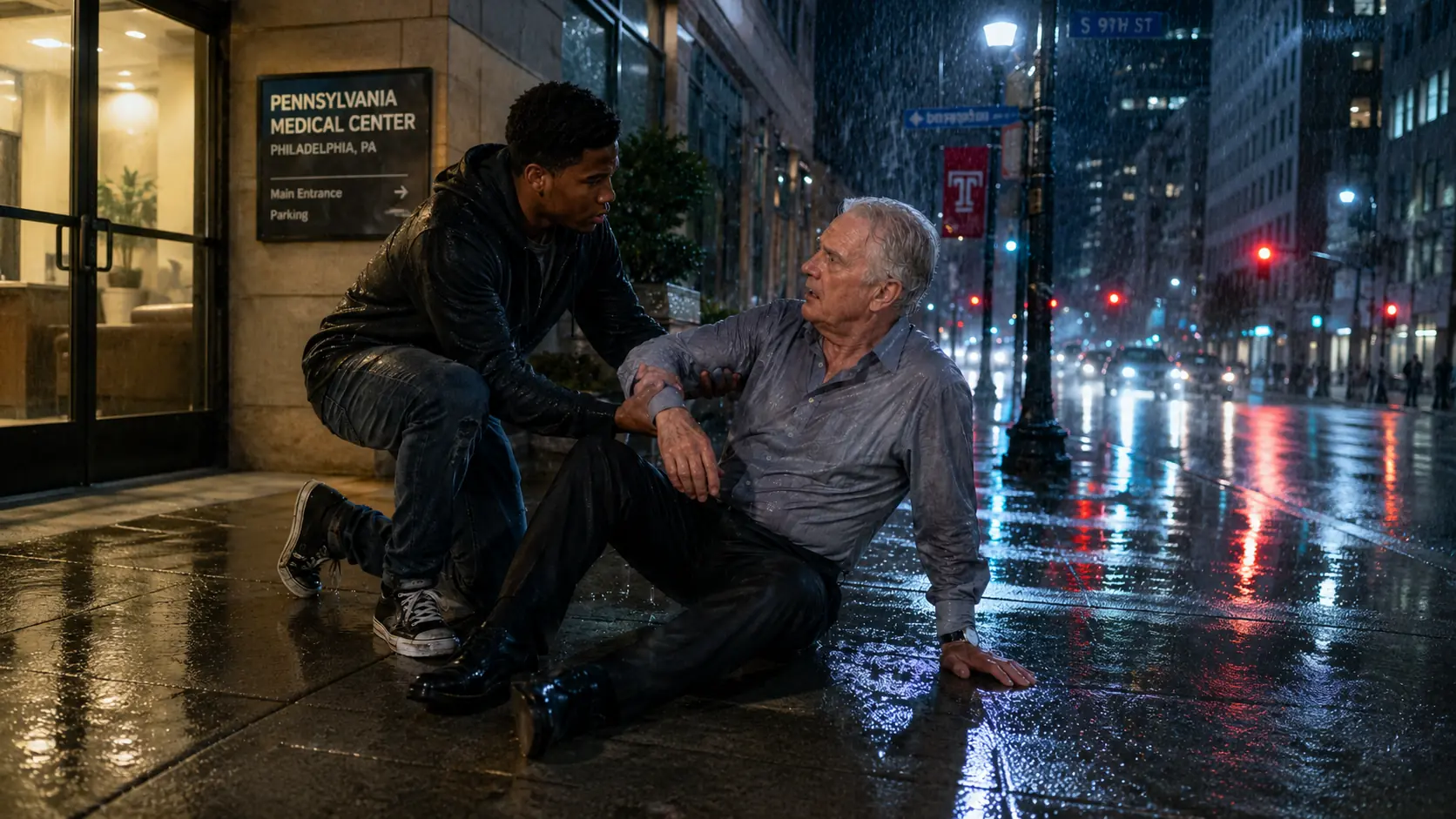
In that flash, he saw him.
The old man from earlier.
Edmund.
The one with the trembling hands.
Standing outside a medical building.
No umbrella.
No coat.
Soaked through.
Dress shirt plastered to his body like a second skin.
Trying to hail a cab with one hand while the other clutched his chest.
Cabs passed without slowing down.
Windshield wipers on full blast.
Drivers hunched forward, focused only on getting home.
The man stumbled, caught himself on a lamppost, face pale even in the dim light.
Lips slightly blue.
Breathing visible even from twenty feet away.
Chest heaving.
Mouth open.
Elias’s mind raced.
Grandma was waiting.
She was probably panicking.
She would think he was hurt.
He was already soaked.
He needed to get home.
The man was a stranger.
He was clearly rich.
Look at that watch.
That coat.
He would be fine.
Someone else would help.
He probably had people.
A driver.
An assistant.
But the man staggered again.
Even through the rain, Elias could see his chest heaving.
Labored.
Wrong.
He looked like Dad.
That day.
The day before the fall.
Dad had come home from work early, face gray.
Said his chest felt tight.
Grandma wanted to take him to the hospital.
Dad refused.
Just tired.
Long day.
Need to rest.
He went to work the next morning.
Fell forty feet three hours later.
Then Elias noticed something strange.
A black Lincoln Town Car was parked fifty feet away, hazard lights blinking orange through the rain.
The driver’s door opened.
A man in a suit stepped out, holding an umbrella.
Edmund saw him and waved him off sharply, angrily.
“No. I said no. Get back in the car.”
“Mr. Hail, please. You’re not well.”
“I told you I’m not riding with you. I’ll find my own way home.”
“Sir, this is dangerous.”
“I said no, Mitchell. Get back in the car.”
The driver hesitated, looking torn, then retreated to the vehicle.
Elias was confused.
Why would someone refuse their own ride in a storm like this when they were clearly sick?
It did not make sense.
Unless there had been a fight.
An argument.
Something big enough to make a sick man choose a storm over a warm car.
Thunder cracked directly overhead.
The old man’s knees buckled.
He went down hard, catching himself on his hands, kneeling on the wet sidewalk as water rushed past him toward the storm drain.
People rushed past under umbrellas, heads down, focused on their own survival.
Cars splashed through puddles without slowing.
No one stopped.
The man tried to stand.
Could not.
His arms gave out.
He collapsed onto his side.
Elias moved before he decided to.
“Sir! Are you okay?”
He ran and knelt next to the man.
Rain poured down both their faces, making it hard to see, hard to breathe.
The man looked up, eyes unfocused.
“I just... I need to get home. Can’t find my phone. I can’t...”
His voice was slurred.
Confused.
Medical distress.
“Where do you live?”
“Rose Hill Square. The building with... with the green awning. Eighteenth Street. I can’t... can’t remember the number.”
Fifteen blocks home.
His car dead behind him.
Through the worst storm of the year.
Elias’s phone was in the restaurant a block away.
He could run, get it, call 911.
But this man might collapse before he got back.
Might die alone on this sidewalk while Elias was trying to help.
“Sir, your driver is right there.”
“No.”
The man grabbed Elias’s arm with surprising strength.
Desperate.
Frightened.
“Not with him. Please. I can’t. I can’t explain right now, but I need to walk. I need to get home on my own.”
He was not making complete sense, but he was desperate.
And he was sick.
Dangerously sick.
This was not about the storm.
This was about something else.
Something personal.
Pride maybe.
Or fear.
Or anger.
It did not matter what.
What mattered was that this man was going to die if someone did not help him.
The stakes flashed through Elias’s mind in rapid sequence.
If I walk this man fifteen blocks through this storm, I’ll be soaked for over an hour.
Risk of getting sick.
Missing work.
Missing school.
Grandma will be terrified.
She’ll think something happened to me.
I might lose tomorrow’s shift.
We need that money.
Every dollar matters.
But if I walk away and this man dies alone on this sidewalk, I’ll carry that forever.
I’ll see his face every time it rains.
Every time I walk past this street, I’ll wonder if I could have saved him.
The choice was not really a choice at all.
Elias took off his jacket.
Thin.
Soaked.
Basically useless at this point.
But it was something.
A gesture.
A promise.
He draped it over the man’s shoulders.
“I’ll walk you home, sir. Lean on me.”
The man looked at him for a long, searching moment.
Water ran down his face.
Could have been rain.
Could have been tears.
“You don’t have to do this. You don’t even know me.”
“I know you need help. That’s enough. Come on.”
Elias pulled the man to his feet.
He was heavy.
At least one hundred and ninety pounds, maybe more.
Dead weight.
Elias was five-nine, one hundred and forty pounds, soaking wet, and every pound of Edmund’s weight settled onto his shoulder.
They started walking.
Behind them, the driver got out of the car again.
“Mr. Hail, please!”
Edmund did not turn around.
He just kept walking, leaning on this stranger.
Elias did not know it yet, but this walk, this choice, this moment, was about to change everything.
Every step through that storm was a choice.
And Edmund Hail was counting every single one.
Blocks one through three were a physical battle.
Rain came in sheets, almost horizontal.
Wind tried to knock them over.
Elias’s sneakers, holes in both soles, filled with water immediately.
Every step.
Squish.
Squish.
Cold water between his toes.
His socks were gone, basically disintegrated.
Edmund was dead weight, leaning heavily on Elias’s right shoulder, breathing ragged, wet, and labored.
Every breath sounded painful.
Elias’s shoulder already ached.
A deep, burning ache that spread down his arm.
His legs burned.
They had walked two blocks.
Thirteen more to go.
Lightning struck close, maybe three blocks away.
The thunder came instantly.
So loud Elias felt it in his chest.
In his bones.
Edmund stumbled.
His legs gave out.
Elias caught him and nearly went down himself.
“I got you. Just keep moving. One foot, then the next foot. One foot, then the next.”
He repeated it out loud this time, creating a rhythm.
A chant.
Something to focus on besides the cold, the pain, and the exhaustion.
His teeth chattered.
His hands were numb.
Water streamed down his face.
He could not tell rain from sweat from the water running from his hair.
Do not let him fall.
Do not let him die.
One foot.
Next foot.
Do not let him fall.
Block four.
The rain lessened slightly.
Still pouring, but no longer feeling like needles hitting skin.
The worst of the storm cell had passed overhead.
Edmund’s breathing stabilized just enough for talking.
He lifted his head slightly.
“What’s your name, son?”
“Elias, sir.”
“Elias.”
He repeated it carefully, like he was memorizing it.
“Strong name. Old name. I’m Edmund. Edmund Hail.”
The name still did not click for Elias.
He nodded and focused on keeping them both upright.
“You should have just called 911, Elias. This is too much to ask of a kid.”
“I’m twenty, sir. And I didn’t have my phone. You needed help now, not in twenty minutes when an ambulance might get here.”
Edmund fell quiet for half a block.
Just breathing.
Walking.
Trying to stay conscious.
“You remind me of someone,” he finally said.
Blocks five and six.
Edmund started talking.
Maybe to distract himself from the pain.
Maybe because he needed to say it out loud.
Maybe because he thought he might not get another chance.
“I had a son once. Marcus. He’d be thirty-one now, I think. Might be thirty-two. I lose track sometimes. Time gets blurry when you’re trying not to count it.”
Elias did not know what to say.
He just listened.
Kept walking.
“Car accident. Nineteen years ago. He was nineteen. Just finished his freshman year at Penn. Engineering major. Coming home from volunteering at a youth shelter in West Philadelphia. Drunk driver ran a red light doing sixty in a thirty-five zone. Marcus didn’t have a chance.”
Edmund’s voice cracked.
Broke.
Reformed.
“He was a lot like you. Kind without thinking about it. Saw people who needed help and just helped. Didn’t calculate the cost. Didn’t wonder what he’d get in return. Just helped because someone needed it.”
“I’m sorry, sir. That’s... I’m sorry.”
“He wanted to be an engineer. Civil engineer. Bridges, specifically. Used to drive me crazy talking about load distribution and tensile strength and arch calculations. I didn’t understand half of it. Probably didn’t listen as well as I should have.”
Edmund laughed.
It was bitter, sad, painful.
“Bridges. Things that connect people. That’s what he’d say. ‘Dad, a bridge isn’t just about getting across water or a valley. It’s about connection. It’s about making sure everyone can reach opportunity, not just the people born next to it.’”
His voice dropped to almost a whisper.
“And I’ve spent the last nineteen years building walls instead.”
“What kind of walls?”
“Emotional ones. Professional ones. I threw myself into work after he died. Made a lot of money. Started a foundation in his name. Built buildings, funded programs, wrote checks with lots of zeros. I thought I was honoring him, keeping his memory alive.”
He paused and took several labored breaths.
“But really, I was running from grief. From guilt. From the fact that I worked eighty-hour weeks when he was alive and barely knew him. Missed his baseball games because I had meetings. Missed his science fairs because I was traveling. Missed his high school graduation speech because I was closing a deal in Tokyo. Always too busy building my empire to notice I was losing my son long before that car hit him.”
His voice broke completely.
“And now I’m sixty-eight and sick. And I realize I spent nineteen years building monuments to my guilt instead of living the life Marcus would have wanted me to live. I stopped seeing people. Stopped seeing what Marcus saw. Humans who need help. I just saw transactions, investments, returns.”
They walked another block in silence.
Just the sound of rain and their footsteps and Edmund’s labored breathing.
Then Elias spoke.
“You’re seeing me right now, sir.”
Edmund stopped walking and looked at Elias through the rain.
“What?”
“You’re seeing me right now. In this moment. So maybe you didn’t forget how. Maybe you just needed a reminder.”
Edmund’s eyes watered.
Definitely not rain this time.
“How old are you, Elias?”
“Twenty, sir.”
“Twenty.”
He shook his head slowly.
“When I was twenty, I was drunk every weekend, failing half my classes, chasing girls and money in that order. You’re walking a sick stranger home in a storm at twenty. You’re different.”
Elias shrugged.
Water ran off his shoulders.
“I’m just cold and wet, sir. Let’s keep moving before we both freeze.”
They walked.
One foot.
Next foot.
Blocks seven through nine.
The struggle intensified.
They were in Center City now.
Streetlights brighter, more frequent.
More people, though still not many in this weather.
The ones who were out moved quickly, hunched under umbrellas, focused on their destinations.
Edmund’s pace slowed.
He was exhausted.
Every step was a fight.
His legs barely lifted.
Elias was essentially dragging him now.
“I’m sorry,” Edmund gasped. “God, I’m so sorry. I’m slowing you down.”
“Don’t be sorry. Just keep walking. We’re over halfway there.”
A car passed too close to the curb, splashing them with a wave of gutter water.
It smelled like oil and rot.
Elias closed his eyes and kept moving.
His whole body was shaking now.
Not just from cold.
From exhaustion.
He had been on his feet since six in the morning.
It was after eleven at night.
Seventeen hours.
Two jobs.
Classes.
Now this.
But he did not stop.
Could not stop.
This man would die if he stopped.
Edmund noticed.
“You’re limping.”
“Hole in my shoe. Water’s getting in. It’s fine.”
“It’s not fine.”
Edmund looked down and saw Elias’s beat-up sneakers, the duct tape barely holding, water pouring out with each step.
His face changed.
Shame.
Realization.
Horror.
“Those shoes. How long have you had those?”
“Couple years. They work.”
“They have holes in them.”
“Yeah.”
“And you’re walking me fifteen blocks in the rain wearing shoes with holes.”
“You needed help.”
Edmund stopped walking, forcing Elias to stop.
He looked at him directly.
Really looked.
Like he was trying to see through skin and bone to whatever made Elias who he was.
“Elias, why are you doing this? You could have walked away. Everyone else did. You could have called 911 and left. You could have helped me to that car and let my driver take me. Why are you here?”
Elias thought about it.
Rain running down his face.
Exhaustion making his thoughts slow and heavy.
“My dad used to say something. He’d say, ‘If you see someone who needs help and you can help, you help. That’s it. No reason needed. No reward expected. You just help because that’s what people are supposed to do for each other.’”
“Your dad sounds like a good man.”
“He was. He really was.”
“Was?”
“Three years ago. Construction accident. Fell from scaffolding.”
Edmund went quiet.
They walked another block in silence.
Just breathing.
Just surviving.
“I’m sorry,” Edmund finally said. “That’s too young to lose a father.”
“Yeah. It is.”
Another block.
Their breathing synchronized now.
In.
Out.
Step.
Step.
Two bodies moving as one through the storm.
“What does your father’s voice tell you right now?” Edmund asked quietly.
Elias did not hesitate.
“Keep walking.”
Edmund smiled.
First real smile since they started.
“Mine too. Marcus’s voice, I mean. I can hear him. ‘Dad, you don’t get to give up. Not when someone’s trying to help you.’”
“Honor that, then.”
“Let’s honor it.”
“Come on.”
Blocks ten through twelve.
The rain picked up again.
Another storm cell moving through.
But they were close now.
So close.
Elias could feel his body starting to shut down.
His vision got spotty around the edges.
His legs were moving on autopilot.
Everything hurt.
But Edmund was still upright.
Still breathing.
Still alive.
That was enough.
Blocks thirteen and fourteen.
Rose Hill Square appeared ahead.
The difference was stark, immediate, almost obscene.
Elegant brownstones.
Manicured trees that somehow looked perfect even in the storm.
Doormen in uniforms.
Gas lamps.
Wrought iron fences.
Wealth radiating from every brick, every window, every carefully placed flower box.
Elias felt it immediately.
The shift.
He did not belong here.
He was soaked, exhausted, and looked homeless.
People would assume the worst.
They always did.
But he kept walking because Edmund needed him to.
“That one,” Edmund said, pointing. “Green awning.”
Block fifteen.
The arrival.
They reached the building.
Six stories.
Limestone facade.
Green awning with gold lettering.
The Prescott.
A doorman station visible through glass doors.
The doorman, middle-aged, name tag reading George, saw them coming through the window.
His eyes went wide.
He rushed out with a massive umbrella.
Too late to help, but the gesture was there.
“Mr. Hail, my God. What happened? Are you hurt? Should I call Dr. Patterson?”
“I’m fine, George. Just got caught in the rain. This young man helped me home.”
George looked at Elias for the first time.
Really looked.
His expression shifted through several emotions in quick succession.
Surprise.
Confusion.
Suspicion.
Disapproval.
He looked Elias up and down, taking in the cheap clothes, the soaked jacket, the shoes with holes, the duct tape, the way water was literally pooling around Elias’s feet.
His eyes said everything his mouth did not.
What is this kid doing here?
Why is Mr. Hail with someone like this?
Should I call the police?
Elias felt it like a punch to the gut.
The shift.
The judgment.
The unspoken you don’t belong here.
He had felt it before, many times, but it never stopped hurting.
He stepped back away from the shelter of the awning.
“You’re home now, sir. You should get inside. Get warm.”
Edmund grabbed his arm.
Surprisingly strong grip.
“Wait. Please don’t go yet.”
“Mr. Hail, perhaps I should call—”
George hovered.
Protective.
Still eyeing Elias like he might be a threat.
“George, give us a moment. Please.”
George hesitated, looked between them, then stepped back, but not far.
He was watching.
Vigilant.
Edmund looked at Elias.
Really looked.
Eyes still unfocused from exhaustion and illness, but clear in their intensity.
“Thank you. You didn’t have to do this. You had every reason to walk away, but you didn’t. That means something. That means everything.”
Elias nodded.
He did not know what to say.
His teeth were chattering too hard.
“Anyway, you should get inside, sir. Get warm. Maybe see that doctor your doorman mentioned.”
“I will. But first...”
Edmund started to reach for his wallet.
Elias was already backing away.
“No, sir. I don’t want money.”
“Elias, please. At least let me—”
“I helped because you needed help. Not for a reward. If I take money, it changes what it was.”
Edmund’s hand dropped.
He stared at Elias like he was seeing something impossible.
A myth made real.
“Do you have any idea how rare you are?”
“I’m just trying to get home, sir.”
“No. Listen to me. I know billionaires who would take money they don’t need just because it’s offered. I know people who calculate the value of every interaction, every gesture, every moment. And you... you need money. I can see it in those shoes, in that jacket. And you’re saying no.”
Elias shrugged and shivered.
“I’m not from your world, sir.”
Edmund laughed.
Real and genuine, despite everything.
“No, you’re not. And thank God for that. Thank God someone like you still exists.”
He put his wallet away and pulled out a business card instead.
Heavy stock.
Embossed lettering.
Even wet, it felt expensive.
Elias took it and read it, though he could barely focus his eyes.
Edmund J. Hail.
Founder and Chairman.
Hail Foundation.
His stomach flipped.
The construction site.
The Hail Institute.
This was that Hail.
“You’re... you’re building that center on Broad Street. The one with the bridge.”
Edmund nodded slowly.
“You’ve seen it.”
“I walk past it every day on my way to class. I stop and look at the rendering. That bridge...”
He trailed off.
“Tell me.”
“It’s beautiful, sir. The arch. The way it connects the center to the library. Like it’s saying knowledge should meet opportunity. People should be able to cross from one to the other without barriers.”
Edmund’s eyes watered.
“That’s exactly what Marcus said. Those almost exact words. ‘Dad, bridges remove barriers.’”
They stood there for a moment.
Rain falling.
Two people from completely different worlds who had somehow collided in this storm.
“Elias Monroe. What school do you go to?”
“Trinity State, sir. Engineering major. Second year.”
“Second year. Engineering.”
Edmund nodded slowly, memorizing every detail.
“Of course. Of course you are.”
George brought towels from inside, still watching Elias warily.
Edmund wrapped one around his own shoulders and handed another to Elias.
“Thank you, Elias Monroe. You didn’t just help an old man tonight. You reminded him why he does what he does. You reminded him what Marcus saw in people.”
Elias nodded and wrapped the towel around his shoulders, even though it would not help.
He was soaked through to the bone.
“Get inside, sir. Please see that doctor.”
“I will. I promise. And Elias.”
Edmund held up the business card, making sure Elias had it securely.
“If you ever need anything, and I mean anything, call that number. Day or night. Promise me you’ll keep it.”
“I promise.”
“I mean it. Not just for favors. If you ever need help, if you’re ever in trouble, if you ever just want to talk about bridges and engineering with someone who misses hearing about it, call.”
“I will, sir.”
“I won’t forget this. I won’t forget you.”
Elias nodded one last time, turned, and walked back into the rain.
Behind him, he heard George’s voice.
“Mr. Hail, we should really get you inside. You’re hypothermic. I’m calling Dr. Patterson.”
And Edmund’s response.
“In a minute, George. I just need to watch him go. Need to make sure he’s real.”
Elias walked fifteen blocks home in the opposite direction, through the storm he had just walked through.
His body was beyond pain now.
Beyond cold.
Moving on pure will.
But somehow, despite everything, despite the exhaustion, despite the cold, despite the ache in every muscle and bone, Elias felt something he had not felt in a long time.
He felt like maybe, just maybe, doing the right thing still mattered in this world.
Even when nobody was watching.
Even when it cost you everything.
Even when the world told you to keep walking, to mind your own business, to protect yourself first.
He had done the right thing.
And for tonight, in this moment, that was enough.
He made it home at 12:47 a.m.
He climbed the three flights of stairs on legs that barely functioned and opened the door as quietly as possible.
Grandma was awake, sitting in her chair by the window, crying.
“Baby.”
She stood, winced, and rushed to him anyway.
“Oh my God, baby. I thought something happened. I thought you were hurt. The storm, and you weren’t answering your phone, and I thought—”
“I’m okay, Grandma. I’m sorry. My phone’s in the car. I had to help someone.”
She saw how wet he was.
How he was shaking.
How he could barely stand.
“What happened?”
“Old man. Sick. Needed help getting home. I couldn’t leave him.”
Her face did something complicated.
Pride.
Fear.
Love.
Frustration.
“Of course you couldn’t. You got your daddy’s heart.”
She pulled him inside.
“Now get out of those wet clothes before you freeze to death. You trying to kill me with worry?”
“No, ma’am.”
She made him strip right there in the living room.
Brought towels.
Made hot tea.
Heated up soup.
Wrapped him in two blankets.
“This man you helped, he okay?”
“Yeah. Got him home safe.”
“He give you anything? Money for a cab?”
Elias thought about the business card in his wet jacket pocket.
About Edmund Hail.
About the Hail Foundation and the billions of dollars behind that name.
“Just his thanks, Grandma. That’s all.”
She looked at him for a long moment, saw something in his face, and decided not to push.
“Your daddy would be so proud of you, baby. So proud.”
“Thanks, Grandma.”
“But don’t you ever scare me like that again. You hear me?”
“Yes, ma’am.”
She kissed his forehead and went to bed.
Elias sat at the table, drinking tea, his hands shaking around the cup.
He thought about Edmund Hail.
About Marcus.
About bridges that connected people.
About doing the right thing, even when it was hard.
He pulled out the business card.
Still damp, but intact.
Read it again.
Edmund J. Hail.
Founder and Chairman.
Hail Foundation.
Would he remember me?
Tomorrow he’ll wake up warm and dry in his expensive building, and I’ll just be a story he tells at dinner parties.
The kid who helped me in the storm.
That’s all.
But then Elias remembered the way Edmund had looked at him.
The way he had said, I won’t forget you.
Maybe he had meant it.
Elias finished his tea, went to his mattress on the floor, and lay down.
He was asleep in thirty seconds.
He dreamed of bridges.
What Elias did not know was that Edmund Hail spent that entire night awake, sitting in his study, staring at the storm through his window, thinking about a twenty-year-old kid with holes in his shoes who had walked fifteen blocks in the rain for a stranger.
And making plans.
Big plans.
Plans that would arrive at Elias’s door in less than twenty-four hours.
But for now, both of them slept.
One in a million-dollar condo.
One on a mattress on the floor.
Both dreaming of bridges.
Wednesday morning, 6:00 a.m.
Elias woke up sore.
Every muscle in his body screamed.
His shoulder throbbed where Edmund had leaned on him.
His feet were covered in blisters from walking fifteen blocks in wet shoes.
Dark circles sat under his eyes.
He looked like he had aged five years overnight.
He found the business card on his nightstand, where he had put it to dry.
He pulled out his cracked phone, opened the browser, and typed:
Edmund Hail Philadelphia.
Results flooded in.
Hundreds of them.
Billionaire Philanthropist Edmund Hail Pledges $50 Million To Philadelphia Education.
Hail Foundation Awards $500 Million In Grants To Urban Development Over Five Years.
Edmund J. Hail: The Man Who Rebuilt Philadelphia’s Economy.
Forbes Profile: Net Worth Estimated At $2.9 Billion.
Hail Foundation Opens Fourth Community Center In West Philadelphia.
Elias’s hands shook.
He clicked on the Forbes article and read.
Edmund J. Hail, 68, is one of Philadelphia’s most successful entrepreneurs and philanthropists. After making his fortune in commercial real estate development, Hail has dedicated the last two decades to social impact.
There was a photo.
Edmund in a sharp suit, smiling, looking healthy.
Nothing like the sick, desperate man from last night.
The Hail Foundation has invested over $800 million in Philadelphia communities since its founding nineteen years ago. Hail’s latest project, the Hail Institute For Innovation, represents his most ambitious undertaking yet, a $120 million facility dedicated to providing free engineering and technology education to underserved youth.
Elias’s breath caught.
The construction site.
The bridge.
One hundred and twenty million dollars.
He kept reading.
Hail’s philanthropic focus intensified following the death of his only son, Marcus, in a drunk driving accident in 2009. Friends say Hail channeled his grief into creating opportunity for young people, particularly in education and technology sectors.
Elias looked at the business card again.
I walked home a billionaire.
And I turned down his money.
Part of him regretted it.
That money could have solved immediate problems.
Rent.
Medicine.
Food.
Relief.
But a bigger part of him was proud.
He did not help for a reward.
He helped because someone needed help.
Still, the math was impossible to ignore.
If Edmund Hail wanted to thank him, really thank him, he could change Elias’s entire life without even noticing the expense.
But that was not going to happen.
Rich people said nice things, made nice promises, then forgot.
“Elias, you’re going to be late for class.”
He pocketed the card and told himself to forget about it.
It was one night.
One moment.
That was all.
But he could not stop thinking about Edmund’s voice.
I won’t forget you.
Time would tell.
Elias dragged himself through his morning routine.
Breakfast.
Grandma’s pills.
She watched him move slowly, wincing.
“Baby, you should stay home. You’re exhausted.”
“I’m fine, Grandma. Got a quiz in structural engineering.”
“You can’t take care of me if you don’t take care of yourself.”
“I’ll rest this weekend. I promise.”
He would not.
They both knew it.
But saying it made them both feel better.
He was about to leave for class when he checked his temperature, curious and worried.
One hundred degrees Fahrenheit.
Fever.
He had probably caught something walking through that storm.
“Grandma.”
“Yeah, baby?”
“I feel a little warm. Maybe I should stay home after all.”
Her face shifted from concern to action mode.
“Get back in bed. Now.”
“I’m calling the diner, telling them you can’t work today.”
“But—”
“No buts. Bed. Now.”
He was too tired to argue.
He went back to his mattress, wrapped himself in blankets, and fell asleep almost immediately.
He dreamed fitfully.
Edmund’s face.
Marcus’s face from the photo.
Bridges collapsing.
His father falling from scaffolding.
All mixed together in fever-dream logic.
Hours passed.
11:30 a.m.
Elias was half asleep on the couch, wrapped in blankets.
Grandma was in the kitchen making tea, humming gospel songs softly.
Then came sounds outside.
Distinct.
Wrong.
Car doors slamming.
Multiple vehicles.
Heavy doors.
Expensive doors.
Grandma stopped humming and went to the window.
Her face went white.
Actually white.
Bloodless.
“Elias, baby, come here right now.”
Her voice had a tone he had never heard before.
Terror.
Pure terror.
“What?”
He threw off the blankets and stood on wobbly legs.
“Come here now.”
He went to the window and looked down at the street.
Three black SUVs.
Lincoln Navigators.
Tinted windows.
Parked in perfect alignment.
Six people in dark suits stepped out.
Sunglasses despite the overcast sky.
Earpieces.
Moving with military precision.
One carried a leather folder.
Another spoke into his wrist.
A third, a woman in a charcoal suit, clearly led them.
Neighbors froze mid-step.
Mrs. Washington from 2B clutched her rosary, lips moving in prayer.
Kids on bikes scattered like startled birds.
Someone dropped a grocery bag.
Windows all along the street started opening.
People leaned out, watching.
Someone yelled, “FBI!”
Someone else yelled, “ICE!”
A teenager had his phone out.
“Yo, somebody’s in trouble. Somebody getting arrested.”
Mrs. Rodriguez from the first floor ran up the outside steps, pounding on doors.
“Marlene! Marlene, you okay? You need me to call somebody?”
Grandma’s hands shook.
She grabbed Elias’s shoulders, fingers digging in.
“Baby, what did you do?”
“What?”
“What did you do?”
“I didn’t do anything.”
“Then why are they here? People like that don’t come to places like this unless someone’s in trouble.”
“Grandma, I swear I don’t know.”
Heavy footsteps on the stairs.
Multiple people moving fast.
Professional.
Three flights up.
Getting closer.
The footsteps stopped right outside their door.
Grandma looked at Elias with fear he had never seen in her eyes.
“Did you steal something? Did you get in a fight? Did someone accuse you of something? Tell me the truth right now.”
“No. I swear to God, no.”
“Then what?”
Knock on the door.
Three sharp, authoritative raps.
Grandma and Elias stared at each other.
His heart hammered.
Hers too, probably.
The moment stretched.
Another knock.
Louder.
More insistent.
A voice.
Female.
Professional.
Calm.
Authority without aggression.
“Mrs. Monroe, this is Camille Hart with the Hail Foundation. We need to speak with Elias Monroe. It’s urgent.”
Grandma mouthed the word.
Hail.
Elias’s heart stopped, then started again, racing.
The business card.
Edmund.
Oh my God.
But why would he send people?
Why like this?
Grandma’s hands shook as she approached the door.
She kept the chain on and opened it two inches.
A woman stood there.
Mid-forties.
Perfectly tailored charcoal suit.
Crisp white shirt.
Pearl earrings.
Briefcase.
Hair pulled back.
Professional but not cold.
Kind face.
Sharp eyes.
Behind her stood two men in suits, hands clasped in front of them.
Not threatening, but clearly security.
“Mrs. Monroe, I’m Camille Hart, Director of Special Projects for the Hail Foundation.”
She showed an ID badge.
Official.
Laminated.
Photo matched.
“I apologize for the dramatic arrival. Is Elias home?”
“What do you want with my grandson?”
Grandma’s voice was strong despite her fear.
“Mr. Edmund Hail would like to speak with him today, as soon as possible. It’s regarding last night.”
“Last night?”
“When Elias helped Mr. Hail get home safely during the storm. Mr. Hail would like to thank him properly.”
“Is my grandson in trouble?”
Camille smiled.
Warm.
Genuine.
The first smile that reached her eyes.
“No, ma’am. Absolutely not. The opposite, actually. May we come in? I have something for Elias, and this conversation is better had inside.”
Grandma looked back at Elias.
He nodded.
She opened the door and removed the chain.
Camille stepped inside.
The two security men stayed outside, flanking the door.
Camille looked around the apartment without judgment.
She took it in.
The peeling wallpaper.
The water stains.
The careful poverty.
Everything clean but worn, used until it could not be used anymore.
“Is Elias here?”
Elias stepped forward, still in sweatpants and a T-shirt, barefoot, fever-flushed.
“I’m Elias.”
Camille’s face softened immediately.
“It’s good to meet you, Elias. Mr. Hail told me about last night. About what you did for him.”
“I just helped him get home.”
“You did more than that.”
She set her briefcase on the small table and opened it.
“Mr. Hail would very much like to speak with you in person tomorrow. Thursday morning, ten o’clock, at the Hail Institute construction site. Would that work for you?”
“I guess. Why?”
“He’ll explain everything when you meet. But he asked me to give you this now.”
She pulled out an envelope.
Thick.
Cream-colored.
Heavy paper stock.
The Hail Foundation logo embossed on the front in gold.
“Please open it.”
Elias took the envelope with shaking hands and opened it carefully.
Inside was a handwritten note.
Real handwriting.
Not printed.
Blue ink.
Slightly shaky letters, but elegant.
Elias,
You asked for nothing last night. That is exactly why I want to give you everything you need. Tomorrow, we will talk about your future. But today, please accept this small gesture to address immediate concerns. You and your grandmother deserve peace of mind.
Thank you for saving my life.
Thank you for reminding me what matters.
With deep gratitude,
Edmund Hail
Below the note was a check.
Elias pulled it out and stared.
Pay to the order of Elias Monroe.
$6,000.
Six thousand dollars.
Memo: For rent, medicine, and peace of mind.
Grandma gasped behind him.
Covered her mouth with both hands.
Her eyes filled with tears.
Elias could not breathe.
$6,000.
That was rent for four months.
That was Grandma’s medicine for a year.
That was breathing room.
That was the difference between drowning and surviving.
“Mr. Hail wanted you to have that now,” Camille said. “No strings attached. No expectations. Just his gratitude.”
Elias’s hands shook so badly the check fluttered.
“This is... this is too much.”
“Mr. Hail doesn’t think so. He’s a very wealthy man, Elias. This is a drop in the bucket for him, but he knows what it means to you. He wants you to have it.”
Grandma was crying now.
Full tears.
“Baby, is this real?”
Camille pulled a card from her briefcase and handed it to Grandma.
“You can call the bank. The check will clear. I guarantee it.”
Elias looked at Camille.
“What does he want from me?”
“Nothing. He wants to give you something. That’s different.”
Camille closed her briefcase.
“Tomorrow at ten o’clock, a car will pick you up here. Nine forty-five sharp. Black Mercedes. The driver’s name is James. He’ll take you to the Hail Institute site. Mr. Hail will explain everything.”
Then she straightened.
“Elias, what you did last night, walking a sick stranger fifteen blocks in a storm... Mr. Hail says people like you are rare. He wants to help you. Let him.”
She headed for the door, paused, and turned back.
“One more thing. Mr. Hail asked me to tell you: Marcus would have liked you. He hopes you’ll understand what that means tomorrow.”
She left.
The security men followed.
Footsteps descended the stairs.
Car doors closed.
Engines started.
The SUVs pulled away.
Silence.
Outside, neighbors started talking immediately.
Loud.
Excited.
Confused.
“What was that about?”
“Who’s in trouble?”
“Did you see those suits?”
“That was the Hail Foundation. That’s Edmund Hail’s people.”
Inside 3C, Grandma and Elias just stared at each other.
He was holding a check for $6,000.
She was crying.
“Baby,” she whispered. “What did you do last night?”
“I told you. I just walked him home, Grandma. He was sick. I couldn’t leave him.”
She started crying harder and sat down hard in her chair.
“Your daddy. Oh, your daddy is so proud right now. Wherever he is, he’s smiling so big.”
Elias sat next to her and showed her the check, the note.
She read Edmund’s handwriting and traced the words with her finger.
You asked for nothing. That is exactly why I want to give you everything you need.
“Six thousand dollars,” she whispered. “Baby, do you know what this means? We can pay rent. We can pay rent for months. We can get my medicine. We can... we can breathe.”
They held each other.
Both crying now.
Outside, Mrs. Rodriguez pounded on the door.
“Marlene, you okay in there?”
Grandma wiped her eyes and opened the door.
Mrs. Rodriguez.
Mr. Chen from across the hall.
Three neighbors from downstairs.
All crowded outside, worried.
“We’re fine,” Grandma said. “Better than fine.”
“My grandson... he helped someone last night. Someone important. They came to thank him.”
“Who was it?”
“Edmund Hail.”
Silence.
Then gasps.
“The billionaire?”
“The one building that big center downtown?”
“What did Elias do?”
Grandma’s smile was enormous.
Proud.
“He was kind. That’s all. Just kind to someone who needed help.”
The neighbors looked at Elias with new eyes.
Respect.
Wonder.
Word spread through the building within an hour.
By dinner, the whole block knew.
The kid from 3C helped Edmund Hail, and Hail sent people to thank him.
That night, Elias and Grandma ordered Chinese food for the first time in eight months.
They ate it at their small table.
The check sat between them.
“Tomorrow you’ll meet him,” Grandma said.
“I’m nervous.”
“Don’t be. You just be yourself. That’s who he wants to see.”
“What if he wants something from me?”
“Then you listen. But baby, that man wrote, ‘You asked for nothing.’ He respects that. He’s not going to ruin it by asking too much.”
Elias nodded and looked at the check again.
Still could not believe it was real.
“Grandma, what if this changes things?”
“Let it change things, baby. You’ve been carrying the world for two years. Let somebody help you carry it for once.”
That night, Elias lay on his mattress, staring at the ceiling.
Tomorrow, he would meet Edmund Hail again.
And nothing would ever be the same.
He fell asleep thinking about bridges, about Marcus, about the way Edmund had looked at him and said, I won’t forget you.
He had meant it.
And tomorrow, Elias would find out exactly what that meant.
When Elias met Edmund Hail on Thursday morning, he learned the truth.
And the truth was bigger, more heartbreaking, and more hopeful than he could have possibly imagined.
Thursday morning, 9:30 a.m.
Elias stood in front of his bathroom mirror, trying to look presentable.
He did not own a suit.
Did not own dress shoes.
The best he could do was khaki pants he had bought at Goodwill two years ago, still in decent shape, and a button-up shirt.
Light blue.
Slightly too big because Grandma had bought it on clearance, thinking he would grow into it.
He had not.
A black belt with a crack in the leather that he covered with marker when it got too obvious.
Shoes were the problem.
His only pair of non-sneakers were old dress shoes from his father’s funeral.
Leather cracked.
Soles worn thin.
But they were better than the sneakers with holes.
He looked at himself.
Nervous.
Scared.
Excited.
Grandma appeared in the doorway.
She was wearing her Sunday dress even though it was Thursday.
She wanted to see him off properly.
“You look handsome, baby.”
“I look broke.”
“You look like a young man with dignity. That’s what matters.”
At 9:45 a.m. exactly, a black Mercedes S-Class pulled up outside.
Pristine.
Gleaming.
Even under gray skies.
The neighbors were watching.
Everyone was watching.
Word had spread.
The kid from 3C was going to meet Edmund Hail.
The driver got out.
Black suit.
Professional.
Opened the back door.
“Elias Monroe?”
“Yes, sir.”
“I’m James. Mr. Hail is looking forward to meeting you.”
Grandma hugged him tight and whispered in his ear, “Be yourself. Be honest. Your daddy’s with you.”
Elias got in the car.
Leather seats.
Climate control.
Smooth, silent ride.
He had never been in a car this nice.
They drove through Rivergate, through West Dockside, where he lived, through Center City, to Broad Street and the construction site.
The Hail Institute For Innovation.
Up close, it was even more impressive.
The main building was mostly framed now.
Glass and steel.
Modern, clean lines.
Purpose in every angle.
And the bridge.
His bridge.
Marcus’s bridge.
Even half-built, it was beautiful.
Curved arch connecting the institute to the public library.
Pedestrian walkway.
LED strips that would light up at night.
James parked at a trailer marked Administration.
“Mr. Hail is inside. Go right in.”
Elias’s hands were shaking.
He wiped them on his pants and stepped out.
The trailer was nicer than most offices.
Inside, blueprints covered every wall.
3D models sat on a central table.
Renderings.
Computer monitors showing design software.
And at the head of the table sat Edmund Hail.
He looked better than Tuesday night.
Clean.
Dry.
Rested.
Gray slacks.
Navy cardigan over a white shirt.
But still tired.
Still sick.
Using a cane that leaned against his chair.
Oxygen cannula in his nose, connected to a small portable tank.
He saw Elias.
His face transformed.
Lit up like someone had turned on every light in the room.
“Elias. You came.”
“Yes, sir.”
“Did you cash the check?”
“Yes, sir. We deposited it yesterday. Thank you. It’s more than—”
“It’s not enough. Sit, please.”
Elias sat.
A woman he recognized, Camille Hart, sat to Edmund’s right.
A man he did not know sat to the left, laptop open.
“This is Camille. You met her. And this is David Chen, my attorney. They’re here to witness and to help explain what I’m about to offer you.”
“Offer me?”
Edmund took a breath and winced slightly.
Pain or emotion, Elias could not tell.
“I owe you an explanation about Tuesday night. About why I refused my driver. About why I was willing to risk my life walking through that storm.”
“Sir, you don’t owe me anything.”
“I do. Because what I’m about to ask requires you to understand who I am and why this matters so much.”
Another breath.
Deeper.
“Tuesday afternoon, I had a doctor’s appointment. Cardiologist. Heart disease. Advanced. They’ve been managing it for three years, but it’s gotten worse.”
He tapped his chest.
“He told me I have six months, maybe a year with aggressive treatment. No surgery. No cure. Just time. And not much of it.”
Elias’s stomach dropped.
“I’m sorry.”
“Let me finish, please. I’m sixty-eight. I’ve built companies, made billions, started a foundation. I lost my wife, Susan, ten years ago to cancer. Lost my son, Marcus, nineteen years ago to a drunk driver. And when the doctor told me I was next, that my time was coming, I felt relief.”
His voice cracked.
“Relief. Can you imagine? I was relieved to be dying because I’m tired, Elias. So tired. Tired of waking up alone in that big apartment. Tired of throwing money at problems to avoid feeling them. Tired of pretending the foundation and the buildings and the donations are anything other than expensive monuments to my guilt.”
He pulled out a photo and slid it across the table.
A teenage boy.
Brown hair.
Bright smile.
Holding a model bridge made of balsa wood.
Wearing a Penn Engineering T-shirt.
“My son Marcus died when he was nineteen. Freshman year at Penn. Engineering major. He wanted to be a civil engineer. Bridges, specifically. Used to talk about load distribution and tensile strength until my eyes glazed over. I didn’t appreciate it then. Didn’t listen the way I should have.”
Edmund smiled through tears.
“He believed bridges were about more than crossing rivers. They were about connection. About making sure everyone, everyone, could reach opportunity. He’d say, ‘Dad, what’s the point of building something amazing if half the people who need it can’t get to it?’”
Elias’s throat tightened.
“He sounds like someone I would have liked.”
“You would have. And he would have loved you.”
Edmund wiped his eyes.
“After he died, I threw myself into work. Built my fortune. Started the Hail Foundation nineteen years ago. Named it after him. Built community centers, funded scholarships, wrote big checks. I thought I was honoring his memory. But really, I was running from grief. From guilt. From the fact that I worked eighty-hour weeks when he was alive. Missed his baseball games. Missed his science fairs. Missed his graduation speech because I was in Tokyo closing a deal. I was too busy building my empire to notice I was losing my son long before that car hit him.”
His voice broke completely.
Tears streamed down his face.
“And now I’m sixty-eight and dying. And I realize I spent nineteen years building monuments to my guilt instead of living the life Marcus would have wanted me to live. I stopped seeing people. Stopped seeing what Marcus saw. Humans who need help. I just saw investments, returns, tax write-offs.”
He looked directly at Elias.
“So Tuesday night, after that doctor’s appointment, I did something stupid. I sent my driver away. Sent my assistant away. Walked into that storm thinking, if this is how it ends, fine. Let it end. I’m tired of pretending any of this matters.”
Silence.
Just the hum of the oxygen tank.
“But then you appeared. Twenty years old. Soaking wet. Shivering. Wearing shoes with holes in them. And you took off your jacket, your only jacket, and put it on my shoulders. You said, ‘I’ll walk you home, sir,’ like it was the most natural thing in the world.”
Edmund leaned forward.
“And I realized I don’t get to quit. Not yet. Because if a kid who has nothing can give everything, what the hell am I doing giving up? If you can see someone suffering and run toward them instead of away, then maybe there’s still good in this world. Maybe Marcus’s vision of people connecting, of bridges being built, of kindness mattering... maybe it’s not dead.”
He reached across the table and took Elias’s hand.
“You didn’t just save my life that night. You gave me a reason to fight for the time I have left. You reminded me what Marcus saw in humanity. And now I want to spend every day I have left doing what Marcus would have wanted. Building bridges. Real ones and metaphorical ones.”
Tears streamed down Elias’s face.
Now he could not help it.
“Sir, I just... I just helped because you needed help.”
“I know. That’s exactly why this matters.”
Edmund released his hand and opened the folder in front of him.
“Here’s the truth, Elias. I’m not doing this out of guilt. I’m not doing this because you’re charity. I’m doing this because for the first time in nineteen years, I feel like I can breathe. Like maybe Marcus’s death wasn’t meaningless. Like maybe if I can help you live the life he would have lived, his dream lives on through you.”
He slid the first document across.
Official legal letterhead.
“This center opens September 2027. Eighteen months from now. Five hundred students. Full scholarships. Tuition, meals, supplies, everything. Focus on engineering, technology, skilled trades. Creating opportunity for kids who have been told they don’t belong in these fields.”
Next document.
“I’m establishing the Marcus Hail Memorial Scholarship. Full ride to any university in the country. Four years undergrad, four years graduate school if you want, plus a sixty-thousand-dollar annual stipend for living expenses and family support.”
Elias’s breath caught.
“Sixty thousand a year?”
“Yes. So you can focus on school instead of working yourself to death.”
Another document.
“Total scholarship value over eight years: approximately $1.3 million.”
Elias could not breathe.
“One point three million.”
“You’ll be the first recipient. Every year after, we’ll select one new scholar. Twenty total over twenty years. I’m endowing it with fifty million dollars. Your scholarship, Marcus’s legacy, will exist as long as there are kids who need it.”
Camille added, “You’d have full choice of schools. MIT, Stanford, Penn, Caltech, anywhere.”
Edmund pointed to blueprints on the wall.
“The bridge. We’re building a bridge connecting this institute to the public library. Knowledge to opportunity. It’ll be called Marcus’s Bridge, and I want you to co-design it with my engineering team.”
“Me? But I’m just a sophomore.”
“You’re passionate. You’re talented. You see what Marcus saw. That’s enough. You’ll work with our team. Paid consultant. Thirty dollars an hour. Weekends and after classes. Eight-month timeline through construction.”
Elias did the math automatically.
Thirty dollars times ten hours times thirty-two weeks.
Almost ten thousand dollars.
“One more thing.”
Edmund slid another document across the table.
“I know your grandmother works two cleaning jobs. I know her arthritis makes every day painful. I’d like to offer her a position as Community Outreach Coordinator for the Hail Institute. Part-time. Twenty hours a week. Seventy thousand per year.”
Elias’s mouth fell open.
“Seventy...”
“Plus full health benefits. Her arthritis treatment will be covered. Physical therapy, medication, surgery if needed, everything.”
Tears streamed down Elias’s face.
He could not stop them.
Could not breathe.
“She’ll never have to scrub floors again.”
“Never. She’ll work with families in the community, help with enrollment, coordinate with churches, use her life experience to help others. Twenty hours a week. She can rest. Heal. Live.”
Elias buried his face in his hands and sobbed.
Could not help it.
Camille handed him tissues and rubbed his shoulder.
“It’s okay. Take your time.”
Edmund waited.
Let him cry.
Finally, Elias looked up.
“Why me? There are thousands of kids who need this more. Kids smarter than me. Kids who’ve had it worse.”
Edmund leaned forward.
“Are there? Because from where I’m sitting, you’re exactly who needs this. You’re brilliant. Your professors say so. You’re working two jobs while maintaining straight A’s. You saw a sick stranger and ran toward him when everyone else walked past. You refused money because you helped from the heart.”
He paused.
“And you’re one bad month away from dropping out to work full-time. Am I wrong?”
Elias looked down.
He could not deny it.
“I’ve been thinking about it. We need the money.”
“I know. So let me help. Let Marcus’s dream live through you. Let me build this bridge from where you are to where you could be.”
David, the attorney, laid out contracts.
“Everything’s here. The scholarship terms, your grandmother’s employment contract, the consultant agreement for the bridge project. Since you’re over eighteen, you sign for yourself.”
Elias read carefully.
Every word.
The way Grandma taught him.
It was all there.
Everything Edmund promised.
No catches.
No hidden clauses.
Just opportunity.
He looked at Edmund.
“What if I fail? What if I’m not good enough?”
Edmund smiled.
“Then you fail, and you learn, and you try again. That’s what Marcus would have done. That’s what engineers do. We try. We fail. We iterate. We build.”
“But if I take this and fail—”
“Then you fail with support instead of failing alone. Either way, you’ll have tried. And trying with help is better than drowning in silence.”
Elias picked up the pen.
His hand shook so badly he could barely hold it.
He signed his name.
Elias J. Monroe.
The signature was barely legible, but it was done.
Edmund stood and walked around the table with his cane.
He offered his hand.
They shook.
“Welcome to the Hail family, Elias. Let’s build something beautiful together.”
Elias broke down again.
Full sobs.
This sixty-eight-year-old billionaire pulled him into a hug.
“Thank you,” Edmund whispered. “Thank you for giving me a reason to fight. Every extra day I get is because of you. Because you reminded me why any of this matters.”
They stayed like that for a long moment.
Two people from completely different worlds, connected by a storm and a choice and a bridge yet to be built.
Camille wiped her own eyes.
Even David looked moved.
“There’s one more thing,” Edmund said, pulling back. “I want you to meet the team. The people who will help make this happen.”
He led Elias out of the trailer and across the construction site.
Workers in hard hats waved.
Some recognized him.
Word had spread about the kid who helped Mr. Hail.
They entered another trailer.
Inside, three people waited.
A man in his fifties, wearing glasses.
“Dr. James Okafor,” Edmund said. “Head structural engineer. He’ll be your supervisor on the bridge project.”
Dr. Okafor shook Elias’s hand firmly.
“I’ve reviewed your professor’s notes and some of your sketches. You’ve got instincts. We can teach technique. Instinct is harder.”
A woman in her thirties, warm smile.
“Maria Santos, education director. I’ll help with your college applications and transition.”
A younger man, maybe thirty.
“Tom Chen, community liaison. I’ll work with your grandmother on her new role.”
They all shook Elias’s hand.
Welcomed him.
For the first time in years, Elias felt like he was not carrying everything alone.
There were people here.
People who wanted to help.
People who saw him.
James drove Elias home.
The whole way, Elias clutched the folder, reading the contracts again, making sure it was real.
It was real.
He burst through the apartment door.
“Grandma!”
She was cooking.
Gospel music on the radio.
She turned and saw his face.
“Baby, what happened?”
He could not speak.
He just handed her the folder.
She sat down and read.
Her hands shook.
She read the scholarship terms.
The stipend.
Then her employment contract.
Her face crumpled.
She started crying.
“Seventy thousand a year. Plus benefits. Full health coverage. Your arthritis treatment.”
“I don’t have to go back to the hospital laundry.”
“Never. You’ll work with families twenty hours a week. You can rest, Grandma. You can heal.”
She dropped the folder, buried her face in her hands, and sobbed.
Elias knelt beside her and held her while she cried.
“Your daddy,” she whispered. “Oh, baby, your daddy is so proud. Wherever he is, he’s smiling so big.”
They held each other.
Both crying.
Years of fear and exhaustion pouring out.
Finally, she pulled back and cupped his face.
“You did this. You and that good heart of yours.”
“I just walked him home, Grandma.”
“No, baby. You lived what your daddy taught you. You helped when you didn’t have to. You gave when you had nothing to give. And look what came back.”
That night, they ordered pizza.
First time in eight months.
They sat at their small table, eating and crying and laughing.
Grandma kept looking at the papers.
“I can’t believe this is real.”
“It’s real.”
“One point three million. MIT. Stanford. You can go anywhere.”
“I can build bridges. Real ones. Like Marcus wanted to.”
She smiled through tears.
“Then you build them, baby. You build bridges that connect people. You build the future your daddy didn’t get to see.”
Elias lay in bed that night, staring at the ceiling.
Everything had changed.
In two days, his entire life had transformed.
He thought about Edmund.
About Marcus.
About the way grief and hope could coexist.
About how one choice in a storm could create ripples that changed everything.
He pulled out his notebook, the one with bridge designs, opened to a blank page, and started sketching Marcus’s Bridge.
But this time, he was not just dreaming.
He was building.
Tomorrow, the real work would begin.
And Elias was ready.
Three months later, in March 2026, the transformation was impossible to ignore.
Elias was almost unrecognizable from the exhausted kid who had walked Edmund home.
He worked with Dr. Okafor’s engineering team every Saturday.
Eight-hour sessions.
His design ideas, curve calculations, load distribution concepts, and aesthetic elements were being implemented.
His sketches had become reality, refined by experienced engineers but rooted in his vision.
The Philadelphia Inquirer ran a front-page story.
From Storm Walker To Scholar: Twenty-Year-Old’s Act Of Kindness Leads To Life-Changing Scholarship.
Local TV did a segment.
Elias appeared on camera, wearing a hard hat, explaining the bridge design.
“The arch represents strength and flexibility. It’s designed to carry heavy loads while remaining graceful, like the communities it connects.”
He spoke with confidence.
Like he belonged.
At Trinity State, everything was different.
Dr. Chen publicly praised him in class.
The guidance counselor asked him to mentor struggling engineering students.
Other professors sought him out and wanted to know his story.
He was on the honor roll.
Not hiding anymore.
Not invisible.
But it was Grandma Marlene’s transformation that made Elias cry.
She worked twenty hours a week at the Hail Institute’s temporary office.
She talked to families about enrollment.
Coordinated with churches.
Shared her story.
Helped others navigate systems she had spent years fighting alone.
She got physical therapy twice a week, new medication, and her arthritis pain was down sixty percent.
She walked without limping.
Smiled constantly.
She told a reporter, “I got my grandson back. He used to come home exhausted, barely able to speak. Now he comes home excited, talking about arches and load-bearing calculations. I don’t understand the engineering. I understand the joy. That’s worth more than any amount of money.”
The story went viral.
Storm Walker trended online.
Comments poured in.
This is what humanity should be.
Proof that kindness is never wasted.
This man invested in character.
Not just a kid, but a movement.
But there were other comments too.
Performative charity.
Rich guy buying good PR.
Easy to be kind when it gets you a million dollars.
Elias read them.
They stung.
They made him doubt himself.
Edmund called.
“Turn off the comments. You earned this through character. Let them talk. Miserable people always find ways to diminish other people’s joy.”
“But what if they’re right? What if I don’t deserve—”
“Stop. Listen to me. Deserving has nothing to do with it. You helped me because you’re kind. I’m helping you because I can. That’s how humanity is supposed to work. End of discussion.”
Community reactions were mixed, but mostly positive.
Rosy’s Diner framed the article and hung it behind the register.
Carlos, the manager, pointed to it whenever someone came in.
“That’s our Elias.”
Trinity State saw engineering applications increase forty percent.
Students were suddenly interested in fields they had never considered.
The local church invited Elias to speak.
He stood before two hundred people, nervous but determined.
“I didn’t do anything special. I just helped when someone needed it. Anyone could have done what I did, but everyone kept walking. So here’s my challenge: be the person who stops. Be the person who helps. You never know what it might mean.”
Standing ovation.
But some students at Trinity resented him.
Must be nice.
Walk one rich guy home and get a million dollars.
Where’s my billionaire?
Elias tried to ignore it.
Mostly succeeded.
But it hurt.
He talked to Edmund.
“Some people think I don’t deserve this.”
“What do you think?”
“I think I got lucky. Right place, right time.”
“Wrong. You made a choice. A choice most people wouldn’t make. You prioritized someone else’s well-being over your own comfort. That’s character. That’s what I’m investing in.”
“But—”
“No buts. You keep doing the work. Keep being kind. Let your actions speak louder than their jealousy.”
In March, Edmund and Elias stood before reporters at a press conference.
The Hail Institute site was behind them, construction progressing rapidly.
Edmund spoke first.
“Three months ago, a young man saved my life. Not just physically, but spiritually. He reminded me what my son believed, that we are all connected, that kindness matters, that opportunity should be accessible to everyone.”
He paused.
“Today, I’m announcing the expansion of the Marcus Hail Memorial Scholarship. Twenty scholarships awarded annually. Five hundred thousand dollars per year in perpetuity. Criteria: exceptional character through community service, financial need, and academic potential.”
Gasps from the reporters.
“Elias isn’t the exception. There are thousands of kids like him in Philadelphia alone. Kids working two jobs while getting straight A’s. Kids taking care of sick relatives. Kids who help strangers in storms. Let’s find them. Let’s help them. Let’s build bridges.”
Elias spoke next.
Nervous, but clear.
“I thought I was alone. I thought no one saw me struggling. I was wrong. Someone saw. Someone helped. And now I’m not alone anymore.”
He looked at Edmund.
“If you see someone struggling, stop. Help. You might change their life. They might change yours.”
The press conference made national news.
Other Philadelphia philanthropists took notice.
Two announced similar programs, explicitly crediting the Hail model.
Unexpected ripples spread.
Tech companies donated computers to the Hail Institute.
Internet providers donated bandwidth.
Construction firms offered paid internships.
The bridge got a nickname in the community.
The Storm Walker Bridge.
When the city council officially named it, they added:
In honor of Elias Monroe and Marcus Hail, who remind us that bridges are built by people who dare to connect.
June 2026.
Bridge construction began.
Groundbreaking ceremony.
Five hundred people attended.
Local news covered it live.
Edmund spoke, leaning on his cane.
Weaker than three months ago, but present.
Determined.
“This bridge connects knowledge to opportunity. It says, you belong here. Your dreams matter. We will help you reach them.”
Elias spoke too.
No longer nervous.
Confident.
“When I walked past this site months ago, I pressed my face against the fence and dreamed. I never thought I’d help build it. But here I am because someone saw my potential. Someone built a bridge to me.”
He pointed to the gathered crowd.
Students.
Families.
Community members.
“This bridge is for all of us. We’re building it together.”
The construction crew was sixty percent local hires.
Good-paying jobs.
Paychecks to families who needed them.
Elias worked on-site as a paid intern.
Wore a hard hat.
Reviewed blueprints.
Learned from professionals.
Got paid to build his dream.
August 2026.
The center neared completion.
Five hundred students enrolled for the first year.
A waitlist of 1,420.
Marcus Hail Scholars selected.
Twenty kids like Elias getting their chance.
One hundred fifty local jobs created.
Eight million dollars invested in West Dockside.
Property values rising.
Crime dropping.
Sixty Trinity State students received scholarships to various programs inspired by Elias’s story.
National media covered it extensively.
How One Act Of Kindness Created A Movement.
Billionaire And Student Build Bridges, Literal And Metaphorical.
Cities across the country reached out.
Could this be replicated?
The model spread.
September 2027.
The Hail Institute officially opened.
Ribbon-cutting ceremony.
The mayor spoke.
Edmund spoke.
Elias spoke.
Five hundred students walked through the doors.
Elias was one of them.
Now twenty-one years old, junior year.
The Storm Walker Bridge was complete.
LED-lit.
Beautiful.
Functional.
Exactly what Marcus had envisioned.
A plaque stood at the entrance.
Marcus’s Bridge
Dedicated to Marcus Hail, 1989–2008, who believed bridges connect people to opportunity.
And to Elias Monroe, who proved that the strongest bridges are built with kindness.
May all who cross remember: we build the future together.
Community impact was measurable.
Crime down eighteen percent in the surrounding area.
High school graduation rates up twelve percent.
Local employment up twenty-three percent.
New businesses opening.
Numbers did not lie.
One act of kindness.
One walk in the rain.
One choice to help instead of walking past.
And an entire community transformed.
Edmund Hail was still alive.
He had defied the doctor’s timeline.
Treatment had bought time.
Not a cure.
But time.
He was frailer now.
Needed a wheelchair sometimes.
Oxygen always.
But he was present.
He attended every center event and knew students by name.
He watched Elias like a proud father.
He told anyone who would listen, “I was ready to die. Elias gave me a reason to live. Every morning I wake up is a gift he gave me.”
September 2028.
One year after opening, the institute thrived.
Students excelled.
Eighty-seven percent college acceptance rate.
Dozens of internships secured.
Futures being built.
Sixty-three Marcus Hail Scholars over two years.
Sixty-three kids getting their chance.
Elias was applying to MIT for graduate school.
Full ride guaranteed.
Dr. Okafor wrote his recommendation.
So did Edmund.
One rainy evening in September, Elias walked home from robotics club.
It was raining.
Not a storm.
Just steady autumn rain.
He was crossing through Rose Hill Square, the neighborhood he had walked Edmund through that night.
He visited Edmund regularly now.
They had dinner, talked about bridges and life.
Then he saw them.
A teenage girl, maybe sixteen, struggling with an elderly woman at a crosswalk.
The grandmother had a walker and could barely move.
Traffic was impatient, honking.
The girl looked overwhelmed, frightened, on the verge of tears.
Elias stopped.
Did not hesitate.
“Need some help?”
The girl looked up suspiciously.
“We’re okay.”
“I’ve got time. Where are you headed?”
“Just two blocks. But my abuela, she can’t move fast.”
“Then we’ll move slow. Come on.”
He helped the grandmother across the street, taking her arm gently.
The girl watched, surprised.
They walked two blocks together.
Slowly.
Patiently.
Elias carried the grandmother’s bag, made small talk, made them laugh.
At their building, the girl finally asked, “Why did you help us? You don’t even know us.”
Elias smiled and reached into his wallet.
He pulled out a card.
Hail Institute For Innovation.
“Someone helped me once. Changed my life. If you ever need help with school, college applications, anything, call that number. Tell them Elias sent you.”
The girl took the card.
Confused.
Grateful.
“Thank you.”
“Thank you for letting me help.”
Elias walked away.
He crossed the Storm Walker Bridge.
His bridge.
Then he stopped in the middle and looked back at the institute glowing with light and life and possibility.
His phone buzzed.
Text from Edmund.
Dinner Thursday. Want to hear about MIT plans.
Elias smiled and texted back.
Yes, sir. 6:00 p.m. I’ll bring dessert.
He looked up at the rain.
Remembered that night.
The cold.
The fear.
The choice.
People asked him all the time, “Do you ever regret walking him home? Do you wish you had just called 911?”
And he told them, “No. Never. Because I didn’t just help Edmund that night. I helped myself. I learned that doing the right thing, even when it’s hard, even when it costs you, is what makes us human. That’s what builds real bridges.”
He continued walking.
The bridge behind him.
The institute glowing.
City lights reflecting in puddles.
Rain falling softly.
Somewhere, he knew his father was smiling.
And Marcus too.
If you see someone struggling in a storm, on a street corner, in a classroom, anywhere, stop.
Help.
You never know what that moment might mean.
Maybe you will not meet a billionaire.
Maybe no one will write articles about you.
Maybe you will just be wet and cold and tired.
But kindness creates ripples.
Small acts become waves.
One choice can change everything.
Elias Monroe was just a young man with holes in his shoes who walked a sick man home in the rain.
And it changed his life.
It changed Edmund’s life.
It changed five hundred students’ lives.
It changed an entire community.
So be someone’s storm walker.
Build bridges.
Connect people to opportunity.
You never know what happens next.
But it matters.
It always matters.