At twenty-four, Sophie Miller had learned that kindness did not always arrive as something grand.
Sometimes it was a hand on someone’s shoulder.
Sometimes it was a door held open in the rain.
Sometimes it was staying quiet when a person was embarrassed.
And sometimes it was buying the last tray of pastries from an old man who looked as if he had already been turned away by the world too many times.
Sophie lived in a small town in Vermont called Briarwood, a place of wet sidewalks, old brick shops, maple trees, narrow streets, and mornings that smelled like coffee from the bakery on the corner.
She was a young woman with fair skin, long dark-brown hair usually tied into a low ponytail, soft hazel eyes, and a calm way of speaking that made people feel as if they could breathe again.
She worked as a junior coordinator at the Briarwood Community Arts Center.
It was not glamorous work. She answered emails, carried folding chairs, hung children’s paintings on bulletin boards, cleaned paintbrushes, set up tables for workshops, printed flyers, organized sign-in sheets, and helped nervous people find the right room.
But Sophie loved the place.
The arts center was one of the few buildings in town where people of every age came together without needing to be perfect. Children painted crooked suns. Retired men learned pottery.
Widows joined watercolor classes and pretended they were only there because their daughters insisted. Teenagers played guitar badly in the basement practice room. Seniors came for quilting circles, storytelling afternoons, and coffee they claimed was too weak but drank anyway.
Sophie’s dream was to start a program called The Shared Kitchen, a warm community workshop where elderly residents could teach family recipes to children, teenagers, young parents, and anyone who wanted to learn.
She believed recipes were not only instructions.
They were memory.
A grandmother’s handwriting.
A father’s habit of adding too much pepper.
A mother’s note in the margin that said, “Bake until the kitchen smells right.”
A family recipe could hold love in a way people did not always know how to say out loud.
But dreams needed money, permission, supplies, kitchen equipment, insurance, food safety training, and people willing to believe an idea before it proved itself.
Sophie only had a notebook full of plans.
So she kept working at the arts center, helping with other people’s classes and quietly hoping one day she would be allowed to build something of her own.
One rainy Thursday afternoon in October, Sophie left the arts center later than usual. The sky was gray, the wind was cold, and rain streaked down the windows of every shop on Main Street. She pulled her hood over her hair and hurried toward Briarwood Market to buy soup, bread, and tea before going home.
The market was small but busy, warm inside and bright against the rain. The produce section smelled faintly of apples and damp coats. The bakery counter near the back gave off the comforting scent of butter, sugar, cinnamon, and fresh bread.
Sophie picked up a basket and moved slowly through the aisles.
She was tired.
The day at the arts center had been long. A children’s clay workshop had run over time, a painting class had lost half its brushes, and the old heater in Studio B had made a knocking sound that frightened everyone until the janitor kicked it once and declared it “emotionally unstable.”
Sophie smiled to herself remembering it.
She turned into the bakery section, meaning to buy only one small loaf of bread.
That was when she noticed the old man.
He stood beside the discount pastry shelf near the end of the counter.
He was a white American man in his late seventies, thin and slightly stooped, with silver hair under a worn brown flat cap, pale blue eyes behind square glasses, and a deeply lined face that looked tired in a way sleep could not fix. He wore a dark wool coat, old trousers, and polished shoes that had clearly been repaired more than once.
In front of him sat a tray of leftover pastries marked down for the day.
Blueberry scones.
Apple turnovers.
Small croissants.
Cinnamon twists.
Lemon tarts.
Only a few of each remained.
The old man held a paper bag in one hand and a small handful of coins in the other.
He counted the coins.
Then looked at the pastries.
Then counted again.
Sophie slowed without meaning to.
The man picked up one blueberry scone with a pair of tongs, placed it into the paper bag, then hesitated. He looked at the apple turnovers, reached toward one, stopped, and looked down at his coins again.
The bakery clerk behind the counter, a young man named Tyler, watched impatiently.
“Sir,” Tyler said, not unkindly but not gently either, “those are already discounted.”
“I know,” the old man said softly.
He put the apple turnover back.
Then he picked up a lemon tart.
His hand shook slightly.
“How much for this one?”
“Still two dollars.”
The old man looked at his coins again.
“Oh.”
He set it back carefully, as if apologizing to it.
Sophie felt something tighten in her chest.
The man placed one more scone into the paper bag, then stared at the rest of the tray with a sadness so quiet that most people would have missed it.
Tyler sighed.
“You want the two scones, then?”
The old man nodded.
“Yes. Just the two.”
Behind Sophie, a woman reached around her for a loaf of bread. Another customer pushed a cart past. Life moved on around the old man’s small humiliation.
Sophie did not move on.
She stepped closer.
“Excuse me,” she said gently.
The old man turned toward her, startled.
“I’m sorry,” he said immediately, stepping back. “Am I in your way?”
“No,” Sophie said. “Not at all.”
He looked embarrassed anyway.
Sophie glanced at the pastries, then back at him.
“Are those for someone special?”
His face changed.
For a moment, the tiredness lifted.
“My granddaughter,” he said. “Emily. She turns seven today.”
Sophie smiled.
“Seven is a very serious birthday.”
“It is.” The old man nodded as if grateful she understood. “She loves blueberry scones. My wife used to make them for her. But…” He looked down at the paper bag. “My wife passed last winter.”
“I’m sorry,” Sophie said softly.
The old man swallowed.
“Her name was Anna. She baked every birthday in the family. Cakes, pies, rolls, scones. Nothing store-bought if she could help it.” A faint smile touched his mouth. “She said love should leave flour on the counter.”
Sophie felt her throat tighten.
“That’s beautiful.”
“She was beautiful,” he said.
Then his smile faded.
“I tried to bake the scones myself this morning. Burned them black. Set off the smoke alarm. Scared the neighbor’s dog half to death.” He shook his head. “So I came here hoping to buy enough for Emily and her cousins. But prescriptions cost more this week than I expected.”
He stopped abruptly, as if he had said too much.
Shame returned to his face.
“I’m sorry. You didn’t ask for my whole life.”
Sophie looked at the tray.
“How many pastries did you need?”
“Oh, no.” He shook his head quickly. “No, dear. I’m not asking.”
“I know.”
“I can take the two scones. Emily will understand.”
Sophie looked at the two lonely scones in the bag.
A seven-year-old girl would understand, maybe.
But she should not have to.
Sophie turned to Tyler.
“How much for the whole tray?”
Tyler blinked.
“The whole tray?”
“Yes.”
He looked down.
“There are twelve pastries left. With the discount, twenty-four dollars.”
The old man stiffened.
“No. Please, don’t.”
Sophie took out her card.
“I’ll take them.”
“No,” the old man said, voice trembling. “I can’t let you do that.”
Sophie looked at him gently.
“You’re not letting me. I’m choosing.”
“That is too much.”
“It’s a birthday.”
“I don’t even know you.”
“My name is Sophie Miller.”
He stared at her, helpless.
“George Whitman,” he said quietly.
“Well, Mr. Whitman,” Sophie said, “today I would very much like to help Emily have blueberry scones, apple turnovers, croissants, cinnamon twists, and lemon tarts.”
His eyes filled.
“I can pay you back.”
“You can tell Emily happy birthday from the lady in the rain.”
He laughed once, but it broke halfway.
Tyler packed the remaining pastries into two bakery boxes. Sophie paid before George could protest again.
When Tyler handed over the boxes, George took them with both hands, as if they were worth far more than twenty-four dollars.
“I don’t know what to say,” he whispered.
“You don’t have to say anything.”
“Yes,” George said. “I do.”
He looked at the bakery boxes.
“My wife used to tell me that food given kindly tastes different.”
Sophie smiled.
“I hope she was right.”
“She usually was.”
The rain had not slowed when they reached the front of the market. George paused near the door, balancing the boxes carefully.
Sophie noticed.
“Did you walk here?”
“Yes. I live four blocks away.”
“In this rain?”
“It wasn’t this bad when I left.”
Sophie lifted her umbrella from her basket.
“Then I’ll walk with you.”
George shook his head at once.
“No, no. You’ve done too much already.”
“Mr. Whitman, you’re carrying twelve pastries, birthday hope, and a coat that looks only partly loyal. I’m walking with you.”
He stared at her.
Then he laughed properly this time.
“Anna would have liked you.”
“I already like Anna.”
They walked slowly through the rain.
Sophie held the umbrella mostly over George and the pastry boxes. Water ran along the curb. Cars hissed by. Wind tugged at the edges of the umbrella. George moved carefully, his shoes slipping once on wet leaves near the corner.
Sophie steadied the boxes.
“Careful.”
“I’m fine.”
“You are holding lemon tarts. No sudden bravery.”
George smiled.
“I see you take pastry safety seriously.”
“Very seriously.”
His house was a small white cottage with green shutters and a narrow porch. Warm light glowed through the kitchen window. As they reached the front steps, the door opened.
A little girl in a purple sweater appeared, wearing a paper crown decorated with stickers.
“Grandpa!”
George’s face changed completely.
“Happy birthday, Emily.”
The girl rushed forward, then stopped when she saw the boxes.
Her eyes widened.
“Are those from Grandma’s bakery?”
George looked at Sophie.
Then back at the child.
“Yes,” he said softly. “With some help.”
A woman in her thirties appeared behind Emily. She had tired eyes and George’s same blue gaze.
“Dad,” she said, worried. “You walked in this rain?”
George cleared his throat.
“I had an escort.”
The woman looked at Sophie.
Sophie smiled awkwardly.
“I’m Sophie. I met your father at the market.”
Emily leaned toward the boxes.
“Are there blueberry scones?”
George opened the top box.
“Four.”
Emily gasped.
“Four?”
“And apple turnovers,” Sophie said.
“And lemon tarts,” George added.
Emily looked up at Sophie with the sincere seriousness only a seven-year-old could manage.
“Thank you for helping Grandpa.”
“You’re welcome,” Sophie said. “Happy birthday.”
George’s daughter introduced herself as Laura and insisted Sophie come in to dry off. Sophie tried to decline, but Emily was already pulling a chair from the kitchen table.
“You have to eat one,” the child said. “Birthday rule.”
Sophie looked at George.
He smiled.
“Very strict rule.”
So Sophie stayed.
The house smelled of old wood, coffee, and something faintly burned from George’s failed baking attempt. On the kitchen counter sat a tray of blackened scones that looked like small stones.
Emily pointed at them.
“Grandpa made volcano rocks.”
George sighed.
“They were meant to be scones.”
“They are not,” Emily said solemnly.
Everyone laughed.
For the next hour, Sophie sat at George’s kitchen table with his daughter, granddaughter, and three small cousins who arrived later with wet shoes and loud voices. The pastries were placed on a plate in the center of the table. Emily chose a blueberry scone first and held it carefully.
“Grandma used to make these,” she said.
George’s eyes softened.
“I know, sweetheart.”
Emily took a bite.
Then smiled.
“It tastes happy.”
George looked away quickly.
Sophie pretended not to notice the tears in his eyes.
Before she left, George walked her to the porch.
The rain had slowed to a mist.
“I won’t forget this,” he said.
“It was just pastries.”
“No,” George said gently. “It was not.”
Sophie did not argue.
She was beginning to understand that people often called things small because they were afraid to admit how much they mattered.
The next week, George came to the community arts center.
Sophie was in Studio C, cleaning paint trays after a children’s class, when the front desk volunteer came in.
“Sophie? There’s an older gentleman asking for you.”
She found George in the lobby, holding a brown paper bag.
He wore the same flat cap and a nervous expression.
“Mr. Whitman,” Sophie said, surprised.
“George,” he corrected.
“George.”
He held out the bag.
“Blueberry scones.”
Sophie blinked.
“You made these?”
“Second attempt. Less volcanic.”
She laughed.
They sat at a small table near the window. Inside the bag were six blueberry scones wrapped in wax paper. They were uneven, slightly pale, and smelled wonderful.
Sophie tasted one.
George waited anxiously.
“Well?”
“They’re delicious.”
His shoulders dropped with relief.
“Anna would still have corrected something, but I’ll accept delicious.”
Sophie smiled.
“Did Emily like them?”
“She said they were almost like Grandma’s.”
“That sounds like high praise.”
“The highest.”
George looked around the arts center lobby. Children’s paintings hung on the wall. A pottery display stood near the office. From another room came the sound of a beginner violin class making brave and painful noises.
“This is a good place,” he said.
“I think so.”
“You work here?”
“Yes.”
“What do you do?”
“Mostly everything nobody notices unless it’s missing.”
George nodded.
“Important work, then.”
Sophie looked at him, surprised.
Most people did not say that.
He noticed.
“Anna did work like that,” he said. “School cafeteria. Thirty-seven years. Everyone thought she only served lunch. She knew which children were hungry before they said anything. 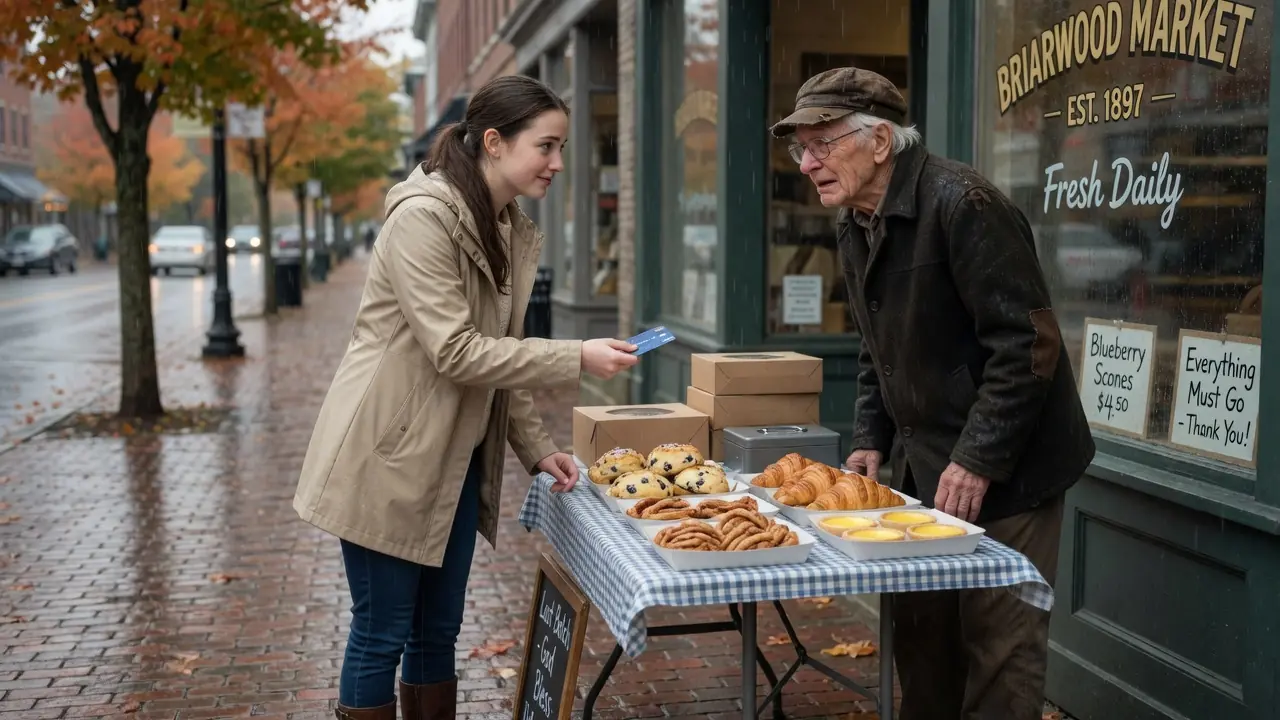
She knew who needed an extra roll, who had no breakfast, who was having a hard day.” He smiled faintly. “She said feeding people was a way of listening.”
Sophie felt the sentence settle deep inside her.
“Feeding people was a way of listening,” she repeated.
George nodded.
“She had a lot of sayings. Too many, maybe.”
“No,” Sophie said softly. “Not too many.”
After that, George began visiting the arts center once a week.
At first, he brought scones.
Then apple turnovers.
Then cinnamon rolls.
Some were excellent.
Some were not.
George always wanted honest feedback.
“Too dry?” he would ask.
“A little.”
“Anna would say that means I lost focus.”
“Did you?”
“I was watching the neighbor’s cat judge me through the window.”
“Reasonable distraction.”
Over time, Sophie learned more about him.
George had worked as a mail carrier for forty years. He knew every street in Briarwood. He had delivered birthday cards, bills, wedding invitations, medical letters, postcards, and once a live chicken by mistake.
Anna had been the baker in the family.
She baked for birthdays, sick neighbors, school events, funerals, graduations, welcome-home dinners, and anyone who looked as if they needed a reason to sit down.
When she died, George stopped baking.
The kitchen felt too quiet.
The measuring cups looked accusing.
The recipes were written in Anna’s handwriting, and for months he could not bear to touch them.
Emily’s birthday had forced him to try.
Sophie’s kindness had helped him try again.
One afternoon, George brought a small blue notebook tied with ribbon.
He placed it on the table between them.
“This was Anna’s recipe notebook,” he said.
Sophie looked at it carefully.
The cover was worn at the corners. A small flour stain marked the front. The ribbon had faded from bright blue to gray-blue.
“I can’t take that,” Sophie said immediately.
George smiled.
“I haven’t offered it yet.”
“I know where this is going.”
“You are young. You cannot know everything.”
“I know I can’t take Anna’s notebook.”
George untied the ribbon.
“I’m not giving it to you. Not today. I want to show you something.”
He opened to the first page.
Anna’s handwriting was neat but lively.
Blueberry Scones — for rainy mornings and stubborn men.
Sophie smiled.
George turned the pages.
Lemon Tea Cake — bake when someone says they do not want a fuss.
Apple Turnovers — good for apologies.
Cinnamon Rolls — do not rush the second rise, no matter what George says.
Sophie laughed.
“She mentioned you often.”
“She had concerns about my patience.”
The notebook was full of recipes, notes, jokes, and names.
Mrs. Clark likes less sugar.
For Emily when she is old enough to help.
If making for children, add glaze. Children forgive many things if glaze is involved.
George watched Sophie read.
“She wanted to teach classes after she retired,” he said softly.
“Baking classes?”
“Yes. Not fancy ones. Just family recipes. She said young people were losing recipes because everyone thought memory could live on the internet.” He looked around the arts center. “She would have liked a place like this.”
Sophie grew still.
The Shared Kitchen.
Her dream.
Her notebook.
Her idea suddenly seemed less imaginary.
“I’ve wanted to start something like that,” she admitted.
George looked up.
“What do you mean?”
Sophie hesitated, then opened her own notebook.
She showed him the pages.
The Shared Kitchen.
Elderly residents teaching family recipes.
Children learning to bake.
Young parents learning affordable meals.
Memory recipe cards.
Community meals.
Workshops where food and stories belonged together.
George read every line slowly.
When he finished, his eyes were wet.
“Anna wrote this through you.”
Sophie shook her head.
“No. I wrote it before I met you.”
“Exactly,” George said. “That is how I know it matters.”
With George’s encouragement, Sophie spoke to the arts center director, Marlene, about starting one small baking workshop.
Marlene was cautious.
“We don’t have a full kitchen.”
“We have the demonstration room,” Sophie said. “There’s an oven, a prep counter, and a sink.”
“We’d need food safety forms.”
“I’ll handle them.”
“We’d need an instructor.”
Sophie looked toward the lobby, where George was waiting with a box of scones.
“I have one.”
The first workshop was called Family Baking Day: Blueberry Scones With George.
George almost refused when he saw his name on the flyer.
“I am not an instructor.”
“You are a man with a recipe and strong opinions about butter.”
“That does not make me qualified.”
“It makes you perfect.”
The class filled in three days.
Twelve people came: four children, two teenagers, three seniors, a young mother, and two widowers who claimed they had only signed up because “scones sounded decent.”
George stood at the front of the demonstration room wearing one of Anna’s aprons. It was yellow with tiny blue flowers. He looked deeply uncomfortable until Emily, his granddaughter, tied the strings behind him and said, “Grandma would laugh.”
George relaxed.
Then he began.
He taught them how to measure flour by spooning it lightly into the cup. He showed them how cold butter should be cut into small cubes. He explained that dough did not like being bullied. He told them Anna always said blueberries should be folded in like secrets.
The children loved that.
“Like secrets?” one little boy asked.
George nodded seriously.
“If you smash them, everyone knows too soon.”
The first batch came out uneven.
The second batch came out better.
By the end of the class, the room smelled of butter, blueberries, sugar, and something deeper.
Memory.
People sat together eating warm scones from paper plates while George told stories about Anna. A widower named Mr. Lewis said he had not baked since his wife died. A teenager asked if George could teach cinnamon rolls next. Emily proudly told everyone her grandmother invented “volcano rocks,” which George firmly denied.
Sophie stood near the back of the room and watched.
This was it.
The thing she had dreamed of.
Not perfect.
Not polished.
But alive.
The Shared Kitchen became a monthly program.
Then twice monthly.
Each session featured a different elder and a family recipe.
Mrs. Alvarez taught tamales.
Mr. Jenkins taught chicken stew.
Mrs. Parker taught peach cobbler.
A retired nurse taught simple vegetable soup.
George taught blueberry scones, apple turnovers, and eventually cinnamon rolls once he learned not to rush the second rise.
The classes brought people together in a way Sophie had never seen at the arts center before.
Children listened to seniors.
Seniors laughed with teenagers.
Widowers learned to cook for one.
Young parents learned recipes that did not cost much.
People brought stories, not just ingredients.
Sophie began creating printed recipe cards for each workshop, with the recipe on one side and the family story on the other.
The program became known around town.
People stopped Sophie at the market.
“My mother wants to teach biscuits.”
“My grandfather makes the best bean soup.”
“My aunt has a cake recipe from 1948.”
“My father says he can’t teach, but he absolutely can.”
Sophie started keeping a waiting list.
One afternoon, George brought her an envelope.
“I wrote something,” he said.
Sophie smiled.
“A recipe?”
“A letter.”
It was a recommendation letter for a community heritage grant that Sophie had mentioned once and then dismissed because she thought the program was too small.
George disagreed.
In the letter, he told the story of the rainy afternoon at Briarwood Market, the leftover pastries, Emily’s birthday, Anna’s recipes, and the first baking class.
At the end, he wrote:
Sophie Miller understands that recipes are not only about food. They are memory made useful. She helps people feed one another without letting their stories disappear.
Sophie cried in the arts center office.
With George’s letter, workshop photos, attendance records, recipe cards, and Marlene’s support, Sophie applied for the grant.
She won.
Not a fortune.
Not a building.
Not anything grand.
But enough to buy mixing bowls, baking trays, portable burners, safety supplies, printed recipe binders, aprons, ingredients, and recording equipment to preserve the elders’ stories.
The Shared Kitchen became an official arts center program.
Sophie became its coordinator.
For the first time, she had a title that matched her dream.
George became the program’s first honorary instructor.
His name tag read:
George Whitman
Scone Specialist
Emily designed it.
He wore it proudly, though he claimed it was “too official for a man who once burned breakfast into geology.”
Years passed.
The Shared Kitchen grew beyond Briarwood.
Other community centers called Sophie to ask how they could start their own recipe-story workshops. Sophie trained volunteers, built recipe archives, recorded elders telling food memories, and created intergenerational cooking days across the county.
She never became rich.
But she built something that mattered.
George kept teaching as long as his hands allowed. When standing for long periods became hard, Sophie gave him a stool at the front of the room. When reading small handwriting became difficult, she printed Anna’s recipes in large type. When he forgot a step, Emily helped him.
No one made him feel embarrassed.
The kitchen had room for every version of him.
One winter afternoon, George came to the arts center carrying the blue notebook tied with ribbon.
Sophie knew immediately.
“No,” she said softly.
George smiled.
“You haven’t heard me yet.”
“I already know.”
“I am old. Let me make speeches.”
Sophie sat down.
George placed Anna’s recipe notebook in front of her.
“Emily has copies,” he said. “Laura has copies. I have copies. But this original should live where Anna’s dream finally found a room.”
Sophie’s eyes filled.
“George, this belongs to your family.”
“You are part of why my family remembers how to use it.”
“I only bought pastries.”
“No,” George said gently. “You saw an old man trying not to fall apart over a tray of discounted scones, and you chose not to look away.”
Sophie covered her mouth.
George pushed the notebook toward her.
“Anna wanted these recipes shared. You made that happen.”
The notebook became the heart of The Shared Kitchen archive.
It was kept in a glass-front cabinet in the demonstration room, not as a museum piece, but as a reminder. Beside it was a photograph of Anna in her yellow apron, smiling in a kitchen dusted with flour.
Under the photograph, Sophie placed a line from Anna’s notes:
Love should leave flour on the counter.
George passed away peacefully three years later, just after Emily’s tenth birthday.
At his memorial gathering, held at the arts center because he had asked for “scones, coffee, and no gloomy folding chairs,” the demonstration room filled with people who had learned from him.
Children brought handwritten thank-you notes.
Seniors brought recipes.
Emily brought blueberry scones, made from Anna’s recipe, almost perfect except for one slightly burned edge that George would have called “character.”
Sophie stood near the recipe cabinet, holding back tears.
Laura, George’s daughter, handed her a final envelope.
“Dad wanted you to have this.”
Inside was a note in George’s careful handwriting.
Dear Sophie,
The day we met, I thought I had failed Anna because I could not even bring enough pastries to our granddaughter’s birthday.
You did not let shame have the last word.
You bought the tray.
You walked me home.
You helped me bake again.
Then you gave Anna’s recipes a room full of voices.
Keep teaching people that food is memory with a place at the table.
With gratitude,
George Whitman
Sophie framed the note beside Anna’s recipe notebook.
Years later, whenever people asked how The Shared Kitchen began, she told them the truth.
“It began with an old man at a grocery store bakery counter, counting coins for his granddaughter’s birthday pastries.”
Then she would show them Anna’s notebook.
The gift was small.
A recipe book.
A letter.
A tray of pastries that almost did not make it to a seven-year-old girl’s table.
But inside those small things was the future Sophie had been trying to build.
And every time a child folded blueberries into dough, every time an old woman corrected someone’s soup seasoning, every time a widower learned to bake again after grief had made the kitchen too quiet, Sophie remembered George standing in the rain with pastry boxes in his hands.
Kindness did not always arrive as something grand.
Sometimes it arrived as twelve leftover pastries.
Sometimes it arrived as a recipe written in flour-stained ink.
Sometimes it arrived as a young woman who saw embarrassment at a bakery counter and decided to make sure love had enough to share.