At twenty-four, Emma Parker had learned that a bicycle could carry more than a person.
It could carry groceries.
It could carry flowers.
It could carry library books, medicine, birthday gifts, and little paper bags of peaches from the farmer’s market.
It could carry pride.
It could carry independence.
It could carry the last quiet proof that an old woman still knew how to move through the world on her own.
Emma understood that better than most people her age.
She had grown up in a small town in Michigan called Briar Glen, where bicycles leaned against porch rails, children rode through quiet neighborhoods after school, and elderly people still used old bikes to reach the grocery store, post office, pharmacy, and church basement dinners.
Her father had owned a bicycle repair shop for almost thirty years.
It was called Parker’s Wheels, a narrow little shop on Maple Street with grease-stained floors, hanging tires, metal shelves full of tools, and a front window crowded with repaired bikes waiting for pickup.
Emma had spent most of her childhood there.
She learned to patch tubes before she learned to drive.
She learned the difference between a loose chain and a worn chain by sound.
She learned how to adjust brakes, tighten spokes, clean gears, replace cables, and calm down customers who thought their bicycle was ruined when it only needed patience and a wrench.
Her father used to say, “A bike is honest. If something is wrong, it tells you. You just have to listen before it breaks.”
Emma had carried that sentence into adulthood.
Now she worked at the same shop part-time while taking night classes in community development.
Her father had retired after his knees got bad, but the new owner, Mr. Langley, kept her on because he said she had “mechanic hands and social worker eyes.”
Emma did not know exactly what that meant.
But she liked it.
She was a young white American woman with fair skin, long chestnut-brown hair usually tied into a low ponytail, soft hazel eyes, and careful hands that were almost always marked with tiny scratches, chain grease, or dust from old tires.
Most customers trusted her after five minutes.
Some did not.
Some men still walked into the shop, looked past her, and asked if “the bike guy” was around.
Emma would smile, wipe her hands on a rag, and say, “Tell me what’s broken.”
By the time she finished fixing the problem, they usually stopped looking over her shoulder.
Emma loved bicycles because they made movement feel human.
A car sealed people away.
A bicycle left them exposed to wind, weather, effort, and balance.
It required the rider to participate.
It gave freedom without hiding the cost of it.
Her dream was to start a program called Second Ride.
It would repair donated bicycles and give them to people who needed transportation but could not afford reliable options.
Seniors who no longer drove but could still ride short distances.
Teenagers who needed to get to after-school jobs.
Workers without cars.
Single mothers who needed a grocery bike with a basket.
Elderly widows who wanted to ride to the library without asking their children for every errand.
Second Ride would also offer free safety check days: brakes, tires, lights, baskets, reflectors, and basic maintenance lessons.
Emma imagined a back room full of old bicycles being cleaned, repaired, and returned to life.
But dreams needed money.
Parts.
Storage space.
Insurance.
Volunteers.
Permission from Mr. Langley.
A truck for pickups.
Helmets.
Locks.
Time.
Emma only had a notebook full of ideas, a set of tools from her father, and a stubborn belief that transportation should not be a privilege.
So she kept fixing bicycles one at a time.
The afternoon that changed everything came in late April.
It had rained that morning, leaving the streets shiny and clean, but by three o’clock the clouds had broken apart and sunlight came through in pale strips.
The sidewalks were still damp.
Small puddles sat near the curbs.
The air smelled like wet pavement, spring leaves, and bread from the bakery two doors down.
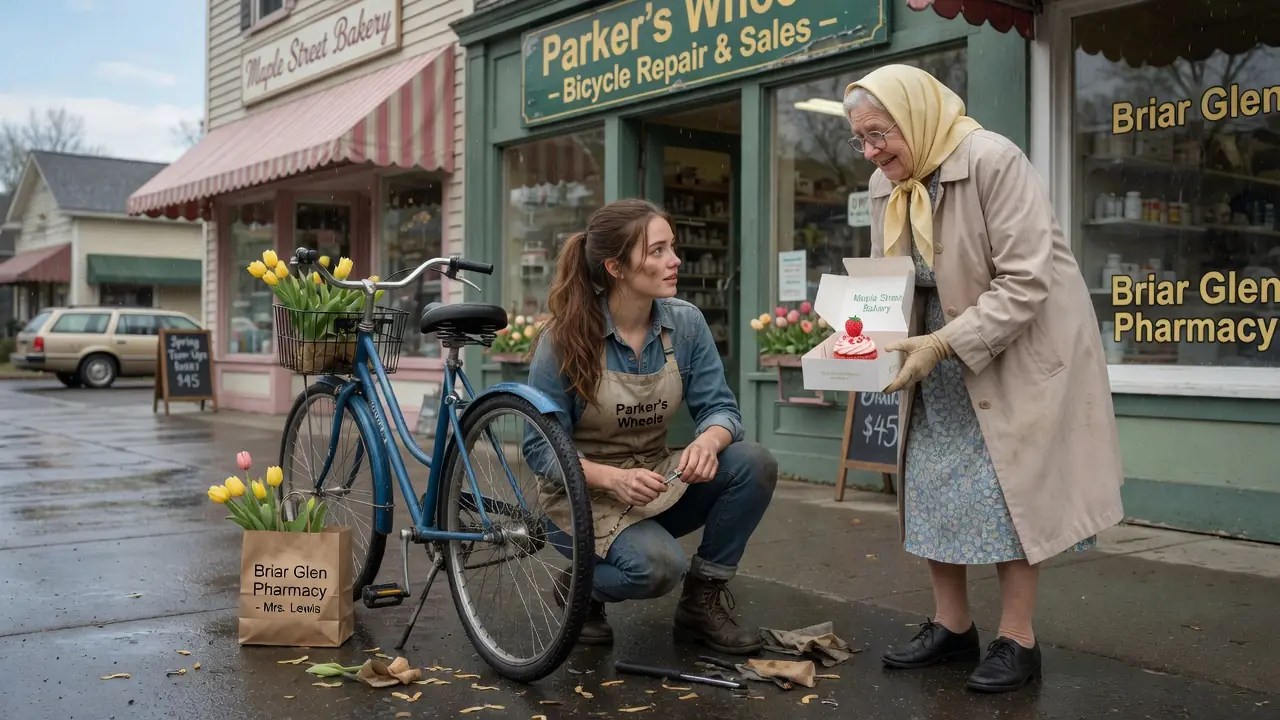
Emma was outside Parker’s Wheels, tightening the rack on a red commuter bike, when she heard a sharp metallic snap from the corner near the pharmacy.
Then an elderly woman cried out.
“Oh no. Please, not now.”
Emma looked up.
Across the street, near the crosswalk, an old blue bicycle had jerked sideways and stopped at an awkward angle.
Beside it stood an elderly woman, gripping the handlebars with both hands.
She was a white American woman in her late seventies, short and thin, with silver hair tucked beneath a pale yellow scarf, pale skin, and bright blue eyes behind round glasses.
She wore a light beige coat, a blue floral dress, black shoes, and thin gloves.
The bicycle had a front basket tied with faded ribbon.
In that basket sat a small white bakery box, a brown paper pharmacy bag, and a bundle of yellow tulips wrapped in paper.
The chain had slipped off and jammed near the rear gears.
The back tire looked soft.
The right brake cable hung loose.
The front basket had tilted forward so far that the tulips nearly slid out.
But the old woman was not looking at the chain.
She was looking at the bakery box.
The lid had popped open.
Inside, Emma could see a small strawberry cupcake with pink frosting, still safe but dangerously close to the wet edge of the basket.
Emma dropped her wrench and ran.
“Ma’am, don’t move the bike. I’ll help.”
The woman turned toward her, startled.
“Oh, dear, I’m sorry. I’m in the way.”
“You’re not in the way,” Emma said. “Are you hurt?”
“No. I don’t think so.”
“Did you fall?”
“No. It stopped suddenly, and I managed to step off.”
“That’s good.”
Emma moved to the basket first and carefully lifted the bakery box to safety.
The old woman let out a shaky breath.
“Thank you. That cupcake is important.”
“I figured.”
Emma placed it on the dry windowsill of the pharmacy, then rescued the tulips and pharmacy bag.
The old woman touched her chest.
“I thought it would spill.”
“Cupcake survived.”
“Thank heavens.”
Emma crouched beside the bicycle.
“What’s your name?”
“Margaret Lewis.”
“I’m Emma Parker. I work at the bike shop right there.”
Margaret looked across the street at the shop.
“You fix bicycles?”
“Yes.”
Margaret’s relief was immediate, but she tried to hide it behind politeness.
“Oh, that is very fortunate. I usually know how to put a chain back, but this one looks stuck.”
Emma inspected the rear gears.
“It’s wedged pretty tightly.”
“I heard a clank, and then the pedal locked.”
“That makes sense. Your derailleur is bent inward. The chain slipped, twisted, and got trapped between the gear and the frame.”
Margaret looked at her blankly.
Emma smiled.
“Translation: the bike got stubborn.”
Margaret gave a small laugh.
“That sounds more understandable.”
Emma checked the brakes.
The front brake worked.
The rear brake was dangerously loose.
She squeezed the back tire.
Almost flat.
This was not a bicycle that should have been on the road, especially with an elderly rider carrying fragile cargo.
But Emma knew better than to say that harshly.
People did not keep riding unsafe bikes because they were careless.
Sometimes they kept riding because it was all they had.
“Were you headed far?” Emma asked.
“Only to my granddaughter’s school.”
“With the cupcake?”
Margaret nodded.
“Today is Lily’s birthday. She is nine. Her mother had to work late at the hospital, so I promised I would bring a cupcake and flowers before her little classroom party ended.”
She looked toward the street.
“The school is only six blocks away.”
Emma checked her watch.
3:12 p.m.
“What time is the party?”
“Three-thirty.”
Emma looked at the bicycle again.
The chain needed freeing.
The brake needed a temporary adjustment.
The tire needed air.
The basket needed tightening.
The derailleur needed careful alignment later.
They had eighteen minutes.
“We can get you there,” Emma said.
Margaret stared at her.
“You can fix it that quickly?”
“Enough to roll safely for six blocks. Full repair later.”
“Oh, I couldn’t ask—”
“You didn’t. The bike asked by making that sound.”
Margaret looked at the old bicycle.
Then she looked back at Emma.
“My husband used to say the same thing.”
“What was his name?”
“Arthur.”
The name softened her whole face.
“He bought this bicycle for me in 1978. Secondhand, but he polished it until I thought it was new. He said a woman should have her own wheels.”
Emma felt something in her chest shift.
Her father would have liked Arthur.
Margaret touched the handlebar gently.
“I rode it to work, to the library, to the grocery store, to every school event when my daughter was little. After Arthur died, I kept riding because walking felt too slow and driving felt too lonely.”
Emma looked at the old blue bicycle again.
Not just a bike.
A marriage.
A routine.
A way of staying herself.
“Then we’ll treat it properly,” Emma said.
She ran back across the street, grabbed her portable repair kit and floor pump, then returned to the corner.
Margaret stood beside the bike, guarding the cupcake and tulips like a soldier protecting treasure.
Emma put on gloves and began.
First, she freed the chain.
It took patience.
The chain was greasy, stiff, and wedged at an angle that could easily bend the gear teeth if pulled too hard.
Emma lifted the rear wheel slightly, rotated the pedal backward by hand, and used a small screwdriver to guide the chain out of the trapped space.
Margaret watched anxiously.
“Is it broken?”
“Not broken. Dirty and badly behaved.”
Margaret smiled despite herself.
“Arthur would say that about our old washing machine.”
The chain came free with a metallic click.
Emma checked each link.
No full break.
Good.
Then she shifted the chain back onto the correct gear and adjusted the derailleur enough to keep it from falling inward again.
“Temporary,” Emma said. “It still needs real alignment at the shop.”
Margaret nodded seriously.
“Temporary but respectful.”
“Exactly.”
Next, Emma tightened the rear brake cable.
The cable was frayed near the clamp, which meant it needed replacing soon, but she could make it hold long enough for slow riding.
She adjusted the brake pads and tested them.
Better.
Not perfect.
Safe for gentle riding.
Then she pumped the rear tire.
The tube held air, which was a relief.
The valve cap was missing.
Emma added one from her kit.
Finally, she tightened the basket bracket.
One screw was almost gone.
She replaced it with a spare bolt and added a small washer.
The basket straightened.
The tulips, pharmacy bag, and cupcake box could ride again without tipping forward.
Margaret looked at Emma’s hands with open wonder.
“You carry all that?”
“Most of it.”
“In that little bag?”
“Yes.”
“You are like a traveling hospital for bicycles.”
Emma laughed.
“That may be the best compliment I’ve ever received.”
Margaret looked at the bike.
“Can it go?”
“It can go slowly. No fast pedaling. No hard turns. No hills if possible. And after the party, it comes to the shop.”
Margaret looked down at her shoes.
“I don’t know what a full repair will cost.”
Emma heard the fear behind the sentence.
“We’ll inspect it first. Safety repairs in stages. We’ll figure it out.”
“I don’t want charity.”
“I didn’t offer charity.”
Margaret looked at her.
Emma said, “I offered a plan.”
The old woman’s shoulders relaxed slightly.
“A plan is easier to accept.”
“I know.”
Margaret reached for the handlebars.
Emma stopped her gently.
“I’m walking with you.”
“Oh no, dear. You’ve done enough.”
“You have a repaired-but-temporary chain, one weak brake, an important cupcake, and damp sidewalks. I’m walking with you.”
Margaret blinked.
Then she laughed.
“You argue like my daughter.”
“Your daughter sounds practical.”
“She is terrifyingly practical.”
“Then she would approve.”
Margaret smiled.
“She would.”
Emma placed the cupcake box back into the basket, tucked the tulips beside it, and secured the pharmacy bag with a clean cloth strap from her kit.
Margaret mounted the bicycle carefully.
Emma walked beside her on the sidewalk, one hand near the basket whenever they crossed rough pavement.
They moved slowly through Briar Glen.
The old blue bicycle creaked faintly, but it rolled.
Margaret sat upright, careful and proud.
The pale yellow scarf beneath her chin fluttered slightly in the spring air.
As they went, she told Emma stories.
Arthur teaching her to ride with no hands even though she had not asked to learn.
Arthur tying a picnic basket to the handlebars on their first anniversary.
Arthur claiming the bicycle bell sounded “too polite” and replacing it with one that rang clear enough to be heard across a street.
Emma looked at the bell on the handlebar.
It was small and brass, scratched and worn, with a tiny painted daisy on top.
“That’s the original bell?”
“Yes,” Margaret said. “Arthur said kindness should announce itself.”
Emma smiled.
“That is a beautiful sentence.”
“He had a few.”
The school came into view at 3:27.
A low brick elementary building with a flagpole, a small playground, and a row of parents’ cars near the front.
Margaret’s face filled with relief.
But as they approached the gate, the bicycle chain clicked sharply again.
Emma reacted quickly.
“Stop pedaling.”
Margaret stopped.
The chain held.
Barely.
Emma crouched and checked it.
“It’s all right. We made it.”
The front door opened, and a little girl ran out with a paper crown on her head.
“Grandma!”
Margaret’s whole face changed.
“Lily.”
The girl was nine years old, with light brown hair in two messy braids, bright blue eyes, and a pink sweater covered in tiny hearts.
She ran toward them but slowed when she saw the bicycle.
“Grandma, did your bike break?”
“It had a disagreement with the chain,” Margaret said.
Emma smiled.
Lily looked at Emma.
“Did you fix it?”
“Enough to protect the cupcake.”
Lily gasped.
“The cupcake?”
Margaret lifted the bakery box from the basket and opened it.
The strawberry cupcake sat inside, slightly tilted but safe.
Pink frosting.
One little sugar flower.
Lily clasped her hands.
“You brought it.”
“I promised.”
“And tulips!”
“Yes.”
Lily hugged Margaret carefully around the waist.
Margaret closed her eyes for one second.
That one second told Emma everything.
The ride had mattered.
The cupcake had mattered.
The bicycle had mattered.
A young woman came through the school door behind Lily.
She looked to be in her late thirties, with dark blonde hair pulled into a hospital-worker bun, tired blue eyes, and a lunch break ID badge still clipped to her jacket.
She was breathing hard, as if she had hurried there from work.
“Mom,” she said, worry sharpening her voice. “You rode the bike?”
Margaret straightened.
“Hello, Claire.”
Claire looked at the bicycle, the repair kit in Emma’s hand, and her mother’s flushed face.
“What happened?”
“The chain jammed near the pharmacy,” Emma said gently. “I fixed it enough to get her here, but it needs proper repair before she rides again.”
Claire closed her eyes briefly.
“Mom.”
“I was careful.”
“You were lucky.”
“I was helped,” Margaret corrected.
Claire turned to Emma.
“Thank you. I mean it.”
“You’re welcome.”
Claire looked back at the bike.
“I told her I could pick up the cupcake after work.”
Margaret lifted her chin.
“You were working. Lily asked for my bakery cupcake.”
Lily hugged the cupcake box.
“It’s Grandma’s special place.”
Claire’s face softened.
“I know.”
Margaret touched the bicycle handle.
“Arthur’s bike got me here.”
Claire looked at her mother.
Then at the old blue bicycle.
Something passed between them.
Not argument.
History.
Claire sighed.
“Okay. But the bike gets fixed properly.”
Emma nodded.
“I can take it to the shop now if you want. She can bring it after the party, or I can walk it back.”
Margaret immediately protested.
“Oh no, I can bring it.”
Claire and Emma both looked at her.
Margaret paused.
“Apparently not.”
Lily giggled.
Claire smiled despite herself.
They all went inside for a few minutes because Lily insisted Emma had to see the classroom decorations.
Emma tried to decline, but Margaret said, “You are already in the story.”
So Emma followed.
The classroom smelled like crayons, paper, frosting, and cleaning spray.
Children sat at little desks with construction-paper crowns.
The teacher placed the cupcake in front of Lily with a candle.
The whole class sang.
Margaret stood near the back, holding the tulips, tears shining in her eyes.
Claire stood beside her.
Emma stayed near the doorway, trying not to intrude.
When Lily blew out the candle, she looked toward her grandmother first.
That was the moment Emma understood why Margaret had ridden the bike.
Not because she was reckless.
Not because she refused help.
Because some promises were too important to trust to convenience.
After the party, Claire drove Margaret home, and Emma walked the old blue bicycle back to Parker’s Wheels.
The bike felt heavy with history.
Every scratch seemed earned.
The seat was worn but polished by years of use.
The grips had softened with age.
The brass bell gave a clear, sweet ring when Emma accidentally brushed it.
Mr. Langley looked up when Emma rolled it into the shop.
“New patient?”
“Important patient.”
He stepped closer.
“Old Schwinn?”
“Yes. Late seventies, maybe.”
“Needs everything?”
“Almost.”
He inspected it.
“Brake cables. Chain cleaning, maybe replacement. Derailleur alignment. Tire check. Basket bracket. Probably bearings soon.”
Emma nodded.
“Can we do a senior safety discount?”
Mr. Langley looked at her.
“Is this for your imaginary program?”
“It’s not imaginary.”
“It does not officially exist.”
“Yet.”
He sighed.
“How much can she pay?”
“I don’t know.”
“Then inspect first. Estimate honestly. We’ll figure out labor.”
Emma smiled.
“Thank you.”
“I am not agreeing to a program.”
“I didn’t say you were.”
“You are thinking it.”
“I think many things.”
He pointed at the bike.
“Fix the brakes first.”
Margaret came to the shop the next morning with Claire.
Lily was at school.
Margaret held her purse in both hands and looked nervous.
The old blue bicycle was on the repair stand.
Emma had already removed the rear brake cable.
The chain sat in a parts tray, soaking in cleaner.
The basket leaned on the workbench.
Margaret looked at the bike and seemed suddenly emotional.
“It looks like surgery.”
Emma smiled.
“Very minor surgery.”
Claire stood beside her mother.
“Tell us the damage.”
Emma explained carefully.
Rear brake cable replacement.
Front brake adjustment.
Chain cleaning.
Derailleur alignment.
Rear tube check.
Basket reinforcement.
General safety check.
Margaret’s face tightened as Emma spoke.
“How much?”
Emma gave the lowest fair total possible.
Margaret looked down.
Claire immediately said, “I’ll pay.”
Margaret’s face changed.
“No.”
“Mom.”
“No. This is my bicycle.”
“And you nearly got stranded yesterday.”
“I will pay.”
Claire opened her mouth, then stopped.
Emma saw the tension.
This was not about money only.
It was about independence.
She said, “We can split the repair into stages. Safety first. Rear brake, alignment, tire, basket. Later, we can talk about the chain and bearings if needed.”
Margaret looked relieved.
Claire looked frustrated but tried to understand.
Emma added, “Also, we sometimes use donated parts when available. I have a good used brake cable housing and a spare basket bracket. That lowers cost without lowering safety.”
Margaret looked at her.
“That is not charity?”
“No. That is practical repair.”
Claire smiled faintly.
“She renamed help again.”
Margaret glanced at her daughter.
“Apparently that is a skill.”
Emma completed the repair over the next two days.
She cleaned the chain link by link.
She replaced the rear brake cable.
She adjusted both brakes until they responded smoothly.
She straightened the derailleur hanger enough for safe shifting.
She patched a tiny puncture in the rear tube.
She reinforced the basket bracket with a stronger mount.
She polished the brass bell last.
When Margaret returned, the bicycle stood outside the shop in the morning sun.
The blue frame looked brighter.
The basket sat straight.
The bell shone softly.
Margaret stopped on the sidewalk.
For a moment, she did not speak.
Claire stood beside her quietly.
Emma rolled the bike forward.
“She’s ready.”
Margaret touched the handlebar.
“You made her look like herself again.”
“She had a lot of herself left.”
Margaret’s eyes filled.
“My husband would have liked you.”
“I would have liked him.”
“He believed old things deserved maintenance, not pity.”
Emma smiled.
“That sounds like a bike mechanic’s philosophy.”
“It was also marriage advice.”
Claire laughed.
Margaret paid the repair cost in cash.
Emma accepted it respectfully.
Then she added a small laminated card to the bike basket.
It listed repair dates, tire pressure, brake check reminders, and Parker’s Wheels phone number.
Margaret read it.
“This is helpful.”
“It’s a bike health card.”
Margaret smiled.
“Arthur would say the bike has better records than he did.”
After that, Margaret became a regular at Parker’s Wheels.
Every month, she rode the blue bicycle to the shop for a quick check.
Sometimes nothing was wrong.
Sometimes something was.
A loose bolt.
A soft tire.
A squeaky brake.
A basket screw that needed tightening.
Emma never made her feel foolish for asking.
Margaret always brought something.
Tulips once.
Muffins once.
A jar of peach jam.
A photograph of Arthur standing beside the bicycle in 1978, looking proud and slightly too young.
Emma pinned a copy of that photograph above her workbench.
The picture showed Arthur with one hand on the handlebars and Margaret beside him, laughing.
On the back, Margaret had written:
Arthur and my first true wheels.
Emma loved that.
Margaret also began telling stories while Emma worked.
How she rode the bike to her first job at the library.
How she carried Claire in a child seat when Claire was small.
How Arthur added the basket after Margaret complained she could not carry enough books.
How he replaced the bell because he said the original sounded “like a mouse apologizing.”
How they used to ride to the lake on Sundays with sandwiches wrapped in wax paper.
Emma wrote some of the stories down in her notebook during breaks.
Margaret noticed one day.
“What are you always writing?”
“Just ideas.”
“At my age, just ideas usually means a future trying to look harmless.”
Emma laughed.
“That is very accurate.”
“Let me see.”
Emma hesitated.
Then she opened the notebook to Second Ride.
Margaret read slowly.
Donated bicycle repairs.
Senior mobility checks.
Free safety inspections.
Baskets for grocery bikes.
Lights and reflectors.
Transportation for people without cars.
Youth mechanic workshops.
Community bike library.
Margaret turned the page.
Then another.
Finally, she looked up.
“This is not just about bicycles.”
Emma felt suddenly exposed.
“No?”
“No. It is about people not getting trapped.”
Emma swallowed.
“Yes.”
Margaret touched the page with the words Senior Safety Ride Day.
“You should do this.”
“I don’t have funding.”
“Start small.”
“I don’t have space.”
“You have a sidewalk.”
“I need permission.”
“Ask.”
“I need parts.”
“Ask people for their old bikes.”
Emma smiled.
“You make it sound simple.”
“No,” Margaret said. “I make it sound possible. Different thing.”
Those words stayed with Emma.
A week later, Margaret returned with three old bicycle baskets in the trunk of Claire’s car.
“Arthur collected things,” she said.
Claire muttered, “That is one way to describe the garage.”
Margaret ignored her.
“These baskets can help your program.”
“The program doesn’t exist yet.”
Margaret looked at her over her glasses.
“Then call them encouragement baskets.”
The next week, she brought a used bike from her neighbor.
Then another.
Then a box of reflectors.
Then a list of seniors who owned bikes but had not ridden in years because the tires were flat or the brakes felt unsafe.
Emma realized Margaret was not encouraging the program.
She was starting it.
Mr. Langley watched the donated bikes pile up near the back wall.
“No,” he said one morning.
Emma looked up.
“I didn’t say anything.”
“You were about to.”
“We could host one free safety check morning.”
“No.”
“Just one.”
“No.”
“For seniors only. Brakes, tires, chains, baskets. No major free repairs unless we approve.”
“No.”
“Margaret already told people.”
Mr. Langley froze.
“She what?”
Emma winced.
“She may have mentioned it at the senior center.”
Mr. Langley rubbed his forehead.
“How many people?”
“Unclear.”
“That means many.”
“Probably.”
He sighed so deeply the hanging tires seemed to move.
“One morning.”
Emma smiled.
“One morning.”
“No promises beyond that.”
“Of course.”
“You are smiling like there will be promises.”
“I smile naturally.”
“You do not.”
The first Second Ride Safety Morning happened on a Saturday in June.
Emma put a sign outside Parker’s Wheels.
Senior Bicycle Safety Check
Brakes, Tires, Chains, Baskets, Bells
No Shame. No Rush. Ask Questions.
Margaret arrived first on the blue bicycle, wearing a pale yellow scarf and a name tag she had made herself.
Margaret Lewis.
Bell Consultant.
Emma stared at it.
“Bell Consultant?”
Margaret lifted her chin.
“A bicycle bell is a matter of public courtesy.”
“I can’t argue with that.”
“Good.”
By nine o’clock, six seniors had arrived.
By ten, twelve.
By noon, twenty-one.
There were old bikes with flat tires, rusty chains, loose brakes, crooked seats, cracked grips, bent baskets, missing reflectors, and bells that either screamed or whispered.
Emma worked nonstop.
Mr. Langley pretended to be annoyed but fixed three brake systems himself.
Claire helped check people in.
Lily handed out lemonade and stickers that said My Bike Got A Checkup.
Margaret stood near the bell test station, ringing each bell and making judgments.
“Too weak.”
“Too rude.”
“Acceptable.”
“Excellent. Clear but not aggressive.”
People laughed.
But they listened.
The day revealed something Emma had suspected.
Many older people had stopped riding not because they no longer wanted to ride, but because their bicycles no longer felt safe and they did not know how to ask for help.
One man said he had not ridden to the library in three years because his brakes squealed.
A widow said she missed riding to the garden center.
A retired teacher said she wanted to ride with her grandson but was afraid her tires would fail.
Emma saw how small repairs could reopen parts of people’s lives.
Second Ride became real that day.
Not official.
Not funded.
But real.
They held another safety morning the next month.
Then another.
Donated bikes began arriving.
Some were too broken.
Some needed only tires.
Some could be rebuilt.
Emma started staying late on Thursdays to repair bikes for people who needed transportation.
A college student received a refurbished commuter bike.
A grocery worker received a bike with a rear rack.
A retired man received a three-speed with upright handlebars.
A single mother received a bicycle with a front basket and child seat.
Margaret called every bike “another set of wheels returned to the world.”
Emma wrote that down.
With Margaret’s encouragement, Emma applied for a small community mobility grant.
She included repair records, safety check numbers, photos of refurbished bikes, letters from recipients, and a statement from Margaret.
Margaret’s letter told the story of the broken chain, Lily’s birthday cupcake, Arthur’s old bicycle, and the program that grew from one sidewalk repair.
At the end, she wrote:
Emma Parker understands that a bicycle is not only a machine. For many people, it is independence, memory, transportation, and the courage to keep moving through the world. She repairs wheels without damaging pride.
Emma cried after reading it.
Mr. Langley read it too.
Then he cleared his throat and said, “Good letter.”
That was his version of weeping.
The grant was approved in early autumn.
It was not a fortune.
Not enough for a building.
Not enough for paid staff.
But enough to buy repair stands, tubes, brake cables, chains, helmets, lights, locks, baskets, reflectors, and storage racks.
Second Ride became official.
Emma became the program coordinator while still working at Parker’s Wheels.
Mr. Langley pretended the title meant nothing but printed it on her name tag anyway.
Emma Parker.
Mechanic / Second Ride Coordinator.
Margaret said the slash made it look important.
The program grew through the next year.
Free senior safety checks.
Donated bike rebuild days.
Youth mechanic workshops.
Low-cost repair vouchers.
Grocery baskets for seniors.
Bike lights for workers riding after dark.
Emma trained volunteers to treat every bike with respect.
Even rusty ones.
Especially rusty ones.
“People bring us bikes after they have already felt embarrassed,” she told them. “Do not make the embarrassment worse.”
Margaret attended most events.
Her health changed with the seasons.
Some days she rode the blue bicycle to the shop herself.
Some days Claire drove her.
Some days she sat in a folding chair and supervised bell testing like a queen overseeing court.
Lily grew older and began helping too.
She liked decorating donated baskets with reflective stickers.
She also insisted that every child’s refurbished bike needed a bell because “quiet bikes are suspicious.”
Margaret said this proved the family wisdom continued.
One spring afternoon, Margaret came to the shop carrying a small cloth bag.
Emma knew the look on her face.
“No,” Emma said immediately.
Margaret stopped.
“You do not know what is in the bag.”
“I know it is something meaningful.”
“Yes. Open it.”
Inside was the brass bell from Margaret’s blue bicycle.
The original bell Arthur had installed.
The one with the tiny painted daisy.
Emma froze.
“No.”
Margaret smiled softly.
“Yes.”
“No, Margaret. That belongs on your bike.”
“It did.”
“It belongs to you.”
“It did.”
Emma’s eyes filled.
“What happened?”
“Claire bought me a new bell for the bike. Louder. Easier for my hands.”
“That doesn’t mean you give this one away.”
Margaret touched the brass dome.
“Arthur put that bell on my bicycle and said kindness should announce itself.”
“I remember.”
“Then you understand why it belongs with Second Ride.”
Emma shook her head.
“It’s too precious.”
“That is exactly why.”
Margaret placed the bell in Emma’s hand.
“The blue bicycle still lives with me. Arthur’s photograph still lives with Claire. Lily has the cupcake story and the school memory. This bell should ring when someone gets their wheels back.”
Emma closed her fingers around it.
The bell was small, worn, and still bright in places where years of touch had polished the brass.
Margaret also gave her a letter.
Dear Emma,
The day my bicycle broke, I thought I would miss Lily’s birthday promise.
You saved the cupcake, fixed the chain, walked beside me, and treated my old bicycle like it mattered because you understood that it did.
Then you built Second Ride so others could keep moving too.
Arthur believed kindness should announce itself.
Let this bell do that.
With love,
Margaret Lewis
Emma cried in the repair room.
Mr. Langley walked in, saw her holding the bell, and quietly walked back out.
The bell became the symbol of Second Ride.
Emma mounted it on a small wooden block near the workbench.
Whenever a refurbished bike was finished and given to someone who needed it, the recipient could ring Margaret’s bell.
The first person to ring it was a retired teacher named Mrs. Green, who received a repaired bicycle with a basket so she could ride to the library again.
The bell rang clear and sweet.
Everyone clapped.
Margaret cried.
Then she complained that everyone was being too emotional.
No one believed her.
Years passed.
Second Ride grew beyond Briar Glen.
Other towns asked Emma how to start their own bicycle repair programs.
She created guides.
She trained volunteers.
She partnered with schools, senior centers, food pantries, libraries, and community health groups.
The program gave people transportation, but it also gave them something harder to measure.
Confidence.
A reason to go outside.
A way to carry groceries.
A ride to work.
A path to the library.
A Saturday morning with a grandchild.
Margaret’s blue bicycle eventually retired from regular riding.
Not because it was worthless.
Because Margaret’s knees had become less cooperative than her spirit.
Emma restored the bicycle fully and mounted it on a display stand in the shop window for one summer, with Margaret’s permission.
Beside it was a sign:
This bicycle carried work, books, groceries, flowers, cupcakes, and one grandmother’s promise.
It helped start Second Ride.
People stopped to read it.
Some smiled.
Some cried.
Some brought old bicycles to donate.
Margaret passed away peacefully three winters later.
At her memorial gathering, held at the senior center because she had once said churches made her “too aware of uncomfortable shoes,” the blue bicycle stood near the entrance.
The basket held yellow tulips.
A small bakery box sat beside them.
Lily, now a teenager, placed one strawberry cupcake inside.
Claire hugged Emma tightly.
“She said you kept her moving longer than she expected.”
Emma cried.
“She kept all of us moving.”
After the gathering, Lily handed Emma an envelope.
“Grandma wanted you to have this.”
Inside was a photograph.
Margaret on the blue bicycle, younger, laughing, one hand on the handlebar, Arthur standing beside her.
On the back, Margaret had written:
A woman should have her own wheels.
There was also one final note.
Dear Emma,
If you are reading this, I have finally stopped arguing with gravity.
Do not be sad for the bicycle.
It did its work.
So did I.
Keep repairing what helps people arrive where love is waiting.
Ring the bell when kindness is on its way.
With love,
Margaret
Emma framed the note beside the bell.
Years later, whenever people asked how Second Ride began, Emma told them the truth.
“It began with an old woman, a broken bicycle chain, and a strawberry cupcake that had to reach a little girl’s birthday.”
Then she would show them Margaret’s bell.
The gift was small.
A brass bell.
A letter.
A photograph of a woman laughing beside the man who believed she deserved her own wheels.
But inside those small things was the future Emma had been trying to build.
And every time someone received a repaired bicycle, every time an elderly rider tested new brakes, every time a worker rode away with lights and a lock, every time a child rang a bell for the first time, Emma remembered Margaret’s hands on the blue handlebars.
She remembered the cupcake.
The tulips.
The chain jammed near the pharmacy.
The way Margaret had said, “A plan is easier to accept.”
So Emma kept making plans.
One bicycle at a time.
One repair at a time.
One person at a time.
Because a bicycle was not only metal, rubber, pedals, and gears.
It was movement.
It was dignity.
It was memory.
It was independence.
It was the courage to keep going.
And sometimes, if kindness arrived at the right moment, it rang like a small brass bell on a spring afternoon.