At twenty-four, Emily Dawson believed bicycles had a way of telling the truth about people.
A car could hide someone behind glass, doors, and speed.
But a bicycle showed everything.
The tired legs.
The careful balance.
The basket tied with string.
The old hands gripping worn rubber handles.
The stubborn hope that a person could still get somewhere on their own.
Emily lived in a small town in Michigan called Briar Glen, where the streets curved past old houses, small stores, maple trees, and a quiet lake that turned silver when rain clouds gathered.
She was a young woman with fair skin, long chestnut-brown hair usually tied into a low ponytail, soft gray eyes, and careful hands that were almost always marked with chain grease, tiny scratches, or dust from old tools.
She worked at Briar Glen Bike & Repair, a small bicycle shop near Main Street.
Most days, she fixed flat tires, adjusted brakes, tightened chains, replaced cables, repaired bent baskets, cleaned gears, and helped parents choose used bikes their children would outgrow too fast. Some customers still looked past her and asked if “the mechanic” was available.
Emily would smile and say, “Tell me what’s broken.”
Usually, by the time she finished, they stopped looking for someone else.
She loved fixing bicycles because they were simple and honest. If the chain slipped, there was a reason. If the brakes squealed, there was a reason.
If a wheel wobbled, something needed attention. Problems did not vanish because a person ignored them. They only waited until the worst possible moment.
Her dream was to start a small program called Second Ride, repairing donated bicycles for elderly people, low-income workers, students, and anyone who needed transportation but could not afford a car.
She imagined free safety checks, low-cost repairs, refurbished bikes, reflective lights, baskets for groceries, and classes teaching people how to maintain their own wheels.
But dreams needed money.
Tools.
Parts.
Space.
Volunteers.
Insurance.
A truck.
Time.
Emily had a paycheck, her father’s old repair stand, and a notebook full of ideas.
So she kept working at the bike shop and helping whenever she could.
One cold afternoon in April, the sky over Briar Glen turned gray, and the wind began pushing dry leaves along the sidewalk. Emily had just finished her shift and was walking toward the small grocery store when she heard a sharp metallic snap.
Then an elderly man’s voice cried out.
“Oh no. Please, no.”
Emily turned.
Across the street near the corner of Pine Avenue, an old man stood beside a bicycle that had tilted sideways against the curb.
He was a white American man in his late seventies, thin but tall, with silver hair beneath a brown flat cap, pale skin, blue eyes behind square glasses, and a deeply lined face flushed from worry. He wore a dark green coat, gray trousers, and old brown shoes.
His bicycle was an old blue road bike with a wire basket attached to the front.
The chain had come off and jammed between the rear gears and the frame. The back tire was low. One brake cable hung loose. The front basket had tipped, and several small wrapped packages had spilled onto the sidewalk.
But the old man was not looking at the packages.
He was staring at a small white bakery box lying near the curb.
The lid had popped open.
Inside was a chocolate cupcake with blue frosting, still mostly safe, but dangerously close to the dirty water running along the gutter.
Emily ran.
“Sir, don’t step into the street. I’ll get it.”
She reached the bakery box first and lifted it carefully away from the curb. Then she gathered the wrapped packages and set them upright beside the bicycle.
The old man put one hand over his chest.
“Thank you,” he whispered. “That cupcake is for my grandson.”
Emily looked at the bike.
“What happened?”
“I don’t know.” His voice shook. “The pedal locked. Then the chain snapped sideways, and I nearly fell.”
“Are you hurt?”
“No. Only foolish.”
“You’re not foolish. Your chain jammed.”
The old man looked at her with sudden hope.
“You know bicycles?”
“I work at the bike repair shop down the street.”
His eyes widened.
“You do?”
“Yes. My name is Emily Dawson.”
“Arthur Bell,” he said, still breathing hard.
Emily crouched beside the bicycle.
The chain had not snapped, which was good. It had slipped off, twisted, and jammed because the rear derailleur was out of alignment. The brake cable was badly frayed. The tire was soft enough to make riding unsafe.
“You can’t ride this as it is,” Emily said.
Arthur looked stricken.
“I have to.”
“No, sir. Not safely.”
He looked toward the road, then at the bakery box.
“My grandson’s birthday party starts at four. It’s only six blocks away. My daughter said she could pick me up, but I told her I could manage. I used to ride everywhere.” He touched the bicycle handle. “This was my wife’s bike before it was mine.”
Emily’s hands stilled.
“What was her name?”
“Clara.”
The name came out soft and careful.
“She rode this bicycle to the library for thirty years. After she passed, I started riding it because walking felt too quiet.” He looked down at the chain. “Today is the first birthday party since she died. My grandson asked if Grandpa could bring the cupcake from Clara’s favorite bakery.”
Emily looked at the old blue bicycle, the small bakery box, and the man trying not to cry on the sidewalk.
This was not just a broken bike.
It was a grandfather trying to arrive with love in his hands.
“We can fix enough to get you there,” Emily said.
Arthur stared at her.
“You can do it here?”
“I can do a temporary repair here. Then you bring it to the shop for a proper one.”
“I don’t want to trouble you.”
“You’re standing beside a jammed bicycle holding birthday frosting. Trouble already happened.”
Arthur blinked.
Then he laughed weakly.
Emily smiled and pulled a small repair pouch from her backpack. She carried it everywhere: tire levers, mini pump, chain tool, gloves, cable ties, a small wrench, and a rag.
Arthur watched in amazement.
“You carry tools in your purse?”
“It’s a backpack. And yes.”
“Clara would have approved.”
“Then I already like Clara.”
Emily put on gloves and began.
First, she lifted the rear wheel slightly and eased the chain free from where it had wedged near the frame. It took patience. The chain was greasy, stiff, and stubborn, but not broken. She checked the derailleur and adjusted it enough to keep the chain from slipping immediately again.
Then she tested the brakes.
The front brake worked.
The rear brake was unsafe.
She tightened the loose cable as much as she could, but the frayed section needed replacement.
“You need to ride slowly,” she said. “No hills. No sudden stops. And after the party, this bike comes to the shop.”
Arthur nodded seriously.
“Yes, ma’am.”
Emily pumped air into the back tire until it was firm enough for the short ride. Then she checked the front basket. One of the basket brackets had loosened, causing it to tilt. She tightened it and used two cable ties to secure it for the trip.
Finally, she placed the bakery box in the basket, flat and steady.
“There,” she said. “Cupcake transport restored.”
Arthur looked at the bicycle.
Then at her.
“I don’t know how to thank you.”
“Ride slowly and don’t pretend the bike is fine tomorrow.”
He smiled.
“You sound like my daughter.”
“Your daughter sounds smart.”
“She is. Terrifying, but smart.”
Emily glanced at the sky. The wind had picked up, and the clouds looked heavier.
“Actually,” she said, “I’ll walk beside you to the house.”
Arthur immediately shook his head.
“No, dear. You’ve done enough.”
“You said it’s six blocks.”
“Yes.”
“With a temporary chain adjustment, one weak brake, a cupcake, and a man determined to prove he can manage?”
Arthur stared at her.
Then he sighed.
“You make a difficult argument.”
“I repair bikes for stubborn people. I get practice.”
So they went together.
Arthur rode slowly while Emily walked beside him on the sidewalk, one hand near the basket whenever they crossed a rough patch. He did not pedal fast. He did not show off. He rode carefully, the way a man rides when memory is balanced in the basket.
As they moved through Briar Glen, Arthur told her about Clara.
Clara had been a librarian.
She loved card catalogs even after computers arrived.
She hated wasting food.
She carried books in the bicycle basket until the wire bent from the weight.
She once rode home in the rain with a birthday cake under her coat because the box would not fit in the basket.
“She said a bicycle made errands feel like adventures,” Arthur said.
“She sounds wonderful.”
“She was.”
At the birthday house, a little boy ran onto the porch as soon as he saw them.
“Grandpa!”
Arthur carefully stopped the bike.
The boy was about seven, with sandy hair, bright eyes, and a paper birthday crown sliding sideways on his head.
“I brought the cupcake,” Arthur said.
The boy looked into the basket and gasped.
“Blue frosting!”
Arthur smiled.
“Your grandmother’s favorite bakery.”
The boy’s face softened in a way too tender for his age.
“Mom said Grandma liked the chocolate ones.”
“She did.”
Arthur lifted the box from the basket with both hands and gave it to him like a treasure.
Emily stepped back, ready to leave.
But a woman appeared in the doorway.
She was in her forties, with tired eyes and Arthur’s same blue gaze.
“Dad,” she said, relief and irritation mixing in her voice. “You rode here?”
Arthur opened his mouth.
Emily spoke gently.
“He had bike trouble near Pine Avenue. I fixed it enough for the short ride and walked with him.”
The woman’s face changed.
“Oh my God. Thank you.”
“It still needs real repair,” Emily said. “The rear brake cable is frayed, the tire should be checked, and the derailleur needs proper alignment.”
Arthur’s daughter gave him a look.
Arthur looked at the porch floor.
“I was going to mention that.”
“No, you weren’t,” his daughter said.
The birthday boy looked at Emily.
“You fixed Grandpa’s bike?”
“Only enough to protect the cupcake.”
“That’s important.”
“Very.”
Arthur laughed, and for the first time, his face looked lighter.
His daughter insisted Emily come in for a slice of cake, but Emily declined. She had grease on her hands and a long walk home.
Before she left, Arthur took the small brass bell from the bicycle handlebar.
It was old, scratched, and shaped like a tiny dome. He turned it once.
The bell rang clearly.
Bright.
Soft.
“Clara put this on the bike,” he said. “Said people should know kindness is approaching.”
Emily smiled.
“That sounds like her.”
“It does.”
He did not give it to her then.
Not yet.
But the sound stayed with Emily all the way home.
The next morning, Arthur brought the blue bicycle to Briar Glen Bike & Repair.
Not riding it.
His daughter drove him.
Emily looked up from the repair stand and smiled.
“You listened.”
Arthur nodded.
“My daughter supervised the listening.”
His daughter folded her arms.
“Strongly.”
Emily gave the bicycle a full inspection. It needed more than a quick fix. New brake cables. New rear tube. Derailleur adjustment. Chain cleaning. Fresh handlebar tape. Basket reinforcement. Brake pads soon.
Arthur looked worried when she listed it all.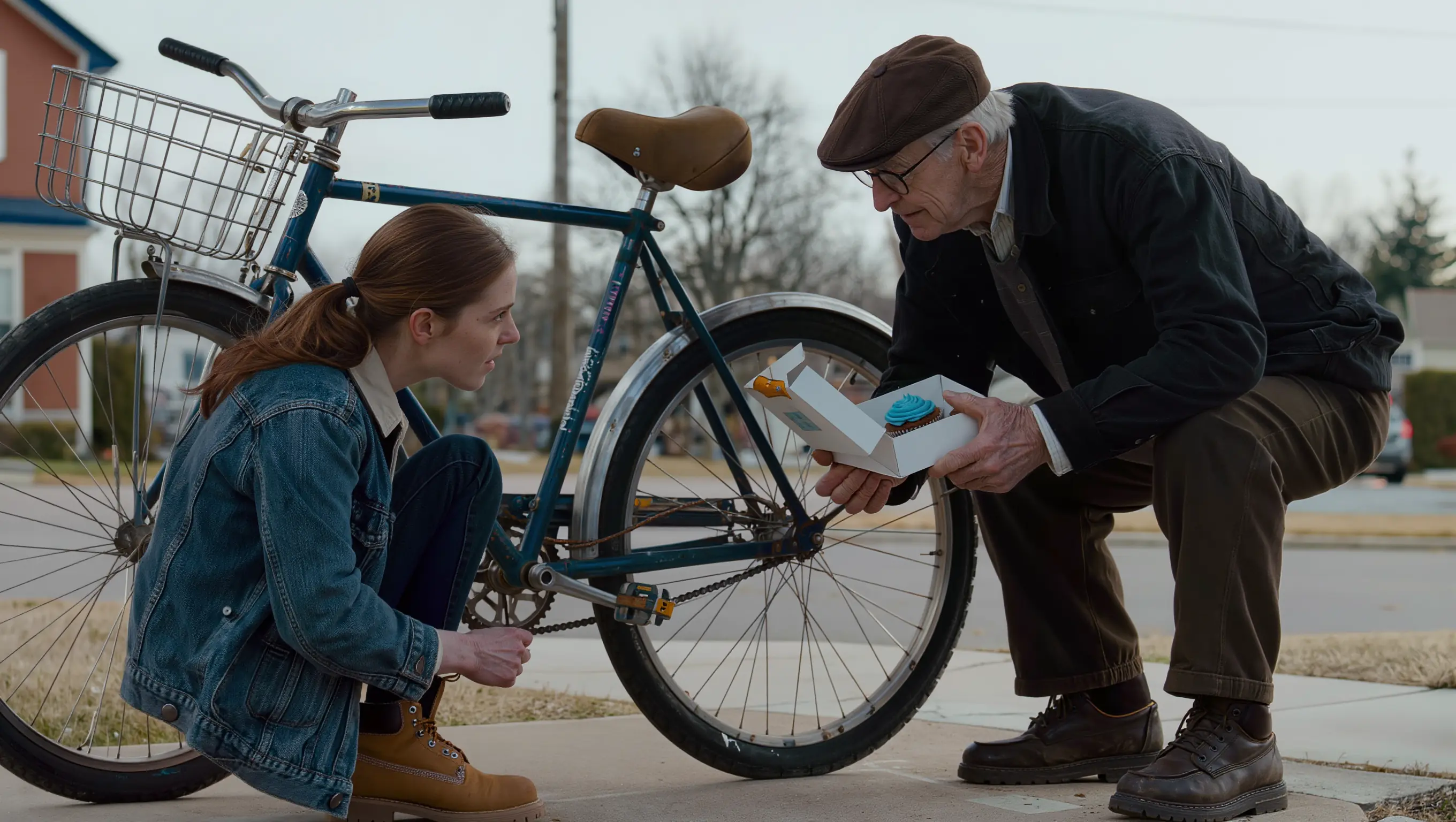
“How much?”
Emily gave him the lowest fair price she could without insulting him.
He still hesitated.
His daughter reached for her purse.
Arthur stopped her.
“No. I’ll pay.”
Emily understood that tone.
Pride was not always arrogance. Sometimes it was the last fence around a person’s independence.
She said, “We can do it in stages. Safety first. Cosmetic later.”
Arthur looked relieved.
“Safety first.”
Emily repaired the brakes and tire that day. She cleaned the chain and aligned the derailleur. The bike rode smoothly again.
When Arthur tested it outside the shop, he smiled like a boy.
“There she is,” he whispered.
Emily knew he was not only talking about the bike.
After that, Arthur became a regular.
Every Wednesday morning, he rode the blue bicycle to the shop, parked it carefully outside, and came in to talk. Sometimes he bought nothing. Sometimes he brought Emily a muffin from Clara’s favorite bakery. Sometimes he asked questions about bicycle maintenance and pretended they were casual.
“What causes a chain to sound rude?”
“Can a basket be too proud?”
“How often should a man oil something before he becomes annoying?”
Emily always answered seriously.
Arthur told stories while she worked.
Clara’s library days.
Their first apartment.
The summer they rode bikes to the lake every Sunday.
The time Clara fell into a rose bush because she insisted she could ride with three library books under one arm.
Emily began writing some of the stories down in her notebook.
Arthur noticed.
“What is that?”
“Just ideas.”
“At my age, ‘just ideas’ usually means a future trying to get its wheels under it.”
Emily laughed.
Then she showed him the pages for Second Ride.
Repair donated bikes.
Teach basic maintenance.
Help seniors keep riding safely.
Provide baskets and lights.
Create low-cost transportation for people who could not afford cars.
Start a community bike library.
Arthur read slowly.
“This is good.”
“It’s not real yet.”
“Neither is a ride until someone starts pedaling.”
Emily smiled.
“I don’t have funding.”
“You have proof.”
“What proof?”
Arthur pointed outside to Clara’s blue bicycle.
“That bike nearly made a grandfather miss a birthday. You fixed more than the chain.”
Emily looked down.
“I just helped.”
“Yes,” Arthur said. “Exactly.”
Arthur became determined.
He asked his daughter to donate an old children’s bike from her garage. Then he asked neighbors. Then his grandson asked classmates. Within two months, five used bikes sat in the back of the shop waiting for repair.
Emily began staying late on Thursdays, fixing them one by one.
A pink bike for a girl whose family could not afford one.
A sturdy black commuter bike for a man who needed to get to work.
A small red bike for a boy who had outgrown walking behind his older brothers.
Arthur helped in his own way.
He labeled parts.
Cleaned reflectors.
Polished bells.
Sorted baskets.
He also sat in a chair and told anyone who entered, “This young woman is building something. Pay attention.”
Emily always groaned.
“Arthur.”
“What? It’s true.”
The shop owner, Mr. Langley, eventually noticed the attention. Customers began donating parts. Parents brought in old bikes instead of throwing them away. A local teacher asked if Emily could teach a basic bike safety class.
Second Ride began without an official launch.
Just repairs.
Then lessons.
Then a list of people who needed bikes.
One afternoon, Arthur brought Emily a small envelope.
Inside was a letter of recommendation for a local transportation access grant.
He had written about the broken bicycle, the cupcake, the birthday party, and the way Emily’s help had grown into a program.
At the end, he wrote:
Emily Dawson understands that mobility is not only movement. It is dignity, memory, and the ability to arrive where love is waiting.
Emily cried behind the repair counter.
With Arthur’s letter, Mr. Langley’s support, photographs of repaired bikes, and records of donated parts, Emily applied.
She won a modest grant.
Not a fortune.
Not a building.
Not a new shop.
But enough to buy repair stands, tubes, cables, lights, helmets, locks, baskets, tools, and safety materials.
Second Ride became official.
Emily held the first community repair day in the parking lot behind the shop.
Arthur arrived early on Clara’s blue bicycle, wearing a name tag he had made himself:
Arthur Bell
Cupcake Transport Consultant
Emily laughed so hard she had to sit down.
Children brought squeaky bikes.
Seniors brought old bikes from garages.
Workers brought commuter bikes with bad brakes.
Volunteers learned to patch tubes, adjust seats, clean chains, and check tires.
Arthur rang Clara’s bicycle bell whenever a repaired bike was ready to roll.
The first time he rang it, everyone clapped.
He pretended to be embarrassed.
He was not.
Years passed.
Second Ride grew across Briar Glen. Emily eventually became the program coordinator and a certified bicycle mechanic. The shop gave her permanent space in the back for donated bikes. The town helped create safe cycling routes. The library partnered with her for bike-to-books days in Clara’s honor.
Arthur kept riding as long as he could.
Slower each year.
Shorter distances.
But always with the blue bicycle clean, the basket steady, and the brass bell shining.
One spring afternoon, Arthur came into the shop carrying the bell in his hand.
Emily looked up.
“Something wrong with the bike?”
“No,” he said. “Something right with the timing.”
He placed the bell on the counter.
Emily froze.
“Arthur, no.”
“Yes.”
“That’s Clara’s bell.”
“It is.”
“I can’t take it.”
“You can.”
“It belongs on her bike.”
Arthur touched the old brass dome gently.
“Clara’s bike will stay with my family. But the bell belongs with Second Ride.”
Emily’s eyes filled.
“I don’t know what to say.”
“Say you’ll ring it when someone gets where they need to go.”
She covered her mouth.
Arthur smiled softly.
“Clara believed people should know kindness is approaching. You proved her right.”
Emily kept the bell on a wooden shelf above the repair counter. She did not ring it for every repair. Only special ones.
A first bike.
A fixed commuter bike for someone starting a new job.
A senior rider brave enough to ride again after years of fear.
A child receiving a donated bike.
Each ring sounded small but bright.
Arthur passed away peacefully three years later.
At his memorial gathering, held in his daughter’s backyard, Clara’s blue bicycle stood near the porch with a basket full of flowers and one chocolate cupcake with blue frosting.
Emily brought the brass bell and rang it once.
Clear.
Soft.
Strong.
Arthur’s grandson, older now, hugged her.
“Grandpa said you saved his birthday.”
Emily smiled through tears.
“He saved a lot more than that.”
Arthur’s daughter handed Emily a final note.
Dear Emily,
The day my bicycle failed, I thought I was only losing a ride.
But I was afraid I was losing the part of myself that could still show up.
You fixed the chain.
You saved the cupcake.
You walked beside me without making me feel foolish.
Then you helped others keep moving too.
Ring Clara’s bell when kindness is on its way.
With gratitude,
Arthur Bell
Emily framed the note beside the Second Ride workbench.
Years later, whenever people asked how Second Ride began, she told them the truth.
“It began with an old man, a broken bicycle chain, and a birthday cupcake nearly lost to the curb.”
Then she would show them Clara’s bell.
The gift was small.
A bell.
A letter.
A bicycle story.
But inside those small things was the future Emily had been trying to build.
And every time a repaired bicycle rolled out of the shop, Emily listened for what Arthur had taught her.
A bicycle was not only a way to move.
Sometimes it was a way to arrive with love still intact.