At twenty-four, Abby Turner had learned that a person’s whole world could change because of one bad step.
She lived in a small town in New Hampshire called Whitcomb Falls, where winter came early, sidewalks turned slick before dinner, and everyone pretended they were used to the cold even when their fingers ached through their gloves.
Abby was a young white American woman with fair skin, long sandy-blonde hair usually tied into a messy ponytail, soft gray eyes, and careful hands that always carried tiny marks from needles, glue, polish, and leather dye.
She worked at Whitcomb Shoe Repair, a narrow little shop between a bakery and a pharmacy on Main Street.
Most people barely noticed the shop unless they needed it. They brought in broken zippers, worn heels, cracked leather boots, torn purse straps, loose soles, and shoes they were not ready to throw away.
Abby loved the work.
She loved taking something worn and making it useful again. She loved the smell of leather, waxed thread, rubber soles, cedar shoe trees, and old polish. She loved the quiet satisfaction of handing a repaired pair of boots back to someone who had thought they were ruined.
Her boss, Mr. Bell, had owned the shop for thirty-eight years.
He was gruff, practical, and slow to praise, but he had taught Abby everything he knew.
“People think shoes are about fashion,” he liked to say. “They’re wrong. Shoes are about getting through the day.”
Abby believed that.
Especially because of her mother.
Her mother had struggled with balance after a surgery that damaged a nerve in her leg. Suddenly, ordinary things became dangerous: wet stairs, loose rugs, smooth floors, shoes with bad grip, uneven sidewalks. Abby had watched her mother become afraid of leaving the house, not because she lacked courage, but because the world gave her too many chances to fall.
That was why Abby dreamed of opening a small workshop one day called Steady Step, where she could repair shoes, add safe soles, adjust straps, fix walkers and cane tips, and help elderly people stay mobile without embarrassment.
But dreams needed money.
A workspace. Tools. Training. Insurance. Supplies. Certification. Customers.
Abby had a paycheck, an old car, and a notebook full of sketches.
So she stayed at Whitcomb Shoe Repair and learned one repair at a time.
One bitter Tuesday afternoon in January, snow began falling just before four o’clock.
Main Street turned white within minutes. Cars moved slowly. People hurried between storefronts with scarves over their mouths. The wind pushed snow across the sidewalks in thin, icy sheets.
Abby was carrying a repaired pair of boots to the front window display when she heard a sharp crack outside.
Then a man cried out.
She turned.
Across the sidewalk, an elderly man had frozen near the curb, one hand gripping a wooden cane, the other clutching a small black case against his chest. He was a white American man in his late seventies, tall but thin, with white hair under a gray wool cap, pale blue eyes behind square glasses, and a deeply lined face red from the cold.
The rubber tip of his cane had split open.
Half of it lay on the snowy sidewalk.
Without the rubber grip, the cane’s wooden end slid every time it touched the ground.
The old man tried to step backward.
His shoe slipped.
Abby dropped the boots and ran outside.
“Sir! Don’t move. I’ve got you.”
He looked embarrassed immediately.
“I’m all right.”
“No, you’re not. Your cane tip broke.”
He glanced down, then swallowed.
“Oh.”
A car rolled by too close to the curb, spraying slush near his feet. The man tightened his grip around the black case.
Abby stepped beside him and held out her arm.
“Lean on me for a second.”
“I don’t want to trouble you.”
“You’re standing on ice with a broken cane. Trouble already started.”
That made him blink.
Then, despite the cold, he gave a faint laugh.
“All right.”
He leaned lightly on her arm while Abby guided him away from the curb and toward the front of the shoe repair shop. His shoes were polished but old, with smooth leather soles that had almost no traction left.
Abby noticed immediately.
“Your shoes are slipping too.”
“They were my good shoes.”
“Good for indoors, maybe. Not for January.”
The man smiled weakly.
“My wife used to say the same thing.”
“What’s your name?”
“Henry Wallace.”
“I’m Abby Turner. I work right here.”
She opened the shop door and helped him inside. Warm air wrapped around them. The bell above the door rang softly. Mr. Bell looked up from the back workbench.
“What happened?”
“Broken cane tip,” Abby said. “And slick soles.”
Henry removed his cap, still holding the black case.
“I only meant to walk from the pharmacy to the church hall. It’s two blocks.”
“In this weather?” Mr. Bell asked.
Henry looked down.
“It seemed reasonable before the snow.”
Abby helped him sit on the wooden bench near the front counter.
“What’s in the case?” she asked gently.
Henry’s hand tightened around it.
“My wife’s dance shoes.”
Abby paused.
He opened the case slowly.
Inside lay a pair of women’s cream-colored ballroom shoes. The satin was worn at the toes. The straps were delicate. The small heels had scuffs along the edges. They were old, but beautifully cared for.
“My wife, Margaret, loved to dance,” Henry said softly. “Every winter, the church holds a memorial dance for families who lost someone. Tonight is the first one since she passed.”
Abby’s expression softened.
“I’m sorry.”
He nodded.
“I was bringing her shoes to place on the memory table. I almost stayed home. Then I thought…” His voice trembled. “If I couldn’t dance with her, at least her shoes could be there.”
Abby looked at the broken cane tip on the floor.
“And then the cane broke.”
Henry gave a tired smile.
“Very poetic timing.”
“No,” Abby said. “Very rude timing.”
He laughed once, then wiped his eyes quickly.
Abby crouched beside the cane.
“I can fix this enough to get you safely to the church hall.”
“You repair canes?”
“We repair things people need to stand on.”
Mr. Bell snorted from the back.
“That is not technically our slogan.”
“It should be,” Abby said.
She took the cane to the workbench and inspected the end. The old rubber tip had dried out and split from age. She found a replacement tip in a drawer where Mr. Bell kept odd mobility repairs for longtime customers. It was slightly too wide, so she trimmed a rubber insert from a scrap sole, fitted it inside, and secured the tip properly.
Then she looked at Henry’s shoes.
“Mr. Wallace, may I add temporary traction pads to your soles?”
He looked uncertain.
“Will it damage them?”
“No. It will keep you from sliding on the way there.”
“How much?”
Abby glanced at Mr. Bell.
He raised one eyebrow.
She looked back at Henry.
“Today, the snowstorm special is free.”
Henry frowned.
“I don’t want charity.”
Abby nodded.
“Then pay me by letting me do the repair correctly.”
Mr. Bell coughed into his hand, hiding a smile.
Henry studied Abby for a moment, then nodded.
“All right.”
Abby cleaned the soles, cut two thin rubber grip pads, and applied them with fast-setting adhesive. While the glue cured, she polished the cream-colored dance shoes gently and replaced one weak strap hole with a tiny reinforcement stitch.
Henry watched quietly.
“My Margaret would have liked your hands,” he said.
Abby looked up.
“My hands?”
“You don’t rush what matters.”
For some reason, that made her throat tighten.
She looked back down.
“My mother needed help walking after surgery. I learned to pay attention.”
Henry nodded slowly.
“Then you understand.”
“I try.”
When the cane was ready and the shoes had traction, Abby helped Henry stand. He tested the cane once on the shop floor.
The rubber held.
Then he took one step in his good shoes.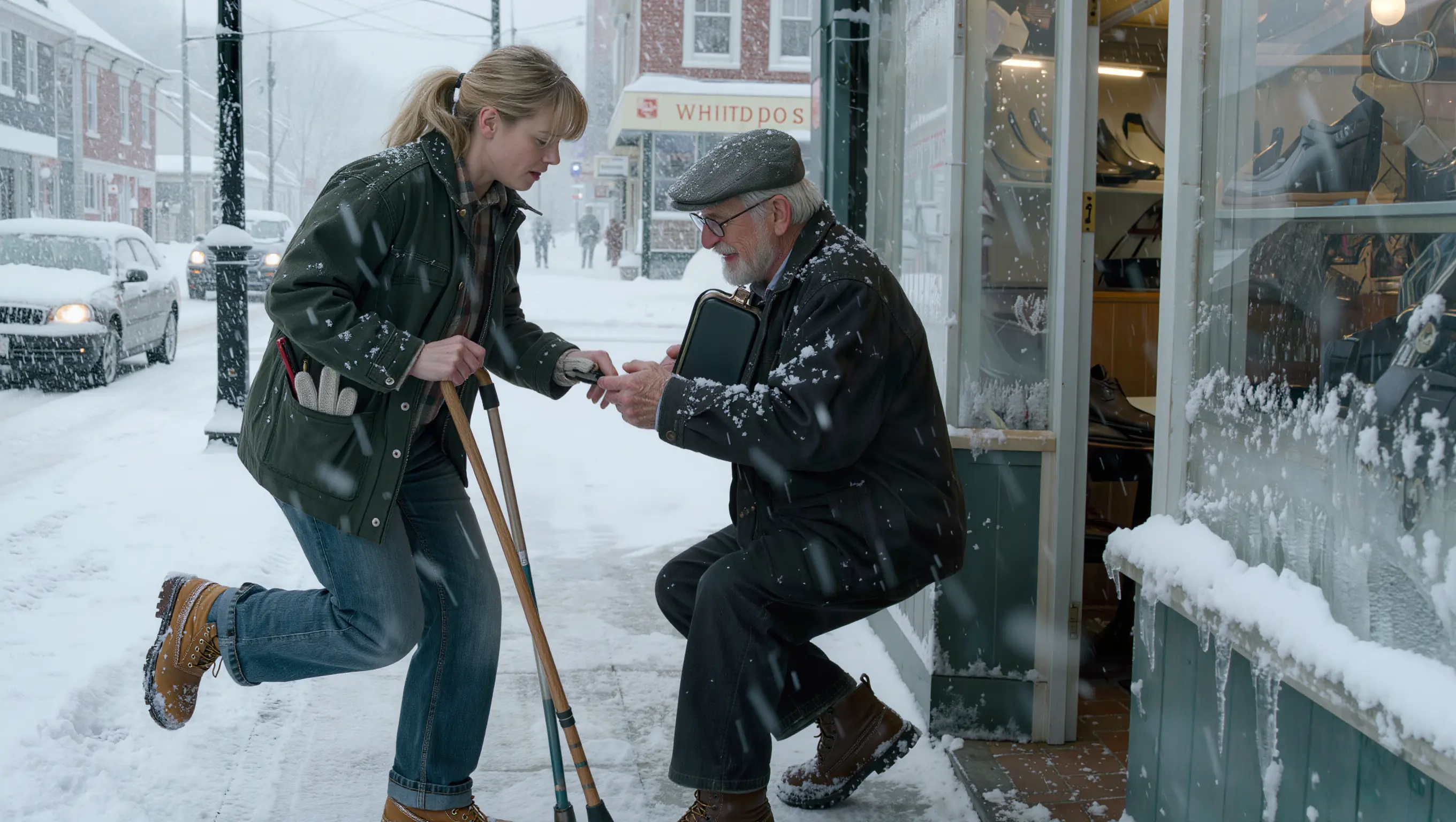
No slip.
His face changed with relief.
“Oh,” he whispered. “That’s better.”
Abby smiled.
“Good. Now I’m walking you to the church hall.”
Henry shook his head.
“You’ve already done enough.”
“No. I repaired your cane and shoes. If you fall two blocks away, that’s bad customer service.”
Mr. Bell called from the back, “Take the umbrella.”
Abby grabbed it.
She carried Margaret’s dance shoes in their case while Henry walked beside her, cane steady now. They moved slowly through the falling snow. Abby matched his pace, watching the sidewalk ahead for ice.
At the church hall, warm light spilled through the windows. Inside, people were setting up a memory table with framed photos, candles, flowers, and keepsakes. Henry stopped at the entrance.
“I don’t know if I can go in,” he whispered.
Abby stood beside him.
“You don’t have to do anything quickly.”
He looked at the black case in her hands.
“I was married to her for fifty-three years. Now I don’t know how to enter a room without her.”
Abby’s voice softened.
“Maybe tonight, you don’t enter without her.”
She handed him the case.
“You brought her shoes.”
Henry closed his eyes for a moment.
Then he nodded.
Inside, Abby helped him place the cream-colored dance shoes on the memory table beside a photograph of Margaret. In the photo, Margaret was laughing in a blue dress, one hand lifted as if music had just begun.
Henry touched the frame.
“Hello, Maggie,” he whispered.
Abby stepped back.
A woman from the church brought Henry a chair. Someone asked about the shoes, and Henry began telling a story about the first dance he and Margaret ever shared. His voice shook at first, then steadied.
Abby watched from the doorway for a moment.
Then she left quietly.
She thought that would be the end of it.
It was not.
The next week, Henry came back to Whitcomb Shoe Repair.
This time, he brought coffee, a paper bag of cinnamon rolls, and three more canes.
“One is mine,” he said. “Two belong to neighbors.”
Abby laughed.
“Are you starting a collection?”
“I am starting a safety campaign.”
Mr. Bell looked over his glasses.
“Do we know about this campaign?”
“We do now,” Abby said.
Henry became a regular.
He brought canes with worn tips, shoes with slick soles, walkers with loose rubber feet, and stories about elderly friends who were afraid of falling but too proud to ask for help. Abby repaired what she could. Sometimes she charged a few dollars. Sometimes Mr. Bell pretended not to notice when she charged less.
Henry watched her work.
He asked questions.
He told stories about Margaret.
She had been a dance instructor before arthritis made movement painful. After she could no longer dance much herself, she taught seniors how to move safely, how to turn slowly, how to trust a partner, how to stand up from a chair without fear.
“She said balance was not only in the feet,” Henry told Abby one afternoon. “It was in confidence.”
Abby wrote that in her notebook later.
Balance is confidence.
Over the next year, Abby started a small Saturday service at the shop.
She called it Steady Step Saturday.
Nothing fancy.
Just a little sign in the window:
Free Cane Tip Checks
Shoe Traction Advice
Walker Feet Replacements
Ask Before The Ice Does
The first Saturday, only Henry came.
The second Saturday, he brought two friends.
By the fourth, six elderly customers lined up before noon.
Some needed cane tips. Some needed safer soles. Some needed shoelaces they could tie with stiff fingers. Some needed someone to explain why their favorite shoes had become dangerous without making them feel old or foolish.
Abby loved it.
Mr. Bell pretended to grumble.
But he ordered more cane tips.
One afternoon, Henry brought Abby a small wooden box.
“I want you to have something,” he said.
Abby immediately shook her head.
“Henry.”
“You do not even know what it is.”
“I know that tone.”
He smiled and opened the box.
Inside was an old leatherworker’s awl with a smooth wooden handle, a small stitching wheel, and a folded piece of paper.
“These belonged to my father,” Henry said. “He repaired shoes during the Depression. Not professionally. Just for neighbors. He used to say a good sole was the difference between staying home and keeping your life.”
Abby touched the awl carefully.
“I can’t take this.”
“Yes, you can.”
“It’s family.”
“And family tools should keep helping people.”
She unfolded the paper.
It was a handwritten note from Henry.
Abby Turner does not simply repair shoes and canes. She repairs a person’s courage to step outside again. Any program supporting elder safety would be wise to support her.
Abby looked up, eyes filling.
“What is this for?”
“The community improvement grant,” Henry said. “I saw the notice at the library. They fund small safety projects. You should apply.”
“I don’t have a business.”
“You have a service.”
“I don’t have credentials.”
“You have proof.”
He tapped the notebook where she kept records of repairs, safety tips, and customer needs.
“Start there.”
With Henry’s letter, Mr. Bell’s support, and her own notes from Steady Step Saturdays, Abby applied.
She did not expect much.
But she won a small grant.
Not a fortune.
Not a building.
Not enough to open her dream workshop completely.
But enough to buy proper supplies: cane tips in multiple sizes, walker feet, traction materials, grip tape, adaptive shoelaces, a portable work kit, printed safety guides, and a small table she could take to senior centers and church halls.
Steady Step became real.
At first, it was a weekend program.
Then senior centers invited her.
Then physical therapists began referring patients.
Then families called asking if Abby could look at their father’s shoes or their mother’s walker before winter.
Abby kept working at the shoe repair shop, but now her dream had a shape.
Henry attended her first senior center event wearing his polished shoes with Abby’s traction pads still firmly in place.
He stood beside her display table and told everyone, “She kept me from falling before I knew how close I was.”
Abby blushed every time.
Years passed.
Steady Step grew slowly, one repair at a time. Abby completed training in adaptive footwear and fall-prevention support. She partnered with local clinics and senior programs. She still repaired old shoes, but now she also helped people stay connected to the world outside their doors.
Henry grew older.
He still visited the shop, though slower each year. He always brought Margaret’s dance shoes once before Christmas so Abby could polish them for the memorial table.
One winter, he handed Abby one final gift.
It was a small brass shoehorn, worn smooth at the handle.
“Margaret used this after her arthritis got bad,” he said. “She hated needing it until she decided tools were not admissions of weakness. They were invitations to continue.”
Abby held it gently.
“Henry…”
“No tears yet,” he said. “I am still here to be embarrassed by them.”
She laughed through tears anyway.
Henry passed away the following spring.
At his memorial, Margaret’s cream-colored dance shoes sat beside his photograph. Abby placed his repaired cane next to them, its rubber tip still steady.
When people asked how Steady Step began, Abby told them the truth.
“It began with an old man in the snow, a broken cane, and a pair of dance shoes he refused to leave behind.”
Then she would show them Henry’s father’s awl, the recommendation letter, and Margaret’s brass shoehorn.
The gifts were small.
A tool.
A letter.
A shoehorn.
But inside them was everything Abby needed.
A skill.
A chance.
A reminder.
And every winter, when the sidewalks turned slick and people began walking carefully through town, Abby opened her repair kit and remembered what Henry had taught her.
A good sole could be the difference between staying home and keeping your life.