At twenty-three, Mia Carter made her living fixing other people’s broken walls.
She was not an architect, not a designer, and not the kind of person who stood in clean clothes pointing at blueprints. Mia worked with her hands. She patched drywall, repaired cracked plaster, replaced window frames, fixed loose doors, painted water-stained ceilings, and made old rooms feel livable again.
Her job title at Harbor Home Repair in Portland, Maine, was “general repair assistant,” which sounded simple. But most days, she did whatever needed to be done. She carried ladders through narrow hallways, scraped paint from frozen window trim, replaced rotten baseboards, sealed leaks, and crawled into corners where nobody else wanted to fit.
She was young, but she was good.
Her father had taught her how to hold a hammer before he taught her how to drive. He used to say, “A house talks before it breaks. Listen early, and the damage won’t get worse.”
Mia listened.
She noticed the tiny crack above a window before rain found it. She noticed the soft spot in a floor before someone’s foot went through. She noticed the loose hinge, the bad latch, the smell of damp wood, the draft slipping beneath an old door.
People around her called those things small.
Mia knew better.
Small damage was only small until someone ignored it long enough.
Her father had learned that the hard way. When Mia was seventeen, a weak attic floor collapsed under him during a repair job. He survived, but the injury ended his work. After that, Mia watched her mother take extra shifts at a grocery store, watched her father sit in a chair by the window pretending he did not miss his tools, and watched bills turn the kitchen table into a battlefield.
So Mia worked.
She did not dream of luxury. She dreamed of opening a small repair studio called Second Frame Restorations, focused on fixing old homes for elderly people who could not afford big renovation companies. She wanted to repair windows, doors, railings, ceilings, and rooms before small problems became dangerous.
But dreams were expensive, and Mia was still paying for her father’s medication, her truck repairs, and the night classes she took twice a week in historic preservation.
Most mornings, she left home before sunrise in a paint-stained jacket, steel-toe boots, and a ponytail that never stayed neat. She drove a gray pickup with a ladder rack, a cracked dashboard, and a toolbox that rattled every time she turned too sharply.
On a cold Friday evening in February, Mia was driving back from a repair job near Munjoy Hill when the snow began falling harder.
Portland looked beautiful in weather like that. Streetlights glowed over icy sidewalks. Brick buildings stood firm against the wind. The harbor air smelled of salt and cold metal. But beauty did not make the roads safer, and Mia was tired enough to feel every mile in her shoulders.
She almost drove straight home.
Then she saw the old woman.
The woman stood outside a narrow, weathered house on Howard Street, one hand pressed against the side of the building, the other gripping a grocery bag that had split open at the bottom. Cans had rolled across the snowy walkway. A carton of eggs lay broken near her boots.
But that was not what made Mia brake.
A second-floor window above the porch was broken.
Not cracked. Broken open.
A jagged hole gaped in the glass. Snow blew through it into the house, and one loose shard hung dangerously from the frame, tapping in the wind.
The old woman was looking up at it helplessly.
Mia pulled her truck to the curb.
She stepped out into the snow and called, “Ma’am, are you all right?”
The woman startled and turned. She looked to be in her late seventies, small and thin, wearing a dark purple coat, a gray knit hat, and old black boots dusted with snow. Her cheeks were red from cold. Her hands trembled.
“I’m fine,” the woman said quickly.
Mia glanced at the broken eggs, the spilled cans, the shattered window, and the woman’s shaking hands.
“No, ma’am,” she said gently. “You’re not.”
The woman looked embarrassed. “It’s only a window.”
“That’s not only a window in this weather.”
The wind pushed snow sideways. From above, another glass shard shifted with a faint scraping sound.
Mia looked up sharply.
“Please step away from the porch.”
The woman frowned. “Why?”
“That loose glass could fall.”
The woman took one step back, then another. A second later, the shard broke free, struck the porch roof, and shattered across the steps.
The woman gasped.
Mia moved fast. She guided the woman farther back toward the sidewalk, then picked up the grocery bag and gathered what food she could save.
“My name is Mia Carter,” she said. “I do home repairs. What’s your name?”
“Eleanor Brooks.”
“Mrs. Brooks, is anyone else inside?”
“No. Just me.”
“Is the room with the broken window a bedroom?”
Eleanor’s eyes dropped.
“Were you sleeping in there?”
“I was going to.”
Mia looked at the snow blowing straight into the second floor.
“Not tonight.”
Eleanor’s pride rose immediately.
“I have blankets.”
“Blankets won’t stop broken glass or snow.”
“I called a company.”
“When?”
“This morning.”
“And?”
“They said the earliest they could come was Monday. Another man said emergency work costs extra.”
“How much extra?”
Eleanor’s mouth tightened. “Too much.”
Mia knew that answer.
She looked toward her truck, then back at the house. She had plywood scraps, plastic sheeting, screws, sealant, gloves, and a ladder. She could not replace the window tonight, but she could secure it. She could stop the snow. She could make sure Eleanor did not sleep in a freezing room full of glass.
“I can board it up temporarily,” Mia said.
Eleanor shook her head. “No, dear. I can’t pay emergency rates.”
“I didn’t say emergency rates.”
“I can’t pay regular rates either.”
Mia looked at the broken window again. The wind whistled through it like something alive.
“Then pay me with a cup of tea if you have one.”
Eleanor blinked.
“That is not a business model.”
“No,” Mia said. “It’s a storm plan.”
Eleanor looked at her for a long moment, trying to decide whether kindness was a trick.
Then her shoulders lowered.
“I have peppermint tea.”
“Perfect.”
Mia got to work.
The scene was simple enough for anyone to understand.
An old woman stood outside in the snow, unable to protect her house. A broken upstairs window let winter into her bedroom. Glass had already fallen near the front steps. No one had come. Mia did.
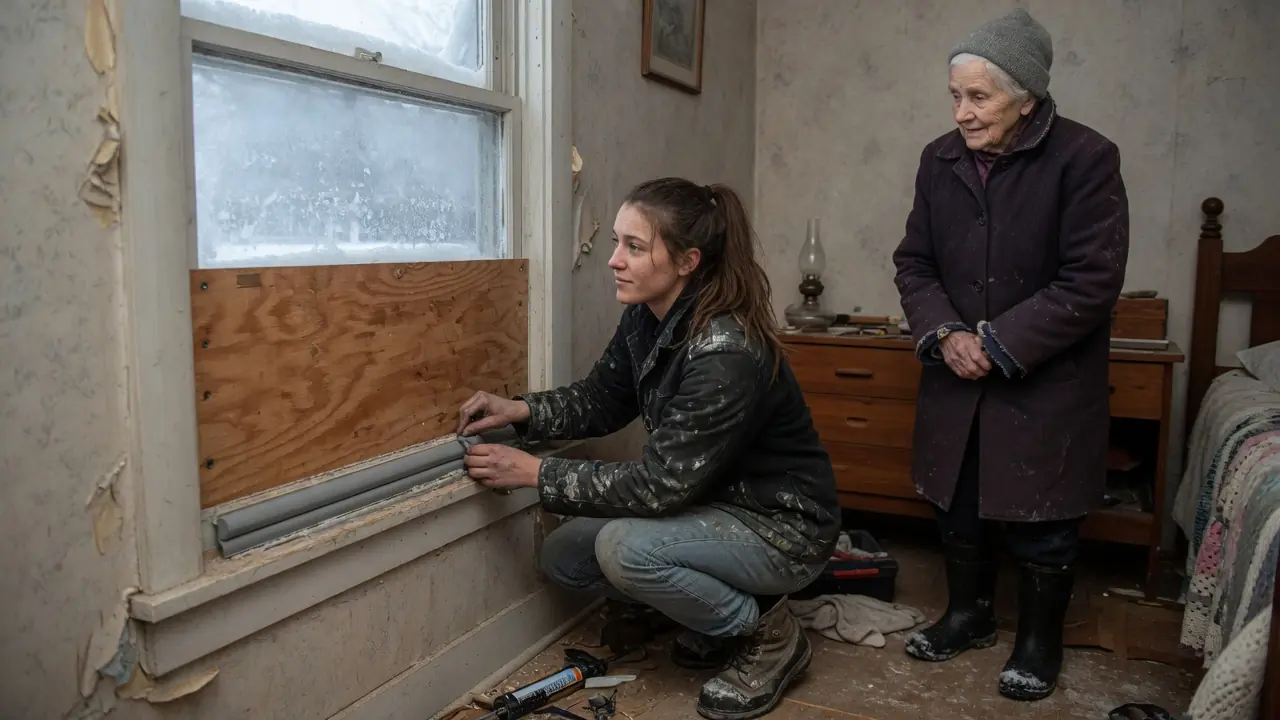
She carried her ladder from the truck and placed it carefully against the side of the house. She put on work gloves, climbed up, and removed the remaining loose glass piece by piece. The wind cut against her face. Snow clung to her sleeves. Her fingers stiffened inside the gloves.
Eleanor stood below, clutching her coat.
“Please be careful,” she called.
“I am.”
“That ladder looks slippery.”
“I’ve got it.”
“You are very young.”
“I’ve been told.”
“And stubborn.”
“That too.”
Mia smiled despite the cold.
After clearing the sharp glass, she climbed down and went inside with Eleanor. The house was narrow and old, with creaking floors, faded wallpaper, and framed photographs lining the stairway. It smelled faintly of dust, lavender, and cold air.
The upstairs bedroom was worse than Mia expected.
Snow had blown across the floor and onto the bed. Broken glass glittered near the window. A small wooden nightstand was wet. The curtains were torn where the glass had cut through them. The room was freezing.
Eleanor stood in the doorway, looking smaller than before.
“My husband built that window frame,” she said quietly. “A long time ago.”
Mia softened.
“What was his name?”
“Thomas.”
“He did good work.”
Eleanor looked at the crooked, damaged frame.
“It doesn’t look like it now.”
“Good work gets old too. That doesn’t mean it was bad.”
Eleanor’s eyes shone, but she looked away quickly.
Mia swept the glass first. Then she folded the wet blanket away from the window, moved the nightstand, wiped snow from the sill, and measured the opening. The frame was damaged, but the structure could hold a temporary board. She went back outside, cut plywood in the truck bed under a streetlight, brought it upstairs, and fitted it over the opening from inside.
She screwed the plywood into the strongest parts of the frame, sealed the edges with plastic sheeting and tape, and packed a towel along the lower gap until she could return with better materials.
The wind stopped entering the room.
The silence after that felt enormous.
Eleanor stood near the bed, staring at the boarded window.
“It’s warmer already,” she whispered.
“It’ll hold through the weekend,” Mia said. “But the window frame needs real repair. So does the exterior trim. There may be water damage below the sill.”
Eleanor nodded slowly.
“How much will that cost?”
Mia hesitated.
A proper repair would require new trim, a custom frame adjustment, glass, sealant, paint, maybe replacement of some interior plaster. A company could charge thousands.
“I’ll inspect it in daylight,” Mia said. “Then I’ll tell you the cheapest safe way to fix it.”
“The cheapest safe way,” Eleanor repeated.
“Cheap without safe is expensive later.”
Eleanor looked at her with surprise.
“My husband used to say things like that.”
“Then he was smart.”
“He was.”
Downstairs, Eleanor made peppermint tea while Mia cleaned the porch steps and gathered the last of the groceries from the snow. Several eggs were lost. Two cans were dented but fine. Bread was wet on one side.
Mia set everything on the kitchen counter.
“You need groceries replaced,” she said.
“I need many things replaced,” Eleanor replied, then gave a small tired smile. “But one crisis at a time.”
The kitchen was old but tidy. Blue cabinets. White curtains. A round wooden table with two chairs, though only one had a cushion. A framed photo hung near the stove: a younger Eleanor standing beside a tall man with broad shoulders and a gentle smile. Thomas, probably. Behind them was the same house, freshly painted, bright and proud.
Eleanor noticed Mia looking.
“That was 1978,” she said. “The year we bought this place.”
“It’s beautiful.”
“It was.”
“It still is.”
Eleanor gave a soft laugh. “You repair people always talk like that.”
“Because we can see what’s underneath.”
They sat with tea while snow pressed against the kitchen windows.
Eleanor told Mia that Thomas had been a cabinetmaker. He had built shelves in nearly every room, repaired the stairs, added the little breakfast nook, and made the wooden window frames himself. After he died six years earlier, the house became harder to maintain. The big repairs were too expensive. The small ones piled up. A sticking door. A leaking gutter. A cracked pane. Loose plaster. The broken window had happened when a frozen branch snapped from the old maple outside and struck the glass.
“I should have had the tree trimmed,” Eleanor said.
“Maybe,” Mia replied. “But blaming yourself won’t fix the window.”
Eleanor looked at her.
“You speak plainly.”
“My dad says I was born without decorative language.”
That made Eleanor laugh properly, and the kitchen felt warmer.
Before Mia left, Eleanor insisted on paying something. She opened a little tin near the stove and counted out twelve dollars in singles and quarters.
Mia wanted to refuse, but she saw the pride in Eleanor’s careful hands.
So she accepted.
“Thank you,” Mia said.
Eleanor looked relieved.
“No,” she replied. “Thank you for stopping.”
Mia returned the next morning.
In daylight, the house showed its problems clearly. The broken window was only the beginning. The exterior trim around it had rotted. A clogged gutter had sent water down the wall for years. Paint peeled near the corner. The porch steps needed reinforcement. The back door latch barely worked. The kitchen window had a draft wide enough to move the curtain.
Eleanor stood beside Mia on the sidewalk, wrapped in her purple coat.
“It looks worse in daylight,” she said.
“Most things do before they get better.”
“Can it get better?”
“Yes.”
“You say that quickly.”
“Because I mean it.”
Mia made a list.
She separated repairs into urgent, important, and later.
Urgent: secure window, replace glass, repair frame, seal exterior trim, clear gutter.
Important: reinforce porch step, fix back door latch, seal kitchen window draft.
Later: repaint trim, repair plaster, inspect roof edge, trim maple branch.
Eleanor listened carefully, though Mia could see fear rising with each item.
“I can’t do all of that,” Eleanor said.
“We don’t do all of it at once.”
“How much for urgent?”
Mia calculated materials as low as possible. She had some leftover trim from a job. She could use reclaimed wood if it was sound. She would need glass and weatherproof sealant.
“Materials, maybe two hundred thirty dollars.”
Eleanor swallowed.
“And labor?”
Mia looked at the house, then at Eleanor.
“Installments.”
“Mia.”
“I’m serious. Pay what you can monthly.”
“I don’t want pity.”
“This isn’t pity. This is repair.”
“I don’t want to owe someone.”
“You won’t owe me more than we agree.”
Eleanor’s face tightened.
“My husband and I paid our bills. We never wanted help.”
Mia nodded.
“My family needed help after my dad’s accident. He hated it too. But needing help doesn’t erase who you are.”
Eleanor turned away, eyes wet.
For a while, only the wind moved between them.
Finally, Eleanor said, “I can pay forty dollars now.”
“Then we start with forty.”
So they did.
Mia came after work and on Sunday afternoons. She replaced the glass, repaired the wooden frame, sealed the trim, and cleared the gutter. She reinforced the porch step and fixed the back door latch. She sealed the kitchen window draft with proper weatherstripping, and for the first time in years, Eleanor could sit at breakfast without cold air brushing her ankles.
Each repair had a visible before and after.
Before, snow entered the bedroom. After, the window held firm.
Before, Eleanor avoided the porch step. After, she stepped down safely to collect the mail.
Before, the back door stuck so badly she did not use it. After, it opened smoothly onto the small garden.
Before, the kitchen curtain moved from the draft. After, it hung still.
Eleanor noticed everything.
The first morning after Mia fixed the kitchen window, Eleanor called her.
“It stayed warm,” she said.
“What did?”
“The kitchen. I made oatmeal and did not have to wear gloves.”
Mia smiled into the phone.
“That’s good.”
“No, dear,” Eleanor said. “That’s freedom.”
The word stayed with Mia.
Freedom could be as simple as a warm kitchen.
As weeks passed, Mia and Eleanor became connected by more than repairs.
Eleanor began keeping a notebook labeled House List. Every time she noticed a problem, she wrote it down instead of panicking. Mia would review it during visits.
Loose towel bar.
Bathroom light flickers.
Shelf leaning.
Bedroom plaster crack.
Front door chain too high.
Some items were simple. Some needed more planning. Mia taught Eleanor what was urgent and what could wait. Eleanor taught Mia how to make apple cake, how to remove ink from fabric, and how to read people who said “I’m fine” too quickly.
One evening in March, Mia arrived after a long day and found Eleanor waiting with two bowls of stew.
“You look exhausted,” Eleanor said.
“I’m fine.”
Eleanor raised one eyebrow.
Mia sat. “I walked into that.”
“Yes.”
They ate in the kitchen while rain tapped against the repaired window.
Eleanor asked, “Do you like the company you work for?”
Mia thought of her boss, Vince Harbor, who valued fast jobs and big invoices. He was not cruel, but he avoided low-income clients because they could not pay enough. He often sent Mia to finish small tasks while he chased larger contracts.
“I like the work,” Mia said.
“That was not the question.”
Mia sighed. “I don’t know.”
“What would you do if you could choose?”
The answer came too quickly to hide.
“I’d fix houses for people like you.”
Eleanor set down her spoon.
“Old women with broken windows?”
“Older people who want to stay home safely. People who can’t afford huge companies. Small repairs before they become disasters.”
“That sounds needed.”
“It is.”
“Then why not do it?”
Mia laughed softly. “Because I need money, insurance, licenses, tools, a better truck, and customers.”
Eleanor nodded. “A list.”
“A large list.”
“Still a list.”
“You sound like my father.”
“Good. He sounds sensible.”
Mia smiled, then looked down.
“I’m scared I’ll fail.”
“Of course you are. If dreams did not scare us, they would be errands.”
Mia stared at her.
“Did you just make that up?”
“I am old. People assume all our sentences are wisdom.”
They laughed, but the conversation stayed with Mia.
In April, Eleanor fell.
It happened in the grocery store parking lot. Not because of Mia’s repairs. Not because of the house. A patch of wet pavement near the curb caught Eleanor’s foot, and she went down hard. She did not break anything, but her wrist sprained badly, and her hip bruised. The hospital released her the same day, but she was shaken.
Mia found out when Eleanor did not answer the phone.
She drove to Howard Street, knocked, and heard Eleanor call weakly from inside.
“I’m coming. Slowly.”
When the door opened, Eleanor looked pale, one wrist wrapped, cane shaking slightly in her good hand.
Mia’s stomach dropped.
“What happened?”
“I had a disagreement with a parking lot.”
“Eleanor.”
“I lost.”
Mia stepped inside and immediately saw the problem.
The house was safe enough for Eleanor on a normal day. But with one wrist injured, everything became harder. The front door was heavy. The bathroom had no grab bar near the toilet. The bedroom lamp switch was too far from the bed. The kitchen shelves required reaching.
Mia moved through the house with purpose.
“Okay,” she said. “We’re making adjustments today.”
“Mia, I’m fine.”
“No.”
Eleanor opened her mouth.
“No,” Mia repeated. “You are hurt. That changes the house.”
The trailer image would be clear: an elderly woman with a wrapped wrist struggling to open her own door, and the young repairwoman immediately turning the house into a safer place.
Mia installed a temporary door pull that Eleanor could use with one hand. She moved dishes to lower shelves. She added a battery light near the bed. She secured a non-slip mat in the bathroom. She installed a grab bar beside the toilet, using proper anchors, not cheap suction cups. She placed a small bench near the back door so Eleanor could sit while changing shoes.
Eleanor watched, emotional and embarrassed.
“You don’t have to do all this today.”
“Yes, I do.”
“Why?”
“Because tonight matters.”
The words came from Mia before she fully understood them.
Eleanor grew quiet.
Mia continued, “People always talk about long-term care, big plans, future safety. But tonight, you need to get to the bathroom without falling. Tonight, you need to turn on a light without reaching. Tonight, you need to open the door without hurting your wrist. Tonight matters.”
Eleanor sat slowly at the kitchen table.
“My Thomas would have liked you.”
Mia tightened a screw on the cabinet handle.
“I think I would’ve liked him too.”
By May, Eleanor began introducing Mia to neighbors.
Not casually.
Strategically.
“This is Mia Carter,” she told Mrs. Powell next door. “She repaired my window properly after that ridiculous company tried to charge me half my pension.”
Then to Mr. Lewis down the block: “Mia knows doors. Your back door sounds like a dying goose.”
Then to a retired librarian: “You need someone to look at that porch rail before it sends you flying into the hydrangeas.”
Mia protested at first.
“Eleanor, I still work full-time.”
“Then give estimates on Saturdays.”
“I don’t have business cards.”
“Make some.”
“I don’t have a business.”
“Not with that attitude.”
Within a month, Mia had six side repair jobs.
Small jobs, exactly the kind big companies ignored.
A loose stair rail.
A cracked windowpane.
A broken storm door.
A bathroom grab bar.
A porch light installation.
A sticky bedroom door that trapped an elderly man inside for ten frightening minutes.
Mia handled each job carefully. She charged fairly. She explained the work in plain language. She showed receipts for materials. She cleaned up afterward. People talked.
Eleanor kept a folder of Mia’s handwritten invoices and called it “evidence.”
“Evidence of what?” Mia asked one afternoon.
“That you are already running the business you claim you cannot start.”
Mia rolled her eyes, but privately, she began to believe it.
That summer, Harbor Home Repair lost a major contract. Vince cut Mia’s hours without warning. Her paycheck dropped almost in half.
Panic rose first.
Then clarity.
Mia sat in her truck outside Eleanor’s house, staring at her schedule. She had three company shifts next week and five independent repair requests from elderly homeowners.
Maybe Eleanor was right.
Maybe the dream had already started.
She walked into Eleanor’s kitchen and said, “I think I’m going to do it.”
Eleanor looked up from peeling apples.
“Do what?”
“Second Frame Restorations. Officially.”
Eleanor’s hands stilled.
Then she smiled.
“Well,” she said. “It took you long enough.”
Starting was messy.
Mia registered the business. Bought basic liability insurance. Built a simple website using a template and a lot of frustration. Her father helped repair the gray pickup and repaint the toolbox. Her mother printed flyers at the library. Eleanor edited the flyers with a red pen.
The final flyer read:
Second Frame Restorations
Small Home Repairs For Safer Living
Windows, Doors, Railings, Grab Bars, Draft Sealing, Minor Plaster Repair
Honest Work For Older Homes And The People Who Love Them
Eleanor added one final line:
Because Home Should Not Become A Hazard.
Mia stared at it.
“That’s good.”
“I know,” Eleanor said.
The first year was difficult.
Mia worked long days and longer nights. Some months were thin. Some clients paid late. Some repairs uncovered bigger problems. She learned bookkeeping the hard way. She learned not to undercharge just because she cared. She learned that helping people and surviving as a business required boundaries.
Eleanor helped with that too.
“You cannot pour tea from an empty kettle,” she said whenever Mia tried to discount every job.
“That metaphor is too cute.”
“It is accurate.”
Slowly, Second Frame Restorations became known across Portland’s older neighborhoods.
Mia’s work was practical, visible, and emotionally easy to understand. She helped an elderly couple stop using a dangerous back stair. She repaired a window for a widower who had been sleeping in a coat. She fixed a bathroom door for a woman whose walker kept catching on the threshold. She installed handrails for a retired nurse recovering from surgery.
Every repair changed a daily life.
People began saying, “Call Mia before it gets worse.”
Two years passed.
Eleanor’s house became the unofficial office of Second Frame Restorations. Mia often stopped there between jobs for tea, paperwork, or advice. Eleanor sat at the kitchen table with reading glasses on, reviewing invoices like a strict board member.
“You forgot to charge for fasteners,” she said one Tuesday.
“It was three dollars.”
“Three dollars is not invisible.”
“I know.”
“Do you?”
Mia laughed. “Yes, ma’am.”
“Good.”
Eleanor also became a kind of grandmother to Mia. She attended Mia’s first community workshop on winterizing old homes. She clapped too loudly when Mia spoke at the senior center. She kept every newspaper clipping about the business in a folder labeled Mia’s Good Trouble.
But Eleanor was growing older.
Her steps slowed. Her voice softened. She tired easily. Mia noticed, though Eleanor tried to hide it.
One autumn evening, Eleanor asked Mia to sit with her in the repaired bedroom.
The room looked different now. The window was strong and properly sealed. Pale curtains moved gently in clean air. A quilt covered the bed. The nightstand Thomas had built stood beside it, polished and dry.
Eleanor sat in an armchair near the window, wrapped in a blue shawl.
“I need to show you something,” she said.
Mia sat on the edge of the bed.
Eleanor handed her a small brass key.
Mia turned it over in her hand.
“What is this?”
“The upstairs back room.”
“I thought that was storage.”
“It is. Mostly.”
“Mostly?”
Eleanor smiled. “Thomas’s workroom.”
Mia looked up quickly.
“You never told me he had a workroom.”
“I wasn’t ready.”
“For what?”
“To open it.”
Eleanor nodded toward the hallway.
Mia helped her stand, and together they moved slowly to the back room. Eleanor unlocked the door.
The room smelled of cedar, dust, and memory.
Inside were workbenches, shelves, old hand tools, clamps, wood scraps, jars of nails, rolled drawings, and unfinished window frames. Against one wall stood a drafting table beneath a covered window. On the shelves were small boxes labeled in Thomas’s handwriting: hinges, pulls, brass screws, sash weights, glass points.
Mia stepped inside like entering a church.
“He made windows here,” Eleanor said. “Cabinets too. He repaired half the neighborhood from this room.”
Mia touched a hand plane resting on the bench.
“It’s beautiful.”
“It has been closed since he died.”
“Why open it now?”
Eleanor sat carefully on a stool.
“Because I’m leaving this house to the right person.”
Mia turned.
“No.”
Eleanor raised a hand.
“Listen before arguing.”
“Eleanor.”
“Listen.”
Mia went quiet.
Eleanor’s voice was steady.
“I have no children. My nieces live far away and do not want an old house in Maine. Developers have called twice. They would tear it apart into expensive apartments and call it charm.”
She looked around the workroom.
“This house was built to shelter people, not impress them. Thomas repaired it with his hands. You saved it when I could not. You made it safe for me. You made it useful again.”
Mia’s throat tightened.
“I only fixed what was broken.”
“No, dear. You saw what was still worth saving.”
Eleanor handed her a folder from the drafting table.
Inside were legal papers.
“I have arranged for the house to become the first permanent home of Second Frame Restorations,” Eleanor said. “If you accept, the front rooms can become your office and teaching space. The workroom can be restored. The upstairs can store materials. The kitchen can keep making tea for people who need courage.”
Mia could barely speak.
“I can’t take your house.”
“You are not taking it. I am giving it a future.”
“It’s too much.”
“It is exactly enough.”
Mia shook her head, tears already falling.
“Why me?”
Eleanor looked toward the repaired window down the hall.
“Because you stopped in a snowstorm when everyone else drove past.”
Mia covered her mouth.
Eleanor continued.
“You gave me warmth that night. Then safety. Then dignity. Then company. You gave me more years in my home, not by making me feel helpless, but by making the house meet me where I was.”
She placed her hand over Mia’s.
“Let this house help others the way you helped me.”
Mia cried then, standing in Thomas’s old workroom, holding the future she had been afraid to ask for.
Eleanor passed away the following spring, peacefully, after a short illness.
At her memorial, neighbors filled the church. People spoke about her kindness, her sharp humor, her apple cake, her love for Thomas, and the way she had become the unofficial queen of home repair referrals in her final years.
Mia stood to speak last.
She told the story clearly.
She described seeing Eleanor in the snow with broken groceries at her feet. She described the shattered upstairs window, the falling glass, the freezing bedroom, and the temporary plywood board that stopped the storm from entering the house. She described the first cup of peppermint tea. The notebook of house repairs. The injured wrist. The grab bar. The kitchen window. The business flyer Eleanor edited with a red pen.
Then Mia said, “I thought I was helping Mrs. Brooks stay safe in her home. I did not understand that she was helping me build mine.”
People cried.
Mia did too.
That summer, the house on Howard Street became the official home of Second Frame Restorations.
Mia did not erase Eleanor from it.
She restored the workroom, but kept Thomas’s sign above the bench.
Listen before it breaks.
She turned the front parlor into a consultation room where elderly homeowners could bring photos, repair lists, and worries. She kept Eleanor’s kitchen table, because too many important decisions had happened there to replace it. She placed a small framed note near the repaired window:
This Room Was Once Saved From A Storm.
Now It Helps Others Weather Theirs.
Mia also started monthly safety clinics for older residents.
She taught people how to spot dangerous cracks, loose rails, bad locks, window leaks, and drafts. She showed families how small repairs could prevent falls, illness, and fear. She trained young apprentices, especially women who had been told repair work was not for them.
In the first class, a nervous nineteen-year-old named Paige raised her hand.
“How do you know when a repair matters enough?”
Mia looked toward Eleanor’s kitchen, then upstairs toward the repaired bedroom.
“When it changes how someone lives tonight,” she said.
The business grew.
Not quickly. Not magically. But steadily.
Second Frame Restorations became known for honest small repairs that larger companies ignored. Mia hired Paige, then two more apprentices. Her father began teaching tool safety classes from a chair in the workroom, his injured leg stretched out, his voice proud again. Her mother handled scheduling part-time and made sure nobody forgot lunch.
The house was never quiet for long.
Older clients came for consultations. Apprentices sanded window frames. Volunteers packed weatherproofing kits. Neighbors dropped off donated tools. Someone was always making tea.
Years later, when Mia Carter was invited to speak at a community housing conference, people expected her to talk about business growth, preservation, aging in place, and repair economics.
She did talk about those things.
But she began with Eleanor.
She showed one photograph on the screen: the broken upstairs window on Howard Street, boarded temporarily with plywood during a snowstorm.
Then she showed another: the same room restored, bright and safe, now used for training apprentices.
“This,” Mia told the audience, “is what small repair can do. It can stop a storm from entering a bedroom. It can keep an old woman in the house she loves. It can turn a closed workroom into a place where young people learn a trade. It can become a future.”
After the talk, people asked what Eleanor had given her.
Mia answered carefully.
“She gave me a house, yes. She gave me tools, space, and the chance to build my business. But more than that, she gave me proof that helping someone clearly, practically, and immediately can grow into something far larger than the first repair.”
On quiet evenings, Mia still walked through the Howard Street house alone.
She would check the window she had once boarded in the snow. She would run her hand along Thomas’s workbench. She would sit at Eleanor’s kitchen table and read through the old House List, now framed on the wall.
Loose towel bar.
Bathroom light flickers.
Shelf leaning.
Bedroom plaster crack.
Front door chain too high.
At the bottom, in Eleanor’s handwriting, added much later, was one final line.
Help Mia remember she already began.
Mia smiled every time she read it.
Because Eleanor had been right.
The future had not started with a business loan, a perfect plan, or a grand opening.
It had started with a broken window, an old woman in the snow, and a young repairwoman who refused to drive past.