At twenty-four, Elena Cruz knew the sound of a car before most people knew the problem.
She could hear a weak battery in the slow cough of an engine. She could hear bad brakes in the thin scrape behind a wheel. She could hear a loose belt before it snapped, a tired alternator before the dashboard lights flickered, and fear in a customer’s voice before they admitted they could not afford the repair.
Elena was a young Latina American woman living in Albuquerque, New Mexico, with warm brown skin, thick dark hair usually tied into a low braid, sharp brown eyes, and hands that were almost always marked with grease no matter how hard she scrubbed them. She worked as a junior mechanic at Desert Star Auto, a busy repair shop near a highway exit where tourists, commuters, delivery drivers, and local families came when something under the hood started making a noise they could no longer ignore.
She was the only woman mechanic in the shop.
That meant she was noticed for the wrong reasons before anyone noticed her skill.
Some customers asked if “one of the guys” could look at their car. Some men on the crew called her “kid” even after she fixed problems they missed. Some people seemed surprised that she knew the difference between a fuel pump and a water pump, even though she had been learning engines since she was twelve.
Elena let the work speak.
Her father, Mateo Cruz, had owned a small garage before a stroke took strength from his right side. He could still walk slowly, still talk, still laugh, but he could not work under cars the way he once had. After the stroke, the garage closed. The tools were sold piece by piece to pay medical bills. The old sign came down from the building, and Elena watched the place where she had learned to change oil become a storage unit for a furniture company.
She never forgot that loss.
Her dream was to open a small garage called Cruz Community Auto, a repair shop for working families, elderly drivers, and people who needed honest explanations instead of fear. She wanted a place with clear prices, safe payment plans, and mechanics who would not make customers feel stupid for not understanding their own vehicles.
But a dream like that needed money.
Lifts, tools, insurance, permits, rent, diagnostic equipment, parts accounts, business licenses, and enough savings to survive the first year.
Elena had a paycheck, an old pickup, and a notebook full of sketches.
So she kept working at Desert Star Auto.
Her boss, Rick Barlow, cared about speed and profit. He was not the worst man in the world, but he believed sympathy slowed down business.
“Diagnose it, price it, move it out,” he often said. “We are not here to adopt every sad story with a bad transmission.”
Elena hated that line.
Because behind every broken vehicle was a person trying to get somewhere.
To work.
To school.
To a doctor.
To someone they loved.
One Thursday afternoon in March, the shop was packed.
A delivery truck needed brake work. A sedan had overheated near the interstate. A college student was waiting on a battery replacement. The phone rang every few minutes. The smell of motor oil, rubber, metal, and dust filled the open bays.
Elena was replacing a serpentine belt on an old Toyota when she heard a loud grinding sound outside.
Not from the Toyota.
From the parking lot.
She looked up.
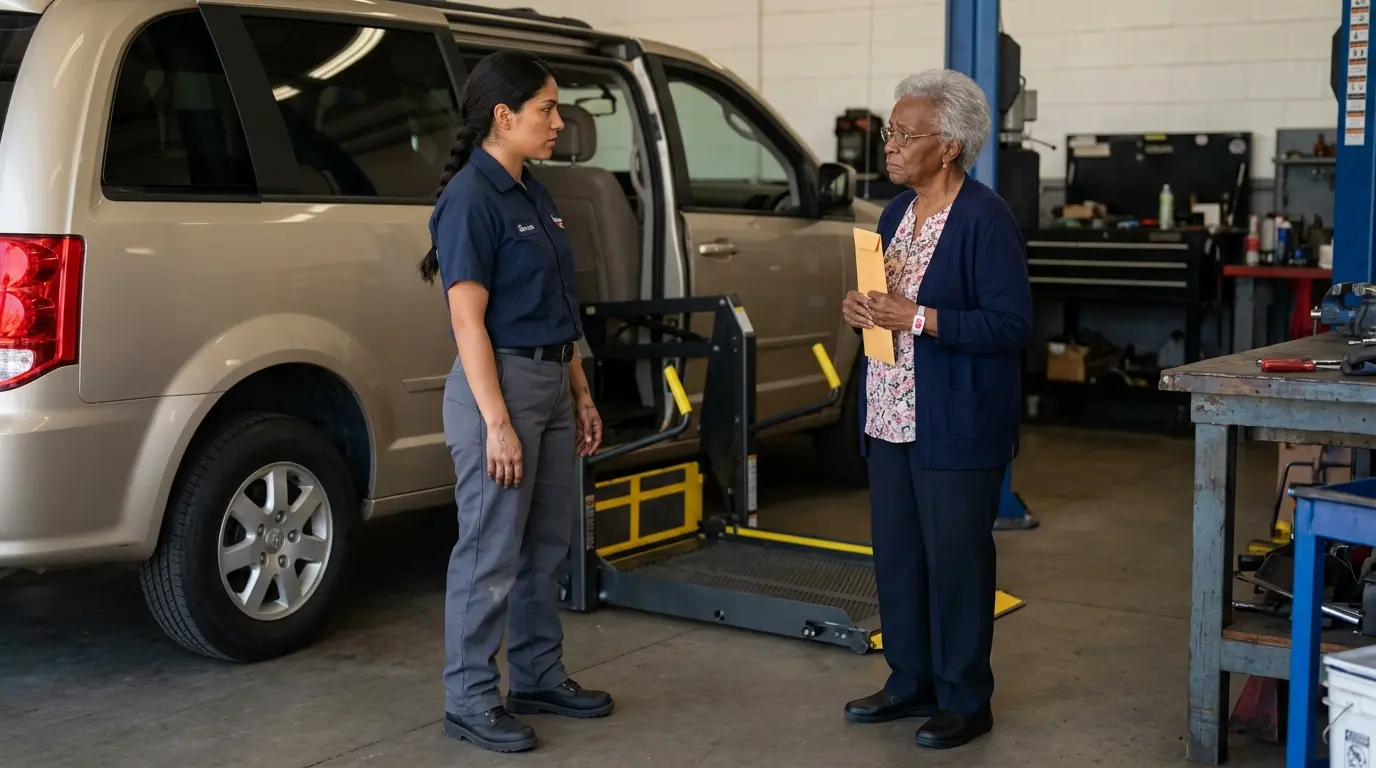
A beige wheelchair-accessible van rolled slowly toward the shop entrance, making a harsh metal scrape every few feet. The driver stopped crookedly near the first bay. The side door opened halfway, then jammed. A mechanical lift attached to the van shuddered, dropped an inch, and froze.
An elderly woman sat behind the wheel, gripping it with both hands.
Her face was pale.
She looked to be in her late seventies, with silver hair cut short around her face, deep brown skin, tired eyes behind gold-rimmed glasses, and a floral blouse beneath a navy cardigan. She wore a medical alert bracelet on one wrist. In the passenger area behind her sat a folded wheelchair, strapped in place.
Elena wiped her hands and walked toward the van.
Rick stepped out of the office at the same time.
“Ma’am, you can’t block the bay,” he called.
The woman opened her door carefully.
“I’m sorry,” she said. “I didn’t know where else to stop. The lift won’t close right, and something is scraping underneath.”
Elena stepped closer.
“I’m Elena. What’s your name?”
“Marian Brooks.”
“Mrs. Brooks, are you hurt?”
Rick glanced at the van and sighed. “Those mobility lift systems are specialty equipment. We don’t usually handle them.”
“I called the mobility service center,” Marian said quickly. “They can’t see me until Monday.”
“Then you’ll probably need to wait for them.”
Marian’s lips trembled.
“I can’t wait until Monday.”
Rick’s expression tightened with impatience.
“Ma’am, if it’s specialized, there’s only so much we can do.”
Elena looked at the lift. It was not fully deployed, not fully stored. A loose bracket near the underside seemed to be dragging. The lift motor housing looked misaligned, and one safety arm was jammed at an angle.
“What happened?” Elena asked.
Marian took a folded envelope from her purse.
“I was leaving the courthouse. The lift started making a noise when I lowered it. I got the wheelchair in, but when I tried to close it, it stuck. I drove here slowly because this was the closest repair shop.”
“The courthouse?” Elena asked.
Marian nodded.
“My granddaughter’s adoption hearing is tomorrow morning.”
That made Elena pause.
Marian’s voice grew unsteady.
“My daughter passed away two years ago. My granddaughter, Tessa, has been living with me since. Tomorrow is the final hearing. I promised her I would be there early, dressed nicely, with her favorite blue ribbon in my purse.” She looked at the van. “This is the only vehicle I can use when my arthritis is bad. If the lift won’t work, I can’t safely manage the chair by myself.”
Rick rubbed the back of his neck.
“I’m sorry, but we’re full today. We can look at the scraping underneath, but the lift system—”
“I’ll look at it,” Elena said.
Rick turned. “Elena.”
She ignored his tone and crouched beside the van.
The trailer image would be clear.
An elderly woman stands outside an auto shop, holding a courthouse envelope, her wheelchair lift jammed open and scraping against the pavement. The shop owner is ready to turn her away. A young Latina mechanic kneels beside the van, looks at the broken lift, and says, “I’ll look at it.”
Elena put on gloves, grabbed a flashlight, and slid partly under the side of the van.
The dragging sound came from a bent support arm connected to the lift frame. One bolt had loosened, another had sheared halfway, and the bracket had shifted out of alignment. The lift motor still worked, but the mechanism could not retract properly because the arm was binding. It was dangerous to force it.
She stood.
“Mrs. Brooks, I think the lift frame shifted. The bracket is loose, and one bolt is damaged. I may be able to stabilize it enough to close and reopen safely, but I need to inspect the wiring and support arm.”
Marian’s eyes filled with hope.
“You can fix it?”
“I can try. I won’t lie. A mobility specialist should still inspect it. But I may be able to make it safe enough for tomorrow.”
Rick stepped closer, lowering his voice.
“We don’t have time for experimental charity.”
Elena looked at him.
“This isn’t experimental. It’s a bracket, a support arm, and a lift alignment issue.”
“We don’t stock parts for that.”
“I can fabricate a temporary support plate and replace the bolt with grade-eight hardware from inventory.”
“And if it fails?”
“I’ll test it.”
Rick shook his head.
“She’ll need a liability waiver.”
“Fine.”
Marian looked from one to the other.
“I can pay some,” she said. “Not all today, maybe, but I can pay.”
Elena saw shame moving across the woman’s face.
She hated how often repair shops made people feel cornered.
“Let me diagnose it first,” Elena said. “Then we’ll talk cost.”
Rick opened his mouth, but Elena added, “I’ll do it on my lunch and after my shift if I need to.”
“You already skipped lunch.”
“Then I’m consistent.”
Rick stared at her, frustrated.
“Do not hold up paid jobs.”
“I won’t.”
Elena guided Marian to a chair inside the waiting area and brought her water. Then she pulled the van into a side space, moving slowly so the dragging bracket would not tear loose. She set wheel chocks, lifted the side with a jack, secured it on stands, and got to work.
The problem was worse up close.
The bracket had not only loosened. The mounting area had rust around the edge. Not catastrophic, but enough to make the lift unstable if ignored. The wiring harness had also been rubbed by the shifted arm, exposing a small section of insulation. One more rough trip could have caused a short.
Elena worked quickly but carefully.
She removed the damaged bolt.
Cleaned the rusted area.
Checked the frame.
Cut a small steel plate from scrap stock.
Drilled it to match the bracket holes.
Filed the edges smooth.
Reinforced the bracket.
Replaced the bolt with stronger hardware.
Secured the wiring harness away from the moving arm.
Lubricated the hinge points.
Then came the hard part.
The alignment.
She opened and closed the lift slowly with the manual control, watching every inch of movement. At first, it stuck halfway. She adjusted the support arm. Tested again. Still too much resistance. She adjusted the stop position. Tested again.
The lift moved better.
Not perfect.
Better.
Marian watched through the waiting room window, hands clasped around the courthouse envelope.
The shop moved around them. Engines started. Impact wrenches rattled. Customers paid and left. Rick took phone calls. The sun lowered behind the buildings, turning the parking lot orange.
Elena kept working.
At six o’clock, Rick locked the front office.
“You staying?” he asked.
“Yes.”
“You’re not getting overtime for this.”
“I know.”
He sighed.
“You’re stubborn.”
“I’ve been told.”
After he left, the shop became quiet except for the buzz of fluorescent lights and the faint ticking of cooling engines.
Marian still sat in the waiting room.
Elena went to her.
“You should call someone to pick you up.”
“I don’t want to leave the van.”
“It’ll be safe here.”
Marian shook her head.
“Tessa is at home with my neighbor. She called twice. I told her I’m handling it.”
“You are.”
Marian looked at the courthouse envelope.
“I told her tomorrow would be the day everything became official. She wore her blue ribbon to school all week. She keeps asking if judges smile.”
Elena smiled softly.
“Do they?”
“I don’t know. I hope this one does.”
Elena sat across from her for a moment.
“How old is Tessa?”
“Seven.”
“That’s a big day.”
“The biggest of her life so far.”
Marian’s voice broke.
“I can’t let a van be the reason I miss it.”
Elena stood.
“Then it won’t be.”
She returned to the lift.
At nearly eight o’clock, after multiple adjustments, she tried the full cycle again.
The side door opened.
The lift deployed.
Lowered.
Raised.
Retracted.
Locked.
No scraping.
Elena exhaled.
Then she tested it again.
And again.
And again.
Marian stood in the bay doorway, one hand over her mouth.
“Is it working?”
“Yes,” Elena said. “But I want to test it with the wheelchair weight.”
They strapped the folded wheelchair properly and ran the cycle again. The lift moved steadily.
Elena checked the bracket after each cycle.
The temporary reinforcement held.
“It should get you through tomorrow safely,” Elena said. “But you need a mobility technician to do a permanent inspection next week.”
Marian nodded quickly.
“I will. I promise.”
Elena wrote everything down clearly: what had failed, what she repaired, what still needed professional mobility-system inspection, and what warning signs to watch for. She also taped a bright note near the lift controls: Do not force lift. If resistance occurs, stop and call service.
Marian looked at the paper.
“You explained it so I can understand.”
“That’s how explanations should work.”
A tear slipped down Marian’s cheek.
“What do I owe?”
Elena hesitated.
Materials were not expensive. Labor was hours.
Rick would expect something.
“Pay for the hardware and basic shop fee,” Elena said. “I’ll cover my time.”
“No.”
“Mrs. Brooks.”
“No, dear.” Marian straightened. “Do not make my dignity another thing I cannot afford.”
Elena stopped.
She understood that.
“Then we’ll make it a payment plan.”
Marian nodded.
“That I can accept.”
The next morning, Elena woke before sunrise and drove to the courthouse before her shift.
She told herself she only wanted to make sure the lift worked.
Marian arrived fifteen minutes later in the beige van. The lift deployed smoothly. Marian stepped carefully onto it with her wheelchair folded beside her. Elena watched from a distance as a little girl in a blue ribbon ran toward her.
“Grandma!”
Marian bent down and hugged Tessa tightly.
The courthouse doors opened.
The judge did smile.
Later that afternoon, Marian came to Desert Star Auto with Tessa beside her.
Tessa wore a blue dress, white shoes, and the same blue ribbon in her hair. She held a small paper in both hands.
Marian’s face shone with exhaustion and joy.
“It’s official,” she said.
Tessa stepped forward and handed Elena the paper.
It was a child’s drawing.
A beige van.
A smiling grandmother.
A mechanic with a braid holding a wrench.
At the top, in uneven letters, Tessa had written:
Thank you for fixing Grandma’s van so she could keep me.
Elena had to turn away for a second.
When she looked back, Marian was crying too.
“You didn’t just repair a lift,” Marian said softly. “You kept a promise I made to a child.”
Elena pinned Tessa’s drawing inside her toolbox.
After that day, Marian became a regular part of Elena’s life.
At first, it was practical. Marian brought the van in for checkups. Elena made sure the lift stayed secure. She helped Marian schedule the proper inspection with a mobility specialist. She checked tire pressure, fluids, belts, and brakes because she knew Marian drove Tessa to school, therapy appointments, and family court follow-ups.
Then the visits became personal.
Marian sometimes brought empanadas from a bakery near her church. Tessa came with drawings. Elena showed her how to check oil with a dipstick and explained why tires needed air. Tessa declared she would become “a car doctor” when she grew up.
Marian laughed.
“Elena may have started something dangerous.”
“Good,” Elena said. “The world needs more girls with tools.”
Marian had once worked as a school principal. She had spent thirty-five years in education, mostly in neighborhoods where children carried more than backpacks into the classroom. She knew how to speak with authority, but she also knew how to listen beneath noise.
“You remind me of girls I used to fight for,” Marian told Elena one afternoon.
“Fight for?”
“Girls who were told to be smaller than they were.”
Elena looked down at the wrench in her hand.
“I’m not small.”
“No,” Marian said. “But sometimes you work in places that try to make you feel that way.”
Elena did not answer.
She did not have to.
Over the next year, Elena’s frustration at Desert Star grew.
Rick trusted her skill but not her judgment. He gave her complicated jobs but introduced her to customers as “one of our younger techs,” never as the mechanic who solved problems other people missed. He refused to consider payment plans for elderly customers, even when repairs were safety-related. He once told a retired man to “scrap the car” before Elena discovered the problem was a corroded ground wire.
She kept thinking of Cruz Community Auto.
A garage where explanations were clear.
Where customers sat at a desk instead of being talked down to over a counter.
Where older people could bring vehicles for safety checks without fear of being tricked.
Where girls could see women under the hood.
Where nobody’s dignity was treated like an extra charge.
One evening, after work, Marian found Elena sitting outside the shop on a concrete curb, staring at her notebook.
“What are you designing?” Marian asked.
Elena startled.
“Nothing.”
Marian sat beside her slowly.
“At my age, ‘nothing’ usually means something too heavy to say.”
Elena smiled tiredly.
“It’s just a garage I’ll never afford.”
“Tell me anyway.”
So Elena told her.
Cruz Community Auto.
A small repair shop with fair pricing, basic safety inspections for seniors, clear written explanations, bilingual service, payment plans for essential repairs, and a training bay for young women interested in mechanics.
Marian listened like she was hearing a business proposal, not a fantasy.
When Elena finished, Marian said, “You already know what it is.”
“That doesn’t mean I can build it.”
“No. But it means it is real enough to be built.”
“I need money, a building, lifts, tools, insurance, permits, customers, parts accounts…”
“A list,” Marian said.
“A giant list.”
“Still a list.”
Elena laughed softly.
“You sound like my dad.”
“Good. He must be wise.”
“He is.”
“Then listen to both of us.”
Elena closed the notebook.
“I’m scared.”
Marian looked at the open garage bays.
“Of failing?”
“Of leaving a steady job. Of proving everyone right. Of opening a shop and watching it collapse like my dad’s did.”
Marian’s face softened.
“Your father’s garage did not close because he failed. It closed because life struck your family hard.”
Elena swallowed.
“That’s what he says.”
“Believe him.”
The conversation stayed with Elena.
Months later, Rick crossed a line.
An elderly widower brought in a minivan with a warning light and a rattling noise. Rick quoted him a huge repair package after a quick inspection. Elena looked at the vehicle during her lunch and discovered the most urgent issue was a failing tensioner pulley, not everything Rick had listed.
When she challenged him, Rick told her in front of two other mechanics, “Stop trying to be everyone’s savior. You work for my shop, not your imaginary charity garage.”
Elena felt every word burn.
She finished the day.
Then she gave notice.
Rick told her she was making a mistake.
Maybe she was.
But by then, staying felt like a different kind of failure.
For three months, Elena worked odd jobs. Mobile oil changes. Brake pads in driveways. Battery replacements. Pre-purchase inspections. Small repairs for neighbors. Marian referred everyone she knew. Tessa made flyers with too many stars and taped them at church, school, and the community center.
Elena’s business existed out of her pickup truck.
It was exhausting.
But it was hers.
One morning, Marian called and asked Elena to meet her somewhere.
The address led to an old garage on a quiet street near the community college. The building was faded white with two service bays, a small office, cracked pavement, and a sign so weathered Elena could barely read it.
Brooks & Lane Service
Marian stood beside the van with Tessa, holding a folder.
“What is this?” Elena asked.
“My husband’s old shop,” Marian said.
Elena turned slowly.
“Your husband was a mechanic?”
“Not exactly. He handled customers and bookkeeping. His brother was the mechanic. They ran this place for twenty-two years. After my husband died, I rented it to a tire company. Then it sat empty.”
Elena walked toward the bay doors.
Through dusty windows, she saw an old lift, workbenches, shelves, a parts counter, and an office with yellowed blinds.
Her heart began pounding.
Marian watched her.
“You see it.”
“I shouldn’t.”
“But you do.”
Elena faced her.
“Marian…”
The old woman opened the folder.
“I spoke with my attorney. I am offering you a lease for one dollar a month for the first two years. After that, rent based on what the business can reasonably pay. If Cruz Community Auto becomes stable and continues offering senior safety checks and training opportunities, we will discuss transferring the building into a community trust.”
Elena shook her head immediately.
“No.”
“Yes.”
“I can’t accept this.”
“You can.”
“It’s too much.”
Marian stepped closer, her cane steady against the pavement.
“Too much was standing outside a repair shop with a broken wheelchair lift, afraid I would miss the hearing that made Tessa legally mine. Too much was watching people dismiss the problem because it was inconvenient. Too much was wondering how to explain to a seven-year-old that I could not keep my promise because a bracket failed.”
Her voice trembled, but her eyes stayed firm.
“You did not treat me like a burden. You treated my problem like it mattered. You stayed after hours. You made the lift work. You got me to that courthouse.”
Tessa slipped her hand into Marian’s.
Marian continued.
“You helped me keep my family. Let me help you build the garage your father taught you to dream of.”
Elena covered her mouth.
Tears came before words.
Tessa held up another drawing.
This one showed a garage with a big sign: Cruz Community Auto.
Under it, she had written:
Girls can fix things too.
Elena broke.
She hugged Marian carefully, then hugged Tessa, then stood in front of the old garage with the key in her hand and cried like someone whose future had finally become a place she could touch.
The renovation took almost a year.
The building needed electrical work, new lighting, updated permits, lift inspection, paint, insurance, signage, tools, and cleaning that seemed endless. Elena’s father helped design the layout from his kitchen table. Though his right hand was weak, his mind was sharp, and he remembered everything about running a garage.
Her mother handled phone calls.
Marian reviewed customer policies.
Tessa swept floors with more enthusiasm than accuracy.
Former customers donated tools. A retired mechanic volunteered twice a week. A community college instructor helped Elena set up an apprenticeship agreement. A local women’s business group helped her apply for a grant.
The old sign came down.
A new one went up.
Cruz Community Auto
Honest Repairs. Clear Explanations. Safe Roads Home.
Opening day arrived on a bright Saturday morning.
Marian was the first official customer.
She drove the beige van into Bay One, the same van Elena had repaired years earlier. Tessa sat beside her, older now, still wearing blue ribbons whenever she wanted courage.
Elena’s father sat near the office door, tears in his eyes.
Elena opened the hood, checked the fluids, tested the battery, inspected the belts, then tested the wheelchair lift carefully. Everything worked.
She printed the first invoice.
Safety inspection: No charge.
Marian frowned. “Elena.”
Elena smiled. “Grand opening special.”
“You are impossible.”
“I learned from you.”
The garage filled steadily.
Working families came for repairs. Elderly drivers came for safety checks. Young women came asking if Elena really trained apprentices. She did. Slowly, carefully, seriously. She taught them how to listen to engines, how to use tools safely, how to explain repairs without arrogance, and how to never make a customer feel foolish for asking a question.
Cruz Community Auto did not become rich overnight.
But it became trusted.
That was better.
Years passed.
Marian’s health declined, but she remained part of the garage’s heart. She sat in the office on Fridays, greeting customers as if she owned the place, which in a way, she did. She corrected Elena’s spelling on flyers, helped nervous elderly clients read estimates, and told every girl who entered, “Tools are not born belonging to boys.”
Tessa grew taller and louder and eventually started spending summers at the garage, learning to rotate tires, check brake pads, and organize parts.
One afternoon, Marian handed Elena a small metal box.
Inside was an old name badge from Brooks & Lane Service, a faded photograph of Marian’s husband standing beside the garage, and the original key to the front door.
“I want you to keep these,” Marian said.
Elena touched the photograph gently.
“Are you sure?”
“My husband believed a good garage protected people from getting stranded. You made that true again.”
Elena’s eyes filled.
Marian smiled.
“And when I am gone, I want this place to keep doing what it does best.”
“What is that?”
“Making sure people can get where they need to go.”
Marian passed away peacefully two winters later, with Tessa and Angela beside her.
At her memorial, Elena spoke.
She told the story of the broken van clearly.
The courthouse envelope.
The jammed wheelchair lift.
The scraping bracket.
The shop owner ready to turn Marian away.
The young mechanic staying late under fluorescent lights, fabricating a support plate, replacing the bolt, testing the lift again and again until it worked.
Then she told them what happened the next morning.
A grandmother arriving at court.
A little girl with a blue ribbon.
An adoption made official.
A family kept whole because a repair was treated as urgent.
“Elena,” Tessa said afterward, now a teenager, “Grandma said you didn’t just fix cars.”
“What did she say I fixed?”
Tessa smiled through tears.
“She said you fixed the road between people and the promises they needed to keep.”
Years later, Cruz Community Auto became known across Albuquerque as the garage where people were treated like neighbors before invoices. The senior safety program expanded. The apprenticeship bay trained dozens of young women. Elena’s father taught evening classes from a stool near Bay Two, his voice proud and steady. Tessa became one of the best apprentices the shop ever had.
In the office, Elena framed three things.
Tessa’s first drawing of the van.
The original key to Brooks & Lane Service.
And Marian’s sentence, written in careful letters:
Tools are not born belonging to boys.
Whenever someone asked how Cruz Community Auto began, Elena always told the truth.
“It began with a grandmother, a broken wheelchair lift, and a promise she could not miss.”
Then she would look toward Bay One, where the beige van had once rolled in scraping and half-broken.
“She needed to get to court for her granddaughter. I stayed late and fixed what I could. Years later, she gave me the garage.”
People loved that part.
But Elena knew the deeper truth.
Marian had given her more than a building.
She had given her proof that honest work could become a community, that a repair done with care could change a family’s future, and that sometimes the road to your own dream begins when you help someone else keep a promise.
Every morning, before opening the shop, Elena touched the old key hanging near the office door.
Then she unlocked Cruz Community Auto, turned on the lights, and listened as the garage woke around her.
The air smelled of oil, metal, coffee, and possibility.
And somewhere in the first bay, beneath the sound of engines and tools, Elena could still hear Marian’s voice.
Make sure people can get where they need to go.