At twenty-four, Emma Wallace believed a home did not become old all at once.
It happened quietly.
A window began to stick.
A step started to dip.
A hinge loosened.
A ceiling stain appeared after heavy rain.
A person promised to fix it “next week,” and then next week became next month, and next month became another winter.
Emma noticed things like that because she had grown up in a house where repairs were never optional. Her father had been a carpenter, the kind of man who could look at a crooked door and know exactly which hinge had given up first. Her mother used to say he did not fix houses. He helped them keep their promises.
Emma lived in a small town in Michigan called Briar Lake, where the streets curved around maple trees, modest houses, old porches, and narrow driveways where people still waved from their cars.
She was a young white American woman with fair skin, long chestnut-brown hair usually tied into a low ponytail, soft green eyes, and careful hands that were often marked with sawdust, paint, or tiny cuts from old wood.
She worked at Briar Lake Hardware & Repair, a small shop on Main Street that sold tools, paint, screws, lumber, plumbing parts, batteries, weatherstripping, and everything people needed when something broke at the worst possible time.
Emma was not the owner.
She worked the counter, mixed paint, carried supplies to cars, cut keys, and helped with small repair jobs when her boss trusted her enough to send her out. Some customers still asked, “Is there a man who knows about this?” when she answered their questions.
Emma had learned to smile and say, “Tell me what’s broken first.”
Usually, by the end of the conversation, they stopped asking.
Her dream was to start a small home-repair service for elderly people called The Good House Project.
She wanted to help older neighbors repair the things that kept them safe: loose rails, broken steps, bad locks, leaking gutters, weak porch boards, stuck windows, and roof leaks that could turn into disasters.
She did not want to build luxury remodels.
She wanted to help people stay in the homes where their lives had happened.
But dreams needed insurance, tools, a truck, training, permits, business licenses, and money.
Emma had her father’s old measuring tape, a borrowed drill, a small paycheck, and a notebook full of ideas.
So she kept working.
Next door to Emma lived Mrs. Helen Carter.
Helen was seventy-nine, a white American woman with short silver hair, pale skin, gentle blue eyes, and a soft voice that made even ordinary sentences feel like they had been wrapped in a quilt.
She lived alone in a small blue house with white trim, a narrow porch, and a backyard full of hydrangeas her late husband had planted thirty years earlier.
Her husband’s name had been Walter.
Emma had never met him, but she felt as if she knew him from Helen’s stories.
Walter had been a school bus driver.
Walter had loved black coffee.
Walter had built the kitchen shelves himself and made them slightly crooked.
Walter had planted the hydrangeas too close together because he believed flowers liked company.
Walter had danced with Helen in the living room every New Year’s Eve, even after his knees got bad.
Every Saturday morning, Emma brought Helen’s trash bin back from the curb.
Every Sunday afternoon, Helen brought Emma something small: banana bread, tomatoes, soup, or a note that said, “Do not skip dinner, young lady.”
They were neighbors first.
Then friends.
One stormy evening in late September, rain began falling before sunset.
At first, it was gentle. Then the wind rose. By seven o’clock, rain hammered the roofs, gutters overflowed, and water rushed down the street in silver streams.
Emma was in her kitchen making tea when she heard knocking.
Not at her front door.
From outside.
She opened the door and saw Helen standing on her porch in a raincoat, soaked at the shoulders, one hand gripping the rail.
“Helen?” Emma hurried forward. “What are you doing out in this rain?”
Helen’s face was pale.
“I’m sorry, dear. I didn’t know who else to ask.”
Emma stepped onto the porch.
“What happened?”
Helen’s voice trembled.
“The ceiling is leaking. In Walter’s room.”
Emma did not ask what Walter’s room meant.
She already knew.
It was the small back room Helen kept exactly as it had been when Walter was alive. His books were there. His bus-driver cap. His old radio. Boxes of photographs. Letters. A wooden model bus he had carved by hand. A desk covered in papers Helen could not yet sort.
Emma grabbed her rain jacket and toolbox.
“I’m coming.”
Inside Helen’s house, the smell of rain and old wood filled the hallway. A steady drip echoed from the back room.
Helen led her there with shaking hands.
Water was falling from the ceiling near the window.
Not a little.
A thin but constant stream.
It dripped directly onto a cardboard box sitting beneath the desk. The top had already darkened with water. Beside it, several envelopes and a photo album lay dangerously close to the growing puddle.
Helen froze at the doorway.
“Oh no,” she whispered.
Emma moved fast.
She picked up the photo album first and carried it to the hallway. Then she lifted the wet cardboard box. It was heavier than she expected, and the bottom sagged.
“Kitchen table,” she said. “Quick.”
Together, they carried what they could. Emma spread towels across the table and opened the box carefully.
Inside were blueprints.
Old house drawings.
Some were rolled.
Some folded.
Some loose and handwritten.
Helen covered her mouth.
“Walter’s plans.”
Emma looked up.
“Walter drew these?”
Helen nodded, tears filling her eyes.
“He wanted to build small homes after he retired. Simple homes. Safe homes. Homes older people could live in without stairs everywhere. He drew plans for years, but then he got sick.”
Emma looked down at the damp papers.
The top pages were wet at the edges, but not destroyed.
She moved carefully, laying them flat on dry towels, placing paper towels between damp sheets, and weighting the corners with plates so they would not curl.
“Helen, these can be saved if we dry them slowly.”
“Are you sure?”
“Yes. But I need to stop the leak first.”
Helen looked toward the back room.
“The roof?”
“Probably flashing or shingles near that back corner. I can’t repair the whole roof in this storm, but I can make a temporary patch to stop more water from coming in tonight.”
“Oh, Emma, no. It’s raining too hard. I can call someone tomorrow.”
“Tomorrow, those plans might be gone.”
Helen’s face crumpled.
Emma softened her voice.
“I’ll be careful.”
She called her boss, Mr. Briggs, at the hardware store.
“Emergency roof leak. Elderly neighbor. Water coming into a room with paper records. I need a tarp, roofing tape, and temporary patch supplies.”
Mr. Briggs did not hesitate.
“Store key is under the office mat. Take what you need. Do not climb if there’s lightning.”
“There’s no lightning now.”
“If there is, you get down.”
“Yes, sir.”
Emma drove through the rain to the shop, gathered a heavy tarp, roofing sealant, waterproof tape, a utility knife, rope, gloves, and a headlamp, then returned to Helen’s house.
The rain had softened slightly, but the roof was slick.
Emma set up the ladder carefully, tied it off, and climbed only high enough to reach the low back section of the roof. She found the problem quickly. A branch had fallen against the shingles near the back dormer, lifting a section and allowing water to run beneath.
It was not a permanent fix.
But it could be protected.
Emma cleared the branch, laid the tarp across the damaged area, secured it with rope, and sealed the most vulnerable edge with temporary roofing tape. Rain ran down her sleeves and into her gloves. Her hair stuck to her face. Twice, the wind pushed the tarp sideways, and she had to stop, breathe, and reset it.
From below, Helen called, “Please be careful!”
Emma looked down.
“I am!”
“You sound like someone being brave instead of careful!”
Emma almost laughed.
“Sometimes they overlap!”
By the time she climbed down, the drip inside had slowed.
Then stopped.
Helen stood in the back room staring at the ceiling.
No more water fell.
She turned to Emma, eyes full.
“You stopped it.”
“For tonight,” Emma said. “A roofer still needs to fix it properly.”
“You saved the room.”
Emma looked toward the kitchen, where Walter’s blueprints lay drying on towels.
“No. We saved the important part first.”
Helen sat heavily at the kitchen table.
Her hands trembled as she touched one of the drawings.
“This one,” she whispered. “This was his favorite.”
Emma leaned closer.
The drawing showed a small one-story cottage with a wide front porch, no stairs at the entrance, broad doorways, a kitchen open to the living room, a bedroom close to the bathroom, and a laundry space designed so no one had to carry baskets down steps.
There were notes in the margins.
No step at entry.
Room for walker beside bed.
Windows low enough to see garden while seated.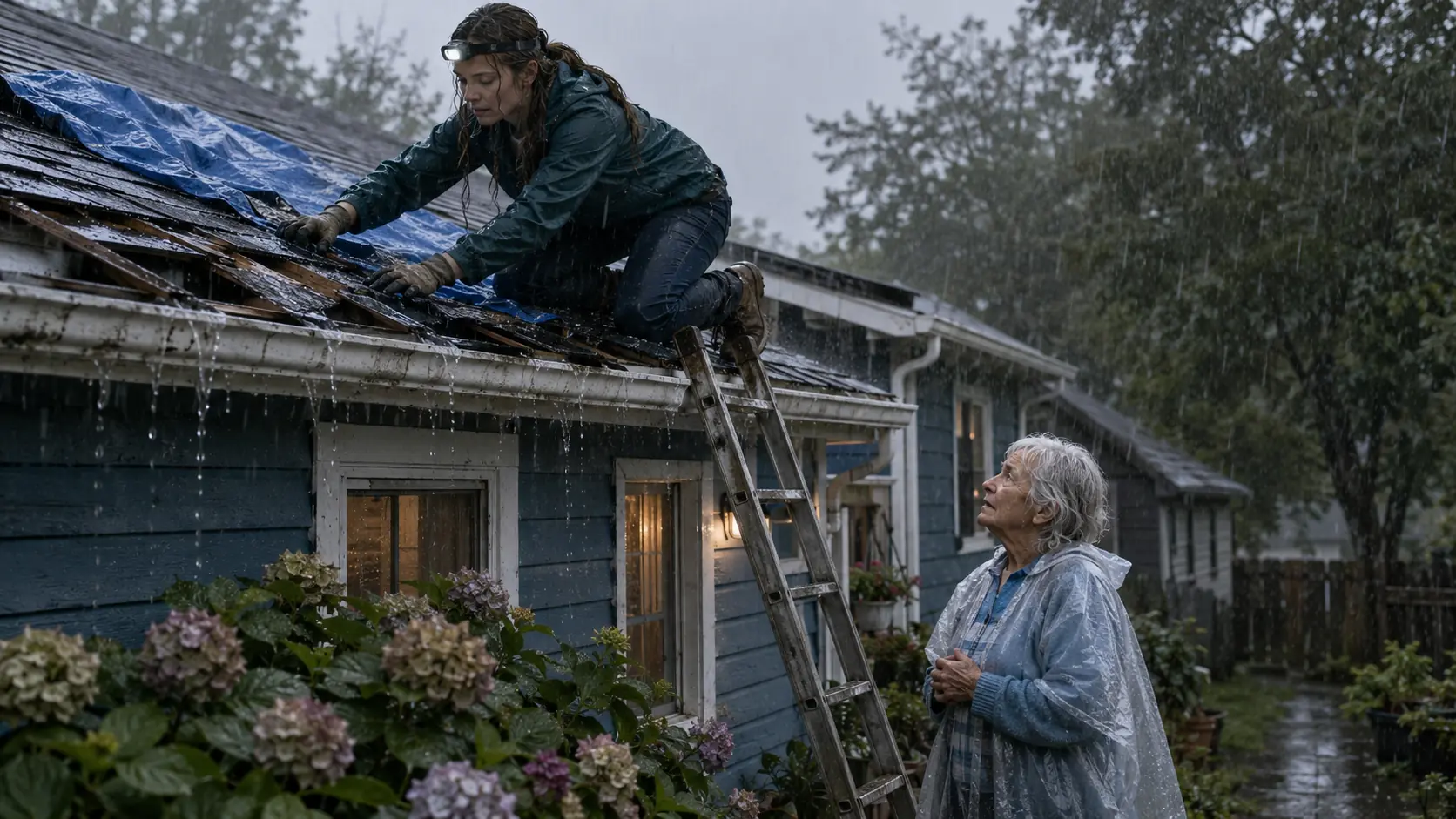
Porch rail must feel like welcome, not warning.
Small house, big dignity.
Emma read that last line twice.
Small house, big dignity.
“That’s beautiful,” she said softly.
Helen smiled through tears.
“He said people should not have to leave beauty behind just because their bodies changed.”
Emma’s throat tightened.
That was exactly what she believed, but Walter had drawn it before she even knew how to say it.
For the next week, Emma helped Helen dry and organize the blueprints. She brought archival sleeves from the library, made digital scans at the hardware store office, and labeled each plan carefully.
Helen told stories while Emma worked.
Walter had started drawing after his mother fell twice in her old house.
He hated how many homes made aging feel like failure.
He wanted to design simple repairs and small accessible houses that looked warm, not medical.
He never had the money to build them.
“He used to say a good home should not punish you for growing old,” Helen said.
Emma wrote that down in her notebook.
The permanent roof repair happened a few days later. Emma arranged the appointment, helped Helen compare estimates, and made sure the contractor understood exactly where the leak had started. She also moved Walter’s papers into plastic storage bins with labels.
Helen watched her carefully.
“You do this naturally.”
“What?”
“Protect what lets people stay home.”
Emma looked embarrassed.
“I just know what can go wrong.”
“That is a gift.”
“It feels more like worry.”
“Many gifts begin as worry.”
After that storm, something changed.
Helen began showing Emma more of Walter’s plans. Not only house drawings, but repair notes: safer porch steps, better handrails, brighter entry lights, easier door handles, ramps that looked like part of the home, kitchen shelves reachable from a chair.
Emma studied them at night.
She began adding her own notes.
Materials list.
Estimated cost.
Simpler repair version.
Possible volunteer day.
Good for older homes on narrow lots.
She did not realize Helen had noticed until one Saturday morning, when Helen placed a small wooden box on the kitchen table.
Inside were Walter’s drafting pencils, a brass ruler, a small compass, and a worn black notebook.
Emma looked up quickly.
“Helen, no.”
Helen smiled.
“You haven’t heard the offer.”
“I know where this is going.”
“Then don’t interrupt an old woman.”
Emma closed her mouth.
Helen opened the black notebook to the first page.
Walter had written:
A home is not safe because it is new.
It is safe because someone cared enough to notice where life actually happens.
Emma’s eyes burned.
Helen pushed the box toward her.
“I want you to have these.”
“I can’t.”
“You can.”
“They were Walter’s.”
“And Walter would want them in working hands.”
“They belong to your family.”
“My family has his photographs, his letters, his watch. These belong to the person who climbed onto my roof in the rain to save his unfinished work.”
Emma swallowed hard.
“I didn’t do it for a reward.”
“That is why you deserve one.”
Helen also handed her a folded letter.
“I wrote this for the small business grant at the county office. The one you mentioned once and then pretended not to care about.”
Emma stared.
“You remembered that?”
“I am old, not empty.”
Emma laughed through tears.
Helen’s letter told the story of the storm, the leaking roof, the rescued blueprints, and Emma’s dream of The Good House Project. At the end, she wrote:
Emma Wallace understands that repair is not only about wood, nails, and tools. It is about helping people remain safely inside the lives they built.
With Helen’s letter, Walter’s plans, photos of Emma’s small repair jobs, and support from Mr. Briggs, Emma applied for the grant.
She won.
It was not a fortune.
Not a company handed to her.
Not a truck.
But enough to buy liability insurance, better tools, a used ladder rack, safety gear, printed repair checklists, and a small website.
The Good House Project began on weekends.
Her first official customer was Helen.
Not for the roof.
For the porch rail.
Then Mrs. Alvarez down the street needed brighter stair lighting.
Mr. Donnelly needed a loose bathroom grab bar fixed.
A retired teacher needed her kitchen shelves lowered.
An older couple needed a threshold ramp.
Emma charged fairly when people could pay and used donated funds when they could not. She kept detailed records. She photographed repairs before and after. She wrote down the stories too, because Walter’s blueprints had taught her that practical work and human dignity belonged together.
Helen became her unofficial office manager.
She sat at her kitchen table with tea and told Emma which neighbors needed help but were too proud to ask.
“Call Mrs. Reed first,” she would say. “She says her steps are fine, which means they are absolutely not fine.”
Emma learned that Helen was usually right.
Years passed.
The Good House Project grew slowly across Briar Lake. Emma still worked part-time at the hardware store at first, then less, then finally opened her own small repair office in a converted garage. She specialized in helping elderly people stay safely in their homes: railings, steps, lighting, door handles, ramps, leak prevention, storage changes, and beloved furniture repairs.
She never became rich.
But she became trusted.
On the wall of her office, Emma framed one of Walter’s rescued blueprint pages.
Small house, big dignity.
Helen lived long enough to see it there.
She stood in Emma’s office one spring afternoon, looking at the frame with tears in her eyes.
“He would be impossible about this,” Helen said.
“Impossible how?”
“He would pretend not to cry, then measure the frame to see if it was level.”
Emma laughed.
“It is level.”
“He would check anyway.”
Helen passed away peacefully two winters later.
At her memorial gathering, held in her blue house, Walter’s blueprints were displayed across the dining table. Neighbors told stories about repairs Emma had done because Helen had quietly sent her their way.
Afterward, Helen’s daughter handed Emma an envelope.
“Mom left this for you.”
Inside was a photograph of Helen and Walter standing in front of their blue house, young and smiling, Walter holding a rolled blueprint under one arm.
There was also a note.
Dear Emma,
The night the roof leaked, I thought the rain had come to take one more piece of Walter from me.
You came with your toolbox.
You climbed into the storm.
You saved the plans.
Then you gave them somewhere to keep living.
Keep noticing what others overlook.
Keep fixing what lets people stay.
With love,
Helen Carter
Emma framed the note beside Walter’s blueprint.
Years later, whenever people asked how The Good House Project began, Emma told them the truth.
“It began next door, in the rain, with a leaking roof and an old woman afraid her husband’s drawings would be destroyed.”
Then she would show them Walter’s black notebook.
The gift was small.
A box of pencils.
A letter.
A rescued blueprint.
But inside those small things was the future Emma had been trying to build.
And every time she tightened a railing, sealed a leak, repaired a step, or lowered a shelf for someone who wanted to stay in the home they loved, Emma remembered Walter’s words.
A good home should not punish you for growing old.
So she worked carefully.
Because sometimes fixing a house was really helping a life remain standing.