At twenty-six, Hannah Miller had learned that hunger did not always announce itself with a loud stomach or an outstretched hand.
Sometimes hunger walked through a bakery door wearing a clean but thin coat.
Sometimes it held a worn handbag with both hands, as if politeness alone could keep the world from noticing need.
Sometimes it stood beneath the soft glow of pastry cases and asked for something no one should have to ask for.
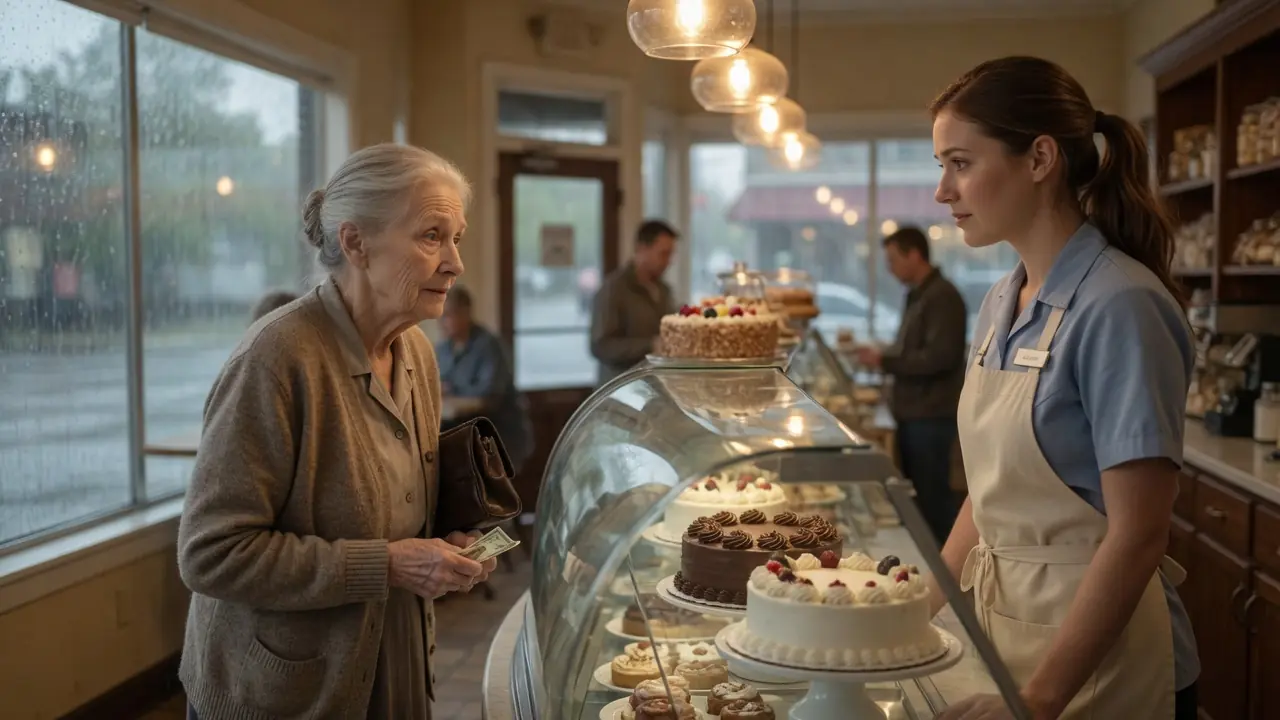
“Do you have any expired cake?” she whispered.
Hannah looked up from behind the counter.
For a moment, she thought she had misheard.
The bakery was warm, bright, and fragrant with butter, cinnamon, vanilla, coffee, and fresh bread.
Outside, late afternoon rain streaked the windows of Miller’s Bakery on Main Street in Cedar Falls, Ohio.
Inside, glass cases displayed lemon bars, blueberry muffins, chocolate cupcakes, cinnamon rolls, apple turnovers, butter cookies, and small round cakes with smooth frosting.
It was the kind of place where people came to buy birthday treats, apology cookies, office donuts, holiday pies, and something sweet after a hard day.
It was not the kind of place where someone should have to ask for expired cake.
The woman standing at the counter looked to be in her late seventies.
She was white, small, and thin, with silver hair tucked beneath a pale gray knit hat.
Her skin was pale and finely lined, her blue eyes tired behind round glasses.
She wore a beige coat that had been brushed clean but was clearly old, dark gloves with one small hole near the thumb, and black shoes damp from the rain.
A small handbag hung from her arm.
She stood very straight, as if posture could protect dignity.
Hannah was a young white American woman with fair skin, long chestnut-brown hair tied into a loose ponytail, soft hazel eyes, and flour dusted faintly across one sleeve.
She worked at the bakery six days a week.
Her aunt owned the place, but Hannah did almost everything: opened the shop, brewed coffee, helped customers, decorated cupcakes, packed orders, cleaned tables, and sometimes stayed late to prepare dough for the next morning.
She loved the bakery because it made people happy in small, visible ways.
A child pressing both hands against the glass case.
An old man buying one cinnamon roll every Friday for his wife.
A tired nurse taking home a box of cookies after a long shift.
A father choosing a cake with more seriousness than most people chose cars.
But Hannah also knew the bakery showed another side of people.
People counted coins at the register and pretended not to.
People asked for the cheapest thing and apologized.
People bought one muffin and cut it in half for two children.
People looked at food through glass and then walked away smiling too brightly.
Hannah had learned to recognize the face of someone trying to hide need.
The old woman’s question made the entire warm bakery feel suddenly quiet.
“Do you have any expired cake?” she whispered again, even softer.
Hannah came closer to the counter.
“I’m sorry?”
The old woman’s cheeks flushed.
“Expired cake. Or anything you were going to throw away.”
Her voice was careful.
Not demanding.
Not dramatic.
Careful in the way people become when they are afraid of being refused.
“I don’t need anything nice,” the woman added quickly. “Just if it’s not sellable. I can pay a little.”
Hannah felt something twist in her chest.
The bakery had fresh cakes cooling in the back.
There were muffins from that morning.
There were rolls, cookies, and bread.
Yet this woman had asked for the thing least likely to make her feel like she deserved kindness.
Expired cake.
“What’s your name?” Hannah asked gently.
The woman blinked, surprised.
“Margaret Ellis.”
“I’m Hannah.”
Margaret nodded, holding her handbag tighter.
“I don’t want to be trouble, Hannah.”
“You’re not trouble.”
“I know bakeries throw things away at the end of the day. I thought maybe…” She swallowed. “Maybe you had something from yesterday.”
Hannah looked at the clock.
4:42 p.m.
The shop closed at six.
There were still customers sitting near the window: two college students sharing coffee and a mother with a little boy eating a cookie.
Margaret seemed painfully aware of them.
She kept her voice low.
Hannah understood.
This was not only about hunger.
It was about being seen hungry.
That was worse for some people than hunger itself.
Hannah stepped around the counter.
“Margaret, would you like to sit for a moment?”
“Oh, no. No, I only came to ask.”
“You’re wet from the rain.”
“I’m fine.”
Her hands were shaking.
Fine was not true.
Hannah smiled softly.
“We have a table near the heater. You can sit while I check what we have.”
Margaret hesitated.
“I don’t want people staring.”
“No one will.”
Hannah guided her to the small table in the corner beside a shelf of jams and coffee beans.
It was the quietest table in the bakery, partly hidden from the main counter by a wooden display.
Margaret sat carefully, as if she did not want to take up too much space.
Hannah noticed the way she lowered herself slowly, one hand gripping the chair for support.
She noticed the damp hem of her coat.
She noticed the way Margaret’s eyes flicked toward the pastry case, then away quickly.
Hunger had pride.
That was the hardest part.
Hannah went behind the counter and found her aunt, Linda, in the back room frosting cupcakes.
Aunt Linda was fifty-eight, sturdy, sharp-eyed, and kind in the practical way of women who had spent decades feeding people and pretending not to notice when feeding became rescue.
“What is it?” Linda asked.
“There’s an elderly woman at table five. She asked for expired cake.”
Linda’s hand stopped above a cupcake.
“Expired?”
“Yes.”
Linda looked toward the front.
“Is she asking for scraps?”
“She said she could pay a little.”
Linda closed her eyes for one second.
Then she said, “Make her a plate.”
Hannah nodded.
“Fresh?”
Linda gave her a look.
“Did I say give that woman trash?”
Hannah smiled faintly.
“No.”
“Soup too. There’s vegetable soup in the warmer.”
“That’s for staff.”
“So now she’s staff.”
Hannah’s throat tightened.
“I’ll make it.”
“And don’t make a show of it,” Linda said.
“I know.”
Hannah prepared a tray carefully.
A bowl of hot vegetable soup.
Two slices of fresh bread with butter.
A small piece of vanilla cake with strawberry filling.
A cup of tea.
She added a napkin, a spoon, and a fork.
Then she paused.
If she brought too much, Margaret might feel exposed.
If she brought too little, she might still be hungry.
Hannah took a breath and carried the tray to the corner table.
Margaret looked up, startled.
“Oh, no. Dear, I can’t afford all that.”
“It’s from the kitchen,” Hannah said softly. “We made extra soup today, and this cake slice is from a sample batch.”
Margaret’s eyes moved to the cake.
Fresh frosting.
Soft crumb.
A small strawberry layer visible at the side.
Not expired.
Not leftover garbage.
Something a person would choose.
“I asked for expired,” Margaret whispered.
“I know.”
“This is fresh.”
“Yes.”
“I can’t—”
Hannah sat across from her for a moment.
“My aunt says sample cake needs an opinion. You would be helping us.”
Margaret looked at her carefully.
“That is not true.”
Hannah smiled gently.
“Not completely.”
Margaret gave a tiny laugh, but tears filled her eyes.
“I don’t want charity.”
“I don’t want you hungry.”
The words were simple.
Too simple to argue with.
Margaret looked down at the soup.
Her hands trembled around the spoon.
“Just this once,” she whispered.
“Just this once,” Hannah agreed, though she already knew it would not be the end.
Margaret began with the soup.
At first, she took small, careful spoonfuls.
Then the warmth reached her.
Her shoulders lowered.
Color returned faintly to her cheeks.
She ate the bread slowly, spreading a little butter on each bite.
When she tasted the cake, she closed her eyes.
For a second, Hannah saw not an old woman asking for expired food, but a person remembering sweetness.
Margaret opened her eyes quickly, embarrassed.
“It’s very good.”
“Thank you.”
“My husband loved vanilla cake.”
“What was his name?”
“Arthur.”
The name softened her face.
“He said chocolate cake tried too hard.”
Hannah laughed.
“That’s a strong opinion.”
“Arthur had many of those.”
Margaret looked at the cake again.
“He passed three years ago.”
“I’m sorry.”
“Thank you.”
Her fork rested against the plate.
“After he died, I stopped baking. It felt foolish to make a whole cake for one person.”
Hannah understood.
Grief often changed the size of ordinary things.
A table became too large.
A pot of soup became too much.
A cake became evidence that someone was missing.
Margaret took another bite.
“I didn’t come because I wanted cake,” she said quietly.
Hannah waited.
“I came because my grocery card didn’t work.”
Her voice shook.
“At the store, I mean. The card declined. I thought maybe I had miscounted, but the cashier said the balance was zero. It should not be zero.”
Hannah’s attention sharpened.
“Did you call anyone?”
“My daughter, Claire. She works at the hospital and couldn’t answer. I tried the benefits office, but they close at four. I bought nothing. I walked around for a while.” Margaret’s cheeks flushed with shame. “Then I saw the bakery lights.”
“And you came in.”
“I almost didn’t.”
“I’m glad you did.”
Margaret looked down.
“I have food at home. Some crackers. Tea. Maybe canned beans.”
“When did you last eat?”
Margaret did not answer.
That was answer enough.
Hannah kept her face calm.
“Margaret, do you live nearby?”
“Maple Terrace Apartments.”
Hannah knew it.
A senior apartment building six blocks away.
“Did you walk here?”
“Yes.”
“In the rain?”
“It wasn’t raining hard when I left.”
It was raining hard now.
Hannah glanced toward the window.
The streetlights had begun reflecting in puddles.
A cold wind pushed rain against the glass.
She looked back at Margaret’s thin coat.
No.
This woman was not walking home alone in that.
Hannah returned to the counter and told Aunt Linda the rest.
Linda’s face darkened with concern.
“Benefits card zero?”
“That’s what she said.”
“Could be a system error. Could be theft. Could be recertification paperwork. Could be anything.”
“I know.”
“She needs real food tonight.”
“I know.”
Linda pointed to the storage shelf.
“Pack a box.”
Hannah packed carefully.
Not random scraps.
A loaf of fresh bread.
Two containers of soup.
Chicken salad.
Boiled eggs.
Apples.
A small bag of oatmeal cookies.
A wrapped slice of cake.
A carton of milk from the staff fridge.
Linda added a covered dish of macaroni and cheese from the bakery’s lunch special.
“She can heat it.”
Hannah looked at the box.
“She may not accept it.”
Linda said, “Then don’t hand her pity. Hand her a plan.”
Hannah carried the box to Margaret after she finished eating.
Margaret saw it and immediately shook her head.
“No.”
Hannah sat beside her.
“Margaret, this is food we prepared today that cannot be sold tomorrow.”
“That sounds like what I asked for.”
“Not expired. Just day-end food.”
“I can pay.”
“We have a community shelf account.”
Margaret frowned.
“A what?”
Hannah improvised only slightly.
“It’s for situations exactly like this. People donate to cover food for neighbors who need it. You can take this today, and when your card is fixed, you can donate a dollar or write a note or tell us which soup needs more salt.”
Margaret stared at her.
“That is a very strange system.”
“It’s new.”
“How new?”
Hannah smiled.
“About five minutes.”
Margaret laughed before she could stop herself.
The laugh turned into tears.
“I have never asked for food like this.”
“I know.”
“I worked my whole life.”
“I believe you.”
“I paid bills. I cooked for my family. I packed lunches for my children. I baked pies for church dinners. I brought casseroles when neighbors were sick.”
Her voice broke.
“I don’t know how to be the person who asks for expired cake.”
Hannah reached across the table, not touching her hand but placing her own close enough to offer.
“Maybe tonight you’re not that person.”
Margaret looked at her.
“Then who am I?”
“You’re Margaret Ellis, who had a terrible day, whose card failed, whose daughter couldn’t answer, and who still walked into a bakery instead of giving up.”
The old woman’s face crumpled.
“That sounds better.”
“It is better.”
“No,” Margaret whispered. “It is kinder.”
Hannah sat with her until the tears stopped.
Then she called Claire again using Margaret’s phone number from the small paper address book in her purse.
This time, Claire answered breathlessly.
“Mom? Are you okay?”
Margaret closed her eyes.
“Yes. I’m at Miller’s Bakery.”
“The bakery? Why?”
“My grocery card didn’t work.”
There was a sharp silence.
“What?”
“It said zero.”
“Mom, I added funds last week. There should be money.”
“I thought so.”
“Did you eat?”
Margaret looked at Hannah.
“Yes.”
Claire’s voice trembled.
“Did you eat because you had food or because someone helped you?”
Margaret’s mouth pressed together.
Hannah gently took the phone when Margaret nodded.
“Hi, Claire. This is Hannah Miller. I work at the bakery. Your mother is safe. She came in after her grocery card declined. We gave her dinner, and we’re sending food home with her.”
Claire exhaled shakily.
“Oh my God. Thank you.”
“She’s embarrassed.”
“I know she is.”
“She shouldn’t be.”
“I know. Can I talk to her again?”
Hannah handed the phone back.
Margaret listened.
Her face changed as Claire spoke.
Shame.
Relief.
A little irritation.
Love.
“Yes, I know,” Margaret said. “No, don’t leave work. Hannah is helping me get home.”
She looked at Hannah.
“Are you?”
“Yes,” Hannah said.
Margaret sighed.
“Hannah says yes.”
Claire said something that made Margaret smile faintly.
“No, I am not adopting another daughter,” Margaret said. “One is already bossy enough.”
Hannah laughed.
After closing, Hannah drove Margaret home.
The bakery box sat in the back seat, warm containers packed carefully inside.
Margaret held the cake slice in her lap like something fragile.
Maple Terrace Apartments stood on the edge of Cedar Falls, a brick building with old shrubs, a small lobby, and warm yellow lights in the windows.
Hannah carried the food box inside while Margaret unlocked her apartment.
Apartment 1C was small but neat.
A blue armchair sat near the window.
A framed photograph of Arthur stood on the side table.
There were lace curtains, a stack of library books, a ceramic rooster on the kitchen shelf, and a calendar full of careful handwriting.
Margaret looked embarrassed by how little was in the refrigerator when Hannah helped put the food away.
A half-empty jar of mustard.
Tea.
Two apples.
A container of crackers.
One can of beans.
Hannah said nothing.
Silence, in that moment, was respect.
She placed soup on the top shelf, bread on the counter, milk in the door, and the cake slice in a covered container.
Margaret watched.
“I was going to fix it tomorrow.”
“I know.”
“I didn’t want Claire to worry.”
“She already worried.”
Margaret sighed.
“She always does.”
“That’s what daughters do.”
“I don’t like being worried over.”
“Neither did my aunt when she broke her ankle,” Hannah said. “She called it supervision with affection.”
Margaret smiled.
“That is exactly what it is.”
Before Hannah left, she wrote down a plan.
Call benefits office at 8:30 a.m.
Call Claire before calling.
Keep card and ID ready.
Eat oatmeal or soup for breakfast.
Call Miller’s Bakery if no one answers.
Margaret read the list.
“You write like a schoolteacher.”
“My mother was one.”
“Was?”
“She passed when I was nineteen.”
Margaret touched the paper gently.
“I’m sorry.”
“Thank you.”
Margaret looked at the food, then at Hannah.
“You gave me fresh cake.”
“Yes.”
“I asked for expired.”
“I remember.”
“Why?”
Hannah did not pretend to misunderstand.
“Because you deserved fresh.”
Margaret’s eyes filled again.
No one spoke for several seconds.
Then Margaret whispered, “Arthur would have liked you.”
Hannah smiled softly.
“I think I would have liked him too.”
The next morning, Claire came to the bakery before opening.
She was in her mid-forties, with tired blue eyes, dark blonde hair pulled back, and a hospital badge still clipped to her coat.
She carried a folder and a paper bag.
“I’m Claire Ellis.”
Hannah smiled.
“You found me.”
Claire hugged her before Hannah could decide what to do.
“Thank you,” Claire said. “Thank you for not making my mother feel small.”
Hannah’s throat tightened.
“She was hungry.”
“Yes. And proud.”
“Those can exist together.”
Claire pulled back and wiped her eyes.
“The benefits office said there was a renewal error. They sent paperwork to the wrong address. Her card should be restored in three days.”
“Three days?”
“I’m taking groceries this morning.”
“Good.”
Claire placed the paper bag on the counter.
“Mom made you something.”
Hannah opened it.
Inside was a small jar of homemade strawberry jam.
There was also a handwritten note.
Dear Hannah,
You gave me fresh cake when I asked for old crumbs.
I will remember that longer than you know.
With gratitude,
Margaret Ellis
Hannah read the note twice.
Then she placed it behind the counter, near the register.
Aunt Linda read it and said nothing for a long moment.
Then she wiped her hands on her apron and said, “Community shelf account.”
Hannah looked at her.
“What?”
“We should make it real.”
And they did.
At first, it was simple.
A jar by the register labeled:
Neighbor Bread Fund.
Help someone eat with dignity.
People dropped in change.
Then dollar bills.
Then twenties.
A local teacher donated fifty dollars and asked for it to cover “any kid who looks too long at cookies.”
A retired man donated every Friday.
A church group offered monthly support.
A farmer donated eggs.
The diner shared soup.
Hannah created a system.
No expired food.
No scraps unless they were safe and intentionally packaged.
Fresh bread when possible.
Soup cups.
Day-end meals.
Quiet pickup.
No public announcements.
No humiliating forms at the counter.
Anyone could ask.
Staff could offer discreetly.
A card went into every bag:
You are not taking charity.
You are receiving what neighbors made sure would be here.
Margaret came back the next week.
This time, she bought one loaf of bread with her restored card.
Then she placed one dollar into the jar.
“I said I would donate when it was fixed.”
Hannah smiled.
“You did.”
Margaret pointed at the jar.
“Neighbor Bread Fund is a plain name.”
“It is clear.”
“It could use dignity.”
“What would you call it?”
Margaret thought for a moment.
“The Fresh Slice Fund.”
Aunt Linda, passing by with a tray of muffins, stopped.
“That’s better.”
Hannah laughed.
“It is.”
The jar was renamed that day.
The Fresh Slice Fund became part of Miller’s Bakery.
Quietly at first.
Then powerfully.
People used it when grocery cards failed, when checks came late, when heat bills took the food money, when grandchildren arrived unexpectedly, when grief made cooking impossible, when an elderly person needed one warm meal and no questions.
Margaret became its unofficial ambassador.
She came every Tuesday to fold napkins and place cards in meal bags.
Her name tag read:
Margaret Ellis.
Fresh Cake Witness.
Hannah laughed when she saw it.
Margaret lifted her chin.
“It is accurate.”
Claire helped too.
She connected the bakery with the hospital social workers.
Aunt Linda partnered with the senior center.
The bakery began preparing twenty meal bags every Friday.
Soup.
Bread.
Fruit.
A small sweet.
Always fresh.
Always packed nicely.
Hannah insisted on that.
“A brown bag can still be beautiful,” she said.
Margaret agreed.
“Dignity needs presentation.”
Hannah wrote that down.
Over the next year, The Fresh Slice Fund grew beyond the bakery.
Other small businesses joined.
The diner offered soup vouchers.
The grocery store donated produce.
The library hosted food resource cards.
The senior center helped identify residents who needed quiet support.
Hannah still worked at the bakery, but now her job had become something larger.
She tracked donations.
Coordinated meal bags.
Called community partners.
Created a list of people who could be checked on during storms.
Helped seniors call benefit offices.
Printed renewal forms.
Delivered food when necessary.
One afternoon, Margaret saw Hannah writing in a notebook.
“What is that?”
“Just ideas.”
Margaret raised one eyebrow.
“At my age, just ideas usually means a future trying not to bother anyone.”
Hannah laughed.
“You sound like you’ve said that before.”
“I have had time to become wise and annoying.”
Hannah opened the notebook.
Fresh Slice Outreach.
Bakery-based meal support.
Benefit renewal help.
Senior food check-ins.
Storm meal delivery.
Quiet dignity model.
Community partner list.
No expired food.
Fresh when possible.
Beautiful always.
Margaret read each page.
When she finished, she touched the line that said No expired food.
“This matters.”
“I know.”
“No,” Margaret said. “It matters because asking for expired cake changes how you see yourself.”
Hannah became very still.
Margaret continued.
“You gave me fresh cake before I believed I deserved it. That is the moment I began to feel human again.”
Hannah’s eyes filled.
“I didn’t know.”
“I know,” Margaret said. “That is why it was real.”
Margaret wrote a letter for Hannah’s first grant application.
At the end, she wrote:
Hannah Miller understands that hunger is not only an empty stomach. It is humiliation, silence, fear, and the belief that one should only ask for what no one else wants. The Fresh Slice Fund gives food, but more importantly, it returns dignity.
The grant was approved.
Not a fortune.
Not a huge program.
But enough to buy a second refrigerator, meal containers, delivery bags, printing supplies, a part-time coordinator stipend, and fuel cards for volunteers.
Hannah became that coordinator.
Her bakery job and community work blended into one life.
She learned grant reporting.
Volunteer scheduling.
Food safety rules.
Benefit office contacts.
Senior outreach.
Delivery planning.
She learned how to feed people without making them feel fed by pity.
Three years later, Cedar Falls held a community dinner honoring The Fresh Slice Fund.
The bakery closed early that day.
Tables filled the church hall.
Soup bowls, fresh bread, salad, and cake slices were served to everyone, donors and recipients alike, with no labels separating who had given and who had needed.
Margaret sat beside Hannah at the front table.
She wore a lavender sweater, her silver hair neatly pinned, and a small brooch shaped like a strawberry.
Claire sat on her other side.
Aunt Linda gave a speech that made everyone cry even though she claimed she hated public speaking.
Then Margaret stood.
The room quieted.
She held the edge of the podium.
“I walked into Miller’s Bakery one rainy evening,” she said, “and asked for expired cake.”
The room went completely still.
Hannah felt her throat tighten.
Margaret continued.
“I asked for expired cake because I thought hunger had moved me to the edge of what I was allowed to receive. Hannah gave me fresh soup, fresh bread, and fresh cake. She did not make me explain myself first.”
She looked at Hannah.
“That kindness did not fill only my stomach. It corrected a lie I had begun to believe about myself.”
People wiped their eyes.
Margaret smiled gently.
“The Fresh Slice Fund is not about cake. It is about making sure no one has to ask for crumbs when the community has enough bread.”
The applause that followed was long and strong.
Hannah cried openly.
Later that evening, Margaret handed Hannah a folder.
“Oh no,” Hannah said. “Folders are dangerous.”
Margaret laughed.
“This one is good.”
Inside was a letter from the Cedar Falls Community Foundation.
Margaret, Claire, Aunt Linda, and several community partners had nominated Hannah for a regional community food dignity fellowship.
The fellowship would pay for Hannah to study nonprofit food access systems, provide a salary for one year, and fund expansion of The Fresh Slice Fund into five towns.
Hannah stared at the page.
“I can’t.”
Margaret sat beside her.
“Yes, you can.”
“This is too much.”
“No,” Margaret said. “Too much was an old woman asking for expired cake. Too much is anyone believing they deserve only what is no longer wanted. This is the proper size of response.”
Hannah cried again.
The fellowship changed everything.
She trained with food access organizations, senior service agencies, small business networks, and community kitchens.
She learned how to build programs that preserved choice.
How to design dignified pickup systems.
How to avoid waste without offering people shame.
How to partner bakeries, diners, groceries, and farms.
How to help seniors with benefit renewals before their cards failed.
The Fresh Slice Fund expanded.
Five towns joined.
Then eight.
Then twelve.
Every location followed the same rule Hannah wrote in honor of Margaret:
Never give people what tells them they are last.
Give what reminds them they belong.
Margaret lived long enough to see the first regional Fresh Slice kitchen open.
At the ribbon-cutting, she wore her strawberry brooch and stood beside Hannah.
The first meal served was vegetable soup, fresh bread, and vanilla cake with strawberry filling.
Margaret took one bite of cake and closed her eyes.
Hannah smiled.
“Still good?”
Margaret opened her eyes.
“Still fresh.”
Two years later, Margaret passed away peacefully in her apartment, with Claire beside her and a container of strawberry jam on the kitchen table.
At her memorial gathering, the family served vanilla cake.
Not expired.
Not leftover.
Fresh.
After the service, Claire handed Hannah an envelope.
“Mom wrote this for you.”
Inside was Margaret’s careful handwriting.
Dear Hannah,
The night I asked for expired cake, I thought I had reached the part of life where I should accept whatever scraps were left.
You gave me fresh cake.
You gave it quietly.
You gave it like I had not fallen beneath deserving.
Then you built a way for others to receive that same truth.
The fellowship was not repayment.
It was my way of helping your kindness feed more people than one old woman at one small table.
Keep serving fresh.
With love,
Margaret Ellis
Hannah framed the letter in the Fresh Slice office.
Beside it, she placed the first handwritten label from the jar:
Neighbor Bread Fund.
Then, below it, the better name Margaret had given:
The Fresh Slice Fund.
Years later, whenever people asked how the program began, Hannah told them the truth.
“It began with an old woman walking into a bakery and asking, ‘Do you have any expired cake?’”
Then she would show them Margaret’s letter.
The gift Hannah received was not a house.
Not a car.
Not a fortune.
It was a chance.
A fellowship.
A way to turn one slice of fresh cake into a movement that helped people eat without shame.
And every time someone came to the bakery counter with lowered eyes and whispered, “Do you have anything old, anything cheap, anything you were going to throw away?” Hannah smiled gently.
She never made them repeat the question.
She never let the bakery become a place where dignity expired before food did.
She simply reached for a fresh bag, filled it carefully, and said, “We have something for you today.”
Because sometimes help was not grand.
Sometimes it was soup.
Bread.
Tea.
A slice of cake.
A quiet corner table.
A young woman who understood that hunger should never have to beg for leftovers.
And sometimes, giving someone fresh cake when they asked for expired crumbs was enough to remind them that their life still deserved sweetness.