At twenty-four, Hannah Miller had learned that hunger did not always look desperate.
Sometimes it looked quiet.
Sometimes it looked polite.
Sometimes it looked like an old woman standing outside a grocery store in the cold, pretending to read a notice board because she did not want anyone to see her staring at the food inside.
Hannah noticed those things.
She noticed because she had grown up in a house where food was counted carefully.
Her mother never said they were poor. She said they were “stretching things.”
Soup was stretched with potatoes.
Pasta was stretched with canned tomatoes.
Bread was stretched into breakfast, lunch, and sometimes dinner.
When Hannah was little, she thought stretching food was normal.
When she got older, she understood that her mother had been stretching worry too.
Now Hannah lived in a small town in Vermont called Briar Glen, where the streets were narrow, the winters were long, and the shops along Main Street glowed softly in the late afternoon like little promises against the cold.
She was a young white American woman with fair skin, long chestnut-brown hair usually tied into a low ponytail, soft green eyes, and a calm face that made people feel less embarrassed when they needed help.
She worked at the Briar Glen Community Center.
Her job was simple but never small.
She helped serve senior lunches, organized donation shelves, carried boxes from the food pantry, cleaned tables after children’s programs, printed flyers for town events, and checked on elderly visitors who came in mostly because the building was warm and someone knew their name.
The community center had a small kitchen in the back.
It was not beautiful.
The counters were scratched. The refrigerator hummed too loudly. The stove needed one burner lit with patience and mild threats.
But Hannah loved that kitchen.
She loved the smell of soup rising on cold mornings.
She loved the sound of coffee being poured into paper cups.
She loved the way people sat down more easily when food was already waiting.
Her dream was to start a program called The Supper Shelf.
It would be a quiet food program for elderly people who were too proud, too tired, or too ashamed to ask for help.
Not a public line.
Not a humiliating form.
Not a system where people had to prove they were hungry.
Just simple meals packed with care, available at the community center, library, pharmacy, and grocery store.
Soup.
Bread.
Fruit.
Tea.
Small casseroles.
Soft foods for people with dental problems.
Low-salt meals for seniors.
Food that looked like someone had thought about the person eating it.
But dreams needed funding, a food safety plan, volunteers, storage containers, refrigeration, delivery support, and approval from people who liked to say, “That sounds nice, but complicated.”
Hannah only had a notebook full of ideas.
So she kept working at the community center and helping one person at a time.
One cold Friday evening in January, snow began falling over Briar Glen just before sunset.
It came down slowly at first, soft and pretty, dusting the sidewalks and rooftops.
Then the wind picked up.
The snow thickened.
By five o’clock, the streets were slick, the air had turned sharp, and people hurried from shop to shop with scarves pulled high over their faces.
Hannah had stayed late at the community center cleaning up after a children’s craft class.
There were paper snowflakes on the floor, glue on three tables, and glitter in places glitter had no right to be.
By the time she finished, most of the building was dark except for the kitchen.
On the counter sat a large pot of vegetable chicken soup left from the senior lunch program.
There were also six dinner rolls, a few apples, and half a tray of baked pasta.
The food was still good.
Too good to throw away.
Hannah packed some into containers, planning to place them in the community fridge before leaving.
As she locked the side door and stepped out into the cold, she saw an elderly woman standing across the street near the closed grocery store.
The woman stood beneath the awning, half-hidden from the wind.
She was small and thin, probably in her late seventies, with short silver hair tucked beneath a faded gray knit hat, pale skin, and tired blue eyes behind round glasses.
She wore a brown winter coat that was too light for the weather, black gloves with worn fingertips, and old shoes dusted with snow.
In one hand, she held a canvas bag.
In the other, she held a grocery receipt.
She looked through the grocery store window at the bright shelves inside.
But the store was closed.
The lights were on for cleaning, but the front door sign had been turned to CLOSED.
Hannah slowed.
The old woman did not knock.
She did not shout.
She simply stood there, looking at the food she could no longer reach.
Then she folded the receipt carefully and placed it back into her pocket.
That small gesture hurt Hannah more than tears would have.
The woman turned to leave, but she moved slowly, unsteadily.
A gust of wind pushed snow across the sidewalk.
The woman tightened her grip on the canvas bag and took one step.
Then another.
Then she stopped beside the bench near the bus stop and sat down heavily, as if her legs had run out of strength.
Hannah crossed the street.
“Ma’am?” she called gently. “Are you all right?”
The woman looked up quickly.
For a second, embarrassment flashed across her face.
“Yes, dear. I’m fine.”
Her voice was polite.
Too polite.
Hannah had heard that kind of “fine” many times.
It usually meant, please do not look too closely.
Hannah stopped a few feet away, giving her space.
“My name is Hannah Miller. I work at the community center across the street.”
“The community center,” the woman repeated softly.
“Yes.”
The woman nodded.
“I know it. My husband and I used to go to the pancake breakfasts there.”
“What’s your name?”
“Margaret Ellis.”
Hannah smiled gently.
“It’s nice to meet you, Margaret.”
Margaret tried to stand, but her hand trembled when she pushed against the bench.
Hannah stepped closer.
“Please don’t rush. The sidewalk is icy.”
“I should get home.”
“Do you live nearby?”
“Six blocks.” Margaret looked down the street, where snow had begun covering the curb. “Maybe seven. I usually walk faster.”
Hannah noticed the empty canvas bag.
She noticed the receipt.
She noticed the way Margaret kept swallowing, as if hunger had become something she was trying to hide from her own body.
“Were you trying to get groceries?” Hannah asked softly.
Margaret’s cheeks flushed.
“I came too late.”
“The store closed early because of the snow.”
“Yes.” Margaret’s eyes moved away. “I should have checked the time.”
“It happens.”
“I had a coupon,” Margaret said, almost apologetically. “For soup and bread. It expired today.”
Hannah looked at her.
The old woman laughed once, but there was no humor in it.
“Silly thing to be upset about.”
“No,” Hannah said. “It isn’t.”
Margaret looked down at her gloves.
“I have food at home.”
Hannah waited.
Margaret added, “Some crackers. Tea. Half a jar of peanut butter.”
The words came out quietly, reluctantly.
Not a request.
A confession.
Hannah felt the cold air tighten around them.
“Margaret,” she said gently, “have you eaten today?”
The old woman’s lips pressed together.
She tried to answer.
Then her eyes filled.
“I had tea this morning.”
Hannah’s heart sank.
“Just tea?”
“And a cracker,” Margaret said quickly, as if defending herself. “I meant to make soup, but I thought I would get groceries first. Then the snow came, and I moved too slowly, and the store was closed.”
Her voice trembled.
“I used to manage better.”
Hannah sat beside her on the bench.
“You are managing a snowstorm, a closed store, and an empty stomach. That is too much for one person.”
Margaret closed her eyes.
“I don’t want to be a burden.”
“You’re not a burden.”
“I don’t like asking for help.”
“You didn’t ask.”
Margaret opened her eyes and looked at her.
Hannah smiled softly.
“I noticed.”
For a moment, Margaret did not speak.
Snow gathered on the edge of the bench between them.
Then the old woman whispered, “My husband used to notice.”
“What was his name?”
“Thomas.”
The name softened her face.
“He passed four years ago. He always knew when I hadn’t eaten. He would stand in the kitchen and say, ‘Margaret, tea is not a meal, no matter how elegant you make it sound.’”
Hannah smiled.
“He was right.”
“He usually was. About food, at least.”
Hannah stood.
“Come with me to the community center.”
Margaret shook her head at once.
“Oh no. I couldn’t.”
“Yes, you can.”
“I don’t want special treatment.”
“It’s not special treatment. It’s dinner.”
Margaret looked toward the dark building across the street.
“Is it still open?”
“I have the key.”
“You were going home.”
“I can go home after you eat.”
“Dear, no.”
“Margaret,” Hannah said gently, “there is soup in the kitchen right now. Warm soup. Bread. Apples. Baked pasta. If you walk home hungry in this snow, I will spend the whole night worrying. So really, you would be helping me by eating.”
Margaret gave a tiny laugh through tears.
“That is a very clever way to argue.”
“I work with seniors. I’ve had practice.”
Margaret looked at the sidewalk.
“I don’t know if I can walk back across the street.”
“Then we’ll go slowly.”
Hannah offered her arm.
Margaret hesitated.
Then she took it.
They crossed the street step by careful step.
Hannah kept one hand steady under Margaret’s elbow and the other holding the bag of food containers close to her chest.
The snow blew sideways now, catching in Margaret’s hat and on Hannah’s eyelashes.
At the community center door, Hannah unlocked the side entrance and guided Margaret inside.
Warm air met them.
The hallway was dim, but the kitchen light still glowed at the end.
Margaret stopped just inside the door and looked around.
“I haven’t been here in years,” she whispered.
“You came for pancake breakfasts?”
“Yes. Thomas loved them. He said the pancakes were terrible but the company was good.”
Hannah laughed.
“That sounds like our pancakes.”
She helped Margaret into the kitchen and pulled out a chair near the small table.
“Sit here.”
Margaret obeyed, but she looked uncomfortable.
“I really don’t want to take food meant for someone else.”
“This food was going into the community fridge. You are the community.”
Margaret looked down.
That sentence seemed to quiet the shame in her for a moment.
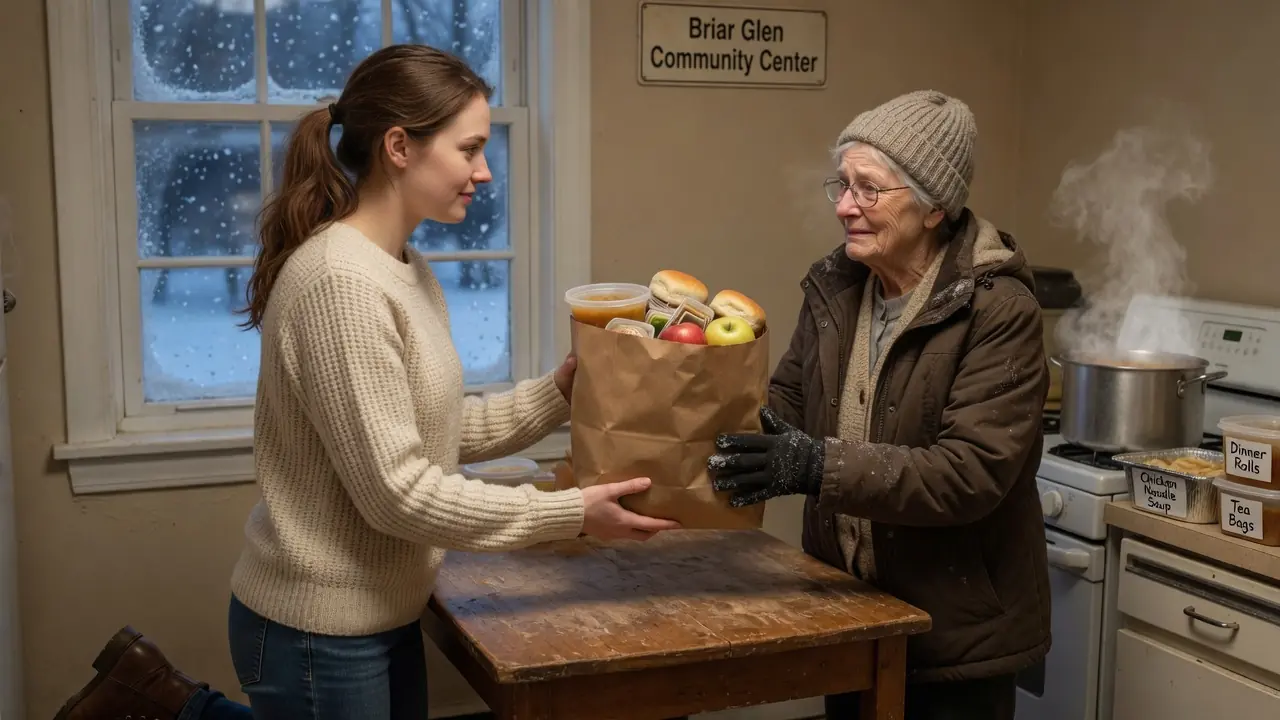
Hannah washed her hands, reheated soup on the stove, warmed two dinner rolls in the oven, and placed an apple on the table.
The kitchen slowly filled with the smell of broth, carrots, onions, chicken, potatoes, and herbs.
Margaret wrapped both hands around the mug of hot tea Hannah made for her.
“Thomas used to make soup when it snowed,” she said.
“What kind?”
“Bean soup. Thick enough to stand a spoon in. He said thin soup was just tea with ambition.”
Hannah laughed.
“I like Thomas.”
Margaret smiled.
“So did I.”
When the soup was ready, Hannah placed a bowl in front of her.
Margaret stared at it.
For a second, she did not move.
Then she picked up the spoon with a shaking hand.
She took one small bite.
Then another.
Her eyes closed.
Hannah looked away politely, pretending to wipe the counter.
Some moments deserved privacy.
Margaret ate slowly at first, then with quiet hunger she could no longer hide.
She finished the soup.
Then one roll.
Then half the apple.
Hannah offered more soup.
Margaret hesitated.
Then nodded.
“Yes, please.”
The second bowl made her cry.
Not loudly.
Just two tears sliding down her cheeks while she kept eating.
Hannah sat across from her with a small bowl of her own, not wanting Margaret to feel watched.
For a while, they ate in silence.
Outside, snow tapped against the kitchen window.
Inside, the old building hummed softly around them.
Finally, Margaret said, “I didn’t think anyone would notice.”
Hannah looked up.
“Outside the store?”
Margaret nodded.
“I was standing there like a fool, looking through the window. People passed. I was glad they didn’t stop. Then I was sad they didn’t stop. Isn’t that ridiculous?”
“No,” Hannah said. “That’s human.”
Margaret wiped her eyes with a napkin.
“I have a son in Chicago. Daniel. He asks if I need money. I always say no.”
“Why?”
“Because he has children. Bills. A life.” She looked at her hands. “Because I don’t want to become one more thing he worries about.”
“Would you worry if he were hungry?”
Margaret looked up immediately.
“Of course.”
“Then maybe love goes both ways.”
Margaret’s lips trembled.
“That is easy to forget when you are the old one.”
Hannah nodded.
“My mother used to hide bills from my grandmother. My grandmother found out and said, ‘You do not get to decide that I love you less because you are struggling.’”
Margaret smiled sadly.
“Your grandmother sounds formidable.”
“She was five feet tall and terrifying.”
That made Margaret laugh.
After dinner, Hannah packed food into containers.
Two bowls of soup.
A serving of baked pasta.
Two rolls.
Three apples.
A few tea bags.
She placed everything into a sturdy paper bag and wrote the date on each container.
Margaret watched, stunned.
“Oh, dear, I can’t take all that.”
“Yes, you can.”
“That’s too much.”
“It’s enough for tonight and tomorrow.”
“I can pay.”
“No.”
“I insist.”
“Then pay me by calling Daniel tonight and telling him the truth.”
Margaret froze.
Her hand tightened around the napkin.
“I don’t know.”
“You said he asks.”
“Yes.”
“Maybe he is waiting for an honest answer.”
Margaret looked toward the window.
Snow covered the glass in soft white streaks.
“I don’t want him to think I failed.”
“Hunger is not failure,” Hannah said. “Silence can become dangerous, though.”
Margaret absorbed that slowly.
Then she whispered, “Could you sit with me while I call?”
“Of course.”
Hannah brought the community center phone to the kitchen table.
Margaret opened her purse and took out a small address book, its cover worn and floral.
Her fingers trembled as she found Daniel’s number.
Hannah dialed for her.
A man answered on the third ring.
“Mom?”
Margaret closed her eyes.
“Daniel.”
“Mom, are you okay? It’s snowing there, isn’t it?”
“Yes. I’m at the community center.”
“The community center? Why?”
Margaret looked at Hannah.
Hannah nodded gently.
“I went to the grocery store, but it was closed. I hadn’t eaten. A young woman helped me.”
There was silence on the other end.
Then Daniel’s voice changed.
“Mom, what do you mean you hadn’t eaten?”
Margaret began to cry.
“I didn’t want to worry you.”
“Oh, Mom.”
“I thought I could manage.”
“Mom, I ask you every week.”
“I know.”
“Why didn’t you tell me?”
Margaret pressed a hand to her mouth.
“Because I wanted to still be your mother, not your problem.”
Hannah looked down at the table, giving her privacy but staying close.
Daniel’s voice broke.
“You will never be my problem. You’re my mom.”
Margaret cried harder then.
Not because she was ashamed.
Because she was loved and had forgotten how to receive it.
They talked for nearly twenty minutes.
Daniel said he would set up grocery deliveries.
Margaret protested.
Daniel insisted.
Margaret finally agreed.
They also agreed he would visit the next weekend.
When the call ended, Margaret sat very still.
“How do you feel?” Hannah asked.
“Tired,” Margaret said. “Relieved. Embarrassed. Loved.”
“That sounds like a lot.”
“It is.”
Hannah smiled.
“Better than hungry?”
Margaret laughed through tears.
“Much better.”
Hannah drove Margaret home in the community center’s old van because the snow had become too heavy for walking.
Margaret’s house was small and pale yellow, with white trim and a porch light that flickered in the snow.
Inside, the house was tidy but cold around the edges.
Hannah placed the food in the refrigerator and checked that Margaret had tea, crackers, and peanut butter where she could reach them.
On the kitchen wall hung a photograph of Margaret and Thomas standing beside a garden full of tomatoes.
Thomas had one arm around her shoulders and a wide grin on his face.
Margaret touched the frame.
“He would have scolded me tonight.”
“Lovingly?”
“Loudly.”
Hannah smiled.
“Then we can be glad Daniel got there first.”
Before Hannah left, Margaret took her hand.
“You gave me food,” she said. “But you also gave me back my son.”
Hannah’s throat tightened.
“You called him. That was you.”
“Because you sat with me.”
The next week, Daniel came to town.
He arrived at the community center first, looking for Hannah.
He was in his early fifties, tall, with tired blue eyes and a kind face drawn tight with emotion.
“You’re Hannah?”
“Yes.”
He took both her hands.
“Thank you for helping my mother.”
“I’m glad I was there.”
“She told me you found her outside the store.”
“She was cold and hungry.”
Daniel closed his eyes briefly, pain crossing his face.
“I should have known.”
“She didn’t want you to worry.”
“I know. That’s exactly why I should have known.”
Hannah shook her head gently.
“People can hide need very well when they’re protecting someone they love.”
Daniel looked toward the kitchen.
“She said you fed her soup.”
“Yes.”
“She said you told her she was the community.”
Hannah smiled softly.
“She was.”
Daniel’s eyes filled.
“That sentence changed her mind.”
After that, Daniel helped Margaret arrange grocery delivery every two weeks.
He also began calling on Tuesday and Friday evenings, not just Sunday afternoons.
At first, Margaret complained that he was “hovering from another state.”
Then she started looking forward to the calls.
She came back to the community center the following month.
Not because she was hungry that day.
Because she brought something.
A small container of bean soup.
Thomas’s bean soup.
She placed it on the kitchen counter in front of Hannah.
“I made too much,” Margaret said.
Hannah opened the lid and smelled the rich broth, beans, carrots, onions, and smoked paprika.
“It smells amazing.”
“It is very thick. Thomas would approve.”
They ate together at the little kitchen table.
Margaret watched Hannah take the first bite.
“Well?”
Hannah smiled.
“Thin soup should be ashamed.”
Margaret laughed so hard she had to wipe her eyes.
That was how it began.
Margaret started coming to the community center every Friday afternoon.
Sometimes she brought soup.
Sometimes bread.
Sometimes handwritten recipe cards.
Sometimes she only came to sit while Hannah prepared food pantry bags.
One day, Hannah showed her the notebook for The Supper Shelf.
Margaret read the pages slowly.
Emergency meals for seniors.
Discreet food pickup.
Soup containers in community locations.
No shame.
No public line.
Food packed with dignity.
Family contact support when needed.
Margaret looked up.
“This is because of me.”
Hannah hesitated.
“It became clearer because of you.”
Margaret was quiet for a moment.
Then she said, “Good.”
Hannah blinked.
“Good?”
“Yes. If my pride nearly made me go hungry, then let my story feed someone else.”
Hannah felt tears rise.
“I would never use your name without permission.”
“You may use it when needed,” Margaret said. “Carefully. Truthfully. No pity.”
“No pity,” Hannah promised.
Margaret tapped the notebook.
“Start with soup.”
“I don’t have funding yet.”
“Start with one pot.”
“I need approval.”
“Ask.”
“I need containers.”
“I have containers.”
“You do?”
“Every old woman has containers. We do not know why. We simply collect them.”
Hannah laughed.
The Supper Shelf began with one pot of soup.
Margaret’s bean soup.
Hannah packed it into eight containers and placed them in the community fridge with a small sign:
Free Supper Containers. Please Take One If Needed.
No forms.
No questions.
By the next morning, all eight were gone.
The following week, they made twelve.
Then sixteen.
Then twenty-four.
Hannah added rolls from a local bakery willing to donate day-old bread.
A small grocery store donated apples.
The pharmacy agreed to keep two supper bags behind the counter for elderly customers who came in hungry or weak.
The library placed a small freezer in the staff room after the librarian heard the story.
The program stayed quiet.
That was important.
People could take food without announcing need to a room full of strangers.
The containers had handwritten labels.
Chicken vegetable soup.
Bean soup.
Pasta bake.
Soft rice and chicken.
Low-salt potato soup.
Applesauce cups.
Tea bags.
Each label also said:
You are part of the community.
Margaret insisted on that line.
“It matters,” she said.
She was right.
One elderly man began taking soup every Wednesday after his wife died.
A retired nurse picked up meals for her neighbor recovering from surgery.
A grandmother took pasta bake for two grandchildren staying with her unexpectedly.
A widower came every Friday and left a thank-you note but never signed his name.
The Supper Shelf became real before it became official.
Then the community center director noticed the numbers.
Hannah brought her the notebook, the meal counts, the donation lists, and a letter Margaret had written.
In the letter, Margaret told the story of the snowy evening, the closed grocery store, the soup, and the phone call to Daniel.
At the end, she wrote:
Hannah Miller understands that hunger is not only an empty stomach. Sometimes it is loneliness, pride, grief, and the fear of becoming a burden. She feeds people in a way that lets them remain whole.
The director approved a formal pilot.
Then Hannah applied for a small community nutrition grant.
Daniel helped with the budget.
The bakery wrote a support letter.
The pharmacy wrote another.
The library joined.
Margaret edited the proposal with a red pen and strong opinions.
“You used the word assistance too many times,” she said.
“What should I say?”
“Meals.”
“That’s too simple.”
“Hunger is simple. Systems make it complicated.”
Hannah left the word meals.
They won the grant.
Not a fortune.
Not a kitchen renovation.
Not a miracle.
But enough to buy containers, labels, storage shelves, a freezer, basic delivery bags, ingredients, and food safety training.
The Supper Shelf became official.
Hannah became its coordinator.
Margaret became its first recipe volunteer.
Her name tag read:
Margaret Ellis
Soup Authority
She chose the title herself.
Every Friday, she sat in the community center kitchen and supervised.
“More carrots.”
“That needs pepper.”
“Do not insult beans by undercooking them.”
“Rolls go in separate bags unless you enjoy soggy bread.”
Volunteers adored her.
Children from the after-school program began calling her Grandma Soup.
She pretended to dislike it.
She did not.
Years passed.
The Supper Shelf grew across Briar Glen and nearby towns.
It remained simple.
Meals for people who needed them.
Quiet pickup.
Optional delivery.
No shame.
No interrogation.
No one had to prove hunger with paperwork before receiving soup.
Hannah trained volunteers to speak gently.
Never say, “Are you poor?”
Never say, “Do you need charity?”
Never ask in front of others.
Say, “We have extra supper containers today. Would one be useful?”
Or, “There is a meal available if you’d like to take one home.”
Margaret called it “feeding with manners.”
Hannah wrote that into the training guide.
As Margaret grew older, Daniel visited more often.
Eventually, he moved back to Vermont and worked remotely so he could be closer.
Margaret complained that he rearranged her pantry wrong.
Daniel said he was saving her from expired crackers.
Their arguments made Hannah happy.
One autumn afternoon, Margaret came to the community center carrying a small wooden box.
It was old, dark brown, and worn at the corners.
She placed it on the kitchen table.
“For you,” she said.
Hannah recognized the seriousness in her voice and immediately shook her head.
“No.”
Margaret laughed.
“You do not even know what it is.”
“I know it is too meaningful.”
“Correct. Open it anyway.”
Hannah opened the box.
Inside were recipe cards.
Dozens of them.
Some written in Margaret’s handwriting.
Some in Thomas’s.
Some older, written by Margaret’s mother.
Bean soup.
Chicken stew.
Potato bread.
Apple cake.
Rice pudding.
Soft oatmeal for sick days.
Tomato broth.
Snowstorm soup.
At the very back was one card labeled:
For someone who says tea is enough.
Hannah laughed and cried at the same time.
“Margaret…”
“This is my family recipe box,” Margaret said.
“I can’t take this.”
“Yes, you can.”
“It belongs to Daniel.”
“Daniel has copies. He helped me scan every card.”
“It belongs to your grandchildren.”
“They have copies too. The original belongs here.”
Hannah held the box carefully.
“Here?”
Margaret nodded.
“At The Supper Shelf. These recipes fed my family through winters, grief, tight paychecks, sickness, and ordinary Tuesdays. Now they should feed others.”
Hannah could barely speak.
Margaret touched the edge of the box.
“Thomas used to say a recipe is only alive when someone makes it.”
Hannah whispered, “We’ll make them.”
“I know.”
Margaret also handed her a letter.
It was not for a grant this time.
It was for Hannah.
Dear Hannah,
The night you found me outside the grocery store, I was hungry in more ways than one.
You gave me soup.
You gave me warmth.
You gave me the courage to call my son.
Then you built a table wide enough for others.
Please keep this box where recipes do what they were meant to do.
Feed people.
With love,
Margaret Ellis
Hannah framed the letter beside the community center kitchen door.
The recipe box stayed on a shelf above the prep table, safe from spills but close enough to be used.
Every month, The Supper Shelf featured one of Margaret’s family recipes.
Thomas’s Bean Soup became the most requested.
Snowstorm Soup became a winter tradition.
Apple Cake was served every January on the anniversary of the night Hannah found Margaret outside the grocery store.
Margaret lived long enough to see the program serve its ten-thousandth meal.
The community center held a small celebration.
Nothing fancy.
Soup, bread, apples, and cake.
Margaret sat at the front table wearing her Soup Authority name tag.
Hannah gave a short speech, but she did not say too much.
She simply said, “This began because one person deserved dinner and dignity at the same time.”
Margaret squeezed her hand under the table.
Two years later, Margaret passed away peacefully at home, with Daniel beside her and a pot of bean soup cooling on the stove because he had finally learned to make it properly.
At her memorial gathering, people brought soup instead of flowers.
The community center kitchen filled with steam, stories, laughter, and tears.
Daniel placed Margaret’s Soup Authority name tag beside a photograph of her stirring a pot with a wooden spoon.
After the gathering, he handed Hannah one final envelope.
“Mom wrote this during her last winter,” he said.
Inside was a note in Margaret’s careful handwriting.
Dear Hannah,
I used to think needing food meant I had failed at being strong.
You taught me that receiving kindness can be a kind of strength too.
You noticed me when I hoped no one would.
You fed me when I could not ask.
You helped me call my son when pride had kept me silent.
Then you made sure others would not have to stand outside closed doors feeling invisible.
Keep the soup warm.
Keep the labels kind.
Keep telling people they are part of the community.
With love,
Margaret
Hannah framed that note beside the first.
Years later, whenever people asked how The Supper Shelf began, Hannah told them the truth.
“It began with an old woman outside a closed grocery store in the snow, pretending she wasn’t hungry.”
Then she would show them Margaret’s recipe box.
The gift was small.
A recipe box.
A letter.
A bowl of bean soup that had once been eaten by a woman who thought tea was enough.
But inside those small things was the future Hannah had been trying to build.
And every time someone came to the community center and whispered, “Do you have any extra food today?” Hannah smiled gently.
She never made them explain their hunger.
She never made them prove their need.
She simply handed them a warm container and said, “Yes. We saved some for you.”
Because food was not only food.
It was notice.
It was warmth.
It was dignity.
It was the quiet message that someone had looked at the world and decided no one should have to stand hungry outside a closed door.
And in Briar Glen, because of one snowy evening and one bowl of soup, fewer people did.