At twenty-four, Olivia Reed had learned that hunger did not always look like hunger.
It did not always look like someone begging on a corner or pressing both hands to an empty stomach.
Sometimes hunger looked like an old woman standing outside a grocery store window, pretending to read a notice board because she did not want anyone to know she was staring at the food inside.
Sometimes hunger looked like a coat buttoned too tightly, shoulders pulled inward, eyes lowered whenever someone walked too close.
Sometimes hunger looked like pride trying to survive one more evening.
Olivia had seen that kind of pride before.
She had seen it in her mother, who used to smile while cutting one chicken breast into enough pieces for three people.
She had seen it in her grandfather, who would say he was not hungry if there was only one piece of cornbread left on the table.
She had seen it in neighbors who said they were “just stretching things” when what they really meant was that the refrigerator was nearly empty.
Because of that, Olivia had become the kind of person who noticed quiet need.
She noticed the old man counting coins at the pharmacy.
She noticed the single mother putting back apples at the grocery store.
She noticed the elderly woman at the community center who always came early for coffee but never stayed for lunch, even though her hands trembled when food was served.
Olivia lived in Lancaster, Pennsylvania, in a modest second-floor apartment above a closed flower shop.
The building was old, with pipes that knocked at night and windows that let in too much winter air, but Olivia had made it feel like home.
She was a young white American woman with fair skin, long chestnut-brown hair usually tied into a low ponytail, soft gray eyes, and a gentle face that made strangers ask her for directions even when she was clearly busy.
She worked at the Lancaster Neighborhood Community Center, a brick building on Maple Street with a small kitchen, a multipurpose room, a pantry closet, and a front desk covered in flyers.
The center was not fancy.
The paint on the hallway walls had faded from years of cleaning.
The folding tables had scratches, dents, and old tape marks.
The kitchen floor always seemed to need mopping, no matter how often someone mopped it.
But to Olivia, it was one of the most important places in the city.
It was where children came after school when their parents worked late.
It was where seniors came for lunch, bingo, chair exercises, and conversation they pretended they did not need.
It was where struggling families came for canned goods, donated coats, school supplies, and someone patient enough to help them fill out forms.
Olivia’s official job title was program assistant.
That meant she did almost everything.
She answered phones, stacked chairs, printed schedules, organized donation shelves, carried boxes of canned food, helped serve lunch, cleaned after craft classes, signed in volunteers, and listened to people who came to the front desk with problems too complicated for any form.
She loved the work, even when it exhausted her.
She loved how a quiet room could change once a pot of soup was placed on the table.
She loved the way people softened when someone remembered their name.
She loved the small dignity of offering help without making a person feel as if they had been reduced to their need.
Her dream was to create a program called The Supper Shelf.
It would be a quiet meal program for elderly people who lived alone, widows and widowers, disabled neighbors, and anyone who had reached the end of a long day with nothing warm waiting at home.
Olivia did not want it to feel like charity.
She wanted it to feel like care.
No public line.
No loud announcements.
No clipboard demanding that someone prove hunger in front of strangers.
Just neatly packed meals available at familiar places: the community center, the pharmacy, the library, the senior apartment lobby, and maybe someday the local grocery store.
Soup in sturdy containers.
Soft rolls wrapped in paper.
Applesauce cups for people with dental trouble.
Low-salt casseroles for seniors watching their blood pressure.
Tea bags tucked into small envelopes.
Labels written kindly.
You are part of the community.
That sentence mattered to Olivia.
She had written it at the top of the first page in her notebook.
She imagined opening a refrigerator at the center and finding rows of meals waiting for people who were too proud to ask directly.
She imagined an older person taking a meal home without having to explain the loneliness behind it.
She imagined a town where no one had to stand outside a closed store in the cold, pretending they were fine.
But dreams needed more than kindness.
They needed refrigeration, containers, food safety training, volunteers, donated ingredients, approval from the center director, reliable transportation, and money.
The community center barely had enough funding for its existing programs.
Olivia knew that.
So her notebook stayed in her backpack, full of plans that felt too big for her life.
She kept working.
She kept serving lunches.
She kept packing leftover bread carefully instead of throwing it away.
She kept telling herself that one day she would find the right beginning.
That beginning came on a snowy Friday evening in January.
The day had been long from the moment Olivia arrived.
The children’s craft class had used glitter, which Olivia believed should be classified as a permanent building material.
The senior lunch program had run out of coffee halfway through, which caused more distress than the broken heater ever had.
A volunteer had forgotten to label three trays of donated casseroles, and Olivia had spent twenty minutes trying to identify them by smell.
By late afternoon, the center had mostly emptied.
The children had gone home with paper snowflakes.
The seniors had taken leftover rolls wrapped in napkins.
The director had left early to attend a city meeting.
Olivia stayed behind to clean the kitchen.
Outside, snow began falling over Lancaster.
At first, it looked gentle, almost pretty, drifting past the kitchen window in soft white pieces.
Then the wind changed.
The snow thickened.
By five o’clock, the sidewalk outside the community center had turned white, and the streetlights glowed in hazy circles through the falling snow.
Olivia stood at the counter, looking at the food left from the day.
There was half a pot of chicken vegetable soup, a tray of baked pasta, eight dinner rolls, several apples, and a container of rice pudding someone had donated for dessert.
It was not enough for a formal dinner program.
But it was too much to throw away.
Olivia packed what she could into containers from the pantry shelf.
She filled two containers with soup.
Two with pasta.
One small container with rice pudding.
She wrapped the rolls in paper and put the apples into a grocery bag.
Her plan was to place the food in the community fridge in the front hallway before locking up.
But as she was stacking the containers, her phone buzzed.
A message from her roommate, Jenna.
Roads are getting bad. Come home soon.
Olivia glanced toward the window.
The snow was no longer gentle.
It was blowing sideways.
She put the containers into a large paper bag, shut off the kitchen lights, and walked through the empty hallway toward the side door.
The building felt different after everyone left.
During the day, it was full of voices, footsteps, laughter, arguments, chairs scraping the floor, and someone always asking where the tape had gone.
At night, it became quiet enough for Olivia to hear the old pipes clicking in the walls.
She locked the side door behind her and stepped into the cold.
The air hit her face sharply.
Snow landed on her eyelashes, her coat sleeves, and the paper bag in her arms.
She turned toward the bus stop, planning to walk quickly before the sidewalks became worse.
Then she saw the old woman.
Across the street, beneath the awning of a closed grocery store, a small figure stood almost still.
The store was called Miller’s Market, a family grocery that usually stayed open until seven, but the owner had closed early because of the weather.
The lights inside were still on, and Olivia could see employees cleaning near the checkout lanes.
The front door sign had been turned to CLOSED.
The old woman stood in front of that door, looking through the glass.
She was not knocking.
She was not calling for someone to open.
She simply stood there, holding a canvas bag in one hand and a folded paper in the other.
She looked to be in her late seventies, short and thin, with silver hair tucked beneath a worn navy hat, pale skin reddened by the cold, and tired green eyes behind round glasses.
Her coat was dark brown and too thin for January.
Her black gloves had worn fingertips.
Her shoes were old, with soles that looked unsafe on the snow.
Olivia stopped on the community center steps.
Something about the woman’s stillness made her chest tighten.
Then the woman lifted the folded paper and looked at it again.
A coupon, maybe.
A shopping list.
A receipt.
She looked back through the grocery store window at the shelves inside.
Then she folded the paper carefully and slipped it into her coat pocket.
That carefulness hurt Olivia.
The old woman turned away from the store.
She took three slow steps along the sidewalk, then stopped beside the bus stop bench.
For a moment, she stood as if deciding whether to continue.
Then she sat down heavily.
Not resting.
Giving up for a moment.
Olivia crossed the street without thinking.
Snow crunched beneath her boots.
The wind pushed against the paper bag in her arms.
“Ma’am?” Olivia called gently.
The old woman looked up quickly.
Embarrassment crossed her face before fear did.
“Yes?” she said.
Her voice was polite, soft, and strained.
“Are you all right?” Olivia asked.
The old woman smiled automatically.
“Oh, yes. I’m fine, dear.”
Olivia had heard that kind of fine too many times.
It was not an answer.
It was a shield.
“My name is Olivia Reed,” she said. “I work at the community center across the street.”
The woman glanced toward the building.
“The community center,” she repeated.
“Yes.”
“I used to go there with my husband,” the woman said after a moment. “For pancake breakfasts.”
Olivia smiled.
“We still have them sometimes.”
“My husband said the pancakes were terrible,” the old woman said, and a faint smile touched her mouth. “But he always ate three.”
“That sounds like most of our pancake guests.”
The woman’s smile faded as quickly as it came.
Olivia moved a little closer, still giving her space.
“What’s your name?”
“Margaret Ellis.”
“It’s nice to meet you, Margaret.”
Margaret looked down at her empty canvas bag.
“I should be getting home.”
“Do you live nearby?”
“Not far.” Margaret looked toward the street, where snow was beginning to cover the curb. “Six blocks. Maybe seven.”
Olivia looked at her shoes, then at the falling snow.
“That’s a long walk in this weather.”
“I usually manage.”
“I believe you.”
Margaret looked surprised by that.
Most people, Olivia knew, jumped too quickly to correction.
You shouldn’t be out here.
You can’t walk in this.
You need someone to take care of you.
Even when those things were true, they could land like insults.
Olivia tried again, softer.
“Were you trying to get groceries?”
Margaret’s gloved fingers tightened around the canvas bag.
“I came too late.”
“The store closed early because of the snow.”
“Yes.” Margaret lowered her eyes. “I should have checked.”
“It caught a lot of people off guard.”
“I had a coupon,” Margaret said, almost under her breath. “For soup, bread, and apples. It expired today.”
Olivia glanced at the folded paper in Margaret’s pocket.
Margaret gave a small embarrassed laugh.
“Silly thing to be upset about, isn’t it?”
“No,” Olivia said. “It isn’t.”
Margaret looked away.
“I have food at home.”
Olivia waited.
Margaret added, “Some tea. Crackers. Peanut butter.”
The snow moved between them in thin white lines.
Olivia’s voice became very gentle.
“Margaret, have you eaten today?”
The old woman’s lips pressed together.
She looked toward the street.
“I had tea this morning.”
Olivia did not speak.
“And two crackers,” Margaret added quickly, as if trying to make it sound better.
Only tea and crackers.
It was nearly evening.
The paper bag in Olivia’s arms suddenly felt heavier.
“Margaret,” Olivia said, “come inside the community center with me.”
Margaret shook her head immediately.
“No, dear. I couldn’t.”
“Yes, you can.”
“I don’t want to trouble anyone.”
“You won’t.”
“You were leaving.”
“I can leave after you eat.”
Margaret’s eyes filled, though she tried to blink the tears away.
“I don’t accept charity.”
Olivia sat beside her on the snowy bench.
The cold went through her coat, but she ignored it.
“This isn’t charity,” Olivia said.
Margaret looked at her.
“What is it, then?”
“Dinner.”
The old woman looked down.
Olivia held up the paper bag.
“There is warm soup in here. Baked pasta. Rolls. Apples. It was going into the community fridge. You are part of the community.”
Margaret’s face changed.
Not dramatically.
But enough.
The words had found the place shame had been guarding.
“You are part of the community,” she repeated quietly.
“Yes,” Olivia said.
Margaret looked toward the community center, then back at the closed grocery store.
“I don’t want people to see me.”
“The center is empty. Just me.”
“You don’t have to do this.”
“I know.”
“Then why are you?”
Olivia looked at the snow gathering on Margaret’s thin coat.
“Because no one should sit hungry outside a closed door in weather like this.”
Margaret’s eyes filled again.
She looked down at her hands.
“My husband used to say things like that.”
“What was his name?”
“Thomas.”
The name softened her entire face.
“He always noticed when I hadn’t eaten. I would say I was fine with tea, and he would stand there with his hands on his hips and say, ‘Margaret, tea is not a meal, no matter how elegant you make it sound.’”
Olivia smiled.
“Thomas was right.”
“He usually was about food,” Margaret said. “Not about directions.”
Olivia laughed softly.
Margaret’s shoulders relaxed a little.
Then she tried to stand.
Her knees wavered.
Olivia stood quickly and offered her arm.
“May I help you across the street?”
Margaret hesitated.
Then she placed her hand lightly on Olivia’s sleeve.
“Yes,” she whispered. “Thank you.”
They crossed slowly.
The street was quiet, but snow made every step uncertain.
Olivia kept one arm steady for Margaret and held the paper bag close with the other.
When they reached the community center, Olivia unlocked the side door and guided Margaret inside.
Warm air met them.
Margaret stopped just inside the hallway.
For a moment, she looked around as if the building held ghosts she had not expected to meet.
“The pancake breakfasts were in that room,” she said, pointing toward the multipurpose hall.
“Yes.”
“Thomas would sit at the table near the window. He said he liked to monitor the parking lot.”
“Was he expecting crime?”
“He was expecting bad parking.”
Olivia laughed.
Margaret smiled, and for one brief second she looked less cold.
Olivia led her to the kitchen.
She turned the lights back on and pulled out a chair at the small round table near the pantry shelves.
“Sit here.”
Margaret obeyed slowly.
“I still feel I shouldn’t.”
“I know,” Olivia said. “You can feel that while eating.”
Margaret looked at her.
Then she laughed.
It was small, but real.
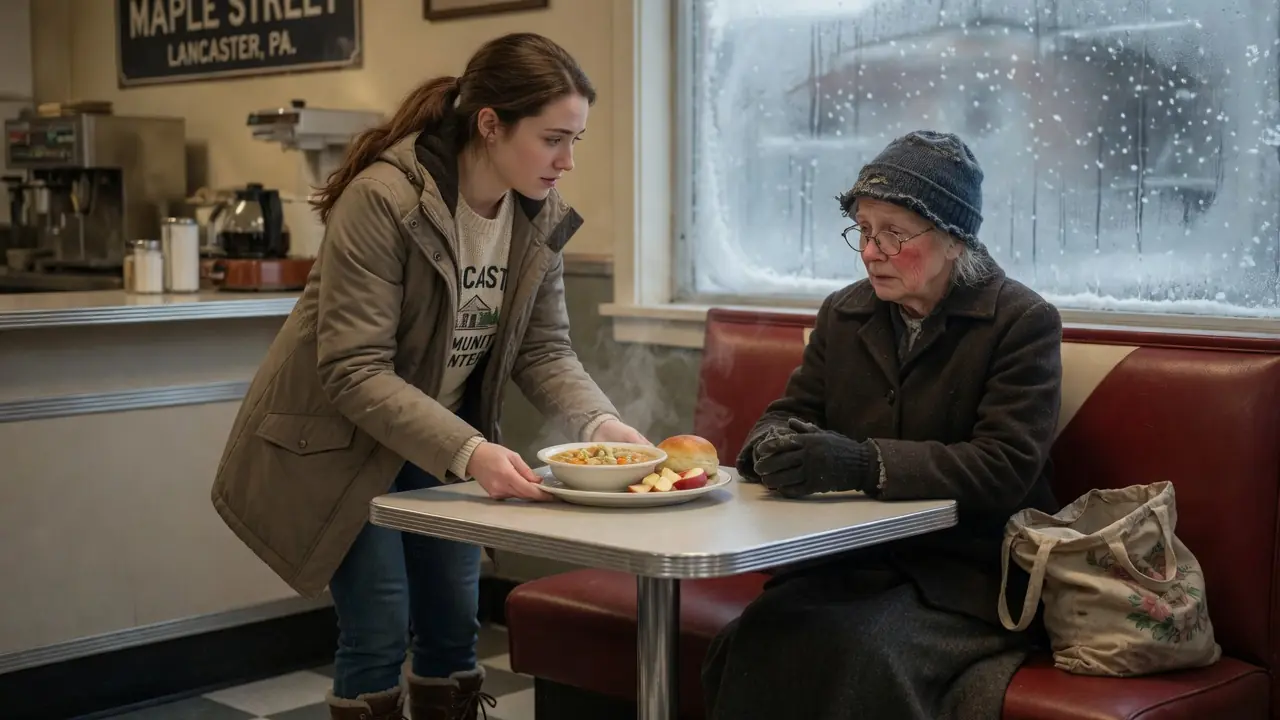
Olivia washed her hands, then reheated soup in a small pot on the stove.
The kitchen filled with the smell of chicken broth, carrots, celery, onions, potatoes, and herbs.
Margaret wrapped both hands around the cup of tea Olivia made for her.
Her fingers were still trembling.
“Your hands are cold,” Olivia said.
“They are always cold now.”
“Do you have gloves at home?”
“These are gloves.”
“Warmer gloves?”
Margaret gave her a look.
“I have old-woman pride. Do not attack it too quickly.”
Olivia smiled.
“Understood.”
She warmed a roll in the oven and placed it beside the soup bowl.
Then she set the bowl in front of Margaret.
Steam rose between them.
Margaret stared at it.
“You eat too,” she said suddenly.
“I will.”
“Not because you are being polite.”
“I promise.”
Olivia filled a smaller bowl for herself and sat across from her.
Only then did Margaret lift her spoon.
The first bite made her close her eyes.
Olivia looked down at her own bowl to give her privacy.
Margaret ate slowly at first, as if careful not to seem too hungry.
Then her body betrayed her.
She took another bite.
Then another.
Her shoulders lowered.
Her hand stopped shaking as much.
Halfway through the bowl, tears slipped down her cheeks.
She did not sob.
She simply kept eating, crying silently into the steam.
Olivia did not ask her to stop.
She did not say, “Don’t cry.”
Crying was not the problem.
Hunger and loneliness were.
When Margaret finished the first bowl, Olivia quietly asked, “Would you like more?”
Margaret hesitated.
Then she nodded.
“Yes, please.”
The second bowl disappeared more slowly.
Margaret ate with the exhausted relief of someone who had held herself together too long and finally found a table where she could set the weight down.
After the soup, she ate half a roll with butter.
Then a few spoonfuls of rice pudding.
Finally, she leaned back and closed her eyes.
“I did not realize how hungry I was,” she whispered.
Olivia said nothing for a moment.
Then she answered softly, “Sometimes the body waits until it feels safe to tell the truth.”
Margaret opened her eyes.
“That is a very wise thing for someone so young to say.”
“I learned from people older than me.”
“Good,” Margaret said. “That is the proper way.”
The snow tapped against the kitchen window.
The building around them creaked softly.
For a while, they sat without speaking.
Then Margaret said, “I didn’t think anyone would notice me.”
Olivia looked at her.
“Outside the store?”
Margaret nodded.
“I was standing there looking through the window. People passed by. I was glad they didn’t stop, because I was embarrassed. Then I was sad they didn’t stop, because I was tired.” She gave a fragile smile. “People are complicated, aren’t they?”
“Yes,” Olivia said. “Very.”
“I told myself I wasn’t really hungry. I told myself tea would be enough.” Margaret looked down at the empty bowl. “It was not enough.”
“No.”
“I used to cook every night. Big dinners. Thomas said I cooked like I was expecting a church choir to show up.”
Olivia smiled.
“What did you make?”
“Everything. Bean soup, chicken stew, potato bread, apple cake, rice pudding, biscuits, meatloaf, peach cobbler.” Margaret’s eyes grew distant. “Food was how I kept time. Monday soup. Wednesday casserole. Friday fish. Sunday roast if we could afford it.”
“That sounds wonderful.”
“It was ordinary.”
“Ordinary can be wonderful.”
Margaret looked at her.
Then she nodded.
“Yes. I suppose it can.”
She wrapped both hands around her tea again.
“After Thomas died, cooking became strange. Recipes for two became too much. Recipes for one felt too lonely. I would make soup and freeze half, then forget to eat it. Or I would eat toast because making a real meal felt like admitting he wasn’t coming to the table.”
Olivia felt that sentence settle in her chest.
Grief could make a kitchen impossible.
She had seen it before.
At the community center, many widows and widowers came for lunch not because the food was excellent, but because eating alone at home had become unbearable.
Margaret took a slow breath.
“My son, Daniel, asks if I need anything. He lives in Chicago. Good job. Two children. Busy life. He calls every Sunday.”
“That’s good.”
“It is.” Margaret’s eyes filled again. “But I always say I’m fine.”
“Even when you’re not?”
“Especially then.”
Olivia waited.
Margaret gave a shaky laugh.
“I don’t want to become another item on his list.”
“You’re his mother.”
“That is why I don’t want to be a burden.”
Olivia leaned forward slightly.
“Would you think Daniel was a burden if he were hungry?”
Margaret’s head lifted quickly.
“No.”
“Would you want him to tell you?”
“Of course.”
“Then maybe he wants the same chance to love you honestly.”
Margaret looked down.
The words seemed to open something painful.
“I know that in my head,” she said. “But pride lives lower than the head.”
Olivia smiled gently.
“In the chest?”
“In the bones,” Margaret said.
They sat quietly again.
Then Olivia stood and began packing food.
She filled two containers with soup, one with pasta, and one with rice pudding.
She wrapped two rolls in paper.
She placed two apples in the bag and added several tea bags from the pantry shelf.
Margaret watched with alarm.
“Oh, no. Dear, I can’t take all that.”
“Yes, you can.”
“That is too much.”
“It is dinner tonight and food for tomorrow.”
“I can pay.”
“No.”
“I insist.”
“Then pay me another way.”
Margaret narrowed her eyes.
“I am suspicious.”
Olivia sat back down.
“Call Daniel tonight. Tell him the truth.”
Margaret froze.
The whole kitchen seemed to pause.
Outside, the snow thickened against the window.
“Olivia,” Margaret said quietly, “that is harder than taking food.”
“I know.”
“I don’t want him upset.”
“He might be upset because he loves you.”
“I don’t want him to drive all the way here in this weather.”
“Then tell him not to.”
Margaret gave her a look.
“Have you met adult sons?”
“No.”
“They are poor listeners when frightened.”
Olivia smiled.
“That may be true. But silence has not been taking care of you.”
Margaret looked away.
Her gloved hand rested near the paper bag of food.
After a long moment, she said, “Could you sit with me while I call?”
“Yes.”
“I might not know what to say.”
“Start with, ‘I need to tell you something honestly.’”
Margaret repeated it softly.
“I need to tell you something honestly.”
“That’s enough to begin.”
Olivia brought the community center phone to the table.
Margaret opened her purse and took out a small floral address book, the kind with worn edges and names written in careful handwriting.
Her fingers moved slowly over the pages.
Daniel — Chicago.
Home.
Cell.
Work.
Grandchildren.
Birthdays.
Olivia noticed that every number had been updated in pen at least once.
This little book was not just information.
It was Margaret’s map of connection.
Olivia dialed Daniel’s cell number and handed her the phone.
Margaret held it with both hands.
It rang three times.
A man answered.
“Mom?”
Margaret closed her eyes.
“Daniel.”
“Everything okay? It’s snowing there, right?”
“Yes. It’s snowing.”
“Are you home?”
Margaret’s lips trembled.
“No.”
There was a pause.
“Where are you?”
“At the community center.”
“The community center? Why?”
Margaret looked at Olivia.
Olivia nodded gently.
“I went to the grocery store, but it was closed. I hadn’t eaten today except tea and crackers. A young woman from the center brought me inside and gave me soup.”
Silence.
Then Daniel’s voice changed completely.
“Mom, what?”
Margaret began to cry.
“I’m all right now.”
“You hadn’t eaten?”
“I meant to.”
“Mom.”
“I didn’t want you to worry.”
“Of course I’m worried.”
“I know.”
“Why didn’t you tell me?”
Margaret pressed a hand over her mouth.
“Because I wanted to still feel like your mother.”
On the other end, Daniel said nothing for a moment.
Then his voice broke.
“You are my mother. You don’t stop being my mother because you need dinner.”
Margaret closed her eyes as if the words hurt.
Then she whispered, “I know.”
“No, Mom. I don’t think you do.”
Olivia looked down at the table, giving her privacy while staying close.
Daniel continued, softer now.
“I ask because I want to know. Not because you’re a burden. Because I love you.”
Margaret cried openly then.
“I’m sorry.”
“Don’t be sorry. Just tell me the truth.”
“I was hungry,” Margaret whispered.
The sentence was simple.
It sounded like a door opening.
Daniel exhaled shakily.
“Okay. Then we fix that. We’ll set up grocery delivery. I’ll call Miller’s tomorrow. I’ll come this weekend if roads are clear.”
“You don’t have to come.”
“I want to.”
“The children—”
“They can come too. They miss you.”
Margaret looked stunned.
“They do?”
“Mom, yes.”
She wiped her face with a napkin.
“I didn’t want them to see me old.”
Daniel gave a sad laugh.
“They know you’re old. They still like you.”
Margaret laughed through tears.
For almost half an hour, mother and son talked.
They talked about groceries.
They talked about delivery.
They talked about Daniel visiting.
They talked about Thomas.
They talked about the grandchildren, who apparently loved Margaret’s apple cake even though she had not made it in years.
When the call ended, Margaret sat very still.
The phone rested in her lap.
Olivia waited.
Finally, Margaret whispered, “I feel like I just climbed a hill.”
“A good hill?”
“A necessary hill.”
“That sounds important.”
Margaret looked at the paper bag of food.
“I thought I needed dinner.”
“You did.”
“I also needed to stop lying.”
Olivia smiled gently.
“Sometimes both can happen at the same table.”
The snow had grown too heavy for Margaret to walk home.
Olivia used the community center van, an old white vehicle with a heater that made a loud rattling sound but still worked.
She helped Margaret into the passenger seat, placed the food bag on her lap, and drove slowly through the snowy streets.
Lancaster looked softened by white.
Porch lights glowed.
Cars moved cautiously.
The world seemed quieter than before.
Margaret’s house was six blocks away, a small yellow home with white trim and a narrow porch.
The porch steps had been salted earlier, probably by a neighbor, but Olivia still walked Margaret carefully to the door.
Inside, the house was neat and chilly around the edges.
The kitchen was small, with pale cabinets, a round wooden table, and a window over the sink.
On the table sat a single teacup, a plate with cracker crumbs, and a jar of peanut butter.
Margaret saw Olivia notice.
She looked embarrassed.
Olivia said nothing about it.
Instead, she unpacked the food containers into the refrigerator and placed one soup container near the front.
“This one is for tomorrow,” she said.
Margaret pointed to the cupboard.
“Tea goes there.”
Olivia placed the tea bags inside.
On the kitchen wall hung a photograph of Margaret and Thomas standing in a backyard garden.
Thomas was tall and broad-shouldered, with a wide smile and one hand resting on Margaret’s shoulder.
Margaret looked young in the picture, laughing at something beyond the camera.
“He grew tomatoes every summer,” Margaret said.
“They look proud of themselves.”
“The tomatoes or Thomas?”
“Both.”
Margaret smiled.
“He said tomatoes needed admiration.”
Olivia laughed.
Before leaving, she wrote her name and the community center number on a note and placed it by the phone.
“If you need anything tomorrow, call.”
Margaret nodded.
“I will.”
Olivia lifted an eyebrow.
“Will you really?”
Margaret looked guilty.
“I will try.”
“That is more honest.”
Margaret took Olivia’s hand.
Her fingers were warmer now.
“You gave me food,” she said. “But you also gave me back my son.”
“You called him,” Olivia said.
“Because you sat with me.”
The next day, Daniel called the community center.
Olivia answered the front desk phone and heard a man clear his throat.
“Is this Olivia Reed?”
“Yes.”
“My name is Daniel Ellis. Margaret Ellis is my mother.”
Olivia sat straighter.
“Is she okay?”
“Yes,” Daniel said quickly. “She’s okay. She ate soup for breakfast, which she claims is normal.”
Olivia smiled.
“For Margaret, today it may be.”
Daniel laughed softly, then his voice turned emotional.
“I wanted to thank you.”
“I’m glad I saw her.”
“She told me what happened. All of it, I think. I’m not sure she would have told me if you hadn’t helped her make that call.”
“She was brave.”
“She is stubborn.”
“Those can overlap.”
Daniel gave a short laugh.
“My father used to say that.”
Then he became quiet.
“I should have known she was struggling.”
“People hide things when they’re trying to protect someone.”
“I know. But still.”
“Now you know.”
He breathed out.
“Yes. Now I know. And we’re going to do better.”
Daniel did come that weekend.
He arrived with his two children, a trunk full of groceries, and enough concern to irritate Margaret within an hour.
Margaret later told Olivia all about it.
“He reorganized my pantry,” she complained the next Friday at the community center.
“Was it helpful?”
“That is not the point.”
“What is the point?”
“He put rice where flour belongs.”
Olivia smiled.
“Very serious.”
“Extremely.”
But Margaret’s eyes were brighter.
Her cheeks had more color.
And she had brought something with her.
A container of bean soup.
Thomas’s bean soup.
She placed it on the community center kitchen table with ceremony.
“For you,” she said.
Olivia opened the lid.
The soup smelled rich and deep, full of beans, carrots, onions, smoked paprika, and something earthy she could not name.
“This smells incredible.”
“It is thick.”
“I can see that.”
“Thomas said thin soup was tea with ambition.”
Olivia laughed.
“That man had strong opinions.”
“Mostly correct ones.”
They warmed the soup and ate together at the kitchen table.
After one bite, Olivia understood why Thomas had been proud.
The soup was simple, but it tasted like care.
Not restaurant care.
Home care.
The kind that came from someone knowing exactly how long onions should soften, how much salt was enough, and when a pot needed to be left alone.
“This is amazing,” Olivia said.
Margaret tried to look modest.
She failed.
“It is good soup.”
“It is more than good.”
“Careful,” Margaret said. “You’ll make an old woman vain.”
“Maybe old women deserve vanity.”
Margaret laughed so hard she had to wipe her eyes.
From then on, Margaret started coming to the community center every Friday afternoon.
At first, she said she was only bringing containers Olivia had lent her.
Then she brought soup.
Then bread.
Then handwritten recipe cards.
Then old stories.
She sat in the kitchen while Olivia prepared food pantry bags and talked about Thomas, Daniel, her grandchildren, the old neighborhood, and the years when she cooked every day because people were always coming through the back door.
“Food makes a door less heavy,” Margaret said once.
Olivia stopped packing cans and looked at her.
“What?”
“Food makes a door less heavy. If you know there is soup somewhere, it is easier to knock.”
Olivia wrote that sentence in her notebook.
Margaret noticed.
“What are you writing?”
“Just something you said.”
“At my age, everything I say is either wisdom or nonsense. You must choose carefully.”
Olivia smiled.
“I think that was wisdom.”
“Good. Write it nicely.”
A few weeks later, Margaret caught sight of the notebook.
The Supper Shelf was written across the first page.
“What is that?” she asked.
Olivia hesitated.
“Just ideas.”
Margaret gave her a pointed look.
“At my age, just ideas usually means a future trying not to frighten its owner.”
Olivia laughed.
“That is annoyingly accurate.”
“Let me see.”
Olivia passed her the notebook.
Margaret read slowly, turning each page with care.
Quiet meal pickup.
No public line.
No shame.
Meals at familiar places.
Labels with dignity.
Delivery for seniors in bad weather.
Community fridge.
Soft foods.
Low-salt options.
Family contact support.
Margaret’s fingers paused on the sentence at the top.
You are part of the community.
She looked up.
“That sentence.”
“It matters to me.”
“It mattered to me,” Margaret said.
Olivia’s throat tightened.
Margaret closed the notebook and placed her hand on top of it.
“You must do this.”
“I don’t know how.”
“You already began.”
“With one bowl of soup?”
“Yes.”
“That’s not a program.”
“Everything is not a program until someone keeps doing it.”
Olivia looked at her.
Margaret leaned forward.
“Start with soup.”
“I need approval.”
“Ask.”
“I need containers.”
“I have containers.”
Olivia smiled.
“Why do all older women have containers?”
“We are assigned them at a certain age.”
“I knew it.”
Margaret smiled, then became serious.
“Use my story if you need to. Not for pity. For truth.”
Olivia shook her head gently.
“I don’t want to expose you.”
“You won’t. You will tell it respectfully.”
“I would never use your name without permission.”
“You have permission.”
Olivia felt tears rise.
Margaret tapped the notebook.
“If my pride nearly made me hungry, let my honesty feed someone else.”
That sentence became the real beginning of The Supper Shelf.
The first official batch was Margaret’s bean soup.
She and Olivia made it together in the community center kitchen on a Thursday afternoon.
Margaret sat on a stool and supervised with intense authority.
“More onion.”
“That pot is too hot.”
“No, not that spoon. The wooden one.”
“Beans need patience.”
“Do not rush garlic. Garlic remembers insult.”
Olivia laughed more that afternoon than she had in weeks.
They packed twelve containers.
Each container had a simple white label.
Thomas’s Bean Soup.
Made with care.
You are part of the community.
They placed six in the community fridge and six in the freezer.
By the next morning, all twelve were gone.
Olivia stared at the empty shelf.
She felt both joy and grief.
Joy because people had taken the food.
Grief because the need had been waiting.
The next week, they made twenty containers.
The bakery donated day-old rolls.
The grocery store donated apples.
The pharmacy agreed to keep two shelf-stable meal bags behind the counter for elderly customers who seemed weak or hungry.
The library offered a small refrigerator in its staff area for quiet pickup.
At first, Olivia worried no one would take the meals.
Then she worried there would never be enough.
People came carefully.
A widower in a brown coat took one soup container every Wednesday.
A grandmother took pasta bake after school, saying her grandchildren had “unexpectedly large appetites.”
A retired nurse picked up two meals for the neighbor she was helping after surgery.
A man who never gave his name left a thank-you note folded beneath the empty return bag.
The note said:
I ate dinner at a table tonight instead of standing over the sink. Thank you.
Olivia saved it.
The Supper Shelf became real before the community center officially approved it.
Then the director noticed.
Her name was Mrs. Lawson, a practical woman who believed every good idea required a form, a calendar, and a backup volunteer.
She called Olivia into her office.
“I hear you are feeding half the neighborhood from my kitchen.”
Olivia froze.
“I can explain.”
Mrs. Lawson lifted one eyebrow.
“I hope so.”
Olivia brought the notebook.
She brought meal counts.
She brought donation lists.
She brought food safety notes.
She brought a letter from Margaret.
Margaret’s letter told the story of the snowy evening, the closed grocery store, the bowl of soup, and the call to Daniel.
At the end, Margaret had written:
Olivia Reed understands that hunger is not only an empty stomach. Sometimes it is pride, grief, loneliness, and the fear of becoming a burden. She feeds people in a way that lets them remain whole.
Mrs. Lawson read the letter twice.
Then she removed her glasses.
“This is good.”
“The letter?”
“The work.”
Olivia exhaled shakily.
“I wanted to ask before it got too big.”
“It already got too big.”
“I’m sorry.”
“I did not say too big was bad.”
Olivia looked up.
Mrs. Lawson tapped the notebook.
“We need rules. Food safety. Donation tracking. Storage logs. Volunteer schedules. But yes. We can pilot this properly.”
Olivia’s eyes filled.
“Really?”
“Really. But no more mystery soup appearing in my refrigerator without labels.”
“It was labeled.”
“Better labels.”
“Understood.”
The pilot began in March.
The Supper Shelf operated three days a week.
Meals were packed in the kitchen after senior lunch, using leftovers, donated food, and recipes designed by Margaret and other volunteers.
The labels were clear.
The pickup locations were discreet.
The language was careful.
No one asked, “Are you poor?”
No one asked, “Why do you need this?”
Volunteers were trained to say, “We have extra supper containers today. Would one be useful?”
Useful.
That word worked.
It gave people room to say yes without surrendering their pride.
Margaret became the first recipe volunteer.
Her name tag read:
Margaret Ellis — Soup Authority.
She chose the title herself.
Daniel visited one Friday and saw her wearing it.
“Mom,” he said, “Soup Authority?”
Margaret lifted her chin.
“It is accurate.”
“It is.”
“Do not sound surprised.”
He hugged her.
She pretended to be annoyed, but she held him longer than usual.
The pilot grew fast.
Too fast, sometimes.
By summer, The Supper Shelf was packing fifty meals a week.
By autumn, seventy-five.
Local farms donated extra vegetables.
A high school club volunteered to chop carrots and write labels.
The bakery donated rolls twice a week.
A church group donated containers.
The senior center helped identify people who needed delivery during bad weather.
The pharmacy called when someone seemed too weak to walk home without food.
Olivia created a delivery route for the coldest evenings.
She also created a family contact option.
Not forced.
Not automatic.
But available.
Sometimes, like Margaret, a person needed food and a phone call.
The grant application came next.
Mrs. Lawson insisted.
Olivia was terrified.
“What if they say no?”
“They might,” Mrs. Lawson said.
“That is not encouraging.”
“It is realistic.”
Margaret said, “Ask anyway.”
Daniel helped with the budget.
The bakery wrote a support letter.
The pharmacy wrote another.
The library wrote another.
Margaret edited the personal statement.
“You wrote ‘nutritional insecurity,’” she said.
“That’s a real term.”
“It is also ugly.”
“What should I write?”
“Hunger.”
“That’s too plain.”
“Hunger is plain. That is why people understand it.”
Olivia changed the sentence.
The grant committee approved The Supper Shelf for one year of funding.
Not a fortune.
Not a new kitchen.
Not enough to solve hunger in Lancaster.
But enough to buy a freezer, containers, labels, storage shelves, delivery bags, ingredients, food safety training, and a part-time stipend for Olivia to coordinate the program officially.
The day the approval letter arrived, Olivia read it three times.
Then she ran to the kitchen where Margaret was stirring soup.
“We got it.”
Margaret turned.
“The grant?”
“Yes.”
Margaret smiled slowly.
Then she pointed the spoon at Olivia.
“Good. Now stop crying near the onions. It confuses the soup.”
Olivia laughed and cried anyway.
Years passed.
The Supper Shelf became part of Lancaster.
It was still simple.
That was its strength.
Meals were packed with care.
Labels were written with dignity.
People could take food without being questioned.
Volunteers learned that food help was not only about calories, but about how the meal made a person feel when they carried it home.
A warm meal could say:
You were remembered.
You are worth feeding.
Your hunger does not make you small.
Margaret’s recipes became the heart of the program.
Thomas’s Bean Soup.
Snowstorm Chicken Stew.
Potato Bread.
Apple Cake.
Soft Rice Pudding.
Sunday Tomato Broth.
The recipe cards were copied, laminated, and kept in a binder marked Community Meals.
Margaret added notes in the margins.
Do not rush the beans.
This one freezes well.
Good for sore teeth.
Needs extra pepper.
Serve with bread or people will complain.
Olivia treasured every note.
Margaret grew older, but she remained fiercely involved.
Some days, she only sat at the kitchen table and supervised.
Some days, she peeled apples slowly.
Some days, she told stories to high school volunteers who listened with surprising seriousness.
She told them about cooking during hard winters.
About stretching meat with beans.
About Thomas pretending not to like rice pudding while eating two bowls.
About Daniel as a boy refusing carrots until she called them orange coins.
The teenagers adored her.
They called her Mrs. Soup.
She hated it for one week.
Then she began signing notes that way.
Eventually, Daniel moved back to Pennsylvania.
He said it was because remote work made it possible.
Margaret said it was because he did not trust her pantry.
Both were true.
He bought a house fifteen minutes away and brought the grandchildren often.
They helped at The Supper Shelf during holidays.
Margaret’s grandson, Caleb, designed new labels.
Her granddaughter, Emily, helped record Margaret reading recipes aloud so the program could preserve the stories behind them.
One afternoon, when Margaret was eighty-two, she brought Olivia a small wooden box.
It was dark brown, worn at the corners, and tied with a faded blue ribbon.
She placed it on the community center kitchen table.
Olivia knew immediately it was important.
“No,” she said softly.
Margaret smiled.
“You don’t know what it is.”
“I know it is something you should probably keep.”
“I have kept it for sixty years.”
“That sounds like a reason to keep it longer.”
“That sounds like fear dressed as respect.”
Olivia laughed through sudden tears.
Margaret pushed the box toward her.
“Open it.”
Inside were recipe cards.
Dozens of them.
Some written in Margaret’s handwriting.
Some in Thomas’s.
Some in a delicate older script Margaret said belonged to her mother.
There were stains on many of them.
Butter.
Tomato.
Coffee.
Time.
Olivia touched the top card carefully.
Bean Soup For Snow Days.
Under it, in Thomas’s handwriting, someone had written:
Tea is not dinner.
Olivia laughed and cried at the same time.
“Margaret…”
“This is my family recipe box.”
“I can’t take this.”
“Yes, you can.”
“It belongs to Daniel.”
“Daniel has copies.”
“The grandchildren?”
“Copies.”
“Margaret, the original—”
“Belongs where the recipes are being used,” Margaret said firmly.
Olivia could not speak.
Margaret’s voice softened.
“These recipes fed my family when money was tight, when grief was heavy, when babies were born, when people were sick, when neighbors needed comfort, when Thomas and I argued and made up over stew.”
She touched the wooden lid.
“A recipe is not alive because it sits in a box. It is alive because someone makes it and feeds another person.”
Olivia held the box with both hands.
“I’ll take care of it.”
“I know.”
Margaret also gave her a letter.
Dear Olivia,
The night you found me outside the grocery store, I thought hunger was my shame.
You made it a shared table instead.
You fed me, sat with me, helped me call my son, and built a place where others could receive food without losing dignity.
Please keep this box where the recipes can keep doing their work.
Feed people.
Let them stay whole.
With love,
Margaret Ellis
Olivia framed the letter beside the kitchen door.
The recipe box stayed on a high shelf above the prep table, safe from spills but close enough to reach.
Every month, The Supper Shelf featured one recipe from the box.
On the anniversary of the snowy evening, they made Thomas’s Bean Soup and apple cake.
Margaret always pretended the apple cake was not sweet enough.
Everyone knew she was proud.
By the time Margaret turned eighty-four, The Supper Shelf had served ten thousand meals.
The community center held a small celebration.
No fancy decorations.
No speeches that lasted too long.
Just soup, bread, apples, cake, and a room full of people who had either cooked, delivered, donated, received, or been changed by a meal.
Olivia stood near the front with Margaret beside her.
Margaret wore her Soup Authority name tag and a blue cardigan Daniel had given her.
Olivia tried to give a speech, but her voice broke.
So she kept it simple.
“This began because one person deserved dinner and dignity at the same time,” she said.
Margaret took her hand under the table.
“That was enough,” she whispered.
Two years later, Margaret passed away peacefully at home.
Daniel was beside her.
A pot of bean soup was cooling on the stove because he had finally learned how to make it properly, though Margaret had told him the week before that he still cut carrots too large.
At her memorial gathering, people brought soup instead of flowers.
The community center kitchen filled with steam, stories, laughter, and tears.
Someone brought potato bread.
Someone brought apple cake.
Someone brought rice pudding.
A teenager who had volunteered for years brought a handwritten card that said:
Mrs. Soup taught me that feeding people is serious work.
Olivia stood near the recipe box, unable to stop crying.
Daniel came to her after the gathering with an envelope.
“Mom wrote this last winter,” he said.
Inside was Margaret’s final note.
Dear Olivia,
I used to think needing food meant I had failed at being strong.
You taught me that receiving kindness can be a kind of strength too.
You noticed me when I hoped no one would.
You fed me when I could not ask.
You helped me call my son when pride had kept me silent.
Then you made sure others would not have to stand outside closed doors feeling invisible.
Keep the soup warm.
Keep the labels kind.
Keep telling people they are part of the community.
With love,
Margaret
Olivia framed the note beside the first one.
Years later, whenever people asked how The Supper Shelf began, Olivia told them the truth.
“It began with an old woman outside a closed grocery store in the snow, pretending she wasn’t hungry.”
Then she would show them Margaret’s recipe box.
The gift was small.
A wooden box.
A stack of stained recipe cards.
A letter from a woman who once believed tea could be enough.
But inside those small things was the future Olivia had been trying to build.
And every time someone came to the community center and whispered, “Do you have any extra food today?” Olivia smiled gently.
She never made them explain their hunger.
She never made them prove their need.
She simply handed them a warm container and said, “Yes. We saved some for you.”
Because food was not only food.
It was notice.
It was warmth.
It was dignity.
It was the quiet message that someone had looked at the world and decided no one should have to stand hungry outside a closed door.
And in Lancaster, because of one snowy evening, one bowl of soup, and one old woman brave enough to tell the truth, fewer people did.