At twenty-four, Emma Lawson had learned that the world was not equally loud for everyone.
She lived in a small city in North Carolina called Whitmore, where downtown streets filled every morning with buses, delivery trucks, students, office workers, and people hurrying through crosswalks with coffee in one hand and phones in the other.
Most people thought the city was easy to navigate because the sidewalks were wide and the traffic lights were clear.
Emma knew better.
She worked at Whitmore Community Radio, a tiny local station above a used bookstore. Her job was part receptionist, part assistant producer, part errand runner, part whatever-needed-doing.
She answered calls, edited simple audio clips, scheduled guests, carried equipment, updated community calendars, and recorded small interviews with teachers, shop owners, firefighters, librarians, and elderly residents with stories nobody else had asked for.
Emma was a young white American woman with fair skin, long chestnut-brown hair usually tied into a low ponytail, soft green eyes, and a calm voice people often said was made for the radio.
She loved sound: the low hum of an old microphone, the crackle before a recording began, the way someone’s breath changed before they told the truth.
Her dream was to create an audio-story project called Voices Still Here, recording the memories of elderly people before those memories disappeared. She wanted to preserve ordinary voices: grandmothers talking about wartime kitchens, retired bus drivers describing old routes, widowers remembering first dances, teachers recalling students who changed their lives.
But dreams needed equipment, training, grants, time, and someone willing to believe a young assistant could do more than answer phones.
Emma had a used laptop, a borrowed microphone, and a notebook full of story ideas.
So she kept working at the radio station and waited for chances.
One gray Thursday afternoon in October, Emma left the station carrying a small audio recorder in her backpack. She had just finished interviewing a bakery owner about a charity pie sale and was walking toward the bus stop when she reached the busiest intersection in downtown Whitmore.
The traffic light changed.
People crossed quickly.
That was when she saw the old man.
He stood at the edge of the crosswalk with a white cane in his right hand and a worn leather shoulder bag across his chest. He was a white American man in his late seventies, tall but slightly stooped, with neatly combed silver hair, a deeply lined face, dark glasses, and a brown wool coat buttoned carefully. His left hand held a small cassette recorder against his chest.
He listened for the signal.
The crosswalk speaker crackled once, then went silent.
The man lifted his cane and stepped forward.
At that exact moment, a cyclist cut too close through the curb lane.
The cyclist’s wheel clipped the bottom of the cane.
The white cane snapped near the tip.
The old man stumbled.
His cassette recorder slipped from his hand, struck the pavement, and skidded toward the street.
A car horn blared.
The man froze in the crosswalk.
People rushed around him.
Someone shouted, “Move!”
But the old man could not see where to move.
Emma ran.
“Stop!” she called toward the nearest car, raising one hand.
She stepped into the crosswalk, grabbed the cassette recorder before a tire could crush it, and moved beside the old man.
“Sir, I’m right here,” she said clearly. “My name is Emma. Your cane broke. I’m going to guide you back to the curb.”
The man’s face tightened with panic.
“My recorder.”
“I have it.”
“The tape—”
“I have it. It’s safe.”
His shoulders dropped slightly, but his breathing was still fast.
Emma remembered what she had learned from interviewing a mobility instructor once: do not grab. Offer an arm. Be clear. Let the person choose.
“Would you like to hold my elbow?” she asked.
“Yes,” he said, voice shaking.
She placed her arm so he could take it, then spoke steadily.
“We’re turning left. Three steps to the curb. There’s a raised edge. I’ll tell you when.”
He held her elbow with trembling fingers.
“One step. Two. Three. Curb now.”
He stepped up safely.
Behind them, traffic moved again.
Emma guided him to the side of a closed storefront, away from the flow of pedestrians. Then she picked up the broken cane pieces from the sidewalk and handed him the cassette recorder.
His hands closed around it immediately.
“Oh, thank God,” he whispered.
“Are you hurt?”
“No. Just frightened.”
“That was frightening.”
He turned his face toward her voice.
“You stopped.”
“Yes.”
“Most people don’t.”
Emma did not know what to say to that.
“What’s your name?” she asked.
“Arthur Bell.”
“I’m Emma Lawson.”
“Emma,” he repeated, as if trying to place the name somewhere safe.
She looked at the broken cane.
“Do you have another cane with you?”
“No. I was only going two blocks.”
“Where were you going?”
“To the radio station.”
Emma blinked.
“Whitmore Community Radio?”
“Yes.” He touched the recorder again. “I called this morning. A woman said I could drop off an old tape for the local history program.”
“That was probably me.”
Arthur’s expression changed.
“You work there?”
“I do.”
He gave a faint, shaky laugh.
“Then I nearly got run over delivering a tape to the person who answered the phone.”
“Let’s not make that the headline.”
His laugh steadied him a little.
Emma glanced toward the station building two blocks away.
“I can walk you there. But first, we need to deal with your cane. The tip is broken too badly to use safely.”
Arthur’s face tightened.
“I don’t want to trouble you.”
“You’re not trouble. You’re a person who just had mobility equipment break in traffic.”
“That sounds more official.”
“It is.”
She opened her backpack and pulled out a roll of strong gaffer tape she carried for audio cables. It would not make the cane safe long-term, but she could stabilize the broken section enough for him to use it lightly while holding her arm.
“This is temporary,” she said. “Only to keep the loose part from swinging. You should not use it alone until it’s replaced.”
“You sound like you know what you’re doing.”
“I know what not to pretend.”
“That may be better.”
Emma wrapped the cane carefully, securing the broken section, then gave it back to him.
“Ready?”
Arthur nodded.
He held her elbow with one hand and carried the recorder with the other.
They walked slowly toward the radio station.
The city sounded different when Emma walked at Arthur’s pace. She noticed every uneven crack, every rushing engine, every sudden shout, every scooter passing too close. She noticed how many signs were visual only. How many crosswalk sounds were too quiet or broken. How many people assumed a stranger would simply move out of the way.
By the time they reached the bookstore entrance beneath the radio station, Emma understood something she had only thought she understood before.
Accessibility was not kindness as decoration.
It was safety.
Upstairs, the station office was warm and cluttered. Posters covered the walls. A red ON AIR light glowed above the studio door. The air smelled of coffee, dust, and old cables.
Emma guided Arthur to a chair near the recording desk.
“Sit here. I’ll get water.”
“I’m all right.”
“You keep saying that after nearly getting hit by traffic.”
He smiled.
“My wife said the same thing.”
“What was her name?”
“Eleanor.”
His face softened around the name.
“She had a voice made for stories. Mine was always too stiff, she said.”
Emma set the water beside him.
“And the tape?”
Arthur held up the recorder.
“This was hers.”
Emma sat across from him.
“What’s on it?”
He took a slow breath.
“Eleanor recorded interviews with people in our neighborhood for years. Not for money. Just because she thought ordinary people deserved to be remembered. She interviewed shopkeepers, church ladies, bus drivers, janitors, farmers, children, anyone with a story.”
Emma felt her heart quicken.
“That sounds exactly like what I want to do.”
Arthur turned toward her voice.
“Then maybe I came to the right place.”
He pressed the recorder into her hands.
“This tape is the last one she made before she got sick. She interviewed me, though I protested. She said I had been standing behind her stories for forty years and it was my turn.”
Emma held the recorder carefully.
“Have you listened to it?”
Arthur shook his head.
“Not all the way. I tried once after she died. I could not bear hearing her ask questions and knowing she would never ask another.”
“I’m sorry.”
“She died two years ago.”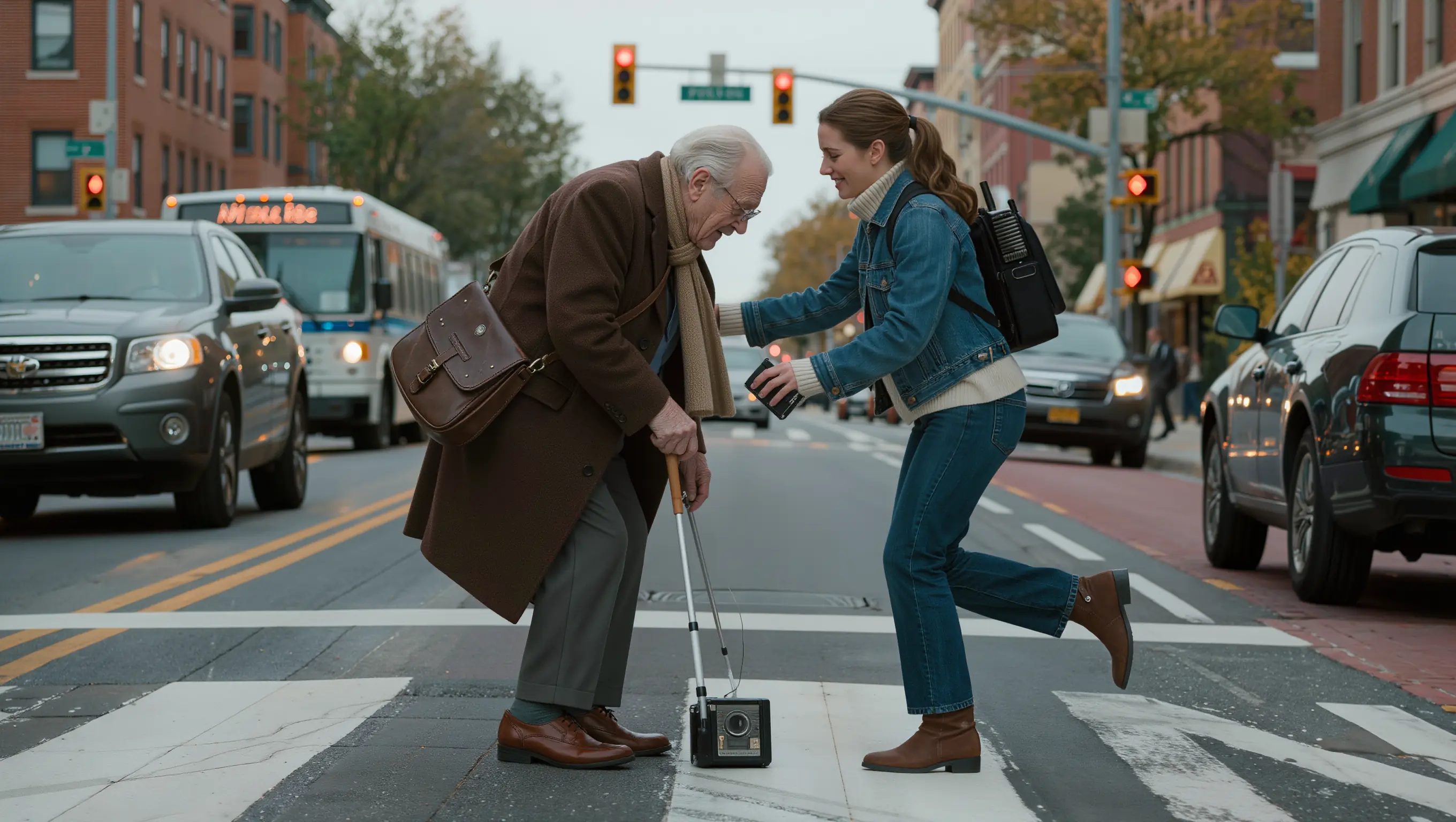
Emma looked at the old cassette inside the recorder.
“Would you like us to digitize it?”
“That is what I came to ask. I don’t know how. I’m afraid the tape will break.”
“We can help.”
His hands moved to the broken cane.
“I almost lost it in the street.”
“But you didn’t.”
“No,” he said quietly. “You didn’t let me.”
The station manager, Denise, came out of the studio and listened as Emma explained what had happened. She looked at the recorder and the broken cane, then at Arthur.
“We’ll digitize it carefully,” Denise said. “No charge.”
Arthur shook his head immediately.
“I can pay.”
Denise smiled.
“Then pay by letting us keep a copy for the local history archive, if you feel comfortable.”
Arthur lowered his head.
“Eleanor would have wanted that.”
Emma spent the next hour transferring the tape.
She cleaned the cassette gently, checked the reels, placed it into the station’s old cassette deck, and connected the audio interface. Arthur sat beside her, hands folded around the broken cane.
When the recording began, Eleanor’s voice filled the room.
Clear.
Warm.
Curious.
“All right, Arthur Bell, stop pretending you have nothing to say.”
Arthur covered his mouth.
On the tape, his younger voice answered, “I don’t have nothing. I have privacy.”
Eleanor laughed.
“Privacy is not a story. Start with the bus station in 1968.”
Arthur began to cry silently.
Emma watched the audio waves appear on the screen. She listened to Eleanor guide him gently through memories: meeting her at a bus station, losing his sight gradually in his fifties, learning to navigate the city again, the first time he crossed Main Street alone with a cane, the way fear made him angry before it made him brave.
Then Eleanor said on the tape:
“Arthur, what do you want people to understand about blindness?”
There was a long pause.
His recorded voice answered, “That losing sight did not make me disappear. People did.”
Emma looked at Arthur.
He was crying openly now.
She paused the recording.
“Do you want to stop?”
Arthur shook his head.
“No. Keep going.”
They listened to the whole tape.
When it ended, the room stayed quiet.
Emma saved the file once.
Then again.
Then on a backup drive.
Arthur exhaled slowly.
“I thought hearing her would break me.”
“Did it?”
He touched the recorder.
“No. It gave me a room to sit with her.”
Emma wrote that sentence down later.
Over the next few months, Arthur became a regular at the radio station.
First, he came to review Eleanor’s tapes. There were more than one. Boxes more. His neighbor helped bring them. Emma digitized them carefully, one by one. She labeled voices, dates, neighborhoods, and topics. Arthur identified people by sound, laughing when he recognized someone’s cough or way of saying “well now.”
The project became bigger than anyone expected.
Denise gave Emma a weekly five-minute segment called Voices Still Here.
The first episode featured Eleanor interviewing Arthur.
The line that stayed with everyone was the same one that had stopped Emma’s heart:
“Losing sight did not make me disappear. People did.”
Listeners called the station.
Some cried.
Some asked how to submit old tapes.
Some offered stories.
A retired teacher sent recordings of classroom songs. A widow brought answering machine messages. A farmer brought cassette interviews his daughter had made for a school project in 1992. An old pastor brought sermons, but Emma gently told him the program was more interested in the people after church than the pulpit. He laughed and brought potluck stories instead.
Arthur helped Emma understand what audio could do.
“Photographs show faces,” he said one afternoon. “Audio lets people enter the room with you.”
Emma wrote that down too.
She began interviewing older residents herself, using what she learned from Eleanor’s style. Ask slowly. Leave silence. Do not rush tears. Let people correct themselves. Do not treat ordinary details like interruptions. Sometimes the recipe, the bus route, the cracked church bell, the price of bread in 1954—that was the heart of the story.
Arthur listened to her early interviews and gave honest feedback.
“You interrupt when you get excited,” he told her once.
Emma winced.
“I know.”
“Excitement is good. Interruption is not.”
“I’ll work on it.”
“You already are.”
One afternoon, Arthur came to the station carrying a small cloth bag.
“I have something for you,” he said.
Emma immediately shook her head.
“Arthur.”
“You do not know what it is.”
“I know that tone.”
He smiled.
Inside the bag was a small handheld audio recorder. Old, but high quality. Worn at the edges. Carefully kept. Beside it was a pair of headphones and a folded note.
“This was Eleanor’s field recorder,” Arthur said. “Not the cassette one from the early days. This is the last recorder she used.”
Emma’s throat tightened.
“I can’t take this.”
“You can.”
“It belonged to her.”
“Yes. And she believed tools should stay in motion.”
Emma picked it up carefully.
The folded note was in Eleanor’s handwriting.
For the next listener:
Ask gently. Wait longer than feels comfortable. The story usually arrives after the first answer.
Emma had to sit down.
Arthur stood beside her.
“You helped me cross the street when I could not find safety. You saved the tape. Then you gave Eleanor’s work a second life.” He touched the recorder. “Let this help you build yours.”
It was not money.
Not a house.
Not a job title.
Just a recorder.
But to Emma, it felt like a key.
With Arthur and Denise’s encouragement, Emma applied for a regional public media fellowship for young audio storytellers. Arthur wrote a recommendation letter.
He wrote about the broken cane at the crosswalk, the saved cassette recorder, Emma’s careful work digitizing Eleanor’s tapes, and the way she understood that preserving a voice was not a technical task first. It was an act of respect.
At the end, he wrote:
Emma Lawson listens as if the person speaking is still becoming visible.
Emma cried when she read it.
She won the fellowship.
Not a huge prize.
Not a fortune.
But enough for training, mentorship, better equipment, and a small stipend to produce a longer audio series on aging, memory, and belonging in Whitmore.
She titled it Still Becoming Visible.
Arthur was the first episode.
He told the story of the crosswalk himself.
“I was standing in traffic with half a cane and all my pride broken,” he said into Eleanor’s recorder. “Then a young woman told me where the curb was.”
Emma laughed behind the microphone.
Arthur smiled.
“You may include that.”
The series grew.
People began recognizing Emma’s work. Schools used the episodes. The library hosted listening nights. Families came to the station with tapes and stories. Emma became not just an assistant, but the producer of the station’s most beloved local project.
Arthur grew older, but he kept coming to the station as long as he could. The city eventually repaired the broken crosswalk speaker after Emma aired a segment about accessible intersections. Arthur joked that it only took public embarrassment to make traffic lights polite.
One spring morning, Arthur passed away peacefully.
At his memorial, Emma played a short clip from his interview with Eleanor.
Eleanor’s voice asked, “Arthur, when did you first feel brave again?”
Arthur’s recorded voice answered, “When I realized asking for help did not mean surrendering myself.”
The room was silent after that.
Then full of tears.
After the service, Arthur’s niece gave Emma a small envelope. Inside was the broken white cane tip from the day they met. Arthur had kept it.
There was a note with it.
Emma,
Uncle Arthur said this was the day his story started moving again. He wanted you to remember that.
Emma held the broken piece in her palm and cried.
Years later, when people asked how Voices Still Here began, Emma told them the truth.
“It began with a blind old man, a broken cane, and a cassette recorder sliding toward traffic.”
Then she would show them Eleanor’s recorder, Arthur’s letter, and the broken cane tip.
The gifts were small.
A recorder.
A recommendation.
A broken piece of cane.
But inside them was the future Emma had been trying to name.
And every time she began a new interview, she read Eleanor’s note once more:
Ask gently. Wait longer than feels comfortable.
Then she pressed record.
Because some voices did not need to be rescued from silence.
They needed someone willing to stop, listen, and help them cross back into the world.