At twenty-six, Clara Bennett had learned that people often misunderstood what strength looked like.
Sometimes strength looked like a man in a leather jacket standing beside a motorcycle, arms crossed, face hard against the wind.
Sometimes it looked like a group of bikers parked along a roadside, boots planted in gravel, engines cooling under a gray sky.
But sometimes strength looked like a young woman kneeling in the mud with a wrench in her hand, rain dripping from her sleeves, refusing to let a broken trailer stop a promise from reaching the people waiting for it.
Clara had spent most of her life around tools.
Her father had owned a small garage outside Lancaster, Pennsylvania, back when the sign still read Bennett Auto Repair in faded red letters.
She grew up sweeping the floor, sorting bolts into coffee cans, holding flashlights under hoods, and listening to her father explain engines like they were stubborn animals with habits and tempers.
By twelve, she could change oil.
By fourteen, she could patch a tire.
By sixteen, she could back a trailer into a narrow bay better than most grown men in town.
By twenty, she was doing brake jobs, replacing belts, rewiring trailer lights, and diagnosing the little problems customers ignored until those problems became expensive.
But when her father got sick, everything changed.
Medical bills came first.
Then late rent on the garage.
Then the bank letters.
Then the final week when Clara stood inside the empty repair bay, staring at the tools her father had sold one by one to stay afloat.
He died in spring.
The garage closed in summer.
By autumn, Clara was working at a gas station off Route 22, making sandwiches, selling coffee, restocking windshield fluid, and doing small repairs in the parking lot whenever someone begged nicely enough.
She did not have her own shop anymore.
She did not have a lift.
She did not have a proper tool wall.
But she still had her father’s old toolbox in the back of her pickup.
And she still had his voice in her head.
“Find what failed first,” he used to say. “Panic wastes time. Diagnosis saves it.”
Clara carried that sentence like a prayer.
The gas station where she worked was called Miller’s Stop & Go.
It sat beside a long stretch of rural highway, with a diner across the road, a bait shop next door, and miles of farmland beyond the tree line.
Truckers stopped there before sunrise.
Farmers stopped for diesel.
Parents stopped for snacks before soccer games.
Travelers stopped because the next gas station was twenty-seven miles away and the highway did not forgive poor planning.
Clara worked long shifts.
Morning coffee rush.
Lunch sandwiches.
Evening fuel customers.
She wore a blue work shirt with her name stitched over the pocket, jeans, and boots with oil stains that never fully washed out.
Most customers saw a cashier.
Some saw a young woman who should smile more.
Few saw the mechanic she still was.
Clara had a dream she barely admitted out loud.
She wanted to reopen a garage.
Not a big dealership place with polished floors and waiting rooms full of fake plants.
A real garage.
Honest repairs.
Fair prices.
A bay for cars.
A bay for motorcycles.
A small trailer repair corner, because Clara knew how many people lost whole days to bad wiring, broken hitch locks, worn bearings, bent jacks, and cracked safety chains.
She had even written a name in a notebook.
Second Chance Garage.
The name was sentimental, and she knew it.
But after losing her father’s shop, she could not imagine calling it anything else.
The problem was money.
The old Bennett garage had been sold to a property company.
Her tools were limited.
Her credit was damaged from medical debt tied to her father’s final year.
And every time she thought about starting again, a bill arrived and reminded her that dreams did not pay rent.
So she worked.
She saved a little.
Lost a little.
Kept going.
The day everything changed began on a cold Saturday in late October.
The morning sky had been dull and silver, but by afternoon, rain swept across the highway in restless waves.
Wind pushed loose leaves across the gas station lot.
The air smelled of wet asphalt, diesel, and coffee.
Clara had been outside refilling washer fluid displays when she heard engines coming from the east.
Not one engine.
Many.
A deep, rolling sound that seemed to rise from the road itself.
She turned.
A line of motorcycles came over the hill, headlights glowing in the rain.
There were maybe twelve of them.
Large touring bikes.
Cruisers.
A few with flags mounted behind the seats.
Most of the riders wore black leather jackets, rain gear, gloves, and helmets.
Behind them, pulled by a dark pickup, was a long enclosed trailer.
White.
Older.
Covered in decals.
Clara caught a few words as it passed the station entrance.
Winter Ride For Families.
Coats. Blankets. Toys. Food.
Then the trailer lurched.
Hard.
The pickup swerved slightly.
The motorcycles behind it spread out fast, riders reacting with practiced control.
A loud metallic crack cut through the rain.
The trailer tilted to the right.
One wheel wobbled violently.
The driver guided the whole rig onto the shoulder just beyond the gas station lot.
Clara dropped the washer fluid bottle and ran.
By the time she reached the trailer, the bikers had already dismounted.
Several stood around the tilted wheel.
Others were directing traffic away from the shoulder.
Rain darkened their jackets.
Their faces were tense.
The pickup driver, a big man with a gray beard, crouched near the trailer axle and swore under his breath.
An older biker, tall and broad-shouldered despite his age, stood beside the trailer door with one hand braced against the metal panel.
He looked to be in his late seventies, white, with weathered skin, silver hair under a black helmet, and sharp blue eyes that seemed to take in everything.
His leather vest carried a patch that read:
Iron Shepherds.
Below it, another patch read:
Ride For Families.
Clara stopped a few feet away.
“What happened?” she called over the rain.
The gray-bearded man looked up quickly.
“Wheel bearing, maybe. Trailer started walking on us.”
The older biker glanced at her work shirt.
“You work at the station?”
“Yes.”
“You got a tow contact?”
“I’ve got tools first,” Clara said.
The bikers looked at her.
Not dismissively exactly.
But with surprise.
The bearded man said, “This trailer’s heavy.”
Clara nodded.
“Then we should find the problem before it gets heavier.”
The older biker’s mouth moved slightly, almost a smile.
“What’s your name?”
“Clara Bennett.”
The gray-bearded man blinked.
“Bennett? Any relation to Frank Bennett who had the garage outside Lancaster?”
Clara’s chest tightened.
“He was my father.”
The men exchanged glances.
The older biker stepped closer.
“Your father fixed my Harley in 2009 after I blew a belt outside Harrisburg. Wouldn’t let me leave until he packed me a sandwich.”
That sounded like her father.
Clara swallowed.
“Then he liked you.”
The old man held out a rain-wet hand.
“Vince Harper.”
She shook it.
His grip was firm but careful.
“This is Dale,” he said, pointing to the gray-bearded man. “Rick, Tommy, Moose, Eli, and the rest of these old problems on wheels.”
One biker called from near the road, “We heard that.”
Vince ignored him.
Clara crouched near the trailer wheel.
Rain soaked through the knees of her jeans.
The right rear wheel sat at a slight angle.
The tire was not flat, but there was black grease around the hub and streaks of metal dust near the rim.
The bearing cap was gone.
The hub was hot.
Too hot.
Clara held the back of her hand near it without touching.
“Bearing failure,” she said.
Dale nodded grimly.
“That’s what I thought.”
“How far were you trying to go?”
“Mercer County family shelter,” Vince said. “Forty miles west.”
Clara looked at the trailer decals.
“What’s inside?”
“Winter coats. Blankets. Toys. Food boxes. Baby supplies.” Vince’s jaw tightened. “Families are waiting tonight.”
The rain suddenly felt colder.
Clara looked under the trailer.
“Any spare hub assembly?”
Dale shook his head.
“Spare tire, yes. Hub, no.”
“Grease?”
“Yes.”
“Jack?”
“Yes.”
“Bearing kit?”
Dale hesitated.
“Maybe. We’ve got parts bins inside. I don’t know if the right size is there.”
Clara looked toward the station.
“I need it off the shoulder. You can’t work here safely.”
Vince looked at the tilted trailer.
“Can it move?”
“Slowly. Very slowly. Across the lot, not down the highway.”
Dale said, “If the bearing seizes—”
“It’s already nearly there,” Clara said. “But if we move ten yards at crawling speed with spotters, we can get it into the back of the station lot.”
Vince studied her face.
“You sure?”
“No,” Clara said. “I’m informed. That’s better than sure.”
For the first time, Dale laughed.
Vince nodded once.
“All right. She’s in charge.”
A few bikers looked surprised.
Vince turned his head.
“Anyone got a problem with that?”
No one did.
Clara organized them quickly.
Two riders directed traffic.
Two walked beside the trailer.
Dale drove the pickup.
Vince stood near Clara, watching her hand signals.
The trailer groaned as it moved.
The damaged wheel wobbled.
Clara’s heart beat hard with every slow rotation.
“Easy,” she called. “No faster. Stop if I say stop.”
The rig crawled from the shoulder into the gas station lot, then around back near the old service bay that Miller’s Stop & Go no longer used.
The moment the trailer was on flat ground, Clara raised her hand.
“Stop.”
Dale stopped.
Everyone exhaled.
Clara ran to her pickup and pulled out her father’s toolbox.
It was heavy, dented, and scratched, with Bennett written on the side in faded white paint.
Vince noticed it.
“That Frank’s box?”
“Yes.”
He nodded quietly.
“Good box.”
“The best.”
They worked under the overhang behind the station, rain pounding the metal roof above them.
Clara removed the wheel while Dale operated the jack.
The hub fought her.
The cotter pin was chewed.
The castle nut had heat damage.
Grease had burned dark.
When the hub finally came free, the bearing pieces nearly fell apart in her hand.
Rick whistled.
“That’s ugly.”
Clara held up the damaged bearing.
“That’s not ugly. That’s a confession.”
Tommy laughed.
“She talks like a mechanic.”
Dale said, “She is a mechanic.”
Clara did not look up, but something in her chest warmed at that.
They searched the trailer’s parts bins.
Inside were straps, gloves, spare bulbs, hitch pins, grease, a portable compressor, tools, zip ties, emergency cones, and several small boxes of trailer parts.
But the bearing kit was not a perfect match.
Close.
Not right.
Close did not count when a trailer carried thousands of pounds of supplies on a wet highway.
Clara sat back on her heels.
“This kit won’t work.”
Vince’s face hardened.
“How long to get the right one?”
“Maybe tomorrow if we order. Maybe Monday depending on supplier.”
Several bikers cursed under their breath.
Vince turned away and placed both hands on the trailer door.
For the first time, Clara saw past the leader.
She saw the old man underneath.
Tired.
Wet.
Fighting the possibility of failing people who had trusted him.
“There has to be another way,” he said quietly.
Dale rubbed a hand over his beard.
“We could unload into pickups.”
“Not enough room,” Rick said.
“We could make two trips.”
“Roads will freeze tonight,” Tommy said. “Shelter needs the coats now.”
Clara looked toward the old service bay beside the station.
It had been used for storage since Miller stopped offering repairs years ago.
She knew what was inside because she had reorganized it during summer.
Old shelves.
Broken signs.
Snow shovels.
An ancient tire machine.
And, if she remembered correctly, a small utility trailer the station owner had used years ago for hauling propane tanks and equipment.
She stood.
“Mr. Miller still have that old utility trailer?”
The station manager, Gary Miller, had been watching from the back door with a worried expression.
He was a thin man in his sixties who liked rules until emergencies forced him to become human.
“The old red one?” he asked.
“Yes.”
“It hasn’t been used in years.”
“Does it roll?”
“I don’t know.”
“Does it have a title?”
“Yes.”
“Lights?”
“Probably not.”
“Where?”
Gary pointed toward the side shed.
Clara ran through the rain to the shed.
Vince followed.
Inside, under a tarp and a layer of dust, sat the old red utility trailer.
Small.
Open.
Rust at the corners.
Two tires low but not destroyed.
Clara crouched and checked the frame.
Solid enough.
She checked the coupler.
Functional.
Safety chains.
Rusty but usable if reinforced.
Wiring harness.
Chewed by mice.
Of course.
Vince looked at it.
“You think this can help?”
“It won’t carry everything. But it can carry the most urgent items if we get it road-safe.”
“How long?”
Clara glanced at the sky.
“Forty-five minutes if the lights cooperate. Longer if they don’t.”
“Lights never cooperate,” Vince said.
“No. But they can be persuaded.”
They pulled the red trailer into the covered bay.
Clara inflated the tires.
They held air.
Good.
She checked the bearings.
Old, but not hot, not seized.
She greased them.
Dale helped reinforce the safety chains with rated connectors from the bikers’ supply bin.
Rick cleaned the coupler.
Tommy sorted the cargo by priority after Vince opened the main trailer.
Inside were boxes stacked carefully.
Children’s coats.
Adult coats.
Blankets.
Diapers.
Canned food.
Baby formula.
Toys.
Hygiene kits.
A box labeled Emergency Motel Vouchers.
A smaller box labeled First Night Bags.
Clara paused when she saw that.
“First Night Bags?”
Vince nodded.
“For families who arrive at the shelter with nothing. Pajamas, socks, toothbrushes, stuffed animal for kids, notebook for adults, gift card for food.”
“Who made those?”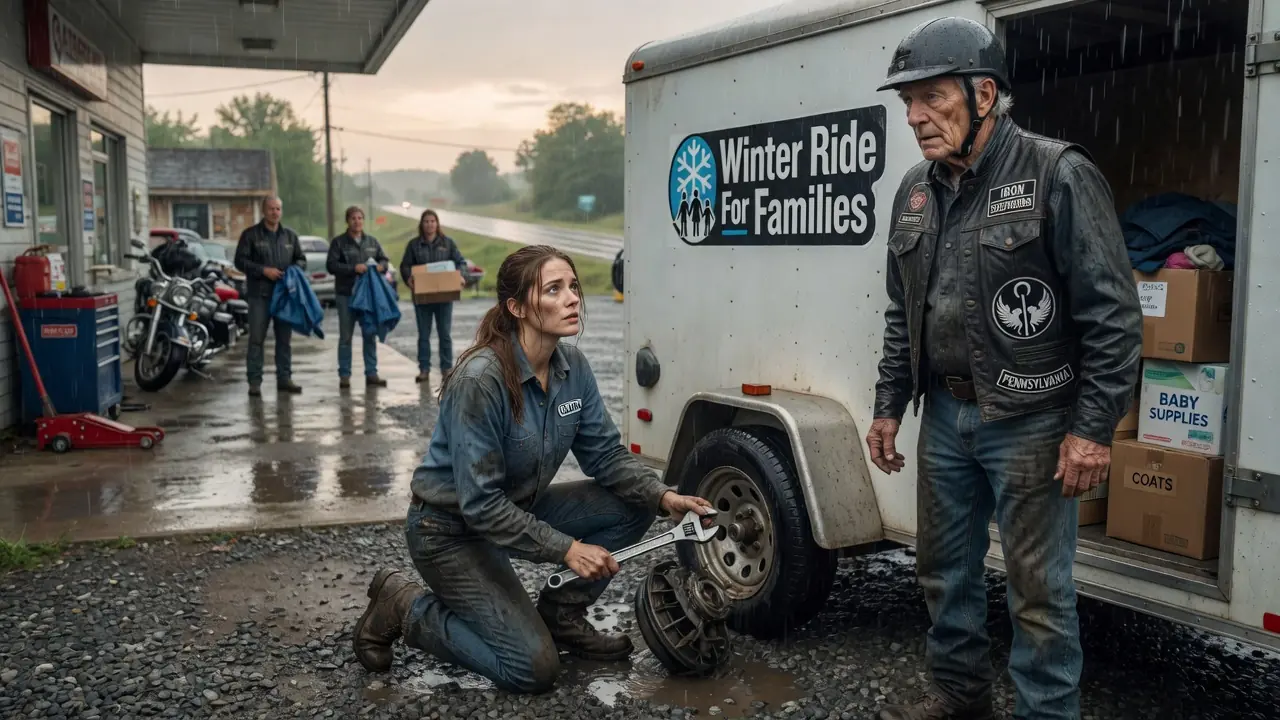
“My wife started it.”
“What was her name?”
“Eleanor.”
His voice changed when he said it.
“She passed four years ago. But the ride keeps going.”
Clara looked at the boxes.
This was not a hobby.
Not a biker outing.
This trailer held warmth, food, dignity, and the memory of a woman who had decided families should not arrive anywhere empty-handed.
Clara turned back to the wiring.
The red trailer’s lights were dead.
The harness had been chewed through.
She stripped the damaged section, spliced in spare wire from her toolbox, replaced one bulb, cleaned the contacts, and wrapped the connections carefully.
Still nothing.
She checked the ground.
Bad ground.
Always the ground.
Her father’s voice rose in her head.
Electric problems are just honesty problems. Something is not connected where it pretends to be.
She scraped rust from the grounding point, tightened the screw, and had Dale test the brake lights again.
Red light flashed against the wet pavement.
Everyone cheered.
Clara pointed the screwdriver at them.
“Don’t celebrate until both turn signals work.”
The left signal worked.
The right did not.
She stared at it.
The bikers stared at her.
Vince said, “Can it go with one?”
Clara did not even look at him.
“No.”
He smiled faintly.
“Frank Bennett’s daughter.”
She replaced the second bulb, adjusted the socket, and tested again.
Right signal blinked.
This time, the bikers cheered louder.
Clara allowed herself one smile.
They loaded the red utility trailer with the most urgent supplies.
Children’s coats.
Blankets.
First Night Bags.
Baby supplies.
Food boxes.
Emergency vouchers.
Not everything.
But enough to matter tonight.
The bikers covered the load with heavy tarps and strapped it tight.
Clara checked every strap herself.
Vince watched quietly.
“You always this particular?”
“Yes.”
“Good.”
Gary Miller cleared his throat from the doorway.
“I can lend my pickup to tow the red trailer.”
Clara turned.
“You sure?”
Gary looked at the loaded supplies.
“Families waiting, right?”
Vince nodded.
“Yes.”
Gary tossed Clara the keys.
“You drive. You know the trailer now.”
Clara blinked.
“I’m still on shift.”
Gary glanced at the broken trailer, the bikers, the rain, and the boxes.
“I think this counts as work.”
Dale laughed.
“She’s got a boss with sense.”
Gary pointed at Dale.
“Don’t spread that around.”
Within ten minutes, the convoy was ready.
Gary’s pickup towing the repaired red trailer.
Bikers ahead and behind.
Dale staying back with two men to secure the broken white trailer until a proper repair could be arranged.
Vince climbed into the passenger seat beside Clara.
“I can ride,” he said.
Clara looked at him.
“You’ve been in the rain for an hour, and your knee is stiff.”
“My knee is none of your business.”
“It became my business when you almost tripped over a jack stand.”
He grumbled.
But he stayed in the passenger seat.
The drive to Mercer County was slow.
Rain turned to sleet halfway there.
The road shone black under headlights.
Motorcycle taillights glowed red ahead of them like small lanterns.
Vince sat with both hands resting on his knees, watching the trailer through the side mirror.
“You worried about the load?” Clara asked.
“Yes.”
“It’s strapped well.”
“I know.”
“Then what?”
He was quiet for a moment.
Then he said, “Eleanor promised the shelter we’d never miss the first freeze.”
Clara kept her eyes on the road.
“And tonight is the first freeze?”
“Yes.”
“Then we won’t miss it.”
Vince looked at her.
“You say that like you can command weather.”
“No. Just trailers.”
He laughed softly.
They reached Mercer County Family Shelter just before eight.
The building was old brick with warm light in the windows and a covered entrance where families stood waiting.
Children pressed close to mothers.
A father held a toddler under his coat.
Shelter volunteers came outside as the motorcycles rolled in.
When they saw the loaded trailer, their faces changed with relief.
Vince opened the pickup door slowly.
One little girl in a pink hat shouted, “The motorcycle people came!”
The bikers became different men the moment they stepped under the shelter lights.
Their hard faces softened.
Their voices lowered.
They carried boxes gently.
They knelt to give children coats.
They handed blankets to mothers.
They asked volunteers where to place supplies.
Clara helped unload the trailer.
A small boy hugged a stuffed bear from one of the First Night Bags and would not let go.
A woman wrapped a new blanket around her shoulders and closed her eyes.
A teenage girl held a pair of winter boots like she could not believe they were hers.
Vince stood near the entrance, watching the supplies move inside.
His eyes were wet.
Clara pretended not to notice.
A shelter director named Mrs. Alvarez came to him.
“You made it,” she said.
“Barely,” Vince replied.
“Eleanor would be proud.”
Vince swallowed.
“She would have yelled at me for not replacing the bearing sooner.”
Mrs. Alvarez smiled.
“That too.”
Vince turned and pointed toward Clara.
“She’s why we made it.”
Clara shook her head immediately.
“I fixed wiring and moved boxes.”
Mrs. Alvarez walked to her and took both of her hands.
“You brought warmth before midnight. That matters here.”
Clara did not know what to say.
So she said, “You’re welcome.”
After unloading, the bikers gathered in the shelter’s community room for coffee.
Clara sat near the wall, tired, soaked, and still wearing grease on her hands.
A little girl came over holding a cookie.
“My mom said give this to the lady who fixed Christmas.”
Clara looked at the cookie.
Then at the child.
“I didn’t fix Christmas.”
The girl shrugged.
“That’s what she said.”
Clara accepted the cookie.
Vince watched from across the room.
His expression was unreadable.
On the drive back, the sleet had stopped.
The highway was quiet.
Vince looked at Clara’s hands on the wheel.
“You should have your own shop.”
Clara laughed once.
“That requires money.”
“I didn’t say it was easy.”
“I had a shop. Sort of. My father did.”
“Bennett Auto Repair.”
“Yes.”
“Why did it close?”
She hesitated.
Then told the truth.
“Medical bills. Debt. Bad timing. After Dad passed, I couldn’t keep it.”
Vince said nothing for a while.
Then he asked, “Do you want it back?”
Clara’s hands tightened on the wheel.
“Yes.”
The word came out before pride could stop it.
“More than anything.”
“What would you do with it?”
She almost said, Fix cars.
But that was too small.
“I’d run honest repairs. Cars, motorcycles, trailers. Fair prices. Emergency help for rural roads. I’d train young mechanics. Especially women. People who get told they don’t belong under a hood.”
Vince smiled faintly.
“You have a notebook.”
Clara looked at him.
“How do older people always know about notebooks?”
“Because we had dreams before phones.”
She laughed.
“Yes. I have a notebook.”
“Bring it to the Iron Shepherds clubhouse next Thursday.”
“Why?”
“Because Eleanor’s foundation still has funds for useful trouble.”
Clara glanced at him.
“Useful trouble?”
“You.”
The next Thursday, Clara went to the clubhouse.
It was an old brick building behind a feed store, filled with folding tables, motorcycle photos, coffee mugs, donated coats, toy bins, and thank-you cards from shelters and hospitals.
The Iron Shepherds sat around a table.
Vince at the head.
Dale beside him.
Rick, Tommy, Moose, Eli, and several others with expressions far more serious than Clara expected.
She brought her notebook.
Second Chance Garage.
Her hands shook slightly when she opened it.
She explained the idea.
A repair shop.
Roadside trailer support.
Rural emergency help.
Apprenticeships.
Women in mechanics.
Fair pricing.
Community service days.
Trailer safety workshops before winter charity runs.
A bay reserved monthly for low-cost repairs for seniors and single parents.
She expected polite nods.
Instead, they asked hard questions.
Budget?
Location?
Tools?
Insurance?
Training?
Revenue?
Partnerships?
Timeline?
Clara answered what she could.
When she did not know, she admitted it.
Vince listened without interrupting.
Finally, he placed one hand on the notebook.
“You’re not asking for a gift.”
“No,” Clara said. “I’m asking for a chance.”
Dale smiled.
“That’s the right answer.”
Vince opened a folder.
Inside was a proposal from the Iron Shepherds Community Ride Foundation.
They wanted to fund a one-year apprenticeship and business launch program for Clara.
They would help her lease a small garage space, purchase essential tools, complete business training, and create a trailer safety program for charity organizations and rural drivers.
Clara stared at the page.
Her throat closed.
“I can’t accept this.”
Vince leaned back.
“You can.”
“This is too much.”
“No,” he said. “Too much was a trailer full of coats sitting useless in the rain while families waited in the cold. Too much is a good mechanic selling sandwiches because the world took her garage. This is the proper size of response.”
Clara cried before she could stop herself.
The bikers looked away politely, which somehow made it worse.
She accepted.
The year that followed was the hardest and best of her life.
The foundation helped her rent a small two-bay garage outside Mill Creek.
Not fancy.
Concrete floor.
Old office.
Leaky sink.
One lift that needed servicing.
A sign with peeling paint.
But it was hers.
She named it Second Chance Garage.
The Iron Shepherds helped repaint the walls, install tool storage, repair the office, and build a trailer service station.
Dale donated a compressor.
Rick donated a motorcycle lift.
Tommy built shelves.
Moose handled electrical work.
Vince brought coffee and criticism.
Clara loved every minute of it.
She took business classes at the community college.
She learned bookkeeping, insurance, customer scheduling, vendor accounts, payroll basics, and grant reporting.
She worked late.
She made mistakes.
She fixed them.
Her first customers were nervous old friends of the bikers.
Then farmers.
Then single mothers with minivans.
Then riders.
Then local nonprofits with trailers.
The trailer safety workshops became her signature program.
Before winter, charities brought their trailers to Second Chance Garage.
Clara checked bearings, lights, tires, hitches, chains, wiring, brakes, and load balance.
She taught volunteers what failure looked like before it became disaster.
She always held up a burned bearing and said, “This is what almost stopped a shelter delivery.”
People listened.
Clara also started an apprenticeship for young women from the high school shop class.
The first class had four girls.
One was quiet and angry.
One was bubbly and afraid of getting dirty.
One had been told by her uncle that mechanics was not for girls.
One already knew more than half the boys in her class and was tired of pretending she didn’t.
Clara handed each of them a wrench and said, “Tools don’t care who holds them. Learn the work.”
The girls came back.
Then more came.
Within three years, Second Chance Garage became known across the county.
Honest.
Skilled.
Fair.
Community-minded.
The Iron Shepherds kept bringing their bikes and trailers.
The winter ride never missed another first freeze.
Vince remained involved, though he rode less as his knees worsened.
He still came every October to inspect the charity trailer himself, even though Clara had already done it.
“You don’t trust me?” she asked once.
“I trust you completely,” he said. “I don’t trust trailers.”
Fair enough.
One spring morning, Vince arrived at Second Chance Garage with a wooden box.
Clara looked at it and groaned.
“What now?”
Vince smiled.
“You are suspicious of containers.”
“Because old men keep putting life-changing things in them.”
Dale, standing nearby, laughed.
“She learns.”
Inside the box was a key.
Clara stared.
“What is this?”
Vince’s voice softened.
“The old Bennett garage is for sale again.”
Clara stopped breathing.
He continued.
“The property company went under. The foundation bought it.”
Her eyes filled instantly.
“Vince.”
“We are not giving it to you.”
She blinked.
He smiled.
“We are leasing it to Second Chance Garage for one dollar a year for the first five years, with an option to buy at a fair price after that. The foundation board approved it. Your father’s place should not become storage for someone’s broken furniture.”
Clara covered her mouth.
The old Bennett garage.
Her father’s garage.
The place where she had learned to hold a wrench.
The place she thought she had lost forever.
“This is too much,” she whispered.
Vince shook his head.
“No. Too much was watching you kneel in the rain with your father’s toolbox and no shop to go home to. This is the proper size of response.”
Clara cried openly.
Vince did too, though he denied it later.
Second Chance Garage moved into the old Bennett building that summer.
Clara kept her father’s faded sign inside the office.
Outside, she hung a new one.
Second Chance Garage
Cars. Motorcycles. Trailers. Honest repairs. Safe roads.
Underneath, in smaller letters, she added:
Founded in memory of Frank Bennett and Eleanor Harper.
Vince stood beneath the sign for a long time.
“She would have liked that.”
“So would Dad.”
The grand opening drew half the county.
There were bikers, farmers, librarians, teachers, shelter workers, single parents, teenage apprentices, old customers who remembered Frank, and families who had received coats from the winter ride.
The white charity trailer stood in the lot, fully repaired, polished, and checked twice.
The old red utility trailer sat beside it, restored and painted bright red.
A small plaque on the side read:
The trailer that carried the first load through.
Clara touched it before the ceremony.
She remembered the rain.
The broken bearing.
The little girl at the shelter saying she had fixed Christmas.
She had not fixed Christmas.
But she had fixed enough for hope to arrive.
Vince passed away peacefully five years later.
By then, Second Chance Garage had trained twenty-three apprentices, repaired hundreds of trailers, and helped multiple charities deliver supplies safely through storms, holidays, and hard seasons.
At his memorial, the Iron Shepherds rode in formation.
The sound of motorcycles filled the road outside the church like thunder rolling low across the hills.
After the service, Dale handed Clara an envelope.
“Vince wrote this for you.”
Clara opened it later in the garage office.
Inside was Vince’s rough handwriting.
Dear Clara,
The day the trailer broke, I thought I had failed Eleanor, the shelter, and every family waiting for warmth.
You saw a bad bearing, a dangerous shoulder, a useless old trailer, and a way forward.
You did not fix everything.
You fixed enough for the promise to keep moving.
That is what good mechanics and good people do.
Second Chance Garage was not repayment.
It was continuation.
You gave our ride a second chance.
We gave your father’s garage one.
Keep the lights working.
Keep the bearings greased.
Keep teaching the girls.
And never let anyone tell you a woman with a wrench is unexpected.
She is exactly who the road was waiting for.
With gratitude,
Vince Harper
Clara framed the letter in the front office.
Beside it, she placed the burned bearing from the broken trailer and the first key to the old Bennett garage.
Years later, whenever people asked how Second Chance Garage came back to life, Clara told them the truth.
“It began with a group of bikers, a broken trailer, a rainstorm, and a load of winter coats that had to reach a shelter before nightfall.”
Then she would show them Vince’s letter.
The gift Clara received was not a simple reward.
Not a check handed over in public.
Not a shiny new car.
It was a chance.
An apprenticeship.
A garage.
A way to turn one roadside repair into a future full of open bays, trained hands, and promises that kept moving.
And every autumn, before the first freeze, the Iron Shepherds still pulled into Second Chance Garage with the white trailer.
Clara inspected every bearing.
Every light.
Every chain.
Every tire.
Her apprentices watched closely.
One of them always asked why she took so long.
Clara would hold up a wrench and smile.
“Because somebody is waiting for what this trailer carries.”
Because sometimes help was not dramatic.
Sometimes it was grease under fingernails.
A ground wire scraped clean.
A small red trailer pulled from a shed.
A young woman saying, “No, one turn signal is not enough.”
Sometimes kindness wore work boots.
Sometimes it sounded like ratchets clicking in the rain.
And sometimes, fixing a broken trailer was enough to bring a whole life back home.