At twenty-four, Jenna Parker had learned that people were often wrong about who looked dangerous and who actually needed help.
She lived in a small town in Tennessee called Ridgefield, where the highway cut past old gas stations, farm roads, pine woods, and a row of weathered shops that had been standing long before Jenna was born.
Jenna was a young American woman with fair skin, long chestnut-brown hair usually tied into a low ponytail, sharp green eyes, and strong careful hands that were almost always marked with grease, dust, or tiny cuts from metal parts.
She worked at Parker Roadside Supply, a small auto parts and repair shop owned by her father.
The shop sold motor oil, spark plugs, tire plugs, trailer lights, straps, brake fluid, batteries, fuses, cheap coffee, rain ponchos, and enough emergency parts to save people from being stranded on the highway.
Jenna loved the shop.
She loved the smell of rubber, gasoline, metal, and old coffee. She loved diagnosing a problem by sound. She loved tightening a loose bracket, replacing a burnt fuse, fixing a trailer light, and watching a worried customer’s face relax when something worked again.
Her father had taught her almost everything.
“People don’t come here because their day is going well,” he used to say. “So don’t make them feel stupid for needing help.”
Jenna never forgot that.
Her dream was to start a small mobile repair service one day called Road Mercy Repairs, helping stranded drivers, bikers, delivery workers, elderly travelers, and families stuck on rural roads where tow trucks took too long and people often felt alone.
But dreams needed money.
Tools.
A service truck.
Insurance.
Certifications.
A phone line.
Trust.
Jenna had a paycheck, an old pickup, and her father’s second-best toolbox.
So she kept working.
One hot Friday afternoon in July, the sky turned gray over Ridgefield.
The air grew heavy. Thunder rolled somewhere beyond the pine trees. Jenna was closing a box of trailer wiring kits near the front counter when she heard the sound of motorcycles outside.
Not one.
A whole group.
Engines rumbled into the gravel lot, one after another, deep and uneven. Jenna looked through the window and saw seven bikers pulling in beside the gas pump.
They wore leather vests, denim jackets, boots, gloves, and road-worn expressions. Their motorcycles were big, loud, and shining with dust from the highway. Behind one bike, a small utility trailer sat at an awkward angle.
Something was wrong.
The trailer’s left wheel leaned outward.
One strap had snapped loose.
And in the trailer, covered by a tarp, was a large wooden rocking chair.
Jenna stepped outside.
The bikers turned toward her.
Most people in Ridgefield would have stopped at the sight of them: broad shoulders, gray beards, tattoos, heavy boots, patched vests, and serious faces.
Jenna noticed different things.
The older biker in front was pale from stress.
The younger ones kept looking at the trailer, not the shop.
One man had grease on his hands from trying to fix something already.
Another held the torn strap like it had personally betrayed him.
“You open?” one of them asked.
Jenna nodded.
“For another twenty minutes. What happened?”
The oldest biker removed his helmet.
He was a white American man in his late seventies, tall but thin, with a long gray beard, weathered skin, pale blue eyes, and deep lines around his mouth. He wore a black leather vest over a faded denim shirt, dark jeans, and boots that had seen thousands of miles.
His name patch said Hank.
“Our trailer wheel started wobbling three miles back,” he said. “Then the strap snapped. We pulled off before the whole thing came loose.”
Jenna crouched beside the trailer.
The hub was hot.
The cotter pin was missing.
The castle nut had backed off slightly.
The bearings were in trouble.
If they had kept riding, the wheel might have come off.
She looked up.
“You were lucky you stopped.”
The younger biker with grease on his hands muttered, “Told you.”
Hank glared at him.
“You told me after it started shaking.”
“Still counts.”
Jenna stood.
“You can’t tow this farther like that.”
Hank looked toward the trailer.
“We have to.”
“No, you don’t.”
He stared at her.
Jenna folded her arms.
“You can argue, but the wheel doesn’t care.”
One of the bikers laughed under his breath.
Hank looked annoyed, but not offended.
“What’s your name?” he asked.
“Jenna Parker.”
“You know trailers?”
“I work in a roadside supply shop on a highway. Trailers are basically unpaid employees here.”
That got a real laugh from the group.
Hank’s expression softened just a little.
“I’m Hank Morrison. This is Caleb, Dean, Marcus, Paul, Eddie, and Roy.”
Jenna nodded toward the trailer.
“What’s in there?”
No one answered immediately.
Then Hank pulled the tarp back.
The wooden rocking chair underneath was old, handmade, and beautiful. The arms were worn smooth. The back had a carved flower pattern. One rocker was wrapped carefully in cloth. It looked fragile but deeply loved.
Hank touched the chair with unexpected gentleness.
“My mother’s.”
The whole group went quiet.
Jenna looked at him more carefully.
Hank swallowed.
“She passed two months ago. We’re taking the chair to my daughter in Kentucky. My mother rocked every grandchild in that chair. My daughter just had her first baby. We promised the chair would get there before the weekend.”
Jenna looked at the trailer wheel again.
Now she understood.
This was not cargo.
It was family.
“Then we fix the trailer properly,” she said.
Hank shook his head.
“We don’t want to take over your evening.”
“You already did.”
He blinked.
Jenna smiled slightly.
“Relax. I mean that in a helpful way.”
Her father came out from the back garage, wiping his hands on a rag.
“Problem?”
“Trailer bearing issue,” Jenna said. “Missing cotter pin, loose nut, possible bearing damage. Family rocking chair in the trailer.”
Her father looked at Hank, then at the chair.
“Bring it around to bay two.”
The bikers exchanged looks.
Hank said, “We can pay.”
Her father nodded.
“I’d hope so. But first, let’s keep your mother’s chair out of a ditch.”
They pushed the trailer slowly into the side bay as thunder rolled closer. Rain began falling in large drops just as they got under cover.
Jenna guided the trailer into place, then pulled on gloves.
“Everybody stay clear of the wheel.”
Caleb crouched nearby.
“You need help?”
“I need you to hand me tools and not explain things I already know.”
Caleb grinned.
“Yes, ma’am.”
Hank laughed once.
“She got you.”
Jenna jacked up the trailer, removed the wheel, and inspected the hub. The outer bearing was worn and gritty. The grease was dirty. The nut had loosened enough to create the wobble. The missing cotter pin had allowed everything to back off.
She looked over her shoulder.
“When was this serviced?”
The group went silent.
Jenna sighed.
“That answer has a sound.”
Paul raised one hand.
“In our defense, we checked the tire pressure.”
Jenna stared at him.
“That is not the same thing.”
Paul nodded solemnly.
“I see that now.”
The rain hit the garage roof harder.
Jenna worked steadily.
She cleaned the spindle.
Inspected the races.
Repacked the bearings.
Replaced the damaged outer bearing from shop stock.
Installed a new seal.
Reset the hub.
Adjusted the castle nut correctly.
Added a new cotter pin.
Then she checked the other wheel, because one bad side often meant another tired side.
It was not failing yet, but it needed grease.
She handled it too.
While she worked, the bikers stood around the bay, no longer intimidating, just worried men watching a young woman save something precious.
Hank stayed close to the rocking chair.
Jenna noticed.
“You want to move that inside while the trailer’s being fixed?”
Hank looked at the chair.
“No. It’s tied.”
“One strap already snapped.”
He frowned.
She was right.
Jenna walked to the trailer and examined the remaining straps. They were old, sun-damaged, and not suitable for something fragile.
“These are done,” she said.
Hank looked embarrassed.
“We thought they’d hold.”
“They held until they didn’t.”
Dean asked, “You sell better ones?”
“Yes. And moving blankets. And corner protectors.”
Hank reached for his wallet.
Jenna lifted one hand.
“Let me show you first.”
She brought out proper straps, soft loops, padding, and two clean moving blankets. Together, she and the bikers unloaded the rocking chair carefully and brought it into the shop, away from the rain. Jenna placed it near the front counter on a clean tarp.
The chair looked strangely gentle among motor oil and tool displays.
Hank stood staring at it.
“My mother sat in that chair every morning,” he said quietly. “Coffee in one hand, crossword puzzle in the other. If you came into her kitchen upset, she pointed at the chair across from her and said, ‘Sit down before your feelings get loud.’”
Jenna smiled.
“She sounds wonderful.”
“She was bossy.”
“Those can overlap.”
Hank chuckled.
“Yes, they can.”
The rain became a full storm.
Lightning flashed over the highway. Water rushed through the gravel lot. The sky darkened early.
Jenna’s father looked outside.
“Nobody’s riding in this tonight.”
Hank shook his head.
“We need to get back on the road.”
Jenna turned.
“No, you don’t.”
“We’re already behind.”
“You’ll be more behind if one of you slides under a truck.”
The garage went quiet.
Hank looked at her, jaw tight.
Jenna softened her voice, but not her meaning.
“The chair can wait one night. Your daughter would rather get it tomorrow than have seven soaked bikers injured on the highway.”
Marcus said, “She’s right.”
Caleb nodded.
Hank looked at the storm.
Then at the chair.
Then down at his wet boots.
Finally, he sighed.
“My mother would have said the same thing.”
Jenna’s father said, “There’s a motel two miles down. But in this weather, I’d rather you not ride there either.”
Jenna added, “We have the old break room and the storage loft. Not fancy. Dry. There’s coffee, a microwave, and vending machine food of questionable character.”
Paul raised his hand.
“How questionable?”
“Emotionally complicated,” Jenna said.
The bikers laughed.
Hank looked at her father.
“We don’t want to impose.”
Her father shrugged.
“Storm’s imposing. You’re just standing in it.”
So they stayed.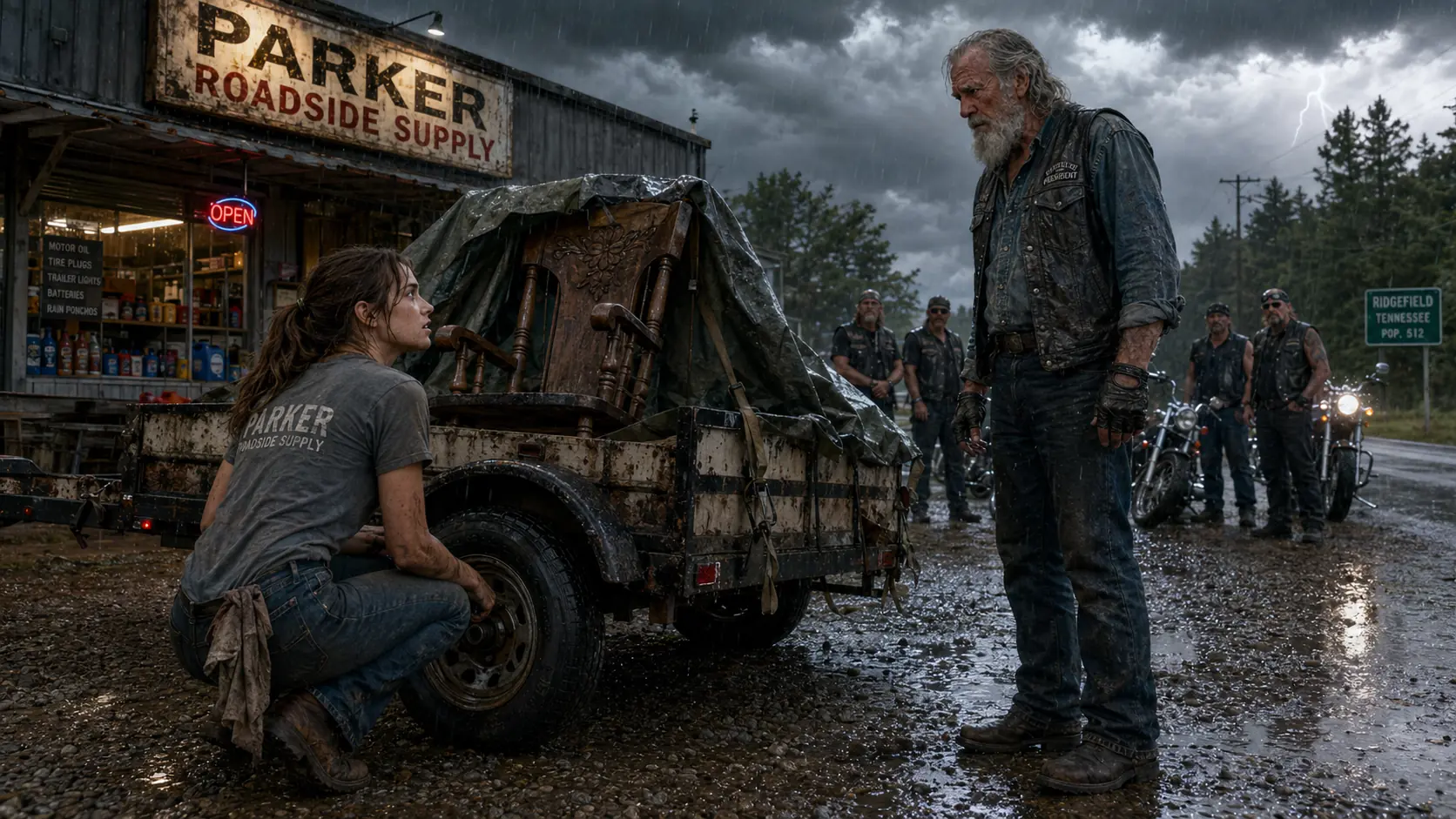
The motorcycles were rolled under the side awning. The trailer remained in the bay.
The rocking chair stayed near the counter, covered with a blanket. Jenna made coffee. Her father found old cots from the storage loft.
The bikers bought snacks, rain ponchos, and enough beef jerky to embarrass everyone.
That evening, while the storm hammered the roof, Jenna sat near the counter finishing the trailer paperwork.
Hank sat nearby, looking at his mother’s rocking chair.
“You handled that repair better than most mechanics twice your age,” he said.
Jenna looked up.
“Thanks.”
“You always work on trailers?”
“And bikes, cars, lawnmowers, generators, anything that breaks near this road.”
“You want your own shop?”
“Mobile service.”
He raised an eyebrow.
“Roadside?”
“Rural roadside. People get stranded out here all the time. Bad weather, bad tires, dead batteries, trailer problems, overheated engines. Sometimes tow trucks take hours. Sometimes people don’t know who to call.”
Hank nodded slowly.
“You got a name?”
“Road Mercy Repairs.”
He looked at her for a long moment.
“That’s a good name.”
“It’s just an idea.”
“At my age, ‘just an idea’ means someone hasn’t found the courage or the cash yet.”
Jenna smiled faintly.
“Both, probably.”
Hank looked at his group, then back at her.
“Bikers know roads. We know where people get stranded. We know which curves are bad, which gas stations have air pumps, and which stretches have no signal.”
Jenna sat still.
“You’re saying…”
“I’m saying maybe your idea needs maps.”
The next morning, the storm had passed.
The sky was clean and pale. The highway steamed under sunlight. Jenna finished securing the rocking chair in the trailer with new straps, proper padding, and a better weight balance. The wheel was repaired. The lights were checked. The trailer was safe.
Hank walked around it twice, inspecting her work.
“Well?” Jenna asked.
He nodded.
“My mother would approve.”
“Was she hard to impress?”
“Impossible.”
“Then I’ll accept that.”
Before they left, Hank took a small patch from his vest pocket.
It was black with white stitching, not an official club patch, but a memorial patch.
Morrison Family Ride
Carry What Matters
He placed it on the counter.
Jenna shook her head.
“No. I can’t take that.”
“Yes, you can.”
“That’s family.”
“So was what you helped protect.”
Jenna looked at the patch.
Hank’s voice grew softer.
“My mother used to say people reveal themselves by how they handle what matters to someone else. You handled that chair like it mattered to you.”
“It did.”
“I know.”
He pushed the patch gently toward her.
“Keep it.”
The bikers rode out slowly, with the repaired trailer rolling steady behind them. Hank lifted one hand as they turned onto the highway.
Jenna watched until they disappeared.
She thought that was the end.
It was not.
Two weeks later, Hank returned.
This time, he came alone, riding a black Harley with silver trim. He carried a large folded map, a notebook, and a paper bag of peach muffins his daughter had apparently insisted he deliver.
The rocking chair had made it to Kentucky.
His daughter had cried.
The baby had been rocked in it that night.
And Hank had not forgotten Road Mercy Repairs.
He spread the map across the shop counter.
“I marked bad spots,” he said.
Jenna leaned over.
He had circled rural areas with poor cell service, dangerous shoulders, steep curves, long stretches between gas stations, and places bikers often stopped when weather turned.
“These are good notes,” Jenna said.
“I’ve got more.”
Over the next few months, Hank and his biker friends became unexpected partners in Jenna’s dream.
They brought information.
Where riders broke down.
Which roads flooded.
Which bridges iced first.
Which gas stations closed early.
Which towns had no after-hours repair.
Jenna began building a roadside response notebook.
Battery jump zones.
Tire repair needs.
Trailer emergency supplies.
Weather shelter points.
Volunteer contacts.
Local mechanics.
Safe pull-off spots.
Hank told everyone, “She’s not building a tow company. She’s building common sense with tools.”
Jenna liked that more than she expected.
The biker group began stopping by once a month. At first, her father was amused. Then impressed. They were serious, organized, and loyal. They donated used but good tools, extra rain gear, and emergency supplies.
Caleb helped Jenna install shelves in her old pickup.
Marcus donated reflective cones.
Paul found a used portable air compressor.
Dean made laminated roadside safety cards.
Eddie knew a retired dispatcher who helped Jenna organize call logs.
Roy had a cousin who did small-business insurance.
Slowly, Road Mercy Repairs became less of a notebook and more of a beginning.
One afternoon, Hank handed Jenna a folded letter.
“What’s this?”
“Recommendation.”
“For what?”
“That county rural business grant.”
Jenna stared.
“How do you know about that?”
“You left the flyer on the counter.”
“You read my counter?”
“I am a retired man. We read everything.”
The letter told the story of the broken trailer, the storm, the rocking chair, and Jenna’s dream. Hank wrote that she had not only fixed a wheel. She had understood the value of what the wheel carried.
At the end, he wrote:
Jenna Parker has the rare kind of skill that combines mechanical sense with human respect. She knows that roadside repair is not about machines alone. It is about getting people and what they love safely home.
With Hank’s letter, her father’s recommendation, the maps, and the first volunteer records, Jenna applied.
She won a modest grant.
Not a fortune.
Not a new truck.
Not a full business handed to her.
But enough to buy insurance, a better roadside jack, battery equipment, tire repair tools, lights, cones, a small generator, and decals for her pickup.
On the side of the truck, in simple white letters, it read:
Road Mercy Repairs
Rural Roadside Help
Hank came to see it the day the decals were finished.
He walked around the truck slowly.
Then he nodded.
“Your letters are straight.”
“My dad checked them three times.”
“Good man.”
Jenna smiled.
Hank reached into his saddlebag and pulled out an old wrench.
It was heavy, worn, and polished smooth from years of use.
“This was my brother’s,” he said.
Jenna’s smile faded.
“Hank…”
“Tommy was the mechanic in our family. He could fix a bike with half a toolbox and a bad attitude.”
Jenna held back a laugh.
“He sounds useful.”
“He was.” Hank looked at the wrench. “He passed before my mother did. That chair was his favorite place too. He used to sit beside her and hand her crossword answers she did not ask for.”
He held the wrench out.
“I want this in your truck.”
“I can’t take your brother’s wrench.”
“You can.”
“That belongs to your family.”
“It’s going into family work.”
Jenna’s eyes stung.
Hank placed it in her hand.
“Use it when something important needs to keep moving.”
Years passed.
Road Mercy Repairs grew slowly but steadily.
Jenna still worked at the shop, but her roadside calls increased. She helped families with flat tires, farmers with trailer issues, bikers stranded in storms, elderly drivers with dead batteries, and travelers who had no idea where they were.
She never became rich.
But she became known.
If someone broke down between Ridgefield and the county line, people said, “Call Jenna.”
The biker group remained part of the network. They helped with safety events, delivered emergency kits, and taught new riders how to prepare for long rural routes. Hank became the unofficial senior advisor, though he preferred the title Road Captain Emeritus, which he made Jenna print on a name tag.
He wore it proudly.
Every summer, the bikers organized a ride called Carry What Matters, raising money for Road Mercy Repairs and collecting emergency supplies for stranded travelers.
At the front of every ride was a small photo of Hank’s mother’s rocking chair, safely placed in his daughter’s nursery.
Hank grew older.
His rides became shorter.
His knees got worse.
His beard turned almost fully white.
But he still came by the shop, sat near the counter, drank bad coffee, and gave advice nobody had requested.
One autumn afternoon, he arrived without his motorcycle.
Caleb drove him.
Jenna noticed immediately.
“You okay?”
Hank waved her off.
“Old parts. Hard to source.”
She laughed, but her chest tightened.
He handed her one final small box.
Inside was the original broken cotter pin from the trailer.
Jenna stared.
“You kept this?”
“Of course.”
“Why?”
“Because that little missing piece nearly cost us something big.”
He closed her hand around it.
“Remember that. Small parts matter.”
Hank passed away the following spring.
At his memorial gathering, held outside Parker Roadside Supply because that was where he had demanded people meet “if they wanted to tell lies about him,” the bikers lined the gravel lot with motorcycles. Jenna parked the Road Mercy truck near the garage bay where she had fixed the trailer years before.
Caleb handed her an envelope.
“Hank left this.”
Inside was a note written in Hank’s rough handwriting.
Jenna,
The day we rolled into your lot, I thought we had a trailer problem.
We did.
But we also had a promise problem.
You fixed both.
You helped us get my mother’s chair to a baby who needed to know where she came from.
Then you built a way to help other people carry what matters.
Keep the wrench. Keep the patch. Keep stopping.
Roads are hard.
People should not have to face them alone.
— Hank
Jenna cried openly.
She did not care who saw.
Years later, whenever people asked how Road Mercy Repairs began, she told them the truth.
“It began with a group of bikers, a broken trailer wheel, and a rocking chair that had to get home.”
Then she would show them Tommy’s wrench and Hank’s patch.
The gifts were small.
A patch.
A wrench.
A broken cotter pin.
But inside those small things was the future Jenna had been trying to build.
And every time she pulled onto the shoulder behind a stranded vehicle, turned on her hazard lights, and stepped into rain, heat, dust, or darkness, she remembered Hank’s words.
Small parts matter.
So did small acts.
And sometimes, helping someone fix one broken wheel was enough to set an entire life in motion.