The rain came down like punishment that Tuesday afternoon in Houston, Texas.
It hammered against bus stop roofs, rushed along the gutters in muddy streams, and turned the streets into shining gray ribbons beneath the traffic lights.
Cars moved slowly through intersections, their tires hissing over deep puddles.
Wind pushed loose flyers against fences. Palm trees bent under the storm, their wet leaves shivering like tired hands.
The sky looked low and heavy, the kind of sky that made the whole city feel older.
People hurried beneath umbrellas with their heads down, focused only on getting somewhere warm and dry. They stepped over puddles, avoided eye contact, and moved around strangers with the practiced efficiency of people who had trained themselves not to notice too much.
No one wanted to be delayed.
No one wanted another problem.
No one wanted to inherit someone else’s emergency.
Aaliyah Brown understood that feeling better than most.
At twenty-four years old, she stood beneath the leaking shelter of a bus stop on Westheimer Road, clutching the strap of her worn black purse with one hand and a folded job confirmation email with the other.
The paper had softened at the edges from rain.
She kept checking it anyway, as if rereading the words could keep the opportunity from slipping away.
Morrison’s Diner.
Probationary evening shift.
Start time: 5:30 p.m.
Late arrival may result in cancellation of placement.
Those words had been printed plainly, almost casually, but to Aaliyah they felt like a threat written across the future.
Late arrival may result in cancellation of placement.
She had been searching for steady work for nearly two months.
Not just side work.
Not just cash cleaning jobs.
Not just temporary shifts that disappeared after three days.
A real job.
A place that might put her on the schedule regularly enough to help with rent, groceries, and the growing pile of medical bills waiting on the kitchen counter.
Her mother, Denise Brown, had been in and out of Houston Methodist for months after a series of health complications left her weak, exhausted, and unable to return to her hotel housekeeping job. The doctors were kind. The nurses were patient. But kindness did not cancel balances.
Every visit seemed to create another bill.
Every prescription came with a price.
Every phone call from a billing department made Aaliyah’s stomach knot before she even said hello.
She had tried to stay calm for her mother.
“You focus on healing, Mama,” she would say, sitting beside the hospital bed and holding Denise’s hand. “I’ll handle everything else.”
But everything else was becoming too heavy.
The apartment was one missed payment away from disaster.
The electricity had already been shut off once and restored only because a church fund covered the minimum. The refrigerator hummed with almost nothing inside it. The landlord had stopped asking politely. And Aaliyah had started waking up before dawn every morning with her heart pounding, as if fear itself had become an alarm clock.
Today was supposed to be the beginning of change.
Just one shift.
Just one chance.
If she showed up on time, worked hard, smiled through exhaustion, and proved she could be reliable, the manager said they might keep her on.
Aaliyah had dressed carefully that afternoon in her cleanest black pants, a white blouse, and the only pair of shoes she owned that looked professional enough, though the soles were thin and already letting in rainwater.
Her hair was pulled back tight at the nape of her neck. She had borrowed a little lip gloss from her neighbor, Mrs. Alvarez, who had squeezed her hand and said, “Go get that job, baby.”
Aaliyah had smiled.
She had said, “I will.”
Now the bus was late.
Again.
She checked her phone.
4:47 p.m.
The bus should have arrived twelve minutes ago.
The ride to Morrison’s Diner would take fifteen minutes in good traffic, maybe twenty in weather like this. Then she would have to walk another five minutes from the stop.
If the bus came now, she might still make it.
Barely.
Her stomach twisted with an emptiness that had nothing to do with hunger, though she had not eaten since yesterday morning. She had exactly twenty-three dollars in her wallet. Twelve of it needed to last for transportation until Friday. Five had been set aside for the pharmacy copay her mother needed. The rest was for whatever could not be postponed.
Aaliyah’s phone buzzed.
Her whole body tightened.
For a second, she thought it might be Morrison’s Diner calling to cancel.
Instead, the screen showed the hospital.
She answered immediately.
“Hello?”
“Miss Brown, this is Houston Methodist billing. We wanted to remind you that the remaining balance on your mother’s medication account is still pending.”
Aaliyah closed her eyes.
Rain dripped through a crack in the bus shelter roof and landed near her shoes.
“Yes. I know. I’m trying to make a payment this week.”
“We understand, but the account is marked urgent.”
“I understand.”
“Would you be able to provide anything today?”
Aaliyah looked down at her purse.
Twenty-three dollars.
Her entire world at that moment.
“No,” she said quietly. “Not today.”
There was a pause on the other end. The woman softened her voice, but the softness made Aaliyah feel even smaller.
“All right. Please be aware that delays may affect coverage for future refills.”
“I said I understand.”
She hated how sharp her voice sounded.
The woman was only doing her job.
Everyone was always only doing their job.
That was how cruelty often moved through the world without anyone having to claim it.
Aaliyah ended the call and pressed the phone against her chest for a moment.
She thought of her mother lying in that narrow hospital bed, smiling whenever Aaliyah came into the room, pretending not to be scared.
Denise Brown had raised her alone after Aaliyah’s father left when she was eight. He had promised he was only going to Dallas for work. He never came back. At first, Denise had cried at night in the bathroom where she thought Aaliyah could not hear. Then she stopped crying and started working more.
Double shifts.
Weekend cleaning.
Laundry jobs.
Church kitchen work when someone needed help.
Denise’s hands had always smelled faintly of bleach, lotion, and peppermint gum.
She had given everything.
Now Aaliyah was trying desperately to give something back before time ran out.
The bus sign swayed in the wind.
Aaliyah looked down the road.
Nothing.
Only rain.
Only traffic.
Only headlights smeared across wet pavement.
Then she saw her.
An elderly woman sat alone on a stone bench in front of a closed storefront across the street.
She looked close to eighty.
Her silver hair hung in wet strings around her face, plastered to her cheeks by the relentless rain. She wore a floral dress beneath a thin cardigan, no coat, no umbrella, no shoes suited for weather. One of her stockings had torn near the ankle. Her arms were wrapped around a large purse that she clutched to her chest as if it were the only solid thing left in the world.
At first, Aaliyah thought the woman might be waiting for someone.
Then she noticed the way the woman’s head tilted slightly forward.
The way her eyes stared without focus.
The way her lips moved around words no one could hear.
The woman was trembling so badly the purse shook against her chest.
People walked past her.
One man stepped around the bench without slowing.
A woman under a red umbrella glanced at the old woman, frowned, then hurried on.
A teenager raised his phone as if to take a video, then changed his mind when his friend pulled him away.
Aaliyah’s chest tightened.
Not your problem, she told herself.
The thought came fast, frightened, practical.
You have your own problems.
You have a job to get to.
You have your mother to think about.
You cannot save everyone.
The elderly woman shifted on the bench, and for one terrible second, her body leaned too far to the side. She caught herself weakly, one hand sliding against the wet stone.
Aaliyah stepped forward without meaning to.
Then stopped.
Her phone read 4:51 p.m.
If the bus came now, she would make it.
If she crossed the street, if she helped, if she got involved, she would miss it.
The manager at Morrison’s Diner had been clear.
Show up on time or don’t bother showing up at all.
Aaliyah looked down the road.
At that exact moment, the bus turned the corner.
Its headlights cut through the rain.
Her heart lurched.
There it was.
Her chance.
Her way to the job.
Her way to a paycheck.
Her way to medicine, rent, dignity, one small step back from the edge.
Across the street, the old woman’s head drooped again.
This time, she did not catch herself as quickly.
Aaliyah saw another face.
Her mother’s.
Not now, but three years earlier when Denise’s own mother, Aaliyah’s grandmother, had suffered memory problems near the end of her life. Grandma Louise had once wandered out of the house in her nightgown during a storm, confused and looking for a church that had closed thirty years before. A stranger had found her under a tree, soaked and frightened, and had brought her home.
Aaliyah remembered her mother crying afterward.
“Someone stopped,” Denise had whispered. “God bless the person who stopped.”
The bus hissed toward the curb.
Aaliyah could see the driver’s face through the wet windshield.
Her legs felt frozen.
Then the old woman nearly slid from the bench.
“Damn it,” Aaliyah whispered.
Her body moved before her fear could stop it.
She turned away from the bus and ran across the street.
A car blared its horn.
Water splashed over her shoes.
Behind her, the bus doors opened.
Aaliyah did not look back.
She reached the bench breathless, rain soaking through her blouse in seconds.
“Ma’am?” she said, kneeling in front of the old woman. “Ma’am, can you hear me?”
The woman’s eyes fluttered.
Up close, she looked even more fragile. Her skin was pale and papery. Her lips had a bluish tint. Rainwater dripped from her chin. She smelled faintly of expensive soap and cold air.
She blinked at Aaliyah.
“I have to find him,” she whispered.
“Who?”
“My son.”
Aaliyah leaned closer.
“What’s your name?”
The woman’s brow furrowed.
“I… I was going to… Ethan. I need Ethan.”
“Is Ethan your son?”
The woman nodded, then shook her head, confused.
“He was little. He had a blue sweater. I told him not to run near the fountain.”
Aaliyah felt fear settle in.
This woman was not just cold.
She was lost in time.
The bus doors closed behind her.
The engine rumbled.
Aaliyah heard it pull away from the curb.
For one second, grief passed through her so sharply she almost could not breathe.
There went the job.
There went the chance.
There went the fragile plan she had built in her mind.
But the old woman’s hand slipped from the purse, fingers trembling.
Aaliyah swallowed her panic.
She took off her thin jacket and wrapped it around the woman’s shoulders.
The cold struck her immediately. Rain soaked her blouse, and wind pressed the wet fabric against her skin.
The old woman looked at the jacket, then at Aaliyah.
“You’ll be cold.”
“So will you.”
“I’m sorry,” the woman whispered.
“No. Don’t apologize.”
Aaliyah looked around quickly.
The closed storefront offered no help. The bus shelter across the street was leaking. The nearest open place was a small corner store three blocks down with a faded green sign that read:
Thompson’s Groceries and More.
“All right,” Aaliyah said. “We’re getting you somewhere warm.”
“I need Ethan.”
“We’re going to find Ethan. But first, we need to get you out of the rain.”
The woman clutched her purse tighter.
“My bag.”
“I’ve got it.”
Aaliyah slung the heavy purse over her own shoulder, then helped the woman stand.
She was lighter than expected, but unsteady. Her knees trembled. Twice she nearly slipped. Aaliyah wrapped one arm around her waist and guided her slowly down the sidewalk.
Every step felt like time stealing from her.
Her phone buzzed once.
Then again.
She did not check it.
She already knew.
Morrison’s Diner.
Maybe the manager.
Maybe the job disappearing in real time.
Rain blurred her vision.
The old woman murmured as they walked.
“Ethan doesn’t like storms. He used to hide under the dining table. Sarah would bring him cookies.”
Aaliyah kept her voice calm.
“Sarah is family?”
“My daughter.”
“Where is Sarah now?”
The woman’s face crumpled.
“She was sick.”
Aaliyah did not press.
Some grief did not need help opening.
By the time they reached Thompson’s Groceries, Aaliyah was shivering violently. Her shoes squelched with every step. The elderly woman could barely hold herself upright.
Aaliyah pushed through the door with her shoulder.
A bell rang overhead.
Warm air met them, carrying the smell of coffee, canned goods, and old wood.
Behind the counter, Mr. Thompson looked up from a newspaper.
He was a white man in his sixties, broad around the middle, with reading glasses perched low on his nose and a gray beard trimmed close.
His eyes widened when he saw them.
“Jesus, Mary, and Joseph.”
He came around the counter immediately.
“What happened?”
“I found her outside,” Aaliyah said. “She’s cold and confused. I think she’s lost.”
Mr. Thompson did not waste time.
“Back here. Chairs by the office.”
Together, they helped the old woman to a small alcove near the store’s back office. Mr. Thompson pulled out a plastic chair, then disappeared and returned with clean towels and a blanket that smelled faintly of laundry detergent.
Aaliyah wrapped the blanket around the woman and began gently drying her hair.
“I’ll put on hot water,” Mr. Thompson said. “Tea?”
“Yes, please,” Aaliyah said, then caught herself. “I don’t have money right now. I can—”
“I didn’t ask for money.”
His voice was gruff, but kind.
He looked at her soaked clothes and the jacket around the old woman’s shoulders.
“You did a good thing bringing her in.”
Aaliyah looked away because praise felt dangerous when she had just lost the job she needed most.
She knelt in front of the old woman.
“Ma’am, I need you to look at me.”
The woman blinked.
“That’s better. Can you tell me your name?”
A pause.
Then, slowly, “Evelyn.”
“Good. Evelyn. Do you know your last name?”
The woman’s brows drew together.
“Hayes,” she said finally. “Evelyn Hayes.”
Aaliyah repeated it softly, anchoring the woman with her own name.
“Evelyn Hayes. That’s good. Do you know where you live?”
Evelyn looked toward the store window, where rain streaked the glass.
“The apartment with the tall windows.”
“Okay.”
“You can see the park. Ethan said I shouldn’t go alone.”
“Ethan is your son?”
“My son,” Evelyn said. “Yes. He’s always working. Such a good boy. Too much like his father.”
Her voice shifted, as if she were stepping from one memory into another.
“I was looking for him.”
“Do you remember his phone number?”
Evelyn stared at her.
“I used to know numbers. I knew everyone’s number.”
“That’s okay.”
“I don’t remember.”
Her face filled with fear.
“I don’t remember my own son’s number.”
Aaliyah took her cold hand.
“It’s okay. We’ll find him another way.”
Mr. Thompson returned with tea in Styrofoam cups. He handed one to Evelyn, one to Aaliyah.
Aaliyah wrapped both hands around the cup, grateful for the heat.
Her phone buzzed again.
She finally looked.
Three missed calls.
One voicemail.
Morrison’s Diner.
Her throat tightened.
Not now.
She pushed the phone into her purse and looked at Mr. Thompson.
“Do you have Wi-Fi? I need to search for her son.”
“Password’s taped on the office wall.”
Aaliyah connected with shaking fingers.
Her battery was at 18%.
She typed quickly.
Evelyn Hayes Houston Ethan.
Too many results.
Nothing useful.
Ethan Hayes Houston mother Evelyn.
Still too many.
She tried, “Hayes apartment tall windows park Houston.”
Nothing.
“Evelyn,” Aaliyah said gently, “does Ethan work somewhere? Do you remember what he does?”
Evelyn sipped her tea.
Her hands still trembled, but some color had returned to her cheeks.
“The building,” she murmured.
“What building?”
“The big one. With his name.”
Aaliyah leaned closer.
“What name?”
“Hayes,” Evelyn said suddenly, clearly, as if a door had opened in her mind. “Hayes Global Industries. That’s Ethan’s company. He’s always there. Always in meetings.”
Aaliyah’s fingers froze over the phone.
Hayes Global Industries.
She searched it.
The results loaded.
Her breath caught.
Hayes Global Industries was one of the largest energy infrastructure and technology firms in Texas, headquartered in downtown Houston.
CEO: Ethan Hayes.
Aaliyah clicked the image result.
A man in his late thirties stared back from a corporate photograph. Dark hair. Serious eyes. Expensive suit. The kind of man who appeared on business magazine covers and gave speeches about markets and innovation.
She looked at Evelyn.
Then back at the phone.
“Mr. Thompson,” she said, voice shaking slightly, “can I use your phone? Mine’s almost dead.”
He handed over the cordless phone from the office without question.
Aaliyah dialed the main number listed on the company website.
Her heart pounded harder with every ring.
“Hayes Global Industries, how may I direct your call?”
“I need to speak with Ethan Hayes,” Aaliyah said, trying to sound calm. “It’s urgent. It’s about his mother.”
A crisp pause.
“Mr. Hayes is in a meeting. May I take a message?”
“No. Please. His mother is with me. She was lost in the rain. She’s safe now, but she’s confused and cold, and I need to speak to him.”
Another pause.
“I’m sorry, ma’am, but I can’t interrupt Mr. Hayes without verification.”
Aaliyah closed her eyes.
“Listen to me. Her name is Evelyn Hayes. She keeps asking for Ethan. She says she lives in an apartment with tall windows and she can see the park. She said Sarah died. I don’t know who Sarah is, but she said it. Please tell him someone found his mother.”
The receptionist’s tone changed.
“One moment.”
Hold music began.
Classical.
Soft.
Expensive-sounding.
Aaliyah held the phone so tightly her knuckles turned pale.
Evelyn hummed quietly from the chair, staring into her tea.
Mr. Thompson stood nearby with his arms crossed, watching the rain.
Thirty seconds passed.
Forty-five.
A minute.
Then a man’s voice exploded through the line.
“Where is she?”
Breathless.
Frantic.
Barely controlled.
“Where is my mother? Is she hurt? Tell me where you are right now.”
“She’s okay,” Aaliyah said quickly. “We’re at Thompson’s Groceries on Westheimer near County Line.”
Mr. Thompson supplied the full address, and Aaliyah repeated it.
“She was outside in the rain. She was cold, but we got her inside. She’s drinking tea.”
“Don’t move,” Ethan said. His voice shook. “Please. Don’t let her leave. I’m coming right now. Ten minutes.”
“We’ll be here.”
The line went dead.
Aaliyah lowered the phone slowly.
Her hands were trembling.
Mr. Thompson exhaled.
“Well. Sounds like we found the son.”
Evelyn looked up suddenly.
“Ethan?”
“He’s coming,” Aaliyah said gently.
Evelyn’s whole face softened.
“My boy.”
The words made Aaliyah’s chest ache.
She thought of her mother, who would be waiting for her visit later. If she missed visiting hours because of this, Denise would pretend not to mind. She always pretended not to mind.
Mr. Thompson cleared his throat.
“You want some soup?” he asked. “Got chicken noodle in the back. Nothing fancy.”
Aaliyah’s stomach cramped at the mention of food.
She looked at Evelyn, at her thin frame and the way her hands still shook slightly.
Then she looked down at her own purse.
Twenty-three dollars.
Her last money.
The job probably gone.
The hospital still waiting.
Her mother still sick.
She thought about telling Mr. Thompson no.
Then Evelyn whispered, “I haven’t eaten since breakfast.”
Aaliyah knew immediately that breakfast might have been yesterday or the day before.
“I’ll pay for it,” she said.
Mr. Thompson frowned.
“I said I got soup.”
“I’ll pay.”
He studied her face and seemed to understand that refusing would injure something in her.
“Fine,” he said. “You can pay me a dollar.”
“Soup costs more than a dollar.”
“Not today.”
He heated two bowls.
One for Evelyn.
One for Aaliyah, though she protested until he placed it in her hands and said, “Don’t make me argue with a wet woman in my store.”
When Evelyn’s hands shook too much, Aaliyah held the bowl and guided the spoon.
Evelyn ate slowly at first, then with more need.
“You’re very kind,” Evelyn said between spoonfuls. Her eyes were clearer now, warmed by tea and soup. “What’s your name, dear?”
“Aaliyah.”
“Aaliyah,” Evelyn repeated. “That’s a beautiful name.”
“Thank you.”
“Sarah would have liked you.”
“Who’s Sarah?”
“My daughter,” Evelyn said.
Her face clouded.
“She’s gone, isn’t she?”
Aaliyah held her gaze.
“Yes, I think so.”
Evelyn nodded, tears filling her eyes.
“She was kind too.”
Aaliyah’s throat tightened.
“My mother is kind.”
“Is she still here?”
“Yes. She’s sick.”
“Then go see her as often as you can,” Evelyn whispered. “When they’re gone, you’ll want every minute back.”
Aaliyah looked away quickly.
A black Mercedes sedan arrived ten minutes later, its headlights sweeping across the storefront windows.
The car barely stopped before the driver’s door flew open.
A man rushed out into the rain without an umbrella.
He was in his late thirties, wearing a dark suit that probably cost more than Aaliyah’s rent. His hair was slightly disheveled, like he had been running his hands through it. His face was tight with worry, fear, and something like barely contained panic.
He burst through the door of Thompson’s Groceries like a man fleeing a burning building.
“Mom.”
Evelyn looked up.
The man crossed the store in three strides and dropped to his knees in front of her chair.
“Mom. Oh my God. Are you okay? Are you hurt?”
Evelyn stared at him for a moment, confused.
Then recognition lit her face.
“Ethan.”
He let out a broken breath.
“There you are,” she said softly. “I was looking for you.”
“I know, Mom. I know.”
He took her hands, checking her face, her arms, the blanket, the jacket around her shoulders. His own hands were shaking.
“You can’t do this. You can’t leave like that. I’ve been searching for two hours. I thought…”
His voice broke.
Evelyn touched his cheek.
“Don’t fuss. This nice girl helped me.”
Only then did Ethan seem to register Aaliyah.
He stood slowly.
His eyes took in her soaked blouse, her missing jacket, her damp hair, the exhaustion written in every line of her face.
“You found her,” he said.
“Yes.”
“You called me.”
“Yes.”
“Where was she?”
“On a bench near the bus stop. She was alone in the rain.”
Something passed across Ethan’s face.
Horror.
Guilt.
Gratitude.
All at once.
“How long were you with her?”
Aaliyah checked her phone.
6:32 p.m.
Nearly two hours.
The shift at Morrison’s Diner had started an hour ago.
Her missed calls sat on the screen like proof of failure.
“A while,” she said simply.
Ethan’s eyes moved to the phone in her hand, then back to her face.
“You were going somewhere.”
Aaliyah did not answer.
His expression changed.
“You were waiting for a bus.”
Again, she said nothing.
“And you missed it to help my mother.”
Aaliyah looked down.
“It was just a job.”
The lie sounded weak even to her.
Ethan closed his eyes briefly.
When he opened them again, they were bright with unshed tears.
“Thank you,” he said, and the words sounded like they were being pulled from somewhere deep inside him. “Thank you for stopping. Thank you for staying with her. Thank you for keeping her safe.”
“Anyone would have done the same,” Aaliyah said quietly.
“No,” Ethan said.
His voice was certain.
“No, they wouldn’t have.”
Ethan insisted on paying for everything at Thompson’s.
The soup.
The tea.
A pack of dry socks for Evelyn.
A phone charger.
Then he tried to press money into Mr. Thompson’s hand for helping, but the store owner shook his head.
“She brought her in. I just opened the back room.”
Ethan looked at Aaliyah again.
“Please let me drive you home.”
She wanted to refuse.
She had learned a long time ago that accepting help from wealthy people could come with invisible strings.
But she was cold, exhausted, and already late beyond repair. The thought of standing at another bus stop in the rain made her bones ache.
“Okay,” she said. “Thank you.”
The Mercedes smelled of leather, rain, and clean air.
Aaliyah sat in the passenger seat while Evelyn rested in the back, wrapped in the blanket. Ethan had called his assistant and arranged for a nurse to meet them at his mother’s apartment.
At first, they drove in silence.
Houston blurred past the windows, wet and shining.
Then Ethan spoke carefully.
“May I ask what you were going to?”
Aaliyah watched the streetlights streak across the glass.
“First day at a diner job.”
He said nothing for a moment.
“And you missed it.”
“Yes.”
“I’m sorry.”
“Not your fault.”
“No,” he said quietly. “But it happened because of my mother.”
“It happened because I made a choice.”
He absorbed that.
“What kind of work do you want?”
Aaliyah almost laughed.
“Want doesn’t have much to do with it right now.”
“What did you want before survival got in the way?”
The question struck her harder than expected.
Before survival.
She had not thought of life that way, but it was true. Survival had stepped in front of everything.
“I wanted to work in healthcare,” she said. “Not a doctor or anything. Maybe nursing. Maybe elder care. My grandma had memory problems before she passed, and I helped care for her. I was good at it.”
“You were good with my mother.”
“I knew that kind of confusion.”
Ethan nodded slowly.
“My mother has early-stage dementia. Some days she’s clear. Some days she thinks my sister is still alive. Some days she tries to go find people who are gone.”
“I’m sorry.”
“Sarah died three years ago. Cancer. After that, Mom started slipping faster. Grief made everything worse.”
Aaliyah looked back at Evelyn.
The old woman had fallen asleep against the seat, face peaceful now.
“She said Sarah was kind.”
“She was.”
Ethan’s hands tightened slightly on the steering wheel.
“She would have stopped too.”
They drove to Evelyn’s apartment first.
It was in a high-rise near a park, with tall windows just as she had described. The lobby was quiet and elegant. A doorman greeted Ethan by name, then turned pale when he saw Evelyn wrapped in a store blanket.
“Mr. Hayes, we were looking everywhere.”
“I know,” Ethan said sharply, then softened. “It’s all right. She’s safe.”
Upstairs, a nurse arrived and checked Evelyn’s vitals. Ethan helped his mother into dry clothes with the practiced care of a son who had done it many times before. Aaliyah waited near the living room window, looking out over the wet park below.
The apartment was beautiful.
Floor-to-ceiling windows.
Soft gray furniture.
Art on the walls.
Fresh flowers on a table.
Everything expensive.
Everything lonely.
When Ethan returned, he looked more exhausted than before.
“She wants to see you before you go.”
Aaliyah followed him into the bedroom.
Evelyn was tucked beneath a blanket, hair dried, face pale but calmer.
She reached for Aaliyah’s hand.
“You gave me your coat.”
“Yes.”
“You didn’t have another one, did you?”
Aaliyah smiled faintly.
“Not with me.”
Evelyn squeezed her fingers weakly.
“Sarah would have liked you.”
Aaliyah blinked back tears.
“I think I would have liked Sarah.”
Evelyn nodded, satisfied.
Then she closed her eyes.
Ethan drove Aaliyah home afterward.
When she gave him the address, she saw something flicker across his face, the kind of recognition that came from knowing what kind of neighborhood it was without saying so.
She did not apologize for it.
She was too tired to apologize for poverty.
When they pulled up to her apartment complex, the rain had softened to a cold drizzle. Aaliyah reached for the door handle.
“Wait,” Ethan said.
She paused.
“I know you probably don’t want anything from me.”
“That’s not what I said.”
“But it’s what your face says.”
Despite everything, she almost smiled.
Ethan took a breath.
“I want to offer you something, and I need you to hear me out completely before you answer.”
Aaliyah tensed.
“My mother needs help,” he continued. “Not medical care. She has nurses for that. She needs someone with her during the day. Someone patient. Someone who can talk to her, keep her calm, help her feel safe, make sure she doesn’t leave alone.”
Aaliyah stared at him.
“You want to hire me.”
“Yes.”
“You don’t know me.”
“I know enough to trust you with the person I love most.”
She looked away.
“I’m not qualified.”
“You found her in the rain, got her warm, fed her, found me, and kept her calm for two hours. Four professional caregivers with certifications have quit or been fired in three months because they treated her like a task instead of a person.”
Aaliyah’s throat tightened.
“I missed my job.”
“I know.”
“And if I don’t work, I don’t pay rent.”
“That’s why this is a job offer, not charity.”
He named a salary.
Aaliyah turned to him sharply.
“That’s too much.”
“It’s fair.”
“For sitting with someone?”
“For protecting my mother’s dignity.”
She had no response to that.
He continued, “Healthcare benefits. Paid training if you want elder care certification. A housing stipend so you can live closer to her building or closer to your mother’s hospital. A one-month trial. If it feels wrong, you leave. No penalties.”
Aaliyah stared at him.
Rain streaked down the windshield between them and the dark city beyond.
“Why?” she asked.
“You could hire anyone.”
“I have hired anyone,” Ethan said. “It hasn’t worked.”
“No. I mean why trust me?”
He looked at her fully.
“Because when everyone else walked past my mother, you crossed the street. You had somewhere to be. You had something to lose. And you still crossed.”
Aaliyah looked down at her hands.
The offer was impossible.
Too sudden.
Too good.
Too frightening.
“I need time to think.”
“Of course.”
He handed her a business card and wrote his personal number on the back.
“Call me tomorrow. Or the next day. Whenever you’re ready.”
Aaliyah stepped out of the car.
The apartment stairwell smelled of damp concrete and old smoke. She climbed to the third floor slowly, every muscle aching. When she reached her door, an orange notice was taped to the peeling paint.
Notice to Vacate.
Seventy-two hours.
Her breath left her.
She pulled the notice down and carried it inside.
The apartment was dark. The power had not been cut, but one of the lights had burned out and she had not replaced it. The kitchen table was covered in envelopes, hospital forms, and the pharmacy receipt she had not paid yet.
Aaliyah sat on the floor with the eviction notice in one hand and Ethan’s business card in the other.
Her phone buzzed.
A text from an unknown number.
This is Ethan Hayes. I know you have doubts. I would too. But this is not charity. This is a desperate son asking for help from the only person who has been able to reach my mother in months. Please consider it.
Aaliyah looked at the message for a long time.
Then she typed back:
One month trial. If anything feels wrong, I leave immediately. No questions asked.
The response came within seconds.
Deal. Thank you.
Then another message.
You saved her today. I won’t forget it.
Aaliyah leaned her head against the wall and closed her eyes.
She had just said yes to the strangest proposition of her life.
The apartment Ethan arranged was not luxurious, but to Aaliyah it felt almost impossible.
It was small, clean, and safe.
The heat worked.
The windows locked.
The water ran clear.
There was no mold near the bathtub, no hole beneath the sink, no upstairs neighbor screaming through the night, no smell of damp carpet in the hallway.
It was six blocks from Evelyn’s building and close enough to the hospital that Aaliyah could visit her mother after work without two bus transfers.
The first night she slept there, she woke twice because the silence felt suspicious.
Ethan covered the deposit and first month as part of the employment relocation agreement. Aaliyah made him put everything in writing.
He did.
No hesitation.
“No hidden strings,” he said.
Aaliyah looked over the paperwork three times anyway.
Trust, she had learned, should not be rushed.
Her first official day with Evelyn began at 8:00 a.m.
Ethan met her at the elevator on the twenty-third floor. He looked tired, his tie loosened and sleeves rolled up as if he had been working since dawn.
“Thank you for coming,” he said.
“You said that already.”
“I may keep saying it.”
“You don’t have to.”
“I know.”
He led her into the apartment.
Everything was brighter in daylight. The windows overlooked the rain-washed park. The furniture was expensive and immaculate, but the apartment still felt incomplete somehow, like a beautiful room where no one laughed enough.
Evelyn sat in an armchair near the window, wrapped in a pale blue shawl.
When she saw Aaliyah, her face lit up.
“The girl with the coat.”
Aaliyah smiled.
“Yes, ma’am.”
“You came back.”
“I did.”
Evelyn held out her hand.
Aaliyah crossed the room and took it.
“How are you feeling today?”
“Better now.”
Ethan looked away quickly, but Aaliyah saw the emotion on his face.
For the next four hours, Aaliyah sat with Evelyn.
They talked about small things at first.
Tea.
Rain.
The park.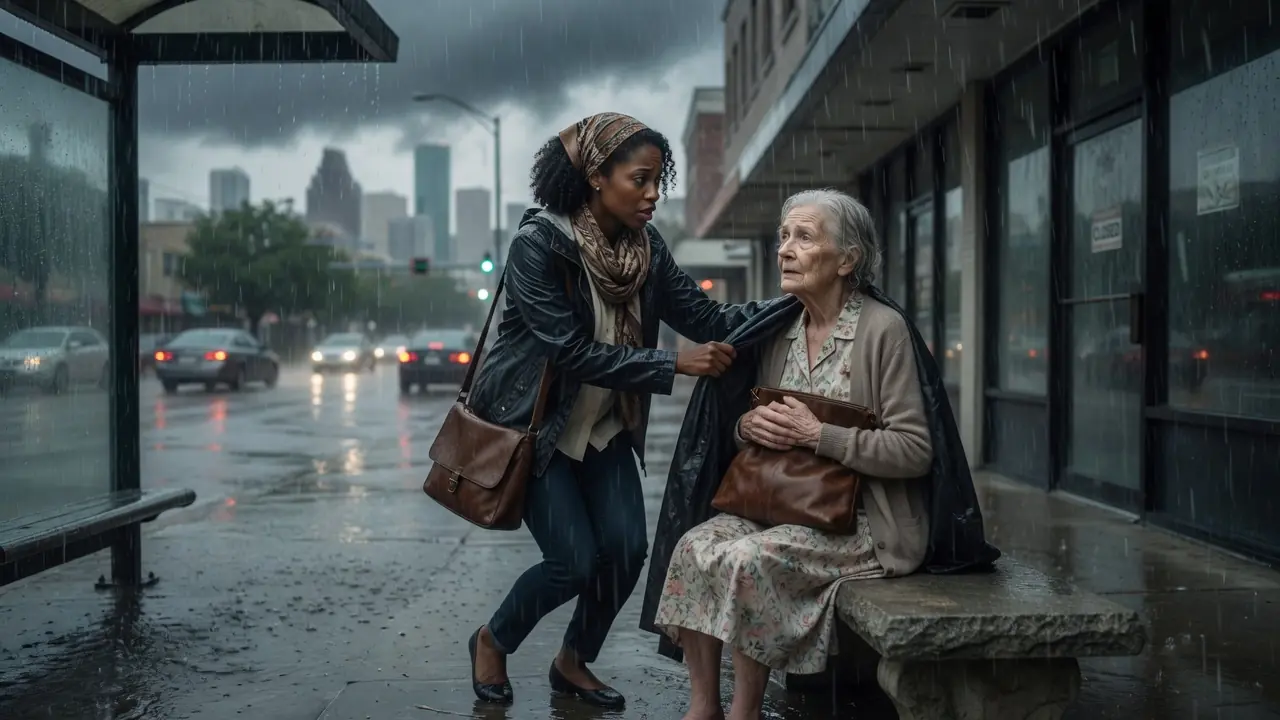
Flowers.
Then Evelyn began telling stories.
About growing up in Galveston.
About meeting her husband James at a charity auction where she accidentally insulted his tie.
About Ethan as a boy, serious even at seven years old, always lining up toy cars by color.
About Sarah, who loved poetry, old movies, and strawberry cake.
Sometimes Evelyn’s thoughts wandered.
She would stop mid-sentence and ask where James was.
Aaliyah learned not to say, “He died,” every time. That only reopened the wound.
Instead, she said gently, “Tell me about him.”
And Evelyn would.
Some days were harder.
Some days Evelyn woke suspicious, asking why Aaliyah was in her home. Once she accused Aaliyah of taking Sarah’s scarf, then cried when she realized she had frightened her. Aaliyah sat beside her through the shame.
“It’s all right,” she said.
“No, it isn’t. I’m becoming terrible.”
“You’re becoming confused sometimes. That isn’t the same as terrible.”
Evelyn stared at her.
“You talk like someone who knows.”
“I cared for my grandmother near the end.”
“And your mother?”
“My mother is sick now.”
Evelyn reached for her hand.
“Then you are carrying too much.”
Aaliyah looked down.
“Maybe.”
“People will let you carry too much if you don’t set it down.”
Aaliyah smiled sadly.
“I don’t know where to put it.”
Evelyn squeezed her fingers.
“Here, sometimes.”
Aaliyah did not answer because her throat tightened too much.
Within two weeks, Evelyn’s nurses noticed the difference.
“She’s calmer with you,” one said.
“She eats more when you’re here.”
“She asks for you after you leave.”
Ethan noticed most.
He began coming home earlier.
At first, he would appear in the doorway during Aaliyah’s afternoon reading time, pretending he needed a document from the living room. Then he began sitting down for ten minutes. Then twenty.
One evening, Evelyn insisted they all eat dinner together.
“I’m tired of meals on trays,” she declared.
Ethan ordered from a nearby restaurant. Aaliyah tried to excuse herself.
“I should go.”
Evelyn frowned.
“Why?”
“You’re having dinner with your son.”
“And you are here.”
Ethan looked at Aaliyah.
“You’re welcome to stay.”
It was easier to say yes than to disappoint Evelyn.
They ate at the dining table beneath a chandelier that made the glasses sparkle. Evelyn told a story about Sarah burning garlic bread. Ethan corrected one detail. Evelyn accused him of always being too precise. Aaliyah laughed before she could stop herself.
Ethan looked at her.
Not surprised exactly.
But grateful.
As if laughter had become rare in that room.
Aaliyah visited her mother every evening after work.
Denise noticed the change quickly.
“You look less scared,” she said one night.
Aaliyah sat beside the hospital bed, smoothing lotion over her mother’s hands.
“I got a job.”
“A real one?”
“Yes.”
“With that woman you helped?”
“With her son.”
Denise listened as Aaliyah explained everything.
The apartment.
The salary.
Evelyn’s dementia.
The companion work.
The training.
When she finished, Denise lay quiet for a long moment.
Then she said, “That old woman was your bus.”
Aaliyah frowned.
“What?”
“You thought you missed the bus to your future. Maybe God sent another one sitting on a bench.”
Aaliyah laughed softly.
“Mama.”
“I’m serious.”
“I know.”
Denise looked at her daughter with tired but shining eyes.
“You crossed the street.”
Aaliyah nodded.
“Yes.”
“Always remember that.”
By October, Aaliyah began taking evening classes twice a week toward her nursing assistant certification. Ethan arranged her schedule around them. He also had textbooks delivered to her apartment, along with a note.
For when the dream wakes back up.
Aaliyah stared at the note for a long time.
Then she taped it above her desk.
Studying was harder than she expected.
Not because she could not understand the material, but because her life had trained her to expect interruption. Her mother’s health rose and fell. Evelyn had difficult days. Bills still existed, though now they could be paid. Aaliyah’s own exhaustion caught up with her in waves.
Sometimes, at midnight, she sat with flashcards spread across the table and cried silently because she was so tired of being strong.
The next morning, she got up anyway.
Evelyn became invested in her studies.
“What did you learn today?” she would ask.
“Blood pressure ranges.”
“Useful.”
“Patient mobility.”
“Very useful.”
“Infection control.”
“Vital. Nurses used to scold James about handwashing. He believed charm killed germs.”
Aaliyah laughed.
On clear days, Aaliyah took Evelyn to the park across from the building. They walked slowly along the paths, Evelyn’s hand resting on Aaliyah’s arm.
Sometimes Evelyn was lucid and told long stories.
Sometimes she thought Aaliyah was Sarah.
At first, Aaliyah corrected her.
Then one day Evelyn looked so peaceful calling her daughter’s name that Aaliyah only said, “I’m here.”
Later, she told Ethan.
“I didn’t know if that was wrong.”
He sat beside her on a park bench, watching his mother feed birds.
“I don’t know what’s wrong anymore,” he admitted. “I used to think truth mattered most. Now I think peace does.”
Aaliyah looked at him.
“You’re doing your best.”
He gave a humorless laugh.
“My best lost her in a storm.”
“No,” Aaliyah said firmly. “Her illness did that.”
“I should have had more security.”
“She needed more than security.”
Ethan looked toward his mother.
“What did she need?”
“To feel less alone.”
That sentence stayed with him.
He changed after that.
He reduced work travel.
Moved some meetings home.
Had dinner with his mother most nights.
He asked Aaliyah to teach him how to respond when Evelyn repeated questions or forgot Sarah had died. He stopped correcting sharply. He learned to redirect gently.
The first time Evelyn asked where Sarah was and Ethan managed to say, “Tell me what she was like as a child,” instead of breaking, Aaliyah saw how much effort it cost him.
After Evelyn went to bed that night, he stood in the kitchen, gripping the counter.
“I hate this,” he whispered.
“I know.”
“I hate that I’m losing her while she’s still here.”
Aaliyah stood beside him.
“That’s one of the hardest parts.”
“How do people survive it?”
“They stop trying to survive the whole thing at once.”
He looked at her.
“How?”
“One day. Sometimes one hour. Sometimes just one breath.”
Ethan nodded slowly.
“You learned that from your mother?”
“And my grandmother.”
“Strong women.”
“Yes.”
His eyes softened.
“That includes you.”
Aaliyah looked away.
Compliments still made her uncomfortable, especially ones that sounded true.
Winter came quietly to Houston, less harsh than northern winters but gray enough to make the city feel subdued.
Evelyn’s condition declined.
Her lucid days became less frequent. She slept more. Ate less. Wandered more often within the apartment, searching for rooms from old houses or people from long ago.
Aaliyah created a memory wall in the hallway.
Photos of James.
Sarah.
Ethan as a child.
Evelyn’s garden.
Old vacations.
Short labels written clearly beneath each frame.
James, my husband.
Sarah, my daughter.
Ethan, my son.
Home in Galveston.
The roses I loved.
Evelyn stood before the wall every morning.
Sometimes she smiled.
Sometimes she cried.
Sometimes she only touched the frames and whispered names like prayers.
One afternoon, Evelyn asked for paper.
“I want to write down my family,” she said. “So I don’t lose everyone.”
Aaliyah brought a large sheet, colored markers, and tea.
Together, they made a family tree.
Evelyn dictated slowly.
“James Hayes. My husband. He danced badly.”
Aaliyah wrote:
James Hayes, husband. Bad dancer, good heart.
Evelyn laughed.
“Sarah Hayes. My daughter. Loved poems.”
Aaliyah wrote it carefully.
“Ethan Hayes. My son. Too serious. Needs rest.”
Ethan walked in just in time to hear that.
“Thank you, Mom.”
“It’s true.”
Aaliyah smiled and wrote it down.
Then Evelyn looked at a blank space near the bottom of the page.
“There.”
Aaliyah waited.
“Write Aaliyah.”
Aaliyah looked up.
“Mrs. Hayes…”
“Write it.”
“What should I write?”
Evelyn’s voice grew firm.
“Aaliyah Brown. Daughter of my heart.”
The room went still.
Aaliyah’s vision blurred.
Evelyn pointed again.
“And under her, write Denise, the mother who raised her. She belongs because she made you the kind of woman who stops in rain.”
Aaliyah pressed a hand over her mouth.
Ethan looked away, eyes wet.
Aaliyah wrote the words exactly as Evelyn asked.
When she finished, Evelyn studied the page with satisfaction.
“There,” she said. “Now it’s complete.”
Aaliyah later made a copy and brought it to the hospital.
Denise read it slowly.
Daughter of my heart.
The mother who raised her.
Tears slipped down her cheeks.
“That woman knows family,” Denise whispered.
“Yes,” Aaliyah said. “She does.”
In February, Denise’s condition worsened.
Aaliyah balanced hospital visits, work with Evelyn, classes, and her own grief with the stunned determination of someone who could not afford collapse.
Ethan offered more time off.
She refused at first.
He insisted.
“Your mother matters,” he said. “Go be with her.”
Aaliyah spent three days sleeping in a hospital chair beside Denise’s bed.
On the last night, Denise woke near dawn.
The room was quiet except for machines and distant footsteps in the hall.
“Aaliyah,” she whispered.
“I’m here.”
“I know.”
Denise turned her head slightly.
“You helped that old woman find her son.”
“Yes.”
“And she helped you find a road.”
Aaliyah began crying.
“Mama…”
Denise squeezed her hand weakly.
“Don’t stop walking it.”
“I won’t.”
“And don’t let grief make you hard.”
“I don’t know how to do this without you.”
“You do it the way I did it without my mama. You cry. You work. You help somebody. Then you wake up and do it again.”
Aaliyah bowed her head over their joined hands.
Denise passed two days later.
Quietly.
With Aaliyah beside her.
Grief hollowed the world.
For weeks afterward, Aaliyah moved through life as if sound had been turned down. Evelyn asked about Denise often, sometimes remembering, sometimes forgetting and asking why Aaliyah’s eyes looked sad.
Each time, Aaliyah answered gently.
“My mother passed.”
Evelyn would cry anew, then hold her hand.
“I’m sorry, dear.”
Aaliyah did not mind repeating it.
Grief repeated itself too.
Ethan handled the funeral arrangements quietly in the background after Aaliyah admitted she did not know what to do. He did not take over. He only stood beside her through each decision.
At the small service, Evelyn attended in a wheelchair, wrapped in a cream shawl. She held Aaliyah’s hand through the prayers.
Afterward, Evelyn looked at the casket and said clearly, “Thank you for raising her.”
Aaliyah broke then, and Evelyn pulled her close with surprising strength.
Spring brought no full healing, but it brought movement.
Aaliyah returned to classes.
Returned to Evelyn.
Returned to life.
Her grief did not shrink exactly.
She grew around it.
That was something Evelyn taught her without meaning to.
Because Evelyn lived each day surrounded by absences, yet still smiled when the sunlight hit the park, still laughed at bad jokes, still hummed old songs when Aaliyah brushed her hair.
One evening, while rain tapped gently against the windows, Evelyn became unusually lucid.
She asked Ethan and Aaliyah to sit with her.
“I know I’m leaving,” she said.
Ethan stiffened.
“Mom…”
“No. Let me speak while I can.”
Aaliyah sat on one side of the bed, Ethan on the other.
Evelyn looked at her son first.
“You were a good boy.”
Ethan’s face crumpled.
“I wasn’t always a good son.”
“You were tired. Scared. Busy trying to hold the world. That is different.”
“I should have been there that day.”
“You came when called.”
He bowed his head.
Then Evelyn looked at Aaliyah.
“The day you found me, I was not only lost in the rain. I was lost in my own sorrow. I had been looking for Sarah. Then Ethan. Then James. All the people I loved were mixed together in my mind, and I was so frightened.”
Her hand tightened around Aaliyah’s.
“You gave me your coat. You brought me inside. You found my son. You gave me more months with him.”
Aaliyah could not speak.
Evelyn’s voice trembled but stayed clear.
“You thought you lost a job that day.”
Aaliyah nodded through tears.
“You found a family.”
The room blurred.
Evelyn smiled faintly.
“And so did I.”
She slept after that.
Two weeks later, Evelyn Hayes passed away peacefully in her apartment, with Ethan holding one hand and Aaliyah holding the other.
Rain fell softly against the windows.
Not storm rain this time.
Gentler.
Like the city remembering.
The memorial service was held in the apartment with the tall windows overlooking the park. Ethan kept it small because Evelyn had always hated large formal gatherings where people performed grief in expensive clothes.
Her friends came.
A few relatives.
Some former employees from Hayes Global.
Her nurses.
Aaliyah.
In the center of the room, beside flowers, stood the family tree Evelyn had made.
James.
Sarah.
Ethan.
Aaliyah, daughter of my heart.
Denise, the mother who raised her.
People paused before it.
Some looked confused.
Ethan did not explain unless asked.
When someone quietly asked who Aaliyah was, he said simply, “Family.”
After the service, Ethan handed Aaliyah an envelope.
“Mom wanted you to have this.”
Inside was a letter in Evelyn’s shaky handwriting.
Dear Aaliyah,
You found me in the rain when I was looking for my son.
You gave me warmth when I was cold.
You gave me food when I was weak.
You gave me patience when my mind betrayed me.
But most of all, you gave me back to Ethan.
There is no gift larger than that.
I know your mother is gone now, and I know that kind of loss changes the shape of a person’s life. Let it deepen you, dear, but do not let it close you.
I have asked Ethan to make sure your education is paid for in full. Not as charity. As gratitude. As continuation. Become what you were meant to become. Help others the way you helped me.
And when it rains, carry an extra coat.
Love,
Evelyn
Aaliyah held the letter to her chest and cried until her body shook.
Ethan stood nearby, giving her the dignity of not being rushed.
Two years later, Aaliyah walked across a stage in a navy gown and accepted her nursing degree.
The applause sounded distant at first, then enormous.
She searched the audience.
Ethan stood near the front, clapping with both hands, smiling with such pride that for a moment Aaliyah imagined what it might have felt like to have a father who stayed.
Beside him sat Mrs. Alvarez, Mr. Thompson, two of Evelyn’s former nurses, and a framed photograph of Denise and Evelyn placed carefully on the empty chair Ethan had reserved between them.
Aaliyah cried when she saw it.
After the ceremony, Ethan hugged her tightly.
“You did it.”
“We did it,” she said.
He shook his head.
“No. You did the work.”
“You paid for it.”
“That is not the same as earning it.”
She looked at him, and for the first time, fully believed that.
A month later, Ethan invited her to Hayes Global’s downtown office.
Aaliyah had been there only once before. The building was tall and cold from the outside, all glass and steel, but Ethan’s private office had changed since Evelyn’s passing. There were photographs now. A shawl draped over one chair. A framed copy of the family tree near the bookshelf.
Ethan looked nervous.
That surprised her.
“I want to start something,” he said.
Aaliyah sat across from him.
“What kind of something?”
“A foundation in my mother’s name. Companion care for elderly people who are isolated, low-income, or living with memory loss. Not medical care only. Human care. Someone to talk to them, sit with them, help families find support before a crisis.”
Aaliyah’s heart began beating faster.
“The Evelyn Hayes Memorial Foundation,” he said. “I want you to run it.”
Aaliyah stared.
“Me?”
“You know what these families need.”
“I just graduated.”
“You cared for my mother better than anyone I hired before you. You understand the fear. You understand the dignity piece. You understand that elderly people are not problems to manage.”
Aaliyah looked down at her hands.
“What would it do?”
“We would train caregivers from underserved communities. Pay fair wages. Provide companion visits, respite support for families, emergency check-ins during storms, transportation coordination, and memory-care navigation.”
He paused.
“And a rain response program.”
Aaliyah looked up.
“What?”
“When severe weather hits, volunteers check bus stops, parks, shelters, and apartment buildings for elderly people who may be lost or stranded.”
Aaliyah’s throat tightened.
Evelyn in the rain.
The bench.
The missed bus.
The coat.
“We’ll carry extra coats,” Ethan said softly.
Aaliyah covered her mouth.
Then she nodded.
“Yes.”
“You don’t need time?”
“I had time. The answer is yes.”
The foundation opened that fall.
Its first office was modest, located in a renovated community building near a bus route. Aaliyah insisted on that. If they wanted to serve people without cars, they needed to be where people could reach them.
The walls were painted warm yellow.
The waiting room had soft chairs, tea, and framed photographs of elders smiling with companions.
Near the entrance hung Evelyn’s words:
You found me in the rain.
Now we find others.
The first year was difficult.
Funding existed because of Ethan, but systems had to be built from nothing. Aaliyah hired slowly, choosing people not only for credentials but for patience. She trained them to listen, redirect gently, protect dignity, and recognize when confusion might be fear rather than stubbornness.
Some applicants wanted easy work.
They did not last.
Some came with deep compassion but little training.
Aaliyah trained them.
She taught them what she had learned from Evelyn.
Never argue with someone’s grief.
Never talk over an elder as if they are furniture.
Never assume confusion means emptiness.
Never treat family exhaustion as failure.
Never let a person feel like a burden simply because they need help.
The foundation’s first client was Mrs. Langley, a seventy-nine-year-old widow living alone in a subsidized apartment in northeast Houston. Her neighbor had called after seeing her sitting in the lobby for six hours with a packed bag, saying she was waiting for a train that no longer existed.
Aaliyah visited personally.
Rain poured that day too.
She knocked gently.
Mrs. Langley answered, wary and proud.
“I don’t need charity.”
Aaliyah smiled.
“Good. I didn’t bring charity.”
“What did you bring?”
“Soup.”
The old woman stared at her.
“Soup?”
“And tea.”
Mrs. Langley opened the door wider.
“Just for a minute.”
Aaliyah stepped inside and thought of Evelyn.
Just for a minute often became the doorway to everything.
Word spread.
Families called.
Churches called.
Hospitals called.
Apartment managers called.
Sometimes too late.
Often just in time.
The foundation paired isolated elders with trained companions. It helped adult children create care plans before wandering became dangerous. It set up emergency contact cards, medication reminders, transportation, meal deliveries, and respite visits.
Aaliyah worked long hours.
Ethan told her to slow down.
She told him to stop treating concern like management.
He laughed for the first time in weeks.
Their relationship changed slowly over the years.
They had been linked first by crisis, then grief, then work. Friendship came gradually, built through late meetings, shared memories of Evelyn, arguments over budget priorities, and quiet dinners after long days.
Ethan was still serious.
Still too precise.
Still prone to carrying the world in silence.
Aaliyah had become much better at noticing when silence was not peace.
One night, after a difficult case involving an elderly man found wandering near a highway, Ethan sat in the foundation office long after everyone left.
Aaliyah found him staring at Evelyn’s framed letter.
“You okay?”
“No.”
She sat beside him.
He rubbed his hands over his face.
“I keep thinking if this had existed earlier, Mom might not have ended up on that bench.”
Aaliyah let the words settle.
“Maybe.”
He looked at her, startled by the honesty.
She continued, “Or maybe she still would have. We can build the best systems in the world, and people will still slip through sometimes.”
“That’s not comforting.”
“No. But it’s true.”
He leaned back.
“What is comforting?”
“That now, when someone slips, more hands are waiting.”
Ethan looked at her for a long time.
Then he nodded.
“That sounds like her.”
“Evelyn?”
“Yes.”
Aaliyah smiled faintly.
“She taught me that after you taught me the same thing.”
He shook his head.
“I didn’t teach you anything.”
“You taught me that help can be offered without making someone smaller.”
His expression softened.
“You made that easy.”
“No,” she said. “I didn’t. I was suspicious and stubborn.”
“Yes,” he said. “But with good reasons.”
They sat in quiet companionship.
Outside, rain tapped against the windows.
Five years after the storm, the Evelyn Hayes Memorial Foundation had served more than six thousand elders and families across Houston.
The rain response program became a citywide partnership. During severe weather, volunteers checked known high-risk areas and coordinated with shelters, hospitals, and family contacts.
A small card became the foundation’s signature tool.
Waterproof.
Bright blue.
Worn around the neck or kept in a wallet.
My name is…
If I am lost, please call…
I may be confused. Please speak gently.
Aaliyah designed it after remembering Evelyn clutching her purse, unable to name the number she needed most.
The city recognized the foundation with awards.
Aaliyah accepted them politely, then returned to work.
At one ceremony, a reporter asked, “What inspired all of this?”
Aaliyah could have told the polished version.
A storm.
An elderly woman.
A wealthy son.
A foundation.
Instead, she told the truth.
“I was on my way to a job I desperately needed. I saw a woman in trouble. I almost kept walking. That part matters. People like to make kindness sound easy after it happens. But sometimes kindness costs you something before it gives anything back.”
The reporter asked, “Do you regret missing the bus?”
Aaliyah smiled.
“No. That bus was not the only way forward.”
The clip went viral locally.
People called her inspiring.
Aaliyah knew inspiration was dangerous if it made struggle look pretty.
So she kept telling the harder truth.
“No one should have to choose between keeping a job and helping someone survive a storm,” she said in interviews. “We need systems where compassion doesn’t require personal ruin. Until then, we cross the street when we can, and we build better roads for everyone else.”
Ethan loved that line.
He repeated it at donor events.
Aaliyah accused him of stealing.
He said, “I prefer amplifying.”
She said, “That’s rich people language for stealing.”
He laughed.
The foundation eventually opened the Denise Brown Training Center, named after Aaliyah’s mother.
It trained caregivers, companions, and community responders from low-income neighborhoods, paying them during training so they did not have to choose between education and survival.
On opening day, Aaliyah stood before a crowd in the lobby.
Behind her were two portraits.
Evelyn Hayes, smiling in a blue shawl.
Denise Brown, laughing in her hotel housekeeping uniform, one hand on her hip.
Aaliyah’s voice shook when she spoke.
“One woman taught me to stop for people in the rain. One woman taught me why stopping matters. This center belongs to both of them.”
Mrs. Alvarez cried openly.
Mr. Thompson, who had catered the event with grocery-store coffee and his wife’s homemade cookies, pretended he had allergies.
Years continued moving.
Aaliyah became one of Houston’s leading voices in elder dignity care. She advised hospitals, community groups, and city agencies. She helped pass local policies requiring severe-weather outreach for vulnerable seniors. She built programs that brought companion care into neighborhoods where people had long been ignored.
But she never stopped doing visits herself.
Once a week, no matter how busy she became, she took one case personally.
A woman with no family.
A retired bus driver with memory loss.
A former teacher who kept asking for students who were now grown with grandchildren.
A man who had outlived every friend and kept three chairs at his kitchen table anyway.
Aaliyah visited, listened, brought soup, carried extra coats, and remembered that no system could replace a human being sitting close enough to say, “I see you.”
On the tenth anniversary of the day she found Evelyn, rain fell over Houston again.
Not as violent as before, but steady enough to shine the roads and blur the skyline.
The foundation staff had planned a small gathering, but Aaliyah slipped out before it began.
She drove to the old bus stop on Westheimer.
The stone bench was still there.
The storefront behind it had changed twice. Now it was a phone repair shop. The shelter across the road had been replaced with a newer one that did not leak.
Aaliyah stood beside the bench with an umbrella in one hand and Evelyn’s old blue scarf in the other.
Ethan arrived a few minutes later.
She did not ask how he knew where to find her.
He always knew on this day.
For a while, they stood in the rain without speaking.
Then Ethan said, “I used to hate this place.”
Aaliyah looked at him.
“And now?”
“Now I think of it as the place where my mother was returned to me.”
Aaliyah touched the scarf.
“I think of it as the place where I lost a job.”
He smiled softly.
“And found a life.”
“Yes.”
A bus pulled up across the street.
People boarded quickly.
Aaliyah watched the doors close and felt a strange tenderness toward the version of herself who had watched another bus leave ten years ago and thought everything was over.
She wished she could tell that frightened young woman:
You are not losing everything.
You are choosing who you are.
Ethan stepped closer.
“Mom would be proud of you.”
“So would mine of you.”
He gave a small laugh.
“Denise would still tell me I work too much.”
“She would.”
“Evelyn would agree.”
“Definitely.”
They stood until the rain soaked the edges of their coats.
Then Aaliyah saw movement across the street.
An elderly man stood near the new bus shelter, looking confused. He held a folded paper in one hand and kept turning in circles as if the city had rearranged itself around him.
Aaliyah and Ethan saw him at the same time.
She did not hesitate.
Neither did he.
They crossed the street together.
“Sir?” Aaliyah called gently. “Are you looking for someone?”
The man turned toward her, embarrassed and afraid.
“I was supposed to meet my daughter,” he said. “I can’t remember where.”
“That’s okay,” Aaliyah said.
Ethan stepped beside her and opened his umbrella wider.
“We’ll help you find her.”
The man looked between them.
Rain clung to his lashes.
“You don’t mind?”
Aaliyah smiled.
“No, sir. We don’t mind.”
She thought of Evelyn.
Of Denise.
Of the first coat.
Of the missed bus.
Of every elder found, every family reunited, every caregiver trained, every lonely room warmed by someone willing to sit and listen.
Kindness had not made her life easy.
It had made her life meaningful.
And that was something different.
Something stronger.
She took out one of the foundation’s blue cards and began asking gentle questions.
Name.
Daughter’s name.
Last place he remembered.
Ethan called the emergency contact number written on the folded paper.
Within ten minutes, the man’s daughter was on her way, crying with relief through the phone.
Aaliyah stayed beside him until she arrived.
She always stayed.
That was the part people sometimes missed.
Stopping mattered.
But staying was what turned kindness into rescue.
When the daughter finally arrived, she threw her arms around her father, then turned to Aaliyah.
“Thank you,” she said, sobbing. “Thank you for not walking past him.”
Aaliyah looked at Ethan.
He looked back at her.
Both of them heard the echo.
Aaliyah smiled gently.
“Someone once didn’t walk past someone I loved either.”
The daughter did not understand.
She did not need to.
The rain kept falling.
The city kept moving.
Buses arrived and left.
Cars splashed through intersections.
People hurried beneath umbrellas.
But on that corner, for a few minutes, the world slowed down enough for one frightened person to be seen.
And that, Aaliyah had learned, was where everything could begin.
Years later, when Aaliyah trained new foundation workers, she always began with the same story.
Not the whole story.
Not at first.
She would stand before a room of trainees, many of them nervous, some from neighborhoods like the one she once lived in, some carrying their own histories of grief and survival.
She would ask, “What do you do when you see someone lost in the rain?”
Someone would answer, “Call for help.”
Another would say, “Make sure they’re safe.”
Another would say, “Ask their name.”
Aaliyah would nod.
“All good answers.”
Then she would pause.
“But before any of that, you stop. You let their emergency become real to you. That is the first act of care.”
She would tell them about dignity.
About patience.
About how confusion is not childishness.
About how loneliness can be as dangerous as weather.
About how a person can be surrounded by buildings, traffic, and people and still be completely unseen.
Then, at the end, she would tell them about Evelyn.
The elderly woman on the bench.
The coat.
The corner store.
The son found through a phone call.
The family tree.
The letter.
The foundation.
The lives changed because one frightened young woman crossed a street when she had every reason not to.
The trainees always listened differently after that.
Because by then they understood.
They were not just learning a job.
They were learning how to become the person someone prays will come when the rain gets too heavy.
And every year, on the anniversary, the foundation handed out blue coats to elderly residents across Houston.
Inside each coat pocket was a small card that read:
You are not forgotten.
If you are lost, we will help you find your way home.
Aaliyah kept one card in her own wallet.
Beside a photograph of Denise.
Beside a photograph of Evelyn.
Beside the old job confirmation email from Morrison’s Diner, now folded so many times the edges had softened.
She kept it not because she regretted missing the job.
But because it reminded her of the life she thought she had lost.
And the life that began instead.
One storm.
One bench.
One old woman searching for her son.
One young woman who chose to stop.
That was all it took for the world to open.
Not all at once.
Not easily.
But enough.
Enough to bring a mother back to her son.
Enough to give a grieving daughter a new path.
Enough to build a foundation where thousands of elderly people would be seen, protected, and brought safely home.
Enough to prove that no act of mercy is ever truly small.
Especially in the rain.