At twenty-four, Emma Carter had learned that getting lost did not always mean someone had forgotten the road.
Sometimes it meant the world had changed faster than memory could follow.
A shop closed.
A bus route changed.
A street sign disappeared behind rain.
A familiar corner became unfamiliar.
And suddenly, a person who had walked the same town for fifty years could stand in the middle of it feeling like a stranger.
Emma lived in a small town in Massachusetts called Willow Creek, where narrow streets curved past old brick stores, modest houses, maple trees, and a small public library with green shutters. She was a young white American woman with fair skin, long chestnut-brown hair usually tied into a low ponytail, soft green eyes, and a calm voice that people trusted in stressful moments.
She worked at Willow Creek Public Library.
Her job was simple but meaningful. She shelved books, helped children find reading lists, printed documents for elderly visitors, answered phone calls, organized community flyers, and helped people use computers when they were embarrassed to admit they did not know how.
Emma loved the library because it was one of the few places where people could come without buying anything.
A lonely person could sit by the window.
A child could open a book and leave town without leaving the chair.
An elderly person could ask for help with a form, a phone number, or a family photograph.
Her dream was to create a small senior support program called The Safe Return Desk, where older residents could register emergency contacts, receive simple ID cards, learn how to use phone maps, and get help reconnecting with family when confusion, bad weather, or illness made ordinary errands unsafe.
The idea came from her grandmother, who had once gotten confused after a bus route changed. She had been only ten minutes from home, but she had stood outside a closed pharmacy crying because nothing looked right.
Emma had never forgotten that.
But dreams needed approval, funding, volunteers, privacy forms, training, and people willing to admit they might need help someday.
Emma had a notebook full of plans and almost nothing else.
So she kept working at the library, helping one person at a time.
One rainy Thursday afternoon in October, the sky turned dark before four.
Rain fell hard over Willow Creek, soaking the sidewalks and blurring the windows of shops along Main Street. Cars hissed through puddles. People hurried with umbrellas tilted low. Leaves stuck to the pavement in red and brown patches.
Emma had just finished her shift and was walking toward the bus stop with her coat pulled tight when she saw an elderly woman standing outside a closed bakery.
The woman looked lost.
She was a white American woman in her late seventies, small and thin, with short silver hair damp beneath a pale blue knit hat, pale skin, and frightened blue eyes behind rain-specked glasses. She wore a beige coat that was too light for the weather, black shoes, and carried a small brown purse pressed tightly against her chest.
She stood beneath the bakery awning, looking left, then right, then back at the closed door.
A paper shopping bag sat at her feet, slowly softening in the rain.
Emma slowed.
Most people walked around the woman.
One man glanced at her, then kept going.
The old woman took one careful step away from the awning, then stopped. Her lips moved as if she were repeating something to herself.
Emma walked closer.
“Ma’am?” she said gently. “Are you all right?”
The woman startled.
“Oh.” She blinked at Emma. “I’m sorry. I’m waiting for the bakery to open.”
Emma looked at the dark windows behind her.
“The bakery closed last year.”
The woman’s face changed.
“No,” she whispered. “No, that can’t be right. I always buy cinnamon rolls here.”
Emma softened immediately.
There was fear in the woman’s voice now.
Not annoyance.
Fear.
“What’s your name?” Emma asked.
The woman looked down at her purse.
“Margaret. Margaret Allen.”
“I’m Emma Carter. I work at the library right down the street.”
Margaret looked around the rainy sidewalk.
“The library.” She repeated the word slowly, as if it sounded familiar but far away.
Emma noticed the woman’s hands shaking.
“Are you trying to get home, Margaret?”
Margaret’s eyes filled suddenly.
“I was going to the bakery. Then I was going to walk home.” She looked down the street. “But the bakery is gone. And the corner looks wrong. The bus stop isn’t where it was.”
Emma glanced across the street.
The old bus stop had been moved six months earlier because of road work.
Margaret was not imagining it.
The town really had shifted around her.
“Do you know your address?” Emma asked gently.
Margaret opened her purse with trembling fingers and searched inside. She pulled out tissues, a small coin purse, a grocery receipt, and a folded photograph of a young family.
“I know it,” she said, panicking. “I know it. I just—”
“It’s okay,” Emma said softly. “No rush.”
Margaret squeezed her eyes shut.
“Maple something. Or Mill. I know my house. White porch. Blue door. My husband painted it blue.”
“What was your husband’s name?”
“Henry.” Margaret’s voice steadied for one second. “He said a blue door made a house look like it was expecting company.”
Emma smiled gently.
“That sounds lovely.”
Margaret looked at her, ashamed.
“He passed eight years ago. My daughter says I shouldn’t walk alone when it rains. I only wanted cinnamon rolls.”
Rain dripped from the awning.
The paper bag at Margaret’s feet began to tear. Emma picked it up before the bottom gave way. Inside were a carton of milk, apples, tea bags, and a small packet of birthday candles.
“Birthday candles?” Emma asked.
Margaret looked confused for a moment.
Then she remembered.
“My grandson. He’s coming Saturday. I was going to make him a cake.”
“What’s his name?”
“Ethan.” She smiled faintly. “He likes chocolate frosting and too many candles, even when it isn’t his birthday.”
Emma placed the groceries into her own tote bag to keep them dry.
“Margaret, let’s get you out of the rain first. The library is still open for another few minutes. We can sit down, dry off, and call your family.”
Margaret stiffened.
“I don’t want to bother my daughter.”
“You won’t be bothering her.”
“She worries too much.”
“She probably worries because she loves you.”
Margaret looked down.
“I don’t want her to think I can’t manage.”
Emma’s voice softened.
“Getting help today does not mean you can never manage. It means today got confusing in the rain.”
Margaret’s lips trembled.
“That is kinder than what I was telling myself.”
Emma offered her arm.
“Come with me.”
Margaret hesitated, then took it.
They walked slowly through the rain. Emma held her umbrella low over both of them and matched Margaret’s pace. The old woman’s shoes slipped once on the wet leaves, and Emma steadied her carefully without pulling.
At the library, Emma unlocked the side door with her staff key and guided Margaret into the warm lobby.
The building smelled of paper, dust, and old wood. Rain tapped against the windows. A few lights were still on near the front desk where Emma’s coworker, Daniel, was shutting down the computers.
He looked up in surprise.
“Emma?”
“She was lost in the rain,” Emma said quietly. “We need to contact family.”
Daniel nodded immediately.
“I’ll keep the desk open.”
Emma helped Margaret sit in a chair near the reading corner. She brought paper towels for her glasses, a dry library cardigan from the lost-and-found bin, and a cup of tea from the staff room.
Margaret held the cup with both hands.
“I’m embarrassed,” she whispered.
“You don’t have to be.”
“I do. I used to know every street in this town. I worked at the post office for twenty-nine years. People asked me for directions.”
Emma sat beside her.
“Then you know better than anyone that streets change.”
Margaret laughed weakly.
“I suppose they do.”
“Do you have your daughter’s phone number?”
Margaret searched her purse again and pulled out a small address book. The cover was floral and worn at the corners.
“My daughter wrote numbers in here. I can never remember which one is her cell.”
Emma opened it carefully.
Inside were handwritten names, addresses, phone numbers, birthdays, and little notes.
Clara — daughter — call first.
Mark — son-in-law — works late.
Ethan — grandson — loves dinosaurs, hates peas.
Dr. Patel — appointment number.
Cab company — only use if Clara cannot come.
Emma found Clara’s number and dialed from the library phone.
A woman answered on the second ring.
“Hello?”
“Hi, is this Clara?”
“Yes.”
“My name is Emma Carter. I work at Willow Creek Public Library. I’m here with your mother, Margaret Allen. She’s safe. She got turned around in the rain near Main Street, and I brought her inside.”
There was a sharp breath on the other end.
“Oh my God. Mom? Is she okay?”
“She’s okay. Wet and shaken, but safe.”
“Can I talk to her?”
“Of course.”
Emma handed the phone to Margaret.
Margaret gripped it tightly.
“Clara?”
Emma looked away to give her privacy, but she could still hear Margaret’s voice break.
“No, I’m all right. I only got confused. The bakery was gone. I know, I know. Please don’t cry. I’m at the library.”
A pause.
Then Margaret whispered, “I’m sorry.”
Emma’s chest tightened.
After the call, Margaret handed the phone back.
“She’s coming.”
“Good.”
“She sounded scared.”
“She loves you.”
Margaret stared into her tea.
“I hate frightening her.”
Emma looked at the little address book on Margaret’s lap.
“May I make a suggestion?”
Margaret nodded.
“We can make you a simple emergency contact card. Something waterproof. Name, address, your daughter’s number, maybe a note that says to call Clara first if you’re lost or confused.”
Margaret stiffened.
“I don’t want strangers thinking I’m helpless.”
“It does not say helpless. It says reachable.”
Margaret looked at Emma.
Reachable.
The word seemed to land gently.
“I suppose reachable is different.”
“It is.”
Emma printed a simple temporary card on library cardstock and placed it inside a plastic sleeve. On the front, it read:
Margaret Allen
If I seem lost, please call my daughter Clara.
On the back were Clara’s number, Margaret’s address, and the cab company number from the address book.
Margaret held the card carefully.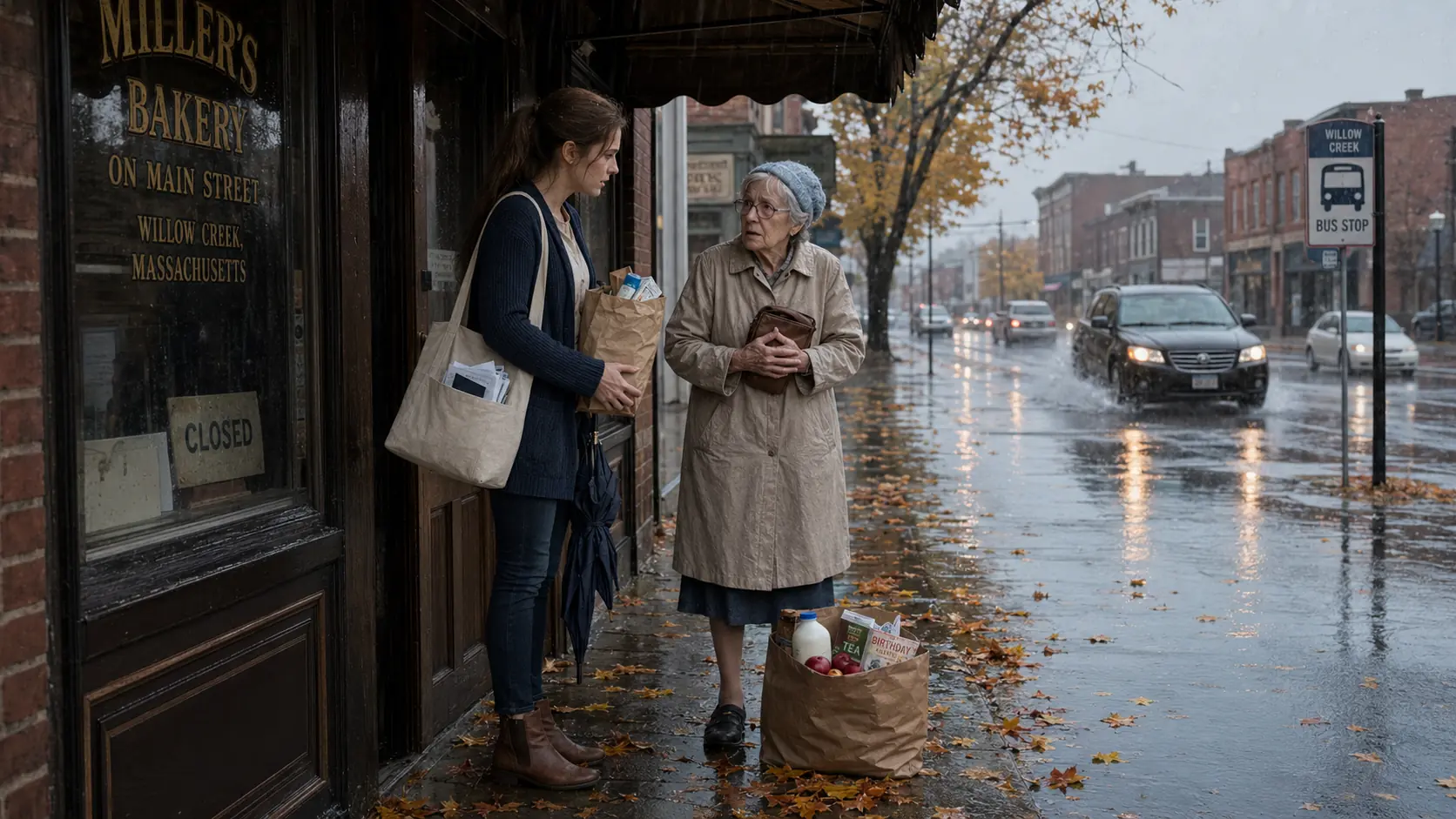
“This would have helped today.”
“Yes.”
“I should have had one already.”
“Most people don’t prepare for the day they need help. That’s why communities should make it easier.”
Margaret looked at her with new attention.
“You think about these things.”
“I do.”
“Why?”
Emma hesitated, then told her about her grandmother.
About the changed bus route.
About the closed pharmacy.
About the fear of being lost ten minutes from home.
Margaret listened quietly.
Then she said, “You should make this card for more people.”
“I want to.”
“Then you should.”
Before Emma could answer, the library door opened.
A woman in her late forties rushed inside, rain on her coat and panic on her face.
“Mom!”
Margaret stood too quickly.
Clara hurried to her and wrapped both arms around her.
Margaret began to cry.
“I’m sorry.”
“No,” Clara said, holding her tighter. “No, Mom. Don’t be sorry.”
“I only wanted cinnamon rolls.”
“I know.”
“The bakery is gone.”
“I know, Mom.”
Emma stood a few steps away, holding Margaret’s rescued groceries.
Clara looked at her with wet eyes.
“Thank you,” she said. “Thank you for stopping.”
“She was near the bakery,” Emma said. “She knew where she was trying to go. The town just changed on her.”
Clara’s face crumpled with relief and grief.
“That’s exactly what I keep trying to explain to people.”
Margaret looked embarrassed.
“Clara.”
Her daughter took her hand.
“No, Mom. It’s true. And it’s okay.”
Emma gave Clara the emergency card.
“I made a temporary one. You can update it later.”
Clara read it and pressed one hand to her mouth.
“This is perfect.”
Margaret looked down.
“It says reachable.”
Clara smiled through tears.
“Reachable is good.”
That night, Clara drove Margaret home. Emma helped carry the groceries to the car and made sure the address book was safely back in Margaret’s purse.
Before leaving, Margaret turned to Emma.
“You brought me back before I was truly gone,” she said.
Emma did not know how to answer.
So she simply squeezed Margaret’s hand.
After that rainy afternoon, Margaret began visiting the library every week.
At first, Clara brought her. Then Margaret came on her own on dry days, carrying the emergency card in her purse and the floral address book tucked inside a zippered pocket.
She always stopped at Emma’s desk.
“Still reachable,” she would say.
Emma would smile.
“Good.”
Margaret had once loved books about travel, gardening, and old houses. She began checking them out again. Sometimes she sat in the reading corner and wrote letters to Ethan, her grandson. Sometimes she helped Emma identify old town photographs for the library archive.
“That store was a bakery before it was a bakery,” Margaret said once, pointing to a black-and-white photo. “It sold shoes in 1962. Bad shoes. Everyone’s feet hurt.”
Emma laughed and wrote it down.
The temporary emergency card became the first piece of a bigger idea.
Emma asked the library director if she could host a free afternoon called Safe Return Session for seniors and caregivers. People could make emergency contact cards, update address books, learn about changed bus stops, and create simple “if lost” plans without shame.
The director hesitated.
“Will people come?”
Margaret, who happened to be standing nearby, said, “They will if you don’t make it sound like a lecture for helpless old fools.”
The director blinked.
Emma tried not to laugh.
Margaret continued, “Call it something useful. Like Staying Connected.”
So they did.
The first session was called Staying Connected Day.
Margaret came early and sat near the sign-in table.
She brought cookies.
Not perfect ones.
Slightly overbaked ones.
But everyone ate them.
Seven seniors came.
Then nine.
Then fifteen.
Some came with adult children. Some came alone. Some insisted they did not need anything and then quietly asked for cards. Emma helped them write emergency contacts, laminate cards, update phone numbers, mark safe pickup locations, and create small address books.
Margaret told everyone, “It is not shameful to be reachable.”
That became the unofficial motto.
Over the next year, the program grew.
The library partnered with the senior center. The local bus office donated updated route maps. A pharmacy offered small waterproof card sleeves. A police dispatcher taught people what information helped in a non-emergency lost-person situation. Caregivers came and cried quietly because someone was finally talking about the problem without blaming anyone.
Emma’s notebook filled with plans.
Safe Return Desk.
Reachable cards.
Updated address books.
Rainy day pickup list.
Memory-friendly town maps.
Family contact sheets.
Margaret noticed the notebook one afternoon.
“What are you writing now?”
“Just ideas.”
“At my age, ‘just ideas’ means something is already alive and waiting for a chair.”
Emma smiled.
“I want to make this official. A permanent desk at the library. Maybe portable sessions at the senior center too.”
“Then do it.”
“I need funding.”
“Then ask.”
“I need letters of support.”
Margaret lifted her eyebrows.
“Dear, I worked at the post office. Letters are my specialty.”
A week later, Margaret brought Emma an envelope.
Inside was a recommendation letter for a small community safety grant.
Margaret wrote about the rainy day outside the closed bakery, the fear of not knowing which way home was, the shame of needing help, and the relief of being treated with dignity.
At the end, she wrote:
Emma Carter did not make me feel lost. She made me feel found. She understands that safety is not only about knowing where someone lives. It is about helping them remain connected to the people who love them.
Emma cried when she read it.
Margaret also gave her something else.
The floral address book.
Emma shook her head immediately.
“No. Margaret, I can’t take this.”
“Yes, you can.”
“You still need it.”
Margaret smiled and pulled a newer address book from her purse.
“Clara made me a fresh one. Larger print. Better tabs. This old one belongs to the beginning.”
“It’s yours.”
“And I am giving it to you.”
Emma held it carefully.
The cover was worn from years of hands. Inside were names, crossed-out numbers, updated numbers, birthdays, notes, and small pieces of a life that had stayed connected through ink.
“It’s too precious,” Emma whispered.
“That is why it should help others.”
With Margaret’s letter, program records, photos from Staying Connected Day, and the library director’s support, Emma applied for the grant.
She won.
Not a fortune.
Not a building.
Not a huge reward.
But enough to buy a laminator, waterproof card sleeves, large-print forms, simple phones for training sessions, printed town maps, a dedicated filing cabinet, outreach materials, and volunteer training supplies.
The Safe Return Desk became real.
It opened every Wednesday afternoon inside Willow Creek Public Library.
People came with walkers, canes, purses full of old receipts, adult children, grandchildren, confusion, pride, fear, and relief.
Emma helped them gently.
No shame.
No scolding.
No treating people like children.
She learned to ask carefully:
“Who should we call first?”
“What name do you like to be called?”
“What place feels familiar if you are confused?”
“Do you have a neighbor you trust?”
“What should someone know to help you feel calm?”
Margaret became the desk’s first volunteer.
Her name tag read:
Margaret Allen
Reachable And Proud
She insisted on the wording.
Years passed.
The Safe Return Desk helped hundreds of families across Willow Creek and nearby towns. It became a model other libraries asked about. Emma eventually became the coordinator for senior access and community safety programs at the library.
She never became rich.
But she became exactly what she had wanted to be: someone who helped people stay connected before fear turned into crisis.
Margaret grew older.
Some days her memory was clear.
Some days it wandered.
But she always recognized the library.
She always recognized Emma’s voice.
And every time she visited, she tapped the emergency card in her purse and said, “Still reachable.”
One spring afternoon, Clara brought Margaret to the library with Ethan, now a teenager. Margaret looked tired but happy.
She placed a small paper bag on Emma’s desk.
Inside were cinnamon rolls.
Not from the old bakery.
That bakery was gone.
These were homemade.
Margaret smiled.
“I finally made them myself.”
Ethan whispered, “Grandma burned the first batch.”
Margaret said, “Great art requires sacrifice.”
Emma laughed.
They ate cinnamon rolls in the reading corner while rain tapped softly against the windows.
Margaret passed away peacefully two years later.
At her memorial gathering, held in her daughter’s home, Clara placed the first laminated emergency card beside a photograph of Margaret smiling at the library.
After the gathering, Clara handed Emma a note Margaret had written months earlier, when her memory was still steady enough for careful words.
Dear Emma,
The day you found me in the rain, I thought I had become a burden.
You did not treat me that way.
You gave me tea.
You called my daughter.
You made me reachable.
Then you helped many others become reachable too.
Keep finding people before they disappear into shame.
With love,
Margaret Allen
Emma framed the note at the Safe Return Desk.
Years later, whenever someone asked how the program began, Emma told the truth.
“It began with an old woman lost outside a closed bakery on a rainy afternoon.”
Then she would show them Margaret’s floral address book.
The gift was small.
An address book.
A letter.
A word.
Reachable.
But inside those small things was the future Emma had been trying to build.
And every Wednesday, when an elderly person sat across from her saying, “I probably don’t need this,” Emma smiled gently and answered the same way Margaret had taught her.
“It’s not shameful to be reachable.”