At twenty-four, Emma Brooks had learned that being lost was not always about distance.
Sometimes a person could be only three blocks from home and still feel as if the whole town had disappeared.
A bus stop could move.
A bakery could close.
A familiar tree could be cut down.
A street could be renamed.
And suddenly, an old man who had walked the same sidewalks for forty years could stand under a gray sky, holding a paper bag, unable to recognize the way back.
Emma lived in a small town in Pennsylvania called Maple Creek, where the streets were lined with old brick buildings, maple trees, narrow sidewalks, and houses with front porches that creaked in the wind.
She was a young white American woman with fair skin, long chestnut-brown hair usually tied into a low ponytail, soft green eyes, and a calm voice that made people feel less ashamed when they needed help.
She worked at Maple Creek Public Library.
Her job was simple but meaningful. She shelved books, printed documents, helped elderly visitors use computers, answered questions at the front desk, organized community flyers, and helped children find books they were excited to carry home.
Emma loved the library because it was one of the few places in town where no one had to buy anything to belong.
A lonely person could sit by the window.
A child could hide in a story.
An elderly man could ask for help reading a form without feeling foolish.
A family could come in from the cold and stay until they felt ready to face the street again.
Emma’s dream was to create a small program called The Way Home Desk, a community safety service for older residents who might become confused, lost, or overwhelmed while out alone.
She imagined simple emergency contact cards, safe-place stickers for local shops, large-print town maps, volunteer check-ins, and a quiet library desk where anyone could come in and say, “I don’t know how to get home,” without shame.
But dreams needed permission, funding, volunteers, training, privacy forms, and proof that the need was real.
Emma only had a notebook full of ideas.
So she kept working at the library and helping one person at a time.
One cold Tuesday afternoon in November, the sky over Maple Creek turned silver-gray. Rain had fallen earlier, leaving the sidewalks wet and shiny.
Leaves stuck to the curb. Cars hissed by slowly. The air smelled of damp wool, coffee, and chimney smoke.
Emma had just finished her shift and was walking toward the small corner market when she noticed an elderly man standing outside the closed bakery on Harris Street.
He was tall but thin, probably in his late seventies, with silver hair beneath a brown flat cap, pale skin, blue eyes behind square glasses, and a deeply lined face that looked frightened in a way he was trying hard to hide.
He wore a dark green coat, gray trousers, and polished old shoes. One hand gripped a wooden cane. The other held a small paper bag from the pharmacy.
He stood facing the bakery door.
But the bakery was empty.
The windows were dark. A faded sign on the door read:
For Lease.
The man stared at the sign as if it had personally betrayed him.
Then he turned left.
Then right.
Then back toward the empty bakery.
He took two steps away, stopped, and looked at the street sign.
Emma slowed.
People passed around him. A woman with an umbrella hurried by. A delivery driver carried boxes into the market. A teenager walked past with headphones on. No one stopped.
Emma watched the old man reach into his coat pocket, pull out a folded paper, and stare at it. His hand shook. The paper slipped from his fingers and fell onto the wet sidewalk.
He tried to bend down for it, but his cane slid slightly on the damp pavement.
Emma ran.
“Sir, please don’t bend. I’ll get it.”
The old man froze.
Emma picked up the paper before it soaked through. It was a pharmacy receipt, already soft at the edges from moisture.
She handed it to him gently.
“Here you go.”
The old man looked at her with startled eyes.
“Thank you.”
“Are you all right?”
“Yes,” he said quickly. “Yes, I’m fine.”
But his voice was not fine.
Emma did not push. She stood a respectful distance away.
“My name is Emma. I work at the library down the street.”
“The library,” he repeated slowly.
“Yes.”
He looked past her, toward the direction of the library, and frowned.
“I know the library.”
“I’m sure you do.”
He looked back at the empty bakery.
“This was Miller’s Bakery.”
“It used to be.”
His face changed.
“Used to be?”
“It closed last spring.”
“No,” he whispered. “No, that can’t be right. I bought cinnamon rolls here.”
Emma’s chest tightened.
“When did you last come here?”
The old man looked confused.
“Friday.”
Emma waited.
Then he added, “My wife liked the cinnamon rolls.”
“What’s your wife’s name?”
“Eleanor.”
The name came easily. Clearly.
Then his face collapsed a little.
“She passed.”
“I’m sorry,” Emma said softly.
He looked at the bakery window.
“She passed three years ago.”
The silence between them became heavier.
Emma understood then.
He was not only looking for a bakery.
He was looking for a time when Eleanor still stood beside him.
“What’s your name?” Emma asked gently.
“Walter Reed.”
“Walter, were you trying to go home?”
He looked down at the pharmacy bag.
“I went to pick up my prescription. Then I thought I’d stop for cinnamon rolls. I know the way from Miller’s to home.” He looked around again, panic rising in his eyes. “But if Miller’s is gone, then the corner is wrong.”
“The corner changed,” Emma said. “That doesn’t mean you did anything wrong.”
Walter gripped his cane tighter.
“I know this town.”
“I believe you.”
“I delivered mail here for thirty-six years.” His voice sharpened with fear and pride. “I knew every house. Every porch. Every dog.”
Emma nodded.
“Then you know better than anyone that towns change.”
Walter stared at her.
For a moment, the words seemed to help.
Then the fear returned.
“I can’t remember which way home is.”
Emma kept her voice steady.
“That’s okay. We’ll figure it out together.”
He looked ashamed.
“I don’t want to bother anyone.”
“You’re not bothering me.”
“I should be able to get home.”
“And you will.”
His lips trembled.
“I don’t want my daughter to know.”
Emma softened.
“Why not?”
“She worries. She already thinks I shouldn’t walk alone.”
“Does she love you?”
Walter blinked.
“Yes.”
“Then she worries because she loves you, not because she thinks less of you.”
He looked away.
“That is easy to say when you are young.”
Emma accepted the correction quietly.
“You’re right. But being helped today does not erase who you were yesterday.”
Walter turned back to her.
His eyes filled.
Emma looked toward the library.
“Walter, the library is warm and close. Let’s go there first. We can sit down, dry the receipt, look for your address, and call someone who knows you.”
“I don’t want to cause a scene.”
“You won’t. You’ll be a library visitor.”
“I don’t have a book.”
“I work there. I can overlook that rule.”
For the first time, a faint smile crossed his face.
“There’s a rule?”
“No. But if there were, I would bend it.”
Walter gave a small laugh, and the sound seemed to steady him.
Emma offered her arm, but she did not grab him.
“May I walk beside you?”
Walter hesitated, then nodded.
“Yes. Thank you.”
They walked slowly toward Maple Creek Public Library. Walter’s cane tapped against the wet sidewalk. Emma matched his pace. She did not hurry him. She did not speak too much. At one corner, Walter paused and looked around as if searching for a landmark that no longer existed.
“There used to be a hardware store there,” he said.
“There’s a coffee shop now.”
“Henry’s Hardware.”
“Yes.”
“Henry had a black dog that slept by the register.”
Emma smiled.
“I’ve heard about that dog.”
“Name was Biscuit.”
“That’s a good name.”
“Terrible dog. Good name.”
Emma laughed softly.
Walter seemed calmer when they reached the library. She unlocked the side door with her staff key and guided him inside.
Warm air surrounded them. The library smelled of paper, old wood, and the faint coffee scent from the staff room. Rain tapped against the windows. A few reading lamps glowed softly near the front desk.
Emma’s coworker, Daniel, looked up from stacking returned books.
“Emma?”
“She needs help?” he asked quietly, reading her expression.
“He,” Emma said softly. “Walter got turned around downtown. I’m going to help contact family.”
Daniel nodded at once.
“I’ll keep the desk open.”
Emma guided Walter to the quiet reading corner near the large front window. She helped him sit in a soft chair and brought him a paper cup of tea from the staff room.
He held it carefully.
“This is kind of you.”
“This is what libraries are for.”
“Tea?”
“Among other things.”
He smiled faintly.
Emma sat across from him.
“May I look in your pharmacy bag or wallet for an address or emergency contact? You can watch me the whole time.”
Walter’s pride flickered across his face.
Then he nodded.
“All right.”
Emma opened the pharmacy bag first. Inside were a prescription bottle, a receipt, a small packet of cough drops, and a folded grocery list.
The prescription label had his address.
Walter Reed
42 Elm Street
Maple Creek, PA
“There,” Emma said. “Your address is Elm Street.”
Walter closed his eyes.
“Elm Street. Yes. I knew that.”
“Yes,” Emma said gently. “You did.”
The grocery list was written in careful handwriting, but not Walter’s. At the top, it said:
Dad — Pick up medicine. Come straight home if it rains. Call me if confused. Love, Claire.
Emma looked up.
“Is Claire your daughter?”
Walter’s face softened.
“Yes. Claire.”
“Do you have her number?”
“In my wallet.”
He handed it to her with a little embarrassment.
Emma found a small card inside.
Emergency Contact:
Claire Reed
Daughter
A phone number was written clearly beneath it.
“She made me carry that,” Walter said.
“That was smart.”
“She is smart. Bossy.”
“Those can overlap.”
Walter smiled.
“Eleanor used to say that.”
Emma called the number from the library phone.
A woman answered after the first ring.
“Dad?”
“Hi, is this Claire Reed?”
“Yes. Who is this?”
“My name is Emma Brooks. I work at Maple Creek Public Library. I’m here with your father, Walter. He’s safe. He got turned around near the old bakery, and I brought him to the library.”
There was a sharp breath on the other end.
“Oh my God. Is he hurt?”
“No. He’s okay. Wet and shaken, but safe.”
“I told him to call me after the pharmacy. I was about to drive downtown.”
“He has his medicine. He’s sitting with tea.”
“Can I talk to him?”
“Of course.”
Emma handed the phone to Walter.
He held it to his ear.
“Claire?”
Emma looked down at her hands to give him privacy, but she could hear the tremble in his voice.
“No, sweetheart. I’m all right. I just got mixed up. The bakery was gone.”
A pause.
“I know. I know you told me. I forgot.”
Another pause.
“I’m sorry.”
Emma’s throat tightened.
Walter listened, then wiped his eyes quickly.
“All right. I’ll wait here.”
He handed the phone back.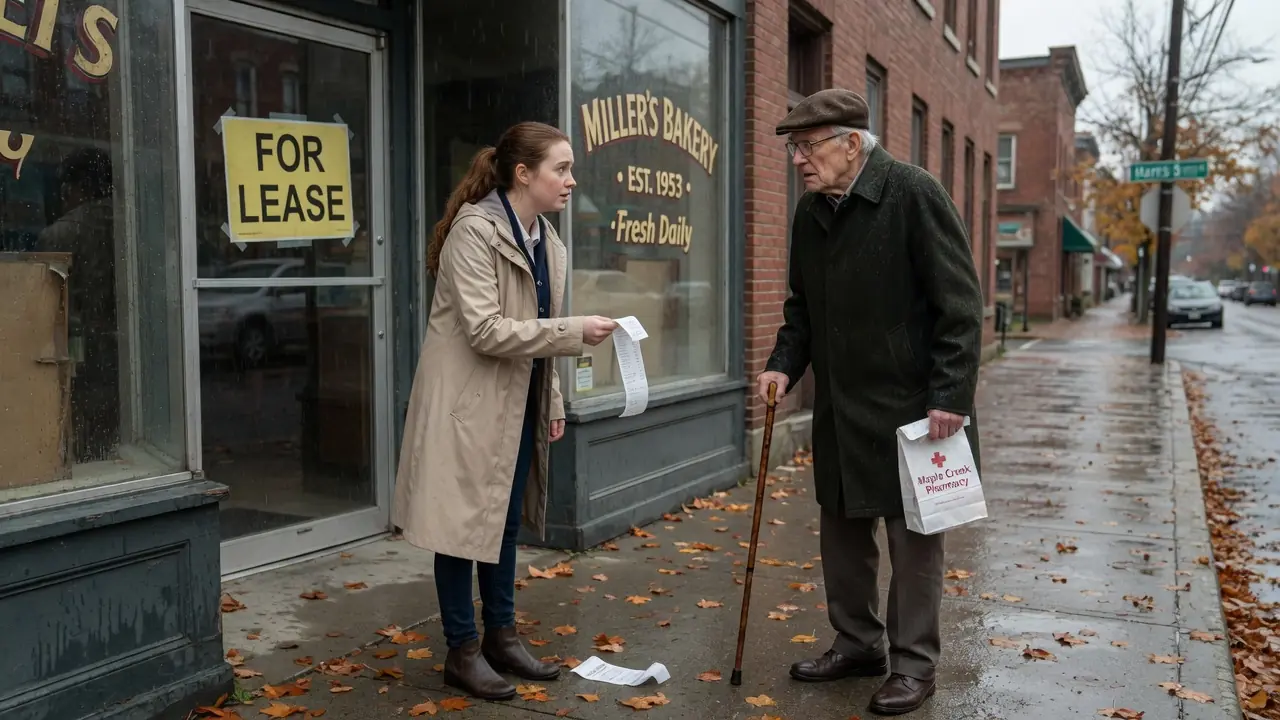
“She’s coming.”
“Good.”
“She sounded scared.”
“Because she loves you.”
Walter stared into his tea.
“I hate this.”
Emma waited.
“I used to know every street,” he said. “I could tell you which house had loose porch steps, which family got too many catalogs, which dog would bark and which dog would bite.” He looked toward the rainy window. “Now I forget a bakery closed.”
Emma leaned forward slightly.
“Walter, knowing the town before it changed still matters.”
“Does it?”
“Yes.”
He looked at her.
“You remember the town people forgot.”
That made him go very still.
No one spoke for a moment.
Then he whispered, “Eleanor used to say that.”
Emma smiled gently.
“Then Eleanor and I agree.”
While they waited for Claire, Walter told Emma stories.
About the old bakery.
About Henry’s Hardware.
About the movie theater that used to show cartoons on Saturday mornings.
About a red mailbox that children used to decorate every December.
About the elm trees that had once lined Elm Street before disease took most of them.
About the best bench in town, which no longer existed.
Emma listened closely.
Then she began writing some of it down.
Walter noticed.
“What are you doing?”
“Saving what you remember.”
He stared at her.
“Why?”
“Because it matters.”
His eyes filled again.
This time, he did not look ashamed.
When Claire arrived, she came through the library door fast, rain on her coat and worry on her face. She was in her late forties, with dark-blonde hair, tired eyes, and Walter’s same careful mouth.
“Dad.”
Walter stood too quickly.
Claire hurried to him and wrapped her arms around him.
He closed his eyes.
“I’m sorry,” he whispered.
“No,” she said. “Don’t be sorry.”
“I forgot.”
“I know.”
“The bakery was gone.”
“I know, Dad.”
“I thought I knew the way.”
Claire’s voice broke.
“You do know so many things.”
Emma stepped back, giving them space.
But Claire turned to her.
“Thank you,” she said. “Thank you for stopping.”
“He was near the bakery,” Emma said. “He knew exactly where he meant to be. The landmark changed.”
Claire’s face softened with painful relief.
“That’s what I keep trying to explain to people. He’s not careless. He’s remembering a town that isn’t there anymore.”
Walter looked at Emma.
“She wrote some of it down.”
Claire looked surprised.
“What?”
Emma suddenly felt shy.
“Walter was telling me about old Maple Creek. I wrote a few things so they wouldn’t get lost.”
Claire’s eyes filled.
“He was the best storyteller when I was little.”
Walter looked down.
“I still am.”
Claire laughed through tears.
“Yes, Dad. You still are.”
Before they left, Emma made a simple large-print card for Walter and laminated it at the front desk.
It read:
My name is Walter Reed.
If I seem lost, please call my daughter Claire.
I live at 42 Elm Street.
I may be remembering old Maple Creek.
Walter read it slowly.
“I may be remembering old Maple Creek,” he repeated.
“Is that okay?” Emma asked.
He nodded.
“That sounds better than confused.”
Claire pressed her hand to her mouth.
“It does.”
From that day on, Walter began visiting the library every Thursday afternoon with Claire.
At first, he came because Claire brought him.
Then he came because Emma asked him to help with something.
She found old town photographs in the library archive and placed them on the reading table. Walter identified buildings, stores, names, streets, and stories no one had written down.
“That was Miller’s Bakery before the new sign.”
“That boy became mayor.”
“That house had the meanest rooster in Pennsylvania.”
“That was not 1962. That was 1964 because the elm tree was already gone.”
Emma wrote everything.
Walter grew more animated each week. His memory was not perfect. Some days were foggier than others. But when the old photographs came out, his eyes often sharpened. The past opened like a door.
Claire watched from the side with tears in her eyes.
“You gave him something back,” she told Emma one afternoon.
Emma shook her head.
“No. He already had it. I just gave it a table.”
The Way Home Desk began from that table.
Emma spoke to the library director about creating a weekly program for older residents and caregivers. It would have two parts: practical safety and memory preservation.
Emergency contact cards.
Large-print maps.
Safe-place lists.
Bus route updates.
Caregiver phone sheets.
And an archive table where seniors could identify old photographs and tell stories about the town as it used to be.
The director was cautious at first.
“We are not a medical facility.”
“No,” Emma said. “But we are a public place people trust.”
“We would need clear boundaries.”
“I’ll write them.”
“We would need volunteers.”
“I’ll find them.”
“We would need proof that people want it.”
Emma looked across the room at Walter, who was telling Daniel about the old movie theater popcorn machine.
“They do.”
The first session had seven people.
Walter came wearing his best coat and the laminated card in his pocket.
His name tag read:
Walter Reed
Old Maple Creek Consultant
He insisted on the title.
The program grew quickly.
Elderly residents came with daughters, sons, nieces, neighbors, and sometimes alone. They made emergency cards. They marked familiar routes on large-print maps. They listed safe places where they could go if they felt lost or overwhelmed: the library, the café, the pharmacy, the community center.
Then they sat at the archive table and told stories.
The old train depot.
The skating pond.
The grocery store that had burned down.
The school principal who wore red suspenders.
The doctor who accepted tomatoes as payment.
Emma realized that the safety part and the memory part belonged together.
People were not only afraid of getting lost in the streets.
They were afraid of becoming lost to the people around them.
The Way Home Desk gave them a way to be known.
One afternoon, Walter brought Emma a folded paper wrapped in a plastic sleeve.
“This is for you,” he said.
Emma opened it carefully.
It was an old hand-drawn mail route map of Maple Creek.
Not a city map.
Walter’s map.
Every street was marked in his handwriting. Some houses had notes.
Mrs. Allen — porch dog, friendly.
Green house — steps uneven.
Old Miller’s Bakery — cinnamon rolls Friday.
Elm Street — home.
Emma looked up.
“Walter, I can’t take this.”
“Yes, you can.”
“This is yours.”
“I made copies with Claire.”
“It belongs to your family.”
“It belongs to the beginning of The Way Home Desk,” Walter said. “Because that day, I forgot the way home. You helped me find it. Now this can help you understand how many ways home can exist.”
Emma’s eyes filled.
Walter also gave her a letter for a small community safety grant. Claire had helped him type it, but the words were his.
At the end, he wrote:
Emma Brooks understands that getting lost is not always a failure of memory. Sometimes it is a failure of the world to offer gentle places where people can be found.
With Walter’s letter, program attendance records, caregiver feedback, and support from the library director, Emma applied.
She won.
Not a fortune.
Not a new building.
Not anything grand.
But enough to buy a laminator, large-print map boards, waterproof card sleeves, volunteer badges, safe-place stickers, a dedicated phone line, and recording equipment for town memory sessions.
The Way Home Desk became official.
Local businesses joined.
The café placed a safe-place sticker in its window.
The pharmacy trained staff to call emergency contacts gently.
The community center offered rainy-day waiting chairs.
The bus office provided updated route maps in large print.
And every Thursday, Walter sat at the library archive table, helping people remember Maple Creek.
Years passed.
The program helped hundreds of people.
Some were elderly residents with memory loss.
Some were widows overwhelmed by changed routines.
Some were caregivers trying to plan ahead.
Some were people who simply felt embarrassed to admit that the town had become harder to navigate.
Emma became the program coordinator.
She never became rich.
But she became someone families called before panic turned into crisis.
Walter grew older.
Some Thursdays, he remembered the old bakery clearly.
Other Thursdays, he asked Emma if Miller’s still sold cinnamon rolls.
Emma always answered gently.
“No, Walter. Miller’s closed. But I wrote down your story about it.”
He would nod.
“Good. Someone should remember the cinnamon rolls.”
When Walter passed away peacefully several years later, his family held a gathering at the library. Old photographs of Maple Creek filled the reading room. His mail route map hung beside the archive table. On one small table sat cinnamon rolls from a new bakery, made from a recipe Claire found in Walter’s papers.
Claire handed Emma a final envelope.
“Dad wanted you to have this.”
Inside was a note written in Walter’s careful handwriting.
Dear Emma,
The day you found me, I thought I had lost the town.
You did not laugh.
You did not hurry me.
You brought me to the library, called Claire, and wrote down what I still knew.
You helped me understand that I was not only a confused old man.
I was also a keeper of old roads.
Keep helping people find their way home, even when home has changed shape.
With gratitude,
Walter Reed
Emma framed the note beside The Way Home Desk.
Years later, whenever people asked how the program began, Emma told them the truth.
“It began with an old man standing outside a closed bakery, trying to find his way home through a town that had changed around him.”
Then she would show them Walter’s hand-drawn map.
The gift was small.
A map.
A letter.
A memory of cinnamon rolls on Friday.
But inside those small things was the future Emma had been trying to build.
And every time someone came to the library with frightened eyes and said, “I think I’m lost,” Emma smiled gently and answered,
“You’re safe here. Let’s find the way together.”