At twenty-four, Olivia Parker had learned that people did not always look lost when they were lost.
Some wandered in circles.
Some asked the same question twice.
Some stood on a sidewalk pretending to read a sign because pride would not let them admit the street no longer made sense.
And some simply stared through the rain, holding a paper bag in one hand, as if the town they had known for decades had quietly rearranged itself while they were not looking.
Olivia lived in a small town in New York called Millbrook Falls, where the streets curved past old brick shops, a movie theater with a faded sign, a bookstore, a pharmacy, a bus stop, and a little café on the corner called Rose Street Café.
Olivia worked there.
She was a young woman with fair skin, long chestnut-brown hair usually tied into a low ponytail, soft hazel eyes, and a gentle but steady voice that made people feel less embarrassed when they needed help. Her job was simple. She brewed coffee, packed pastries, wiped tables, carried soup to customers, refilled sugar jars, wrote the daily specials on the chalkboard, and learned the regulars’ orders by heart.
She loved the café because it was warm in a way that had nothing to do with heat.
People came there when they needed a quiet corner. An elderly woman came every Monday for tea and crossword puzzles. A retired teacher came for black coffee and read the newspaper with a red pen in his hand. A single mother brought her son after school for grilled cheese and tomato soup. A widower sat by the window every Friday and ordered two blueberry muffins, though he only ever ate one.
Olivia noticed these things.
She had always noticed small signs of loneliness.
Her dream was to start a small community program one day called The Warm Corner, a café-based check-in system for elderly residents who lived alone. She imagined simple contact cards, senior coffee mornings, safe waiting spaces during bad weather, and a way for confused or lost older people to come inside without shame and reconnect with family.
But dreams needed permission, funding, training, volunteers, and a reason for people to believe it mattered.
Olivia had a notebook full of ideas and very little confidence.
So she kept working at Rose Street Café, helping one person at a time.
One rainy Tuesday afternoon in March, the sky turned dark before four.
Rain fell hard over Millbrook Falls, blurring the shop windows and turning the sidewalks silver. People hurried past the café with umbrellas tilted low. Cars hissed through puddles. The old clock above the pharmacy looked hazy through the rain.
Olivia was wiping the front window when she noticed an elderly man standing across the street.
He was a white American man in his late seventies, tall but thin, with silver hair beneath a brown wool cap, pale skin, blue eyes behind rain-specked glasses, and a deeply lined face that looked more frightened than he wanted anyone to see. He wore a dark green coat, gray trousers, and old leather shoes. One hand held a cane. The other held a small paper pharmacy bag that was slowly getting wet.
He stood at the corner, looking from the pharmacy to the bus stop, then back to the street sign.
Then he turned around.
Then turned back again.
He did not move forward.
Olivia watched him for a few seconds.
Something was wrong.
She grabbed the café umbrella from behind the counter and stepped outside.
The rain was cold and sharp. Olivia crossed carefully and stopped a few feet from him, not wanting to startle him.
“Sir?” she said gently. “Are you all right?”
The old man looked at her quickly.
“Yes,” he said at once. “Yes, I’m fine.”
But his voice shook.
Olivia softened her tone.
“My name is Olivia. I work at the café across the street.”
He glanced toward the café windows.
“The café,” he repeated slowly.
“Yes. Rose Street Café.”
His brow furrowed.
“I know Rose Street.”
“You’re on Rose Street.”
He looked up at the street sign.
For a moment, confusion passed across his face like a shadow.
“I was going home,” he said. “But the bus stop is wrong.”
Olivia looked toward the bus stop.
It had been moved two blocks down because of road construction three weeks earlier.
“You’re right,” she said. “The bus stop changed.”
His eyes lifted to hers.
“It did?”
“Yes.”
Relief and fear crossed his face at the same time.
“I thought…” He stopped.
“What did you think?”
He looked down at the wet paper bag.
“I thought I had forgotten.”
Olivia’s heart tightened.
“What’s your name?”
“Henry Lawson.”
“Do you live nearby, Henry?”
He straightened slightly, as if trying to recover dignity.
“Yes. I live on Cedar Lane. Or Cedar Court.” His voice faltered. “No. Cedar Lane. My daughter says it’s Cedar Lane.”
“That’s okay. Do you know your daughter’s phone number?”
Henry patted his coat pocket. Then the other pocket. Then his trousers. His hands grew more frantic.
“I had a card.”
Olivia kept her voice calm.
“No rush. We’ll find it.”
He opened the pharmacy bag. Inside were a prescription bottle, a folded receipt, and a small packet of cough drops. Rain dripped onto the paper.
“I was at the pharmacy,” Henry said. “Then I came out, and the stop was gone. I walked to the corner, but the corner didn’t look right. My wife used to know the bus routes.”
“What was her name?”
“Margaret,” he said immediately.
His voice became softer when he said it.
“She passed two years ago. She always said I could get lost in our own kitchen if she moved the coffee.”
Olivia gave a small smile.
“She sounds funny.”
“She was.” Henry swallowed. “She would be very annoyed with me standing in the rain.”
“Then let’s not annoy Margaret.”
Henry looked at her, surprised.
Olivia opened the umbrella wider.
“Come inside the café with me. It’s warm. We’ll dry off, sit down, and call your family.”
Henry hesitated.
“I don’t want to trouble you.”
“You’re not trouble. You’re a customer who hasn’t ordered yet.”
He blinked.
Then he laughed quietly.
It was weak, but real.
Olivia offered her arm.
“May I walk with you?”
Henry looked embarrassed, but he nodded.
“Yes, please.”
She did not grab him. She let him take her elbow. Together, they crossed the street slowly through the rain. His cane tapped carefully against the wet pavement. Olivia held the umbrella low enough to cover him more than herself.
Inside Rose Street Café, warm air wrapped around them.
The bell above the door rang softly. The café smelled of coffee, cinnamon, toasted bread, and tomato soup. A few customers looked up, then politely looked away.
Olivia guided Henry to the corner table near the window, the warmest spot in the room.
“Sit here,” she said. “I’ll get you a towel.”
The café owner, Mrs. Bell, glanced over from behind the counter.
“Everything okay?”
Olivia lowered her voice.
“He got turned around in the rain. The bus stop moved. I’m going to help call his family.”
Mrs. Bell nodded immediately.
“Take your time.”
Olivia brought Henry a towel, a glass of water, and a cup of tea.
He held the tea with both hands.
“I should pay.”
“First warm up. Then we’ll worry about tea economics.”
He smiled faintly.
“You are very organized.”
“I work lunch rush.”
“That would do it.”
Olivia sat across from him with a notepad.
“Henry, may I look at the pharmacy receipt? Sometimes there’s an emergency contact or address.”
He handed it to her.
The receipt had his name but not his address. She checked the prescription bottle. It had an address.
Henry Lawson
18 Cedar Lane
Millbrook Falls, NY
“Good,” Olivia said. “We found your address.”
Henry closed his eyes briefly.
“I knew it.”
“Yes. You did.”
He looked deeply relieved by that.
In his wallet, Olivia found a small folded card tucked behind his insurance card. It was damp but readable.
Emergency Contact:
Clara Lawson — Daughter
A phone number was written beneath it in careful handwriting.
Olivia held it up.
“Is Clara your daughter?”
Henry nodded quickly.
“Yes. Clara. She works at the school.”
“Would you like me to call her?”
His face tightened.
“She’ll worry.”
“She probably already worries because she loves you.”
“I don’t want her to think I can’t go to the pharmacy alone.”
Olivia sat back gently.
“Getting confused after a bus stop moves in the rain does not mean you can never go anywhere alone again. It means today you needed a warm place and a phone call.”
Henry looked at her.
“That sounds better than what I was thinking.”
“What were you thinking?”
He stared into his tea.
“That I am becoming a problem.”
Olivia’s expression softened.
“No. You are a person having a hard afternoon.”
For a moment, Henry did not speak.
Then he nodded once.
Olivia called Clara.
A woman answered after two rings.
“Hello?”
“Hi, is this Clara Lawson?”
“Yes.”
“My name is Olivia Parker. I work at Rose Street Café. I’m here with your father, Henry. He’s safe. He got turned around near the pharmacy because of the moved bus stop, and I brought him into the café.”
There was a sharp silence.
Then Clara’s voice shook.
“Oh my God. Dad? Is he okay?”
“He’s okay. Wet and shaken, but safe. He’s having tea.”
“Can I speak to him?”
“Of course.”
Olivia handed Henry the phone.
His hand trembled as he held it.
“Clara?”
Olivia looked down at her notepad to give him privacy, but she could still hear the softness in his voice.
“No, honey, I’m all right. I didn’t fall. A young woman helped me. No, don’t cry. I’m at Rose Street Café.”
A pause.
Then he whispered, “I’m sorry.”
Olivia swallowed.
Henry listened for a moment, then his eyes filled.
“All right. I’ll wait here.”
He handed the phone back.
“She’s coming.”
“Good.”
“She sounded scared.”
“Because you matter.”
Henry looked toward the window. Rain streamed down the glass.
“I hate making her scared.”
“I know.”
“She has enough to worry about.”
Olivia glanced at his damp coat, the pharmacy bag, and the emergency card.
“May I make a suggestion?”
Henry nodded.
“We can make you a clearer card. Large print. Address. Clara’s number. Maybe Rose Street Café as a safe stop if you get turned around downtown again.”
Henry stiffened slightly.
“I don’t want people to think I’m helpless.”
“It doesn’t say helpless,” Olivia said. “It says reachable.”
He turned that word over silently.
Reachable.
“That is different,” he said.
“It is.”
Olivia went behind the counter, printed a simple card on the café office printer, and placed it inside a plastic sleeve usually used for loyalty punch cards.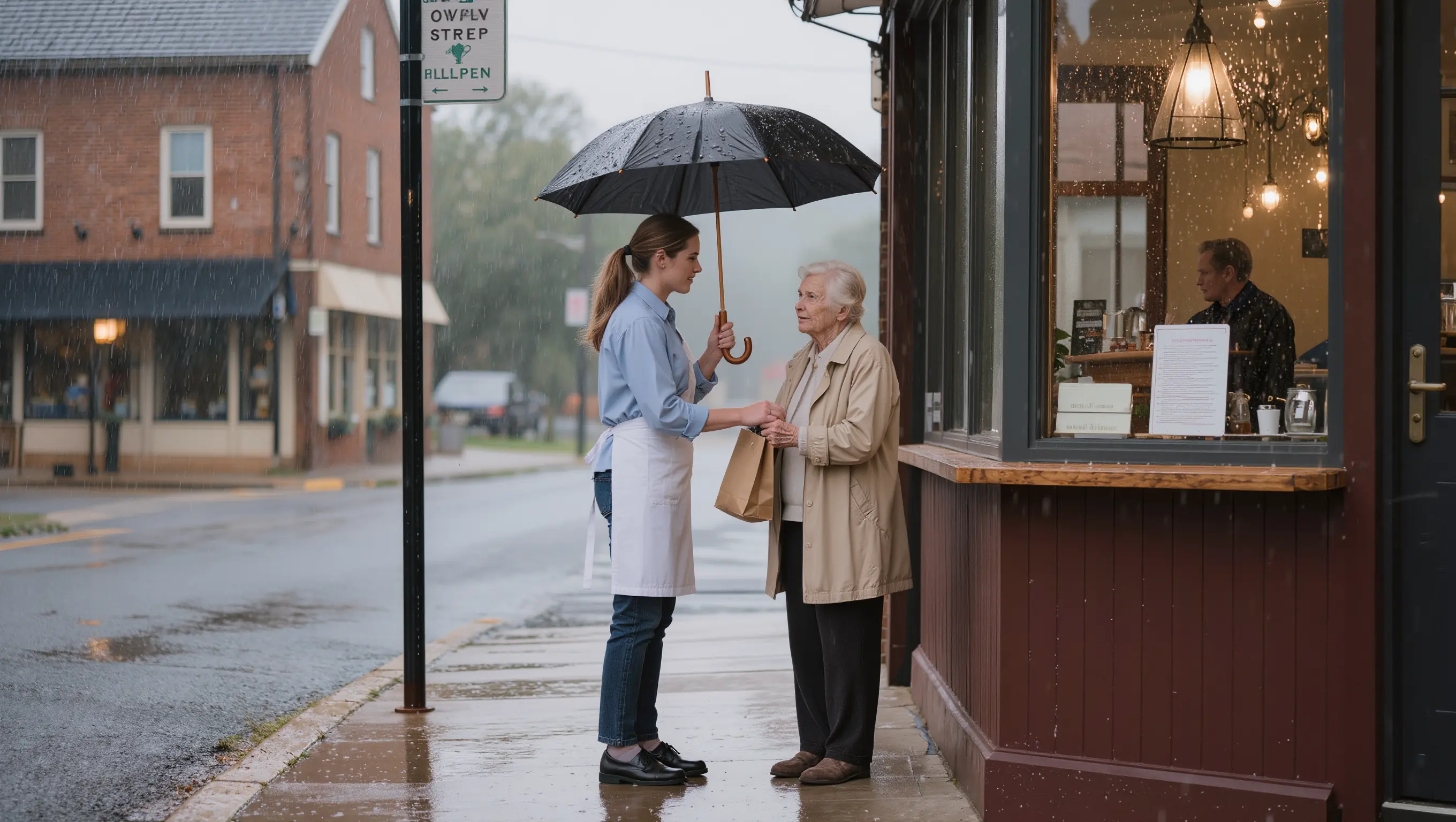
It read:
Henry Lawson
If I seem lost or confused, please call my daughter Clara.
Address: 18 Cedar Lane
Safe Place: Rose Street Café
She brought it back to him.
Henry read it slowly.
“My wife would have liked this.”
“Margaret?”
He nodded.
“She liked practical things that pretended to be simple.”
Olivia smiled.
“Then this is in her honor.”
Before Clara arrived, Henry told Olivia more about Margaret.
She had been a school secretary for thirty years. She remembered every child’s name, every allergy, every parent who needed a kind word, and every teacher who drank too much coffee. She loved almond cookies, red scarves, and bus maps. She had kept Henry organized for fifty-one years.
“When she died,” Henry said quietly, “I thought grief would be the hard part. But it was the ordinary things. Which bills were due. Where the stamps were. Which bus went where. How much soup to buy for one person.”
Olivia listened.
She did not rush him.
When Clara arrived twenty minutes later, she came through the café door breathless, rain on her coat and fear on her face.
“Dad.”
Henry stood too quickly.
Clara hurried to him and wrapped both arms around him.
He closed his eyes.
“I’m sorry,” he whispered.
“No,” Clara said. “Don’t be sorry.”
“I got mixed up.”
“The bus stop moved. That would confuse anyone.”
Henry looked at Olivia.
“That’s what she said.”
Clara turned to Olivia, her eyes wet.
“Thank you. Thank you for bringing him inside.”
“He was just across the street.”
“You still stopped.”
Olivia handed her the card.
“I made this temporary contact card. You can change anything.”
Clara read it and covered her mouth.
“Safe Place: Rose Street Café.”
“If that’s okay,” Olivia said quickly. “I didn’t mean to assume.”
Mrs. Bell called from the counter, “It’s okay.”
Clara laughed through tears.
Henry looked embarrassed but touched.
“I suppose I’m a regular now.”
“You have to order something first,” Olivia said.
Henry looked at his tea.
“Then I am halfway there.”
Clara sat with him for a few minutes before taking him home. Olivia packed two almond cookies in a paper bag.
“For later,” she said.
Henry looked at the bag.
“Margaret loved almond cookies.”
“I know.”
He looked at her with such gratitude that Olivia had to look away.
After that rainy afternoon, Henry began coming to Rose Street Café every Wednesday.
At first, Clara brought him. Then, on clear days, he came alone with a fresh bus map, his emergency card, and a proud expression.
He always ordered tea and one almond cookie.
Sometimes he sat by the window and read the newspaper. Sometimes he brought old bus maps and compared them to new ones, muttering about “unnecessary changes.” Sometimes he told Olivia stories about Margaret.
“She could find any child’s lost mitten,” he said once.
“That sounds impossible.”
“It was her gift.”
Another time, he said, “She believed every public place should have one corner where a person could sit down without buying anything first.”
Olivia wrote that in her notebook.
Henry noticed.
“What do you write in there?”
“Just ideas.”
“At my age, ‘just ideas’ often means a future trying not to make a fuss.”
Olivia laughed.
Then she showed him the pages for The Warm Corner.
A safe café table for elderly residents.
Emergency contact cards.
Rainy day check-ins.
Senior coffee mornings.
Family call assistance.
Bus route help.
A place where someone confused, lonely, or frightened could sit without shame.
Henry read every page slowly.
When he finished, he tapped the notebook.
“This is needed.”
“I don’t know if anyone would come.”
“I would.”
“You already come.”
“Then I am proof of concept.”
Olivia smiled.
“That sounds official.”
“I used to help Margaret organize school forms. I can sound official when necessary.”
With Henry’s encouragement, Olivia spoke to Mrs. Bell about starting a weekly senior coffee hour.
Nothing complicated.
Wednesday mornings.
Discount tea and coffee.
A printed bus route sheet.
Emergency contact cards at the counter.
A phone available if someone needed to call family.
A sign in the window that said:
Need a safe place to wait? Come inside.
Mrs. Bell looked uncertain at first.
“We’re a café, Olivia. Not a social service office.”
“I know. But cafés have tables, warmth, phones, and people who notice.”
Mrs. Bell looked toward Henry, who was carefully folding his bus map near the window.
Then she sighed.
“One month trial.”
The first Wednesday, only Henry came.
He wore his brown cap and said, “Every great institution begins with one old man and a cookie.”
The second Wednesday, he brought Mrs. Alvarez from his building.
The third Wednesday, six seniors came.
By the second month, the corner table was full.
Some came for bus help.
Some came because rain made them nervous.
Some came because they lived alone and Wednesday felt less empty when someone remembered their name.
Olivia printed emergency contact cards in large font. She helped people write down addresses, family numbers, pharmacy numbers, and safe pickup places. Mrs. Bell created a simple house tea special. Clara donated a basket of large-print crossword puzzles from the school library.
Henry became the unofficial greeter.
His name tag read:
Henry Lawson
Map Consultant
He chose the title himself.
One afternoon, Henry brought Olivia a worn leather phone book.
Not a printed public directory.
A personal one.
The cover was brown, softened from years of use. Inside were handwritten names, numbers, addresses, birthdays, notes, and bus routes.
“Margaret’s,” he said.
Olivia held it carefully.
“I can’t take this.”
“Yes, you can.”
“It belonged to her.”
“And she believed names should be written down before people needed them.”
“This should stay with your family.”
“Clara made copies. This one belongs to the beginning of The Warm Corner.”
Olivia’s eyes filled.
Henry also handed her a folded letter.
It was written to the town community care board. Henry described the rainy afternoon outside the pharmacy, the café, the call to Clara, and the program Olivia had started afterward.
At the end, he wrote:
Olivia Parker understands that safety is not always a locked door or a ride home. Sometimes it is a warm table, a phone call, and someone patient enough to say, “You are not a problem.”
Olivia cried in the back room after reading it.
With Henry’s letter, Mrs. Bell’s support, and records from the Wednesday coffee hours, Olivia applied for a small community grant.
She won.
Not a fortune.
Not a building.
Not anything grand.
But enough to buy a dedicated café phone, a laminator, large-print forms, waterproof card sleeves, bus maps, volunteer badges, and a small fund to cover tea or soup for seniors who needed a safe place to wait.
The Warm Corner became official.
The café changed because of it.
Not loudly.
Gently.
A small sign appeared near the door.
If you are lost, cold, confused, waiting for family, or need to call someone, please come in.
No purchase needed.
People noticed.
A delivery driver brought in an elderly man who had missed his bus.
A teenager walked in with a confused grandmother from the park.
A woman with early memory loss began stopping by every Friday while waiting for her daughter.
No one was treated like a problem.
They were given a chair, a warm drink if they wanted one, and help contacting someone who loved them.
Years passed.
The Warm Corner became known across Millbrook Falls. Other cafés asked Olivia how to create something similar. The library partnered with them. The pharmacy began handing out cards with the café’s address. The town updated its bus-change notices to include large-print versions.
Olivia eventually became the program coordinator while still working at Rose Street Café.
She never became rich.
But she became trusted.
Henry grew older.
Some days he remembered every bus route in town. Other days he asked twice whether the pharmacy had moved. Olivia always answered kindly.
“No, Henry. The pharmacy stayed put today.”
He would nod seriously.
“Good. Someone has to.”
When Henry passed away peacefully several years later, Clara held a small gathering at Rose Street Café. His favorite corner table was covered with almond cookies, bus maps, photographs of Margaret, and his name tag:
Map Consultant.
Clara handed Olivia an envelope.
“Dad wanted you to have this.”
Inside was a note written in Henry’s careful handwriting.
Dear Olivia,
The day you found me in the rain, I thought I had become the kind of old man people had to manage.
You did not manage me.
You welcomed me.
You gave me tea, called Clara, and helped me feel reachable instead of helpless.
Then you built a corner where others could feel the same.
Keep the kettle warm.
With gratitude,
Henry Lawson
Olivia framed the note beside the Warm Corner sign.
Years later, whenever people asked how the program began, Olivia told the truth.
“It began with an old man lost outside the pharmacy on a rainy afternoon.”
Then she would show them Margaret’s phone book.
The gift was small.
A phone book.
A letter.
A name tag.
But inside those small things was the future Olivia had been trying to build.
And every time someone stepped into the café with wet shoes, frightened eyes, and the words, “I think I’m lost,” Olivia smiled gently and said,
“You’re safe here. Let’s call someone who loves you.”