At twenty-five, Maya Bennett had learned that people often judged danger by appearances.
A crying child looked helpless.
An elderly woman standing in the rain looked vulnerable.
A man holding a broken grocery bag looked easy to pity.
But a group of bikers parked along a lonely highway, dressed in leather jackets, standing beside heavy motorcycles under a darkening sky, did not usually make people think of needing help.
Most drivers slowed down just enough to stare.
Then they sped up again.
Maya understood that.
She understood how easy it was to judge a person by the shape they made from a distance.
A biker became a threat.
A young woman became fragile.
An old truck became unreliable.
A mechanic with grease on her hands became invisible if she did not look like what people expected.
Maya had spent most of her life proving that appearances were poor evidence.
She lived in a small town in western Pennsylvania called Mill Creek, where the roads curved between wooded hills, gas stations sat far apart, and rain could turn a simple drive into a test of patience.
Mill Creek had one diner, one pharmacy, one feed store, two churches, three auto repair shops, and a family garage called Bennett & Son.
The name had been painted on the front sign long before Maya was born.
Her grandfather had opened the place.
Then her father took it over.
Then Maya grew up under the hydraulic lift, handing wrenches to men who sometimes forgot to thank the little girl with pigtails and a serious face.
By the time she was twelve, she could identify a bad alternator by sound.
By fourteen, she could patch a tire.
By sixteen, she could rebuild a carburetor with her father guiding her from a stool.
By twenty, she could diagnose engine trouble faster than most men who walked into the shop and asked to speak to “the real mechanic.”
Maya was a young white American woman with fair skin, long dark brown hair usually tied into a tight ponytail, sharp hazel eyes, and a steady, focused expression that softened only after the problem in front of her began to make sense.
She was five feet seven, lean and strong from years of lifting tools, tires, batteries, and engine parts.
Her hands were always marked by small cuts, black grease under the nails, and old scars from learning the hard way that hot metal did not forgive carelessness.
She loved machines because machines did not care what she looked like.
A motor did not ask if she was strong enough.
A chain did not ask if she was too young.
A battery did not ask if there was a man nearby.
A machine only asked one question.
Do you understand what went wrong?
Maya wanted to open a mobile roadside repair program one day.
Not a towing company.
Not a full garage on wheels.
Something smaller and faster.
A practical emergency service for rural roads.
Basic motorcycle and car help.
Battery jumps.
Loose cables.
Flat tires.
Chain issues.
Temporary hose repairs.
Fuel problems.
Safe ride coordination.
A way to help stranded drivers and riders before inconvenience became danger.
She had written the plan in a black notebook she kept in the glove box of her old pickup truck.
Road Angels Repair.
She knew the name sounded a little dramatic, but she liked it.
Her father teased her.
“Angels with socket wrenches?”
“Better than angels with harps,” Maya always said.
Her father would laugh, then remind her that a program needed insurance, equipment, training, permits, dispatch support, and money.
Maya knew that.
So the notebook stayed in the truck.
And she kept working long hours at Bennett & Son, saving what she could.
The day everything changed came in early October.
Rain had been falling since morning.
Not a heavy storm, but a steady cold rain that made the asphalt shine and gathered in the low places along the highway.
The trees along Route 18 had begun turning red and gold, but under the gray sky, even the autumn colors looked tired.
Maya had spent the afternoon helping her father replace brake pads on a delivery van.
By four o’clock, the garage smelled of oil, wet rubber, coffee, and metal.
Her father, Frank Bennett, wiped his hands on a rag and looked out at the rain.
“You heading to Harrisburg tonight?”
Maya nodded.
“Just to drop off that rebuilt carburetor for Mr. Langley. He needs it before morning.”
“In this rain?”
“It’s not bad.”
Frank gave her the look all fathers think is subtle.
“It’s always not bad until somebody is stuck on the side of the road.”
Maya smiled and picked up her keys.
“That’s why I keep tools in the truck.”
“Keep your phone charged.”
“Yes.”
“Don’t stop for anything that feels wrong.”
“I know.”
“And if you do stop, park behind them, hazards on, wheels turned away from traffic.”
“Dad.”
“What?”
“I know.”
Frank pointed at her with the rag.
“Knowing and doing are cousins, not twins.”
Maya laughed.
“I’ll text when I get there.”
She loaded the carburetor box into her pickup, checked her tool bag, and pulled onto Route 18 just after four-thirty.
The road wound through low hills and patches of forest.
Rain tapped steadily on the windshield.
The wipers squeaked faintly with each pass.
Traffic was light.
A few trucks.
A few commuters.
A school bus heading back toward town.
Maya drove with one hand on the wheel, the other resting near the gearshift, her mind drifting between the job she had just finished and the future she wanted.
Road Angels Repair.
A truck with proper lights.
A dispatch number.
A roadside safety kit.
A portable compressor.
Battery packs.
Basic motorcycle tools.
Reflective cones.
Rain gear.
Maybe one day, apprentices.
Young women especially.
Girls who liked machines but had been told to pick something cleaner, softer, easier.
Maya imagined a small training shop behind Bennett & Son.
She imagined teaching a seventeen-year-old girl how to change a tire without apologizing.
She imagined a stranded driver saying, “I didn’t expect you,” and the girl saying, “That doesn’t affect the repair.”
Maya smiled at the thought.
Then she rounded a curve and saw brake lights ahead.
Three motorcycles were pulled onto the shoulder near mile marker 47.
A fourth motorcycle stood farther back, angled awkwardly near the guardrail.
A black touring bike.
Big, heavy, expensive-looking.
Its rear wheel was wet with road grime.
Steam or smoke rose faintly near the engine area.
Four bikers stood around it.
They were all men, older than Maya expected.
One was broad and bearded, with a gray braid coming from beneath a black helmet.
One was tall and thin, wearing a dark leather jacket with patches.
One had a red bandana around his neck and a worried expression.
The fourth, the oldest, leaned heavily on the damaged bike’s seat, one hand pressed against his side as if he were trying not to show pain.
They looked intimidating from a distance.
Big motorcycles.
Leather jackets.
Heavy boots.
Gray beards.
Rain darkening everything.
Several cars passed them without stopping.
Maya slowed.
Her father’s words echoed.
Don’t stop for anything that feels wrong.
She studied the scene as she drove closer.
No one waved aggressively.
No one stepped into the lane.
The men looked less threatening than stranded.
The oldest biker tried to crouch near the engine and immediately stood again with a sharp wince.
That decided it.
Maya pulled ahead of them, turned around at the next gravel turnout, came back, and parked her pickup behind the group with her hazard lights flashing.
She put on her rain jacket, clipped a small flashlight to her pocket, grabbed her tool bag, and stepped out.
Rain hit her face cold and sharp.
The bikers turned.
The broad bearded one lifted a hand.
“Ma’am, you don’t need to stop. We’ve got help coming.”
Maya looked at the motorcycle, then at the road, then back at him.
“When?”
He hesitated.
“Tow truck said maybe two hours.”
Maya raised an eyebrow.
“In this rain, on this shoulder, with one of you looking like he’s pretending his ribs don’t hurt?”
The oldest biker looked offended.
“My ribs are fine.”
Maya pointed at him.
“That was too fast.”
The tall thin biker laughed despite himself.
“She caught you, Vince.”
The old man’s name was Vince.
He looked to be in his late seventies, white, tall but stooped, with silver hair under his helmet, a weathered face, and sharp blue eyes that still carried pride even through pain.
His leather jacket was old and carefully maintained.
On the left side was a patch that read:
Iron Shepherds.
Beneath it was another patch:
Veterans Ride For Kids.
Maya noticed but did not comment.
She stepped closer to the motorcycle.
“What happened?”
The bearded man answered.
“Bike started sputtering after the last hill. Then it lost power. Vince got it to the shoulder, but we smelled fuel and saw smoke.”
“Did it catch fire?”
“No.”
“Did anyone go down?”
“No,” Vince said firmly.
The tall biker muttered, “Because he got lucky.”
Vince glared.
“I got skillful.”
Maya crouched near the bike.
“I’m Maya Bennett. Bennett & Son Garage in Mill Creek.”
The men exchanged glances.
The bearded man said, “You’re Frank Bennett’s girl?”
Maya did not look up.
“I’m Frank Bennett’s mechanic.”
The bearded man’s face changed instantly.
“Fair enough.”
He extended a hand.
“Dale Morrison.”
The tall one said, “Rick.”
The one with the red bandana said, “Tommy.”
The oldest nodded.
“Vince Harper.”
Maya paused.
“Harper?”
“No relation unless you’re hiding a branch of the family.”
“No. Just asking.”
She leaned toward the motorcycle.
The smell of fuel was present, but not overpowering.
Rain made everything harder to read.
She switched on her flashlight and looked near the fuel line.
There it was.
A fuel hose clamp had loosened near the carburetor connection.
Fuel had leaked onto the hot engine, causing smoke and sputtering.
The hose itself looked worn but not fully split.
The clamp had shifted.
The bike had likely lost fuel pressure.
Dangerous, but possibly repairable enough to move the bike safely off the highway.
Maya looked at Vince.
“Good news. It’s not dead.”
Vince’s shoulders lowered slightly.
“What is it?”
“Fuel line came loose. Clamp slipped. Hose is worn. It leaked onto hot metal. That’s the smoke.”
Rick stepped forward.
“Can it be fixed here?”
“Temporary fix, maybe. Permanent? No. It needs a proper hose replacement and full inspection.”
Vince looked down the road.
“We need to get to Mercy Children’s Center by six.”
Maya looked up.
“The children’s center?”
Dale nodded.
“We do a charity ride every year. Deliver winter gear, toys, gift cards, all that. Vince promised one kid he’d bring something special today.”
Vince’s jaw tightened.
“Not just one kid.”
Tommy gently said, “It’s okay, Vince.”
“No,” Vince said. “It’s not.”
He reached into the saddlebag and pulled out a small wrapped package protected in plastic.
“Little boy named Marcus. Seven years old. He’s been in and out of treatment for months. Loves motorcycles. I told him I’d bring him a bell from my old bike. Said it would ring good luck for him.”
The rain seemed colder suddenly.
Maya looked at the package.
Then at the broken motorcycle.
Then at Vince, who was trying very hard to stand like the promise mattered more than his body.
“What time is it?” she asked.
Rick checked his phone.
“5:08.”
Mercy Children’s Center was thirty-five minutes away in dry weather.
Longer in rain.
If they waited two hours, they would miss the visit.
Maya stood.
“All right. We’re making a plan.”
Dale blinked.
“We are?”
“Yes. First, I make the fuel line safe enough to move the bike to that farm pull-off half a mile ahead. Second, one of you rides ahead with the package or I drive Vince there. Third, nobody stands on this shoulder longer than necessary.”
Vince frowned.
“I’m not leaving my bike.”
Maya looked him straight in the eye.
“Then you may keep your bike company while a child waits for a promise that could have arrived.”
Vince opened his mouth.
Closed it.
Dale whistled softly.
“Frank Bennett really raised her.”
Maya ignored that and opened her tool bag.
“I need the bike cool enough to work safely. Nobody tries to start it. Dale, you stand behind my truck near the cones. Rick, keep an eye on traffic. Tommy, hold the flashlight when I ask. Vince, sit down.”
“I don’t need to sit.”
Maya looked at him.
“You either sit voluntarily, or I tell your friends you’re the reason this takes longer.”
Tommy laughed.
“Sit down, Vince.”
Vince sat on the guardrail with visible disgust.
Maya pulled reflective cones from her truck and placed them behind the scene.
She set her work light on the wet ground.
Rainwater ran along the shoulder in thin streams.
Cars passed, their tires hissing.
The bikers watched as she worked quickly but carefully.
She loosened the damaged clamp, wiped the hose connection, checked for cracks, trimmed the very end of the softened hose with a utility blade, reseated it firmly, and replaced the weak clamp with a spare from her kit.
The spare was not perfect.
But it was better.
She added a secondary safety tie to keep the line from shifting again.
Then she wiped the surrounding area as dry as possible and waited a few minutes to make sure no fuel continued dripping.
Tommy held the flashlight steady.
“You really carry this stuff?”
“Yes.”
“For cars?”
“Machines like to fail creatively. I prepare broadly.”
Rick laughed.
“That sounds like a shop sign.”
“It should be.”
Vince watched from the guardrail.
“You work like my wife used to.”
Maya glanced up.
“She was a mechanic?”
“No. Nurse. But she had that same look when she decided everyone else was being useless.”
Maya smiled.
“What was her name?”
“Eleanor.”
The name softened the old biker’s face.
“She passed three years ago.”
“I’m sorry.”
Vince nodded.
“She rode with me for forty-two years. Said the bike was too loud, then complained if I rode without her.”
Dale chuckled.
“That was Eleanor.”
Vince looked at the package in his hand.
“She started the charity ride after our granddaughter was treated at Mercy Children’s. Said bikers scared people until they showed up with blankets and teddy bears. Then suddenly everyone remembered we had hearts.”
Maya’s hands slowed for one second.
The Iron Shepherds were not just riders.
They were part of something.
A promise on wheels.
She finished securing the fuel line and stepped back.
“Okay. We test carefully. One start. No revving.”
Vince stood immediately.
Maya pointed.
“Dale starts it.”
Vince looked betrayed.
“It’s my bike.”
“It’s also your fuel leak, and I want you standing away until I know it’s safe.”
Dale grinned.
“She’s right.”
“I dislike all of you,” Vince muttered.
Dale started the bike.
The engine coughed.
Then caught.
It idled rough at first, then steadier.
Maya watched the fuel line closely.
No drip.
No smoke.
Good.
“Shut it off,” she said.
Dale did.
Maya looked at Vince.
“It can move slowly. No highway speed. No hard acceleration. Straight to the pull-off or a garage. This is not a full fix.”
Vince nodded.
“How far can it go?”
“To safety, not to glory.”
Rick laughed loudly.
Vince almost smiled.
Maya checked her watch.
5:27.
“You still won’t make the children’s center on bikes if you all crawl along with this one.”
Vince looked at the package again.
“I’ll ride with Dale.”
Maya shook her head.
“No. You winced when you crouched. You’re wet, cold, and stressed. You’re not riding passenger in this rain if you don’t have to.”
Vince’s pride returned.
“I’ve ridden through worse.”
“That doesn’t make it smart.”
Dale said quietly, “Vince, let her drive you.”
The old man looked at his friend.
Dale’s voice softened.
“Marcus doesn’t care if you arrive on two wheels or four. He cares that you arrive.”
Vince looked away.
Rain ran from the edge of his helmet.
Finally, he nodded once.
“All right.”
Maya loaded Vince’s package into her truck, then helped him into the passenger seat.
Dale rode Vince’s motorcycle slowly to the farm pull-off with Rick and Tommy following.
Maya drove behind them with hazards on until all four bikes were safely off the highway.
Then Rick called another club member with a trailer.
The damaged bike would wait there.
Vince sat in Maya’s truck, jaw tight, watching the motorcycle through the rain.
“I hate leaving it.”
“I know.”
“That bike carried Eleanor.”
“I know.”
“It feels wrong.”
Maya softened.
“Leaving it safely for an hour is not abandoning it.”
Vince looked at her.
“Eleanor would have said that.”
“She sounds like she made sense.”
“Too much sometimes.”
Maya smiled and pulled back onto the road.
They drove toward Mercy Children’s Center.
The rain slowly eased, but the sky remained heavy.
Vince held the wrapped bell in his lap with both hands.
He no longer looked like an intimidating biker.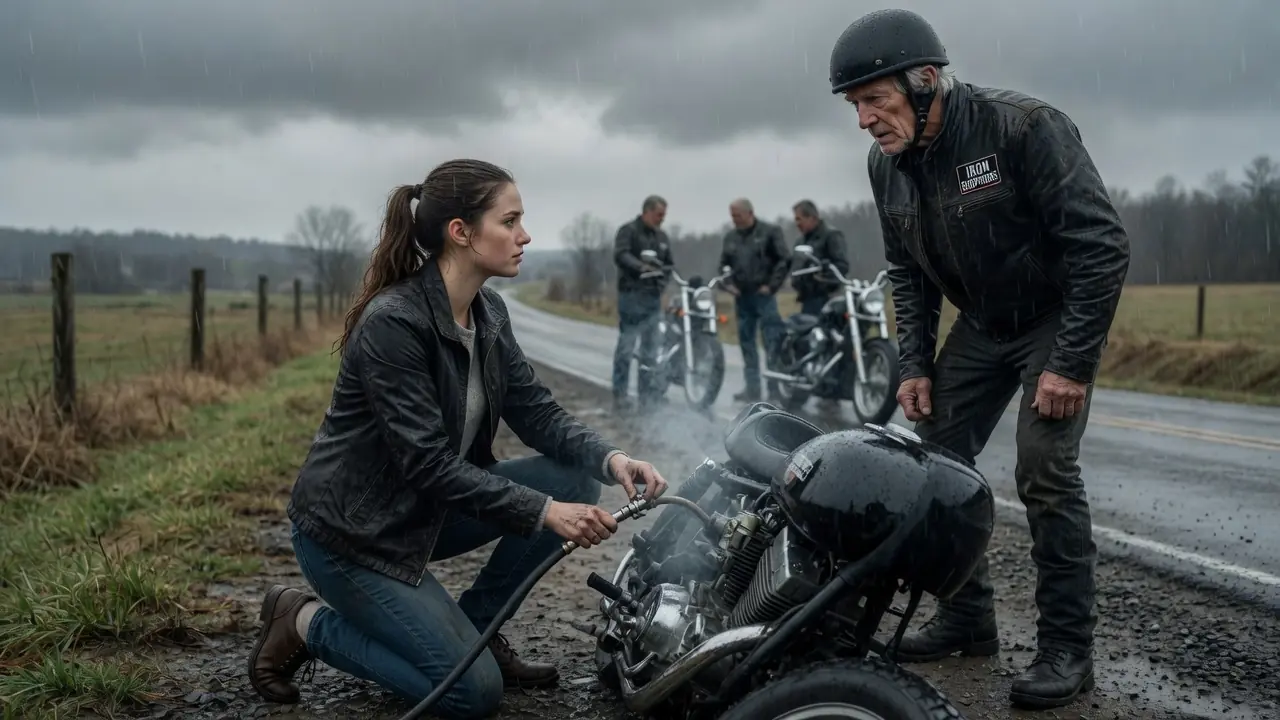
He looked like a tired old man carrying a promise.
“What made you stop?” he asked after several minutes.
Maya kept her eyes on the road.
“You looked stranded.”
“Most people saw bikers and kept going.”
“I saw a fuel leak.”
He laughed softly.
“Mechanic eyes.”
“Something like that.”
“You weren’t scared?”
“I was careful.”
“That’s not the same.”
“No,” Maya said. “It’s better.”
Vince nodded, accepting the answer.
“My granddaughter used to say she wanted to be a mechanic,” he said.
“Did she?”
“For about six months. Then she wanted to be a veterinarian. Then a singer. Then an astronaut.”
“Reasonable range.”
“She died when she was nine.”
Maya’s hands tightened on the wheel.
“I’m sorry.”
Vince looked out the rain-streaked window.
“Leukemia. Mercy Children’s took care of her. Eleanor never forgot it. After she passed, we kept the ride going. Every year, we bring what the kids ask for if we can.”
“And Marcus asked for a bell?”
“He asked if motorcycles had voices. I told him some of them did. He said he wanted a small voice for when he got scared.”
Maya swallowed.
“So you brought him a bell.”
“From Eleanor’s first bike,” Vince said. “She had a little Honda before she married me. Bell is old, scratched, but it still rings.”
Maya felt the weight of the package without touching it.
“That’s a good promise.”
“Yes,” Vince said quietly. “It is.”
They arrived at Mercy Children’s Center at 6:03.
A little late.
But not too late.
The building glowed with warm light against the gray evening.
The entrance canopy protected them from the rain.
Dale, Rick, and Tommy arrived a few minutes later, wet but smiling, having ridden ahead after securing the damaged bike.
A nurse at the front desk recognized the Iron Shepherds immediately.
“You made it,” she said, relieved.
Vince lifted the package.
“Had help.”
The nurse looked at Maya.
“Thank you for getting them here.”
Maya shrugged.
“I fixed a fuel line.”
Vince said, “She fixed the whole evening.”
Inside the children’s activity room, several kids waited with parents, nurses, blankets, and wide eyes.
There were donated coats, toys, books, and gift cards arranged on tables.
The bikers softened as soon as they entered.
Their voices lowered.
Their shoulders relaxed.
One huge man knelt to hand a teddy bear to a toddler.
Rick helped a girl try on a winter hat with cat ears.
Tommy showed a boy pictures of his motorcycle.
Vince scanned the room until a small voice called out.
“Mr. Vince?”
A boy in a blue hoodie sat near the window, thin and pale, with a knit cap pulled low over his head.
His mother sat beside him.
Vince crossed the room slowly.
Maya stayed near the doorway, not wanting to intrude.
But Vince turned.
“Maya.”
She blinked.
“What?”
“You’re in the story now. Come here.”
Maya walked over awkwardly.
Marcus looked at Vince.
“Did you bring the bike voice?”
Vince’s face changed completely.
“Yes, sir. But the bike tried to keep it.”
Marcus’s eyes widened.
“The bike did?”
“Had a breakdown on the highway. This mechanic right here made sure I got here.”
Marcus looked at Maya with awe.
“You fixed his motorcycle?”
“Enough to make it safe,” Maya said.
“That’s cool.”
Vince unwrapped the package.
Inside was a small brass bell, scratched and worn, with a faded red ribbon tied through the top.
He placed it gently in Marcus’s hands.
“This was Eleanor’s,” Vince said. “She rang it whenever she was nervous before a ride. Said it reminded her that courage could make a small sound and still be real.”
Marcus touched the bell carefully.
Then he rang it.
The sound was clear and bright.
Small.
But strong.
The room seemed to pause around it.
Marcus smiled.
His mother began to cry.
Vince looked down, blinking hard.
Maya turned away slightly, but not before tears filled her eyes too.
Later, after the gifts were delivered and the children were tired, Maya drove Vince back to the farm pull-off.
The trailer had arrived.
The damaged motorcycle was loaded safely.
Dale clapped Maya on the shoulder gently.
“You saved us today.”
“I helped with a hose.”
Rick shook his head.
“No. You stopped. That’s the part most people didn’t do.”
Vince stood beside the loaded bike.
Rain had stopped completely.
The clouds had begun to break in the west.
“I owe you,” he said.
“No, you don’t.”
“Yes,” he said. “But not the way you think.”
Maya frowned.
Vince reached into his jacket and pulled out a small card.
On it was written:
Iron Shepherds Community Ride Foundation.
Vince Harper, Director.
Maya looked at it.
“You run a foundation?”
“Eleanor started it. I complain and sign paperwork.”
Dale laughed.
“That’s accurate.”
Vince looked at Maya seriously.
“We fund community projects. Youth training. Road safety. Emergency support. Things that keep people moving.”
Maya felt her heartbeat change.
Vince continued.
“You have a notebook, don’t you?”
Maya stared.
“How did you know?”
“Women who carry hose clamps and traffic cones usually have plans.”
Maya laughed despite herself.
“Yes.”
“What kind?”
“Roadside repair. Rural emergency help. Maybe training young women in basic mechanics.”
Vince looked at Dale.
Dale smiled.
Vince turned back to Maya.
“Bring it to our clubhouse next week.”
“That sounds terrifying.”
“It’s mostly coffee, bad chairs, and men who argue about tire brands.”
“Still terrifying.”
“Good,” Vince said. “Important things should make you sit up straight.”
The next week, Maya went.
The Iron Shepherds clubhouse was not what she expected.
It was an old community building outside Mill Creek, with motorcycle photos on the walls, folding tables, a coffee pot, a wall of donated coats, and a bulletin board covered in thank-you cards from hospitals, shelters, and schools.
Maya brought her black notebook.
Road Angels Repair.
Vince sat at the head of the table.
Dale, Rick, Tommy, and three other members sat around him.
They looked intimidating until one of them asked if she wanted coffee with “the least burned pot” and another apologized because the chairs squeaked.
Maya opened the notebook and presented her idea.
Mobile roadside repair for rural emergencies.
Basic mechanical response.
Safety-first roadside protocols.
Partnerships with garages.
Volunteer rider network.
Young mechanic training.
Women’s repair workshops.
Emergency rain kits.
Referral list for towing, pharmacies, clinics, and shelters.
The men listened.
Really listened.
They asked hard questions.
Insurance.
Liability.
Training.
Dispatch.
Parts inventory.
Fuel safety.
Night calls.
Volunteer boundaries.
Maya answered what she could.
When she did not know, she said so.
Vince liked that.
At the end, he closed the notebook and said, “Eleanor would have backed this.”
Dale nodded.
“So do we.”
Maya stared.
“What does that mean?”
Vince smiled.
“It means the Iron Shepherds Community Ride Foundation is offering you a one-year apprenticeship and start-up grant.”
Maya’s throat tightened.
“I don’t understand.”
“You’ll train with mechanics, tow operators, safety coordinators, and community organizers. We’ll fund a basic mobile repair rig, safety gear, and a pilot program. You’ll build Road Angels properly.”
Maya could not speak.
Vince leaned forward.
“This is not charity. This is investment. You stopped in the rain because you understood that stranded people are still people, even when they look like they don’t need help.”
Maya looked down at her hands.
Grease still lined the edges of her nails.
For years, she had imagined the program alone.
Suddenly, other people could see it too.
She accepted.
The apprenticeship changed everything.
Maya trained with experienced motorcycle mechanics.
She learned roadside safety protocols from tow operators.
She learned dispatch documentation.
She learned insurance requirements.
She learned how to build volunteer schedules that did not depend on one person being heroic.
She learned how to train people without making them reckless.
Vince mentored her in community partnerships.
Dale taught her motorcycle-specific troubleshooting.
Rick taught road positioning and rider safety.
Tommy taught her how to talk to people who were scared but trying to act tough.
Her father Frank watched it all with quiet pride.
He helped outfit her first mobile repair truck.
A white utility pickup with tool drawers, a portable compressor, reflective cones, battery packs, emergency rain tarps, basic motorcycle parts, and a decal on the side:
Road Angels Repair.
Practical help on rural roads.
The first Road Angels pilot ran on weekends.
Maya and two trained volunteers responded to non-dangerous roadside calls referred through partner garages, the Iron Shepherds, and local community centers.
They helped a woman with a flat tire outside a clinic.
A teenager whose scooter chain came loose.
An elderly man whose truck battery died near the pharmacy.
A delivery driver with a loose coolant hose.
A motorcyclist whose saddlebag strap had tangled near the rear wheel.
Each call was small.
Each one mattered.
Maya trained young women from the high school shop class.
At first, three came.
Then seven.
Then twelve.
She taught them how to check tire pressure, jump a battery, identify fluid leaks, tighten basic connections, and stay safe on the roadside.
She also taught them how to handle doubt.
“When someone asks if there’s a man coming,” Maya told them, “you can say, ‘A mechanic is already here.’”
The girls loved that.
Vince attended the first workshop and pretended not to cry.
The Iron Shepherds became regular supporters.
They donated funds, tools, safety vests, and time.
Every year, Road Angels helped escort the Veterans Ride For Kids safely to Mercy Children’s Center.
Marcus rang Eleanor’s bell at the start of the ride the next year.
Then the year after that.
He grew stronger.
He eventually became a teenage volunteer at Road Angels, helping pack rain kits and label tools.
Vince’s bike was repaired properly and continued riding, though he no longer rode in heavy rain.
Maya took credit for that rule.
Vince called it tyranny.
She called it survival.
Years passed.
Road Angels Repair grew across western Pennsylvania.
It became a real program with trained responders, safety guidelines, youth workshops, and partnerships with garages and tow companies.
It did not replace professional repair shops.
It did not promise miracles.
It helped people make the next safe move.
Off the shoulder.
Out of the rain.
Tow arranged.
Temporary fix.
Medication picked up.
Family called.
Promise kept.
Maya became known as the woman who built a bridge between mechanical skill and community care.
Vince remained her mentor for as long as he could.
He was stubborn, sharp, funny, and deeply sentimental when he thought no one was looking.
One spring afternoon, years after the first rainy roadside repair, Vince came to Bennett & Son carrying a small wooden box.
Maya immediately narrowed her eyes.
“No.”
Vince stopped.
“You don’t know what it is.”
“You have that look.”
“What look?”
“The old-man meaningful gift look.”
Frank, from under a lifted truck, called out, “That’s a real look.”
Vince ignored him and placed the box on Maya’s workbench.
Inside was a key.
Not a motorcycle key.
A building key.
Maya looked up.
“What is this?”
Vince smiled.
“The Iron Shepherds bought the old feed store building near Route 18. We’re leasing it to Road Angels for one dollar a year.”
Maya stared at him.
“What?”
“You need a training center.”
“I can’t accept that.”
“You can.”
“Vince—”
He lifted one hand.
“Listen. Eleanor believed promises need places to live. Road Angels has outgrown your father’s back lot. The building has three bays, storage, classroom space, and enough bad plumbing to keep you humble.”
Maya laughed through tears.
“This is too much.”
“No,” Vince said softly. “Too much was almost missing Marcus because of a loose fuel line and pride. Too much is young people with talent and nowhere to learn. This is the proper size of response.”
The Road Angels Training Center opened six months later.
The first class had sixteen students.
Ten were girls.
Six were boys.
All learned basic roadside repair, safety, communication, and community response.
Above the classroom door, Maya hung a sign with Vince’s favorite rule:
To safety, not to glory.
Vince loved it.
He passed away peacefully two years later.
At his memorial ride, the Iron Shepherds gathered outside the Road Angels Training Center.
Eleanor’s old bell, the one Marcus still kept, rang once at the beginning.
Then every motorcycle started.
The sound rolled through the hills like thunder.
Maya stood beside Frank, tears running down her face.
After the service, Dale handed her an envelope.
“Vince wrote this for you.”
Inside was a letter in Vince’s rough handwriting.
Dear Maya,
The day my bike broke down, I thought I had failed a child, Eleanor, and the promise we built together.
You stopped when others passed.
You saw the fuel line, the danger, the deadline, and the old man pretending not to hurt.
You fixed what you could.
You drove me where I needed to go.
Then you built Road Angels so stranded people would not have to depend on luck alone.
The grant, the apprenticeship, and the building were not repayment.
They were continuation.
Keep teaching them that courage can be practical.
Keep stopping safely.
Keep the wheels moving.
With gratitude,
Vince Harper
Maya framed the letter in the Road Angels Training Center.
Beside it, she placed a photograph from that first day at Mercy Children’s Center.
Vince kneeling beside Marcus.
Marcus holding Eleanor’s bell.
Maya standing awkwardly in the background, soaked from rain, grease on her hands, not yet knowing that her whole future had just changed.
Years later, whenever people asked how Road Angels began, Maya told them the truth.
“It began with a group of stranded bikers, a loose fuel line, a rainy highway, and a promise that had to reach a child.”
Then she would show them Vince’s letter.
The gift Maya received was not a house.
Not a car.
Not a fortune.
It was an opportunity.
An apprenticeship.
A training center.
A way to turn one roadside repair into a program that helped thousands of people and trained young mechanics to trust their own hands.
And every time a young woman in the workshop looked at an engine and whispered, “I don’t know if I can do this,” Maya smiled gently.
She handed over the wrench and said, “Start with what failed. The rest will teach you.”
Because sometimes help did not look soft.
Sometimes it arrived in a pickup truck with hazard lights flashing.
Sometimes it smelled like rain, fuel, and road grime.
Sometimes it wore work gloves and carried hose clamps.
Sometimes it stopped for the people everyone else assumed did not need help.
And sometimes, when kindness knew how to use a wrench, it could keep a promise moving down the road.