At twenty-four, Rachel Morgan had learned that some people looked lost long before they admitted it.
She was a young white American woman living in Columbus, Ohio, with fair skin, long dark-blonde hair usually tied in a loose ponytail, soft gray eyes, and a quiet way of paying attention that made strangers trust her sooner than they expected. She worked at a small bus station café near downtown, where passengers came in carrying suitcases, paper tickets, tired faces, and stories they rarely told.
Rachel’s job was simple.
She made coffee, toasted sandwiches, wiped tables, refilled napkin holders, and called out orders over the noise of rolling luggage and bus engines outside. Most people passed through quickly. They bought something hot, checked the departure board, and disappeared toward another city.
But Rachel noticed the ones who lingered.
The mother is counting coins before buying food for her children.
The college student crying quietly over a delayed bus.
The elderly woman reading the same ticket again and again.
The old man standing near the wrong gate, too embarrassed to ask for help.
Her boss, Carla, often said, “Don’t get involved in every traveler’s life.”
Rachel tried not to.
But sometimes life sat down at her counter and looked too cold to ignore.
Her dream was to become a travel social worker one day, helping elderly people, low-income families, and vulnerable travelers navigate transportation, paperwork, appointments, and emergencies. The idea had started with her grandfather, Paul, who had gotten confused during a bus transfer years earlier and spent six frightened hours in the wrong station before anyone called the family.
After that, Rachel could never look at a bus station the same way.
To most people, it was only a place to leave.
To her, it was a place where someone could disappear if nobody looked closely enough.
One bitter January evening, snow began falling just before rush hour. The wind pushed it sideways through the open doors every time passengers entered the station. The floor near the entrance turned slick. People complained about delays, wet shoes, canceled routes, and frozen fingers.
Rachel was behind the café counter pouring coffee when she saw the old man.
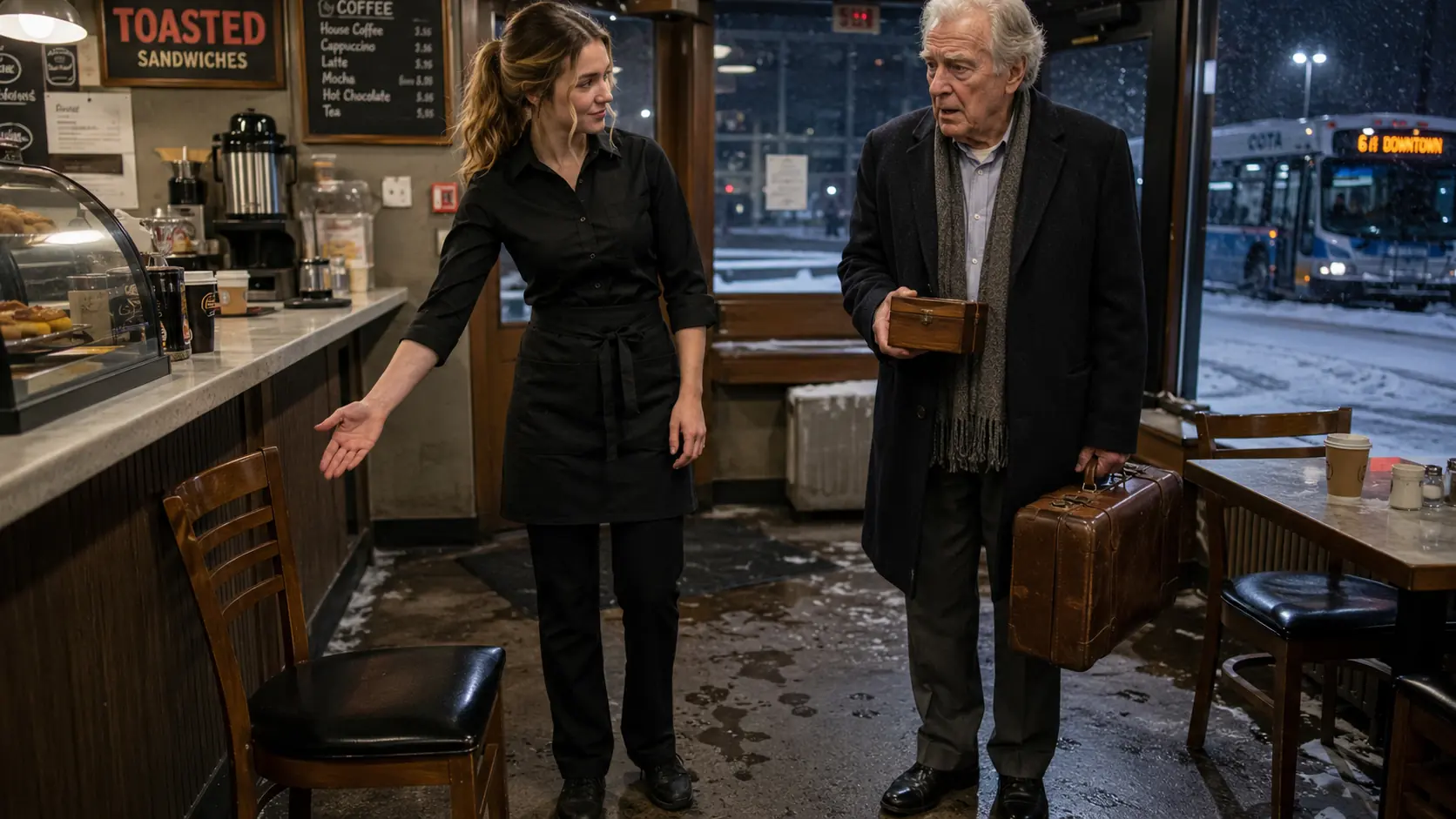
He stood near Gate 4, holding a brown leather suitcase in one hand and a folded ticket in the other. He was a white American man in his late seventies, tall but slightly bent, with thin silver hair, a deeply lined face, pale blue eyes, and a dark wool coat buttoned unevenly. A gray scarf hung loose around his neck. His shoes were polished but wet from the snow.
He looked at the departure screen.
Then at his ticket.
Then back at the screen.
His expression shifted from confusion to fear.
People moved around him without stopping.
Rachel watched him for a full minute. He walked toward Gate 6, stopped, turned around, then walked back toward Gate 4. A boarding announcement came over the speaker, and the old man flinched. His suitcase tipped sideways and fell open.
Clothes spilled onto the floor.
A small wooden box slid out and skidded beneath a bench.
Rachel left the counter.
“Sir, wait. I’ll get it.”
The old man looked up, embarrassed.
“I’m all right.”
Rachel crouched, reached under the bench, and pulled out the wooden box. It was small, polished dark brown, with a brass latch and worn corners. She handed it to him carefully.
His hands closed around it with visible relief.
“Thank you,” he whispered.
“Are you hurt?”
“No. Just foolish.”
“You don’t look foolish. You look overwhelmed.”
He blinked at her, as if kindness had surprised him.
Rachel gathered the clothes and placed them back into the suitcase.
“What’s your name?”
“Edward Hale.”
“I’m Rachel. I work at the café.”
He looked toward the counter, then toward the gates.
“I’m supposed to be going to Dayton.”
Rachel glanced at the ticket in his hand.
“May I see?”
He handed it to her.
The ticket was for Dayton, but the departure time had been changed because of weather. His original bus had been canceled. A new route had been assigned from Gate 9, leaving in twelve minutes.
Rachel looked around.
Gate 9 was on the far side of the station.
“Mr. Hale, your gate changed.”
His face paled.
“I thought so. But the screen kept moving, and I couldn’t find the number.”
“That happens when there are delays.”
“My daughter is waiting in Dayton. My phone died.” He pulled an old flip phone from his pocket and pressed the power button. Nothing happened. “I was trying to call her.”
Rachel looked at his shaking hands, the open suitcase, the wooden box, the snow blowing through the doors, and the crowd pushing toward the gates.
“Come sit at the café for two minutes,” she said. “I’ll charge your phone and confirm the gate.”
“I don’t want to miss the bus.”
“You’ll miss it faster if you keep standing here confused.”
The old man looked at her.
Then he gave a small, tired laugh.
“You sound like my wife.”
“Was she usually right?”
“Always.”
“Then let’s honor her wisdom.”
Rachel helped him close the suitcase and guided him to a table near the café counter. She plugged his phone into a charger, then used the station desk phone to confirm the new route. Gate 9. Eleven minutes. Delayed boarding, but still active.
She returned with hot tea.
“I didn’t order this,” Edward said.
“I know. Your hands are shaking.”
“I can pay.”
“Later. First, warm up.”
He wrapped his hands around the cup.
The wooden box sat on the table between them.
Rachel nodded toward it.
“That must be important.”
Edward looked down at it.
“My wife’s music box.”
His voice changed when he said wife.
Softened.
“She passed away in October. My daughter asked me to come stay with her for a while. I kept putting it off. Today I finally packed.” He touched the box. “This was the first gift I ever gave Margaret. It still plays, but only if you turn the key gently.”
Rachel sat across from him for a moment, forgetting the noise around them.
“What song?”
“Moon River.”
He smiled faintly.
“She said it was too romantic for a man who once forgot our anniversary dinner and brought home motor oil instead of flowers.”
Rachel laughed.
Edward did too, but his eyes filled.
“I don’t want to lose it,” he whispered.
“You won’t.”
The announcement for Dayton crackled overhead.
Final boarding for adjusted Route 22 to Dayton. Gate 9.
Edward stood too quickly.
His face tightened.
“Gate 9?”
“Yes. I’ll walk you there.”
“You have work.”
“I have Carla. She’ll glare, but she’ll survive.”
Rachel turned toward her boss behind the counter.
Carla had been watching. She sighed and waved one hand.
“Go. But don’t adopt him.”
Rachel smiled. “No promises.”
She carried the suitcase because Edward was still holding the music box. The station was crowded, and the floor was slick near the doors. Rachel walked slightly ahead, clearing a path.
“Gate 9 is this way.”
“I’m sorry,” Edward said.
“For what?”
“Being slow.”
“You’re not slow. The station is confusing.”
“I used to travel for work all the time. I knew every transfer. Every schedule.” He looked down. “Now I can’t even find a gate.”
Rachel slowed her pace.
“Grief makes maps harder to read.”
Edward looked at her sharply.
Then his expression softened.
“Yes,” he said. “It does.”
They reached Gate 9 just as passengers were lining up.
Rachel checked with the driver, confirmed the ticket, and made sure Edward’s suitcase was tagged correctly. Then she wrote his daughter’s number, which he recited from memory, on a napkin and called from her own phone.
A woman answered anxiously.
“Hello?”
“Hi, is this Susan Hale?”
“Yes. Who is this?”
“My name is Rachel Morgan. I work at the Columbus bus station café. Your father is here with me. His bus was reassigned because of the weather, and his phone died, but he’s safe and boarding now.”
There was a breath of silence.
Then Susan’s voice broke.
“Oh, thank God. I’ve been calling him for twenty minutes.”
Edward leaned toward the phone.
“I’m all right, Susie.”
“Dad, I was so worried.”
“I got confused.”
“That’s okay. Just get on the bus. I’ll be there when you arrive.”
Rachel handed the phone closer so they could speak privately for a moment.
When the call ended, Edward looked at her with tears in his eyes.
“You didn’t have to do that.”
“I know.”
“You saved me from making my daughter afraid.”
Rachel shook her head gently.
“You were already trying. I just helped the pieces line up.”
The driver called for final boarding.
Edward held the music box close, then paused.
“Rachel.”
“Yes?”
He reached into his coat pocket and pulled out a small folded paper.
“This was Margaret’s recipe for lemon shortbread. She made it every Christmas. I packed it by accident in my coat pocket.” He gave a weak smile. “She believed food solved most problems, except taxes.”
Rachel accepted the paper carefully.
“I can’t take this.”
“It’s a copy. The original is in the box at home.” He looked toward the café. “Make them sometime. People waiting in cold stations need something kind.”
Rachel’s throat tightened.
“I will.”
Edward boarded the bus.
Rachel stood by the window until he found a seat. He lifted the music box slightly, almost like a goodbye. Then the bus pulled away into the snow.
Rachel returned to the café with damp shoes and the folded recipe in her apron pocket.
Carla raised an eyebrow.
“He make it?”
“He made it.”
“Good.”
Then, after a pause, Carla added, “You did right.”
Rachel looked at her, surprised.
Carla only shrugged and turned back to the register.
That night, Rachel made the lemon shortbread.
She followed Margaret Hale’s recipe exactly: butter softened but not melted, lemon zest rubbed into sugar, flour added slowly, dough chilled for one hour, cut into simple squares, baked until pale gold at the edges.
The cookies were delicate, bright, and comforting.
The next day, Rachel brought a small batch to the café.
Carla tasted one and closed her eyes.
“Sell these.”
“They’re not mine.”
“They can still be shared.”
Rachel placed them near the register with a little handwritten sign:
Margaret’s Lemon Shortbread — Limited Batch
They sold out before noon.
A week later, a postcard arrived at the café.
It showed Dayton under snow.
On the back, Edward had written:
Rachel, I arrived safely. Susan cried, then scolded me, then fed me soup. Margaret’s music box is on my bedside table. Thank you for seeing me when I was trying very hard not to look lost. I hope you made the shortbread.
Edward Hale
Rachel pinned the postcard beside the coffee machine.
Months passed.
Edward wrote again.
Then again.
Sometimes he sent memories of Margaret. Sometimes he sent old recipes she had copied by hand. Ginger tea cakes. Apple brown butter bars. Oatmeal lace cookies. Rosemary biscuits. Each card came with a note.
Margaret made these when neighbors were grieving.
Margaret made these for bus trips.
Margaret burned the first batch and blamed the oven until 1998.
Rachel began baking one recipe at a time for the café.
The passengers loved them.
They began asking for “the postcard cookies.”
Rachel wrote the story on a small chalkboard:
Recipes sent by Edward Hale in memory of his wife, Margaret, who believed waiting rooms needed kindness.
Something changed in the café.
It was still small. Still loud. Still full of delays and tired travelers. But people began pausing near the counter. They read the chalkboard. They bought cookies for strangers. They left notes. One woman cried while eating a rosemary biscuit because it tasted like something her mother used to make.
Rachel started keeping a notebook.
Not just recipes.
Stories.
Who sent them. Who baked them. Who remembered them. What kind of comfort they carried.
Her dream began to shift.
She still cared about vulnerable travelers. She still wanted to help people navigate stations and schedules. But now she saw another way to serve them too.
Food for people in between places.
A small comfort counter.
A travel café that helped lost people feel less alone.
She named the idea **The Waiting Table**.
Over the next year, Edward and Susan visited Columbus once. Edward was steadier then, though still moving carefully. He came to the bus station café with the music box in a cloth bag.
Rachel met him at the counter.
“You came back.”
“I had to inspect what you’ve done with my wife’s shortbread.”
“Very official.”
He tasted one cookie slowly.
Then he smiled.
“Margaret would say you need a little more zest.”
Rachel laughed.
“I knew it.”
Then he opened the music box and let it play softly on the café table. Moon River floated under the noise of bus announcements and rolling suitcases.
For one strange, beautiful moment, the station felt almost still.
Before leaving, Edward handed Rachel a small envelope.
Inside was not money.
It was a bus ticket.
A round-trip ticket to Dayton.
“I want you to visit Susan’s community kitchen,” he said. “She runs a small meal program for seniors and travelers. She knows people who can teach you how to turn kindness into something organized.”
Rachel stared at the ticket.
“Edward, I can’t accept this.”
“You can. It is only a ticket.”
“It’s not only a ticket.”
He smiled.
“No. I suppose not.”
Rachel used it.
In Dayton, Susan showed her how the community kitchen worked: donations, volunteers, food safety rules, low-cost menus, grant applications, partnerships with transit stations, and emergency meal programs for stranded travelers. Rachel took notes until her hand cramped.
Susan also gave her something from Margaret.
A worn recipe notebook with copies, not originals, of Margaret’s travel-friendly baked goods.
“My mother believed recipes should move,” Susan said. “Dad wanted you to have this set.”
Rachel held the notebook carefully.
“I don’t know how to thank you.”
Susan smiled.
“Build something kind.”
Years later, Rachel opened **The Waiting Table** inside a renovated corner of the Columbus bus station.
It was not fancy.
It had coffee, soup, simple sandwiches, and baked goods from donated family recipes. It also had a help board with emergency phone numbers, charging stations, printed route-change instructions, and a volunteer travel-assistance desk for elderly passengers and families in crisis.
On the wall, Rachel framed Edward’s postcard, Margaret’s lemon shortbread recipe, and the bus ticket that had taken her to Dayton.
Under them, she wrote:
Some people are not lost.
They are waiting for someone to notice.
Edward came to the opening with Susan.
He was older, slower, and holding the music box in both hands. Rachel served him lemon shortbread with extra zest.
He tasted it.
Then he nodded.
“Now Margaret approves.”
Rachel laughed through tears.
When people asked how The Waiting Table began, Rachel always told the truth.
“It started with an old man at Gate 4 who almost missed his bus.”
Then she told them about the snow, the dead phone, the fallen suitcase, the music box under the bench, the call to his daughter, and the recipe folded in his coat pocket.
Edward did not give her a building.
He did not give her a fortune.
He gave her a recipe.
A postcard.
A ticket.
And a reminder that even in a place built for leaving, kindness could make someone feel found.
Every winter, when snow blew through the station doors and passengers came in tired, cold, and uncertain, Rachel baked Margaret’s lemon shortbread.
And whenever someone looked lost near the gates, she still stepped out from behind the counter.
Because sometimes the most important journey began with someone saying,
“Let me help you find where you’re supposed to go.”