At twenty-four, Clara Bennett had learned that panic did not always sound loud.
Sometimes panic sounded like an old woman whispering, “My papers,” while standing on a sidewalk with both hands pressed to an empty purse.
Sometimes it sounded like a voice trying to stay polite while the whole body trembled.
Sometimes it sounded like someone saying, “I should have known better,” when the truth was that someone else had chosen to be cruel.
Clara knew that kind of panic because she had worked for almost three years at the front desk of the Willow Creek Community Bank.
It was a small bank in a small town in Ohio, the kind of place where customers still came inside because they trusted faces more than machines.
Clara answered questions, helped elderly customers read forms, printed account statements, explained appointment times, and called family members when someone came in confused about a letter they had received.
She was a young white American woman with fair skin, long chestnut-brown hair usually tied into a low ponytail, soft hazel eyes, and a careful voice that made frightened people feel less ashamed.
She had learned that money was rarely just money.
Money was rent.
Medicine.
Groceries.
Heat.
Funeral costs.
A birthday gift for a grandchild.
A deposit that proved someone still had control over their own life.
Paperwork was the same.
A bank statement could protect a home.
A notarized form could release a benefit.
A folder of receipts could prove a bill had already been paid.
A signature could save someone from a mistake they did not understand until it was almost too late.
Clara’s dream was to start a program called Safe Hands.
It would help elderly residents protect important documents, understand suspicious calls, organize bank papers, avoid scams, and bring a trusted person to appointments when they felt unsure.
Not legal advice.
Not financial advising.
Just practical protection.
A place to ask, “Is this letter real?”
A checklist before signing anything.
A document pouch that stayed dry and safe.
A way to call a family member without embarrassment.
A trained volunteer sitting nearby when an older person felt pressured.
Clara had written the whole idea in a notebook she kept in her tote bag.
But dreams needed approval, funding, training, and someone willing to admit the need was real.
So far, she only had the notebook.
That changed on a cold Monday afternoon in March.
The sky over Willow Creek had turned the color of wet cement.
Rain had stopped, but the sidewalks still shone with puddles, and the air smelled like damp coats, exhaust, and old leaves.
Clara had left the bank at four-thirty after staying late to help a retired teacher print statements for a housing review.
She was walking toward the bus stop when she saw an elderly woman standing outside the pharmacy on Main Street.
The woman was in her late seventies, short and thin, with silver hair tucked beneath a pale blue knit hat, pale skin, and frightened blue eyes behind round glasses.
She wore a beige coat, dark pants, black shoes, and one glove.
The other glove lay on the sidewalk near her feet.
Her purse hung open from her wrist.
The contents had spilled across the wet pavement.
A tissue pack.
A coin purse.
A lipstick.
A folded grocery list.
A pharmacy receipt.
But the woman was not looking at those things.
She was staring down the street.
Her face was pale.
“My folder,” she whispered.
Clara slowed immediately.
“Ma’am?”
The woman did not seem to hear.
“My folder. He took my folder.”
Clara stepped closer, keeping her voice gentle.
“Ma’am, are you hurt?”
The old woman turned toward her.
For a second, her eyes did not focus.
Then she looked at Clara as if she had been pulled back from far away.
“My folder,” she said again. “A man took it.”
Clara felt her body sharpen with attention.
“What kind of folder?”
“Brown leather. With my bank papers. My appointment papers. My daughter’s letter.”
Her voice cracked.
“I need them today.”
Clara crouched and began gathering the items from the sidewalk before they became soaked.
“What’s your name?”
“Margaret Ellis.”
“I’m Clara Bennett. I work at Willow Creek Community Bank.”
Margaret’s eyes widened.
“The bank?”
“Yes.”
“I was going there. I have an appointment at five.”
Clara looked at her watch.
4:37.
Twenty-three minutes.
“What happened?”
Margaret pressed one trembling hand to her chest.
“A man stopped me outside the pharmacy. He said he worked with the bank. He said there was a problem with my account and he could help me get checked in faster.”
Clara’s stomach dropped.
“What did he look like?”
“Dark jacket. Baseball cap. Young. Maybe thirty. He was very polite.” Margaret swallowed. “He said I should show him the appointment folder. I thought… I thought maybe the bank sent him because I walk slowly.”
Clara kept her face calm, though anger rose hot in her chest.
“What did he do?”
“He took the folder and said he needed to scan it inside. Then he walked toward the alley beside the pharmacy. I called after him. He started walking faster. Then he ran.”
Clara looked toward the alley.
It ran between the pharmacy and the old hardware store, leading to the back parking lot and a side street.
“Did he take your purse?”
“No. Just the folder.”
“Any cash inside?”
“No. Papers.” Margaret’s mouth trembled. “Statements. A notarized letter. My identification copy. My daughter wrote instructions so I would remember what to ask.”
Clara stood.
“Margaret, listen to me. You did not do anything wrong.”
The old woman’s face crumpled.
“I handed it to him.”
“He lied to you.”
“I should have known.”
“He chose to deceive you.”
“I am not usually foolish.”
“I believe you.”
Margaret closed her eyes.
That sentence seemed to matter.
Clara pulled her phone from her coat pocket.
“I’m going to call the bank manager first. Then I’m going to call the pharmacy and ask if they have outside cameras.”
Margaret looked terrified.
“My appointment—”
“We’re going to protect the appointment too.”
“What if he uses the papers?”
“We will make sure the bank knows immediately.”
Clara called Mr. Lawson, the bank manager.
He answered on the third ring.
“Clara?”
“Mr. Lawson, I’m outside the pharmacy with Margaret Ellis. She has a five o’clock appointment. A man pretending to be from the bank took her document folder.”
His voice changed instantly.
“Is she safe?”
“Yes, shaken but safe.”
“What was in the folder?”
“Bank papers, ID copy, notarized letter, daughter’s instructions. We need to flag her account and confirm no one from the bank was sent.”
“No one was sent. Bring her in now.”
“I’m checking whether the folder can be recovered nearby.”
“Do not chase anyone.”
“I won’t.”
“Clara.”
“I said I won’t.”
“Bring her here if you can. I’ll lock down account changes until we verify everything.”
“Thank you.”
She hung up and turned back to Margaret.
“Your account is being protected.”
Margaret gripped her purse.
“He can’t take my money?”
“Not from those papers alone, and we are flagging everything right now.”
Margaret nodded, but her breathing was still unsteady.
“I need that notarized letter.”
“What is it for?”
“My daughter is being added as a trusted contact. I waited too long. I didn’t want to admit I needed help with calls and letters.” Margaret looked down. “Then last week someone called saying I owed a fee. Claire said it was a scam. She drove from Columbus and helped me make the appointment.”
Clara understood immediately.
The appointment at five was not just a bank appointment.
It was Margaret trying to protect herself after nearly being tricked once.
And now someone had tricked her on the way there.
Clara felt a hard protectiveness settle inside her.
“Margaret, we are going to fix what can be fixed today.”
“How?”
“One step at a time.”
Clara helped Margaret pick up the rest of her purse contents and guided her inside the pharmacy.
The pharmacist, Mrs. Kim, looked up from the counter.
“Clara? Is everything all right?”
“We need help. A man took Mrs. Ellis’s folder outside. Dark jacket, baseball cap, went toward the alley. Do you have exterior cameras?”
Mrs. Kim’s face hardened.
“Yes. Front and side door.”
She came around the counter immediately.
Margaret began apologizing.
“I am so sorry to cause trouble.”
Mrs. Kim stopped in front of her.
“You are not causing trouble. Someone caused trouble to you.”
Margaret blinked.
Clara saw the words land.
Mrs. Kim called her assistant to cover the pharmacy and led them to the small office behind the counter.
The security monitor showed four camera angles.
Front door.
Sidewalk.
Side alley.
Back parking lot.
Mrs. Kim rewound the footage.
“There,” Margaret said suddenly.
Her voice shook.
On the screen, a man in a dark jacket approached her near the pharmacy entrance.
He spoke to her.
She opened her purse.
He took the brown leather folder.
Then he turned toward the alley.
Margaret reached after him.
He quickened his pace.
Then he ran.
Mrs. Kim clicked to the side alley camera.
The man ran down the alley, but halfway through, he opened the folder while moving.
A gust of wind caught some papers.
He stopped, seemed frustrated, pulled out something, then threw the folder toward a stack of cardboard boxes behind the hardware store.
Then he disappeared into the back lot.
Clara leaned closer.
“He dumped it.”
Margaret’s hand flew to her mouth.
“The folder?”
“Maybe. We need to check.”
Mrs. Kim grabbed her coat.
“I’ll come.”
Clara shook her head.
“You stay here. Call Mr. Lawson and tell him what we saw. If the folder is there, we bring it straight to the bank.”
Mrs. Kim nodded.
“Be careful.”
Clara turned to Margaret.
“You stay inside with Mrs. Kim.”
Margaret shook her head.
“No. Those are my papers.”
“The alley is wet.”
“I need to see.”
Clara looked at her.
The old woman was frightened, but there was steel beneath it.
This was not recklessness.
It was ownership.
“All right,” Clara said. “But you hold my arm, and we move slowly.”
They went out the side door.
The alley smelled like rainwater, cardboard, and metal.
Water dripped from fire escapes.
The ground was slick with old leaves.
Clara kept Margaret close to the wall, away from puddles.
Behind the hardware store, near a stack of flattened cardboard boxes, lay the brown leather folder.
Open.
Wet on one side.
Clara reached it first and lifted it carefully.
Inside were papers.
Not all perfectly dry, but most intact.
Margaret made a small sound.
“My folder.”
Clara checked quickly.
Bank statements.
Trusted contact form.
ID copy.
Claire’s handwritten letter.
Notarized authorization.
A printed checklist.
Everything seemed present.
But one thing was missing.
The small envelope clipped inside the folder was empty.
“What was in this?” Clara asked.
Margaret looked.
Her face paled.
“My debit card.”
Clara’s jaw tightened.
“He took the card.”
Margaret swayed.
Clara held her.
“Stay with me. We know now. That means we can act.”
“He has my card.”
“And your bank is already on alert. We are going there now.”
“I feel foolish.”
“You are not foolish.”
“I gave him the folder.”
“He studied you, lied to you, and took advantage of your trust.”
Margaret began crying silently.
Clara placed the folder in the plastic document sleeve from her tote bag.
Then she took Margaret’s arm and walked her back through the alley, slowly and carefully.
Mrs. Kim met them at the side door.
“Mr. Lawson is waiting. He said come through the side entrance of the bank if you want privacy.”
“Thank you,” Clara said.
Mrs. Kim looked at Margaret.
“And you come back later. I’ll make tea.”
Margaret tried to smile.
“I will.”
The bank was only two blocks away, but the walk felt longer.
Margaret moved slowly, leaning on Clara’s arm.
Every passing person made her flinch slightly.
Clara noticed.
She also noticed how Margaret kept touching the folder inside the plastic sleeve, making sure it was still there.
“I don’t usually trust strangers,” Margaret said suddenly.
“Today, he pretended not to be one.”
Margaret looked at her.
“That is true.”
“He used the bank’s name.”
“Yes.”
“That is why this is his shame, not yours.”
Margaret’s mouth trembled.
“I would like to believe that.”
“You can borrow my belief until yours catches up.”
The old woman gave a tiny, broken laugh.
“You speak very strangely.”
“I work in customer service.”
“That explains some of it.”
At the bank, Mr. Lawson met them near the side entrance.
He was in his fifties, with gray hair, kind eyes, and the serious face of a man who understood that trust was part of his job.
“Mrs. Ellis,” he said gently. “I’m very sorry this happened.”
Margaret immediately lowered her eyes.
“I should have known better.”
“No,” he said firmly. “No one from this bank will ever approach you on the street and ask for documents. He lied. We will handle this.”
He led them into a private office.
Clara sat beside Margaret while Mr. Lawson locked the debit card, issued a new one, flagged the account, and reviewed recent activity.
No unauthorized transaction had gone through yet.
The card had been stopped in time.
Margaret pressed both hands together.
“Oh, thank God.”
Mr. Lawson then reviewed the recovered papers.
The notarized letter was damp at the edge but readable.
The trusted contact form was intact.
Claire’s handwritten instructions had a water stain, but the words were still there.
Clara laid each sheet carefully on clean paper towels to dry.
Then she made copies.
New copies.
Dry copies.
Organized copies.
She placed them into a fresh bank folder.
On the front, she wrote:
Margaret Ellis — Trusted Contact Appointment
Account protected.
Debit card replaced.
Documents recovered.
Margaret watched her.
“You are making order out of a terrible mess.”
“That’s the goal.”
Mr. Lawson nodded.
“Clara is good at that.”
Clara felt embarrassed but kept working.
They called Claire together.
Margaret wanted to do it, but her hands shook so badly that Clara dialed and put the call on speaker.
Claire answered quickly.
“Mom? Are you at the bank?”
Margaret closed her eyes.
“Yes, sweetheart. I’m at the bank.”
“What’s wrong?”
Margaret’s voice broke.
“I made a mistake.”
Clara gently touched her arm.
Margaret took a breath.
“A man lied to me outside the pharmacy. He said he was from the bank and took my folder.”
Claire’s voice changed instantly.
“Mom, are you hurt?”
“No. Clara helped me. Mrs. Kim had cameras. We found the folder. He took my debit card, but Mr. Lawson stopped it.”
Claire was quiet for one terrible second.
Then she said, “Mom, I don’t care about the card. Are you safe?”
Margaret began crying.
“Yes.”
“Then we can fix the rest.”
“I should have known.”
“Mom, stop. These people are professionals at tricking people.”
“I feel so ashamed.”
“Don’t. Please don’t. I’m proud of you for going to the appointment.”
Margaret covered her mouth.
Clara looked down at the desk.
Claire continued, voice trembling.
“Can I talk to Clara?”
Clara leaned closer.
“This is Clara.”
“Thank you,” Claire said immediately. “Thank you for helping my mother.”
“I’m glad I was there.”
“She’s been so nervous about this appointment. She almost canceled because she felt embarrassed needing a trusted contact.”
“She did the right thing coming.”
“I know. Please tell her that again.”
“I will.”
Claire added, “I’m leaving work now. I’ll drive over.”
Margaret protested.
“No, Claire. You have the kids.”
“They are coming with me.”
“But—”
“Mom. I love you. Let me come.”
Margaret looked at Clara.
Clara nodded gently.
“Let her come.”
Margaret whispered, “All right.”
By the end of the appointment, Margaret’s account was protected, her card was replaced, her daughter was added as trusted contact, and an alert phrase was set up for future phone calls.
Mr. Lawson explained everything slowly.
Clara wrote it down in large letters.
No bank employee will ask for your card or folder on the street.
Call the branch directly if unsure.
Ask for Clara or Mr. Lawson.
Never rush because someone says urgent.
Margaret read the list twice.
Then she looked at Clara.
“Can I keep this?”
“It’s yours.”
“I want to put it by the phone.”
“That’s a good place.”
Claire arrived twenty minutes later with two children in tow.
She rushed into the bank office and hugged Margaret so tightly the old woman almost dropped her cane.
Margaret cried again.
“I’m sorry.”
Claire held her face gently.
“No more sorry.”
“I scared you.”
“Yes,” Claire said. “Because I love you. But you also protected yourself by letting people help.”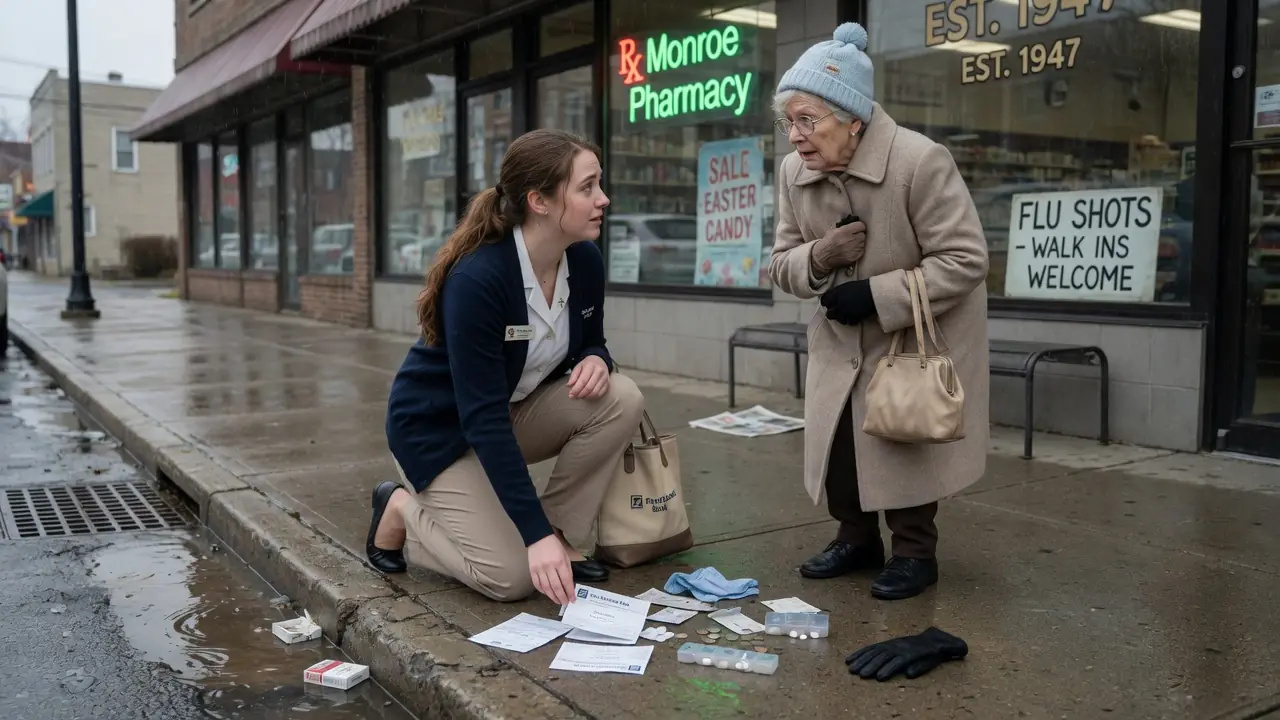
Margaret looked at Clara.
“I did not do that very gracefully.”
Clara smiled.
“You did it. Grace can come later.”
Claire laughed through tears.
The children, a boy and girl around eight and ten, stood quietly near the door.
The little girl stepped forward.
“Grandma, did a bad man take your papers?”
Margaret looked pained.
“Yes, sweetheart. But Clara helped me get them back.”
The girl turned to Clara.
“Thank you for helping Grandma.”
“You’re welcome.”
The boy looked serious.
“Did you chase him?”
“No,” Clara said. “We used cameras and called the bank.”
He looked slightly disappointed.
Claire gave him a look.
“That was the safe choice.”
He sighed.
“Okay.”
That made everyone laugh.
The laughter helped more than anyone expected.
A week later, Margaret returned to the bank.
This time, she came with a small plate of lemon cookies wrapped in foil.
She placed them on Clara’s desk.
“For you.”
Clara smiled.
“You didn’t have to.”
“I know. That is why they are cookies, not a payment.”
Clara accepted.
Margaret sat in the chair across from her.
She looked better than she had the week before.
Still fragile.
Still embarrassed.
But steadier.
“I reported it,” she said.
“To the police?”
“Yes. Claire helped. Mrs. Kim gave them the camera footage.”
“That’s good.”
“They may not find him.”
“Maybe not.”
“But I wanted there to be a record.”
“That matters.”
Margaret nodded.
“I also told the senior center.”
Clara looked up.
“You did?”
“Yes. I stood up after bingo and told them what happened.”
Clara blinked.
“How did that go?”
“Terribly at first. I cried. Then three people told me they had almost fallen for similar calls or letters. One man had lost money. A woman had hidden it from her son for months.”
Margaret looked down.
“I thought I was the only foolish one.”
“You were not foolish.”
“I know that better now.”
She looked at Clara.
“People are ashamed because they think they are alone.”
Clara felt the sentence land in the exact place where Safe Hands lived in her notebook.
“Yes,” she said softly. “They are.”
Margaret looked at the tote bag beside Clara’s desk.
“What is in that notebook you always carry?”
Clara hesitated.
“Just ideas.”
Margaret’s blue eyes narrowed.
“At my age, just ideas usually means something important waiting for permission.”
Clara laughed softly.
“That is very accurate.”
“Show me.”
So Clara did.
She opened the notebook and turned it toward Margaret.
Safe Hands.
Document protection.
Scam awareness.
Trusted contact support.
Bank appointment companions.
Suspicious letter review.
Phone call checklists.
Plastic document sleeves.
Senior workshops.
No shame reporting.
Margaret read slowly.
Her fingers rested on the page that said:
No one should be embarrassed into silence.
When she finished, she looked up.
“You need to do this.”
“I don’t know if the bank will allow it.”
“Ask.”
“I’m not a manager.”
“You are the reason I did not lose more than a card.”
Clara swallowed.
Margaret tapped the notebook.
“People need this before they are tricked. Not after.”
“I know.”
“Then ask.”
Clara brought the idea to Mr. Lawson the next day.
She was nervous.
She expected him to say the bank could not take on more responsibility.
Instead, he listened.
He read Margaret’s letter, which she had written in support of the program.
At the end, Margaret wrote:
Clara Bennett understands that scams do more than steal money. They steal confidence, trust, and dignity. She helped me recover my papers, protect my account, and tell the truth without shame.
Mr. Lawson removed his glasses.
“This is needed.”
Clara exhaled.
“I think so too.”
“We will need compliance rules.”
“I wrote boundaries.”
“No account advice beyond bank policy.”
“I know.”
“No legal advice.”
“I know.”
“No handling documents without customer consent.”
“I wrote consent forms.”
Mr. Lawson looked at her, impressed.
“You wrote consent forms?”
“Yes.”
He closed the notebook.
“One workshop. Senior center. We test interest.”
Margaret attended the first Safe Hands workshop wearing a blue cardigan and a name tag she made herself.
Margaret Ellis.
Scam Survivor.
Clara laughed when she saw it.
Margaret lifted her chin.
“Truth removes teeth from shame.”
The workshop was supposed to last forty-five minutes.
It lasted two hours.
People asked about phone scams.
Fake bank emails.
Suspicious letters.
Grandchild emergency calls.
Fake delivery notices.
Door-to-door contractors.
Online payment requests.
Romance scams.
Charity scams.
Medical billing confusion.
Clara and Mr. Lawson answered what they could.
They gave simple rules.
Hang up and call back using the official number.
Never rush.
Never hand documents to someone outside an office.
Bring letters to the bank if unsure.
Add trusted contacts.
Use account alerts.
Keep important papers in a labeled folder.
Report without shame.
Margaret stood at the end and told her story.
Not dramatically.
Not with self-pity.
Clearly.
Honestly.
She said, “I handed my folder to a liar because he sounded helpful. I am not stupid. I was targeted. There is a difference.”
The room went silent.
Then people clapped.
Not politely.
Strongly.
After that, Safe Hands became monthly.
Then twice monthly.
The bank partnered with the senior center, pharmacy, library, and community office.
Mrs. Kim printed warning cards for pharmacy bags.
The library hosted letter-review hours.
The bank offered trusted contact appointments.
Clara created document safety packets.
Plastic sleeve.
Checklist.
Emergency phone numbers.
Trusted contact form.
Scam warning card.
A note on the front said:
Pause. Verify. Then decide.
Margaret insisted on adding one more line.
No shame in asking.
That became the heart of the program.
Six months later, the bank applied for a community protection grant with Clara’s program plan, Mr. Lawson’s support, pharmacy camera evidence, and testimonies from workshop attendees.
Margaret wrote the main personal statement.
At the end, she wrote:
Safe Hands helped me understand that protection is not suspicion. It is preparation. Clara gave me back the confidence to walk into a bank without feeling like the world had become too clever for me.
The grant was approved.
Not a fortune.
Not a major foundation.
But enough to fund printed materials, volunteer training, senior outreach, fraud-prevention events, document pouches, transportation vouchers for bank appointments, and a part-time coordinator role.
Clara became that coordinator.
Her notebook became a program manual.
Safe Hands grew across Willow Creek.
It helped hundreds of seniors add trusted contacts, review suspicious letters, avoid scams, organize papers, and call official numbers before making decisions.
It also helped families talk about protection without making elderly parents feel controlled.
That part mattered most to Margaret.
“Do not turn help into a cage,” she told Clara once.
Clara wrote that down.
Margaret became the program’s unofficial ambassador.
She attended workshops.
She told her story.
She corrected language.
When someone said, “I was dumb,” she would say, “No. You were pressured.”
When someone said, “I should have known,” she would say, “Now you know more. That is different.”
When someone said, “I don’t want my daughter to think I can’t manage,” Margaret would smile and say, “Let your daughter love you before a stranger pretends to.”
Clara wrote that down too.
Years passed.
Safe Hands became one of the most trusted programs in town.
The bank trained every teller to recognize fear at the counter.
The pharmacy placed warning cards near gift cards.
The library hosted document check days.
The senior center created a “pause table” where people could bring suspicious mail.
The police department used Safe Hands materials in community meetings.
Margaret’s story helped people speak.
And because people spoke, fewer suffered alone.
One autumn afternoon, Margaret came to the bank with Claire.
Clara immediately sensed something was different.
Margaret carried a folder.
Claire carried a small bouquet of yellow flowers.
Clara smiled suspiciously.
“What are you two doing?”
Margaret sat across from her desk.
“Opening a door.”
Inside the folder was a letter from the Willow Creek Community Foundation.
Margaret, Claire, Mr. Lawson, and Mrs. Kim had nominated Clara for a community financial protection fellowship.
The fellowship would pay for Clara’s training in elder financial safety, fraud-prevention outreach, and community program leadership.
It would also provide funding for Safe Hands to expand into three nearby towns.
Clara stared at the page.
Her hands trembled.
“I don’t understand.”
Margaret smiled gently.
“You protected my papers. Now we are protecting your future.”
“This is too much.”
“No,” Margaret said. “What happened to me was too much. What happens to people every day in silence is too much. This is the proper size of response.”
Claire laughed softly through tears.
“She practiced that.”
“I did,” Margaret said.
Clara cried.
The fellowship changed everything.
She completed training.
She learned from fraud investigators, social workers, bank compliance officers, elder advocates, and community educators.
She brought stronger tools back to Safe Hands.
Better workshops.
Clearer warning signs.
Family conversation guides.
Trusted contact scripts.
Emergency account-freeze steps.
Document safety plans.
Three nearby towns joined.
Then five.
Clara eventually became the regional coordinator for elder financial safety programs.
She never forgot the day she found Margaret outside the pharmacy.
The spilled purse.
The empty folder.
The shame that did not belong to her.
Margaret passed away peacefully years later, surrounded by Claire, her grandchildren, and the organized folders she had become famous for labeling in large blue letters.
At her memorial gathering, the family placed a small table near the entrance.
On it were lemon cookies, a blue cardigan, a Safe Hands packet, and the original warning card:
Pause. Verify. Then decide.
No shame in asking.
Claire handed Clara one final envelope.
“Mom wrote this for you.”
Inside was a note in Margaret’s careful handwriting.
Dear Clara,
The day my folder was taken, I thought I had lost my common sense, my dignity, and maybe my savings.
You helped me recover more than papers.
You helped me recover my voice.
You made sure I was protected before I was ashamed into silence.
Then you built Safe Hands so others could ask before fear became loss.
The fellowship was not repayment.
It was my way of helping your courage travel farther than one sidewalk.
Keep teaching people to pause.
Keep reminding them there is no shame in asking.
With love,
Margaret Ellis
Clara framed the note in the Safe Hands office.
Beside it, she placed Margaret’s first workshop name tag.
Scam Survivor.
Years later, whenever people asked how Safe Hands began, Clara told them the truth.
“It began with an old woman outside a pharmacy, an empty purse, and a stolen folder full of papers that mattered.”
Then she would show them Margaret’s note.
The gift Clara received was not a house.
Not a car.
Not a fortune.
It was a chance.
A fellowship.
A way to turn one frightening sidewalk moment into protection for thousands of people.
And every time an elderly customer came in holding a strange letter, whispering, “I’m embarrassed to ask, but is this real?” Clara smiled gently.
She never let shame enter first.
She simply pulled out a chair and said, “Let’s check it together.”
Because sometimes help was not carrying someone home.
It was not fixing a wheel.
It was not rescuing someone from being stuck.
Sometimes help was believing an old woman before she blamed herself.
Sometimes it was protecting papers from rain.
Sometimes it was stopping a card before it could be used.
Sometimes it was saying, clearly and firmly, “You were targeted. You are not foolish.”
And sometimes those words were the first step toward giving someone back their courage.