At twenty-four, Lily Bennett had learned that a person could lose the world in one small crack.
A cracked lens.
A bent frame.
A missing screw.
A pair of glasses slipping from tired hands and hitting a hard floor at the worst possible moment.
To some people, broken glasses were only an inconvenience.
To Lily, they were a crisis waiting to be misunderstood.
She knew because she had worn glasses since she was seven years old.
She remembered the helpless feeling of waking up in the morning and reaching blindly across the nightstand.
She remembered losing her first pair at school and spending half a day unable to read the board.
She remembered how strange and frightening the world became when every face blurred, every sign softened, every step felt uncertain.
Vision was not just sight.
It was confidence.
It was safety.
It was independence.
And for an elderly person, a broken pair of glasses could turn a simple errand into a dangerous journey.
Lily lived in a small town in Virginia called Brookhaven, where the downtown streets were lined with red brick shops, narrow sidewalks, old maple trees, a pharmacy, a diner, a library, and a small optical store with a blue awning.
The store was called Clearview Optical.
Lily worked there as a front desk assistant.
She was a young white American woman with fair skin, long chestnut-brown hair usually tied into a low ponytail, soft gray eyes behind simple round glasses, and a calm voice that made customers feel less embarrassed when they could not read the tiny numbers on insurance cards.
Her job was simple on paper.
She answered phones.
Scheduled eye exams.
Cleaned display frames.
Helped customers choose cases.
Printed receipts.
Adjusted nose pads.
Tightened loose screws.
Called insurance companies.
Helped elderly customers read prescription forms.
Wiped fingerprints from lenses until she felt she could do it in her sleep.
But the work mattered more than people understood.
Every day, someone came into the shop anxious.
A child afraid of needing glasses.
A teenager embarrassed by thick lenses.
A man who had lost his job and needed the cheapest possible repair.
An elderly woman who could not read her medicine labels because her prescription had changed.
Lily noticed all of them.
She noticed the way people apologized for needing help seeing.
She noticed the way older customers laughed at themselves before anyone else could.
She noticed the fear that came when someone realized the world was becoming harder to navigate.
Her dream was to become a licensed optician and eventually start a program called Clear Steps.
It would provide emergency glasses repairs, low-cost reading glasses, transportation-safe vision checks, and lens-cleaning kits for elderly residents.
It would help people who could not afford new frames.
It would repair what could be repaired.
It would teach seniors how to keep backup readers, emergency contact cards, and medication magnifiers.
It would partner with the pharmacy, library, senior center, and community clinic.
Lily imagined a small table once a month where people could bring broken glasses without shame.
No one would be told, “You should have been more careful.”
No one would be laughed at for using tape on a frame.
No one would be sent home unable to see because a repair seemed too small to matter.
But dreams needed training.
Certification.
Money.
Tools.
Approval from the store owner.
Permission from people who worried about liability.
And Lily was only an assistant.
She had a notebook full of ideas and a small repair kit she had bought with her own money.
So she kept working at Clearview Optical, helping one customer at a time.
The afternoon that changed everything came in early December.
Cold rain had been falling over Brookhaven since morning.
It was not heavy enough to close schools or cancel appointments, but it was steady enough to make sidewalks slick and everyone’s mood worse.
By three o’clock, the optical store windows were fogged at the edges.
Customers came in shaking umbrellas, wiping glasses, and complaining about how impossible it was to see in rain.
Lily was behind the counter cleaning a display shelf when the bell over the door rang sharply.
An elderly woman stepped inside, breathing hard.
She was in her late seventies, a white American woman, short and thin, with silver hair tucked beneath a pale blue rain hood, pale skin, and frightened blue eyes that squinted toward the counter.
She wore a beige coat, black gloves, and old brown shoes darkened by rain.
One hand gripped a wooden cane.
The other held a broken pair of glasses.
The right lens was cracked.
One temple arm dangled from a loose hinge.
The frame was bent so badly that the glasses would not sit properly on anyone’s face.
The old woman took two uncertain steps forward.
Then she stopped.
“Please,” she said. “Can someone help me?”
Lily was already moving.
“Yes, ma’am. Come sit down.”
The woman tried to smile.
“I’m sorry. I know I should have called first.”
“You don’t need an appointment for help.”
Lily guided her to the chair near the adjustment table.
The woman sat slowly, still clutching the broken glasses with both hands.
“What’s your name?” Lily asked gently.
“Margaret Ellis.”
“I’m Lily Bennett.”
Margaret nodded, but her eyes were unfocused.
She was trying to see Lily’s face and failing.
“What happened to your glasses?”
Margaret swallowed.
“I dropped them outside the pharmacy.”
“In the rain?”
“Yes. I was holding my cane, my purse, and a paper bag. Someone opened the door quickly, and I stepped back. My glasses slipped from my hand and landed on the sidewalk. Then…” She stopped and looked ashamed. “Then I stepped on them.”
Lily softened.
“That happens.”
“It shouldn’t.”
“It does.”
Margaret held up the broken glasses.
“I need them today.”
“I’ll see what I can do.”
“No, dear. I mean I really need them today.”
Her voice trembled.
Lily sat across from her.
“What’s happening today?”
Margaret’s lips pressed together.
For a moment, it looked as if pride might keep the story locked inside.
Then she exhaled shakily.
“My granddaughter is singing at the school auditorium at four-thirty.”
Lily looked at the clock.
3:18.
Margaret continued.
“She is ten. Her name is Sophie. She has been practicing for weeks. Her mother, my daughter Claire, works at the hospital and may not get there before the first song. I promised Sophie I would sit in the front row so she could find me.”
Margaret’s fingers tightened around the broken frame.
“She gets nervous. She looks for someone she knows. I told her, ‘You look for my blue scarf and my glasses, and I’ll be smiling right there.’”
Her voice broke.
“Now I can’t even see the stage.”
Lily felt the meaning of the broken glasses expand in the room.
This was not only a repair.
This was a grandmother trying to keep a promise to a frightened child.
“Margaret,” Lily said carefully, “we are going to try everything.”
The old woman looked toward her voice.
“Can they be fixed?”
Lily examined the glasses beneath the adjustment lamp.
The right lens was badly cracked but still intact.
The hinge screw was missing.
The frame was bent near the bridge.
One nose pad had twisted sideways.
A full repair would require a new lens and probably a replacement frame.
That would not happen before four-thirty.
But a temporary emergency repair might work.
The goal was not perfection.
The goal was front-row visibility.
Lily checked the prescription marking inside the frame.
Clearview had not made these glasses.
They were older.
Maybe five or six years old.
“Do you have a backup pair?” Lily asked.
Margaret shook her head.
“These were the backup pair. My good pair broke last month, and I was waiting until January to replace them.”
Lily knew what waiting until January meant.
Insurance.
Money.
Hope that nothing else broke before then.
“Do you know your prescription?”
“No.”
“Do you have an old receipt or prescription card?”
Margaret opened her purse and began searching.
Receipts.
Tissues.
A small coin purse.
A folded school flyer.
A church bulletin.
Finally, she found a worn glasses case.
Inside was an old prescription card.
Lily took it gently.
“May I?”
“Yes.”
The prescription was old, but readable.
Lily stood and checked the store’s donated frame drawer.
Clearview kept a small unofficial box of old frames and reading glasses that customers had abandoned after upgrades.
The owner, Mr. Harris, allowed them to use parts for repairs when appropriate, though he always reminded Lily not to “turn the shop into a charity garage.”
Lily found a frame close in size.
Not perfect.
But sturdy.
She also found an older sample lens set for estimating.
It would not match Margaret’s exact prescription, but perhaps she could combine the repaired original left lens with a temporary magnifying clip or replace the cracked lens with a similar strength from a donor pair.
She returned to the adjustment table.
Margaret sat very still.
Her blue scarf was folded neatly in her lap.
Lily noticed that she kept touching it, as if reminding herself of the promise she had made.
“Here’s the situation,” Lily said.
Margaret lifted her face toward the sound.
“I can’t fully replace this lens today. But I may be able to stabilize the frame, secure the cracked lens, and adjust them enough so you can see across an auditorium. It won’t be perfect. It will be temporary.”
“Temporary is enough.”
“We’ll need to be careful.”
“I can be careful.”
Lily smiled.
“I believe you.”
She began working.
First, she removed the bent temple arm and found a replacement hinge screw from her repair kit.
The original hinge had warped, so she adjusted it slowly with padded pliers.
Too much pressure would snap the frame.
She breathed carefully and worked in small movements.
Margaret listened to every tiny sound.
The click of a tool.
The soft scrape of metal.
The tiny screw turning into place.
“Is it bad?” Margaret asked.
“It’s stubborn.”
“That sounds better than bad.”
“Usually.”
Next, Lily adjusted the bridge.
The frame had twisted when Margaret stepped on it, making one side sit higher than the other.
Lily warmed the frame slightly and bent it back little by little.
Then she aligned the nose pads.
The cracked lens worried her most.
The crack ran from the upper corner toward the center but did not fully cross the field of vision.
If Lily secured it with clear lens film and polished the edge, Margaret might see well enough for a short event.
She cleaned the lens carefully.
Then she placed a clear protective film over the crack to keep it from spreading and reduce sharp glare.
It was not beautiful.
It was not permanent.
But it held.
Mr. Harris came out from the back office while Lily worked.
He was in his sixties, tall, with white hair, sharp glasses, and the careful posture of a man who liked rules because rules prevented chaos.
“What happened?” he asked.
“Emergency repair,” Lily said.
Margaret began to stand.
“I’m sorry, sir. I know this is trouble.”
Mr. Harris looked at the broken glasses, the wet coat, and Margaret’s trembling hands.
Then he looked at the clock.
“What time do you need to leave?”
“Soon,” Lily said. “School program at four-thirty.”
Mr. Harris paused.
Then he rolled up his sleeves.
“I’ll check the donor lenses.”
Lily looked at him in surprise.
He did not look back.
“Don’t stare. Keep working.”
Margaret looked between them, confused.
“Is he angry?”
“No,” Lily said, smiling. “He’s helping in his native language.”
Mr. Harris found an old pair of distance glasses with a right lens close enough to Margaret’s prescription to test.
He popped the lens out and compared it to the cracked one.
“Not exact,” he said.
“Better than cracked?” Lily asked.
“Maybe.”
They tried the donor lens in the temporary frame.
It fit loosely.
Mr. Harris shook his head.
“No. Too unstable.”
Lily returned to securing the original lens.
“Then emergency stabilization.”
Mr. Harris nodded.
“I’ll make a protective case for after the program.”
Margaret’s eyes filled.
“You are both being so kind.”
Mr. Harris cleared his throat.
“Seeing a grandchild perform is not optional.”
Lily grinned.
Margaret laughed, but tears slipped down her cheeks.
When the glasses were finally assembled, Lily cleaned them one more time and placed them gently on Margaret’s face.
The old woman blinked.
Then blinked again.
Lily stood a few steps away.
“Can you see me?”
Margaret stared.
Her face changed slowly.
“Yes,” she whispered.
“Clearly?”
“Not perfectly.”
“But enough?”
Margaret looked toward the display wall.
“I can see the blue frames. The white sign. Your face.”
Lily pointed to the clock.
“What time is it?”
Margaret squinted.
“Three fifty-two.”
Lily looked.
3:52.
“Correct.”
Margaret covered her mouth.
“Oh, thank you.”
Lily adjusted the left nose pad slightly.
“These are fragile. Don’t fold them too much. Keep them on your face or in this hard case.”
Mr. Harris handed over a sturdy black glasses case.
“No charge.”
Margaret immediately reached for her purse.
“No, sir. I can pay something.”
“No charge,” Mr. Harris repeated.
“I don’t accept—”
“Margaret,” Lily said gently, “you are accepting a temporary repair so Sophie can see you smile. That is different.”
Margaret stopped.
Then she nodded slowly.
“A plan is easier than charity.”
“Exactly.”
Lily checked the weather outside.
Rain still fell, but lighter now.
The school auditorium was eight blocks away.
Margaret could not walk it safely in time.
“Do you have a ride?” Lily asked.
“I planned to take the bus.”
“In this rain?”
“It stops near the school.”
Lily looked at the clock again.
3:57.
The next bus might not come for fifteen minutes.
“I’ll drive you,” Lily said.
Margaret shook her head at once.
“Oh no. You’re working.”
Mr. Harris picked up his car keys from the counter and handed them to Lily.
“Take mine. Your shift ends at four anyway.”
Lily blinked.
“My shift ends at five.”
“Today it ends at four.”
She stared at him.
He adjusted his glasses and looked away.
“Bring the car back without adding dents.”
Lily smiled.
“Yes, sir.”
Margaret looked overwhelmed.
“I don’t know why everyone is doing this.”
Lily picked up the hard case, Margaret’s purse, and the school flyer.
“Because a ten-year-old girl is looking for a blue scarf and glasses in the front row.”
Margaret’s lips trembled.
“She is.”
“Then let’s get you there.”
They drove through wet streets toward Brookhaven Elementary School.
The rain blurred the windshield.
Margaret sat in the passenger seat with both hands folded over her purse.
She kept lifting one hand to touch the glasses, as if afraid they might disappear.
Lily drove carefully.
No hard turns.
No sudden stops.
The old glasses sat slightly crooked on Margaret’s face, but they worked.
That was enough.
“My husband used to drive me everywhere when it rained,” Margaret said suddenly.
“What was his name?”
“Arthur.”
The name softened her voice.
“He said rain made me nervous behind the wheel. I told him he was being dramatic. Then I drove over our mailbox backing out of the driveway one spring and never heard the end of it.”
Lily laughed.
“Did he replace the mailbox?”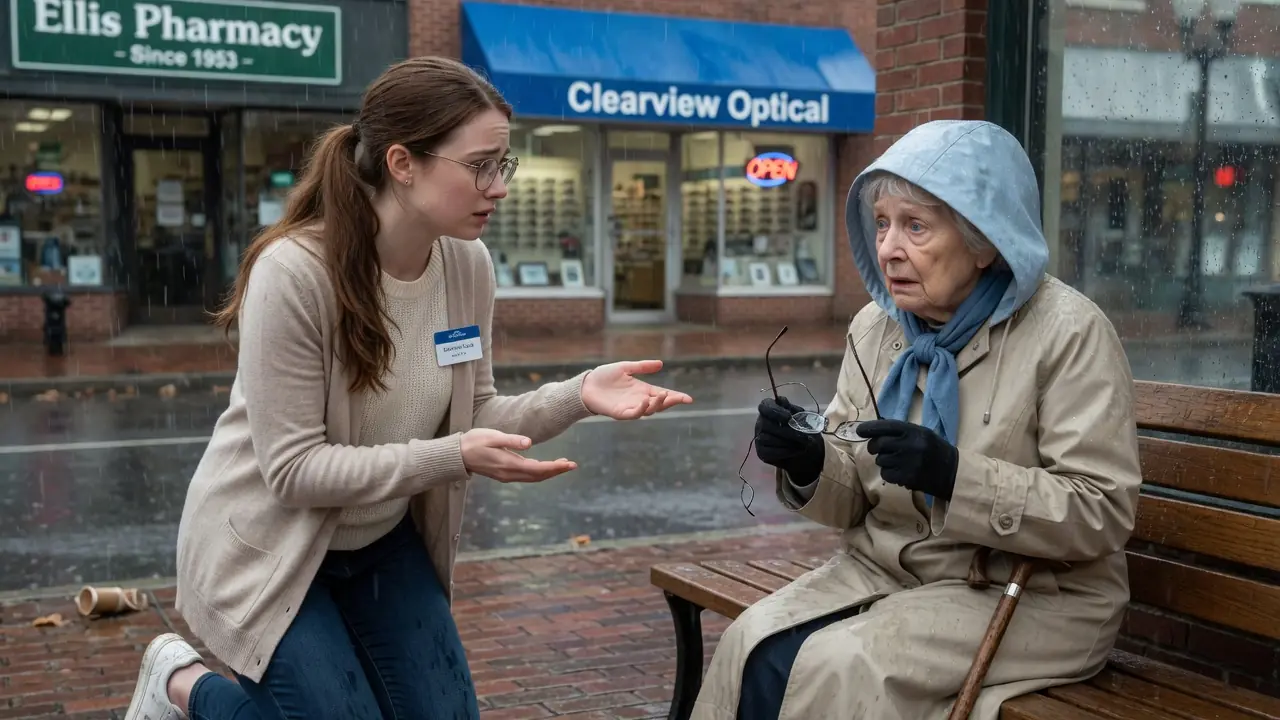
“Yes. With one set in concrete, like a challenge.”
Margaret smiled, then looked down.
“He passed six years ago.”
“I’m sorry.”
“He would have fixed the glasses with electrical tape and confidence.”
“That sounds dangerous.”
“It was. But charming.”
Lily smiled.
Margaret touched her blue scarf.
“Arthur bought me this scarf the day Sophie was born. He said grandmothers should have a signature color.”
“Blue suits you.”
“Thank you.”
Margaret looked out the window.
“Sophie still remembers him a little. Not enough. That hurts Claire. It hurts me too. So I try to show up. Every school play. Every art show. Every birthday. Every small thing. I want her to know there was always someone watching.”
Lily felt her throat tighten.
“That matters.”
“Yes,” Margaret whispered. “It does.”
They arrived at the school at 4:21.
The parking lot was full.
Parents hurried under umbrellas toward the auditorium entrance.
Lily pulled up near the front.
Margaret reached for the door handle, then paused.
“What if she can’t see me?”
Lily looked at her.
“She will.”
“What if the glasses slip?”
“I’ll walk you in and adjust them once more.”
“Oh, dear, no.”
“Yes.”
Margaret laughed nervously.
“You are very determined.”
“I work in eyewear emergencies now. We are intense people.”
Inside, the school smelled like wet coats, floor polish, paper programs, and cafeteria pizza.
Children’s artwork lined the hallway.
Parents moved toward the auditorium doors.
Lily helped Margaret find the front row.
Claire, Margaret’s daughter, stood near the side aisle wearing hospital scrubs beneath a coat.
She looked exhausted and frantic.
When she saw Margaret, she rushed over.
“Mom!”
Margaret braced for scolding.
Claire hugged her instead.
“I thought you wouldn’t make it.”
“My glasses broke,” Margaret said. “Lily fixed them.”
Claire looked at Lily.
Her eyes filled.
“You got her here?”
“Yes.”
Claire’s voice shook.
“Sophie has been looking at the door every two minutes.”
Margaret touched her glasses.
“Can she see me from the stage?”
Claire smiled through tears.
“With that blue scarf? Yes.”
The lights dimmed.
Lily stepped back, intending to leave quietly.
But Margaret caught her hand.
“Stay.”
“Oh, I don’t want to intrude.”
“You are already in the story.”
That phrase made Lily smile.
So she stayed near the side wall.
The children filed onto the stage.
Sophie was easy to spot.
She was ten, with light brown hair in a neat braid, fair skin, and wide blue eyes searching the audience before the music began.
She scanned the front row.
Then she saw Margaret.
Blue scarf.
Glasses.
Smile.
Sophie’s tense little face relaxed.
Margaret lifted one hand and smiled wider.
The first song began.
Sophie sang.
Her voice was small at first, then stronger.
Margaret sat perfectly still, both hands clasped in her lap, glasses repaired, cracked lens secured, eyes fixed on the stage.
She did not miss it.
Not the first song.
Not the second.
Not the nervous bow.
Not Sophie looking toward her after every number.
Lily watched from the side of the auditorium and understood something she had not fully understood before.
The repair had not restored perfect vision.
It had restored presence.
After the program, Sophie ran down from the stage.
“Grandma!”
Margaret opened her arms.
Sophie hugged her tightly.
“You came.”
“I promised.”
“Did you see me?”
Margaret’s voice broke.
“Every second.”
Sophie looked at the glasses.
“What happened to those?”
“They had an adventure.”
Lily laughed.
Sophie turned to her.
“Did you fix them?”
“I helped.”
Sophie looked serious.
“Thank you. I was scared she wouldn’t see me.”
Lily crouched slightly.
“She did.”
Sophie smiled.
Then she said, “I sang louder when I found her.”
Lily felt tears rise.
Claire heard and pressed a hand to her mouth.
Margaret held Sophie closer.
The next week, Margaret returned to Clearview Optical with Claire.
This time, she came for a proper eye exam and new glasses.
Mr. Harris gave her a careful discount without saying the word discount loudly.
Lily helped her choose frames.
Margaret picked blue ones.
“For signature color,” she said.
The new glasses took ten days to arrive.
When Margaret put them on, she looked around the store and gasped softly.
“Oh.”
Lily smiled.
“Better?”
“The world has edges again.”
“That’s the goal.”
Margaret looked at Lily clearly for the first time without the old cracked lenses.
“You are younger than I thought.”
Lily laughed.
“Is that good or bad?”
“Good. It means you have more years to do useful things.”
Claire rolled her eyes.
“Mom.”
“What? It is true.”
After that, Margaret became a regular visitor.
Sometimes she came for adjustments.
Sometimes for lens cleaner.
Sometimes she came because Sophie had a new school photo and Margaret wanted to show Lily.
Claire came too, often rushing in before or after hospital shifts.
Over time, Lily learned more about them.
Claire was a nurse.
Sophie loved singing but got terrible stage fright.
Margaret had been a secretary at a law office for thirty-five years and could still type faster than most people half her age.
Arthur had repaired everything badly but lovingly.
Margaret’s house was full of blue things because Arthur had taken the signature color idea too seriously.
One afternoon, Margaret saw Lily writing in her notebook during lunch.
“What is that?” she asked.
Lily closed it too quickly.
“Just ideas.”
Margaret lifted one eyebrow.
“At my age, just ideas usually means a future trying to hide from criticism.”
Lily laughed.
“You sound like every wise old woman in town.”
“We have meetings.”
Lily eventually opened the notebook.
Clear Steps.
Emergency glasses repairs.
Senior vision safety cards.
Low-cost readers.
Repair clinics.
Backup glasses program.
Partnership with pharmacy for medication magnifiers.
School and senior center outreach.
Transportation-safe eyewear checks.
Margaret read every page slowly.
When she finished, she looked up.
“This is needed.”
“I think so.”
“No, dear. It is needed.”
“I’m not licensed yet.”
“Then become licensed.”
“I can’t afford the certification course right now.”
“Then find help.”
Lily smiled sadly.
“That part is harder than fixing glasses.”
Margaret touched the notebook.
“Maybe. But you helped me see my granddaughter when I thought I would miss the moment. That kind of work deserves a future.”
Those words stayed with Lily.
Margaret did not forget either.
Three months later, she came into Clearview Optical with Claire and Sophie.
Sophie carried a small bouquet of yellow flowers.
Claire carried a folder.
Margaret carried nothing except her cane and a suspiciously determined expression.
Lily looked at them.
“What’s happening?”
Margaret smiled.
“An organized ambush.”
Claire handed Lily the folder.
Inside was an application for the Brookhaven Community Skills Fellowship.
It paid for certification and training for residents doing community service work.
Lily stared at it.
“I’ve heard of this.”
“Good,” Margaret said. “Then you know it is real.”
Claire said, “Mom nominated you.”
Lily’s mouth opened.
“What?”
“I wrote the letter,” Margaret said.
Sophie added, “I helped with the part about singing.”
Lily looked down at the folder.
There was Margaret’s letter.
It described the rainy afternoon, the broken glasses, the emergency repair, the drive to school, and the way Lily helped without making her feel ashamed.
At the end, Margaret had written:
Lily Bennett understands that seeing is not only physical. Sometimes it is safety, confidence, dignity, and the ability to keep a promise. She helped me see my granddaughter when it mattered, and she deserves the chance to help others see their lives clearly too.
Lily could not speak.
Mr. Harris, who had been pretending to reorganize lens cloths nearby, cleared his throat.
“I also wrote a recommendation.”
Lily turned.
“You did?”
He shrugged.
“You are good at this work.”
That was all he said.
But for Mr. Harris, it was a speech.
The fellowship required an interview.
Lily was terrified.
Margaret coached her.
“Do not say ‘just’ so much.”
“I say just?”
“You say, ‘I’m just an assistant.’ ‘It was just a repair.’ ‘It’s just an idea.’ Stop shrinking your own work.”
Lily stared at her.
Margaret adjusted her blue glasses.
“I was a secretary for thirty-five years. I know shrinking language when I hear it.”
Claire laughed.
“She does.”
At the interview, Lily wore a navy dress, her cleanest shoes, and the simple round glasses she always wore at work.
When the panel asked why she wanted the fellowship, she began with Margaret.
She told them about broken glasses in the rain.
A grandmother trying to keep a promise.
A child on a stage searching for a blue scarf.
A repair that was temporary but meaningful.
Then she explained Clear Steps.
Emergency repair kits.
Backup glasses.
Low-cost senior readers.
Vision safety partnerships.
Help for people who could not navigate the world safely when their glasses broke.
She did not say “just” once.
Two weeks later, the letter arrived.
Lily won the fellowship.
It would pay for her optician certification coursework, examination fees, and a small stipend while she trained.
When she read the letter, she cried so hard in the break room that Mr. Harris knocked on the door and awkwardly offered lens tissues instead of regular tissues.
“They’re clean,” he said.
She laughed through tears.
The fellowship changed everything.
Lily studied at night.
She learned frame fitting, lens measurements, prescription interpretation, safety standards, repair techniques, and optical law.
Mr. Harris trained her more seriously at the shop.
He no longer called her front desk.
He called her apprentice.
The first time he said it, Lily pretended not to cry.
She failed.
During training, Clear Steps began as a monthly repair clinic at the senior center.
Lily brought tools, donated readers, lens cloths, large-print care cards, and a sign.
Broken glasses? Loose screws? Bent frames? Trouble reading labels?
Ask us.
No shame.
The first clinic helped nine people.
A man whose glasses had been taped for six months.
A widow who needed help cleaning thick lenses.
A retired teacher whose reading glasses were too weak.
A woman who could not read her prescription bottle instructions.
A grandfather with a missing screw in his only pair of distance glasses.
Lily fixed what she could.
Referred what she could not.
And every time someone apologized, she said, “Glasses work hard. They deserve maintenance.”
Margaret became the program’s unofficial spokesperson.
Her name tag read:
Margaret Ellis.
Front Row Witness.
Lily laughed when she saw it.
Sophie designed the logo for Clear Steps: a pair of glasses with a small path running through the lenses.
Claire helped connect the program to the hospital clinic.
Mr. Harris donated old frames.
The pharmacy donated magnifying cards.
The library offered space for large-print workshops.
By the time Lily became a certified optician, Clear Steps had already helped more than a hundred people.
The fellowship board invited her to speak at a community dinner.
She stood at the podium, nervous, and looked toward the front table.
Margaret sat there in her blue glasses and blue scarf.
Sophie sat beside her, now eleven, waving both hands.
Lily smiled and began.
She talked about vision.
Not only eyes.
She talked about dignity, safety, and the fear of losing independence.
She talked about how a temporary repair could be enough to preserve a promise.
At the end, she said, “When someone comes in with broken glasses, they are not bringing us a small problem. They may be bringing us the only tool they have to move safely through the world.”
The room was silent for a moment.
Then people stood and clapped.
Mr. Harris wiped his glasses three times even though they were not dirty.
Years passed.
Clear Steps grew beyond Brookhaven.
Lily became known as the optician who treated repairs like emergencies of dignity.
She trained volunteers at senior centers.
She created glasses care kits.
She helped establish a backup glasses fund.
She partnered with schools for children who broke frames during the year.
She visited assisted living buildings to adjust glasses for residents who had gone months with crooked frames.
She never became rich.
But she became exactly the kind of person she had wanted to become.
Someone who helped people see clearly without making them feel small.
Margaret stayed part of the program for as long as she could.
She attended repair clinics.
She told everyone, “Do not wait until the day of a performance to fix your glasses.”
Then she would add, “But if you do, find Lily.”
Sophie kept singing.
By middle school, her voice had grown stronger.
She still looked for her grandmother before every performance.
Blue scarf.
Blue glasses.
Front row.
Margaret’s health slowly declined, but she refused to miss Sophie’s big eighth-grade concert.
By then, Lily had made sure she had two backup pairs of glasses, a hard case, and a large-print emergency contact card.
Margaret told her she was becoming bossy.
Lily said she had learned from the best.
One spring afternoon, Margaret came into Clearview Optical carrying a folder.
She moved slower now, with Claire beside her and Sophie holding her arm.
Lily stood from the adjustment table.
“Everything okay?”
Margaret smiled.
“Yes. I came to see clearly one more time.”
Lily adjusted her glasses gently.
The blue frames sat slightly loose from years of wear.
Lily tightened the screws, cleaned the lenses, and replaced the nose pads.
“There,” she said. “Front-row ready.”
Margaret looked at her.
“You made more than my glasses ready.”
Lily’s throat tightened.
“I had help.”
“Yes,” Margaret said. “And you accepted it. That matters too.”
Margaret passed away peacefully the following winter.
At her memorial gathering, Sophie sang the same song from the school auditorium years before.
This time, her voice did not tremble.
On the front table sat Margaret’s blue scarf, her blue glasses, and a photograph of her smiling in the front row.
After the service, Claire handed Lily an envelope.
“Mom wrote this for you.”
Inside was a note in Margaret’s careful handwriting.
Dear Lily,
The day my glasses broke, I thought I would break a promise to my granddaughter.
You did not treat my problem as small.
You fixed what you could, drove me through the rain, and helped me sit where Sophie could find me.
Later, when I had the chance to help you, I did not repay you.
I simply helped open the door you were already walking toward.
Keep helping people see.
Keep reminding them that needing repair is not the same as being broken.
With love,
Margaret Ellis
Lily framed the note at the Clear Steps desk.
Beside it, she placed a photograph of Sophie on stage and Margaret in the front row wearing her blue scarf and repaired glasses.
Years later, whenever people asked how Clear Steps began, Lily told them the truth.
“It began with an old woman in the rain, a broken pair of glasses, and a little girl looking for her grandmother in the front row.”
Then she would show them Margaret’s letter.
The gift Lily received was not a locket.
Not a watch.
Not a box.
It was a chance.
A fellowship.
A path toward becoming the person she had dreamed of becoming.
And every time an elderly customer came in holding broken glasses and whispering, “I’m sorry, I know this is probably silly,” Lily smiled gently.
She never let them feel silly.
She never rushed their fear.
She simply opened her repair kit and said, “Let’s see what we can fix.”
Because sometimes a cracked lens was not only a cracked lens.
Sometimes it was a grandmother’s promise.
A child’s courage.
A safe walk home.
A medicine label.
A familiar face.
A life brought back into focus.
And sometimes, with the right help at the right moment, the world could become clear again.