At twenty-four, Chloe Anderson believed children remembered kindness longer than adults expected.
She lived in a small town in Kansas called Brookfield, where the streets were wide, the wind moved freely across open fields, and the downtown sidewalks were cracked in places from years of heat, cold, and tree roots pushing upward beneath the concrete.
Chloe was a young white American woman with fair skin, long light-brown hair usually tied into a loose ponytail, soft blue eyes, and a calm, practical way of speaking that made people listen even when they were upset.
She worked at Brookfield Elementary School as an after-school aide.
Her job was not glamorous. She helped children with homework, tied shoelaces, passed out snacks, cleaned tables, called parents, found lost jackets, broke up arguments over crayons, and listened to children tell stories that took five minutes to reach the point.
But Chloe loved the work.
She loved helping shy children feel brave enough to raise their hands. She loved noticing when a child was hungry, tired, worried, or pretending to be fine. She loved the quiet moment when a child who had been struggling finally understood something and looked up with surprise.
Her dream was to become a school counselor.
Not because she wanted an office or a title. She wanted to be the adult who noticed the child sitting alone at lunch. The adult who remembered that behavior often had a reason. The adult who asked the second question after everyone else accepted the first answer.
But dreams needed money, graduate school, recommendation letters, experience, and time.
Chloe had a paycheck, night classes, and a notebook full of ideas about children, families, and the small ways schools could become kinder.
So she worked, studied, and kept going.
One cold Monday morning in late November, Chloe was walking to school earlier than usual. The sky was pale gray, and the wind pushed dry leaves along the sidewalk. She carried a tote bag full of construction paper, markers, and a stack of permission slips she had forgotten to copy the day before.
As she turned onto Pine Street, she saw an elderly woman standing near the curb outside a small apartment building.
The woman looked distressed.
She was a white American woman in her late seventies, short and thin, with silver hair tucked beneath a purple knit hat, pale skin flushed from the cold, and worried blue eyes behind round glasses. She wore a long gray coat and held a cane in one hand.
At her feet lay a small red lunchbox.
The zipper had broken open.
A sandwich wrapped in wax paper, an apple, a small carton of milk, and several folded notes had spilled onto the sidewalk.
The wind caught one note and sent it sliding toward the street.
The old woman tried to bend down, but her cane slipped on the leaves.
Chloe ran.
“Ma’am, please don’t bend. I’ll get it.”
The woman froze, breathing hard.
“The notes,” she whispered. “Please, the notes.”
Chloe caught the first note before it reached the curb. Then she gathered the lunch items quickly and carefully. The sandwich was still wrapped. The apple was fine. The milk carton was dented but not leaking.
The notes were small pieces of paper, folded into squares.
One read:
Have a brave day, Max.
Love, Grandma.
Another:
Math is only numbers being bossy. You are bossier.
Chloe smiled despite the cold.
The elderly woman looked ashamed.
“I’m so sorry. I dropped everything.”
“You don’t need to apologize,” Chloe said gently. “Are you hurt?”
“No. Just foolish.”
“You’re not foolish. The zipper broke.”
The woman looked at the red lunchbox with tears in her eyes.
“My grandson will be waiting for this.”
“What’s your name?”
“Margaret Wilson.”
“I’m Chloe Anderson. I work at Brookfield Elementary.”
Margaret looked up quickly.
“You work at the school?”
“Yes.”
“Oh, thank goodness.” Margaret gripped her cane tighter. “My grandson Max forgot his lunch this morning. His mother had to leave early for work, and I promised I’d bring it to school. He gets very anxious if things change. I packed his safe foods and his notes.”
“Safe foods?” Chloe asked gently.
Margaret nodded.
“He has trouble eating when he’s nervous. Same sandwich. Same apple. Same note. It helps.”
Chloe immediately understood.
She worked with children like Max every day. Children whose routines were not preferences but anchors.
“What grade is he in?”
“Second. Mrs. Bailey’s class.”
“I know Max,” Chloe said. “He likes dinosaurs and blue markers.”
Margaret’s face softened.
“Yes. He loves dinosaurs.”
Chloe checked her watch.
School started in twelve minutes.
“Mrs. Wilson, I’m going there now. I can take the lunchbox.”
Margaret shook her head immediately.
“No, dear. I promised him I would bring it myself.”
Chloe looked at the old woman’s thin shoes, the cold wind, the broken zipper, and the uneven sidewalk between them and the school.
“It’s a long walk.”
“I know.”
“Would you like me to walk with you?”
Margaret hesitated.
“I don’t want to slow you down.”
“You won’t. We’re going to the same place.”
Chloe took a spare binder clip from her tote bag and used it to hold the broken lunchbox zipper closed. Then she placed the notes carefully inside the front pocket, making sure they would not blow away again.
Margaret watched her hands.
“You understand why the notes matter.”
“Yes,” Chloe said. “They’re part of the lunch.”
Margaret’s eyes filled.
“Most people think they’re silly.”
“They’re not silly.”
They began walking toward the school.
Margaret moved slowly, leaning on her cane. Chloe stayed beside her, not rushing, not pulling, carrying the lunchbox when the wind became stronger.
As they walked, Margaret told her about Max.
His father had left when he was little. His mother worked long shifts at a medical clinic. Margaret helped before and after school. Max was bright, sensitive, easily overwhelmed, and terrified of being forgotten.
“He asks me every morning, ‘You’ll come back, right?’” Margaret said.
Chloe’s throat tightened.
“What do you tell him?”
“I say, ‘Always, even if I’m slow.’”
“That’s a good answer.”
Margaret smiled sadly.
“I hope it’s true for a long time.”
At the school entrance, children were pouring through the doors. Backpacks bounced. Sneakers squeaked. Teachers called greetings. The morning was loud and fast.
Margaret stopped outside, suddenly nervous.
“I don’t want to embarrass him.”
“You won’t,” Chloe said. “Let’s bring it to the office first.”
Inside, Chloe guided Margaret to the front office and explained the situation. The secretary called Mrs. Bailey’s room. A few minutes later, Max appeared in the doorway.
He was a small boy with sandy hair, serious blue eyes, and a dinosaur sweatshirt. His face was tight with worry.
Then he saw Margaret.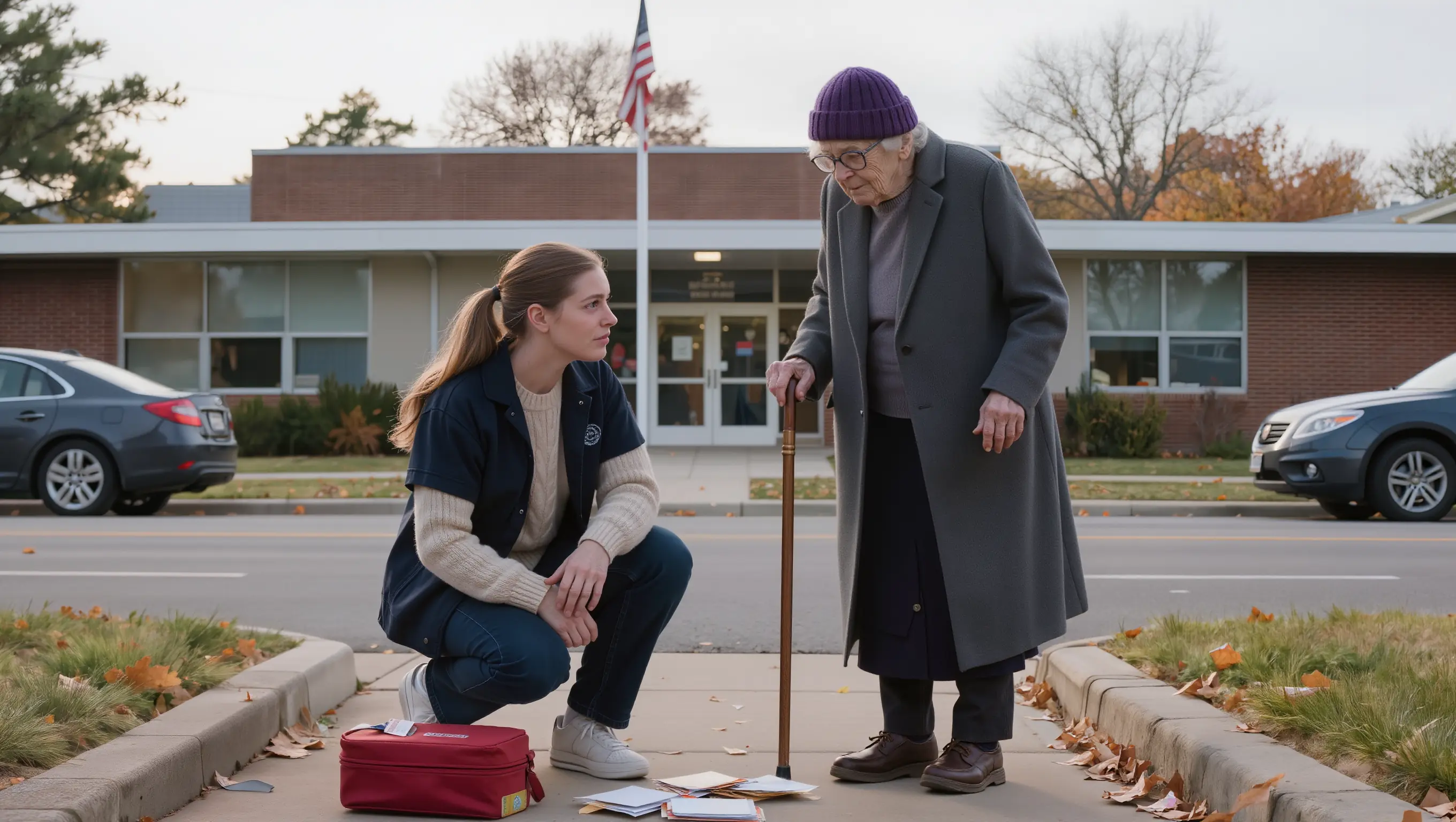
“Grandma.”
Margaret held up the red lunchbox.
“I told you I’d come.”
Max ran to her and hugged her around the waist.
“You were late.”
“I know. The zipper broke.”
Max looked at the lunchbox, then at Chloe.
“She helped?”
“She did,” Margaret said.
Chloe crouched to Max’s level.
“Your sandwich is safe. Your apple is safe. And your notes are safe too.”
Max’s eyes widened.
“You saw the notes?”
“Only enough to know your grandma is very good at lunch notes.”
He looked at Margaret.
“Did you write the math one?”
“I did.”
Max smiled a little.
“Numbers are bossy.”
“They are,” Chloe agreed. “But I heard you’re bossier.”
For the first time that morning, Max laughed.
That small laugh changed something in Chloe.
It reminded her why she wanted to become a counselor.
Not for big speeches.
For moments like this.
A child’s shoulders lowering.
A grandmother’s fear easing.
A routine saved before panic swallowed the day.
After that morning, Margaret began stopping by the school more often. Sometimes she brought Max’s forgotten gloves. Sometimes she came for pickup. Sometimes she waited on the bench outside and talked with Chloe after dismissal.
She told Chloe she had once worked as a children’s librarian.
“I loved the quiet children most,” Margaret said. “Not because they were easier. Because people mistook quiet for simple.”
Chloe wrote that sentence in her notebook later.
Margaret noticed Chloe’s notebook one afternoon.
“What do you write in there?”
“Just ideas.”
“At my age, ‘just ideas’ usually means something important is trying to become real.”
Chloe smiled.
Then she told Margaret about her dream of becoming a school counselor.
Margaret listened carefully.
“You already notice children,” she said.
“I’m not trained yet.”
“Training matters. But noticing comes first.”
Chloe looked down.
“I worry I won’t get into the program. I need stronger recommendations and more experience.”
Margaret was quiet for a moment.
Then she said, “Let me help.”
A week later, Margaret brought Chloe a small box.
Inside were hundreds of children’s bookmarks from her years as a librarian, each printed with gentle encouragement.
Try the next page.
Brave readers ask questions.
Stories wait for you.
You belong in this room.
Margaret also gave Chloe one handwritten note.
It was a recommendation letter.
She wrote about the morning on Pine Street, the broken lunchbox, Max’s anxiety, and the way Chloe understood that the notes were not extra. They were support.
At the end, Margaret wrote:
Chloe Anderson sees children not as problems to manage, but as people trying to feel safe.
Chloe cried when she read it.
With Margaret’s letter, her school experience, and support from Mrs. Bailey, Chloe applied to the counseling program.
She was accepted.
Not with a full scholarship.
Not with everything solved.
But with enough financial aid and field placement support to begin.
Years passed.
Chloe became a school counselor at Brookfield Elementary. She created a small program called Brave Notes, where caregivers could write short daily notes for children who struggled with anxiety, separation, grief, or big transitions. The school kept extra cards in the office. Teachers learned that a note in a lunchbox, backpack, or desk could help a child survive a difficult day.
Max was one of the first children in the program.
He grew taller, louder, and eventually became the kind of fifth grader who helped younger students find their classrooms.
Margaret lived long enough to see Chloe graduate.
At the small celebration in the school library, she handed Chloe one final gift: the original folded note from that cold morning.
Have a brave day, Max.
Love, Grandma.
“I kept a copy,” Margaret said. “This one belongs to the beginning.”
Chloe held it carefully.
“It’s just a little note,” Margaret said.
“No,” Chloe whispered. “It isn’t.”
Margaret smiled.
“I know.”
When Margaret passed away two years later, Max’s family asked Chloe to speak at her memorial gathering. Chloe brought a basket of blank note cards and placed them on a table with a sign:
Write something kind for someone who may need it later.
People filled every card.
Years later, whenever anyone asked how Brave Notes began, Chloe told the truth.
“It began with an old woman, a broken lunchbox, and notes blowing across a sidewalk.”
Margaret had not given her money.
Not a house.
Not a grand reward.
She gave her a letter.
A box of bookmarks.
A folded note.
But inside those small things was the future Chloe had been trying to reach.
And every morning, when anxious children came to her office with worried eyes and tight shoulders, Chloe remembered Max asking, “You’ll come back, right?”
Then she would hand them a note, sit beside them, and say gently,
“Let’s make today feel a little safer.”