At twenty-four, Emma Lawson had learned that independence could get stuck on something very small.
A loose screw.
A cracked sidewalk.
A broken brake.
A wheel caught in a narrow gap.
A curb too high for tired arms.
To some people, those things were minor inconveniences.
To someone sitting in a wheelchair in the rain, holding important papers and trying not to panic, they could feel like the whole world had turned into a wall.
Emma noticed things like that because she had grown up with a mother who used a cane after a factory accident.
Her mother was not helpless.
She cooked, worked, paid bills, laughed loudly, argued with neighbors, and remembered everyone’s birthday.
But Emma had watched how quickly the world could make a capable person feel trapped.
A store entrance with no ramp.
A sidewalk blocked by a trash can.
A bus driver too impatient to lower the step.
A door too heavy to open while holding groceries.
People often spoke about independence as if it lived only inside a person.
Emma knew better.
Independence also lived in sidewalks, doors, wheels, ramps, timing, and whether someone nearby cared enough to move one obstacle before pride turned into danger.
She lived in a small town in Oregon called Willow Creek, where rain was part of daily life for most of the year.
The town had a main street lined with old brick shops, a library, a pharmacy, a courthouse annex, a diner, a senior center, and a small community office where Emma worked part-time.
The office was called Willow Creek Neighborhood Services.
It helped residents with forms, housing referrals, food pantry appointments, senior ride lists, and small emergency needs that did not fit neatly into bigger systems.
Emma was a young white American woman with fair skin, long chestnut-brown hair usually tied into a low ponytail, soft hazel eyes, and a calm voice that made people trust her before they fully knew why.
Her job title was community assistant.
In reality, she did whatever the day required.
She answered phones.
Printed forms.
Carried donation boxes.
Helped seniors read small letters.
Called bus services.
Organized pantry appointments.
Made copies.
Filled coffee pots.
Swept rainwater from the lobby.
Listened to people who were embarrassed to admit how much help they needed.
Emma loved practical work.
She liked help that did not announce itself too loudly.
A dry chair.
A printed map.
A phone call.
A ride arranged before dark.
A form placed in the right folder.
A person walking out with shoulders slightly less heavy than when they came in.
Her dream was to start a program called Clear Path Access.
It would help elderly and disabled residents navigate everyday obstacles before those obstacles became emergencies.
Wheelchair brake checks.
Walker adjustments.
Ramp reports.
Safe route maps.
Volunteer escorts for important appointments.
Rain covers for documents.
Small repairs.
A phone number people could call if they were stuck somewhere and did not know what to do.
Not medical care.
Not transportation for everything.
Not a big expensive agency.
Just community access help.
The kind of help that said, “You should not have to fight the sidewalk alone.”
Emma had written the whole idea in a notebook she kept in her bag.
She had pages of plans.
Safe sidewalk maps.
Volunteer training.
Partnerships with the pharmacy, library, senior center, and repair shop.
Emergency document sleeves.
Wheelchair and walker safety days.
Rain response teams.
But dreams needed approval, funding, volunteers, tools, insurance, and someone willing to believe that small obstacles were not small at all.
Emma only had the notebook.
So she kept working at the community office and helping one person at a time.
The day everything changed began with rain.
Not a storm at first.
Just the steady, cold rain that made Willow Creek feel older than it was.
By late afternoon, the sky had turned gray and low.
Water ran along the curb in thin silver streams.
People hurried down Main Street with umbrellas, hoods, and paper bags held under coats.
Emma had stayed late at the community office because Mrs. Parker from the senior center needed copies of a housing form, and the office copier had jammed twice.
By the time Emma locked the front door, it was almost five o’clock.
She pulled up her hood, tucked her notebook inside her coat, and started toward the bus stop.
Then she heard a sharp cry from across the street.
“Oh, please. No, not now.”
Emma turned.
Near the corner outside the courthouse annex, an elderly woman sat in a wheelchair at the edge of the sidewalk.
The front right wheel had dropped into a broken gap between the curb ramp and the street.
The chair was tilted slightly forward.
A large brown envelope had slipped from the woman’s lap and landed near the gutter.
Rainwater was moving toward it.
The woman leaned forward, trying to reach the envelope, but the wheelchair shifted dangerously every time she moved.
Emma ran.
“Ma’am, don’t reach for it! I’ll get it.”
The woman froze.
Emma reached the envelope just before the water touched it.
She lifted it quickly and tucked it inside her coat.
Then she crouched near the wheelchair.
The front caster wheel was wedged deep in a crack where the curb ramp had broken away.
The brake on one side was not fully engaged.
The woman’s hands trembled on the armrests.
She was in her late seventies, a white American woman, short and thin, with silver hair tucked beneath a pale blue rain hood, pale skin, and frightened blue eyes behind round glasses.
She wore a beige raincoat over a lavender sweater, dark pants, and black shoes.
A canvas purse sat on her lap, damp from the rain.
“Are you hurt?” Emma asked.
“No,” the woman said quickly. “No, I don’t think so.”
“What’s your name?”
“Margaret Ellis.”
“I’m Emma Lawson. I work at Neighborhood Services across the street.”
Margaret looked toward the office building, then back at the stuck wheel.
“I was trying to get to your office.”
“To Neighborhood Services?”
“Yes.” Margaret’s voice trembled. “But then the wheel caught, and my envelope fell, and I thought it would go into the gutter.”
Emma touched the envelope inside her coat.
“It’s safe.”
Margaret closed her eyes.
“Oh, thank God.”
Emma looked at the chair again.
“I’m going to get the wheel out, but I need you to sit back as much as you can.”
Margaret’s face tightened.
“I’m afraid if I move, it will tip.”
“I won’t let it tip.”
The words came out steady, but Emma knew she had to be careful.
If she pulled the chair forward too hard, the wheel could twist and damage the fork.
If she lifted from the wrong angle, Margaret could lose balance.
If another car turned too close, the situation could become dangerous fast.
Emma glanced toward the street.
A truck was approaching slowly through the rain.
She raised one hand sharply to signal it away from the curb.
The driver slowed and moved around them.
Then Emma stepped behind the wheelchair.
“Margaret, I’m going to hold the handles and tilt the chair slightly backward to lift the front wheel. Is that okay?”
Margaret swallowed.
“Yes.”
“Hold your purse against you.”
Margaret did.
Emma braced her boots on the wet sidewalk.
The wheelchair handles were cold and slick.
She tightened her grip, leaned back carefully, and lifted the front wheels just enough to free the trapped caster.
The wheel resisted.
Rain ran down Emma’s face.
She pulled slowly, not jerking.
The caster came loose with a sudden scrape.
Margaret gasped.
“I’ve got you,” Emma said.
She eased the chair back onto the sidewalk, away from the broken curb ramp.
Margaret sat very still.
Her eyes were wide.
For a moment, the only sounds were rain, passing cars, and Emma’s own breathing.
Then Margaret whispered, “I thought I was going to fall.”
“You didn’t.”
“I almost did.”
“But you didn’t.”
Margaret looked up at her.
“Because you stopped.”
Emma gave a small smile.
“Because I noticed.”
She pushed the wheelchair under the awning of the courthouse annex, where the rain could no longer hit them directly.
Then she pulled the brown envelope from inside her coat.
The outside was damp at one corner, but the papers inside were protected.
Margaret reached for it with both hands.
Her fingers shook.
“Thank you,” she whispered.
“What’s in it?”
Margaret hesitated.
Pride appeared first.
Then fear.
Then honesty.
“My husband’s records,” she said. “And mine. Medical papers, housing forms, and proof of income. I needed help making copies before tomorrow morning.”
Emma looked toward the Neighborhood Services office.
It was closed now, but she still had the key.
“Copies for what?”
Margaret’s lips pressed together.
“My apartment building installed a new elevator schedule. It shuts down for maintenance three days a week now. They say it is temporary, but it has been six months. I live on the third floor. I use a wheelchair. I have missed appointments because of it. My daughter says we can file an accommodation request, but they need copies of everything.”
Her voice trembled.
“I came today because the office closes at five. I thought I could make it.”
Emma checked the time.
5:06.
Margaret had been six minutes too late.
The office was closed.
The rain was getting heavier.
The curb had almost tipped her into the street.
And she was sitting there holding the proof that she needed help keeping access to her own home.
Emma felt something inside her settle into decision.
“Margaret,” she said, “come with me.”
Margaret blinked.
“To where?”
“The office.”
“But it’s closed.”
“I have the key.”
“Oh no, dear. You’re off work.”
“I can be off work after we copy the papers.”
Margaret shook her head quickly.
“I don’t want to trouble you.”
“You were stuck at a broken curb in the rain with legal papers in your lap. This is exactly the kind of trouble my office exists for.”
The old woman stared at her.
Then she gave a small, shaky laugh.
“That is a very official answer.”
“I can make it more official if needed.”
Margaret looked at the broken curb ramp.
Then at the envelope.
Then at the locked office across the street.
“All right,” she whispered.
Emma checked the wheelchair again before moving.
The front caster turned, but not smoothly.
A piece of gravel was caught near the fork.
The right brake was loose.
The left wheel had mud along the rim.
It could move, but it needed attention.
“I’m going to push you across the street carefully,” Emma said. “Is that okay?”
Margaret nodded.
“Yes.”
They waited through one full traffic light.
Emma refused to rush.
When the walk sign appeared and all turning cars had stopped, she pushed Margaret across Main Street.
The wheels bumped over the painted crosswalk lines.
Margaret gripped the envelope tightly.
The front caster wobbled once, and Emma slowed immediately.
“You’re doing fine,” she said.
Margaret gave a fragile laugh.
“I am sitting.”
“Sitting during a crisis still counts as doing something.”
They reached the office door.
Emma unlocked it, turned the lights back on, and pushed Margaret into the warm lobby.
The office smelled like paper, coffee, and rain-soaked coats.
Margaret looked around.
“I haven’t been inside since my husband was alive.”
“What was his name?”
“Arthur.”
The name softened her face.
“He came here for tax help years ago. He said every office should have chairs that don’t punish people.”
Emma smiled.
“He was right.”
Margaret looked down at her wheelchair.
“He built the first ramp at our church when the old wooden steps became too much for me. He said if a door mattered, everyone should be able to reach it.”
Emma felt that sentence land hard.
If a door mattered, everyone should be able to reach it.
She wanted to write it in her notebook immediately.
Instead, she guided Margaret to the desk beside the copier.
“May I open the envelope?”
“Yes.”
Emma laid the documents out carefully.
Medical forms.
Doctor’s letter.
Proof of disability.
Lease copy.
Elevator maintenance notices.
A handwritten timeline of missed appointments.
A letter from Margaret’s daughter, Claire.
The letter was direct and emotional.
My mother cannot reliably leave her apartment when the elevator is unavailable. This is not inconvenience. It is isolation.
Emma swallowed.
She looked at Margaret.
“This is important.”
Margaret nodded.
“I know.”
“Did your daughter help you put this together?”
“Yes. She lives two hours away. She works at a school. She came last weekend and organized everything. I promised I would make copies today and bring them to the housing office tomorrow.”
Margaret looked down at her hands.
“I wanted to do one part by myself.”
Emma understood.
The papers were not only papers.
The trip was not only a trip.
It was proof, to Margaret, that she still had some control over her own life.
“You did do it,” Emma said.
“I got stuck.”
“And then you accepted help.”
Margaret looked at her.
“That feels different from doing it.”
“It is part of doing it.”
The old woman became quiet.
Emma began making copies.
She copied every document twice.
One set for the housing office.
One set for Margaret.
She placed each set into labeled folders.
Originals.
Copies for submission.
Backup copies.
She put the damp envelope aside and replaced it with a plastic document folder from the office supply cabinet.
On the front, she wrote:
Margaret Ellis — Elevator Accommodation Request
Margaret watched her carefully.
“You make it look manageable.”
“That’s the goal.”
“It did not feel manageable at home.”
“Papers rarely do when they’re spread across a kitchen table.”
Margaret looked surprised.
“That is exactly where they were.”
Emma smiled.
“They always are.”
She printed a simple checklist for the next morning.
Bring folder.
Bring ID.
Ask for receipt.
Request date-stamped copy.
Call Claire after submission.
Margaret read it slowly.
“Ask for receipt,” she said.
“Yes. Always.”
“My husband kept receipts in coffee cans.”
“Very organized?”
“No. There were six coffee cans, and none were labeled.”
Emma laughed.
Margaret laughed too.
It was the first real laugh since the curb.
Then Emma noticed Margaret rubbing her right hand.
“Are your hands hurting?”
“A little. I was gripping the wheels too hard.”
Emma looked at the wheelchair.
“When was the last time the brakes were checked?”
Margaret hesitated.
“I don’t know.”
“Does the right brake always feel loose?”
“It has for a while.”
“How long is a while?”
Margaret looked guilty.
“Several months.”
Emma softened.
“Okay. We can add that to the plan.”
“Oh no, dear. The papers are enough.”
“Access includes the chair too.”
Margaret looked down.
“I didn’t know who to ask.”
That sentence, simple and quiet, was exactly why Emma’s notebook existed.
I didn’t know who to ask.
Not dramatic.
Not rare.
Dangerous all the same.
Emma checked the office supply closet.
They did not have wheelchair tools, but she had a small multitool in her bag.
She could not do a full repair, but she could inspect enough to know whether Margaret needed a professional check.
The right brake clamp was loose.
Not broken.
Loose enough that it did not grip the wheel properly.
Emma tightened it carefully.
Then she tested it.
Better.
She cleaned the front caster with paper towels and removed a small stone lodged near the fork.
The wheel turned more smoothly.
Margaret watched with amazement.
“You can fix that?”
“Small things.”
“Small things matter.”
“Yes,” Emma said. “They do.”
She wrote down the number for a local mobility repair shop and circled it.
Then she added a note: Ask Claire about full wheelchair safety check.
Margaret sighed.
“She will worry.”
“Yes.”
“I hate that.”
“I know.”
“She already worries about the elevator.”
“She should.”
Margaret looked up sharply.
Emma’s voice stayed gentle.
“You should not be trapped in your apartment three days a week.”
The old woman’s eyes filled.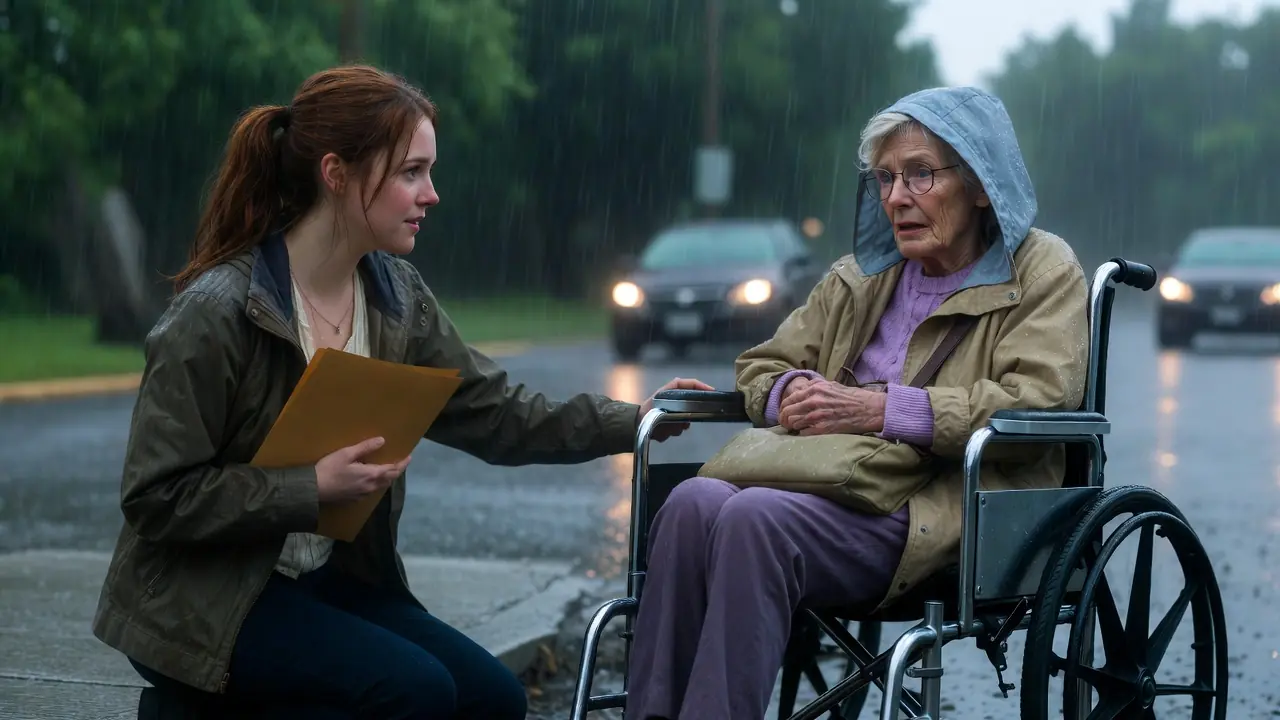
“I try not to call it trapped.”
“What do you call it?”
“Waiting.”
Emma sat across from her.
“Does calling it waiting make it hurt less?”
Margaret looked toward the rain-streaked window.
“No,” she whispered.
They called Claire from the office phone.
Margaret wanted to tell her daughter herself, but her hands trembled so much that Emma dialed.
Claire answered quickly.
“Mom?”
Margaret closed her eyes.
“Claire, I’m all right.”
“That is a frightening way to begin a phone call.”
“I know. I’m sorry.”
“What happened?”
“My wheelchair got stuck at the curb outside the courthouse annex. I almost lost the envelope.”
Claire’s voice rose.
“Mom.”
“But Emma helped me. She works at Neighborhood Services. She got me out, saved the papers, and made the copies.”
There was a pause.
“Can I talk to Emma?”
Margaret handed over the phone.
Emma introduced herself and explained calmly.
The stuck wheel.
The broken curb.
The saved envelope.
The copies.
The folder.
The loose brake.
The need for a full wheelchair safety check.
Claire listened silently at first.
Then her voice broke.
“I told her I could come.”
“She wanted to do this part.”
“I know. That’s why I didn’t push.”
“She did a lot.”
“She could have fallen.”
“Yes,” Emma said softly. “But she didn’t.”
Claire breathed shakily.
“Thank you. Thank you for staying.”
“I’m glad I was there.”
“She hates feeling trapped.”
Emma looked at Margaret, who was pretending not to listen.
“I think anyone would.”
Claire became quiet.
Then she said, “The elevator has made her miss family dinners. Doctors. Even church. Management keeps saying it’s temporary.”
“The documentation is strong,” Emma said. “The timeline helps.”
“You really think so?”
“Yes.”
“I should have submitted it myself.”
“Your mother wanted ownership.”
Claire gave a sad laugh.
“That sounds like her.”
“It also matters.”
“I know.”
When Emma hung up, Margaret looked at her.
“She cried?”
“A little.”
“I hate that.”
“She loves you.”
“That is what makes it heavy.”
Emma did not argue.
Some love was heavy.
That did not make it wrong.
The rain had not stopped.
Emma offered to call the senior ride service, but the last scheduled ride had already ended.
She could not drive because she had taken the bus.
So she called Mr. Ruiz, the owner of the diner next door, who often helped Neighborhood Services with emergency rides.
He arrived fifteen minutes later in an old van with a portable ramp he used for his own brother.
Margaret tried to protest.
Mr. Ruiz waved her off.
“My brother would haunt me if I left you here.”
Margaret looked overwhelmed.
“Everyone keeps helping.”
Emma smiled.
“That can happen when people know what’s needed.”
Mr. Ruiz drove Margaret home.
Emma rode with them to make sure she got inside safely.
Margaret’s apartment building stood three blocks away, an old brick building with faded green awnings and a small lobby.
The elevator was working that evening.
Margaret looked relieved and angry at the same time.
“It works when it wants.”
“That should be in the timeline.”
“It is.”
“Good.”
They reached apartment 3C.
Inside, the apartment was neat, warm, and full of life.
A blue armchair sat near the window.
Framed photos lined the shelves.
A quilt lay folded over the sofa.
A small table beside the armchair held reading glasses, a lamp, and a stack of books.
On the wall near the kitchen hung a photograph of Margaret and Arthur standing beside a church ramp.
Arthur held a toolbox.
Margaret stood beside him, smiling proudly.
“That’s the ramp?” Emma asked.
Margaret looked at the photo.
“Yes. The first one he built.”
“He looks proud.”
“He was impossible for two weeks.”
Emma laughed.
Margaret placed the folder on the kitchen table.
Then she looked at it for a long moment.
“I almost lost it.”
“But you didn’t.”
“I almost tipped into the street.”
“But you didn’t.”
“Because you noticed.”
Emma smiled gently.
“Because I noticed.”
Margaret reached for her hand.
“Do not underestimate that.”
The next morning, Claire drove to Willow Creek.
She took Margaret to the housing office.
They submitted the accommodation request.
They asked for a receipt.
They requested a date-stamped copy.
They followed the checklist.
By noon, Claire called Neighborhood Services and asked for Emma.
When Emma answered, Claire said, “We did it.”
Emma smiled.
“That’s wonderful.”
“Mom asked for the receipt before I remembered.”
“Good.”
“She said Emma wrote it down, so it must be done.”
Emma laughed.
“That sounds official.”
“It was,” Claire said. “Thank you.”
The housing office took three weeks to respond.
During that time, Emma helped Margaret and Claire track every elevator outage.
Dates.
Times.
Missed appointments.
Calls to management.
Photos of posted notices.
Margaret began coming to Neighborhood Services once a week.
Sometimes she brought papers.
Sometimes she brought updates.
Sometimes she brought oatmeal cookies in a tin and claimed she had made too many.
Emma did not believe the “too many” part.
She accepted them anyway.
During one visit, Margaret noticed Emma’s notebook.
“What is that?”
“Just ideas.”
“At my age, just ideas usually means something important trying not to be judged.”
Emma laughed.
“You sound very sure.”
“I have seen many people hide useful things inside notebooks.”
Emma hesitated, then opened it.
Clear Path Access.
Volunteer help for stuck mobility devices.
Safe route maps.
Curb problem reporting.
Wheelchair and walker check days.
Document rain sleeves.
Appointment escorts.
Ramp advocacy.
Emergency ride coordination.
Margaret read every page slowly.
When she finished, she looked at Emma.
“This is not just an idea.”
“It isn’t?”
“No. It is what should already exist.”
Emma’s throat tightened.
“I don’t know how to start.”
“You started at the curb.”
“That was one moment.”
“One moment showed the whole problem.”
Margaret touched the page that said safe sidewalks.
“Young people think access means ramps on buildings. It is more than that. It is whether the path to the ramp lets you arrive alive and with your dignity still attached.”
Emma wrote that down immediately.
Margaret smiled.
“Good. That sounded wise.”
“It was.”
Three weeks later, the housing office approved Margaret’s accommodation request.
The building management was required to provide reliable elevator access or written advance notice with alternative assistance.
They also had to repair the long-standing elevator schedule problem and provide a temporary ground-floor accessible unit during extended outages if needed.
When Margaret came to tell Emma, she cried before she reached the desk.
“I can leave my apartment,” she whispered.
Emma came around the counter and hugged her carefully.
“You always should have been able to.”
Margaret nodded against her shoulder.
“Yes.”
Claire came later with flowers.
She hugged Emma too.
Then she asked about the notebook.
Margaret had told her everything.
Together, they pushed Emma to speak with Mrs. Lawson, the Neighborhood Services director.
Emma resisted for two days.
Then Margaret called and said, “If you make an old woman wait, that is poor access.”
Emma took the notebook to Mrs. Lawson that afternoon.
Mrs. Lawson listened carefully.
She read Margaret’s letter of support.
The letter described the stuck wheelchair, the broken curb ramp, the wet envelope, the copied documents, and the larger problem of residents trapped by small obstacles.
At the end, Margaret wrote:
Emma Lawson understands that access is not a slogan. It is the difference between reaching a door and being stopped in the rain. She sees the small barriers that steal dignity, and she knows how to turn noticing into action.
Mrs. Lawson read the last line twice.
Then she looked at Emma.
“You’ve been thinking about this for a long time.”
“Yes.”
“And you did not bring it to me because?”
“I thought it was too big.”
Mrs. Lawson closed the notebook gently.
“It is big. That is not the same as impossible.”
They began with a pilot.
Clear Path Access would run one Saturday a month.
The first event would be a wheelchair, walker, and cane safety check at the senior center.
A local mobility repair shop agreed to send a technician.
The hardware store donated rubber cane tips, small tools, reflective tape, and rain ponchos.
The library printed safe route maps.
The diner offered coffee.
Margaret insisted on attending as an advisor.
Her name tag read:
Margaret Ellis.
Curb Survivor.
Emma laughed when she saw it.
Margaret lifted her chin.
“Truth is effective.”
The first event drew forty people.
Far more than expected.
Some came with wheelchairs.
Some with walkers.
Some with canes.
Some brought shopping carts with bad wheels.
Some came only to ask which sidewalks were safest after rain.
The mobility technician adjusted brakes, tightened bolts, checked wheels, and referred larger repairs.
Volunteers added reflective tape.
Emma helped people mark problem spots on a town map.
By the end of the day, the map was covered in red dots.
Broken curb ramp outside courthouse annex.
Uneven sidewalk near pharmacy.
Heavy door at post office.
No seating near bus stop.
Poor lighting by library ramp.
Drain grate catching small wheels on Maple Street.
Mrs. Lawson looked at the map and whispered, “This is a case file.”
Emma nodded.
“It is.”
The town council received the report a month later.
At first, they called it “community feedback.”
Margaret attended the meeting and corrected them.
“This is not feedback,” she said from her wheelchair. “This is where people get stuck.”
The room went silent.
Then people listened.
Not all at once.
Not perfectly.
But enough.
The broken curb ramp was repaired.
Then the drain grate was replaced.
Then the post office added an automatic door button.
Then the bus stop got a bench.
Small changes.
Huge consequences.
Clear Path Access became real.
With Margaret’s support letter, the pilot data, the map, and testimony from participants, Emma applied for a community access grant.
The grant was approved.
Not a fortune.
Not a new building.
Not enough to fix every barrier in Willow Creek.
But enough to buy repair tools, portable ramps, rain covers, document sleeves, volunteer vests, a dedicated phone line, safety check supplies, and training materials.
Emma became the coordinator.
Her notebook became a program manual.
Margaret became the program’s unofficial conscience.
Whenever someone tried to make the language too soft, she corrected it.
“Do not say inconvenience when you mean barrier.”
“Do not say limited mobility when you mean the sidewalk is broken.”
“Do not say accessible if I cannot open the door.”
Emma wrote all of it down.
Years passed.
Clear Path Access grew across Willow Creek.
Volunteers helped residents report barriers.
Monthly safety checks became popular.
The safe route map became available at the library, pharmacy, senior center, and online.
The program created emergency rain kits for wheelchair users carrying documents or medicine.
It trained businesses to look at their entrances differently.
It helped people reach appointments, meetings, grocery stores, voting sites, community dinners, and family events without having to fight every inch of the way.
Margaret’s building finally fixed the elevator properly.
She still lived in apartment 3C.
The blue chair stayed by the window.
Arthur’s photo with the church ramp stayed on the wall.
Claire visited often, not because Margaret was helpless, but because they had stopped treating help as defeat.
One spring afternoon, Margaret came to the Neighborhood Services office with Claire.
She carried a folder on her lap.
Emma immediately felt suspicious.
“What are you two planning?”
Margaret smiled.
“Opportunity.”
Inside the folder was a letter from the Willow Creek Community Foundation.
Claire and Margaret had nominated Emma for an accessibility leadership fellowship.
It would pay for Emma’s training in community access planning, provide a stipend, and fund a six-month expansion of Clear Path Access into three neighboring towns.
Emma stared at the page.
Her hands began to shake.
“I can’t accept this.”
Margaret laughed softly.
“Oh, dear. You can.”
“It’s too much.”
“No,” Margaret said. “Being trapped upstairs three days a week was too much. A broken curb throwing my chair forward was too much. This is a proper response.”
Claire smiled through tears.
“Mom has been waiting to say that.”
“I rehearsed,” Margaret admitted.
Emma cried.
The fellowship changed everything.
She learned access planning, mobility advocacy, disability rights basics, volunteer coordination, public reporting systems, and grant management.
She visited other towns and saw the same barriers everywhere.
Sidewalk cracks.
Bad ramps.
Broken doors.
Unclear signs.
Unsafe crossings.
People trapped not by their bodies, but by poor design and public indifference.
Clear Path Access expanded.
It trained volunteers in three towns.
It created regional safe route maps.
It helped dozens of businesses improve entrances.
It helped residents report barriers without feeling like complainers.
Emma became the person town leaders called when they wanted to know whether a place was truly accessible.
She always answered the same way.
“Ask the people who use it.”
Margaret loved that answer.
She passed away peacefully years later, in apartment 3C, with Claire beside her and Arthur’s ramp photograph nearby.
At her memorial gathering, people told stories of Margaret correcting city officials, inspecting sidewalks, and calling every broken curb “a personal insult.”
Claire handed Emma one final envelope.
“Mom wrote this for you.”
Inside was a note in Margaret’s careful handwriting.
Dear Emma,
The day my wheelchair got stuck, I thought the world had finally become too small for me.
You pulled me back from the curb.
You saved my papers.
You copied my documents.
You helped me fight for an elevator that worked.
Then you built a way for others to reach the doors that mattered to them.
The fellowship was not repayment.
It was my way of making sure your noticing could travel farther.
Keep clearing the path.
With love,
Margaret Ellis
Emma framed the note in the Clear Path Access office.
Beside it, she placed the first safe route map, still covered with red dots.
Years later, whenever people asked how Clear Path Access began, Emma told them the truth.
“It began with an old woman in a wheelchair, a broken curb ramp, and an envelope that almost went into the rain.”
Then she would show them Margaret’s letter.
The gift Emma received was not a house.
Not a car.
Not a fortune.
It was a chance.
A fellowship.
Training.
A future wide enough for the work to grow.
And every time someone called the Clear Path line and said, “I’m stuck, and I don’t know who to ask,” Emma answered gently.
“You asked the right place.”
Because access was not a favor.
It was not kindness added later.
It was the difference between a person living in the world and being told to wait at the edge of it.
And sometimes, clearing the path began with one person noticing a wheel stuck in the rain.