At twenty-four, Hannah Carter had learned that a person could look calm while everything inside them was falling apart.
She had seen it many times at Union Street Station in Dayton, Ohio.
A mother trying not to cry after missing the last train home.
A college student pretending he understood the ticket machine while panic reddened his face.
A soldier holding a folded letter so tightly that the paper bent in his fist.
An elderly woman searching the same pocket five times for glasses that were already on her head.
People carried fear differently.
Some shouted.
Some froze.
Some apologized.
Some stood very still, hoping no one would notice they no longer knew what to do next.
Hannah noticed.
She noticed because she had once been a child in train stations, standing beside her mother with two plastic bags of clothes and a paper ticket they could not afford to replace.
Her mother had worked as a motel housekeeper, and after Hannah’s father left, they moved often.
When trains were delayed, when buses were missed, when one wrong platform could ruin an entire day, her mother always became quiet.
Too quiet.
Hannah had learned to watch the shape of that silence.
Now, years later, she worked at Union Street Station as a customer service assistant.
The job was not glamorous.
She answered questions, printed boarding passes, helped passengers use ticket kiosks, carried bags for elderly travelers, explained platform changes, called taxis, handed out delay slips, and repeated the phrase “Track 4 is downstairs to the left” at least fifty times a day.
She was a young white American woman with fair skin, long chestnut-brown hair usually tied into a low ponytail, soft hazel eyes, and a steady voice that made confused travelers feel less foolish.
She wore a navy station vest over a white shirt, black pants, and comfortable shoes because the job required constant walking.
Her coworkers teased her for keeping a small emergency pouch in her locker.
Inside were safety pins, bandages, tape, a penlight, a phone charger, tissues, a sewing kit, breath mints, granola bars, and plastic document sleeves.
“You pack like a grandmother,” her coworker Daniel once said.
Hannah had only smiled.
“Grandmothers survive things.”
Union Street Station was old, busy, and beautiful in a tired way.
The ceiling arched high above the main hall.
The marble floor had cracks polished smooth by decades of footsteps.
The wooden benches were scratched with initials.
The departure board flickered whenever it rained.
The coffee stand smelled like burnt espresso and cinnamon rolls.
The station clock hung above the center hall like a judge of every late person.
Hannah loved the station because it was full of movement.
People leaving.
People arriving.
People waiting.
People saying goodbye.
People trying to reach hospital rooms, weddings, funerals, job interviews, college dorms, family dinners, and second chances.
She had a dream of building a program there called The Arrival Desk.
It would help elderly travelers, disabled passengers, people with anxiety, and anyone carrying important documents or family emergencies.
Not a fancy office.
Not a big agency.
Just a small desk with patient help.
Large-print route cards.
Emergency contact forms.
Platform escort volunteers.
Document sleeves.
A phone line for family members.
A quiet place for people overwhelmed by crowds.
A way to help people arrive without shame.
Hannah had written the whole idea in a notebook.
She had budgets, lists, sample forms, training notes, and even a rough logo drawn badly in the corner.
But dreams needed approval.
Funding.
Staff.
Permission from station management.
And Hannah was only a part-time assistant with night classes and rent due every month.
So the notebook stayed in her locker.
She kept doing what she could.
One traveler at a time.
The day that changed everything began with rain.
Heavy rain.
The kind that made the station windows blur and turned every umbrella into a dripping weapon.
It was a Friday in late September, just before five in the evening.
The station was crowded because two afternoon trains had been delayed by flooding on the tracks north of town.
Passengers filled the benches, leaned against columns, sat on suitcases, argued into phones, and stared angrily at the departure board as if hatred could repair weather.
Hannah stood near the ticket kiosks, helping an older couple reprint their boarding passes, when she heard a crash near the main entrance.
Not a loud crash.
A sharp, wooden crack followed by the scatter of papers.
Then an elderly man’s voice.
“No, no, please.”
Hannah turned immediately.
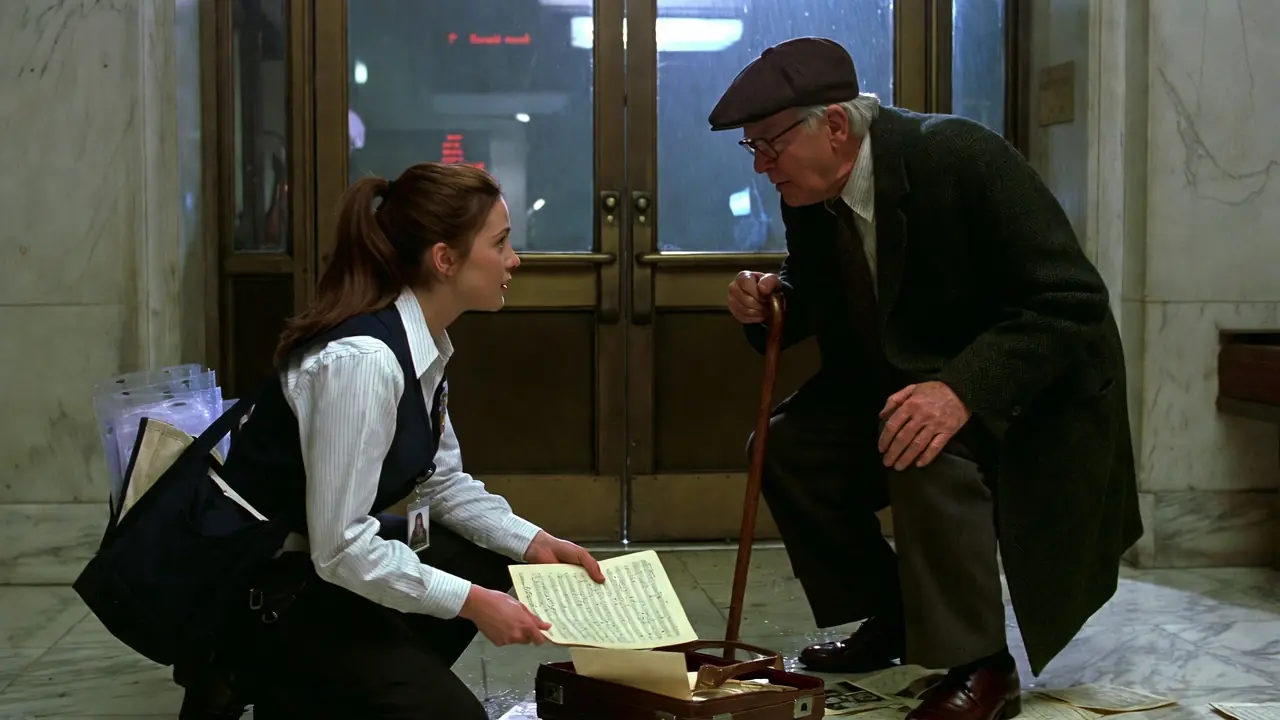
Near the entrance doors, an elderly man stood frozen beside an overturned leather briefcase.
He was a white American man in his late seventies, tall but thin, with silver hair beneath a dark brown flat cap, pale skin, and blue eyes behind rain-specked square glasses.
He wore a dark green wool coat, gray trousers, and polished brown shoes damp from the rain.
One hand gripped a wooden cane.
The other reached helplessly toward the floor.
His briefcase had snapped open when it fell.
Papers had spilled everywhere.
A folder slid across the marble.
An envelope landed near a puddle by the door.
A small wooden box rolled beneath a bench.
People stepped around the mess.
One man frowned, annoyed that the papers blocked his way.
A teenager lifted his shoes to avoid them.
No one stopped.
The old man tried to bend down, but his cane slipped on the wet floor.
Hannah moved fast.
“Sir, please don’t bend. I’ve got it.”
She reached the envelope first, lifting it before rainwater from the entrance mat could soak the corner.
Then she gathered the folder, loose pages, a train ticket, several photographs, and the small wooden box from beneath the bench.
The old man’s hands shook badly.
“The box,” he said. “Please, is the box broken?”
Hannah checked it.
The lid had opened slightly, but nothing inside seemed damaged.
“It looks safe.”
The man closed his eyes.
“Thank God.”
Hannah guided him toward the nearest bench.
“Are you hurt?”
“No. Just embarrassed.”
“You’re not embarrassed,” Hannah said gently. “Your briefcase failed publicly.”
He blinked.
Then, despite the panic in his face, he laughed once.
“That is a kinder way of saying it.”
“What’s your name?”
“Arthur Whitman.”
“I’m Hannah Carter. I work here.”
Arthur sat carefully, his cane between his knees.
Hannah placed the rescued items on the bench beside him, away from the wet floor.
“What train are you taking, Arthur?”
“Cleveland,” he said quickly. “The five-twenty.”
Hannah looked at the departure board.
The Cleveland train was still listed on time.
It was 5:04.
Sixteen minutes.
“What do you need to board?”
“My ticket,” he said.
Hannah held it up.
“Safe.”
“My ID.”
He patted his coat and found his wallet.
“Safe.”
“My folder.”
“Here.”
“My box.”
“Here.”
Arthur exhaled, but the relief did not last.
He looked at the scattered papers now gathered in Hannah’s hands.
“They have to stay in order.”
“What are they?”
His face tightened.
“My wife’s music.”
Hannah paused.
“Music?”
He nodded toward the folder.
“Sheet music. Original copies. Some handwritten. Some old arrangements. My wife, Eleanor, was a pianist.”
His voice softened around the name.
“She passed last year.”
“I’m sorry.”
Arthur nodded, staring at the folder.
“She taught music for forty years. Our granddaughter is performing one of Eleanor’s pieces tomorrow at a memorial scholarship concert in Cleveland. I promised I would bring the original music and the keepsake box.”
Hannah looked at the wooden box.
“What’s in it?”
Arthur opened it carefully.
Inside was a small silver metronome charm on a chain, a folded program from an old recital, and a pair of white gloves.
“Eleanor wore these at her first formal concert,” he said. “Our granddaughter wanted them near the piano.”
The station noise seemed to fade for a moment.
Hannah looked at the wet floor, the broken briefcase, the fragile papers, and the old man trying to carry his wife’s memory through a crowded station.
This was not luggage.
This was love under pressure.
“We’ll get everything organized,” Hannah said.
Arthur looked at the clock.
“The train leaves in sixteen minutes.”
“Then we have sixteen minutes.”
She took the papers to the small service counter nearby and spread them on dry paper towels.
The edges of two pages were damp but readable.
The rest were safe.
Arthur stood behind her, anxious.
“Page numbers?”
“Yes. Some are in pencil.”
Hannah worked quickly.
She sorted the sheet music by number.
She placed the damp pages between clean towels.
She used plastic document sleeves from her emergency pouch to protect the most delicate copies.
She placed the photos into another sleeve.
Then she wrapped the small wooden box in a clean cloth and put it into her station tote.
Arthur watched as if she were repairing a wound.
“You carry document sleeves?”
“Yes.”
“Why?”
“Because paper emergencies are real.”
His mouth trembled.
“My wife would have liked you.”
“I think I would have liked her.”
“She would have corrected your posture at the piano.”
“I deserved that. I never practiced.”
For the first time, Arthur smiled properly.
Then the departure board changed.
Cleveland — Boarding Track 6.
Arthur’s face filled with panic again.
“Track 6,” he whispered. “That’s downstairs.”
“Yes.”
“I don’t do stairs well.”
“There’s an elevator.”
“I couldn’t find it last time.”
“I’ll take you.”
“Oh no, you have work.”
“This is work.”
He looked like he wanted to argue, but the boarding announcement rang overhead.
Hannah placed the protected folder into a station document bag and handed it to him.
Then she carried the damaged briefcase and the wooden box herself.
“Ticket?”
Arthur touched his inside pocket.
“Here.”
“Wallet?”
“Here.”
“Cane?”
“In hand.”
“Music?”
He touched the document bag.
“Here.”
“Then we move.”
They crossed the main hall slowly.
Passengers rushed around them.
The crowd pressed in every direction.
Arthur’s breathing grew shallow.
Hannah matched his pace.
“No rushing,” she said. “The train is boarding, not vanishing.”
“It feels like vanishing.”
“I know.”
They reached the elevator just as the doors began to close.
Hannah held one hand out.
“Please hold.”
A woman inside pressed the open button.
Arthur stepped in carefully.
The elevator smelled like wet coats and coffee.
On the way down, Arthur closed his eyes.
“I have not traveled alone since Eleanor died,” he admitted.
Hannah looked at him.
“That makes today a big trip.”
“I used to take trains all the time.”
“You still are.”
“I nearly lost everything in the lobby.”
“But you didn’t.”
“Because you picked it up.”
“Because you let me help.”
He opened his eyes.
That sentence seemed to matter.
The elevator doors opened onto the lower platform.
Track 6 was crowded, but the train conductor was still helping passengers board.
Hannah guided Arthur toward the accessible boarding area.
The conductor glanced at the document bag and the broken briefcase.
“Need assistance?”
“Yes,” Hannah said before Arthur could refuse. “He needs a steady boarding pace.”
Arthur looked at her.
She smiled.
“Not special treatment. Smart boarding.”
He gave a tired laugh.
“You rename everything.”
“Only when necessary.”
The conductor lowered a small boarding plate over the gap.
Arthur stepped carefully onto the train.
Hannah followed long enough to place the briefcase and wooden box on the luggage rack above his seat.
She made sure the document bag stayed on his lap.
Arthur sat by the window.
The rain streaked the glass behind him.
He looked suddenly small in the train seat, but calmer.
Hannah checked the items one last time.
“Music.”
Arthur touched the bag.
“Here.”
“Box.”
He looked up.
“Above.”
“Ticket.”
“Pocket.”
“Phone.”
“Coat pocket.”
“Daughter’s number?”
“Wallet card.”
“Good.”
Arthur stared at her.
“You do this often?”
“Checklists save people.”
“They do.”
The conductor announced final boarding.
Hannah stepped back.
Arthur reached into his coat and pulled out a folded card.
“My granddaughter’s concert is tomorrow,” he said. “If you ever need proof that the music survived, this is where it will be.”
He handed her the program invitation.
Hannah took it carefully.
“Thank you.”
Arthur’s eyes filled.
“No, Miss Carter. Thank you. You kept Eleanor from being scattered across a station floor.”
Hannah swallowed.
“You’re going to get her there.”
The train doors closed.
Hannah stepped onto the platform.
As the train pulled away, Arthur lifted one hand from the window.
Hannah lifted hers back.
Then the train disappeared into the rainy evening.
She returned upstairs with the broken briefcase handle still in her hand.
Only then did she realize she had missed her own break.
She did not care.
Three days later, an envelope arrived at Union Street Station addressed to Hannah Carter.
Inside was a handwritten note from Arthur.
Dear Hannah,
The concert was beautiful.
My granddaughter played Eleanor’s piece with the original music beside her, and the little wooden box rested on the piano.
I thought grief would be the loudest thing in the room.
It was not.
The music was.
You helped that happen.
With gratitude,
Arthur Whitman
Inside the envelope was a photograph.
A teenage girl sat at a grand piano on a small stage.
Beside the music stand sat the wooden box.
On the front row, Arthur sat with tears in his eyes.
Hannah pressed the photograph to her chest.
She placed it inside her Arrival Desk notebook.
A week later, Arthur returned to the station.
He wore the same brown flat cap, but this time he carried a new canvas messenger bag instead of the broken briefcase.
He found Hannah near the ticket kiosks.
“You replaced the briefcase,” she said.
“My daughter insisted. She said the old one had retired dramatically.”
“It did.”
Arthur smiled.
Then he held out a small bakery box.
“My granddaughter made lemon cookies. She said the woman who rescued Grandma’s music should have at least six.”
“I accept all rescue cookies.”
They sat near the coffee stand during Hannah’s break.
Arthur told her about the concert.
His granddaughter, Lily, had been nervous.
The piece had been one Eleanor wrote for her students years ago.
The scholarship fund had been created in Eleanor’s name for children who could not afford music lessons.
Arthur had cried through most of it.
“I am told this was acceptable,” he said.
“It was.”
He looked at the station around them.
“I have been thinking about what happened here.”
“The briefcase?”
“The briefcase was the beginning. The real problem was that I did not know how to ask for help without feeling smaller.”
Hannah listened carefully.
Arthur continued.
“Eleanor used to manage the details. Tickets. Platforms. Bags. Timing. After she died, I told myself I had to prove I could still do everything. Then one old latch broke, and I became useless in my own mind.”
“You weren’t useless.”
“I know that now. I did not know it when my papers hit the floor.”
He looked at her.
“You treated the music as important before you knew why it was important.”
Hannah’s throat tightened.
“That’s how people should treat things.”
“Yes,” Arthur said. “It is.”
Then he nodded toward the notebook sticking out of her tote.
“What is that?”
Hannah hesitated.
“Just ideas.”
“At my age, just ideas usually means a future waiting for someone to stop apologizing.”
She laughed.
“That sounds like something a pianist would say.”
“Eleanor would have said it better and with more judgment.”
Hannah opened the notebook.
She showed him The Arrival Desk.
Arthur read slowly.
Large-print route cards.
Platform escorts.
Quiet waiting chair.
Family contact calls.
Important document sleeves.
Medication and ticket checklists.
Travel confidence workshops.
Volunteer station guides.
Help for elderly travelers before panic begins.
Arthur read every page.
When he finished, he closed the notebook gently.
“This is needed.”
“I think so.”
“No,” he said. “It is.”
“I don’t know if management will approve it.”
“Then you need evidence.”
“I have some notes.”
“You need testimony.”
Hannah looked at him.
Arthur smiled.
“I can write a letter.”
“You don’t have to.”
“I know. That is why I should.”
Arthur’s letter was three pages long.
He wrote about the broken briefcase, the scattered music, the elevator, the checklist, and the difference between being rushed and being helped.
At the end, he wrote:
Hannah Carter understands that travel assistance is not only about getting people onto trains. It is about preserving dignity, memory, and courage while they are trying to arrive.
Hannah brought the letter to her supervisor, Mr. Bennett.
Mr. Bennett was a practical man in his fifties who measured ideas by how likely they were to create complaints.
He read the letter.
Then he read Hannah’s notebook.
Then he removed his glasses and rubbed the bridge of his nose.
“This will require staff time.”
“Yes.”
“And space.”
“Yes.”
“And training.”
“Yes. I wrote a training outline.”
He looked at her.
“You wrote a training outline?”
“Yes.”
“Of course you did.”
Hannah waited.
Mr. Bennett looked through the station window toward the main hall.
An elderly woman was squinting at the departure board.
A man with a walker was trying to hold a suitcase and coffee at the same time.
A family stood arguing over a platform change.
Mr. Bennett sighed.
“One afternoon a week. Folding table near the information kiosk. No promises beyond that.”
Hannah smiled.
“That’s enough.”
The Arrival Desk began the next month.
At first, it was only a table with a blue sign and a few folders.
Need help with tickets, platforms, bags, documents, or family calls?
Ask at The Arrival Desk.
No shame. No rush.
The first day, people mostly stared at it.
Then an elderly woman approached and said, “I don’t need help, but if someone did need help finding the elevator, where would it be?”
Hannah smiled and showed her.
By the end of the day, eight people had used the desk.
One needed a platform escort.
One needed help calling a daughter because her train was delayed.
One needed a ticket reprinted.
One needed a plastic sleeve for medical documents.
One needed to sit somewhere quieter until boarding.
The next week, fifteen people came.
Then twenty.
Arthur visited often.
Sometimes he traveled.
Sometimes he came only to sit nearby and reassure nervous travelers.
“I once dropped my wife’s entire musical legacy on this floor,” he would say. “You are doing fine.”
People laughed.
That helped.
Hannah created travel checklists based on what she learned.
Ticket.
ID.
Phone.
Medication.
Glasses.
Emergency contact.
Important document.
Destination address.
Family confirmation.
She called it the Arrival Checklist.
Arthur insisted they add one more line.
Courage.
Hannah added it at the bottom.
The Arrival Desk slowly became part of the station.
Conductors began sending elderly passengers to Hannah before boarding.
Ticket clerks referred people who seemed overwhelmed.
Families called ahead to ask if someone could meet a parent at the entrance.
The coffee stand donated small cups of tea for delayed seniors.
The station installed better signs to the elevator after Hannah tracked how often people got lost.
Three months later, Hannah applied for a transportation accessibility grant.
Arthur wrote the recommendation.
His daughter wrote one too.
Lily, the granddaughter, sent a copy of Eleanor’s concert program with a note:
Because Hannah helped my grandfather arrive, my grandmother’s music arrived too.
The grant was approved.
Not a fortune.
Not a new office.
Not a large staff.
But enough to buy a permanent desk, large-print signs, document sleeves, volunteer badges, a dedicated phone line, portable stools, and training materials.
The Arrival Desk became official.
Hannah became its coordinator.
For the first time, the work she had imagined in her notebook had a real place in the station.
Arthur attended the small opening ceremony.
He brought Lily.
Lily was sixteen, with dark blonde hair, serious eyes, and hands that looked built for piano keys.
She gave Hannah a hug.
“You saved the music,” Lily said.
“Your grandfather carried it.”
“You helped him keep carrying it.”
That made Hannah cry.
Arthur pretended to study the new sign until he could compose himself.
Years passed.
The Arrival Desk grew beyond Union Street Station.
Other stations called to ask how it worked.
Hannah trained volunteers in calm assistance.
Ask before touching bags.
Do not rush elderly passengers.
Do not speak to adults as if they are children.
Protect documents.
Use checklists.
Walk with people, not ahead of them.
Understand that panic often hides behind politeness.
The program helped thousands of travelers.
Some were elderly.
Some disabled.
Some grieving.
Some confused.
Some simply overwhelmed by delays, crowds, and changing platforms.
Hannah learned that arrival was not only physical.
People needed to arrive with dignity intact.
Arthur remained one of the program’s most faithful supporters.
He came every Friday morning, sat near the desk, drank terrible station coffee, and told stories about Eleanor.
Sometimes Lily came with him and played piano at community events connected to the scholarship fund.
One winter afternoon, Arthur came to the station carrying a folder.
His steps had grown slower by then.
His hair was thinner.
But his eyes were bright.
“Hannah,” he said, “I have something for you.”
She immediately shook her head.
“No.”
Arthur laughed.
“You have not even seen it.”
“I know that tone.”
“It is not an object,” he said.
That stopped her.
He handed her the folder.
Inside was a letter from the Eleanor Whitman Music Scholarship Foundation.
Hannah read the first page slowly.
The foundation board, led by Arthur’s family, wanted to create a paid apprenticeship at The Arrival Desk for young people interested in community service, accessibility, and public transportation support.
The first apprenticeship would be named in Hannah’s honor.
It would also fund Hannah’s own professional certification in mobility coordination and accessibility services.
She looked up, stunned.
“Arthur…”
He smiled gently.
“You helped my family’s music arrive. Now we want to help your work travel farther.”
“I can’t accept this.”
“You can.”
“This is too much.”
“It is not charity.”
She laughed through tears.
“Everyone says that when they are about to give me something impossible.”
Arthur’s voice softened.
“Then call it continuation. Eleanor believed teaching was the way love kept moving. This apprenticeship will teach others what you taught this station.”
Hannah covered her mouth.
The gift was not a watch.
Not a bell.
Not a box.
It was a path.
A chance.
Training.
Funding.
A future for the work beyond her own two hands.
She accepted.
The apprenticeship changed everything.
Hannah completed her certification.
She trained the first group of Arrival Fellows.
One was a college student studying social work.
One was a retired bus driver.
One was a young woman who had once used the desk to help her grandmother board safely.
The Arrival Desk became stronger, more organized, and more respected.
The program expanded to weekend hours.
Then to the bus terminal.
Then to the senior center, where Hannah taught workshops called Traveling Without Shame.
Arthur attended the first workshop and corrected her once when she forgot to mention courage on the checklist.
She added it to every handout after that.
Arthur passed away peacefully three years later.
At his memorial gathering, Lily played Eleanor’s piece again.
This time, the music was not only grief.
It was gratitude.
The small wooden box sat on the piano.
Inside it were Eleanor’s gloves and the silver metronome charm.
Hannah sat in the front row, crying quietly.
After the service, Lily handed her an envelope.
“Grandpa wrote this for you.”
Inside was a note in Arthur’s careful handwriting.
Dear Hannah,
The day my briefcase broke, I thought I had failed Eleanor.
You gathered the music before anyone else understood what it meant.
You found the elevator.
You made a checklist.
You helped me arrive without making me feel helpless.
Then you built a desk where others could arrive too.
The apprenticeship is not repayment.
It is music continuing.
With gratitude,
Arthur Whitman
Hannah framed the note at The Arrival Desk.
Beside it, she placed the first Arrival Checklist.
At the bottom, the final line read:
Courage.
Years later, whenever people asked how The Arrival Desk began, Hannah told them the truth.
“It began with an old man at a rainy train station, a broken briefcase, and sheet music that had to reach a granddaughter’s piano.”
Then she would show them Arthur’s letter.
The gift she received was not small in the usual way.
It was not a keepsake to hold in her palm.
It was an apprenticeship.
A certification.
A door opened for other people to learn the work.
A future moving forward because she had stopped long enough to pick up scattered pages from a wet station floor.
And every time a traveler came to the desk with shaking hands and said, “I’m sorry, I don’t know where to go,” Hannah smiled gently.
She never rushed them.
She never made them feel foolish.
She simply opened the checklist and said, “Let’s help you arrive.”
Because sometimes people were not only trying to catch a train.
They were trying to carry memory.
They were trying to keep a promise.
They were trying to prove they could still move through the world.
And sometimes, with the right help at the right moment, they could.