At twenty-four, Emma Riley had learned that people did not always ask for help when they needed it most.
Sometimes they stood in the middle of a busy place, holding broken things in both hands, trying to look calm while everything inside them was falling apart.
Sometimes they said, “I’m fine,” while their voice shook.
Sometimes they apologized for taking up space, even when life had just thrown them onto the floor.
Emma noticed those people.
She noticed because she had been one of them once.
She lived in a small town in Maine called Harbor Springs, where rain came often, the air smelled faintly of salt from the coast, and the bus station sat beside an old brick post office at the edge of downtown.
The station was small and worn, with scratched plastic seats, vending machines that buzzed too loudly, a ticket counter that closed early, and a glass door that let in cold air every time someone entered.
Emma worked there as a part-time travel assistant.
Her job was simple.
She printed bus tickets, answered questions, helped elderly passengers read schedules, called taxis, carried bags when someone was struggling, cleaned coffee spills, and reminded impatient travelers that buses did not arrive faster just because people sighed at the clock.
It was not the job she had dreamed of when she was younger.
She had once wanted to become a social worker, someone who helped people navigate difficult moments with dignity. But college had become too expensive after her mother got sick, and Emma had put school on hold. She told people it was temporary. Then one year became two.
Still, she kept a notebook in her desk drawer.
On the cover, in blue ink, she had written:
Safe Steps Program.
It was her dream.
A small community program that would help elderly people travel safely to appointments, family visits, grocery stores, pharmacies, and important events. Not full medical transport. Not complicated. Just practical help: someone to explain schedules, carry luggage, call family members, arrange safe rides, and sit with people who felt embarrassed to say, “I don’t know how to do this alone anymore.”
But dreams needed funding.
Permission.
Training.
Volunteers.
Partnerships.
Confidence.
Emma had none of those things yet.
So she worked at the bus station and helped whoever happened to stand in front of her.
One cold Friday afternoon in November, rain swept across Harbor Springs in heavy gray sheets. The sky had darkened early, and the wind pushed water against the station windows until the whole building seemed to shiver.
The station was crowded with travelers trying to get home before the weather worsened.
A young mother bounced a crying baby near the vending machines.
Two college students argued quietly over a phone charger.
A man in a work jacket slept with his cap pulled over his eyes.
An elderly woman knitted slowly near the heater.
Emma stood behind the counter, sorting printed schedules, when she heard a sharp crack from near the entrance.
Then a scattering sound.
Metal.
Plastic.
Paper.
Something heavy hitting the floor.
“Oh no,” a man whispered. “No, please.”
Emma looked up.
An elderly man stood just inside the glass doors, frozen in embarrassment.
He was probably in his late seventies, a white American man with thin silver hair under a dark brown flat cap, pale skin, tired blue eyes behind square glasses, and a deeply lined face damp from rain. His coat was soaked at the shoulders. One hand gripped a wooden cane. The other held the handle of an old brown suitcase.
The suitcase had split open.
The latch had snapped completely.
Clothes had spilled across the wet station floor.
A folded shirt lay near the door.
A pair of socks had slid under a bench.
A small toiletry pouch had landed beside someone’s boot.
But the old man was not staring at the clothes.
He was staring at a bundle of letters tied with a faded green ribbon.
The letters had fallen from the suitcase and scattered across the floor.
A few had landed in a shallow puddle of rainwater near the entrance.
People looked over.
Some stepped around him.
No one moved to help.
The old man’s face turned red.
“I’m sorry,” he said to no one in particular. “I’m sorry.”
Emma came around the counter immediately.
“It’s okay, sir. Don’t bend down. I’ll get them.”
He looked at her with startled eyes.
“The letters,” he said. “Please, the letters.”
“I’ve got them.”
Emma moved quickly but carefully. She picked up the letters first, lifting the damp ones by the edges so the ink would not smear. She placed them on a dry newspaper from the waiting bench. Then she gathered the clothes, the socks, the toiletry pouch, and a small wooden box that had rolled near the vending machine.
The old man tried to kneel, but his cane slipped on the wet tile.
Emma reached him before he fell.
“Please sit,” she said gently. “The floor is slick.”
“I made a mess.”
“Suitcases make messes. People just get blamed for them.”
He blinked.
Then, despite his embarrassment, he gave a tiny laugh.
Emma guided him to the nearest bench.
“What’s your name?” she asked.
“Walter Bennett.”
“I’m Emma Riley. I work here.”
“I’m sorry, Miss Riley. I didn’t mean to cause trouble.”
“You didn’t.”
He looked at the broken suitcase.
“I thought it would last one more trip.”
Emma examined it.
The suitcase was old, made of brown leather, scuffed at the corners, with a handle worn smooth by years of use. The latch had rusted and cracked. The side seam had torn open from pressure and age.
It was not luggage anymore.
It was memory shaped like luggage.
“Where are you headed?” Emma asked.
“Portland,” Walter said. “The 4:30 bus.”
Emma looked at the clock.
4:12.
Eighteen minutes.
“Do you have family meeting you there?”
“My daughter.” His voice softened and tightened at the same time. “Laura.”
Emma noticed the green-ribbon letters again.
“Are these important?”
Walter looked at them.
His eyes filled immediately.
“My wife’s.”
Emma’s hands stilled.
“What was her name?”
“Margaret.”
He said the name like it still lived in the room.
“She wrote me letters before we married. Then after, whenever I drove trucks and was gone overnight. Fifty-two years of marriage, and she still left notes in my lunch box.” He looked down at the broken suitcase. “She passed eight months ago.”
Emma lowered her voice.
“I’m sorry.”
Walter nodded, but he was not really accepting comfort. He was still looking at the letters.
“My daughter asked me to come stay with her for Thanksgiving. First one without Margaret.” He swallowed. “I almost said no. Then I found these letters in the closet. I thought maybe Laura should see them. Maybe we could read some together. Remember her properly instead of just sitting around pretending not to hurt.”
Emma looked at the letters again.
Now the whole scene changed.
The broken suitcase was not only embarrassing.
It had spilled grief into a public room.
And Walter was sitting there, wet and ashamed, watching strangers step around the pieces.
Emma stood.
“You’re not missing that bus.”
Walter looked up quickly.
“But the suitcase—”
“We’ll handle it.”
“I don’t have another bag.”
“I do.”
Emma went behind the ticket counter and opened the lost-and-found cabinet. Inside were forgotten scarves, cheap sunglasses, a child’s red mitten, two umbrellas, and a navy canvas duffel bag someone had left months earlier and never claimed.
It was clean and strong.
She carried it back.
“This should work.”
Walter shook his head.
“No. I can’t take that.”
“You’re not taking it. You’re borrowing it from the bus station’s collection of abandoned possibilities.”
He stared at her.
Then laughed again, a little stronger.
“That is a very grand name for lost-and-found.”
“It deserves better branding.”
Emma packed carefully.
She placed Walter’s clothes into the duffel.
Then the toiletry pouch.
Then the wooden box.
Finally, she turned to the letters.
She asked at once, “Do you have a plastic bag or folder for these?”
Walter shook his head.
“I wrapped them in the shirt.”
Emma did not scold him. She understood. People often protected precious things with whatever they had.
She went to the office and found a waterproof document sleeve used for shipping forms. She laid the letters flat inside, separating the damp ones with paper towels.
“They need to dry slowly when you arrive,” she said. “Don’t put them near direct heat. Just lay them out carefully.”
Walter listened as if she were giving medical instructions.
“I will.”
Emma zipped the duffel and attached a luggage tag.
Then she looked at the old suitcase.
Walter’s hand moved toward it.
“My wife bought that for me when I got my first trucking job,” he said. “Said a man leaving home should carry something that reminded him to come back.”
Emma’s throat tightened.
The suitcase could not travel safely, but it could not be thrown away in the station trash like broken packaging.
“We can keep it here,” Emma said. “I’ll label it with your name. You can decide what to do after Thanksgiving.”
Walter looked at her in disbelief.
“You would do that?”
“Yes.”
“You don’t even know me.”
“I know enough.”
His eyes filled again.
The bus announcement crackled over the speaker.
Portland. Boarding in five minutes.
Emma lifted the duffel.
“I’ll walk you out.”
“No, no. I can carry it.”
“You have a cane and a wet floor. I have two hands and a job that includes arguing with people about luggage.”
He smiled weakly.
“You are very firm.”
“I’ve been trained by delayed passengers.”
She walked beside him to the platform.
Rain fell hard beyond the covered loading area. The bus engine rumbled. Passengers lined up, impatient and hunched against the cold.
Walter paused near the bus door.
For a moment, his face changed again.
Fear.
Not of the bus.
Of arriving.
Emma saw it.
“You okay?” she asked.
Walter looked at the duffel.
“First holiday without her.”
Emma said nothing.
He continued, voice low.
“If I go, she really won’t be at home waiting.”
Emma’s chest ached.
Sometimes leaving home after loss felt like betrayal, even when staying felt impossible.
“What do you think Margaret would say?” Emma asked.
Walter looked at her.
For a long moment, he did not answer.
Then he smiled through tears.
“She would say, ‘Walter Bennett, don’t make our daughter worry just because you’re afraid of turkey.’”
Emma laughed softly.
“She sounds practical.”
“She was terrifyingly practical.”
“Then you should probably listen.”
He nodded.
The driver lowered the step slightly and offered a hand. Emma passed the duffel up after Walter, making sure the document sleeve stayed upright and safe.
Before he sat, Walter turned back.
“Miss Riley.”
“Yes?”
“You did more than fix a suitcase.”
Emma swallowed.
“I just helped you get on the bus.”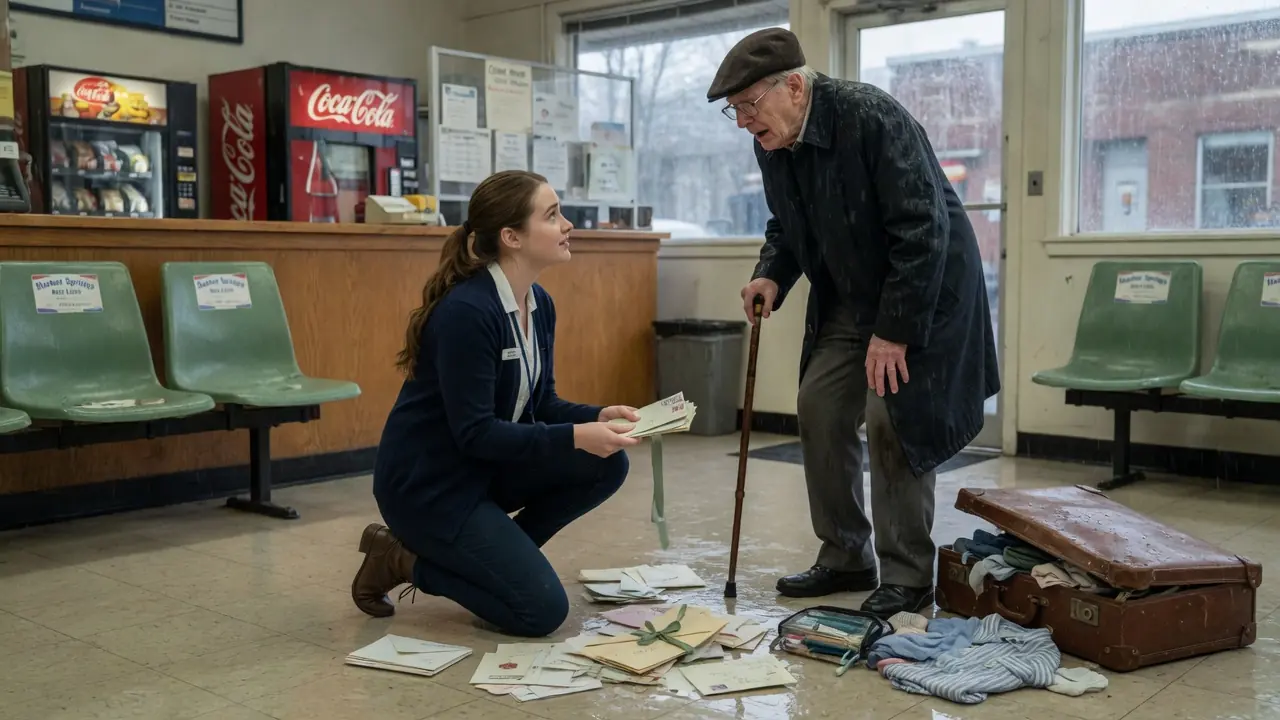
“No,” Walter said. “You helped me not turn around.”
The bus doors closed.
Emma stood on the platform as the bus pulled away into the rain.
She returned inside and placed Walter’s broken suitcase in the office, carefully labeled:
Walter Bennett
Hold for return
Then she sat behind the ticket counter for a moment, feeling something inside her shift.
She thought the story might end there.
It did not.
Five days later, Walter returned to the Harbor Springs bus station.
This time, the sky was clear and cold. He came through the doors wearing the same brown flat cap, carrying the navy duffel over one shoulder and a paper bag in one hand.
Emma looked up from the counter.
“Mr. Bennett.”
“Walter,” he corrected.
“Walter. How was Portland?”
He stood quietly for a moment.
Then his eyes filled.
“Hard.”
Emma nodded.
“But good?” she asked.
He smiled through tears.
“Yes. Good.”
He placed the paper bag on the counter.
“My daughter made pumpkin muffins. She said anyone who saves her father’s letters from drowning deserves muffins.”
Emma laughed.
“Please thank her.”
“I will.”
Walter sat on the bench near the counter while Emma retrieved his old suitcase from the office. When she brought it out, he placed one hand on the cracked leather.
“I thought about throwing it away,” he said.
“Did you?”
“No.” He looked down. “Laura wants to make it into a keepsake box. Put Margaret’s letters inside.”
“That sounds perfect.”
Walter nodded.
“We read the first letter Thanksgiving night.”
Emma waited.
“She was seventeen when she wrote it,” Walter said. “Told me my handwriting was terrible and my haircut was worse.” He laughed quietly. “Laura laughed until she cried. Then she cried until she laughed again.”
“That sounds like remembering her properly.”
“It was.”
Walter looked at Emma.
“You were right to put the letters in that sleeve. The damp ones survived.”
“I’m glad.”
“You said not to dry them near heat. Laura nearly put them by the radiator.”
Emma smiled.
“Good save.”
Walter reached into his coat pocket and pulled out a small brass key.
It was old, darkened with age, and tied to a faded green ribbon.
“This was the key to the suitcase,” he said.
Emma looked at it.
“The broken one?”
“Yes. The lock hasn’t worked in years, but Margaret kept the key anyway. She said keys were hopeful objects.”
Emma smiled softly.
“That sounds like something she would say.”
Walter placed it on the counter.
“I want you to have it.”
Emma immediately shook her head.
“No. Walter, I can’t.”
“Yes, you can.”
“That belongs with your family.”
“My daughter has the letters. The suitcase will be with her. This key belongs to the moment that helped us open them.”
Emma stared at the tiny brass key.
“It doesn’t even open the suitcase anymore,” Walter said. “But it opened something else.”
Emma’s eyes stung.
She touched the green ribbon.
“It’s too precious.”
“That is why it should not sit in a drawer.”
He also handed her an envelope.
“Laura helped me write this.”
Emma opened it carefully.
Inside was a letter addressed to the Harbor Springs Transit Office and the local community foundation.
Walter had written about the broken suitcase, the letters, the rain, the way Emma helped him repack without shame, and how she made sure he did not miss the bus.
At the end, he wrote:
Emma Riley understands that travel assistance is not only about schedules and tickets. It is about helping people cross difficult moments with dignity. Because of her, I made it to my daughter when grief almost sent me home.
Emma read the last line twice.
Her throat tightened.
Walter looked embarrassed.
“Too much?”
“No,” she whispered. “It’s perfect.”
That letter changed everything.
Emma showed it to her station supervisor, Mrs. Callahan, along with her notebook for the Safe Steps Program.
For months, she had been afraid to bring up the idea. She worried it sounded too small, too soft, too impossible to fund. But Walter’s letter made the need visible.
Mrs. Callahan read the proposal carefully.
Senior travel assistance.
Emergency contact cards.
Safe luggage help.
Family call support.
Weather delay check-ins.
Volunteer station escorts.
Document sleeves for important papers.
A waiting-area comfort shelf.
Mrs. Callahan looked up.
“You’ve been thinking about this for a while.”
“Yes.”
“And you think the station could manage it?”
“Not alone. But with the library, the senior center, and a few volunteers, yes.”
Mrs. Callahan tapped Walter’s letter.
“This man makes a strong case.”
Emma smiled.
“He lived one.”
They started small.
Very small.
A card table near the ticket counter.
A sign that said:
Need help reading a schedule, calling family, carrying a bag, or waiting safely? Ask at the Safe Steps Desk.
The first week, only two people used it.
An elderly woman who could not read the small print on the winter bus schedule.
A man recovering from surgery who needed help carrying a bag to the platform.
The second week, six people used it.
The third week, a woman came in crying because her mother’s bus was delayed and she did not know who to call. Emma helped her contact the driver line, call her brother, and sit down long enough to stop shaking.
Then people began telling others.
The senior center asked for printed travel cards.
The library offered volunteers.
A local pharmacy donated waterproof sleeves for medication lists.
The bakery donated coffee vouchers for seniors waiting during delays.
And Walter came every Friday morning.
He did not always travel. Sometimes he just sat near the Safe Steps Desk and helped people feel less foolish.
“I once spilled my entire life across this floor,” he told one nervous old woman whose ticket had printed wrong. “You are doing better than I did.”
She laughed.
That was Walter’s gift.
He made embarrassment survivable.
The Safe Steps Program grew slowly.
Emma created large-print route guides.
She helped seniors write emergency contact cards.
She taught volunteers how to speak respectfully and not grab bags or arms without asking.
She created a “quiet wait” corner for people overwhelmed by crowds.
She kept spare document sleeves for letters, medical papers, tickets, and photographs.
She wrote a short guide called:
Getting There Without Shame.
Walter loved the title.
“Good,” he said. “Shame is a terrible travel companion.”
Emma wrote that down.
With Walter’s letter, station records, volunteer hours, and support from the senior center, Emma applied for a small community mobility grant.
She did not expect to win.
She won.
Not a fortune.
Not a new building.
Not a job magically handed to her.
But enough to buy a proper desk, a phone line, large-print signs, luggage carts, waterproof document folders, volunteer badges, seating cushions, and training materials.
Safe Steps became official.
Emma became its coordinator.
For the first time in years, she felt as if the dream she had postponed had not died.
It had been waiting at the station.
Walter remained part of the program.
His name tag read:
Walter Bennett
Luggage Courage Consultant
He chose the title himself.
Every Thanksgiving season, he came to the station with pumpkin muffins from Laura. Every time, he sat near the Safe Steps Desk and told travelers, “If your suitcase breaks, you are in the right place.”
Years passed.
Safe Steps expanded beyond Harbor Springs. Other small bus stations called Emma to ask how to help elderly travelers with dignity. She trained volunteers. She wrote guides. She built partnerships with libraries, cafés, pharmacies, senior centers, and family caregivers.
She never became rich.
But she became exactly the kind of person she had once hoped to be.
Someone who helped people through difficult moments without making them feel small.
Walter grew older.
His trips to Portland became less frequent, but Laura visited more often. The broken suitcase became a keepsake box in her living room, filled with Margaret’s letters. Every Thanksgiving, the family read one aloud.
Some were funny.
Some were tender.
Some were ordinary.
All of them mattered.
One winter afternoon, Walter came into the station carrying a small frame wrapped in brown paper.
“For your desk,” he said.
Emma opened it.
Inside was a photograph of the old brown suitcase after Laura had restored it into a letter box. The brass key, however, was missing from the lock because it now hung beside Emma’s Safe Steps sign.
On the back of the frame, Walter had written:
Some things stop opening what they used to, and begin opening what they were meant to.
Emma cried.
Walter pretended not to notice.
He passed away peacefully two years later.
At his memorial gathering in Portland, Laura displayed Margaret’s letters in the restored suitcase. Emma stood beside the table, holding the brass key on its green ribbon.
Laura hugged her tightly.
“He always said you got him on the hardest bus of his life.”
Emma’s eyes filled.
“He was brave enough to board it.”
After the gathering, Laura handed Emma one final envelope.
“Dad wanted you to have this.”
Inside was a note in Walter’s careful handwriting.
Dear Emma,
The day my suitcase broke, I thought grief had spilled out in front of strangers.
You did not let me feel foolish.
You gathered the letters first.
You found me a bag.
You kept the suitcase safe.
And you helped me take the trip I almost ran from.
Keep helping people cross the moments that feel too heavy to carry alone.
With gratitude,
Walter Bennett
Emma framed the note at the Safe Steps Desk.
Years later, whenever people asked how the program began, she told them the truth.
“It began with an old man, a broken suitcase, and love letters scattered across a rainy bus station floor.”
Then she would show them Margaret’s brass key.
The gift was small.
A key.
A letter.
A broken suitcase that became a box of memories.
But inside those small things was the future Emma had been trying to build.
And every time an elderly traveler came to the counter saying, “I’m sorry to bother you,” Emma smiled gently and answered,
“You’re not a bother. You’re going somewhere.”
Because sometimes the hardest part of any journey was not the distance.
It was believing you still deserved help getting there.