At twenty-five, Emma Collins had learned that some emergencies did not arrive with sirens.
Some arrived quietly, with a cane sliding across wet pavement, a body dropping hard against the sidewalk, and an old man trying to sit up before anyone noticed he had fallen.
She had learned to notice those moments because her mother had taught her the difference between looking and seeing.
Looking was easy.
Seeing required care.
Looking was watching people pass by your window.
Seeing was noticing that the old woman across the street had not opened her curtains for two days.
Looking was hearing someone say, “I’m fine.”
Seeing was hearing the breath shake beneath the words.
Emma lived in Pinewood, New Jersey, a small town with old brick sidewalks, narrow roads, maple trees, a public library, a pharmacy, a diner, a courthouse annex, and a community outreach office where she worked part-time.
She was a young white American woman with fair skin, long chestnut-brown hair usually tied into a low ponytail, soft hazel eyes, and a calm voice that made people trust her when they were too frightened to think clearly.
Her job at Pinewood Community Outreach was not glamorous.
She answered phones.
Printed forms.
Carried food pantry boxes.
Helped seniors read letters from insurance companies.
Made copies.
Filled out appointment reminder cards.
Organized donated coats.
Called family members when someone forgot a ride.
And sometimes, she sat beside people who came in holding envelopes they were afraid to open.
Emma loved the work because it was practical.
She liked help that had hands.
A chair pulled out.
A phone number written clearly.
A coat found in the right size.
A form copied before the deadline.
A person walked safely to a car when the sidewalk was icy.
Her dream was to build a program called Safe Steps.
It would train young volunteers to help elderly residents with small but urgent public situations.
Falls.
Lost directions.
Weather trouble.
Confusing appointments.
Missing paperwork.
Unsafe sidewalks.
Not medical treatment.
Not police work.
Not a complicated agency.
Just calm, practical community help before a small crisis became a disaster.
She imagined volunteers carrying basic kits: gloves, water, plastic sleeves for documents, emergency contact cards, reflective umbrellas, small first-aid supplies, and clear instructions on when to call professionals.
She imagined senior residents knowing there was a number they could call if they were frightened, disoriented, or unable to finish an important errand.
But dreams needed money.
Training.
Insurance.
Volunteer screening.
Permission from her supervisor.
Partnerships with the clinic, library, senior center, and town council.
Emma only had a notebook full of ideas and a stubborn belief that no one should have to fall in the rain and become invisible.
So she kept working.
One person at a time.
The afternoon that changed everything began with rain.
It had been raining since morning, a steady gray rain that soaked coats slowly and made the whole town smell like wet leaves, cold brick, and exhaust.
By three o’clock, the sidewalks on Elm Street were slick.
Water gathered at the curbs.
The old maple trees dropped brown leaves onto the pavement, where they stuck flat and slippery beneath people’s shoes.
Emma left the outreach office late because Mrs. Alvarez, one of the senior lunch volunteers, had needed help printing medical transportation forms.
By the time Emma locked the office door, it was almost four-thirty.
She pulled up the hood of her navy raincoat, adjusted the tote bag on her shoulder, and started walking toward her apartment above the used bookstore.
Inside her tote bag were her notebook, pens, a small first-aid kit, a bottle of water, tissues, and plastic sleeves for documents.
Her roommate teased her for carrying half an office with her.
Emma always said, “You never know.”
That day proved it.
She had just turned onto Fifth Avenue when she heard a sharp sound ahead.
Not a crash.
Not exactly.
A hard slip, a scrape, and then a low, startled cry.
Emma stopped.
Across the street, outside the closed library, an elderly man had fallen near a streetlamp.
His cane lay several feet away, half in a puddle.
His leather satchel had fallen open beside him.
Loose papers were sliding toward the wet curb.
The man was trying to push himself up with one hand, but his arm trembled badly.
People were nearby.
A young man hurried past with earbuds in.
A woman under a black umbrella glanced over, hesitated, then kept walking.
A car splashed through a puddle at the curb.
Water sprayed dangerously close to the scattered papers.
Emma ran.
“Sir! Please stay still. I’m coming.”
The old man looked up, rain streaking his glasses.
His face was pale, his blue eyes wide with fear and embarrassment.
“I’m all right,” he said automatically.
Emma knelt beside him, ignoring the cold water soaking through the knees of her jeans.
“You may be, but let’s check before you move.”
“I only slipped.”
“That can still hurt.”
He tried to reach for his papers.
“My folder.”
“I’ll get it.”
Emma grabbed the loose pages first, slipping them into a plastic sleeve from her tote bag before rain could ruin them.
Then she picked up the leather satchel and moved it closer to the wall, away from the flowing curb water.
The papers were damp at the edges, but readable.
She saw a few words before looking away.
Grant proposal.
Youth mentorship.
Pinewood Council.
Deadline.
This was not ordinary paperwork.
She turned back to the old man.
“What’s your name?”
“Henry Whitman.”
“I’m Emma Collins. I work at the community outreach office.”
“The outreach office,” he repeated, breathing unevenly.
“Yes. Are you having chest pain?”
“No.”
“Trouble breathing?”
“Only from being startled.”
“Pain in your hip?”
He paused.
“My elbow. My knee. Pride.”
Emma gave him a gentle smile.
“Pride bruises easily, but we’ll check the others too.”
Despite everything, Henry laughed once.
Then he winced.
Emma opened her umbrella and held it over him as best she could.
Rain beat against the fabric, dripping off the sides.
“Henry, I’m going to call the community clinic and ask them what to do. You fell on wet pavement, and I don’t want to move you too fast.”
“I don’t need an ambulance.”
“I didn’t say ambulance. I said clinic.”
“I have to get to the council meeting.”
Emma glanced at the papers.
“The grant proposal?”
His eyes sharpened.
“You saw?”
“Only the title. I put the papers in a dry sleeve.”
His face softened with relief.
“Oh, thank God.”
He tried again to sit up fully.
Emma put a steady hand near his shoulder but did not push him down.
“Slowly. Let’s do this carefully.”
“I’m late.”
“What time is the meeting?”
“Five.”
Emma checked her watch.
4:34.
The town hall was six blocks away.
In dry weather, maybe ten minutes.
In rain, with an old man who had just fallen, much longer.
“What is the meeting for?” she asked.
Henry closed his eyes for a second.
“A vote. Funding for a youth mentorship workshop. I have been building it for two years.”
His voice shook.
“If I miss it, the council may table the proposal until spring. By spring, the grant window closes.”
Emma looked at the wet sidewalk, the scattered leaves, Henry’s scraped hand, and the protected papers in her tote.
Now the fall was not only a fall.
It was a man’s work almost being washed into the street.
“I’m going to help you,” she said.
Henry opened his eyes.
“You don’t even know me.”
“I know you fell. I know those papers matter. That’s enough to begin.”
She called the community clinic.
A nurse named Diane answered.
Emma explained quickly.
Elderly man.
Fall on wet sidewalk.
Alert.
No chest pain.
No obvious major injury.
Scraped elbow and knee.
Dizziness uncertain.
Needs assessment.
Diane asked to speak with Henry.
Emma held the phone to his ear.
Henry answered questions with reluctant honesty.
Yes, he felt a little dizzy.
No, he had not hit his head.
Yes, he took blood pressure medication.
No, he had not eaten since breakfast because he had been too nervous about the meeting.
Diane sighed loudly enough for Emma to hear.
“Mr. Whitman, you need to be checked before you go anywhere.”
Henry looked frustrated.
“I cannot miss the meeting.”
Emma took the phone back.
“Diane, is there a clinic volunteer near downtown?”
“I can send Mark. He’s two blocks away doing home visits. Five minutes.”
“Please send him to the library on Fifth.”
“Done. Keep him seated. Give him water if he can swallow normally. Don’t let him rush off.”
Emma hung up.
Henry looked at her.
“She told you not to let me rush off.”
“Yes.”
“You will obey her?”
“Yes.”
“You are very direct.”
“You fell in the rain. Direct saves time.”
Henry leaned back against the brick wall of the library and closed his eyes.
Rain ran along the edge of the umbrella.
Emma opened the water bottle from her tote.
“Small sips.”
He took it.
“Thank you.”
She picked up his cane and wiped the handle with a tissue.
Then she checked his satchel.
The leather was wet, but the inside had stayed mostly dry because she had closed it quickly.
She slid the protected proposal into the satchel’s inner pocket.
“Your papers are safe.”
Henry’s eyes opened.
“Truly?”
“Yes.”
He looked toward the satchel as if it contained a living thing.
“It took me months to finish that.”
“What is it?”
Henry took another sip of water.
“A mentorship program. Woodworking, reading support, music, basic repairs, life skills. Retired people teaching young people practical things. Young people helping older people with errands and technology. A trade of dignity.”
Emma felt a spark of interest.
“That sounds wonderful.”
“It sounds wonderful on paper,” Henry said. “The council says it needs structure, funding, supervision, insurance, outcomes, all the words people use when they are not sure they want to help.”
Emma smiled faintly.
“I know those words.”
“You work in outreach. Of course you do.”
“What made you want to start it?”
Henry looked at the rain-soaked street.
“My grandson.”
Emma waited.
Henry’s voice softened.
“Eli was sixteen when my daughter died. Angry, lost, too proud to ask for help, too hurt to accept it. I was old and grieving and not nearly as patient as I should have been. A retired shop teacher in our neighborhood took him into his garage and taught him how to build birdhouses.”
He smiled sadly.
“Birdhouses. Of all things. Eli pretended he didn’t care. Then he spent three months sanding wood like the future depended on it.”
“Did it help?”
“It gave his hands something to do until his heart caught up.”
Emma swallowed.
That sentence stayed with her.
A white van pulled up near the curb.
A middle-aged clinic volunteer named Mark stepped out wearing a rain jacket and carrying a medical bag.
“Henry Whitman?”
“That’s me,” Henry said, sounding annoyed that his name had become a case.
Mark crouched beside him and checked him calmly.
Blood pressure.
Pulse.
Pupil response.
Elbow scrape.
Knee scrape.
Basic questions.
Date.
Location.
Current president.
Henry answered correctly and then said, “Can we skip to the part where I go to the meeting?”
Mark looked at Emma.
“He’s stubborn.”
“I noticed.”
Henry sighed.
“I am present.”
Mark cleaned the scrape on Henry’s elbow and placed a bandage over it.
The knee was bruised but did not seem seriously injured.
His dizziness improved after water and a granola bar Emma pulled from her tote.
Mark recommended he avoid walking the six blocks.
“You need a ride,” Mark said.
Henry looked at the street.
“I called no one.”
“Do you have family nearby?” Emma asked.
“My grandson works until six. My daughter is gone. My son lives in Maine.”
He said it plainly, but Emma heard the loneliness beneath it.
“I can call a cab,” she said.
Henry reached for his wallet.
“No need. I can pay.”
“That’s fine. The issue is timing.”
Mark checked his phone.
“Taxi wait is at least twenty minutes because of rain.”
Henry’s face fell.
Emma thought fast.
The outreach office had a small van used for pantry deliveries.
She was not usually allowed to drive it unless scheduled, but Mrs. Lawson, her supervisor, had given her emergency permission before for stranded seniors.
She called Mrs. Lawson.
“Hi. I’m with Henry Whitman outside the library. He fell in the rain, clinic volunteer checked him, no ambulance needed, but he has to get to town hall by five for a council meeting with important documents. Can I use the outreach van?”
Mrs. Lawson paused.
“Is Mark there?”
“Yes.”
“Mark says he’s safe to transport?”
Emma handed the phone to Mark.
He confirmed.
Mrs. Lawson came back.
“Take the van. Document it tomorrow. And Emma?”
“Yes?”
“Do not let him walk those stairs alone at town hall.”
Emma smiled.
“Understood.”
Henry stared at her.
“You are arranging an entire operation.”
“You fell during an important deadline. Operations happen.”
Mark helped Henry stand slowly.
Emma stayed close but let Henry move under his own strength.
His face tightened with pain when he put weight on his knee, but he remained steady.
They walked carefully to the outreach office parking lot.
Emma carried the satchel.
Henry objected.
Emma ignored him politely.
At the van, she helped him into the passenger seat and placed the satchel on his lap.
He immediately checked the papers.
Still dry.
Still there.
As Emma drove toward town hall, rain drummed on the windshield.
Henry sat very upright, one hand on his satchel and the other around his cane.
“You should not have to do all this,” he said.
“Maybe not.”
“Then why are you?”
“Because someone should.”
He looked at her.
“That is not always the answer people choose.”
“No,” Emma said. “But it is the answer I like.”
Town hall appeared through the rain at 4:56.
An old stone building with a ramp on one side, wide steps at the front, and warm light glowing through tall windows.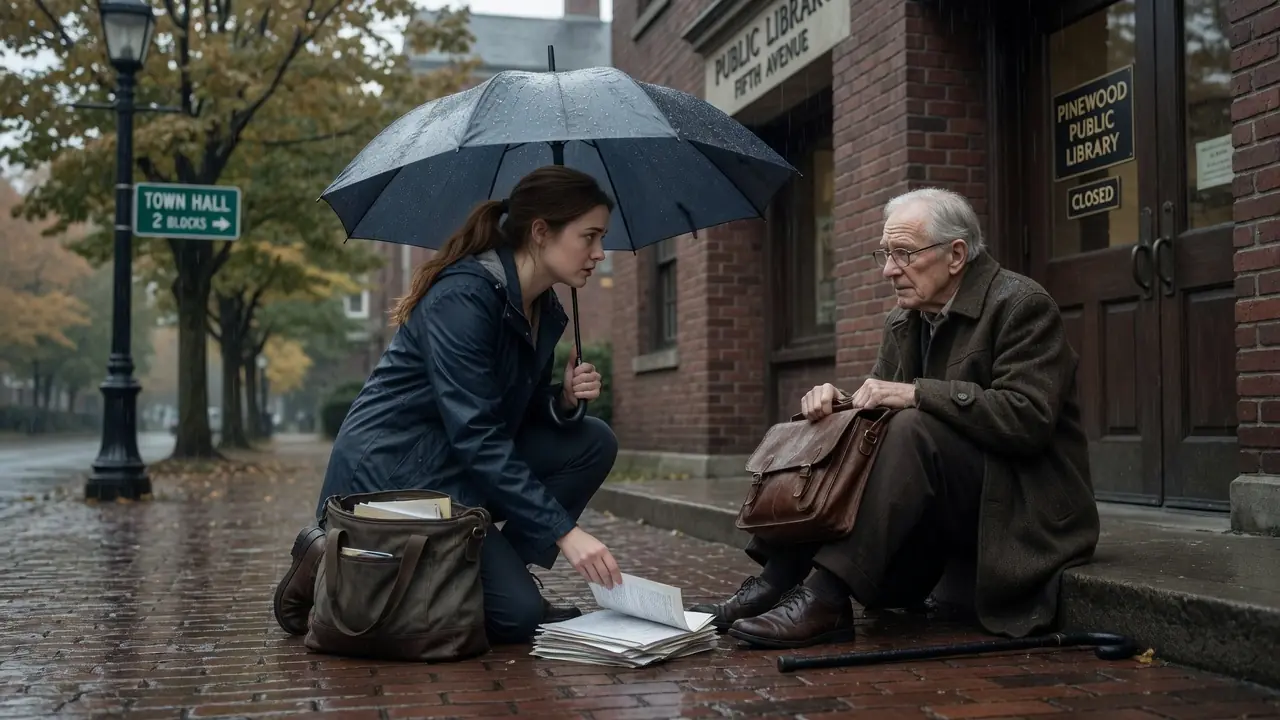
Emma parked near the side entrance.
“You have four minutes,” she said.
Henry looked alarmed.
“We won’t make it.”
“Yes, we will.”
She grabbed the satchel, came around, helped him down, and guided him toward the ramp.
He moved slowly, jaw tight with pain and determination.
At the door, a council assistant was preparing to close the sign-in table.
Emma called out, “Henry Whitman is here for the youth mentorship proposal.”
The assistant looked up.
“Oh, Mr. Whitman. They were about to move you to the end of the agenda.”
Henry straightened as much as he could.
“I am here.”
Emma handed him the satchel.
“Yes,” she said quietly. “You are.”
Inside the council chamber, the air smelled of old wood, coffee, and wet coats.
People sat in rows of chairs facing a long table where council members shuffled papers.
Henry moved toward the front.
Emma intended to leave, but Henry turned.
“Please stay.”
“This is your meeting.”
“You are already in the story.”
Emma had heard older people say things like that before, but something about Henry’s voice made her stay.
She sat in the back row, rain dripping from her sleeves.
Henry was called ten minutes later.
He walked slowly to the podium with his cane.
His elbow bandage showed beneath his coat sleeve.
His trousers were damp at the knee.
But his papers were dry.
His voice shook at first.
“My name is Henry Whitman. I am here to speak for the Pinewood Youth Mentorship Workshop.”
He paused.
The room settled.
Then he continued.
“I fell on the way here today. That is not part of my presentation, but perhaps it should be.”
A few people looked up.
Henry placed one hand on the podium.
“I fell because the sidewalk near the library is slick when it rains and the leaves are not cleared. I almost lost the proposal papers. A young woman from the community outreach office stopped, protected the documents, called the clinic, and helped me arrive.”
Emma froze.
Henry did not look at her.
He looked at the council.
“That is the kind of town we should be. Not one where old people fall and young people walk past. Not one where teenagers have no one to teach them useful things. Not one where experience sits unused in apartments and energy sits unguided on street corners.”
The room became very quiet.
Henry opened the folder.
“My proposal is simple. Retired residents have skills. Young people need guidance. Seniors need connection. Our town needs bridges. This program would build them.”
He spoke for twelve minutes.
About woodworking.
Reading support.
Basic repairs.
Music lessons.
Resume help.
Garden work.
Technology exchange.
Volunteer hours.
Shared meals.
Transportation.
Safety.
Dignity.
Emma listened, moved despite herself.
The proposal was more than a program.
It was a vision of generations helping each other remain useful.
When Henry finished, the room applauded.
The council did not approve the full funding that night.
Government rarely moved that beautifully in one meeting.
But they did something important.
They voted to advance the proposal to the next funding round and granted a small pilot budget to begin planning.
Henry sat down slowly.
His face was pale, but his eyes were alive.
Emma met him near the side aisle.
“You did it,” she said.
He looked at her.
“We did not lose the papers.”
“No.”
“We did not miss the meeting.”
“No.”
“We did not fall twice.”
“Also important.”
He laughed.
Then his eyes filled.
“Thank you, Emma Collins.”
“You did the hard part.”
“You keep saying things like that?”
“When they’re true.”
Over the next few weeks, Henry became a regular at the outreach office.
He came to make copies.
Then to revise the budget.
Then to contact volunteers.
Then to argue with the printer.
Emma helped him with all of it.
She learned that Henry had been a high school history teacher before retiring.
He had a gift for making ordinary events feel connected to something larger.
He could talk about birdhouses and democracy in the same breath.
He also had terrible handwriting.
Emma helped translate his notes into readable documents.
In return, Henry noticed her notebook.
The Safe Steps notebook.
“What is that?” he asked one afternoon.
“Just ideas.”
“At my age, just ideas usually means a future trying not to be noticed.”
Emma laughed.
“Older people keep saying things like that to me.”
“That means you keep hiding notebooks from older people.”
He was right.
Eventually, she showed him.
Safe Steps.
Volunteer training.
Fall response.
Weather help.
Document protection.
Clinic calls.
Safe transportation.
Elderly residents.
Youth volunteers.
Urgent practical support.
Henry read slowly.
He took it seriously, page by page.
When he finished, he closed the notebook and looked at her.
“This belongs beside my mentorship proposal.”
Emma blinked.
“What?”
“My program teaches generations to help each other. Yours teaches them how to do it safely in urgent moments. They fit.”
“I don’t have approval.”
“You have proof.”
“One fall in the rain is not proof.”
Henry lifted an eyebrow.
“One fall in the rain got me to a council meeting and secured pilot funding.”
Emma smiled.
“That is a very generous interpretation.”
“It is an accurate one.”
Henry wrote a letter of support for Safe Steps.
At the end, he wrote:
Emma Collins understands that safety is not only a medical matter. It is attention, dignity, timing, and the willingness to stay long enough to help a person finish what fear interrupted.
Mrs. Lawson read the letter and approved Emma to create a small training session for volunteers.
The first Safe Steps training took place in the outreach office meeting room.
Eight people came.
Three high school students.
Two retired nurses.
A library assistant.
A diner waitress.
And Henry, who insisted on attending even though he said he already knew how to fall.
Emma taught them how to approach someone safely.
Ask before touching.
Check for danger.
Call appropriate help.
Protect documents from rain.
Keep the person seated if dizzy.
Do not rush.
Do not shame.
Do not say, “You should have been more careful.”
Say, “Let’s make sure you’re safe.”
Henry raised his hand.
“Yes?” Emma said.
“Add: do not let the fallen person make speeches before drinking water.”
Everyone laughed.
Emma added it to the notes.
Safe Steps began as a tiny program.
A phone list.
A few volunteers.
Basic kits.
Plastic document sleeves.
Rain ponchos.
A clinic contact card.
A map of unsafe sidewalks.
A partnership with the library and town hall.
But small things become powerful when they meet real need.
The first month, Safe Steps volunteers helped an elderly woman who became disoriented near the pharmacy.
The second month, they helped a widower whose grocery bag split in the rain and whose medication papers nearly blew away.
The third month, they helped a retired man who fell outside the diner and was too embarrassed to tell his daughter.
Each case was documented.
Each one showed the same truth.
People did not need pity.
They needed calm help.
They needed someone trained to notice.
Henry’s mentorship pilot and Emma’s Safe Steps program began working together.
Teenagers in Henry’s workshop learned basic support skills from Emma.
Seniors in the mentorship program taught young volunteers life skills.
A retired carpenter taught tool safety.
A former nurse taught when to call for medical help.
A grandmother taught how to calm a frightened person without speaking down to them.
A retired mail carrier taught safe walking routes in bad weather.
The programs grew together.
One year later, Pinewood Council approved expanded funding.
The youth mentorship workshop became official.
Safe Steps became its partner program.
Emma became the coordinator for community response training.
Henry became her mentor.
He taught her how to write proposals, speak to committees, create budgets, and turn emotional stories into structured arguments that decision-makers could understand.
“Never remove the heart,” he told her. “Just give it a spine.”
Emma wrote that down.
Years passed.
The programs changed Pinewood in quiet ways.
Teenagers who had once been bored after school began helping seniors with errands, technology, porch repairs, and garden beds.
Seniors who had felt useless began teaching skills again.
Safe Steps volunteers responded to small urgent situations around town.
Falls.
Rain trouble.
Lost documents.
Missed rides.
Confusing appointments.
Unsafe sidewalks.
The town repaired the broken stretch near the library after Henry brought a photograph of his fall location to a council meeting and said, “This sidewalk already made its argument.”
No one knew how to respond, so they fixed it.
Henry lived long enough to see his first group of student mentors graduate.
At the ceremony, Eli, his grandson, attended and spoke.
He was grown now, steady, and still built birdhouses.
He said, “My grandfather believed grief could be given tools. He was right.”
Henry cried openly.
Emma cried too.
Then Henry complained that everyone was making the room damp.
One autumn afternoon, Henry came to the outreach office with Eli and Mrs. Lawson.
Emma immediately knew something was happening.
They carried a folder.
She had learned to fear meaningful folders.
“What is this?” she asked.
Henry smiled.
“Opportunity.”
Inside was a letter from the Pinewood Community Foundation.
Henry, Eli, Mrs. Lawson, and the council liaison had nominated Emma for a public service leadership fellowship.
The fellowship would pay for her training in community program development, emergency volunteer coordination, and nonprofit leadership.
It would also fund the expansion of Safe Steps into three neighboring towns.
Emma stared at the letter.
Her hands began to shake.
“Henry…”
He lifted one hand.
“No refusing before reading.”
“I can’t accept this.”
“You have not read it.”
“I know what it is.”
“Then you know you should accept.”
“It’s too much.”
Henry leaned on his cane and looked at her with the same fierce focus he had once brought to the council podium.
“No, Emma. Too much was falling in the rain and thinking my work would die in a puddle. Too much is a town full of people not knowing how to help each other. This is the correct size of response.”
Emma cried.
The fellowship changed everything.
She completed formal training.
She learned program design, risk management, volunteer screening, emergency communication, grant reporting, and community partnership building.
She built Safe Steps manuals.
She trained leaders in nearby towns.
She created youth volunteer modules.
She worked with clinics, libraries, senior centers, and town halls.
Within three years, Safe Steps existed in four towns.
Hundreds of volunteers were trained.
Thousands of small emergencies became safer because someone knew how to approach, ask, protect, call, and stay.
Henry’s health declined slowly, but he remained involved.
He wrote letters.
He attended ceremonies.
He corrected Emma’s speeches when he thought they needed more structure.
He kept saying, “Heart and spine.”
Emma kept writing it down, even after she had memorized it.
Henry passed away peacefully at eighty-four.
At his memorial gathering, the community hall was full.
Teenagers he had mentored sat beside retired volunteers.
Council members sat beside diner staff.
Eli placed a handmade birdhouse near Henry’s photograph.
Emma placed a plastic document sleeve beside it, the same kind she had used to save his papers in the rain.
After the service, Eli handed Emma one final envelope.
“My grandfather wrote this for you.”
Inside was Henry’s careful handwriting.
Dear Emma,
The day I fell outside the library, I thought I had failed my grandson, my proposal, and the young people I wanted to help.
You did not walk past.
You protected my papers.
You called for help.
You got me to the meeting without letting me surrender my dignity.
Then you built Safe Steps so others could be noticed before fear swallowed them.
The fellowship was not repayment.
It was my way of giving your good work a longer road.
Keep noticing.
Keep staying.
Keep giving kindness a spine.
With gratitude,
Henry Whitman
Emma framed the note at the Safe Steps office.
Beside it, she placed the first rain-spotted copy of Henry’s mentorship proposal.
Years later, whenever people asked how Safe Steps began, Emma told them the truth.
“It began with an old man who fell in the rain outside the library, a folder of grant papers, and a meeting he refused to miss.”
Then she would show them Henry’s letter.
The gift Emma received was not a house.
Not a car.
Not a fortune.
It was an opportunity.
A fellowship.
A road long enough for one act of help to become a program that taught entire towns how to notice.
And every time a volunteer called and said, “I found someone in trouble, and I don’t know what to do,” Emma answered gently.
“You did the first important thing. You stopped. Now let’s take the next step.”
Because sometimes help was not dramatic.
Sometimes it was kneeling in the rain.
Saving papers from a puddle.
Calling the clinic.
Finding a ride.
Sitting in the back of a council meeting with wet sleeves.
Sometimes it was letting an old man finish what he came to say.
And sometimes, that was enough to change the future of a whole town.