At twenty-four, Emily Hart believed that small things could carry a weight no scale could measure.
A ring.
A key.
A photograph.
A folded note.
A button saved from an old coat.
Most people saw such things and thought they were only objects. Emily knew better. She had grown up in a house where her mother kept her father’s old work gloves in a kitchen drawer long after he died, not because the gloves were useful, but because his hands had once lived inside them.
Emily lived in a small town in Colorado called Willow Creek, where the streets were lined with pine trees, weathered storefronts, a white-steepled church, and sidewalks that turned icy before winter had fully arrived. She was a young white American woman with fair skin, long chestnut-brown hair usually tied into a loose ponytail, soft blue-gray eyes, and a quiet but determined way of moving through the world.
She worked at Willow Creek Outdoor Supply, a small store that sold hiking boots, maps, flashlights, gloves, walking poles, thermoses, and camping gear for locals and tourists headed toward the nearby mountain trails.
Emily liked the work.
She liked helping people choose boots that would not hurt their feet. She liked explaining trail maps to nervous first-time hikers. She liked teaching people how to pack for sudden weather changes in the mountains. But what she loved most was the idea of guiding people safely from one place to another.
Her dream was to become an outdoor guide and eventually start a small program called Safe Trail, helping elderly people, beginners, and families enjoy gentle nature walks without fear. She wanted to create guided walks for seniors who missed being outdoors but no longer trusted their balance, eyesight, or stamina.
But dreams needed training, certifications, equipment, transportation, insurance, and money.
Emily had a paycheck, her father’s old compass, and a notebook full of ideas.
So she worked at the outdoor supply store, saved what she could, and waited for a door to open.
One cold Saturday afternoon in late October, the wind came down from the mountains sharp and fast. The sky was clear, but the air had the bite of coming snow. Emily had just finished her shift and was walking toward the town square when she saw an elderly man standing alone near the edge of the sidewalk.
He looked completely lost.
Not lost in direction.
Lost in panic.
He was a white American man in his late seventies, thin but tall, with silver hair beneath a brown wool cap, pale skin, a deeply lined face, and blue eyes wide behind square glasses. He wore a dark green coat, gray trousers, and worn leather shoes. One hand gripped a wooden walking stick. The other hand was open, trembling, as he stared down at the cracks between the sidewalk stones.
Beside him lay a small paper bag from the pharmacy.
Its contents had spilled out: tissues, a receipt, a packet of cough drops, and a little tin of mints.
But the man was not looking at any of those.
He was staring at his left hand.
His ring finger was bare.
Emily slowed.
Then she heard him whisper, “No. No, no, no.”
A gust of wind pushed leaves across the sidewalk. The old man dropped to one knee, trying to search between the cracks. His walking stick slipped sideways, and he nearly fell.
Emily ran to him.
“Sir, please don’t kneel there. Let me help.”
He looked up, embarrassed and terrified.
“My ring,” he said. “I lost my ring.”
“Your wedding ring?”
He nodded quickly, his breath shaking.
“I took my glove off outside the pharmacy. My hand was cold, and the ring must have slipped. It was loose. I knew it was loose.”
Emily crouched beside him.
“What’s your name?”
“Walter Reed.”
“I’m Emily Hart. I work at the outdoor supply store down the street. We’re going to find it.”
Walter looked at the sidewalk, then at the street. Cars rolled past. Leaves moved in little circles. The gaps between the stones were dark and narrow.
“It could have gone anywhere,” he whispered.
“Maybe. But we’ll start where you noticed it missing.”
He swallowed hard.
“My wife gave it to me fifty-four years ago.”
“What was her name?”
“Clara.”
His voice broke on the name.
“She passed in June. I still reach for her side of the bed every morning before I remember.”
Emily felt her chest tighten.
The ring was no longer just gold.
It was fifty-four years.
A hand held through hospitals, winters, breakfasts, arguments, birthdays, and the silence after goodbye.
“Walter,” Emily said gently, “we’re going to search carefully. But first, stand up. If you fall, Clara’s going to be mad at both of us.”
That surprised him.
A tiny laugh escaped through his fear.
“She would be.”
Emily helped him stand and guided him to a nearby bench.
“Sit here. Tell me exactly where you walked.”
He pointed with a shaking hand.
“Out of the pharmacy. I stopped there, near the trash can, to put on my glove. Then I walked here. Then I noticed.”
Emily looked at the route.
A pharmacy door.
A trash can.
A patch of leaves.
A storm drain near the curb.
A cracked section of sidewalk.
The storm drain worried her most.
She set down her tote bag and pulled out the small flashlight she carried from the outdoor store. Then she took off her scarf and laid it across the bench beside Walter.
“Put this around your hands.”
“No, dear, I can’t take your—”
“You’re shaking, and I need you warm enough to think.”
He obeyed.
Emily began searching.
First, she checked the sidewalk cracks. She moved leaves carefully with her boot, then crouched and used the flashlight. Nothing.
She checked around the pharmacy door. Nothing.
She checked beneath the bench. Nothing.
Then she moved toward the curb.
The wind pushed more leaves toward the storm drain.
Emily’s stomach tightened.
She knelt carefully and shone the flashlight through the grate.
Something glinted.
Small.
Gold.
At the edge of the drain, resting on a narrow metal lip just below the grate.
The ring.
Emily froze.
“I see it.”
Walter stood too quickly.
“You do?”
“Stay on the bench,” she said sharply, then softened her tone. “Please. It’s near the storm drain. If you step over here and slip, we’ll have two emergencies.”
Walter sat back down, gripping her scarf in both hands.
Emily studied the grate.
The ring had not fallen all the way through. It was caught just under the top lip, barely reachable. One careless movement could knock it deeper into the drain.
She needed something thin.
She looked around, then remembered the outdoor store key ring in her pocket. Attached to it was a small telescoping magnet used for retrieving dropped screws during gear repairs. It might work if the ring had enough metal response, but gold itself was not magnetic. The magnet would not pull it.
She needed a hook.
Emily ran back to the pharmacy entrance and grabbed a wire twist tie from a bundle of sale flyers near the door. She straightened it, bent a tiny hook at the end, and returned to the drain.
Then she lay flat on the cold sidewalk, shoulder pressed to the curb, flashlight between her teeth.
“Careful,” Walter whispered.
Emily did not answer.
The hook slipped once.
The ring trembled.
She stopped breathing.
A car passed, sending wind and dust across her face.
She tried again.
This time, the hook caught the inside curve of the ring.
Slowly, carefully, she lifted.
The ring rose toward the grate.
It nearly slipped.
Emily slid two fingers through the grate opening and pinched the ring just before it fell.
She pulled it free.
For a moment, she simply held it in her palm.
A plain gold wedding band.
Scratched.
Worn thin at the edges.
Still warm somehow, as if a lifetime had stayed inside it.
She stood and walked back to Walter.
“I found Clara,” she said softly.
Walter stared at the ring.
Then his face crumpled.
He took it with both hands and pressed it to his lips.
People walking past slowed, but no one spoke.
Walter cried quietly, shoulders shaking under his old coat.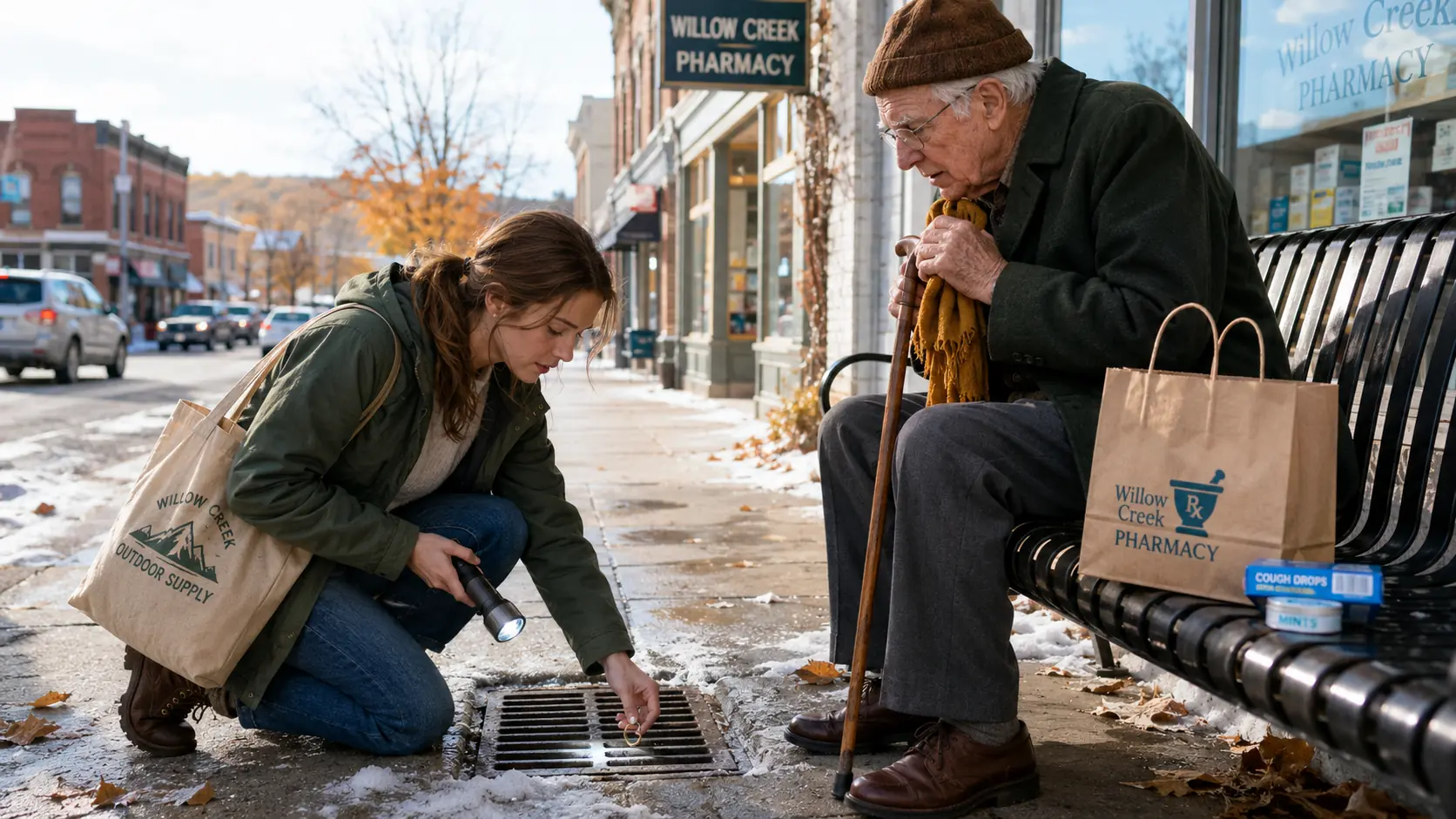
Emily sat beside him and let him cry.
After a while, he whispered, “I thought I had lost her again.”
“You didn’t.”
“I know it’s only a ring.”
“No,” Emily said. “It isn’t.”
He looked at her then, and something in his eyes softened.
“You understand that.”
“I do.”
Walter tried to slide the ring back onto his finger, but it slipped loosely past the knuckle.
Emily stopped him gently.
“It’s too loose. You could lose it again.”
“I know.” He looked ashamed. “I’ve lost weight since Clara died.”
“There’s a jewelry repair shop two streets over. They can size it properly. But until then…” Emily reached into her tote bag and pulled out a small piece of cord used for tying gear tags at the outdoor store. She looped it through the ring and tied it securely.
“You can wear it around your neck for now.”
Walter looked down as she placed the cord in his hand.
“That’s what Clara did with my ring when I had surgery once,” he whispered.
“Then she already approved the method.”
He laughed through tears.
Emily picked up his fallen pharmacy items and put them back in the paper bag. Then she stood.
“I’ll walk you to the jewelry shop.”
“Oh no, dear. You’ve done enough.”
“You just almost donated your wedding ring to the storm drain. We’re not trusting the sidewalk alone yet.”
Walter smiled weakly.
“You are very firm.”
“I sell hiking boots to men who insist sneakers are fine on ice. Firmness is required.”
He laughed again.
They walked slowly to the jewelry shop. Emily stayed beside him, matching his pace. At the shop, the jeweler promised to resize the ring and gave Walter a temporary chain to keep it safe.
Walter held the receipt carefully.
“I don’t know how to thank you,” he said when they stepped back outside.
“You don’t have to.”
“Yes,” he said. “I do.”
He reached into his coat pocket and pulled out a folded paper.
It was an old map.
Not a printed tourist map.
A hand-marked trail map of the gentle walking paths above Willow Creek.
“My wife and I walked these trails for years,” Walter said. “Not the hard ones. Clara liked the quiet ones. Benches. Views. Wildflowers in spring. Places where a person could breathe.”
Emily unfolded the map carefully.
Small notes filled the margins.
Best view in October.
Rest here after hill.
Clara’s favorite pine.
Too steep after rain.
Good place for tea.
Bench needed.
Emily stared at the handwriting.
“This is beautiful.”
“Clara marked most of it,” Walter said. “She said trails should be remembered by kindness, not distance.”
Emily felt that sentence enter her like a bell.
Trails should be remembered by kindness, not distance.
“This is exactly the kind of thing I want to do,” she said softly.
“What do you mean?”
Emily hesitated, then told him.
About Safe Trail.
About wanting to guide elderly people and beginners on gentle walks.
About making nature feel possible again for people who were afraid of falling, getting lost, or slowing others down.
Walter listened carefully.
Then he said, “Clara would have signed up first.”
Emily laughed softly.
“I wish I could have met her.”
“In a way,” Walter said, touching the map, “you just did.”
Over the next few months, Walter began visiting Willow Creek Outdoor Supply.
At first, he came to show Emily the resized ring, now secure on his finger again. Then he came with more maps. Old walking journals. Photographs from trails. Notes Clara had written about which paths had shade, which benches faced west, which creek crossings were difficult after snowmelt.
Emily began organizing the information.
She walked the trails herself on Sundays, checking slopes, loose gravel, icy patches, bench locations, rest spots, and cell service. She added her own notes beside Clara’s.
Good for walkers with poles.
Avoid after heavy rain.
Needs clearer sign.
Beautiful but too narrow.
Safe loop for first group.
Walter reviewed every page.
“You’re making the trails speak politely,” he said one afternoon.
Emily smiled.
“That might be the best compliment I’ve ever received.”
Spring came slowly.
With Walter’s encouragement, Emily proposed a free trial walk through the senior center: Gentle Trail Morning. A one-mile guided walk, slow pace, rest stops, no pressure, no one left behind.
She expected maybe three people.
Twelve signed up.
Walter came too, wearing his gold ring, a warm jacket, and a stubborn expression.
“I am your historical consultant,” he announced.
Emily gave him a name tag that said exactly that.
The walk was simple.
They moved slowly along a flat path near the creek. Emily pointed out safe footing, resting places, and trail markers. Walter told stories about Clara spotting wildflowers, packing terrible sandwiches, and once arguing with a squirrel over a dropped cookie.
People laughed.
More importantly, they relaxed.
One woman said, “I haven’t walked outside like this since my hip surgery.”
Another said, “I thought I’d slow everyone down.”
Emily answered, “That’s the point. We slow down together.”
The walks continued.
Once a month.
Then twice.
Emily saved money for a basic outdoor first aid course. She studied senior fitness, trail safety, navigation, weather planning, and accessibility. Walter wrote her a recommendation letter for a small community wellness grant.
In the letter, he told the story of the ring.
How Emily had stopped.
How she had searched with patience.
How she had understood that losing the ring was not losing jewelry, but losing a thread to the woman he loved.
At the end, he wrote:
Emily Hart understands that safe passage is not only about terrain. It is about dignity.
With that letter, Clara’s marked map, and photos from the senior walks, Emily applied.
She won a modest grant.
Not a fortune.
Not a building.
Not anything grand.
But enough to buy walking poles, reflective vests, small first aid kits, printed trail guides, radios, and insurance for the program.
Safe Trail became real.
Walter attended the first official walk and stood beside Emily at the trailhead.
He handed her a small wooden compass.
“This was Clara’s,” he said.
Emily looked at it in surprise.
“No, Walter.”
“Yes.”
“I can’t take this.”
“You can.”
“It belonged to her.”
“And she believed useful things should not be kept in drawers.”
Emily held the compass carefully.
It was old, scratched, and beautiful. On the back, Clara had carved two tiny words:
Find gently.
Emily’s eyes filled.
Walter smiled.
“She used to say getting somewhere mattered less than how people felt on the way.”
Emily closed her fingers around the compass.
“I’ll keep it with me.”
“Good. Let it boss you around like she bossed me.”
Emily laughed through tears.
Years passed.
Safe Trail grew into one of Willow Creek’s most beloved programs. Emily became a certified outdoor guide specializing in gentle walks for seniors, beginners, and people rebuilding confidence after illness, injury, or loss.
She never led extreme climbs.
She led slow mornings.
Creek paths.
Wildflower loops.
Memory walks for widows and widowers.
Birdsong walks for people recovering from grief.
Sunset walks where nobody cared how fast anyone moved.
Walter kept walking as long as he could. When he became too weak for the trail, Emily visited him and brought leaves, pinecones, and photographs from Clara’s favorite places.
One autumn afternoon, he held Clara’s map in his lap and said, “You kept her walking.”
Emily shook her head.
“No. You did.”
He touched his wedding ring.
“We both did, maybe.”
Walter passed away peacefully the next winter.
At his memorial, Emily placed Clara’s compass beside a framed photograph of Walter wearing his wedding ring on the creek trail. His family displayed the old trail map with Clara’s notes, and people from Safe Trail wrote memories on small cards.
After the service, Walter’s daughter handed Emily a letter.
Dear Emily,
The day I lost Clara’s ring, I thought grief had finally taken the last thing I could still hold.
You found it.
Then you helped me find the trails again.
Do not underestimate small rescues. Sometimes a ring, a map, a walk, or a kind hand at the curb is enough to return a person to the world.
Keep guiding gently.
With gratitude,
Walter Reed
Emily framed the letter in the Safe Trail office.
Years later, whenever someone asked how Safe Trail began, she told them the truth.
“It began with an old man on a cold sidewalk, searching for his wedding ring near a storm drain.”
Then she would show them Clara’s compass and the hand-marked map.
Walter had not given her money.
Not a house.
Not a business.
He gave her a map.
A letter.
A compass.
Small things.
But inside them was the direction she had been waiting for.
And every time Emily led a group onto a quiet trail, she touched the compass in her pocket and remembered the words carved on the back.
Find gently.