At twenty-four, Emily Harper believed gardens were not quiet places.
People thought they were.
They saw flowers, herbs, vegetables, birds, and old wooden fences, then decided gardens were peaceful because they did not know how to listen.
Emily heard more.
She heard soil being turned after a hard winter.
She heard tomato cages rattling in the wind.
She heard bees moving through lavender.
She heard an old gate complaining on rusty hinges.
She heard the small stubborn sound of life continuing.
Emily lived in a small town in Vermont called Meadowbrook, where houses sat behind low fences, maple trees leaned over narrow roads, and summer gardens were treated almost like family members. She was a young white American woman with fair skin, long chestnut-brown hair usually tied into a low ponytail, soft green eyes, and careful hands that were often marked with soil, scratches from rose stems, or paint from old fence boards.
She worked at Meadowbrook Garden Supply, a small shop on the edge of town.
Most days, she watered seedlings, carried bags of soil to cars, arranged seed packets, helped customers choose compost, trimmed dead leaves, and listened patiently while people described their plants as if they were difficult relatives.
“My basil is being dramatic.”
“My tomatoes are refusing to cooperate.”
“My hydrangeas hate me.”
Emily usually smiled and helped.
She loved plants because they responded to care honestly. If they needed water, they showed it. If they needed better soil, they showed it. If they needed more light, they leaned toward it.
People were harder.
People could be starving for help and still say they were fine.
Her dream was to start a small gardening program called The Green Porch Project, helping elderly people keep their gardens alive when age made bending, lifting, kneeling, and repairing fences too difficult.
She did not want to build luxury gardens.
She wanted to help widows keep their husband’s roses blooming.
She wanted to help old men keep vegetable beds they had planted for forty years.
She wanted to build raised beds, repair gates, organize tools, deliver soil, and create simple garden plans that let older people keep touching the life they had grown.
But dreams needed money.
Tools.
A truck.
Insurance.
Volunteers.
Training.
Time.
Emily had a small paycheck, a rusty hatchback, and a notebook full of ideas.
So she kept working at the garden shop.
Across the alley from Emily’s rented apartment lived Mr. Arthur Wells.
Arthur was seventy-nine, a white American man with short white hair, pale weathered skin, kind blue eyes, and a deeply lined face that looked serious until he smiled. He lived alone in a small gray house with white trim, a narrow porch, and a backyard garden surrounded by an old wooden fence.
His wife, Clara, had passed four years earlier.
Emily knew because Arthur spoke of her the way people spoke of weather they still felt in their bones.
Clara had loved roses.
Clara had labeled every seed packet.
Clara had grown basil in chipped mugs on the kitchen windowsill.
Clara had said weeds were only plants with poor manners.
Clara had built the garden with Arthur over fifty years of marriage.
Every spring, Arthur still opened the old garden gate and walked the narrow path between the beds. He planted tomatoes, beans, marigolds, cucumbers, lavender, and Clara’s roses along the back fence. His hands shook more now. His knees hurt. He moved slowly.
But every morning, rain or shine, he visited the garden.
Emily saw him from her kitchen window.
Sometimes he stood there for ten minutes, not touching anything, just looking.
The first time they spoke, Emily was carrying groceries inside, and Arthur called over the fence, “Young lady, do you know why my mint is trying to conquer the world?”
Emily laughed.
“Because mint has no moral boundaries.”
Arthur stared at her for half a second.
Then he laughed so hard he had to lean on the fence.
From then on, they became friends.
Emily brought him extra seedlings from the garden shop.
Arthur gave her cucumbers in summer and jars of Clara’s dried herbs in fall.
Emily carried heavy soil bags from his porch to the backyard.
Arthur told her which neighbors secretly overwatered their plants.
One windy Saturday afternoon in May, Emily came home from work early because dark clouds were gathering over Meadowbrook. The air smelled like rain and wet leaves. Wind pushed through the alley, rattling trash bins and bending the branches of Arthur’s old lilac tree.
Emily had just stepped into her kitchen when she heard a loud crack outside.
Then Arthur’s voice.
“No! No, no!”
She ran to the window.
Arthur was in the alley behind his house, gripping his cane with one hand and staring at his garden gate.
The gate had broken loose.
One hinge had torn away from the fence post, and the whole gate sagged sideways, dragging through the mud. The latch had snapped open. Wind pushed the gate back and forth, slamming it weakly against the fence.
Inside the garden, Arthur’s old seed trays had fallen from a small table near the entrance. Young tomato seedlings lay scattered across the wet ground.
Arthur tried to bend down to pick them up, but his cane slipped in the mud.
Emily ran.
“Mr. Wells! Don’t bend down!”
Arthur froze, breathing hard.
“The seedlings,” he said. “They’ll break.”
“I’ll get them.”
Emily hurried through the alley and into his yard. The wind pushed the broken gate again, nearly hitting her shoulder. She caught it, lifted it off the mud, and leaned it carefully against the fence.
Then she knelt beside the fallen seed trays.
The tomato seedlings were small, fragile, and muddy, but most were still alive. Emily picked them up one by one, supporting the stems gently, placing them back into the tray with loose soil around the roots.
Arthur stood beside her, pale with worry.
“Those are Clara’s tomatoes,” he whispered.
Emily looked up.
“Clara’s?”
He nodded, lips trembling.
“She saved the seeds every year. Same line of tomatoes since 1982. She called them Red Lanterns because they glowed in the evening sun.” He swallowed hard. “This is the last envelope she wrote herself.”
Emily’s hands slowed.
Suddenly, the seedlings were not just plants.
They were Clara’s handwriting.
Clara’s summers.
Clara’s hands pressing seeds into soil years before.
“Then we’re saving every one we can,” Emily said.
Arthur looked at the broken gate.
“I should have fixed that hinge weeks ago.”
“The hinge should have asked for help louder.”
He gave a weak laugh, then wiped rain from his forehead.
The first drops had begun to fall.
Emily stood and looked at the gate. The lower hinge was rusted through. The upper hinge had pulled loose because the fence post had softened near the screw holes. The latch was bent. If the storm got stronger, the gate could break completely, and the wind could tear through the garden.
She looked at Arthur.
“Do you have a shed?”
“Yes.”
“Tools?”
“Old ones.”
“Good. Old tools usually still want attention.”
Arthur managed another small smile.
Emily carried the seed trays onto the covered back porch first. Then she helped Arthur inside and made him sit at the kitchen table.
“I can help,” he protested.
“You can help by telling me where things are.”
“That sounds like being politely benched.”
“It is exactly that.”
The rain grew heavier.
Emily found the shed key hanging by the back door. In the shed, she found a hammer, a hand saw, old screws, a rusted tin of nails, a screwdriver, a small level, and several pieces of scrap wood stacked neatly against the wall.
Not enough for a perfect repair.
Enough for an emergency.
She also found a folded garden journal on a shelf near the door.
It was open to a page written in neat handwriting:
Red Lantern Tomatoes — saved from south bed, September 14.
Arthur says they are too many. Arthur is wrong.
Emily smiled despite the rain.
Clara had a voice even on paper.
She carried the tools to the gate and got to work.
First, she removed the rusted lower hinge.
Then she reinforced the softened fence post with a piece of scrap wood, driving long screws into the stronger section behind it. She repositioned the hinge higher, where the wood was firmer. She tightened the upper hinge and added a support brace across the sagging corner of the gate.
Rain soaked her hair and sleeves.
Mud clung to her knees.
Arthur watched from the kitchen window, looking worried and guilty.
Every few minutes, he opened the back door.
“Emily, it’s raining too hard!”
“I’m fine!”
“You are not fine! You are wet!”
“That is different!”
He closed the door, then opened it again two minutes later.
“Clara would have made you come inside!”
“Clara would have wanted the tomatoes protected!”
Arthur paused.
Then he called, “That is unfortunately true!”
Emily laughed and kept working.
By the time she rehung the gate, the rain had softened to a steady drizzle. The gate swung unevenly but safely. The latch still needed replacement, but she managed to bend it back enough to hold. She added a temporary hook-and-eye latch from the shed to keep it closed through the storm.
Then she checked the seedlings.
Most had survived.
Three were damaged beyond saving.
Twenty-one still stood, muddy but upright, in the trays on the porch.
Arthur came outside slowly, wearing his old brown cardigan and holding a towel.
“You saved them,” he whispered.
“Most of them.”
He looked at the three broken stems.
Emily saw his face fall.
She spoke gently.
“Three didn’t make it. But twenty-one did. That’s enough to keep Clara’s tomatoes going.”
Arthur pressed a hand over his eyes.
“I thought I’d lost them.”
“You didn’t.”
“I almost did.”
“But not today.”
He looked at the gate, then at her muddy clothes, then at the trays.
“I don’t know how to thank you.”
“Let me come back tomorrow and fix the latch properly.”
“That is not me thanking you.”
“No,” Emily said. “That is you being sensible.”
Arthur laughed through tears.
Inside, he insisted on making tea while Emily dried off with an old towel. His kitchen smelled of herbs, rain, and old wood. Above the sink hung a photograph of Arthur and Clara in the garden. Clara had silver-streaked brown hair, bright eyes, and mud on her cheek. Arthur stood beside her holding a basket of tomatoes, looking as if he had been ordered to smile and had obeyed badly.
Arthur noticed Emily looking.
“She took that one with a timer,” he said. “Ran back into place and nearly knocked over the basil.”
“She looks happy.”
“She was happiest dirty,” Arthur said softly. “Soil under her nails, sun on her shoulders, telling me I planted beans too close together.”
“Did you?”
“Every year.”
Emily smiled.
Arthur placed a mug of tea in front of her.
“Clara kept journals. Every garden season. What bloomed. What failed. Which neighbors stole zucchini politely.”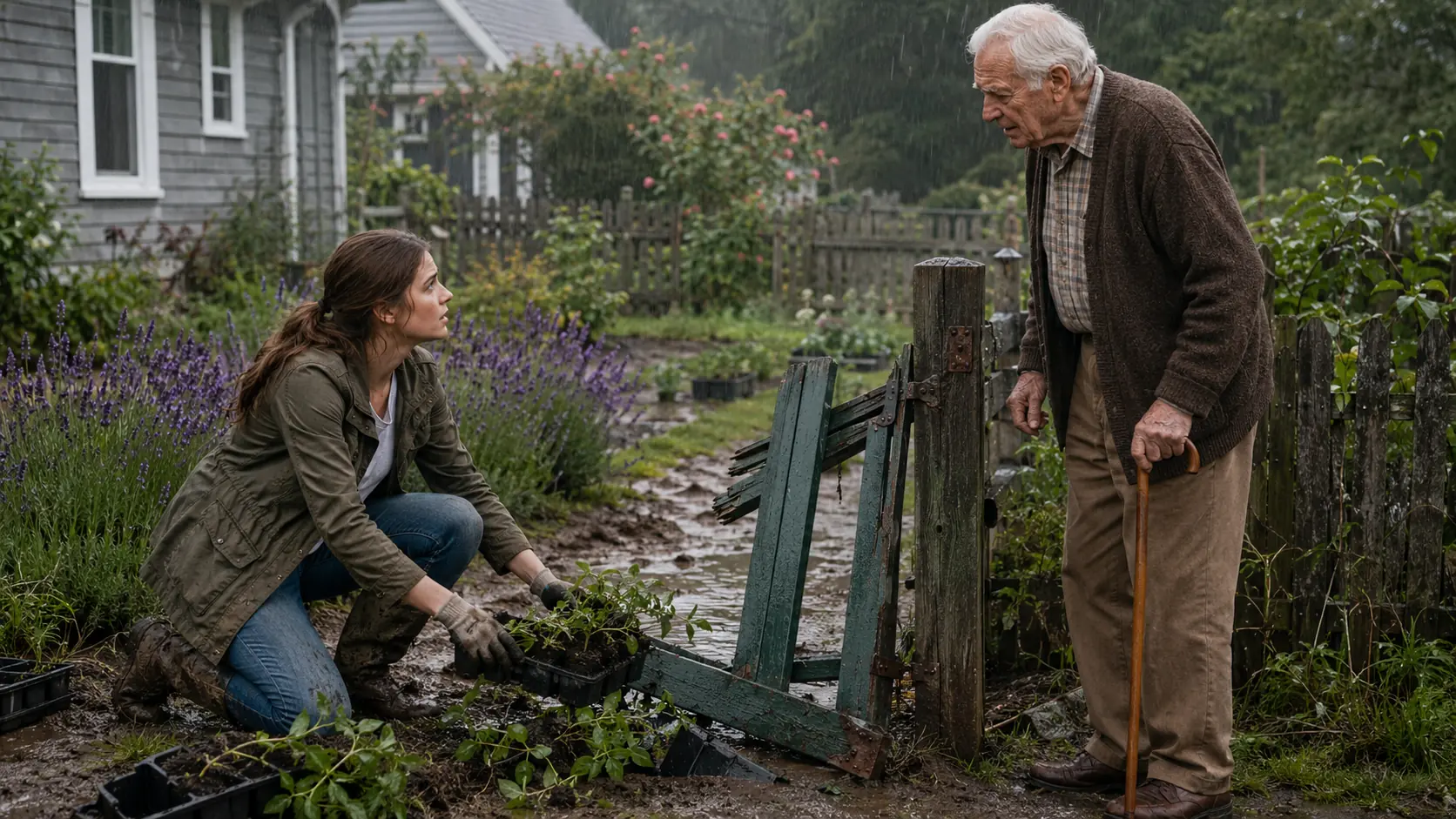
Emily laughed.
“She sounds amazing.”
“She was.” His voice grew quiet. “After she died, I kept planting because stopping felt worse. But every year, something gets harder. The digging. The lifting. The repairs. Today, when that gate broke, I thought maybe the garden was telling me I couldn’t keep it anymore.”
Emily looked at him firmly.
“Gardens don’t say things like that.”
“No?”
“No. Gardens ask for help.”
Arthur looked at her for a long moment.
Then he nodded slowly.
The next day, Emily returned with proper hinges, exterior screws, a new latch, wood filler, sandpaper, and weatherproof paint from Meadowbrook Garden Supply. Her boss had given her a discount after hearing the story.
She repaired the gate properly.
She replaced both hinges.
Reinforced the post.
Installed a new latch that Arthur could open easily without struggling.
Sanded the rough edge.
Painted the repaired section the same faded green Clara had chosen years earlier.
When she finished, Arthur came outside and tested it.
The gate swung open smoothly.
Closed cleanly.
Clicked into place.
Arthur opened it again.
Closed it again.
Opened it once more.
Emily smiled.
“Having fun?”
“It hasn’t worked this well since 1998.”
“That’s oddly specific.”
“Clara wrote it down.”
Of course she had.
Over the next few weeks, Emily helped Arthur transplant the Red Lantern tomatoes into the south bed. She added a small support rail near the garden entrance. She moved his heaviest tools to a waist-high shelf. She helped build one raised bed so Arthur would not have to bend as much.
Arthur resisted at first.
“I don’t want the garden changed too much.”
Emily understood.
“We won’t change Clara’s garden. We’ll make it easier for you to keep it.”
That made him quiet.
Then he said, “All right.”
Spring became summer.
The Red Lantern tomatoes grew tall and strong.
Arthur called Emily over the first evening the fruit began to turn red.
He pointed with pride.
“Look at that.”
The tomatoes glowed in the low sun, red-orange against deep green leaves.
Emily smiled.
“Clara named them perfectly.”
Arthur nodded.
“She usually did.”
That summer, Arthur began inviting Emily over every Sunday evening. They sat near the garden gate, drinking iced tea while he read from Clara’s garden journals.
Some entries were practical.
Cucumbers failed. Try different trellis.
Some were funny.
Arthur bought cheap gloves. They are an insult to hands.
Some were tender.
Rain today. Sat with Arthur under porch roof. Tomatoes still green. Marriage still good.
Emily loved the journals.
They were not just garden records.
They were a life.
One afternoon, Arthur found Emily sketching a plan in her notebook.
“What is that?”
“Nothing.”
“At my age, nothing usually has a name.”
Emily smiled.
“It’s an idea. The Green Porch Project.”
She showed him the pages.
Raised beds for elderly gardeners.
Gate repairs.
Tool organization.
Seedling delivery.
Garden check-ins.
Small repairs that helped older people keep gardening.
Arthur read slowly.
Then he looked at her.
“This is not nothing.”
“I don’t have money to start.”
“You have hands.”
“Hands need tools.”
“You have tools.”
“Not enough.”
“You have proof.”
Emily blinked.
“Proof?”
Arthur pointed toward the garden gate.
“This.”
With Arthur’s encouragement, Emily began helping two more elderly neighbors with small garden problems. She repaired a loose trellis for Mrs. Alvarez. She built a raised herb box for Mr. Coleman. She helped a widow move heavy pots from her porch steps to a safer bench.
She took photos.
Made notes.
Tracked costs.
Arthur wrote down testimonials in his careful handwriting because, as he said, “Young people forget to document miracles when they happen with screws and dirt.”
By autumn, The Green Porch Project was still tiny.
But real enough to apply for a small community grant.
Emily did not think she would win.
Arthur disagreed.
He gave her a letter.
In it, he wrote about the storm, the broken gate, Clara’s Red Lantern tomatoes, and the way Emily helped him keep the garden without making him feel useless.
At the end, he wrote:
Emily Harper understands that independence is not always doing everything alone. Sometimes it is receiving the right help so you can keep doing what still gives your life meaning.
Emily cried when she read it.
With Arthur’s letter, photos of her small projects, and support from the garden shop, she applied.
She won.
Not a fortune.
Not land.
Not a business handed to her.
But enough to buy tools, raised-bed materials, adaptive garden supplies, gloves, seed trays, and a used utility trailer.
The Green Porch Project began the next spring.
Arthur was the first official member.
Naturally, he gave himself the title Tomato Supervisor.
Emily printed him a name tag.
He wore it proudly.
The project grew slowly.
Elderly residents called when they needed help with garden gates, heavy soil, raised beds, trellises, tool handles, watering systems, and plant delivery. Younger volunteers signed up to help. Children from the local school came to learn seed saving from Arthur, who pretended to be stern and secretly loved every minute.
The Red Lantern tomatoes became famous in town.
Every year, Arthur and Emily saved seeds from the strongest plants. They packaged them in small envelopes labeled with Clara’s original name. The proceeds helped fund garden repairs for seniors who could not afford supplies.
One spring morning, Arthur handed Emily Clara’s original seed journal.
Emily stared at it.
“No.”
Arthur smiled.
“Yes.”
“I can’t take this.”
“You can.”
“It’s Clara’s.”
“And Clara believed seeds should travel.”
“This belongs to your family.”
“My family has copies. The garden has the tomatoes. This journal belongs with the person who kept the gate from ending the story.”
Emily’s eyes filled.
“It’s too precious.”
“That is why it should not sit closed.”
He placed the journal in her hands.
“Use it. Add to it. Let other gardens enter.”
Emily opened the cover.
On the inside, Clara had written:
A garden is never only what grows.
It is who keeps coming back to tend it.
Years passed.
The Green Porch Project became one of Meadowbrook’s most loved community programs. Emily still worked at the garden shop part-time, but her project became her life’s work. She helped seniors keep gardens they thought they would have to abandon. She built raised beds, repaired gates, organized tools, saved seeds, and created community planting days where old stories mixed with new soil.
Arthur lived long enough to see Clara’s Red Lantern tomatoes growing in twenty-seven gardens across town.
When he passed away peacefully one winter, Emily placed a packet of Red Lantern seeds beside his photograph at the family gathering. His children hugged her and told her he had been proud of her.
Afterward, Arthur’s daughter gave Emily a final note.
Dear Emily,
The day the gate broke, I thought Clara’s garden had finally become too much for me to hold alone.
You did not take it away from me.
You helped me keep it.
That is a rare kind of kindness.
Keep opening gates for people who still have growing left to do.
With gratitude,
Arthur Wells
Emily framed the note in the small shed that became The Green Porch Project office.
Years later, whenever people asked how it all began, she told them the truth.
“It began with an old man, a broken garden gate, and tomato seedlings lying in the mud.”
Then she would show them Clara’s seed journal.
The gift was small.
A journal.
A letter.
A handful of seeds.
But inside those small things was the future Emily had been trying to grow.
And every spring, when she opened the first packet of Red Lantern tomato seeds, she remembered Arthur standing in the rain, terrified that Clara’s garden was ending.
It had not ended.
It had only needed help staying open.