At twenty-four, Amelia Brooks had learned that people did not always ask for help when they needed it most.
Sometimes they stood very still.
Sometimes they said, “I’m fine,” with shaking hands.
Sometimes they stared at something broken on the ground as if the whole world had fallen apart with it.
Amelia lived in a small town in Pennsylvania called Willowford, where the streets were lined with old brick shops, narrow sidewalks, maple trees, and houses with creaking porches in the wind.
She was a young white American woman with fair skin, long chestnut-brown hair usually tied into a low ponytail, soft green eyes, and a calm, practical way of moving when other people panicked.
She worked at Willowford Community Market, a small grocery store near the town square. Her job was simple but exhausting.
She stocked shelves, packed grocery bags, carried boxes to cars, organized food donations, cleaned spills, helped elderly customers read labels, and sometimes delivered groceries to people who could not make it to the store.
Amelia loved that part most.
The deliveries.
Not because they were easy, but because they reminded her that food was not only food to people who lived alone. A bag of groceries could mean independence.
A warm loaf of bread could mean someone had not been forgotten. A jar of soup could mean one less frightening evening in a quiet house.
Her dream was to start a small neighborhood delivery program called The Good Basket, helping elderly residents get groceries, medicine, household supplies, and simple meals during bad weather or illness.
But dreams needed money, volunteers, a van, insurance, a phone line, storage shelves, and trust.
Amelia had a notebook full of plans, an old bicycle, a small paycheck, and no idea how to begin.
So she kept working at the market and helping where she could.
One cold afternoon in November, rain began falling hard just as Amelia finished her shift. The sky turned gray-blue over Willowford, and water rushed along the gutters in fast little streams. People hurried down Main Street with umbrellas tilted against the wind, shoes splashing through puddles.
Amelia pulled up her hood and stepped outside with a small bag of groceries she had bought for dinner.
She had only walked half a block when she heard a sharp crash.
Then an old man’s voice.
“Oh no. Please, no.”
Amelia turned.
Across the sidewalk near the bus stop, an elderly man stood frozen in the rain. He was a white American man in his late seventies, tall but thin, with silver hair beneath a dark wool cap, pale skin, a deeply lined face, and blue eyes behind rain-specked glasses. He wore a brown coat, gray trousers, and old leather shoes. One hand gripped a wooden cane.
At his feet lay a broken wooden crate.
Groceries had spilled across the wet sidewalk.
Apples rolled toward the curb.
A loaf of bread had fallen into a puddle.
A carton of milk lay on its side, leaking white into the rainwater.
But the old man was not looking at the food.
He was staring at a small brass handbell lying near the storm drain.
The bell had rolled close to the rushing water.
The old man tried to step toward it, but his cane slipped on the wet pavement.
Amelia ran.
“Sir, don’t move! I’ll get it.”
She dropped her grocery bag beside the bus stop and lunged for the bell just before the water pulled it into the drain. Her fingers closed around the cold brass handle. Then she gathered the apples, lifted the broken crate, and moved the leaking milk carton away from the rest of the food.
The old man stood shaking in the rain.
“Did you get it?” he asked.
Amelia held up the bell.
“I got it.”
His face changed with such relief that Amelia immediately understood.
This was not just a bell.
“What’s your name?” she asked gently.
“Samuel Whitaker.”
“I’m Amelia Brooks. I work at the market.”
Samuel looked toward the grocery store down the street.
“The community market?”
“Yes.”
“I was trying to get home from there.” He looked down at the broken crate. “The handle snapped. I should have used a cart.”
Amelia looked at the groceries.
Some could be saved.
Some could not.
The bread was soaked. The milk was gone. Several apples were bruised. A bag of rice had stayed dry because it was wrapped in plastic. The eggs, somehow, had survived.
Then she looked at the bell in her hand.
“Is this important?”
Samuel swallowed.
“My wife’s.”
Amelia softened.
“What was her name?”
“Clara.”
The name came out almost like breath.
“She used that bell for forty years at her little bookshop. Every time someone opened the door, it rang. After she closed the shop, she kept it by her chair. When she needed me, she rang it once.” He smiled sadly. “When she wanted tea, she rang it twice.”
Amelia looked at the little bell, rain dripping from its rim.
Samuel continued, voice trembling.
“She passed last spring. Today would have been our fifty-fourth anniversary. I went to the market to buy the ingredients for her apple cake. I was going to bake it tonight and put the bell on the table, like she was still asking for tea.”
Amelia’s throat tightened.
The rain kept falling.
People passed under umbrellas, glancing over but not stopping.
Amelia closed her fingers around the bell.
“Mr. Whitaker, let’s get you out of the rain.”
“I need to get home.”
“You will. But first, you need dry groceries and a safer way to carry them.”
“I don’t want to trouble you.”
“You’re standing in a storm with a broken crate and your wife’s bell nearly went down a drain. Trouble already arrived.”
Samuel stared at her.
Then, unexpectedly, he laughed.
It was small and shaky, but real.
“You sound like Clara.”
“Then Clara sounds practical.”
“She was very practical.”
Amelia picked up the salvageable groceries and placed them inside her own canvas bag. Then she took the broken crate and tucked the brass bell safely into her coat pocket.
“Come back to the market with me,” she said. “I can replace the ruined items.”
Samuel shook his head quickly.
“No, dear. I can’t afford to buy everything twice.”
“I didn’t say buy.”
“I won’t accept charity.”
Amelia nodded. She had heard that tone before from many elderly customers.
“Then call it storm damage replacement.”
“That sounds invented.”
“It is. But it sounds official.”
He looked at her.
Then he smiled faintly.
“You are very stubborn.”
“I’ve been told.”
Amelia offered her arm, and Samuel took it carefully. She matched his slow steps back to Willowford Community Market. Inside, warm air rushed around them. The store smelled of coffee, bread, oranges, and rain-soaked coats.
Her manager, Mrs. Bell, looked up from the register.
“Amelia? What happened?”
“Crate broke outside. Groceries hit the sidewalk. Mr. Whitaker needs replacement bread, milk, and apples.”
Samuel immediately said, “I’ll pay.”
Mrs. Bell looked at Amelia, then at Samuel’s wet coat, trembling hands, and broken crate.
“We have a weather-loss policy.”
Amelia tried not to smile.
Samuel narrowed his eyes.
“You have that too?”
Mrs. Bell said, “We do today.”
Amelia helped Samuel sit near the small coffee counter. She brought him a towel, hot tea, and a paper bag for the dry groceries. Then she replaced the ruined items: bread, milk, apples, and a small bag of flour because the corner of his old one had split.
When she returned, Samuel was holding the brass bell in both hands.
He had dried it carefully with the towel.
“Still rings,” he said softly.
Amelia sat across from him for a moment.
“May I hear it?”
Samuel hesitated, then lifted the bell and rang it once.
The sound was clear.
Bright.
Small but strong.
For a second, the noisy grocery store seemed to quiet around them.
Samuel’s eyes filled.
“She used to ring it when the shop got too quiet,” he said. “Said every room needed a little proof it was awake.”
Amelia smiled gently.
“I like that.”
Samuel looked at the new bag of groceries.
“I still have to get these home.”
“I’ll walk you.”
“No, no. It’s raining.”
“Exactly.”
“You’re off work.”
“Exactly.”
He stared at her for a second, then surrendered.
“Clara would have liked you.”
Amelia carried the grocery bag in one hand and held an umbrella over both of them with the other. Samuel walked beside her, cane tapping carefully on the wet sidewalk. 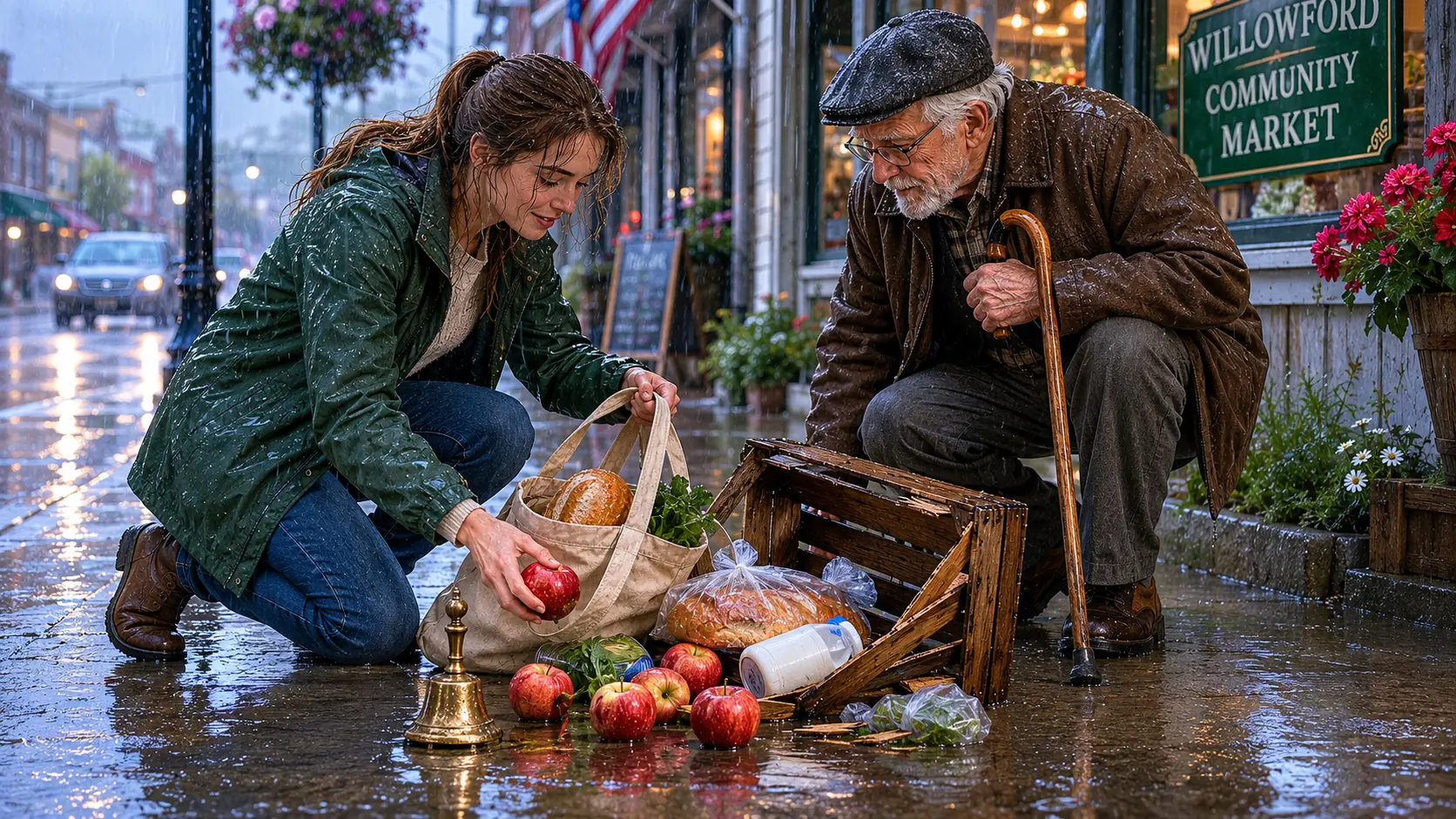
His house was six blocks away, a small white home with blue shutters and a narrow porch.
The walk was slow.
Rain ran along the curb. Cars hissed past. Wind tugged at the umbrella. Twice, Samuel had to stop and rest beneath storefront awnings.
He apologized each time.
Amelia answered the same way.
“We’re not late for anything.”
At his house, Samuel unlocked the door and stepped inside. The house smelled faintly of old books, cinnamon, and lemon furniture polish. Shelves lined the living room walls. In the center of the kitchen stood a small wooden table set for one.
But there were two teacups.
One on Samuel’s side.
One across from him.
Amelia pretended not to notice too much.
She placed the groceries on the counter.
“Do you need help putting these away?”
Samuel looked at the apples.
Then at the bell.
Then at the worn recipe card on the table.
“Actually,” he said quietly, “I don’t know if I remember how Clara made the cake.”
Amelia looked at the card.
The handwriting was old and neat.
Clara’s Apple Cake
But the paper was stained, and several steps were written in shorthand.
“Did she write this?”
“Yes. For herself, not for me. She assumed I knew what ‘enough cinnamon’ meant.”
Amelia smiled.
“That’s a dangerous phrase.”
“Very dangerous.”
She hesitated only a second.
“I can help you figure it out.”
Samuel looked embarrassed.
“You’ve done enough.”
“Mr. Whitaker, I work in a market. I know apples. I know flour. I know when a recipe is trying to be mysterious.”
That made him laugh again.
So they baked.
Samuel peeled the apples slowly while sitting at the table. Amelia mixed the batter. They guessed the cinnamon. Samuel insisted Clara used more brown sugar. Amelia trusted him. They put the cake in the oven and washed the dishes while rain tapped against the kitchen window.
As the cake baked, Samuel told stories.
Clara had owned The Blue Door Bookshop for thirty-two years. She kept the brass bell above the door until the shop closed. She remembered what every child liked to read. She hid mystery novels behind the counter for customers who claimed they were “too busy” to read. She believed books and cake solved different kinds of loneliness.
“She wanted to start a delivery shelf,” Samuel said.
“A what?”
“For people who couldn’t come to the shop anymore. Elderly customers, mostly. She wanted volunteers to bring books and small grocery items together. She said people needed stories and supper.”
Amelia grew still.
“That sounds like my idea.”
Samuel looked at her.
“What idea?”
She hesitated, then told him about The Good Basket.
Grocery deliveries.
Simple meals.
Supply runs.
Friendly check-ins.
A way for elderly neighbors to receive help without feeling like a burden.
Samuel listened carefully.
When she finished, he said, “Clara would have joined before you finished explaining.”
Amelia smiled.
“I wish I’d known her.”
Samuel looked at the brass bell.
“In a way, you met her today.”
When the apple cake came out of the oven, the whole kitchen filled with cinnamon, butter, and warm fruit. Samuel closed his eyes.
“That’s it,” he whispered.
Amelia placed the brass bell in the center of the table.
Samuel rang it once.
Then he cut two slices.
“You’re staying for cake,” he said.
It was not a question.
So Amelia stayed.
After that rainy day, Samuel began visiting the market more often.
At first, he came only for groceries. Then he began bringing Amelia things from Clara’s old bookshop: bookmarks, handwritten customer notes, little cards with book recommendations, and finally, a small notebook labeled:
Delivery Shelf Ideas
Inside, Clara had written plans that looked strangely like Amelia’s.
Names of elderly readers.
Favorite foods.
Favorite books.
Mobility needs.
Birthdays.
Notes like:
Mrs. Henry likes soup but pretends she only wants crackers.
Mr. Bell needs large print and someone patient.
No one should have to ask twice for bread.
Amelia read the notebook with tears in her eyes.
“She really planned this.”
Samuel nodded.
“She got sick before she could begin.”
For months, Amelia and Samuel worked quietly.
They started small.
On rainy days, Amelia delivered groceries to three elderly customers after her shift.
Samuel added paperback books from Clara’s old collection.
Mrs. Bell from the market donated extra bread at closing.
A high school student volunteered to help carry bags.
They called it The Good Basket, just like Amelia had written in her notebook.
But inside every basket, they placed a small card with a blue bell printed at the top.
For Clara.
The first winter, The Good Basket served eight people.
Then sixteen.
Then thirty.
It was never fancy.
A bag of groceries.
A loaf of bread.
Soup.
Tea.
A library book.
A note.
A knock at the door.
A few minutes of conversation.
But for people living alone, those minutes mattered.
One afternoon, Samuel handed Amelia a small box.
Inside was the brass bell.
Clara’s bell.
Amelia immediately shook her head.
“No. I can’t take this.”
“Yes, you can.”
“Samuel, this was hers.”
“And she would want it used.”
“It belongs in your house.”
“It has been in my house long enough,” Samuel said softly. “Now it belongs to the work she wanted to start.”
Amelia’s eyes filled.
“I don’t know what to say.”
“Say you’ll ring it when the room gets too quiet.”
She laughed through tears.
“I will.”
Samuel also gave her a letter. He had written it for a local community grant board, telling the story of the rainy sidewalk, the broken crate, the rescued bell, Clara’s apple cake, and The Good Basket.
At the end, he wrote:
Amelia Brooks understands that delivery is not only bringing things to a door. It is reminding someone that the world has not forgotten their address.
With Samuel’s letter, Clara’s notebook, and records from the first deliveries, Amelia applied for a small grant.
She won.
Not a fortune.
Not a building.
Not a van.
But enough to buy insulated bags, delivery carts, printed cards, basic insurance, and a small phone line for requests.
The Good Basket became official.
Samuel became the program’s first volunteer coordinator, though he preferred the title Bell Keeper.
Every Friday afternoon, he sat at the market coffee counter and helped organize delivery routes. He matched books with groceries. He remembered who liked apples and who hated oatmeal. He wrote little notes in Clara’s style.
Years passed.
The Good Basket grew across Willowford. Volunteers delivered groceries, library books, soup, medicine, and birthday treats. Elderly residents who once felt embarrassed to ask for help began calling because the baskets felt personal, not pitiful.
Amelia eventually became the program director full-time.
She never became rich.
But she became useful in exactly the way she had dreamed.
Samuel grew older, but he kept ringing Clara’s bell at every volunteer meeting. One clear ring meant the meeting was starting. Two meant tea was ready. Three meant Samuel had forgotten what two meant and everyone should laugh.
When Samuel passed away peacefully years later, Amelia placed Clara’s bell on the table at his memorial gathering, beside a warm apple cake made from the recipe they had rescued together.
His niece handed Amelia a final note.
Dear Amelia,
The day my crate broke in the rain, I thought I had almost lost Clara’s bell.
But you caught it.
Then you helped me hear it in the world again.
Keep bringing baskets. Keep bringing books. Keep ringing the bell when lonely rooms need proof they are awake.
With gratitude,
Samuel Whitaker
Years later, whenever people asked how The Good Basket began, Amelia told the truth.
“It began with an old man on a rainy sidewalk, a broken grocery crate, and a brass bell almost lost to a storm drain.”
Then she would show them Clara’s bell.
The gift was small.
A bell.
A notebook.
A letter.
But inside those small things was the future Amelia had been trying to build.
And every Friday, before the volunteers carried baskets across town, Amelia rang the bell once.
Clear.
Bright.
Small but strong.
A reminder that help did not always have to be grand.
Sometimes it only had to arrive at the door.