At twenty-four, Mia Reynolds believed that promises mattered most when keeping them became difficult.
She lived in a small town in Tennessee called Fairmont, where the streets were lined with old brick shops, white churches, maple trees, and houses with porches wide enough for rocking chairs. Mia was a young white American woman with fair skin, long honey-brown hair usually tied into a loose ponytail, warm hazel eyes, and hands that always smelled faintly of flour, sugar, or vanilla.
She worked at Rosewood Bakery, a small family bakery near the town square.
Her job was ordinary to most people. She wiped counters, packed pastries, refilled coffee, tied ribbons around cake boxes, carried flour bags, washed mixing bowls, and helped decorate simple birthday cakes when the head baker was too busy.
But to Mia, baking was never ordinary.
A cake could mean someone had lived another year.
A pie could mean someone was missed at Thanksgiving.
A tray of cookies could mean a neighbor did not know what to say, but still wanted to show up.
Mia dreamed of opening a small bakery one day called The Promise Oven, a place where people could order simple, affordable cakes for birthdays, anniversaries, memorials, and small family moments that deserved care even when money was tight.
But dreams needed money.
Ovens, permits, rent, mixers, display cases, insurance, staff, supplies, and courage.
Mia had a paycheck, a secondhand recipe notebook, and an old car that complained every morning before starting.
So she worked at Rosewood Bakery and learned everything she could.
One cold Saturday afternoon in early December, Mia finished her shift just as the sky began turning gray. The air smelled like snow, and the wind pushed dry leaves across the sidewalk. She buttoned her coat, tucked her tips into her pocket, and started walking toward the parking lot behind the bakery.
That was when she heard a crash.
Not a car crash.
Something smaller.
Metal scraping pavement.
A man gasping.
A box hitting the ground.
Mia turned.
Across the street, near the corner by the old post office, an elderly man had fallen beside a bicycle.
He was a white American man in his late seventies, thin but tall, with silver hair under a brown wool cap, a deeply lined face, and pale blue eyes behind thick glasses. He wore a dark green coat, brown trousers, and old leather gloves. His bicycle lay on its side, one wheel still spinning slowly.
Beside him, on the cold pavement, was a white bakery box.
The lid had come loose.
Inside was a small cake, tilted badly to one side.
The old man reached for it in panic.
“No, no, please,” he whispered.
Mia ran into the crosswalk.
“Sir! Don’t move too fast. Are you hurt?”
“I’m fine,” he said immediately.
But he was not fine.
His glove was scraped. His knee had hit the sidewalk. His breath came in short, frightened bursts. He was not looking at himself at all. He was looking only at the cake.
Mia crouched beside him.
“Let me help you sit up first.”
“The cake,” he said.
“I’ll get it.”
“It’s for my wife.”
“I know. I’ll get it.”
Mia carefully lifted the box from the pavement. The cake inside had shifted, but it had not fallen out. One side of the frosting was crushed against the cardboard. A few sugared flowers had broken. The words on top were smeared, but still partly readable.
Happy Birthday, Ruth.
The old man stared at it with devastated eyes.
“I ruined it.”
“No,” Mia said gently. “It’s damaged. That is not the same as ruined.”
He looked at her as if he wanted to believe her but could not.
Mia helped him sit on the low stone wall beside the post office. Then she picked up his bicycle and leaned it against the wall. The front basket had bent in the fall. A paper receipt from Rosewood Bakery was clipped to the handlebar.
“You bought this from our bakery,” she said.
He blinked.
“You work there?”
“Yes. My name is Mia.”
“Henry Wallace,” he said, still staring at the cake. “I picked it up for my wife’s birthday. She’s at Briar Glen Memory Care. I promised I’d bring her strawberry cake. She doesn’t remember much now, but she remembers strawberry cake.”
Mia’s heart tightened.
“How far is Briar Glen?”
“Six blocks.”
“You were riding there?”
“My car won’t start in the cold. The buses don’t run near the facility on weekends. I thought the bicycle would be fine.” He looked down at his scraped glove. “It was fine until the chain slipped.”
Mia looked at the bicycle. The chain had jumped off the gear and jammed near the rear wheel. The basket was bent inward. Even if Henry had not fallen, the cake would not survive another six blocks in that basket.
“Mr. Wallace,” she said, “you shouldn’t ride this the rest of the way.”
“I have to get there by four. Ruth has her afternoon tea then. If I bring it later, she’ll be tired.”
Mia checked her watch.
3:18 p.m.
The bakery was only across the street.
“Can you walk?”
“Yes.”
“Any dizziness?”
“No.”
“Pain?”
“My pride.”
“That heals slowly but usually isn’t fatal.”
Henry gave a surprised little laugh.
Mia closed the cake box carefully.
“Come with me.”
“To where?”
“The bakery. We’re going to fix the cake.”
His eyes widened.
“You can?”
“I can try.”
“I don’t have money for another one.”
“You don’t need another one. You need this one rescued.”
Mia walked slowly beside Henry back to Rosewood Bakery, carrying the damaged cake in both hands. Her boss, Mrs. Larkin, was wiping down the display case when they came in.
“Mia? I thought you left.”
“I did. Then Mr. Wallace’s bike chain slipped, and his cake got damaged.”
Henry removed his cap, embarrassed.
“I’m sorry to bring trouble.”
Mrs. Larkin looked at the cake, then at Henry’s scraped glove.
“Sit down first.”
Mia led Henry to a small table by the window and brought him a warm towel for his hand. Then she carried the cake behind the counter.
The damage was bad but not hopeless.
The cake itself was intact. The frosting on one side had been crushed. The top writing had smeared. Three strawberries had slid into the corner. The sugared flowers were broken, but there were extra decorations in the back.
Mrs. Larkin looked over Mia’s shoulder.
“You have about twenty-five minutes if he needs to leave by four.”
“I can do it.”
“Then do it.”
Mia put on an apron, washed her hands, and began.
She gently lifted the cake onto a clean turntable. She scraped away the crushed side frosting, smoothed fresh buttercream over it, and used a warm spatula to blend the repair into the original surface. She replaced the strawberries, added a border to hide the dented edge, and piped small white flowers where the broken sugared ones had been.
Then she rewrote the message.
Happy Birthday, Ruth.
Below it, in smaller letters, she added:
With Love, Henry.
When she brought the cake back out, Henry stood slowly.
His eyes filled with tears.
“It looks better than before.”
Mia smiled.
“It looks like it survived a journey.”
Henry laughed softly, but his chin trembled.
“She used to say that about us.”
“About you and Ruth?”
“Yes. Married fifty-six years. We survived everything. Bad jobs. A house fire. My surgery. Her diagnosis.” He looked at the cake. “Now some days she doesn’t know my name. But she remembers strawberry cake. Every birthday, her mother made one. Then she made them for our children. Then I learned to make one badly after her hands got too stiff.”
Mia looked at him.
“You made her cakes?”
“Terrible ones. But she ate them like they were fine dining.”
“That sounds like love.”
Henry nodded.
“It was. It is.”
Mia looked outside at the bicycle.
“I can drive you to Briar Glen.”
Henry shook his head immediately.
“You’ve already done enough.”
“No. I helped the cake. Now I’m helping the promise.”
Mrs. Larkin came from behind the counter holding her car keys.
“Use the delivery van,” she said.
Mia blinked.
“Are you sure?”
“The van has heat, and the cake won’t bounce around. Bring it back before dinner.”
Henry covered his face for a moment.
“You’re all too kind.”
Mrs. Larkin shrugged.
“We sell birthday cakes. We should probably believe in birthdays.”
Fifteen minutes later, Mia drove Henry to Briar Glen Memory Care with the repaired cake resting safely on the flat delivery tray.
Henry sat beside her, holding the box steady with both hands even though it did not need holding.
At the facility, a nurse greeted him warmly.
“Mr. Wallace, Ruth has been asking about tea.”
Henry smiled nervously.
“Did she ask about me?”
The nurse softened.
“She asked if the man with the cake was coming.”
Henry closed his eyes.
“I’ll take it.”
Mia carried the cake while Henry walked beside her.
Ruth Wallace sat near a window in the common room, wrapped in a pale blue cardigan. She was a small elderly woman with white hair, delicate hands, and eyes that seemed to drift between the room and some softer place far away.
Henry approached carefully.
“Hello, Ruth.”
She looked at him.
For one long second, nothing happened.
Then her eyes dropped to the cake box.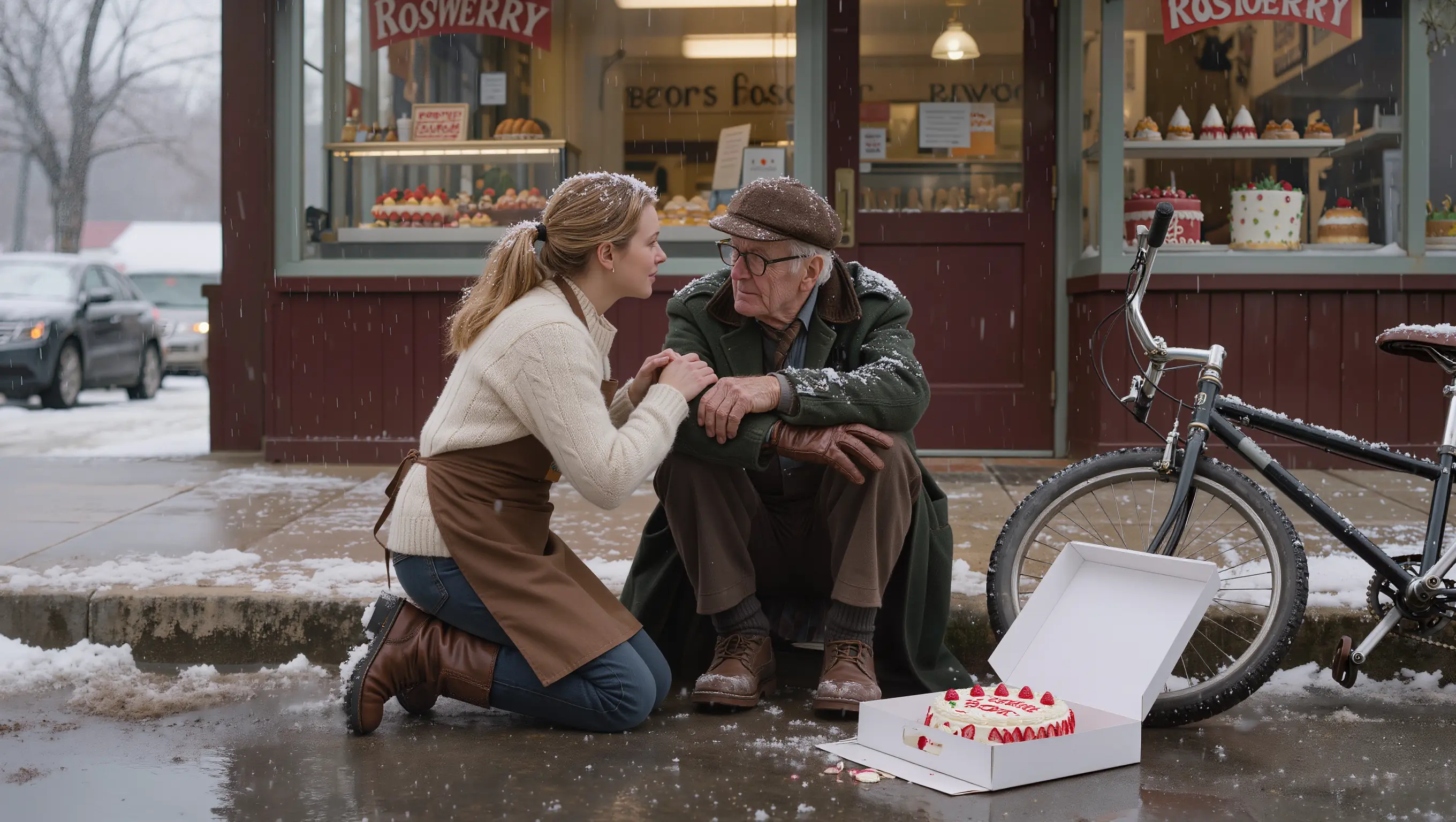
“Strawberry?” she asked.
Henry’s face broke into a smile.
“Yes. Strawberry.”
Ruth smiled too.
“My mother makes strawberry cake.”
Henry’s eyes filled.
“She made the best.”
Mia stood quietly near the doorway as the nurse helped open the box.
When Ruth saw the cake, she touched the words with her gaze.
“Henry,” she said softly.
Henry froze.
Ruth looked up at him.
“You brought cake.”
His voice shook.
“I promised.”
She patted the chair beside her.
“Sit down before it gets cold.”
Henry laughed through tears.
“Cake doesn’t get cold, Ruth.”
“You always argue.”
“I missed it.”
Mia had to look away.
She stayed only long enough to see Henry cut the first slice. Ruth took a bite, closed her eyes, and smiled like a girl remembering a kitchen from long ago.
On the drive back, Henry was quiet.
When Mia parked in front of the bakery, he turned to her.
“You didn’t just fix a cake.”
Mia smiled gently.
“I know.”
“You gave me one more birthday with her.”
Mia could not answer.
So she simply nodded.
After that day, Henry became a regular visitor at Rosewood Bakery.
Not every week, but often enough that Mia began expecting him. Sometimes he bought a small pastry. Sometimes he brought a handwritten recipe Ruth had once used. Sometimes he sat by the window and told stories about her.
Ruth had loved baking, especially cakes for people who claimed they did not need celebrating.
She baked for neighbors who lost jobs.
For children who passed exams.
For widows on anniversaries.
For nurses at the hospital.
“She said every cake was a way of telling someone, ‘Your day matters,’” Henry told Mia.
Mia wrote that in her notebook.
Your day matters.
One afternoon, Henry brought a small wooden recipe box.
It was old, with faded flowers painted on the lid and a tiny crack near one corner.
“This was Ruth’s,” he said.
Mia stared.
“Henry, no.”
He smiled.
“You don’t even know what’s inside.”
“I know enough.”
Inside were handwritten recipe cards.
Strawberry birthday cake.
Lemon tea loaf.
Sunday apple bars.
Chocolate cake for sad days.
Vanilla frosting for children who insist on extra.
Some cards had notes in Ruth’s handwriting.
Henry likes more berries but pretends not to.
Mia turned the cards carefully, her eyes blurring.
“This belongs to your family.”
“My daughter copied the cards. My son has photos. I want the box to go where it will keep working.”
“I can’t take this.”
“Yes, you can.”
“It’s too precious.”
“That is why it should not sit on my shelf.”
Henry placed one card on top.
Strawberry Birthday Cake.
“This recipe brought Ruth back to me for five minutes,” he said. “You helped make that happen.”
Mia cried then, right there at the bakery counter.
Henry also gave her a folded letter.
It was a recommendation to a local small-business baking fellowship. He had written about the accident, the repaired cake, Ruth’s birthday, and Mia’s dream of opening a bakery that treated small celebrations with dignity.
At the end, he wrote:
Mia Reynolds understands that a cake is not flour and sugar first. It is a promise made visible.
With Henry’s letter, Ruth’s recipe box, and Mrs. Larkin’s support, Mia applied.
She won a small fellowship.
Not a fortune.
Not a bakery building.
Not anything grand.
But enough to take a professional baking course, buy better tools, create a small catering menu, and start a Saturday pop-up table inside Rosewood Bakery.
She called it The Promise Oven Table.
Her first featured item was Ruth’s strawberry birthday cake, sold by the slice.
It sold out in two hours.
Mia wrote a small sign beside it:
From Ruth Wallace’s Recipe Box
For Every Day That Still Matters
Henry came that day with his daughter.
He bought two slices.
One for himself.
One to take to Ruth.
Ruth lived another year and a half.
Some days she remembered Henry. Most days she did not. But she always smiled when he brought strawberry cake. Mia made one for every birthday, every anniversary, and sometimes for no reason except that Henry called and said, “It’s a hard week.”
After Ruth passed, Henry came to the bakery with the empty cake box from her last birthday.
He placed it on the counter.
“She finished almost the whole slice,” he said.
Mia reached for his hand.
“I’m glad.”
“She didn’t know my name that day.” He smiled through tears. “But she said the cake tasted like home.”
Mia squeezed his hand.
“That counts.”
“Yes,” Henry whispered. “It does.”
Years later, Mia opened a tiny order-only baking business from a rented commercial kitchen. It was not a storefront. Not yet. But it was hers. She made small birthday cakes, memory cakes, anniversary cakes, and simple desserts for families who wanted something personal without paying luxury prices.
She kept Ruth’s recipe box on the top shelf of her worktable.
Not for decoration.
For direction.
Whenever she felt tired or unsure, she opened it and read Henry’s line again:
A cake is a promise made visible.
Henry passed away peacefully several years later.
At his memorial, Mia brought a small strawberry cake with white flowers and one simple message:
For Ruth And Henry
With Love
Their children cried when they saw it.
So did Mia.
When people later asked how The Promise Oven began, Mia always told the truth.
“It began with an old man, a broken bicycle chain, and a birthday cake that almost didn’t make it.”
Then she would tell them about the cold sidewalk, the fallen bike, the crushed frosting, the memory care room, and the moment Ruth looked up and remembered enough to say Henry’s name.
Henry had not given Mia a house.
Not a fortune.
Not a bakery.
He gave her a recipe box.
A letter.
And proof that the smallest cake could carry a whole life inside it.
And every time Mia wrote someone’s name in frosting, she remembered the old man holding a damaged cake on a winter sidewalk, whispering, “I promised.”
So she baked carefully.
Because promises deserved to arrive whole.