At twenty-four, Grace Whitman believed broken things were not always finished.
She lived in a small town in Connecticut called Briarfield, where old brick shops lined the main street, church bells rang every hour, and winter made the sidewalks glitter with thin sheets of ice.
Grace was a young white American woman with fair skin, long chestnut-brown hair usually tied into a loose ponytail, soft blue eyes, and careful hands that had always been drawn to tiny things: screws, gears, clasps, springs, latches, and locks.
She worked at Briarfield Clock & Watch Repair, a narrow little shop tucked between a bakery and a dry cleaner. Most people walked past without noticing it. But inside, the walls were covered with clocks of every size: grandfather clocks, mantel clocks, cuckoo clocks, pocket watches, wristwatches, and old brass alarm clocks that ticked like small stubborn hearts.
Grace was not the owner.
The shop belonged to Mr. Alden, an old watchmaker with thick glasses and a permanent frown that softened only when he held a perfect movement in his hands. He had hired Grace as a counter assistant two years earlier, but she had learned quickly.
She cleaned cases, replaced straps, polished crystals, organized parts, and slowly, under Mr. Alden’s strict supervision, began repairing simple watches.
She loved the work.
A watch was not only a device for telling time. Not really.
It could be a retirement gift. A father’s last possession. A wedding anniversary present. A soldier’s keepsake. A grandfather’s pocket watch handed down through generations. A watch could sit in a drawer for decades, then return to someone’s hand carrying all the years it had survived.
Grace’s dream was to become a master watchmaker and open a small repair studio of her own one day.
She already had a name for it.
Second Hour Watchworks.
She wanted it to be a place where people could bring old watches, clocks, jewelry boxes, music boxes, and tiny mechanical keepsakes others dismissed as too damaged to matter.
But dreams needed money, training, tools, certification, space, and time.
Grace had a paycheck, a borrowed workbench, and a notebook filled with sketches of gears and repair ideas.
So she worked at Briarfield Clock & Watch Repair and waited for each small chance to learn.
One bitter Friday afternoon in January, snow began falling just as Grace left the shop to bring Mr. Alden’s deposit envelope to the bank. The air was sharp, the sky already darkening, and the wind pushed snowflakes sideways along Main Street. People hurried past with their heads down, boots crunching over salted pavement.
Grace had almost reached the bank when she heard a sound that made her turn.
A sharp crack.
Then an old man’s cry.
“No!”
Across the sidewalk, near the steps of the church hall, an elderly man had slipped on the icy curb. He had not fallen completely, but one knee had struck the ground, and his gloved hand was stretched toward something small lying on the pavement.
A pocket watch.
The case had popped open.
The glass crystal had cracked.
Tiny pieces glittered on the wet sidewalk.
The old man stared at it as if the world had stopped.
He was a white American man in his late seventies, tall but frail, with white hair beneath a dark wool cap, a deeply lined face, pale blue eyes behind square glasses, and a long brown coat dusted with snow. One hand gripped the stone railing. The other trembled above the broken watch.
Grace ran.
“Sir, don’t touch the glass. I’ll get it.”
The man looked up, startled and devastated.
“It broke,” he whispered.
“I see. Let me help.”
She crouched carefully, blocking the wind with her body. First, she picked up the watch case. Then she gathered the loose crystal pieces with a handkerchief from her coat pocket, making sure none remained where someone might step. The watch movement was exposed but not completely shattered.
That mattered.
She knew enough to see hope.
“Are you hurt?” she asked.
The old man shook his head, but his eyes never left the watch.
“It was my wife’s gift.”
Grace softened.
“What’s your name?”
“Edward Collins.”
“I’m Grace Whitman. I work at the watch repair shop down the street.”
His eyes changed instantly.
“You do?”
“Yes.”
“Can it be fixed?”
Grace looked down at the pocket watch.
The outer case was dented. The crystal was broken. The hinge had sprung. The minute hand had loosened. Snowmelt had touched the edge of the dial, but the movement itself might still be safe if dried quickly.
“It can be looked at,” Grace said carefully. “And we need to get it out of the wet right now.”
Edward’s lips trembled.
“I was taking it to the church hall. Tonight is my wife’s memorial gathering. She passed last month. I wanted to place it beside her photograph.”
Grace looked at the church doors.
Warm yellow light glowed inside. Through the windows, she could see people arranging chairs and flowers.
The watch in her palm suddenly felt heavier.
“What was her name?” Grace asked.
“Margaret.”
Grace held the watch gently.
“Then we’re not letting the snow have Margaret’s watch.”
Edward covered his mouth for a moment.
“I should have put it in a box. I should have been more careful.”
“You slipped on ice. That’s not the same as carelessness.”
“But I broke it.”
“No,” Grace said firmly. “It broke while you were carrying love through a snowstorm. That is different.”
Edward looked at her as if those words had given him permission to breathe.
Grace helped him stand. His knee was sore but not badly injured. She guided him inside the church hall first, away from the cold, and asked one of the volunteers for a clean towel and a chair. Then she spread the towel over a small side table and laid the watch on it carefully.
People nearby glanced over, but Edward seemed too ashamed to explain.
Grace did it for him softly.
“Mr. Collins slipped outside. His watch needs to dry before more damage happens. Do you have a quiet room I can use for a few minutes?”
A woman organizing flowers nodded quickly.
“The choir room. This way.”
Grace turned to Edward.
“I need to take this to the shop, or at least open it properly and dry it. But I know you wanted it here tonight.”
Edward looked toward the front table where Margaret’s framed photo stood among white flowers.
“I wanted her to have it.”
Grace thought for a moment.
Then she said, “Do you have a photo of the watch from before it broke?”
Edward blinked.
“My daughter took one last week. On her phone.”
“Can you ask her to send it to me?”
“Why?”
“Because if I can’t make the watch whole before the memorial, I can at least make sure its story is present.”
Edward stared at her.
Then he nodded.
His daughter, Claire, arrived minutes later, anxious after hearing he had slipped. Grace explained quickly. Claire sent the photo of the intact pocket watch to Grace’s phone. It was a beautiful old watch with a silver case, engraved initials, and a small chain.
Grace rushed back to the watch shop.
Mr. Alden looked up from his workbench when she entered with snow in her hair and panic in her face.
“You were supposed to go to the bank.”
“I found an emergency.”
“Watches do not have emergencies.”
“This one does.”
She placed the broken pocket watch on the bench and explained.
Mr. Alden grumbled, but he leaned closer with his loupe.
“Hm.”
Grace waited.
That “hm” could mean anything.
Finally, he said, “Movement may be saved if we dry it now. Crystal replacement later. Case repair later. Hand can be reset. Hinge needs work.”
“So not ruined?”
He looked at her over his glasses.
“Did I say ruined?”
Grace nearly smiled.
They worked quickly.
Mr. Alden opened the case fully and removed moisture from the movement with proper care. Grace dried the case, cleaned the dial edges gently, separated the glass shards, and found a temporary display stand. The watch could not run that night. It should not be wound. But it could be stabilized.
Then Grace printed the photo Claire had sent, placed it in a small black frame from the shop’s display shelf, and wrote a neat card:
Margaret Collins gave this watch to Edward on their 40th anniversary.
He carried it tonight so time could sit beside memory.
Mr. Alden read it and said nothing.
But he did not remove it.
Grace returned to the church hall just before the memorial began.
Edward sat near the front, his daughter beside him. When he saw Grace, he stood too fast.
“The watch?”
“Safe,” Grace said. “It needs proper repair, but the movement isn’t lost.”
His eyes filled immediately.
Grace showed him the stabilized watch, now placed carefully on a soft cloth in a small open box. Beside it, she placed the framed photograph and the card.
Edward read the words.
His hand shook.
Then he whispered, “That’s exactly why I brought it.”
Claire began crying.
They placed the watch, the framed photo, and the card beside Margaret’s portrait.
During the memorial, Edward spoke.
He told everyone how Margaret had given him the pocket watch after forty years of marriage because, as she said, “You are always late, but I have decided to love you anyway.”
People laughed through tears.
He told them how the watch had sat on his bedside table every night after she died.
Then he looked toward Grace at the back of the room.
“And when I broke it in the snow tonight, I thought I had failed her. But a young woman told me it broke because I was carrying love through a storm. I believe Margaret would have liked that.”
Grace looked down, blinking hard.
After that night, Edward became part of Grace’s life.
He brought the watch to the shop for proper repair. Mr. Alden handled the most delicate work, but he allowed Grace to assist. She cleaned the case, sourced the correct crystal, polished the chain, and practiced resetting the hand under supervision.
The repair took weeks.
Edward came every Friday to check on it, though everyone knew he mostly came to talk.
He told Grace about Margaret.
She had been a music teacher. She loved punctuality, lemon tea, crossword puzzles, and clocks that chimed on the hour. She bought the pocket watch at an antique fair because Edward always joked that his sense of time had been damaged at birth.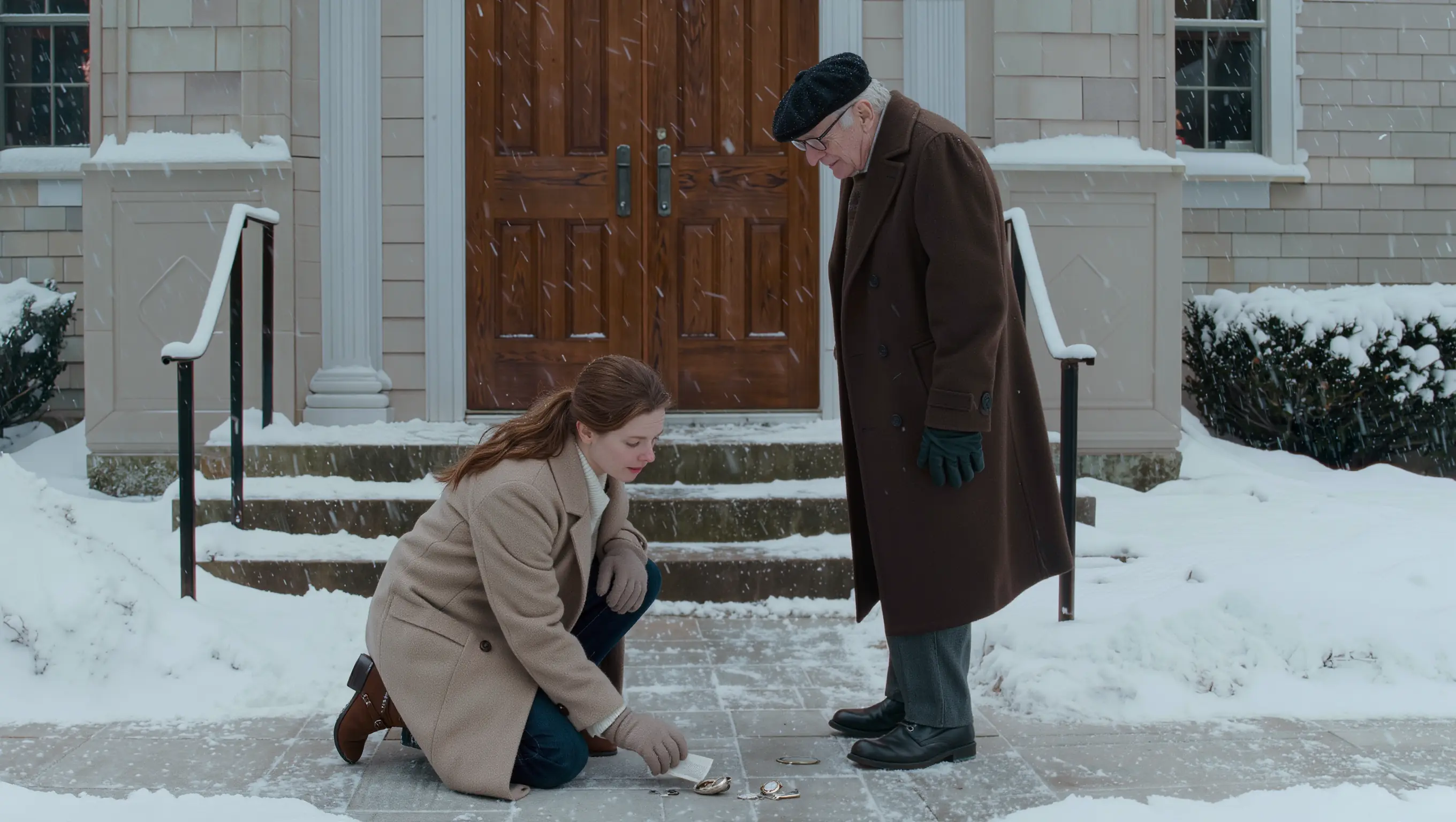
“She said if I carried a better watch, I might become a better man,” Edward said.
“Did it work?”
“No. But she kept me anyway.”
Grace laughed.
When the watch was finished, Edward held it in both hands and cried silently as it ticked for the first time since the fall.
Tick.
Tick.
Tick.
He closed his eyes.
“That sound,” he whispered. “I didn’t know how much I missed it.”
Grace understood.
Sometimes repair was not about making something useful again.
Sometimes it was about giving memory its sound back.
Over the next year, Edward brought more items to the shop.
Not because they all needed repair.
Because he wanted Grace to see them.
A small music box Margaret loved.
A clock from their first apartment.
A broken bracelet clasp.
A tiny brass key from an old jewelry box.
Grace repaired what she could, and Edward told the stories behind each piece.
One afternoon, he brought in a small wooden case.
Inside were watchmaking tools.
Old ones.
A case opener, tweezers, tiny screwdrivers, a brass loupe, oilers, a movement holder, and a small polishing cloth worn thin from use.
Grace stared.
“Whose were these?”
“My father’s,” Edward said. “He repaired watches in his spare time. Not professionally. He worked at the train station, but everyone brought him broken watches because he had patience.”
Grace touched the brass loupe.
“They’re beautiful.”
“I want you to have them.”
She jerked her hand back.
“No.”
Edward smiled faintly.
“I expected that.”
“I can’t take your father’s tools.”
“You can.”
“They belong to your family.”
“My children have the stories. These tools belong with hands that will use them.”
Grace shook her head.
“Edward, this is too much.”
“No,” he said gently. “Too much was kneeling in the snow believing I had broken the last gift Margaret ever gave me. This is a small box of tools.”
“To me, it isn’t small.”
“Then I chose correctly.”
Grace’s eyes filled.
Edward also gave her a folded letter.
It was written to a horology training program Grace had secretly wanted to apply to but had been afraid of. The tuition was not impossible, but the application required recommendations, experience, and confidence she did not have.
Edward’s letter told the story of the snow, the broken watch, the memorial, and Grace’s care.
At the end, he wrote:
Grace Whitman understands that a watch is not merely a machine. It is time made personal. Anyone can learn technique, but she already has reverence.
Grace cried in the back room after reading it.
With Edward’s letter and Mr. Alden’s reluctant but strong recommendation, Grace applied.
She was accepted into a part-time horology training program with a small scholarship.
Not a fortune.
Not a shop.
Not an easy path.
But a door.
For two years, Grace studied while still working at Briarfield Clock & Watch Repair. She learned advanced movement cleaning, case restoration, escapements, balance wheels, mainsprings, jewel replacement, dial preservation, and the delicate ethics of restoring heirlooms without erasing their age.
Edward visited often.
He always brought Margaret’s watch, though it no longer needed repair.
“I’m just keeping it supervised,” he said.
Grace would smile.
“It seems to be behaving.”
“Better than I ever did.”
Second Hour Watchworks began slowly.
Not as a full shop at first.
A small service under Mr. Alden’s roof: heirloom watch documentation, careful cleaning, story cards, and restoration consultations. Customers loved the idea of receiving not only a repaired watch, but a small written history of the object.
Grace created cards like the one she had written for Margaret’s memorial.
Who gave it.
When.
Why it mattered.
What was repaired.
What should be remembered.
Edward said those cards were Grace’s true invention.
“You do not only fix the ticking,” he told her. “You return the meaning.”
Years passed.
Grace completed her training. Mr. Alden eventually retired and let her take over more of the shop’s heirloom work. She did not become rich, but she became trusted. People came from nearby towns with watches wrapped in handkerchiefs, clocks carried in boxes, and stories they were afraid repair shops would not care about.
Edward grew older.
He still came once a month. His steps slowed, but Margaret’s watch remained polished and ticking in his vest pocket.
One spring afternoon, he handed Grace a tiny brass key.
“What is this?” she asked.
“The key to Margaret’s old jewelry box,” he said. “I found it in my desk.”
Grace smiled.
“Do you need the box opened?”
“No. I already opened it.”
“What was inside?”
“Letters. Photographs. A ticket stub from our first movie. Proof that she was sentimental and blamed me for it.”
Grace laughed softly.
Edward placed the key in her hand.
“I want you to keep it.”
“Edward…”
“It does not open anything you own,” he said. “Not literally.”
She looked at him.
He smiled.
“But sometimes a useless key is a useful reminder.”
“Of what?”
“That not every door is visible at first.”
Grace closed her hand around it.
Edward passed away the following winter.
At his memorial, Margaret’s pocket watch sat beside his photograph, ticking softly in the quiet church hall. Grace stood in the back, crying without shame.
Claire, Edward’s daughter, found her afterward.
“Dad wanted you to have this,” she said.
It was a small envelope.
Inside was the card Grace had written the night of Margaret’s memorial.
He carried it tonight so time could sit beside memory.
Edward had kept it all those years.
On the back, in his handwriting, he had added:
This is where Grace began.
Years later, when people asked how Second Hour Watchworks began, Grace told them the truth.
“It began with an old man slipping in the snow and a pocket watch breaking open on the sidewalk.”
Then she would show them Edward’s father’s tools, Margaret’s watch card, and the tiny brass key.
The gifts were small.
A box of tools.
A recommendation letter.
A key that opened nothing.
But inside them was everything Grace needed.
Skill.
Permission.
Direction.
And every time she opened the back of an old watch, she remembered Edward kneeling in the snow, whispering, “It was my wife’s gift.”
So she worked carefully.
Because broken things were not always finished.
Sometimes they were only waiting for the right hands to begin again.