At twenty-four, Claire Morgan believed a person did not have to be famous for their work to matter.
She lived in a small town in Maine called Harbor Falls, where the streets sloped toward the water, old wooden houses faced the bay, and rain could arrive suddenly from the gray sky without asking permission.
The town had fishing boats, a small library, a diner with fogged windows, a hardware store, a bakery, and a narrow art supply shop where Claire spent most of her days.
Claire was a young white American woman with fair skin, long chestnut-brown hair usually tied into a loose ponytail, soft gray eyes, and careful hands that were almost always stained with pencil dust, paint, or charcoal.
She worked at Harbor Falls Art & Frame, a small shop that sold sketchbooks, brushes, canvas boards, watercolor paper, pencils, pastels, and frames for people who wanted to protect something worth hanging.
Most customers came in for simple things.
A frame for a graduation photo.
A mat board for a family portrait.
A set of paints for a child.
A canvas for a hobby someone was too shy to call serious.
But Claire loved the quiet customers most.
The retired woman buying her first sketchbook after forty years of saying she was “not artistic.”
The teenager hiding comic drawings inside a math notebook.
The widower framing his wife’s last watercolor.
The old man who stood in front of the brush display for twenty minutes before choosing the cheapest one.
Claire noticed them because she understood them.
She wanted to become an illustrator.
Not a celebrity artist. Not someone whose paintings sold for absurd prices in white rooms where people whispered. She wanted to make picture books, community murals, memory portraits, and art that helped ordinary people see their own lives as beautiful.
But dreams needed time, training, supplies, applications, connections, and courage.
Claire had a paycheck, an old drawing tablet, a stack of unfinished sketches, and a notebook full of ideas she rarely showed anyone.
So she worked at the art shop and kept drawing at night.
One Thursday afternoon in early April, the weather changed without warning.
The morning had been cloudy but dry. By four o’clock, heavy rain swept in from the harbor, hitting the shop windows so hard the glass seemed to tremble. The street darkened. Water rushed along the curb. People ran between storefronts with bags over their heads, coats pulled tight, and shoes splashing through sudden puddles.
Claire was closing a box of watercolor sets near the front counter when she saw something through the rain-streaked window.
An elderly man stood across the street beside the public bus stop.
He was trying to protect a large cardboard portfolio case under his coat.
But the case had split open.
Several paintings slid out into the rain.
Claire froze for one second.
Then she ran.
She grabbed a large plastic frame sleeve from behind the counter, pushed through the shop door, and hurried across the street through the downpour.
“Sir!” she called. “Don’t bend down. I’ll get them.”
The elderly man looked up, panicked.
He was a white American man in his late seventies, tall but stooped, with thin white hair plastered to his forehead, a deeply lined face, and pale blue eyes behind rain-specked glasses. He wore a dark brown coat, gray trousers, and old leather shoes now soaked through. One hand gripped a wooden cane. The other pressed the broken portfolio case against his chest.
On the sidewalk, watercolor paintings were already getting wet.
One had slid toward the gutter.
Another lay face down near a puddle.
A third was curling at the edges under the rain.
“No,” the man whispered. “No, no, please.”
Claire dropped to her knees on the wet sidewalk and moved quickly but carefully. She knew wet watercolor paper could tear if handled roughly. She slid her hands beneath each sheet, supporting the whole page, then placed them inside the plastic frame sleeve.
The painting near the gutter was almost touching the rushing water.
Claire lunged and caught it just before it slipped away.
The old man tried to step forward, but his cane slipped on the slick pavement.
Claire turned sharply.
“Please stay still. The paintings are safer if you don’t fall.”
He froze, breathing hard.
“They’re my wife’s,” he said.
Claire looked down at the wet papers in her hands.
That changed everything.
“What’s your name?” she asked gently.
“Arthur Bell.”
“I’m Claire Morgan. I work at the art shop right there.”
His eyes lifted with desperate hope.
“You do?”
“Yes. Come with me. We need to dry these properly before the paper buckles worse.”
Arthur looked at the broken case.
“I was taking them to be framed.”
“To our shop?”
He nodded.
“My daughter told me to bring them before the rain. I thought I could make it from the bus stop.”
Claire looked at the downpour, the torn cardboard, and the trembling old man.
“You almost did. Let’s finish the trip.”
She tucked the plastic sleeve under her own jacket and offered Arthur her arm.
He hesitated.
“I don’t want to ruin your coat.”
“My coat is not a watercolor. It will survive.”
For the first time, a small laugh escaped him, weak and broken but real.
Claire guided him across the street slowly. Rain soaked her hair and sleeves. Arthur moved carefully, his cane tapping through shallow water. By the time they entered Harbor Falls Art & Frame, both of them were dripping onto the floor.
Claire’s boss, Marlene, looked up from the framing table.
“What happened?”
“Watercolor emergency,” Claire said.
Marlene immediately moved aside.
“Back table. Clean blotting paper. No heat.”
Claire nodded.
Arthur stood near the door, shivering and ashamed.
“I’m making a mess.”
Marlene handed him a towel.
“Floors dry. Paintings don’t always. Sit.”
Arthur obeyed.
Claire spread clean blotting paper across the large worktable. Then she opened the plastic sleeve and carefully laid out the paintings.
There were six.
A small blue house on a hill.
A harbor at dawn.
A woman’s hands holding a teacup.
A child running through tall grass.
A kitchen window with rain on the glass.
And one unfinished portrait of Arthur himself, sitting in a chair by a lamp, looking down at an open book.
Claire’s breath caught.
“These are beautiful.”
Arthur looked at them from his chair.
“My wife painted them.”
“What was her name?”
“Elena.”
The name came out softly, almost like prayer, though there was no religion in it. Just love.
“She passed seven months ago,” Arthur said. “I found these in her studio closet. I knew she painted, of course, but she never showed many people. She always said they weren’t finished enough.”
Claire looked at the harbor painting. The light was delicate. The brushwork was gentle but confident. The kind of work made by someone who had looked at ordinary things for a long time and loved them without needing applause.
“She was wrong,” Claire said.
Arthur blinked.
“She would have argued with you.”
“I would have argued back.”
That made him smile faintly.
Claire began the rescue.
She placed absorbent sheets under each painting and covered the wettest edges with clean blotting paper. She used light pressure, never rubbing. She changed the paper often, lifted corners carefully, and weighed the curling edges with clean boards.
Marlene brought a space heater but placed it far away, only to warm the room, not the artwork.
“No direct heat,” Claire said.
“I know,” Marlene answered. “I trained you, remember?”
Arthur watched every movement.
“I should have wrapped them better.”
“You used what you had.”
“I should have checked the weather.”
“The weather should have behaved.”
He gave another faint laugh.
Claire glanced at him.
“Were these for a special reason?”
Arthur looked at the paintings.
“My daughter is moving me into a smaller apartment next month. Elena’s studio has to be cleared. I didn’t want the paintings packed away in boxes. I thought if I framed a few, maybe the new place would feel less like I was leaving her behind.”
Claire’s hands stilled for a moment.
Then she said, “That is a very good reason.”
Arthur looked down.
“I almost lost them before I even got them here.”
“But you didn’t.”
“Because you ran into the rain.”
Claire looked at the unfinished portrait of him.
“Because someone needed to.”
For the next hour, Claire and Marlene worked to stabilize the paintings. Some edges were damaged. One corner had softened. The kitchen window painting had a faint water mark along the bottom. But the images survived.
Arthur’s shoulders slowly relaxed.
When the paintings were safe enough to leave flat overnight, Claire brought him tea from the tiny back office.
He held the paper cup with both hands.
“Elena used to paint when she thought no one was watching,” he said. “I would pass the doorway and see her looking at a pear or a chair or a window like it had told her a secret.”
Claire smiled.
“That sounds like an artist.”
“She never called herself that.”
“Many real artists don’t.”
Arthur looked at Claire then.
“Do you?”
“Do I what?”
“Call yourself an artist?”
Claire looked down at her paint-stained fingers.
“Not usually.”
“Why not?”
She shrugged.
“I work in an art shop. I draw at night. That feels different.”
Arthur studied her quietly.
“Elena said the same thing for thirty years.”
Claire did not answer.
The next day, Arthur came back with his daughter, Susan. The rain had stopped, and weak sunlight shone through the shop windows.
Claire showed them the paintings.
Susan began crying immediately.
“I’ve never seen this one,” she said, touching the air above the painting of the blue house. “That’s Grandma’s house.”
Arthur nodded.
“Elena missed it.”
Susan looked at the unfinished portrait of her father.
“She painted you like that?”
Arthur swallowed.
“I didn’t know.”
Claire helped them choose simple frames. Nothing too fancy. Elena’s paintings did not need decoration. They needed protection.
When Arthur reached for his wallet, Marlene gave him a fair price, lower than usual but not insulting.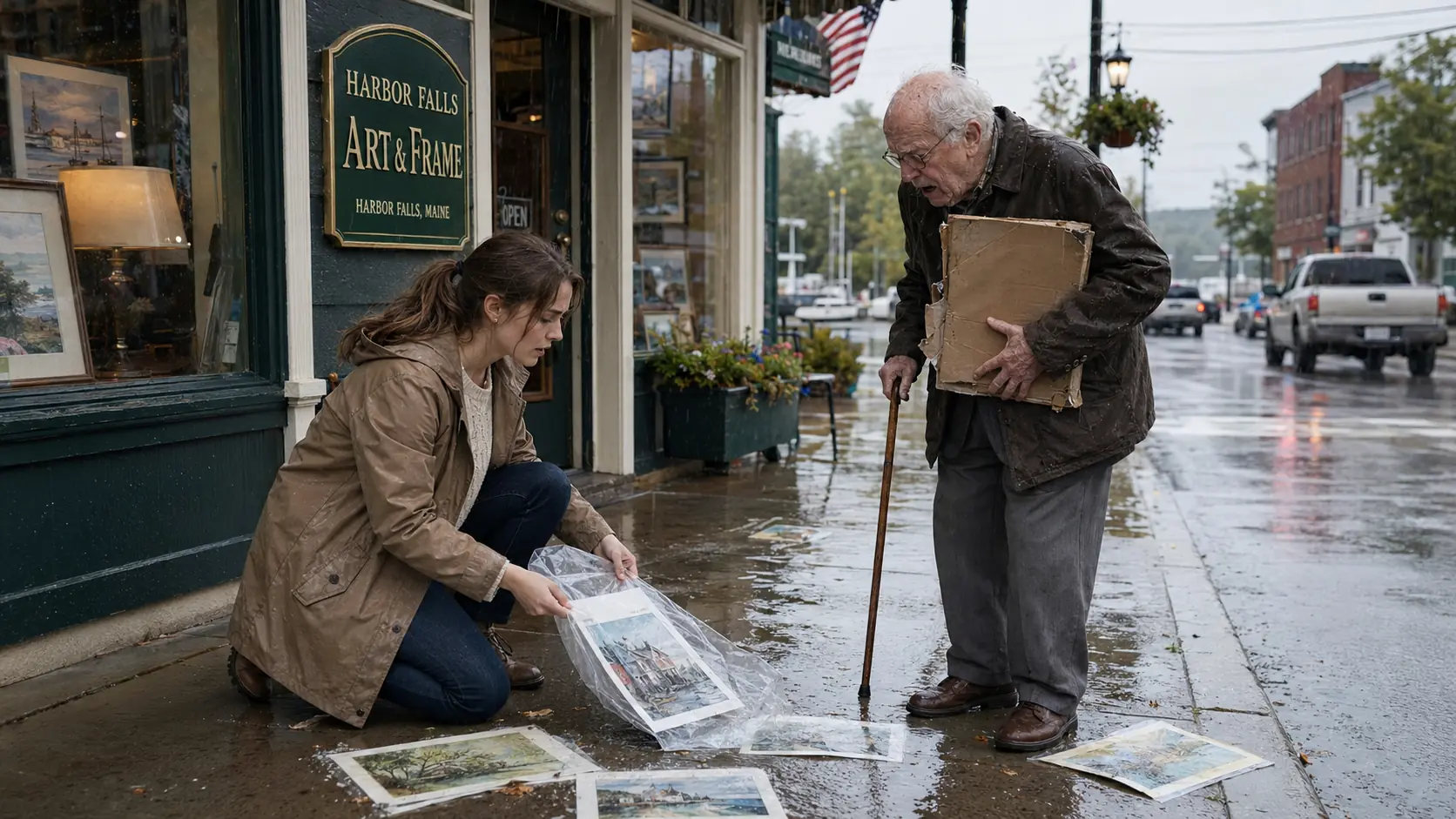
Arthur noticed.
“You reduced the cost.”
Marlene shrugged.
“We have a rain damage discount.”
Claire looked at her.
“We do?”
“We do now.”
Arthur smiled through tears.
After that, Arthur began visiting the shop every Wednesday.
At first, it was about the framing. Then it became about Elena.
He brought more paintings. Sketchbooks. Old brushes. Notes written in the margins of watercolor pads. Small studies of fruit, hands, windows, chairs, trees, shoes by the door.
Claire helped organize them.
She scanned the fragile ones.
She wrote titles when Arthur remembered them.
She helped Susan create a small family album of Elena’s artwork.
The more Claire saw, the more she understood Elena.
Elena had painted ordinary life with deep attention. Not dramatic moments. Not perfect scenes. A chipped mug. Rain on glass. Arthur reading. Susan as a child asleep on the couch. A bowl of lemons. A laundry line in summer.
“She painted like she was saving proof,” Claire said one afternoon.
Arthur nodded.
“Proof of what?”
“That we were happy in small ways,” he answered.
Claire wrote that sentence down later.
Arthur noticed.
“You write things too?”
“Sometimes.”
“And draw?”
“Yes.”
“Show me.”
Claire laughed nervously.
“No.”
“Then I will ask again next week.”
He did.
And the week after.
Finally, Claire brought one sketchbook.
She expected polite praise.
Instead, Arthur looked through it slowly, seriously.
There were drawings of shop windows, lonely benches, elderly hands, children with backpacks, rainwater on sidewalks, people waiting for buses, a woman reading under a lamp.
Arthur stopped at one drawing of an old man sitting alone in a diner booth, one hand resting on a coffee cup.
“This one,” he said.
Claire’s stomach tightened.
“What about it?”
“You saw him.”
“I just drew him.”
“No,” Arthur said. “You saw him.”
Claire looked away.
“Elena would have said that matters.”
Over the months, Arthur became the first person outside Claire’s family who treated her dream like something solid. He asked what she wanted to make. She told him about picture books, community art, memory portraits, and illustrated stories of ordinary people.
He listened.
Then he said, “You need to apply to that regional illustration workshop.”
Claire stared at him.
“How do you know about that?”
“You left the flyer on the counter last week.”
“I was just looking.”
“Looking is often fear wearing a nicer coat.”
Claire laughed, but he did not.
“Apply.”
“It costs money.”
“Apply first. Panic second.”
She did.
A few weeks later, she was accepted, but without enough financial aid to attend.
Claire tried to pretend it did not hurt.
Arthur saw through her immediately.
The next Wednesday, he came to the shop carrying a small wooden box.
“I have something for you.”
Claire shook her head.
“Arthur, no.”
“You don’t know what it is.”
“I know that sentence always means trouble.”
He smiled and opened the box.
Inside were several old watercolor brushes, carefully cleaned, their handles worn smooth. One had a red-stained tip. Another was thin and delicate, perfect for fine lines. Beside them was a folded note in Elena’s handwriting.
For the hand brave enough to begin.
Claire froze.
Arthur’s voice softened.
“Elena bought these when she was young. She kept them long after she replaced them because she said they remembered her first courage.”
Claire’s eyes filled.
“I can’t take these.”
“Yes, you can.”
“They were hers.”
“And they have been waiting for work.”
“They belong to your family.”
“My family has her paintings. Her sketchbooks. Her letters. These brushes should go to someone still afraid to call herself an artist.”
Claire covered her mouth.
Arthur also handed her an envelope.
Inside was a letter of recommendation.
He had written about the rain, the paintings, and Claire’s care. He wrote about her drawings too, about the way she noticed people other artists might turn into background.
At the end, he wrote:
Claire Morgan understands that art is not only what we display. It is what we rescue from being unseen.
With Arthur’s letter, Marlene’s support, and new confidence that still trembled but did not run away, Claire applied for additional workshop aid.
This time, she received a partial scholarship.
Not a fortune.
Not a magical solution.
But enough.
She attended the workshop that summer.
She learned illustration techniques, portfolio building, visual storytelling, watercolor preservation, and how to turn ordinary human moments into images that carried emotional weight. She used Elena’s fine brush for her final project: a series of illustrations called People Who Wait In The Rain.
It won a small student award.
More importantly, it made Claire believe she was allowed to continue.
When she returned to Harbor Falls, she began a small project at the art shop called Seen In Small Ways. People could bring a photograph, object, or memory, and Claire would create a simple illustrated keepsake: a grandmother’s kitchen window, a father’s fishing boots, a mother’s teacup, a childhood porch, a favorite chair.
Arthur was her first customer.
He asked for an illustration of Elena’s studio.
Not perfect.
Not cleaned up.
Exactly as it had been.
Brushes in jars.
A blue sweater over a chair.
Watercolor paper stacked unevenly.
A window looking toward the harbor.
When Claire gave him the finished piece, he cried.
“That is where she still is,” he whispered.
The project grew slowly.
People came with stories. Claire drew them. Some paid. Some could not pay much. Marlene gave her a corner of the shop wall to display samples. Eventually, Claire built a small portfolio and began getting illustration work from local writers, families, and community groups.
Arthur came to every small exhibit she held.
He always stood near Elena’s rescued paintings and told people, “She ran into the rain for those.”
Claire always blushed.
Years passed.
Claire became a working illustrator. Not famous. Not rich. But real. She illustrated children’s books for small publishers, drew memory portraits, and taught community art classes for seniors who insisted they were “too old to begin.”
She always told them, “You are not too old. You are just under-invited.”
Arthur grew older.
He moved into the smaller apartment, but Elena’s framed paintings filled the walls. Claire visited sometimes to help hang new pieces or drink tea by the window.
One spring afternoon, he gave her one final gift.
It was Elena’s favorite brush.
The one she had used for the kitchen window painting.
The handle was pale wood, worn near the grip, with a tiny mark of blue paint that never washed away.
Arthur placed it in Claire’s hand.
“She wrote about this brush in her notebook,” he said. “She said it helped her paint light without chasing it too hard.”
Claire’s eyes stung.
“Arthur…”
“I know. You can’t take it.”
She laughed through tears.
“I was going to say that.”
“And I was going to ignore it.”
He closed her fingers around the brush.
“Use it when you forget that small things deserve attention.”
Arthur passed away the following winter.
At his memorial gathering, Susan displayed Elena’s paintings around the room, along with Claire’s illustration of the studio. People stood before them quietly, seeing not only Elena’s art, but the life she had painted.
Afterward, Susan handed Claire a note Arthur had left.
Dear Claire,
The day Elena’s paintings fell into the rain, I thought I had failed her.
You knelt on the wet sidewalk and gathered every page like each one carried a heartbeat.
Because it did.
You saved her work.
Then you let it teach you.
Do not wait thirty years to call yourself what you are.
With gratitude,
Arthur Bell
Claire framed the note above her desk.
Years later, whenever people asked how her career began, she told them the truth.
“It began with an old man in the rain and watercolor paintings sliding toward the gutter.”
Then she would show them Elena’s brush.
The gift was small.
A brush.
A letter.
A sentence of permission.
But inside those small things was the future Claire had been afraid to claim.
And every time rain tapped against her studio window, she picked up Elena’s brush and remembered Arthur’s words.
Do not wait thirty years to call yourself what you are.
So Claire painted.
And this time, when someone asked what she did, she answered clearly.
“I’m an artist.”