At twenty-five, Emily Harper had learned that winter did not always announce danger loudly.
Sometimes danger came quietly.
It came as a thin layer of ice on a sidewalk.
It came as a bus route delayed by twenty minutes.
It came as an old man standing too long in the cold, pretending he was only resting.
It came as shaking hands hidden inside coat pockets, pale lips, and a voice that kept saying, “I’m fine,” even when fine had already disappeared.
Emily noticed those things because she had spent most of her life around people who tried not to need help.
Her father had been one of them.
He had worked as a delivery driver in Glenwood, Ohio, for nearly thirty years. He drove through rain, snow, summer heat, and winter darkness, carrying packages to homes, stores, clinics, and small businesses across town.
He rarely complained.
Even when his back hurt, he said he only needed to stretch.
Even when his hands shook from cold, he said gloves were for people who didn’t know how to work.
Even when he came home exhausted, he smiled and asked Emily about school before he ever took off his boots.
When Emily was sixteen, he slipped on an icy loading dock during a January storm.
He did not call anyone.
He drove himself home with a fractured wrist and bruised ribs because, as he told her mother later, “I didn’t want to make a fuss.”
Emily never forgot the fear on her mother’s face that night.
She never forgot the way pride had nearly turned a bad fall into something worse.
Since then, she had become sensitive to a certain kind of danger.
Not the dramatic kind.
The quiet kind.
The kind that hid behind politeness.
The kind that waited for someone to notice.
Glenwood was a modest town in central Ohio, the kind of place where Main Street still had a diner, a hardware store, a community center, a small library, a pharmacy, and a row of older brick buildings with second-floor apartments above them.
In winter, the town looked both charming and tired.
Snow gathered along the curbs in gray piles.
Salt stained the sidewalks.
Streetlights glowed through icy air.
People hurried from cars to doorways with their shoulders raised and their faces hidden in scarves.
Emily lived in a small apartment above a used bookstore, three blocks from the community center where she worked.
The apartment was drafty in winter and too hot in summer, but she loved it anyway.
She loved the bookshelves built into the wall.
She loved the view of Main Street from her kitchen window.
She loved being close enough to walk to work, even when walking meant battling snow and wind for fifteen minutes.
Emily was a young white American woman with fair skin, long chestnut-brown hair usually tied into a low ponytail, soft gray eyes, and a calm, steady way of speaking that made people trust her during stressful moments.
She worked at the Glenwood Community Center as a program assistant.
Her job was supposed to involve scheduling classes, helping with youth programs, organizing senior activities, and managing sign-in sheets.
In reality, she did whatever needed doing.
She served soup during senior lunch.
She carried boxes of donated coats.
She helped children finish homework.
She printed forms for people who did not own printers.
She called families when elderly visitors forgot pickup times.
She made coffee for volunteers.
She cleaned tables.
She taped signs to doors.
She listened.
That was the part people did not put in her job description.
Listening.
A widower who came in every Tuesday to talk about his late wife’s garden.
A grandmother who worried her grandson was falling behind in school.
A retired nurse who pretended she came for chair yoga but mostly came because her apartment was too quiet.
Emily listened to all of them.
She believed community work was not only about programs.
It was about noticing when someone was one bad afternoon away from being alone with a problem too heavy to carry.
Her dream was to create a program called Safe Passage.
It would help elderly residents during dangerous weather.
Not an ambulance service.
Not a medical program.
Not something complicated.
Just a practical, human network.
Volunteers who could check on seniors during storms.
A phone line people could call if they were stranded downtown.
Safe places like the library, diner, pharmacy, and community center where older people could wait indoors.
Emergency ride vouchers.
A list of residents who needed weather check-ins.
Reflective umbrellas.
Warm packs.
Simple cards that said:
If the weather is bad and I seem unsafe, please call Safe Passage.
Emily had written all of it in a blue notebook she carried in her work bag.
But dreams required permission.
Funding.
Volunteers.
Insurance.
Training.
Support from the town council.
And courage.
Emily had the notebook.
That was all.
So for the moment, she kept doing the work in front of her.
One person at a time.
The night everything changed began with a winter storm that came faster than anyone expected.
It was a Thursday in February.
The morning had been cold but clear, with hard blue sky and sunlight glinting off old snowbanks.
By lunch, clouds had moved in.
By three o’clock, weather alerts began buzzing on phones across the community center.
Winter advisory.
Freezing rain possible.
Wind gusts.
Falling temperatures.
Emily stood in the community center kitchen, stacking bowls after the senior lunch program, while the volunteers discussed whether the roads would freeze before dinner.
Mrs. Alvarez, who ran the pantry shelf, shook her head at the window.
“Sky looks mean.”
Emily glanced outside.
The clouds had turned heavy and low.
“I should call the evening literacy group and cancel,” she said.
“You should,” Mrs. Alvarez replied. “People always think they can beat the weather. Weather likes to prove otherwise.”
By four o’clock, the director decided to close the center early.
Emily helped call families, cancel classes, and make sure the senior visitors had rides.
She walked Mrs. Parker to her daughter’s car.
She helped Mr. Jenkins zip his coat because his fingers were stiff with arthritis.
She sent two volunteers home with extra soup.
By five-thirty, the building was nearly empty.
Emily stayed behind to finish paperwork for a small grant application.
She knew she should go home.
But the deadline was the next morning, and the Safe Passage notebook sat open beside her computer, tempting her to add just one more paragraph.
Outside, the rain began.
It struck the windows lightly at first.
Then harder.
Freezing rain made a different sound than ordinary rain.
Sharper.
More brittle.
It tapped against the glass like tiny thrown beads.
Emily looked up.
The street beyond the window had begun to shine.
The sidewalk was wet, but the temperature had dropped enough that the wetness was turning dangerous.
She checked the time.
6:08 p.m.
The last bus toward her apartment would come in twelve minutes.
She closed the laptop, packed her notebook, and put on her coat.
In the kitchen, there were still leftovers from senior lunch: chicken vegetable soup, soft rolls, and a few containers of rice pudding.
Emily hesitated.
Then she packed two soup containers and two rolls into a paper bag.
She always hated leaving food behind.
She turned off the lights, locked the side door, and stepped into the storm.
The cold hit her immediately.
It was not the soft cold of snow.
It was hard, wet, and mean.
Rain struck her face, then froze against her scarf.
The sidewalk glistened under the streetlights.
Cars moved slowly down Main Street, tires hissing through slush and water.
The wind pushed the rain sideways, making Emily’s umbrella almost useless before she had even opened it.
She lowered her head and started toward the bus stop.
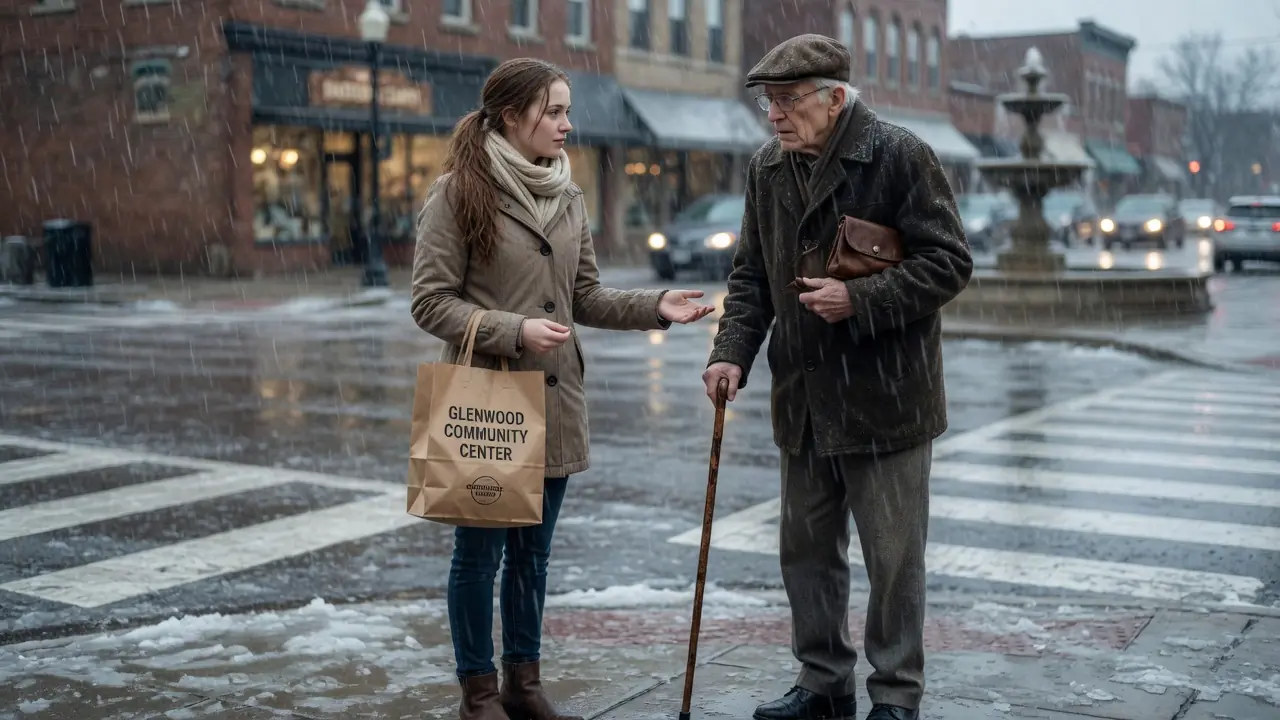
That was when she saw him.
Across the street, near the old town fountain, an elderly man stood at the corner.
He was alone.
At first, Emily thought he was waiting for someone.
Then she saw the way he swayed.
He was tall but thin, probably in his late seventies, with silver hair beneath a worn brown flat cap, pale skin, and blue eyes behind glasses speckled with rain.
He wore a dark wool coat, gray trousers, and polished shoes that were not made for ice.
One hand clutched a wooden cane.
The other held a small leather pouch pressed tightly against his chest beneath his coat.
He looked toward the crosswalk.
Then toward the bus stop.
Then back again.
His cane slipped slightly.
He caught himself, but barely.
Emily’s heart jumped.
A car turned onto Main Street, its tires spraying water along the curb.
The old man stepped back too quickly, and his shoe slid.
He grabbed the streetlamp with one hand.
Emily ran.
“Sir!” she shouted over the wind. “Wait!”
The old man turned toward her, startled.
“I’m all right,” he called.
But his voice shook.
His body shook too.
Emily reached him and held her umbrella over him, though the wind immediately tried to turn it inside out.
“You’re not all right,” she said. “You’re standing on ice.”
“I was trying to get home.”
“Where do you live?”
“Elm Street,” he said. “Only a few blocks.”
His teeth chattered on the last word.
Emily looked at his bare hands.
They were red from the cold.
“Do you have gloves?”
“In my pocket, I think.”
“Can you feel your fingers?”
He hesitated.
That hesitation told her enough.
“What’s your name?” she asked.
“Henry Wallace.”
“I’m Emily Harper. I work at the community center.”
“The center,” he repeated, as if trying to place it.
“Yes. It’s right behind us.”
“I know it.” He blinked against the rain. “My wife used to go there for painting class.”
“What was her name?”
“Margaret.”
His voice softened when he said it.
Then his face tightened again as the wind struck them.
“I need to get home.”
“Henry, you can’t walk alone in this.”
“I’ve walked this street for forty years.”
“I believe you.”
“I know the way.”
“I believe that too.”
He looked at her, confused by the lack of argument.
Emily kept her voice steady.
“But tonight the sidewalk is iced, the rain is freezing, and your hands are shaking. Knowing the way doesn’t mean you should walk it alone.”
Henry looked down.
His pride was visible.
So was his fear.
“I don’t want to be trouble.”
“You’re not trouble,” Emily said. “You’re a person in a dangerous storm.”
“I’m almost home.”
“Then let me help you get the rest of the way.”
He looked toward the crosswalk again.
A truck passed, sending up a sheet of dirty water.
Henry flinched.
Emily saw it.
His fear was not theoretical.
He knew he was in danger.
She softened her tone.
“May I walk beside you?”
Henry swallowed.
Then he nodded once.
“Yes.”
Emily folded her umbrella because the wind had made it more dangerous than helpful.
She took Henry’s arm gently, careful not to grab him.
He leaned on her more than he meant to.
That frightened her.
“Slow steps,” she said.
“I’m sorry.”
“Don’t apologize. Just step.”
They moved along the sidewalk.
The first few steps were the worst.
Henry’s cane slipped twice.
Emily shifted her weight and guided him closer to the building fronts, where the sidewalk had a little more texture.
Rain struck the awnings overhead.
The frozen pavement reflected the streetlights in broken yellow lines.
Every step required attention.
Henry breathed heavily.
Emily could feel the tremor in his arm through his coat.
“You were downtown for errands?” she asked, partly to keep him alert.
“Yes,” he said. “Pharmacy first. Then the bank. Then I meant to stop at the diner.”
“The diner?”
“My daughter was meeting me there.”
“Is she there now?”
“No.” His mouth tightened. “She called and said the roads near her house were bad. She told me to go straight home and said she would call later.”
“But you were already out.”
“Yes.”
“And the weather got worse.”
He nodded.
“I thought I could make it.”
Emily heard the old pain inside the sentence.
Not only I thought I could make it home.
I thought I could still manage.
They reached the first crosswalk.
The curb was hidden beneath dark water.
Emily stopped.
Henry looked at her.
“What is it?”
“The curb is iced.”
“I can step down.”
“Wait.”
The pedestrian signal changed.
A car slowed, but another came behind it too quickly and honked.
Emily did not move.
Henry shifted anxiously.
“We should cross.”
“Not yet.”
The second car slid slightly as it braked.
Not much.
But enough.
Henry saw it too.
His face went pale.
Emily’s grip tightened.
“After this one,” she said.
When the street cleared, Emily stepped first, testing the curb.
Then she guided Henry down.
His shoe slipped the moment it touched the lower pavement.
Emily braced herself and held him upright.
For one terrifying second, his full weight leaned into her.
The cane scraped sideways.
The leather pouch nearly fell from his coat.
“I’ve got you,” Emily said quickly. “I’ve got you.”
Henry gasped.
“I’m sorry.”
“No apologies. Breathe.”
He nodded, shaking.
They crossed slowly.
A driver waited patiently this time, headlights glowing through the icy rain.
When they reached the other side, Henry leaned against the brick wall of the closed florist shop.
His face had gone gray.
Emily felt fear rise in her chest.
“Henry, are you dizzy?”
“A little.”
“Chest pain?”
“No.”
“Shortness of breath?”
“Only old-man foolishness.”
“That is not a medical category.”
He gave a weak laugh.
“I’m cold.”
“I know.”
Emily looked ahead.
They were still several blocks from Elm Street.
The community center was behind them, but going back would require crossing again.
The diner was one block away and still open.
Warm light glowed from its windows.
“Henry, we’re going to the diner.”
He shook his head.
“No. I need to get home.”
“You need to get warm first.”
“I don’t have money for dinner.”
“I didn’t ask if you did.”
He looked at her.
Emily lifted the paper bag.
“I have soup from the community center.”
“This is too much trouble.”
“Henry,” she said gently, “if you fall out here, that will be trouble. Soup is not trouble.”
He stared at her for a moment.
Then he nodded.
“All right.”
The diner was called Ruthie’s, a narrow little place with red vinyl booths, chrome stools, and windows that fogged whenever the griddle was running.
Emily guided Henry inside.
A bell rang over the door.
Warmth wrapped around them.
The smell of coffee, fried potatoes, toast, and old wood filled the air.
Ruthie, the owner, looked up from behind the counter.
She was in her sixties, with short gray hair and glasses hanging on a chain around her neck.
“Emily?” she called. “What are you doing out in this mess?”
“Found Henry stranded near the fountain,” Emily said. “He needs to warm up.”
Ruthie took one look at Henry and pointed to the booth by the radiator.
“Sit him there.”
Henry tried to protest.
“I don’t want to take up a table.”
Ruthie snorted.
“Honey, the storm already scared off dinner rush. Sit.”
Henry obeyed.
Emily helped him slide into the booth.
His hands trembled as he placed the leather pouch on the table.
Ruthie brought a mug of hot tea without asking.
Emily opened one soup container and asked if Ruthie could warm it.
Ruthie took it.
“Community center soup?”
“Yes.”
“Good. Better than mine today.”
A man at the counter laughed.
Ruthie pointed a spoon at him.
“You eat here too often to have opinions.”
The diner’s ordinary warmth helped.
Henry’s breathing slowed.
Color returned faintly to his face.
Emily sat across from him and placed the leather pouch farther from the table edge.
He noticed.
“Thank you,” he said.
“What’s in it?”
For a second, he looked protective.
Then tired.
“My wife’s things.”
Emily waited.
Henry opened the pouch slowly.
Inside were a few folded letters, an old photograph, and a silver pocket watch with a worn chain.
The watch was beautiful in a quiet, weathered way.
Not flashy.
Not expensive-looking.
But loved.
Henry touched it with one finger.
“Margaret gave this to me on our twentieth anniversary.”
Emily smiled gently.
“She gave you a pocket watch?”
“Yes. She said I was the only man stubborn enough to be late while wearing a clock.”
Emily laughed.
Henry smiled, and for a moment, he looked much younger.
“She had a sharp tongue.”
“Sounds like a gift.”
“It was.”
He looked at the watch.
“She died eleven months ago.”
“I’m sorry.”
Henry nodded.
“I was bringing this to my daughter tonight. Claire.”
“The daughter who was meeting you?”
“Yes. She wants to make a memory box before the first anniversary of Margaret’s passing. I kept saying I’d bring things over. I kept delaying.” He swallowed. “Today I finally packed the watch and letters. Then the weather turned, Claire canceled dinner, and I thought I should just go home.”
“But you kept walking.”
“I didn’t want to go back to the empty house with the pouch still in my pocket.”
Emily understood.
Grief made strange errands feel enormous.
A few letters and a watch could weigh more than grocery bags.
Ruthie returned with the soup, now hot, and two rolls on a plate.
“I added rolls,” she said.
Henry reached for his wallet.
Ruthie gave him a look.
“Put that away before I become offended.”
Henry looked overwhelmed.
“I can pay.”
“I know. That’s not the issue.”
Emily smiled.
“Ruthie has strong feelings about rolls.”
“Bread is medicine in weather like this,” Ruthie said, then walked away.
Henry stared at the bowl.
The steam rose softly.
“I didn’t realize how hungry I was,” he admitted.
“Eat,” Emily said.
He did.
At first, he ate slowly, carefully, as if worried about appearing too eager.
Then hunger and cold won.
He finished half the bowl before speaking again.
“This is good.”
“Mrs. Alvarez made it,” Emily said. “She thinks soup should have enough carrots to count as optimism.”
Henry smiled.
“Margaret believed soup needed barley.”
“Was she right?”
“Usually.”
The diner windows rattled as wind pushed freezing rain against the glass.
Emily checked her phone.
Weather alerts filled the screen.
Roads worsening.
Icy conditions.
Avoid unnecessary travel.
Henry looked at the phone and sighed.
“I should call Claire.”
“Yes.”
“I don’t want to scare her.”
“She may already be scared.”
“I left my phone at home.”
“We can use mine.”
Henry hesitated.
Emily slid her phone across the table.
“Call her.”
He looked at it as if it were heavier than the pouch.
Then he gave her the number.
Emily dialed and handed him the phone.
It rang twice.
A woman answered sharply.
“Dad?”
Henry closed his eyes.
“Claire.”
“Dad, where are you? I’ve called the house three times.”
“I’m at Ruthie’s Diner.”
“The diner? In this storm?”
“I was trying to get home.”
“Dad.”
“I know.”
Her voice broke.
“I told you not to walk in this.”
“I know.”
Emily looked down at the table to give him privacy.
Henry’s hand shook around the phone.
“A young woman helped me,” he said. “Emily. From the community center.”
Claire’s voice changed.
“Are you hurt?”
“No. Cold and embarrassed.”
“Dad.”
“I almost fell.”
There was silence.
Then Claire said something Emily could not hear.
Henry’s face folded.
“I’m sorry,” he whispered.
He listened for a moment.
Then he said, “I brought Mom’s watch.”
A longer silence.
Henry wiped at his eyes.
“Yes. I still have it.”
Emily looked away toward the window.
The rain blurred the streetlights.
Finally, Henry handed the phone to Emily.
“She wants to speak to you.”
Emily took it.
“Hi, this is Emily.”
Claire’s voice was tight with emotion.
“Thank you. Thank you for helping him. I should have driven there before the roads got bad.”
“You told him to go home. The storm came fast.”
“He’s stubborn.”
“He’s also cold and tired.”
Claire gave a weak laugh through tears.
“Yes. That too.”
“Can you safely get here?”
“No. The roads near me are iced. I don’t want to risk it with my kids in the car.”
Emily looked across at Henry.
“Then I’ll stay with him until we find a safe ride.”
“You don’t have to—”
“I know.”
Claire went quiet.
Then she said, “Please don’t let him walk home.”
“I won’t.”
When Emily hung up, Henry looked ashamed.
“She cried.”
“She loves you.”
“I hate making her worry.”
“You would worry if she were stranded.”
“Of course.”
“Then let her love you the same way.”
Henry frowned slightly.
“That sounds like something Margaret would say.”
“Then I’ll take it as a compliment.”
“It was.”
Ruthie came over, wiping her hands on a towel.
“No taxis are running right now,” she said. “I called Pete. He said roads are too slick.”
Emily looked toward the front window.
The storm was worse.
Henry’s house was still several blocks away.
The diner was warm, but it would eventually close.
Ruthie seemed to read her mind.
“He can stay here awhile,” she said. “I’m not throwing an old man into an ice storm.”
Henry tried to protest.
Ruthie pointed at him.
“No.”
He closed his mouth.
Emily almost laughed.
Ruthie looked at Emily.
“You either stay too, or I call Mrs. Alvarez and tell her you’re walking around in freezing rain rescuing men without backup.”
Emily winced.
“That is an unfair threat.”
“It is effective.”
So they stayed.
For the next two hours, the diner became a shelter.
Two other people came in from the storm: a delivery driver whose truck had slid near the curb, and a young mother waiting for her brother to pick her up.
Ruthie gave everyone coffee or tea.
Emily helped place salt near the entrance.
Henry sat in the booth by the radiator with the pocket watch on the table.
At some point, he opened the watch.
It still ticked.
Softly.
Steadily.
Emily leaned closer.
“It still works?”
“Yes,” Henry said. “I wind it every Sunday.”
“Why Sunday?”
“Margaret used to say Sunday was for resetting things.”
“That’s lovely.”
“She had many rules. Some made sense. Some were emotional decorations.”
Emily laughed.
Henry turned the watch in his hand.
“I almost left this at home again.”
“Why?”
“Because once I give it to Claire for the memory box, it feels like another piece of Margaret leaves the house.”
Emily let the words sit.
Then she said, “Maybe it doesn’t leave. Maybe it expands.”
He looked at her.
“She gets to hold it too.”
Henry’s eyes filled.
“You are very young to understand grief.”
“I don’t understand all of it.”
“No one does.”
“I just know love doesn’t shrink because it’s shared.”
Henry looked down at the watch.
Margaret’s photograph sat beside it.
“She would have liked you.”
“I think I would have liked her.”
“You would have. She would have fed you immediately.”
“The best kind of person.”
“The very best.”
At eight-thirty, the freezing rain softened into snow.
A city salt truck passed slowly along Main Street.
Ruthie called her nephew, who drove a four-wheel-drive pickup and lived near Henry’s street.
He agreed to take Henry home if Emily rode along to help him inside.
Henry protested again.
No one listened.
By nine o’clock, Emily helped him into the truck.
The streets were icy but passable with caution.
The town looked unreal in the headlights: silver pavement, snow-covered cars, bare trees shining with ice.
Henry held the leather pouch in his lap.
He did not let go of it once.
His house was a small brick home with a green front door and a porch light glowing through the snow.
Emily helped him carefully up the walkway.
The steps had no salt.
She made a mental note.
Inside, the house was warm but quiet.
Too quiet.
It smelled faintly of lemon polish, old books, and the kind of stillness that followed grief.
Henry removed his hat and looked embarrassed by the mess near the front table.
A stack of unopened mail.
A pair of gloves.
A framed photograph turned slightly toward the door.
Margaret.
She had kind eyes, short silver hair, and a smile that looked like she was holding back a clever comment.
Emily smiled at the picture.
“She looks wonderful.”
“She was.”
Henry placed the leather pouch on the kitchen table.
Then he sat down heavily.
“I thought if I brought the watch to Claire, I was doing something brave,” he said.
“You were.”
“But I nearly made it dangerous.”
“Brave and dangerous can get mixed up when people try to do hard things alone.”
He nodded slowly.
Emily checked the kitchen.
There was food, but not much prepared.
A loaf of bread.
Eggs.
Tea.
Canned soup.
She put one of the community center soup containers in the refrigerator.
“This is for tomorrow.”
Henry smiled faintly.
“You are very bossy.”
“I’ve been told.”
“Margaret was bossy.”
“I’m honored.”
He looked at the watch again.
“Can I ask you something?”
“Of course.”
“Would you stay while I call Claire again? I want to tell her I’m home. And maybe…” He paused. “Maybe I should talk about the watch.”
Emily sat across from him.
“I’ll stay.”
He called Claire from the landline.
This time, his voice was steadier.
“I’m home,” he said. “Emily helped me in.”
A pause.
“No, I did not walk.”
Another pause.
“Yes, I ate.”
Emily smiled.
Henry looked at the watch.
Then he said, “Claire, I want to bring the watch tomorrow if roads are clear. But I also want to tell you the story before I give it away.”
He listened.
His eyes filled.
“Yes. Your mother gave it to me because I was always late.”
A longer silence.
Then he laughed.
“She told you that?”
Emily watched his face change as he spoke with his daughter.
Not healed.
Not suddenly fine.
But open.
For the first time that night, Henry was not simply surviving the storm.
He was doing the thing he had left home to do.
He was sharing Margaret.
When the call ended, Henry sat quietly.
“Thank you,” he said.
“You did the hard part.”
“You keep saying things like that.”
“Because they’re true.”
He looked at her with tired gratitude.
“You helped me get home, but you also helped me not go back to silence.”
Emily did not know what to say.
So she only nodded.
The next morning, Henry came to the community center with Claire.
The storm had passed, leaving the town coated in ice and snow beneath a pale winter sun.
Emily was helping unload donated canned goods when she saw them.
Henry wore a warm scarf and gloves this time.
Claire walked beside him, one hand hovering near his elbow but not grabbing.
She was in her forties, with dark blonde hair, blue eyes, and the exhausted softness of someone who had spent the night worrying.
When she saw Emily, she came forward and hugged her before either of them spoke.
“Thank you,” Claire whispered.
“You’re welcome.”
Claire pulled back, wiping her eyes.
“He told me you stayed with him at the diner.”
“Ruthie did most of the commanding.”
“That sounds like Ruthie.”
Henry held a small wooden box in both hands.
“I brought something.”
Emily immediately shook her head.
“No.”
Henry looked amused.
“You don’t know what it is.”
“I know that tone.”
Claire smiled.
“He practiced this speech.”
“I did not practice.”
“He did.”
Henry ignored her and placed the box on the front desk.
Inside was the silver pocket watch.
Emily stepped back.
“Henry, I can’t take that.”
“You can.”
“No. That was Margaret’s gift to you. You were bringing it to Claire.”
“I did bring it to Claire this morning,” Henry said.
Claire nodded.
“We talked. We decided the memory box doesn’t need the watch.”
Emily looked between them.
Henry lifted the watch carefully.
“Claire said the memory box can hold photographs, letters, recipes, and Margaret’s scarf. But this watch has another job.”
Emily’s throat tightened.
“I don’t understand.”
Henry placed the watch in her hands.
“Margaret gave it to me to remind me that time mattered. Last night, you reminded me that timing matters too.”
Emily stared down at the watch.
The metal was cool and smooth.
“I can’t keep this.”
“You can,” Henry said. “You arrived at the exact moment I needed someone. Five minutes earlier, you would have missed me. Five minutes later, I might have fallen.”
Claire’s eyes filled.
Henry continued.
“Use it for your program.”
“My program?”
“Safe Passage.”
Emily froze.
Henry smiled.
“You mentioned it at the diner when you thought I was only eating soup. I listen better than I walk.”
Claire laughed through tears.
Emily shook her head.
“It’s just an idea.”
“No,” Henry said. “It is a need waiting for permission.”
He handed her an envelope.
Inside was a letter.
In careful handwriting, Henry had written about the storm, the icy street, the crosswalk, the diner, the phone call to Claire, and the way Emily helped him without making him feel ashamed.
At the end, he wrote:
Emily Harper understands that safety is not only getting someone out of danger. It is helping them remain whole while they accept help. She walked beside me when pride and weather were both too strong.
Emily read the last line twice.
Her eyes blurred.
Claire touched her arm.
“There are many people like my dad in this town,” she said. “People who think they can make it home because they always have. People who don’t want to bother their children. People who leave before the weather gets bad and get trapped when it changes.”
Henry added, “People who need someone to walk with them.”
Emily closed her fingers around the watch.
For the first time, Safe Passage felt less like a dream and more like a responsibility.
That afternoon, she brought her notebook, Henry’s letter, and a full proposal to Mrs. Lawson, the community center director.
Mrs. Lawson read everything.
She did not interrupt.
She read the phone tree plan.
The weather check-in list.
The volunteer walking escort guidelines.
The safe waiting places.
The emergency ride vouchers.
The reflective umbrellas.
The winter safety cards.
The partnership ideas with the diner, pharmacy, library, and taxi service.
When she finished, she looked at Emily over her glasses.
“You’ve been thinking about this for a long time.”
“Yes.”
“And you didn’t bring it to me because?”
Emily swallowed.
“I thought it was too much.”
Mrs. Lawson tapped Henry’s letter.
“It became too much for Henry last night. That is the point.”
Emily nodded.
Mrs. Lawson leaned back.
“We start with a pilot. Small. Ten seniors. Five volunteers. Weather alerts only. We build from there.”
Emily’s heart leaped.
“Yes.”
“And we need Ruthie.”
“I think Ruthie has already appointed herself.”
“Good. She’ll scare people into cooperation.”
The Safe Passage pilot began two weeks later.
It was simple.
A list of elderly residents who wanted weather check-ins.
A volunteer team trained to call before storms.
A map of safe indoor locations downtown.
A partnership with Ruthie’s Diner, the library, the pharmacy, and the community center.
A small fund for emergency rides.
A printed card for participants.
The card read:
Safe Passage
If weather is dangerous and I seem unsafe, please call this number.
I may need a warm place, a ride, or help contacting family.
Emily insisted on the words warm place.
Danger was not always solved by transportation.
Sometimes the first need was warmth.
Henry became participant number one.
He protested.
“I do not need a number.”
Emily smiled.
“You are not a number. You are the reason the list exists.”
“That is difficult to argue with.”
“Good.”
He carried the card in his wallet.
Claire checked.
Often.
The first storm after the pilot began came in March.
Wet snow.
Then ice.
Then wind.
Volunteers called all ten participants.
Seven were safely home.
One needed medicine picked up before the roads froze.
One was at the library and needed a ride home.
One, Mr. Jenkins, had gone to the grocery store and was trying to walk back with two heavy bags.
A volunteer found him near the hardware store and brought him into Ruthie’s Diner until his nephew arrived.
No one fell.
No one disappeared into the weather.
No one had to pretend they were fine.
The program expanded by winter.
Ten participants became thirty.
Five volunteers became twenty.
Ruthie’s Diner became an official Safe Passage stop.
The library created a warm waiting corner.
The pharmacy began calling Safe Passage when elderly customers seemed unsteady in bad weather.
The hardware store donated salt and reflective tape.
The taxi company created discounted storm rides.
Emily used Henry’s watch as the symbol of the program.
It sat on her desk at the community center beside the phone.
Whenever the phone rang during bad weather, she looked at it.
Time mattered.
Five minutes mattered.
Noticing mattered.
Henry began volunteering too, though not outside.
He came to training sessions and told new volunteers the story of the storm.
Each time, he made it sound slightly more dramatic.
“The wind nearly carried me to Indiana,” he said once.
Emily shook her head.
“It did not.”
“It considered it.”
Claire laughed.
“Let him have that part.”
At the end of each training, Henry became serious.
“She did not drag me home,” he told volunteers. “She walked with me. Remember that. A person can need help and still need respect.”
Emily wrote that into the training manual.
Walk with.
Never drag.
Never shame.
Never rush fear.
Ask before touching someone’s arm.
Offer warmth before instructions.
Call family with permission when possible.
Treat pride gently.
Because pride, Emily learned, was not always arrogance.
Sometimes pride was the last blanket a person had.
Years passed.
Safe Passage became one of Glenwood’s most trusted programs.
During storms, volunteers checked on seniors, walked people from shops to safe waiting places, arranged rides, delivered medicine, called families, and made sure no one was stranded downtown because they were too embarrassed to ask for help.
Emily eventually became the program coordinator full-time.
The town council gave modest funding.
A county foundation added a grant.
Local businesses sponsored emergency ride vouchers.
Safe Passage grew, but Emily fought to keep its heart simple.
One person noticing another person in danger.
One warm place.
One phone call.
One safe ride.
One respectful arm offered, not forced.
Henry remained part of it as long as he could.
His walks became shorter.
His daughter visited more.
His hands trembled more often.
But every Sunday, he wound Margaret’s watch with Emily at the community center.
He said the watch ran better when it had witnesses.
Emily said that made no mechanical sense.
Henry said mechanical sense was overrated.
One winter afternoon, Henry brought Emily a photograph.
It showed him and Margaret on their twentieth anniversary.
He was wearing the pocket watch chain across his vest.
Margaret stood beside him in a blue dress, laughing at something he had clearly said.
On the back, Henry had written:
She gave me time. You gave me more of it.
Emily cried when she read it.
Henry pretended to study the bulletin board until she finished.
He passed away peacefully two years later, at home, with Claire beside him and Margaret’s letters on the table.
At his memorial gathering, Ruthie brought rolls.
Mrs. Alvarez brought soup.
Emily brought the pocket watch and placed it beside Henry’s photograph for the service.
Claire touched it gently.
“He wanted you to keep it,” she said.
“I know.”
“He said Mom gave it to him for love, but Safe Passage gave it work.”
Emily smiled through tears.
“That sounds like him.”
After the gathering, Claire handed Emily one final envelope.
“My dad wrote this for you.”
Inside was a note in Henry’s careful handwriting.
Dear Emily,
The night of the storm, I thought I was only trying to get home.
But I was carrying grief, pride, fear, and Margaret’s memory through weather too strong for me.
You did not shame me for needing help.
You did not rush me.
You walked beside me until I reached my door.
Then you built a way for others to reach theirs.
Keep answering when the weather gets loud.
With gratitude,
Henry Wallace
Emily framed the note at the Safe Passage office.
The pocket watch stayed on the desk below it.
Years later, whenever people asked how Safe Passage began, Emily told them the truth.
“It began with an old man in a freezing storm, a slippery crosswalk, and five minutes that could have changed everything.”
Then she would show them Henry’s watch.
The gift was small.
A pocket watch.
A letter.
A photograph of a woman named Margaret laughing beside the man who loved her.
But inside those small things was the future Emily had been trying to build.
And every time the storm phone rang, every time a volunteer stepped into freezing rain with an umbrella, every time an elderly person whispered, “I didn’t want to bother anyone,” Emily remembered Henry’s hand trembling around his cane.
She would answer gently.
“You’re not a bother. We’re here to walk with you.”
Because sometimes saving a life did not begin with sirens.
Sometimes it began with soup in a diner.
A daughter’s phone call.
A watch ticking on a table.
A young woman who noticed fear hiding behind the words, “I’m fine.”
And one person stopping in time.